Rune Stensrud, Sigmund Valaker (2026). System Awareness, Context Awareness, and Situational Trust in Human-AI Decision Making for Military Command and Control. In: Human Factors in Design, Engineering, and Computing. AHFE Open Access, vol. 238, pp. 2698–2708. https://doi.org/10.54941/ahfe1008494
Artificial intelligence (AI) is increasingly integrated into military command and control (C2), creating a need to better understand the human factors that shape the use of AI-generated recommendations. Existing research has largely examined awareness, trust, and AI-supported decision-making as separate constructs. This paper proposes an integrated Human-AI Decision Competence framework linking three complementary competencies: System Awareness, Probabilistic Context Awareness, and Situational Trust.System Awareness refers to understanding available capabilities, resources, and constraints, while Probabilistic Context Awareness extends traditional awareness concepts by incorporating uncertainty, feasibility, and risk into the interpretation of operational environments. Situational Trust represents the context-dependent judgment that determines whether AI-generated recommendations influence decisions.The framework is informed by recent research on system awareness, probabilistic information fusion, and AI-supported military planning. Findings from a judge-advisor study indicate that situational trust is the strongest predictor of AI advice acceptance, while experience contributes to trust formation and objective AI knowledge is associated with more calibrated skepticism.The paper argues that effective human-AI teaming depends on the interaction between awareness, uncertainty management, and trust calibration. Together, these competencies support adaptive decision-making and organizational agility in AI-enabled military environments. The framework contributes a unified perspective on Human-AI Decision Competence with implications for military education, training, and future decision-support systems.
Artificial intelligence (AI) is increasingly integrated into military command and control (C2), providing recommendations, predictions, and assessments to support decision-making in complex operational environments. However, effective AI-enabled decision support depends not only on algorithmic performance, but also on how military professionals interpret and use AI-generated recommendations.
System Awareness, Context Awareness, and Situational Trust 2699 (Logg et al., 2019; Lyons et al., 2021). In this paper, Human-AI Decision Competence is defined as the ability to understand available capabilities (System Awareness), interpret uncertain operational conditions (Probabilistic Context Awareness), and appropriately determine when AI-generated recommendations should influence decisions (Situational Trust) (Kolb, 1984; Klein, 1998; Jarmasz & Virtue, 2026; Chiou & Lee, 2023; Nakata et al., 2026; Cohen et al., 2026; McTernan et al., 2026).
Recent evidence from AI-supported military planning supports this perspective. Aleksandersen et al. (2026) found that situational trust was the strongest predictor of AI advice acceptance, whereas military expertise and objective AI knowledge showed limited direct influence on decision behaviour. These findings suggest that effective human-AI teaming depends on the interaction between awareness, uncertainty management, and trust calibration. Accordingly, this paper proposes an integrated framework consisting of System Awareness, Probabilistic Context Awareness, and Situational Trust and discusses their implications for military learning, education, and AI-enabled command and control.
The paper contributes by integrating awareness and trust literature, introducing Probabilistic Context Awareness as an uncertainty-oriented extension of traditional awareness concepts, and framing all three components as trainable competencies for military learning and education.
PART I: AWARENESS From Situation Awareness to System Awareness
Awareness has long been recognized as a prerequisite for effective decision- making in military command and control. Boyd’s OODA loop describes decision-making as a continuous cycle of observation, orientation, decision, and action, while Endsley’s theory of Situation Awareness emphasizes perception, comprehension, and projection of environmental conditions. Later developments, including Distributed Situation Awareness, extended awareness beyond individual cognition to encompass teams, technologies, and organizational processes. These perspectives have significantly improved understanding of how decision-makers interpret complex operational environments. To address this gap, this paper adopts the concept of System Awareness, defined as the ability to understand capabilities, constraints, resources, and organizational conditions across individuals, teams, organizations, and technological agents. System Awareness complements traditional awareness concepts by linking environmental understanding to available means for action. Higher levels of System Awareness increase adaptability because they expand the range of feasible options available to decision-makers.
Therefore, military decision-making requires awareness not only of the operational environment but also of available capabilities and constraints. System Awareness addresses the question: What can we do?
Probabilistic Context Awareness While System Awareness focuses on capabilities and constraints, decision- makers must also understand the operational environment in which those
2700 Stensrud and Valaker capabilities are employed. Traditional awareness concepts are primarily concerned with understanding the current situation. Military operations, however, are characterized by uncertainty, ambiguity, incomplete information, and rapidly changing conditions. Commanders rarely operate with a complete picture of reality and must continually assess probabilities, confidence levels, and competing interpretations of events.
This challenge motivates the concept of Probabilistic Context Awareness, defined as the ability to understand operational conditions together with the uncertainty associated with those conditions. Rather than viewing context as a fixed reality, Probabilistic Context Awareness emphasizes likelihood, feasibility, and risk. Awareness therefore includes understanding not only what is happening, but also what may happen and how certain those assessments are.
Recent work on context-aware probabilistic information fusion provides a theoretical foundation for this perspective. Landmark, Stensrud, and Greve argue that context can function as a conditioning mechanism within probabilistic assessments rather than as a separate variable. In this approach, uncertainty is transformed into estimates of feasibility and risk that support decision-making under uncertain conditions. Decision-makers can therefore evaluate whether operational conditions are likely to be favorable, marginal, or unfavorable for a particular course of action.
The growing use of AI further increases the importance of probabilistic reasoning. AI systems increasingly support military command and control through data fusion, prediction, and recommendation generation. Consequently, commanders often evaluate AI-mediated representations of operational reality rather than direct observations alone. Effective awareness therefore requires understanding both operational conditions and the uncertainty embedded within AI-generated assessments (Landmark, Stensrud, & Greve, 2026).
Probabilistic Context Awareness addresses the question: What is happening, how certain are we, and what is likely to happen next?
Awareness as a Foundation for Decision-Making Together, System Awareness and Probabilistic Context Awareness provide the basis for effective decision-making in AI-enabled command environments. System Awareness explains what capabilities and resources are available, while Probabilistic Context Awareness supports interpretation of uncertain operational conditions and their implications for action. Collectively, these competencies answer two fundamental questions:
What Can We Do? Under What Conditions is Action Feasible?
Awareness alone, however, cannot explain whether AI-generated recommendations influence decisions. Decision-makers may understand both their capabilities and the operational context yet still reject AI-generated advice if it is not considered sufficiently credible or relevant in the specific situation. Conversely, recommendations may exert greater influence when they are perceived as trustworthy despite uncertainty.
System Awareness, Context Awareness, and Situational Trust 2701 Awareness therefore provides the foundation for judgement, but it does not directly determine decision influence. Decision-makers must also evaluate whether AI-generated assessments should be incorporated into their reasoning and actions. This evaluation introduces a third competency: Situational Trust. Within the proposed framework, trust functions as the mechanism that transforms awareness into decision influence. Understanding available capabilities and operational conditions is necessary, but AI recommendations become decision-relevant only when they are considered credible within the context of a specific decision.
This relationship positions Situational Trust as the link between awareness and action and provides the foundation for the integrated Human-AI Decision Competence framework developed in the following section (Flavell, 1979; Boyd, 1987; Endsely, 1995; Landmark et al., 2026).
PART II: TRUST Situational Trust in Human-AI Decision-Making
Trust has long been recognized as a key factor in human interaction with automated and AI-enabled systems. In environments characterized by uncertainty, time pressure, and incomplete information, decision-makers frequently rely on recommendations generated by systems whose internal reasoning may only be partially understood. Trust therefore enables decision- makers to accept vulnerability when incorporating system outputs into their judgments. Glikson and Woolley argue that trust is central to effective human-AI collaboration because it shapes willingness to rely on algorithmic recommendations under uncertainty.
Contemporary research increasingly views trust as dynamic and context dependent rather than as a stable personal characteristic. Trust develops through interaction, experience, feedback, and observation of system performance. Consequently, military personnel rarely decide whether they trust AI in general. Instead, they evaluate whether a specific recommendation generated by a particular AI system should influence a specific decision. The relevant question is therefore not “Do I trust AI?” but rather “Do I trust this recommendation in this situation?”
This perspective is particularly important in military command and control, where operational contexts vary significantly and decision consequences may be substantial. Recommendations that appear credible in one context may be less relevant in another.
Within the proposed Human-AI Decision Competence framework, Situational Trust is defined as the context-dependent judgment that determines whether AI-generated recommendations become decision- relevant. Trust does not replace awareness; rather, it operates based on awareness. Decision-makers first develop an understanding of available capabilities and operational conditions through System Awareness and Probabilistic Context Awareness. They then determine whether AI-generated information is sufficiently credible to influence action.
Recent evidence from AI-supported military planning provides empirical support for this view. Aleksandersen and colleagues examined AI-supported military planning using a judge-advisor design in which participants evaluated alternative Courses of Action (COAs), received AI recommendations, and revised their judgments. The influence of AI recommendations was measured through the Weight of Advice (WoA) metric, while situational trust was assessed through established trust measures.
The findings showed that situational trust was the strongest predictor of whether AI recommendations influenced decisions. Participants with higher levels of trust were significantly more likely to adjust their judgments toward AI recommendations. In contrast, military expertise and objective AI knowledge showed limited direct influence on advice acceptance. Experience with AI systems contributed positively to trust formation, while greater AI knowledge appeared to promote more critical evaluation and calibrated skepticism rather than increased reliance.
These findings suggest that trust functions as a decision-proximal mechanism. Decision-makers may possess extensive expertise, understand operational conditions, and recognize the capabilities available to them. Nevertheless, AI-generated advice will exert little influence unless it is perceived as sufficiently trustworthy in the specific situation. Conversely, recommendations are more likely to affect decisions when trust is present, even under conditions of uncertainty.
Within the proposed framework, Situational Trust therefore operates as the link between awareness and action. System Awareness and Probabilistic Context Awareness provide the information required for judgment. Situational Trust determines whether AI-generated information enters the decision-making process as an actionable input. Trust thus transforms awareness into decision influence.
This interpretation aligns with emerging research on trust calibration and AI-supported decision-making. Recent studies suggest that effective human-AI collaboration depends less on maximizing trust than on helping users determine when AI recommendations should and should not be relied upon. Trust is therefore most appropriately understood as a context-dependent judgment process rather than a stable attitude toward technology.
Situational Trust as a Learnable Competency From a Training and Learning Sciences perspective, Situational Trust should be understood as a competency that can be developed through education, training, and operational experience. Trust emerges through repeated interaction with AI-enabled systems, observation of system performance, reflection on outcomes, and exposure to both successes and failures. Users gradually develop mental models regarding system capabilities, limitations, and appropriate use conditions.
System Awareness, Context Awareness, and Situational Trust 2703 This perspective emphasizes the importance of trust calibration. The objective of military AI education should not be to increase trust unconditionally. Excessive trust may result in over-reliance and insufficient critical evaluation, while inadequate trust may lead users to ignore valuable recommendations. Effective human-AI teaming therefore depends on aligning trust with actual system performance and limitations.
Military learning environments can contribute to trust calibration by providing realistic opportunities to interact with AI-enabled decision-support systems. Simulations, planning exercises, adaptive learning environments, and scenario-based training allow personnel to evaluate recommendations, observe outcomes, and refine their judgments regarding when AI support should influence decisions. Through such experiences, trust becomes increasingly calibrated to operational conditions rather than based on assumptions or general attitudes toward technology.
This educational perspective also helps explain why objective AI knowledge alone may not predict advice acceptance. Technical understanding contributes to informed judgment but does not automatically create trust. Rather, trust develops through experience integrating technical understanding with operational decision-making. Consequently, effective human-AI teaming requires more than AI literacy; it requires opportunities to develop practical judgment concerning the use of AI-generated advice under uncertainty.
Viewed collectively, Situational Trust represents both an operational mechanism and a learning outcome. Operationally, it determines whether AI-generated recommendations influence decisions. Educationally, it represents a competency that can be developed through experience and training. Together with System Awareness and Probabilistic Context Awareness, Situational Trust forms a core component of Human-AI Decision Competence and provides the bridge between awareness, decision influence, and adaptive human-AI teaming.
PART III: AN INTEGRATED HUMAN-AI DECISION COMPETENCE FRAMEWORK An Integrated Model
The preceding sections argued that effective human-AI decision-making depends on the interaction between awareness and trust rather than on either construct alone. Building on this argument, this paper proposes an integrated Human-AI Decision Competence framework consisting of three complementary competencies: System Awareness, Probabilistic Context Awareness, and Situational Trust. Together, these competencies explain how AI-generated information becomes decision-relevant and contributes to adaptive human-AI teaming.
System Awareness provides understanding of available capabilities, resources, constraints, and organizational conditions. It defines the range of feasible actions available to decision-makers. Probabilistic Context Awareness complements this perspective by supporting interpretation of operational conditions, uncertainty, feasibility, and risk. Together, these competencies
2704 Stensrud and Valaker help decision-makers understand both what actions are possible and under what conditions they are likely to succeed.
Situational Trust functions as the mechanism that connects awareness to action. Decision-makers may understand both their capabilities and their operational environment, yet AI-generated recommendations will influence decisions only if they are considered sufficiently credible in the specific context. Situational Trust therefore determines whether AI-generated information becomes decision-relevant.
The outcome of this process is Decision Influence, defined as the appropriate integration of AI-generated recommendations into human judgment. The objective is not the replacement of human decision-makers by AI systems, but adaptive human-AI teaming in which humans and AI contribute complementary strengths to decision processes. Human-AI Decision Competence can therefore be understood as the ability to understand available capabilities, interpret uncertain operational conditions, and appropriately calibrate reliance on AI-generated recommendations.
Implications of the Framework The framework contributes to military command and control by integrating awareness, uncertainty management, and trust calibration within a single conceptual model. Traditional awareness research has primarily focused on understanding the operational environment, whereas trust research has focused on reliance on technology. The proposed model suggests that effective human-AI teaming requires both perspectives simultaneously. Awareness without trust may leave valuable AI capabilities underutilized, while trust without awareness may increase the risk of inappropriate reliance.
The framework also highlights the importance of competency development. System Awareness, Probabilistic Context Awareness, and Situational Trust should be viewed as trainable competencies that can be strengthened through education, simulation, operational experience, and interaction with AI-enabled decision-support systems. This perspective aligns with growing interest in adaptive military learning and human-autonomy teaming.
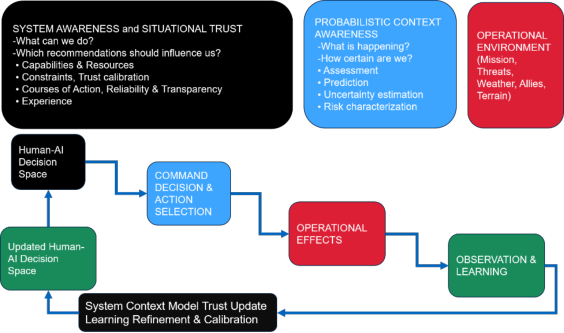
Figure 1 summarizes the proposed relationship between awareness, trust, and decision influence and provides a conceptual foundation for future research on Human-AI Decision Competence in military command and control.
Four implications emerge from the framework:
1. Military education should focus on Human-AI Decision Competence
rather than AI literacy alone. Understanding how AI systems work remains important, but effective human-AI teaming requires personnel to understand organizational capabilities, interpret uncertain operational conditions, and appropriately calibrate trust in AI-generated advice. Training should therefore combine AI-enabled decision support with realistic operational scenarios and experiential learning opportunities. 2. Situational Trust should be treated as a trainable competency. Evidence suggests that trust develops through interaction and feedback rather
System Awareness, Context Awareness, and Situational Trust 2705 than through technical knowledge alone. Consequently, military learning environments should provide opportunities for personnel to evaluate AI recommendations, observe system performance, and develop calibrated trust through experience. 3. AI-enabled organizations must develop collective awareness and
decision competencies. System Awareness supports understanding of organizational capabilities and constraints, while Probabilistic Context Awareness supports adaptation under uncertainty. Together, these competencies strengthen organizational learning and improve the ability to integrate AI support into command-and-control processes. 4. The framework contributes to C2 agility by linking capabilities, context interpretation, and trust. Organizations are better positioned to adapt to changing operational conditions when decision-makers understand what actions are feasible, how uncertainty influences outcomes, and when AI-generated recommendations should influence decisions.
The principal contribution of the framework is to integrate awareness, uncertainty management, and trust calibration within a single model of Human-AI Decision Competence. This perspective provides a foundation for future research on human-AI teaming, military learning, and AI-enabled command and control, while offering practical guidance for the design of future education, training, and decision-support systems. Benesch et al. (2026) demonstrate how AI can support adaptive training through continuous proficiency assessment, enabling personalized learning and feedback at scale. The goal is not to create trust in AI, but to develop the ability to calibrate trust appropriately under operational conditions.
The proposed framework further contributes to discussions of C2 agility. Agility has often been understood as the capacity to adapt rapidly and effectively to changing circumstances. The model suggests that agility is enabled by the interaction of awareness and trust. System Awareness expands understanding of available capabilities.
Figure 1: Human-AI decision-making in military command and control. (Adapted from Landmark et al., 2026; Stensrud et al., 2024).
2706 Stensrud and Valaker The principal theoretical contribution of this paper is therefore the argument that awareness and trust should not be studied independently. Awareness without trust may leave valuable AI outputs unused. Trust without awareness risks inappropriate reliance. Effective human-AI collaboration emerges from balancing both. Viewed collectively, System Awareness, Context Awareness, and Situational Trust represent complementary competencies that transform AI from a source of information into a meaningful contributor to decision-making. This integrated perspective provides a foundation for future research on human-AI teaming, military learning, and adaptive command-and-control systems, while also offering practical guidance for the design of AI-enabled education, training, and operational environments. Recent work in trust- calibration, AI-supported decision making, and adaptive instructional systems suggests that effective human-AI teaming depends on more than trust alone (Sottilare & Schwarz (Eds.), 2026). Möhle et al. show that explanations primarily influence how users interpret capability claims, while Nakata et al. demonstrate that trust emerges through multiple judgment cues rather than single explanations. Similarly, Mikhaylova et al. argue that inappropriate reliance often reflects failures in contextual reasoning rather than excessive trust. The Landmark et al is particularly valuable because it is a study in the table that explicitly introduces uncertainty-aware context representation, giving a strong theoretical justification for replacing “Context Awareness” with “Probabilistic Context Awareness” throughout the paper. Together with emerging work on adaptive instructional systems and military learning, these findings support the view that effective human-AI collaboration depends on the integration of System Awareness, Probabilistic Context Awareness, and Situational Trust as trainable competencies. Aleksandersen et al. (2026) extends this trajectory by arguing that AIS should not only adopt training but also develop Human-AI Decision Competence.
CONCLUSION
This paper proposed an integrated Human-AI Decision Competence framework linking System Awareness, Probabilistic Context Awareness, and Situational Trust. The framework explains how understanding capabilities, interpreting uncertainty, and calibrating trust interact to influence decision-making in AI-enabled command environments. System Awareness supports understanding of capabilities and constraints, Probabilistic Context Awareness supports interpretation of uncertain operational conditions, and Situational Trust determines whether AI-generated recommendations become decision-relevant. Together, these competencies provide a foundation for adaptive human-AI teaming. By framing awareness and trust as trainable competencies, the framework offers implications for military education, training, and AI-enabled command and control. Future research should focus on empirical validation and measurement of Human-AI Decision Competence across individuals, teams, and organizations.
ACKNOWLEDGMENT
The authors would like to thank Aleksandersen and colleagues for their contributions to the study of situational trust and AI advice influence through their work, Situational Trust and the Influence of AI Advice in Military Planning. Their empirical research has provided valuable insights into the relationship between trust, experience, and the influence of AI-generated recommendations on military decision-making.
The authors would also like to thank McTernan and colleagues for constructive discussions and for their work, Awareness and Agility in Military Organisations: Towards a Common Conceptual Model of System Awareness. Their research has contributed significantly to the development of the System Awareness concept adopted in this paper and has helped clarify the relationship between awareness, organizational agility, adaptation, and decision-making in military organizations.
REFERENCES
Aleksandersen, T., Hjelle, E., Hoel, T., Bakken, B. T., Stensrud, R., & Valaker, S.
(2026). Situational Trust and the Influence of AI Advice in Military Planning. (ICCRTS 2026), Laurel, MD, USA. Benesch, D., Lafond, D., Lemaire, N., MacMullin, M., Pynn, R., & Tay, H. N. (2026).
AI-Based Trainee Proficiency Assessment in Marine Training Simulations. In HCII 2026, LNCS 16737. Boyd, J. R. (1987). Organic Design for Command and Control. Chiou & Lee (2023). Trusting Automation: Designing for Responsivity and Resilience. Human Factors. Cohen, M. C., Rebensky, S., Flowers, A., Brown, J., & Klinefelter, Z. (2026). Toward
Human-Autonomy Teaming in Adaptive Instructional Systems. In HCII 2026, LNCS 16737. Springer. DOI: 10.1007/978-3-032-30015-7_11. Endsley, M. R. (1995). Toward a Theory of Situation Awareness in Dynamic Systems.
Human Factors, 37(1), 32–64. Flavell, J. H. (1979). Metacognition and Cognitive Monitoring. American Psychologist. Glikson & Woolley (2020). Human Trust in Artificial Intelligence: AOM. Klein (1998). Sources of Power: How People Make Decisions. Kolb (1984). Experiential Learning. Logg, Minson & Moore (2019). Algorithm Appreciation. Organizational Behavior
and Human Decision Processes. Jarmasz, J., & Virtue, J. (2026). The Adaptive Wingman: A Human-Autonomous Teaming Approach for Supporting Professional Standards and Culture in Military Learning. In HCII 2026, LNCS 16737. Springer. DOI: 10.1007/978-3-032- 30015-7_20. Landmark, K., Stensrud, R., & Greve, S. M. (2026, June). Probability analysis
for context-aware fusion of environmental data: Feasibility and risk in SAR operations. In FUSION 2026, Trondheim, Norway, 23–26 June 2026. ISIF. Lyons et al. (2021). Human-Autonomy Teaming: Definitions, Debates, and Directions. Frontiers in Psychology. McTernan et al. (2026). Awareness and Agility in Military Organisations: Towards a
Common Conceptual Model of System Awareness.
2708 Stensrud and Valaker Mikhaylova, D., Turchi, T., Cevolani, G., & Malizia, A. (2026). Supporting Bayesian
Reasoning to Mitigate Over-Reliance in AI-Assisted Decision Making. In HCII 2026, LNAI 16744. Springer. DOI: 10.1007/978-3-032-30860-3_30. Möhle, M. H., Zall, M., Thorwart-Gumpert, T., Elbert, N., Thiesse, F., & Flath, C. M. (2026).“Trust me, Bro!” On the Influence of Agentic Support on Trust Calibration in AI-Assisted Decision Making. In HCII 2026, LNAI 16744. Springer. DOI: 10.1007/978-3-032-30860-3_30. Nakata, T., Chen, S., & Nakamura, M. (2026). Meeting Retriever XX: Towards
Trust-Calibrated Explanations in Cross-Meeting Retrieval. In HCII 2026, LNAI 16745. Springer. DOI: 10.1007/978-3-032-30849-8_6. Sottilare, R. A., & Schwarz, J. (Eds.). (2026). Adaptive instructional systems: 8th International Conference, AIS 2026, Montreal, QC, Canada, July 26–31, 2026, proceedings (Lecture Notes in Computer Science, Vol. 16737). Springer Nature Switzerland. https://doi.org/10.1007/978-3-032-30015-7 Stensrud, R., Simonsen, A., Nummedal, O. R., & Valaker, S. (2024). Situation
awareness training as a prerequisite for handling complexity in human-autonomy teaming: Demonstration and experiment proposal. In Intelligent Human Systems Integration (IHSI 2024) (Vol. 119, pp. 496–506). AHFE Open Access. https://doi. org/10.54941/AHFE1004514 Stensrud, R., Berby, I., Valaker, S., & Simonsen, A. (2026). Engineering Trusted Team- Machine Collaboration in Adaptive Instructional Systems for Drone Operator Certification. HCII 2026 Late Breaking Papers, 28th International Conference on Human-Computer Interaction (HCII 2026), Montreal, Canada. (Accepted for publication in the HCII 2026 Late Breaking Papers proceedings).
SEARCH THE AHFE DIGITAL BOOKSTORE BY ISBN
Explore the complete digital volume
Human Factors in Design, Engineering, and Computing
Read this individual research paper free through the original publisher, or explore the full digital proceedings book.