Yi Li, Yu Gao, Yanfei Xu (2026). Sensing the Seasons: Exploring Preschoolers’ Seasonal Cognition Through Multisensory Interaction. In: Human Factors in Design, Engineering, and Computing. AHFE Open Access, vol. 238, pp. 2749–2759. https://doi.org/10.54941/ahfe1008499
Current preschool cultural education mainly focuses on visual recognition. It lacks embodied and multisensory learning experiences, which makes it difficult to support children's deep understanding of culture. This study aims to explore how multisensory interaction can support preschool children's embodied understanding of seasonal knowledge and to examine its role in children's attention, exploratory behavior, and conceptual understanding. To achieve this, we grounded our design in embodied cognition theory and designed a multisensory seasonal toolkit themed on the twenty-four solar terms. Using both quantitative and qualitative analyses, we empirically examined the behavior and cognitive performance of 16 preschool children under different sensory conditions. Results showed that tactile-centered multisensory combinations significantly enhanced children's active exploratory behavior. Children's understanding of seasonal order was positively correlated with attention duration and spontaneous verbal expression. Qualitative findings revealed that multisensory experiences connect abstract cultural concepts with children's concrete perceptual understanding. These findings provide design implications for embodied seasonal learning experiences within preschool cultural education.
Preschool cultural education supports children’s cultural awareness and early understanding of the world. However, current practices remain dominated by visual recognition and symbolic instruction, providing limited opportunities for children to engage with culture through meaningful multisensory experiences. The Twenty-Four Solar Terms, rooted in Chinese ecological wisdom, offer opportunities to observe seasonal patterns and form early concepts of temporal change.
However, current Solar Term education mainly relies on pictures, picture books, and videos, lacking physical participation and sensory interaction. Embodied cognition theory emphasizes that bodily interactions with the environment shape cognition (Lakoff & Johnson, 1999; Wilson, 2002). Multisensory integration has been linked to cognitive development in childhood (Dionne-Dostie et al., 2015), and multisensory input can support
early word learning (Seidl et al., 2024), yet empirical research remains scarce for abstract cultural concepts, particularly non-Western concepts of time. Research is needed to identify which sensory combinations support children’s exploratory behavior in this context.
Based on this, this study designed a multisensory seasonal toolkit centered on the Twenty-Four Solar Terms and addressed three research questions: RQ1: How do multisensory interactions affect the cultural learning exploration behavior of preschool children? RQ2: How does children’s engagement in interaction affect their understanding of the sequence of seasons? RQ3: How do multisensory interactions support preschool children’s cultural education?
Combining quantitative and qualitative analyses with 16 preschool children, we examined exploratory behavior and seasonal sequencing performance to inform the design of embodied cultural learning experiences.
LITERATURE REVIEW
Cultural Education and Design Research Cultural learning is a participatory process involving cultural tools in specific social contexts (Tomasello, 2000; Rogoff, 2003). Vygotsky (1978) described language, symbols, and other cultural artifacts as mediators of children’s psychological development. Designed material media, such as toys and interactive interfaces, can likewise support cognition and meaning construction. Children’s interactive products should be designed with their contexts of use in mind (Read & Bekker, 2011). In our toolkit, we applied this principle by giving children opportunities for hands-on exploration of the Twenty-Four Solar Terms.
Time and Nature Cognition of Preschool Children Children learn to order familiar daily events before they can reliably order the seasons (Friedman, 2005; McCormack, 2015). Cognitive development takes place in specific cultural contexts (Rogoff, 2003). The Twenty-Four Solar Terms express the relationship between time and nature in Chinese culture, offering a framework that connects natural cycles with cultural cognition.
Embodied Cognitive Theory and Abstract Concept Learning Embodied cognition holds that cognition draws on perceptual and motor processes (Lakoff & Johnson, 1999; Wilson, 2002). Multisensory perception and physical experience support individuals’ understanding of the world (Barsalou, 2008).
Perception and action are closely linked in early cognitive development (Thelen, 2000). In mathematics education, Abrahamson and Lindgren (2014) illustrate how students can use coordinated hand movements to
Sensing the Seasons: Exploring Preschoolers’ Seasonal Cognition 2751 explore proportional relationships. Children explore the world through direct sensory experience and physical manipulation (Piaget, 1952). For example, using objects to act out events in a story can help children understand what they read (Glenberg, 2010; Wellsby & Pexman, 2014).
However, existing design research mainly focuses on tool development and conceptual embodiment. Empirical evidence on how specific sensory combinations support exploratory behavior remains limited, particularly in cultural education involving non-Western systems of time.
RESEARCH DESIGN Design of the Multisensory Seasonal Toolkit
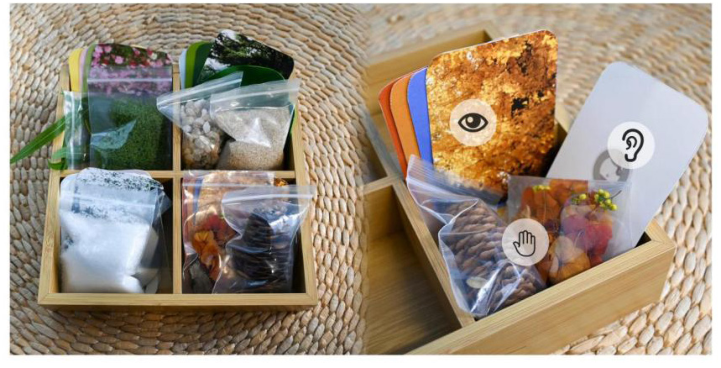
The toolkit represents a complete seasonal cycle through the Beginning of Spring, Summer Solstice, Autumn Equinox, and Winter Solstice. These four solar terms were selected for their seasonal representativeness, perceptual distinctiveness, and cultural familiarity. Each includes visual, auditory, and tactile materials (Figure 1; Table 1).
Figure 1: Multisensory seasonal toolkit.
1. Visual materials: With reference to Guo and Li (2020), three representative
color cards were initially selected for each solar term and paired with natural landscape images with clear details and prominent subjects. Color resolution and printing size were standardized, and matte paper was used to avoid glare. 2. Auditory materials: An NFC (Near Field Communication) tag on the back of each landscape image played a matching sound when activated with an experimenter-provided mobile phone. All sounds had the same duration and playback volume (60 dB). 3. Tactile materials: Materials relevant to each solar term were placed in
transparent 7 × 10 cm bags for easy handling and replacement.
Table 1: Materials of the multisensory seasonal toolkit.
Table available in the original PDF paper.
Solar Terms Visual Materials Auditory Materials Tactile Materials Beginning of Spring
Birdsong and stream sounds
Willow twigs; moss
PANTONE 602 C; PANTONE 1895 C; Image of cosmos flowers and locust trees
Cicada sounds Lotus leaf; sand
Summer Solstice PANTONE 349 C; PANTONE 377 C; Image of grassland and juniper trees Autumn Equinox PANTONE 1525 C; Wind rustling through leaves
Dried leaves; pine cones
PANTONE 151 C; Image of ginkgo trees Winter Solstice PANTONE 628 C; PANTONE 607 C; Image of juniper trees in snow
Blizzard sounds PE artificial snow powder; metal sheet
Participants and Location This study recruited 16 Chinese preschool children aged 5 to 6 from a kindergarten in central China (M = 5.29, SD = 0.37; 8 females, 8 males). No participant had any reported or observable visual, auditory, or motor impairments. Participants were labeled C1 to C16. The study received approval from the kindergarten and relevant institutions. Written informed consent was obtained from all parents or guardians.
Each child completed the experiment individually in a quiet, well-lit kindergarten activity room. Sessions lasted approximately 26–33 minutes and were video-recorded.
Experimental Procedure Design Before the formal experiment, we conducted a small pilot study with three children. The children could distinguish the color cards but were confused by some abstract sounds such as wind and rain. We therefore added semantic cues and comparison examples. We also reduced the number of color cards from three to the two with the highest recognition rate for the formal experiment.
The within-subjects experiment included four sensory conditions: visual (V), visual–auditory (VA), visual–tactile (VT), and visual–auditory–tactile (VAT). A 4 × 4 Latin square balanced their presentation order to control for practice and order effects.
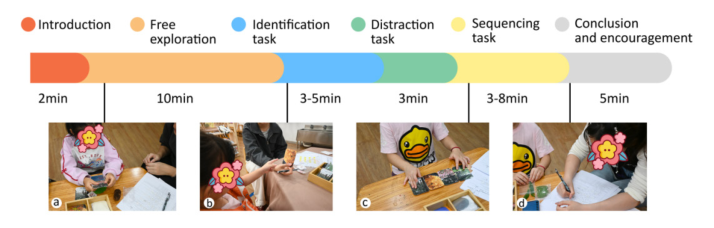
Figure 2 summarizes the procedure. After a toolkit demonstration, children freely explored the materials while the experimenter guided observation and description and recorded spontaneous associations. Children then identified the season represented by each material and briefly explained their choice. A short distraction task with other toys preceded the task of arranging the four season cards in chronological order. A separate question assessed whether children understood that spring follows winter. The session ended
Sensing the Seasons: Exploring Preschoolers’ Seasonal Cognition 2753 with encouragement and a small reward. The experimenter used season names rather than specific solar term names to reduce demands on abstract cultural vocabulary while assessing children’s sensory understanding of seasons.
Figure 2: Experimental procedure: (a) free exploration, (b) identification task, (c) sequencing task, and (d) conclusion and encouragement.
Data Collection and Analysis Methods Quantitative Data Collection and Analysis
For RQ1, we used attention duration and touch frequency as indicators of exploratory behavior. Identification accuracy and reaction time indicated cognitive performance. Children’s preferences were recorded using the Smileyometer (Read et al., 2002) but excluded from the main statistical analysis. Friedman and Wilcoxon signed-rank tests compared performance across sensory conditions (Field, 2018).
For RQ2, engagement was treated as attention and active participation (Fredricks et al., 2004). We used average attention duration and the number of spontaneous verbal expressions as the main behavioral indicators of engagement. We also examined touch frequency, identification accuracy, and identification reaction time. Seasonal sequencing performance was scored on a scale from 0 to 4. One point was awarded for each correctly ordered seasonal transition in the card arrangement: spring to summer, summer to autumn, and autumn to winter. One additional point was awarded for correctly identifying spring as the season following winter in the separate question. Spearman rank correlations were used to examine the relationships between these indicators and the cognitive outcome.
Qualitative Data Collection and Analysis For RQ3, children’s spontaneous verbal expressions and guided associative conversations were video-recorded and transcribed.
The first and second authors conducted thematic analysis (Braun & Clarke, 2006), using open sentence-by-sentence coding and grouping codes into sub-themes through iterative comparison and refinement. Five main themes were identified.
RESULT
Effects of Sensory Conditions on Exploratory Behavior
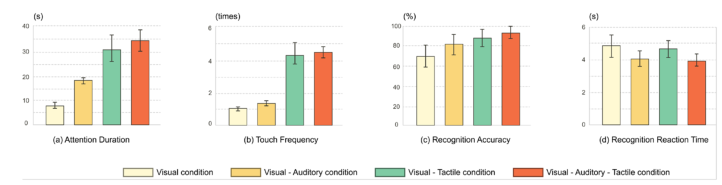
Figure 3 summarizes performance across the four sensory conditions (RQ1).
Shapiro-Wilk tests indicated departures from normality (p < .05), so non- parametric tests were used. Pairwise Wilcoxon comparisons were evaluated at a Bonferroni-adjusted threshold of α = .0083.
Attention duration. The Friedman test showed a significant effect of sensory condition on attention duration (χ²(3) = 27.00, p < .001). Pairwise comparisons showed longer attention duration in VA, VT, and VAT than V ( Z = –3.517, p < .001).
Touch frequency. The Friedman test showed significant differences across sensory conditions (χ²(3) = 40.24, p < .001). Touch frequency was higher in VT and VAT than in V (Z = −3.543 and −3.539, respectively, both p < .001), and higher in VAT than in VA (Z = −3.536, p < .001).
Identification performance. Friedman tests showed no significant differences in identification accuracy (χ²(3) = 4.57, p = .207) or reaction time (χ²(3) = 3.08, p = .380). The V–VAT accuracy comparison was also non-significant after correction (Z = −2.043, uncorrected p = .041, corrected p = .246).
Figure 3: Mean performance across sensory conditions: (a) Attention duration, (b) Touch frequency, (c) Recognition accuracy, and (d) Recognition reaction time. Error bars represent ±1 standard error.
Engagement and Seasonal Sequencing Performance Children’s attention duration and the number of spontaneous verbal expressions were positively correlated with seasonal sequencing scores (ρ = .550, p = .027, and ρ = .737, p = .001, respectively).
Touch frequency, recognition accuracy (ρ = .458, p = .074), and recognition reaction time were not significantly correlated with sequencing performance (Table 2).
Table 2: Engagement indicators and Spearman correlations with seasonal sequencing scores (*p < .05, **p < .01).
Table available in the original PDF paper.
p-Value
Variable Mean SD Spearman’s ρ (with Ordering Score) Attention duration (s) 23.180 6.720 .550* .027
Touch frequency (times) 2.906 0.870 .167 .538 (Continued)
Children’s Understanding of Nature and Culture Thematic analysis identified five themes in children’s spontaneous verbal expressions and guided conversations (RQ3; Table 3).
Table 3: Themes, sub-themes, and selected representative quotes.
“I really like pine cones because I love eating pine nuts.” (C6); “I don’t like summer because it’s too hot.” (C5); Children directly identified material features through multisensory input, including texture, temperature, and hardness. Vision and audition served as auxiliary cues to help them infer seasonal characteristics. Children often linked their current sensory experiences with their own life memories, including play, natural exploration, and family interactions. They also reasoned about seasonal features and relationships between plants and climate, and applied previously learned knowledge of solar terms, astronomy, and cultural symbols. Alongside cognitive and perceptual processing, children expressed emotional attitudes toward nature and the seasons, including positive liking and anticipation as well as negative
discomfort or preference. Together, these observations illustrate connections among sensory perception, personal experience, reasoning, and cultural knowledge during interaction.
DISCUSSION
Answering the Research Questions RQ1: Compared with vision alone, all three multisensory conditions were associated with longer attention, and both conditions involving touch elicited more touches. This pattern is consistent with Lakoff and Johnson’s (1999) account of the role of perception and action in cognition. Touch may support sensorimotor exploration. However, identification accuracy and reaction time did not improve significantly; greater exploratory engagement does not establish gains in abstract conceptual understanding. RQ2: Attention duration and spontaneous verbal expressions were positively correlated with seasonal sequencing scores. Glenberg’s (2010) account of language and bodily experience offers one perspective on the association between children’s spontaneous verbal expressions and their sequencing scores. They do not establish that engagement caused better sequencing performance or mediated the effects of sensory conditions. RQ3: Children’s references to personal memories, cultural concepts, and emotional preferences suggest that sensory experiences can connect concrete perceptions with familiar meanings, consistent with cultural tool mediation (Vygotsky, 1978). The qualitative evidence concerns associations expressed during the session; it does not demonstrate lasting conceptual change.
Implications for Design and Practice Strengthen Tactile-Centered Multisensory Interaction
The results of RQ1 suggest that tactile experiences can support active exploration. Future designs of solar term educational products should prioritize the diversity and realism of tactile experiences, including materials’ temperature, texture, and weight. At the same time, touch should be integrated with auditory and visual cues. This tactile-centered multisensory design draws on Glenberg’s (2010) account of the role of bodily action in comprehension.
Promote Open-Ended Design for Personalized Experience The findings of RQ2 and RQ3 suggest that solar term educational designs should encourage children to integrate their life experiences into the learning process. The product can serve as a medium for expressing experiences and extending memory. This can be achieved by designing open-ended components, such as blank spaces for children to place collected natural items or a “My Solar Term Memory” module to record personal experiences.This design practice applies Vygotsky’s (1978) concept of cultural tool mediation.
Sensing the Seasons: Exploring Preschoolers’ Seasonal Cognition 2757 Emphasize Emotionally Resonant Cultural Experiences
The results of RQ3 identified children’s emotional preferences during sensory experiences. Solar term educational design should go beyond simple knowledge transmission and focus on emotional triggers. Designers should create experience scenarios with a sense of solar term atmosphere through changes in sound, light, and touch. For example, in the “Summer Solstice” unit, simulate the sound of flowing water and bright light to evoke children’s emotional resonance. Drawing on Rogoff’s (2003) emphasis on participation in cultural activities, this design strategy uses sensory cues to invite children to share their own experiences of the seasons.
Connect Indoor Toolkits With Real Natural Experiences Qualitative data from the study showed that children frequently referred to real outdoor experiences to support their understanding. Although sensory toolkits can effectively simulate nature, real natural interactions remain irreplaceable. Therefore, future solar term educational designs should go beyond indoor material manipulation and extend the experience to real environments. Designers can combine solar term teaching with nature exploration activities, encouraging children to observe and collect natural materials outdoors, and then use the toolkit in the classroom for secondary creation, thereby creating a cognitive loop between simulated sensory experience and real-world experience.
Limitations and Future Work External Generalizability: The small sample (N = 16) came from one university-affiliated kindergarten with similar socioeconomic backgrounds, limiting generalizability. Developmental variability among the children may also strongly influence the observed outcome. Future research should include larger samples from different regions and cultural backgrounds.
Operationalization and Measurement Depth: Our behavioral indicators of engagement did not directly measure children’s internal cognitive processes. Future work could combine these indicators with eye-tracking or electroencephalography (EEG) to examine cognitive engagement.
Sensory Channels and Practical Translation: The study excluded smell and taste, and the research prototype lacked long-term validation in educational practice. Future work should examine all five senses and evaluate resource kits in classrooms and homes, potentially exploring AI-supported personalized cultural learning.
CONCLUSION
This exploratory classroom study, grounded in embodied cognition theory, examined how multisensory interactions influence preschool children’s exploratory behavior and engagement, and how these interactions support preschool children’s cultural education. Through an embodied cognition experiment combining quantitative and qualitative analyses, the study
found that in a solar term-themed preschool education context, tactile- centered multisensory experiences significantly enhanced children’s active exploratory behavior. The study also found that children’s understanding of seasonal order was significantly positively correlated with attention duration and spontaneous verbal expression. Qualitative observations suggested that children drew on personal experiences and expressed emotional responses while relating seasonal ideas to concrete natural imagery.
The main contributions of this study are twofold. Theoretically, these findings are consistent with embodied cognition theory’s emphasis on bodily and sensory interaction (Lakoff & Johnson, 1999). The study also highlights the role of touch in children’s active exploration. Practically, this study translated the experimental results into actionable design principles. It proposed four design implications for children’s cultural education products: strengthen tactile-centered multisensory interaction, promote open-ended design for personalized experience, emphasize emotionally resonant cultural experiences, and connect indoor toolkits with real natural experiences.
In the future, with the development of multimodal intelligent technologies, design research can explore innovative ways to integrate virtual and physical realities. This could create learning experiences that maintain the depth of embodied interaction while expanding the boundaries of cultural imagination.
REFERENCES
Abrahamson, D., & Lindgren, R. (2014). Embodiment and Embodied Design.
In R. K. Sawyer (Ed.), The Cambridge Handbook of the Learning Sciences (2nd ed., pp. 358–376). Cambridge University Press. https://doi.org/10.1017/ CBO9781139519526.022 Barsalou, L. W. (2008). Grounded Cognition. Annual Review of Psychology, 59(1), 617–645. https://doi.org/10.1146/annurev.psych.59.103006.093639 Braun, V., & Clarke, V. (2006). Using thematic analysis in psychology.
Qualitative Research in Psychology, 3(2), 77–101. https://doi. org/10.1191/1478088706qp063oa Dionne-Dostie, E., Paquette, N., Lassonde, M., & Gallagher, A. (2015). Multisensory Integration and Child Neurodevelopment. Brain Sciences, 5(1), 32–57. https:// doi.org/10.3390/brainsci5010032 Field, A. (2018). Discovering statistics using IBM SPSS statistics (5th ed.). SAGE
Publications. Fredricks, J. A., Blumenfeld, P. C., & Paris, A. H. (2004). School Engagement: Potential of the Concept, State of the Evidence. Review of Educational Research, 74(1), 59–109. https://doi.org/10.3102/00346543074001059 Friedman, W. J. (2005). Developmental and cognitive perspectives on humans’ sense
of the times of past and future events. Learning and Motivation, 36(2), 145–158. https://doi.org/10.1016/j.lmot.2005.02.005 Glenberg, A. M. (2010). Embodiment as a unifying perspective for psychology.
WIREs Cognitive Science, 1(4), 586–596. https://doi.org/10.1002/wcs.55 Guo, H., & Li, J. (2020). 中国传统色: 故宫里的色彩美学 [Chinese traditional colors: Aesthetic principles of the Palace Museum]. CITIC Publishing Group. Lakoff, G., & Johnson, M. (1999). Philosophy in the flesh: The embodied mind and
its challenge to Western thought. Basic Books.
Sensing the Seasons: Exploring Preschoolers’ Seasonal Cognition 2759 McCormack, T. (2015). The Development of Temporal Cognition. In R. M. Lerner
(Ed.), Handbook of Child Psychology and Developmental Science. Wiley. https:// doi.org/10.1002/9781118963418.childpsy215 Piaget, J. (1952). The origins of intelligence in children (M. Cook, Trans.).
International Universities Press. Read, J. C., & Bekker, M. M. (2011). The Nature of Child Computer Interaction.
Proceedings of HCI 2011 The 25th BCS Conference on Human Computer Interaction. https://doi.org/10.14236/ewic/HCI2011.43 Read, J. C., MacFarlane, S., & Casey, C. (2002, August). Endurability, engagement and expectations: Measuring children’s fun. In Interaction design and children (pp. 189–198). Shaker Publishing. Rogoff, B. (2003). The cultural nature of human development. Oxford university
press. Seidl, A. H., Indarjit, M., & Borovsky, A. (2024). Touch to learn: Multisensory input supports word learning and processing. Developmental Science, 27(1), e13419. https://doi.org/10.1111/desc.13419 Thelen, E. (2000). Grounded in the World: Developmental Origins of the Embodied
Mind. Infancy, 1(1), 3–28. https://doi.org/10.1207/S15327078IN0101_02 Tomasello, M. (2000). Culture and cognitive development. Current Directions in Psychological Science, 9(2), 37–40. https://doi.org/10.1111/1467-8721.00056 Vygotsky, L. S. (1978). Mind in society: The development of higher psychological
processes. Harvard University Press. Wellsby, M., & Pexman, P. M. (2014). Developing embodied cognition: Insights from children’s concepts and language processing. Frontiers in Psychology, 5. https:// doi.org/10.3389/fpsyg.2014.00506 Wilson, M. (2002). Six views of embodied cognition. Psychonomic Bulletin &