Heyao Li, Zuojun Yu (2026). Exploring Multisensory Interaction in Fibre Art: Implications for Design Strategies. In: Human Factors in Design, Engineering, and Computing. AHFE Open Access, vol. 238, pp. 994–1003. https://doi.org/10.54941/ahfe1008330
Fibre art has the potential to support multisensory interaction through material flexibility and the combined use of textile texture, colour, and spatial organisation. This study examines material properties, spatial environments, and audience participation from a multisensory perspective to identify interrelated and complementary design strategies for multisensory interaction design. This study adopts an exploratory multiple-case study approach. Five projects were selected through purposive sampling. Within-case analysis and cross-case comparison examined four dimensions: material properties, sensory modalities, modes of participation, and interaction feedback mechanisms. The findings show how multisensory interaction is organised across these dimensions and identify three design strategies: multisensory integration, embodied interaction, and interaction feedback. The study extends artwork analysis beyond visual form to encompass material perception, audience participation, and spatial environmental experience. The findings offer guidance for material selection, sensory coordination, and the design of audience participation.
Research on material experience design emphasises that understanding a material requires consideration not only of its physical properties but also of how people perceive, interact with, and attribute meaning to it (Karana et al., 2015). In fibre art, this perspective shifts attention from the appearance of an artwork to the processes through which people interact with its materials. Material flexibility, together with the texture and colour properties of textiles and their spatial arrangement, offers opportunities for multisensory interaction. However, the presence of a tactile surface or flexible material does not necessarily encourage active participation. The experience is also shaped by whether viewers can access the work, how they engage with it through bodily movement, and whether their actions can transform or influence the work.
Research on multisensory experience provides a theoretical basis for understanding these relationships. (Velasco & Obrist, 2021) discuss how different sensory elements contribute to experience, while (Spence, 2020) examines interactions among vision, sound, smell, and other factors in
Exploring Multisensory Interaction in Fibre Art: Implications for Design Strategies 995 spatial perception. In fibre art, texture may invite visual exploration and tactile engagement, spatial structures may encourage viewers to move through and linger within the space, and sound may respond to viewers’ bodily movements. However, traditional fibre art practice often emphasises individual sensory modalities. The relationships among materials, environments, and viewers have yet to be sufficiently explored, potentially limiting the coherence and richness of the overall experience.
RESEARCH METHODS Case Selection and Research Scope
This study adopts an exploratory multiple-case study approach. Case studies are suited to exploring practices within their specific contexts, while comparison across cases helps identify shared relationships and contextual differences (Yin, 2018).
Five projects were selected through purposive sampling according to three criteria: (1) the projects apply multisensory interaction in fibre art, encompassing spatial installations, responsive environments, and collaborative practices; (2) they have substantial social impact and a high level of public participation; and (3) they demonstrate the potential to foster emotional connections between artworks and viewers through multisensory interaction. Selected cases are Ernesto Neto’s GaiaMotherTree (2018), Toshiko Horiuchi’s Unknown Pockets 2: A Gift (2009, hereafter A Gift), Living Knitwork Pavilion by a team at MIT (2023), Lee Mingwei’s The Mending Project, and Crochet Coral Reef, initiated by Margaret and Christine Wertheim.
Data Sources and Analytical Procedure Case information was drawn primarily from official project descriptions, exhibition records, and published interviews. Research papers by project teams provided supplementary technical information. Official descriptions were used mainly to establish the materials, settings, and participation rules, while published interviews informed the understanding of artistic intentions and participants’ experiences.
The analysis comprised two stages: within-case analysis and cross-case comparison (Eisenhardt, 1989). First, the materials, sensory cues, participatory actions, and resulting changes were documented for each project. The unit of analysis was the arrangement of multisensory interaction within each project: how materials were organised, how participation occurred, and what perceptible outcomes actions produced. Four dimensions guided the analysis. Material properties concerned the actions supported by yarns, textiles, and their structures. Sensory modalities concerned the senses involved and their relationships. Modes of participation concerned participants’ roles, actions, and stages of involvement. Interaction feedback mechanisms concerned whether actions produced perceptible changes in materials, environments, or the state of the artwork.
The five cases were then compared to identify relationships between materials and senses, action and participation, and behaviour and outcomes. Strategies were derived from these relationships and the conditions under
996 Li and Yu which they applied, rather than by generalising the practices of a single project to all fibre art. For example, entering an installation and making something by hand both involve bodily action, but they give participants different roles. Similarly, material deformation under force and system-triggered changes in sound and light can both provide feedback, although they operate through different mechanisms.
CASE ANALYSIS OF MULTISENSORY INTERACTION GaiaMotherTree
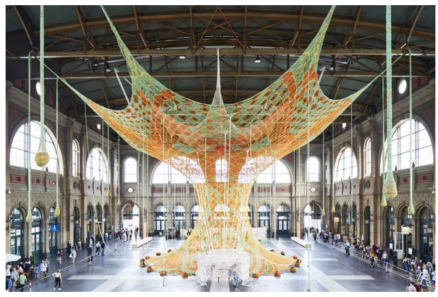
GaiaMotherTree used colourful cotton strips, knotted and finger-crocheted by hand, to create a tree-like space in Zurich Main Station. Viewers could enter the base and rest on seats arranged in a circle. Spices and dried leaves in suspended elements provided olfactory cues, while music and workshops were included in the exhibition programme (Fondation Beyeler, 2018). Its multisensory experience relied primarily on an accessible spatial structure. The tree-like form made the work recognisable from a distance, while the enclosure, scents, and opportunities to linger changed the viewing distance and pace of the experience once visitors entered. Music was associated with particular activities and should not be treated as continuous auditory feedback from the installation.
Figure 1: GaiaMotherTree (2018).
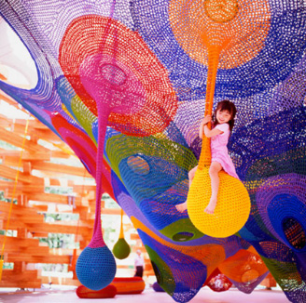
A Gift Whereas GaiaMotherTree primarily supported entering and lingering, A Gift incorporated bodily activity directly into its net structure. The Hakone Open-Air Museum describes the work as a structure that children can climb on, jump in, and explore by sitting on suspended balls. It is made from hand- dyed nylon cords crocheted by hand (Woods of Net, 2009). In a published interview, Horiuchi explained how the elastic net transmits children’s movements, returning motion to their bodies and carrying it to others within the net. Colour and mesh openings therefore do more than invite visual attention: they also help children locate entrances, choose points of
Exploring Multisensory Interaction in Fibre Art: Implications for Design Strategies 997 support, and adjust their positions. Touch and bodily movement are closely linked, while changes in the material under force provide information for subsequent actions.
Figure 2: A Gift, Toshiko Horiuchi.
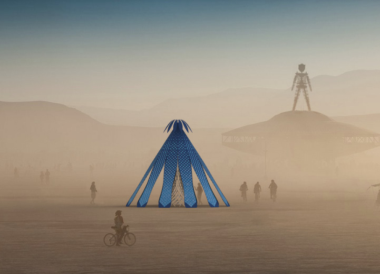
Living Knitwork Pavilion Living Knitwork Pavilion turns a textile structure into a sensing interface. The project team integrated conductive yarns and other functional materials into the textiles. Electric-field sensing detects participants’ positions and activity, which are used to control sound and lighting in real-time interaction mode (MIT Media Lab, 2023). The system establishes a relationship among vision, hearing, and bodily movement: changes in participants’ positions can serve as inputs for audiovisual responses. Photochromic yarns also change colour in response to sunlight, enriching the visual experience.
Figure 3: Living knitwork pavilion.
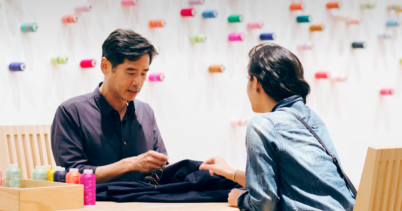
The Mending Project The Mending Project situates multisensory interaction within clothing repair and conversation. Members of the public are invited to bring items that need mending. A mender repairs each item while talking with its owner.
998 Li and Yu Participants can then take the item home or leave it in the exhibition and retrieve it when the exhibition ends (Institute for Contemporary Art, 2018). Thread, fabric, and repair traces provide visible and tactile material experiences, while conversation connects the object to everyday life. The two roles involve different forms of participation. Menders engage through needlework, whereas owners contribute primarily by providing objects, sharing their experiences, and deciding what happens to their belongings. In a published account, one volunteer recalled bringing her late husband’s sweater as an item owner and talking with a mender. Her account illustrates the connection among clothing, personal memory, and conversation (Institute for Contemporary Art, 2018).
Figure 4: The mending project, Lee Mingwei.
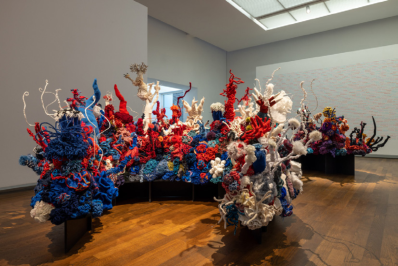
Crochet Coral Reef Interaction in Crochet Coral Reef spans both making and exhibition. The project encourages participants to create varied coral forms by following and modifying crochet patterns. The Baden Baden Satellite Reef brought together more than 40,000 pieces made by over 4,000 contributors (Crochet Coral Reef, 2019). The Wertheim sisters and a local team subsequently assembled these pieces into a collective exhibition work. During making, participants observe changes in loops, density, and form as they work with their hands. During exhibition, individual units become part of a larger visual composition. Viewers encounter the outcome of collective making, whereas makers also experience touching the materials and transforming their forms.
Figure 5: Baden baden satellite reef (2022).
Exploring Multisensory Interaction in Fibre Art: Implications for Design Strategies 999 Cross-Case Analysis
Building on the individual case analyses, the five projects were compared in terms of material properties, sensory modalities, modes of participation, and interaction feedback mechanisms. Table 1 summarises the comparison. The projects use different combinations of senses and different forms of participation. Spatial experience, bodily activity, digital media, and collective making connect materials and senses through distinct interactive processes. This comparison provides the basis for three design strategies: multisensory integration, embodied interaction, and interaction feedback.
Table 1: Comparison of the five cases across four dimensions.
Table available in the original PDF paper.
Case Material Properties
Sensory Modalities
Modes of Participation
Interaction Feedback Mechanisms
GaiaMotherTree Crocheted
Entering, lingering, and joining exhibition activities
Spatial exploration and perception
Vision and smell; hearing during specific activities
and knotted cotton strips; a transparent, tree- like enclosure Vision, touch, and bodily movement
Children climb, jump, and sit on suspended balls
Tactile feedback through the material
A Gift Nylon crochet net; an elastic, load-bearing structure Living Knitwork Pavilion
Entering, moving, and interacting with textile interfaces
System- mediated feedback
Vision and hearing; touch and bodily movement
Functional yarns and knitted panels; textiles also serve as sensing interfaces The Mending Project
Feedback during making
Used clothing and thread; repair traces gradually emerge
Vision and hearing; the mender’s tactile engagement
Mending; providing objects and conversing; deciding whether to take objects home or leave them on display
Crochet Coral Reef
Feedback through participation
Making units for a collective work; viewing the exhibition
Yarns and crocheted units; forms can be extended incrementally
Vision and touch during making; vision during exhibition
FINDINGS AND DESIGN STRATEGIES FOR MULTISENSORY INTERACTION IN FIBRE ART Multisensory Integration Through Materials and Contexts
Multisensory integration concerns how senses support one another. In GaiaMotherTree, the tree-like form, interior space, and scents together establish a setting for entering and lingering. A Gift connects visually guided
1000 Li and Yu exploration with contact with the net, the forces acting on it, and bodily movement. Both works use fibre materials, but their experiential emphasis differs. Sensory relationships depend on how materials are structured, what actions they allow, and the environment in which the work is situated.
Design can therefore begin by identifying a primary sensory or action- based focus and arranging related sensory elements around it. This allows different sensory elements to contribute to a shared experience. The emphasis on perception, meaning, and use in material experience design supports this approach (Karana et al., 2015). Multisensory integration also requires attention to the stage at which an experience occurs. A project may involve different sensory combinations at different stages. Artists should therefore first consider where sensory connections occur and who experiences them, before deciding whether to introduce additional media.
Embodied Interaction Through Bodily Action and Making Bodily participation takes several forms across the cases. Entering GaiaMotherTree changes a person’s spatial relationship with the work. For A Gift, bodily movement changes the state of the net. In mending and crochet projects, actions leave new stitches and forms. Embodied interaction concerns how meaning emerges through action within a particular context (Dourish, 2001). Participation in fibre art should therefore be understood through the role of bodily action in the experience, rather than simply through viewers’ proximity to the work.
Spatial organisation can create opportunities for bodily engagement. In works that viewers experience through movement, the spatial structure should allow viewers to explore the relationship between their bodily actions and the material properties of the work. In A Gift, the net’s capacity to support weight and deform under pressure plays a clear role in shaping the experience. However, not all fibre installations are designed to support weight or accommodate climbing. Spatial and material arrangements therefore be aligned with the intended forms of audience participation.
Participatory co-creation offers another possibility: viewers can contribute to a work through their action. Crochet Coral Reef preserves differences between individual contributions while assembling them into a collective work. The Mending Project organises repair and conversation around objects from everyday life. The former gives individual contributions a place within collective making; the latter creates opportunities to share the histories of objects and personal accounts. These cases suggest that designs aiming to foster emotional connection should provide opportunities for participants to make choices and express themselves. However, the development of such connections also depends on participants’ personal experiences and their engagement in the process.
Interaction Feedback Through Perceptible Outcomes Interaction feedback makes the outcomes of participation perceptible. The cross-case comparison identifies three forms of response. In A Gift, the net deforms under applied force; Living Knitwork Pavilion converts sensed
Exploring Multisensory Interaction in Fibre Art: Implications for Design Strategies 1001 activity into changes in sound and light; and Mending and Crochet Coral Reef gradually transform the surface and form of the work through making. These responses rely, respectively, on physical material behaviour, electronic sensing and mapping, and the gradual accumulation of making outcomes. Feedback therefore does not necessarily rely on digital technology or occur within a short time frame.
For immediate interaction, the relationship between an action and the resulting change should be readily perceptible. Indentation, rebound, or displacement can provide direct responses to contact and applied force. When sensing systems trigger changes in sound and light, designers need to consider whether the location, timing, and direction of these changes enable participants to understand how their actions influence the work. For example, a clearly perceptible local change in response to a participant entering a specific area is easier to interpret than continuous sound and light with no clearly identifiable source. This requires artists to define the sensing area and feedback form, and to test their correspondence between them through practical experimentation.
Feedback during making unfolds over different time scales. New stitches make the progress of repair visible, while new units contribute to the gradual growth of a collective work. Participants can thereby recognise the contribution of their own efforts to the overall outcome. Design can preserve these traces of making and clarify how individual contributions relate to the work as a whole. For installations that rely primarily on spatial atmosphere, sensory conditions should be distinguished from behavioural feedback: scents, lighting, and sound may influence participants’ behaviour without necessarily responding to their actions.
The study thus proposes three design strategies: multisensory integration, embodied interaction, and interaction feedback. These address relationships among sensory modalities, forms of bodily participation, and the connection between action and their resulting feedback, respectively. The strategies can be combined and adapted to the characteristics of individual works and their creative aims, rather than applied uniformly. They provide guidance for different forms of fibre art, translating multisensory concepts into concrete creative decisions.
DISCUSSION AND CONCLUSION By comparing five fibre art projects across material properties, sensory modalities, modes of participation, and interaction feedback mechanisms, this study identifies three design strategies. The findings indicate that material properties do not directly determine viewers’ experiences. Rather, conditions of contact, spatial organisation, and participatory activities shape how these properties are experienced and translated into opportunities for perception and action. Sensory relationships should also be organised according to the work’s primary activities and the different stages of the experience. The three strategies address the coordination of sensory information, the facilitation of bodily participation, and the presentation of action outcomes, respectively.
1002 Li and Yu Together, they establish connections between material properties and the process of participation. In design practice, material selection, spatial and activity planning, and the presentation of interaction outcomes should be considered holistically. The relative emphasis and combination of the strategies can then be adjusted to the work’s aims, site conditions, and intended audience. Personal objects, memories, hands-on making, and face-to-face conversation may foster emotional connections, but emotional meaning still depends on participants’ individual experiences. Multisensory fibre art design therefore requires attention not only to the richness of sensory stimulation, but also to the feasibility of bodily participation, the continuity of interaction, and the opportunities for participants to construct personal meaning. This approach allows the strategies to be adapted to different creative and spatial contexts.
The study has several limitations. Official descriptions, exhibition records, and published interviews offer uneven levels of detail regarding participants’ actual experiences. The effects of different design arrangements have not yet been systematically compared using a common evaluation framework.
Future research will incorporate on-site observations and participant interviews to investigate how viewers perceive material properties, understand opportunities for participation, and recognise the outcomes of their actions. Building on this study, we are also developing a multisensory fibre art installation for further investigation. During its exhibition, sensory configurations, participatory tasks, and feedback mechanisms will be varied independently to compare differences in experience. This research is relevant to the Human-Centered Design & HCI theme of AHFE 2026, particularly the Apparel, Textile & Wearable Design area.
REFERENCES
Crochet Coral Reef. (2019). Baden Baden Satellite Reef | Crochet Coral Reef. https:// crochetcoralreef.org/exhibitions/baden-baden-satellite-reef/ Dourish, P. (2001). Where the Action Is: The Foundations of Embodied Interaction.
The MIT Press. https://doi.org/10.7551/mitpress/7221.001.0001 Eisenhardt, K. M. (1989). Building Theories from Case Study Research. The Academy of Management Review, 14(4), 532. https://doi.org/10.2307/258557 Fondation Beyeler. (2018). Ernesto Neto. Institute for Contemporary Art. (2018). The Mending Project. Institute for
Contemporary Art. https://icavcu.org/projects/the-mending-project/ Karana, E., Barati, B., Rognoli, V., & Zeeuw van der Laan, A. (2015). Material Driven Design (MDD): A Method to Design for Material Experiences. International Journal of Design, 9(2). http://www.ijdesign.org/index.php/IJDesign/article/view/ 1965 MIT Media Lab. (2023). Living Knitwork Pavilion: Soft Responsive Architectural
Space with Functional Textiles and Integrated System. MIT Media Lab. https:// www.media.mit.edu/publications/living-knitwork-pavilion/ Spence, C. (2020). Senses of place: Architectural design for the multisensory mind.
Cognitive Research: Principles and Implications, 5(1), 46. https://doi.org10.1186/ s41235- 020-00243-4
Exploring Multisensory Interaction in Fibre Art: Implications for Design Strategies 1003 Velasco, C., & Obrist, M. (2021). Multisensory Experiences: A Primer. Frontiers in
Computer Science, 3, 614524. https://doi.org/10.3389/fcomp.2021.614524 Woods of Net. (2009). Kids & Family—THE HAKONE OPEN-AIR MUSEUM. The Hakone Open-Air Museum. https://www.hakone-oam.or.jp/en/kidsandfamily/ Yin, R. K. (2018). Case study research and applications: Design and methods (Sixth
edition). SAGE.
SEARCH THE AHFE DIGITAL BOOKSTORE BY ISBN
Explore the complete digital volume
Human Factors in Design, Engineering, and Computing
Read this individual research paper free through the original publisher, or explore the full digital proceedings book.