Mickaël Causse, Maud Dupuy, Alexandre Duchevet, Nadine Matton, Flora Schwartz, Jean-Paul Imbert, Jonathan Deniel (2026). The Influence of Neuroticism on Startle and Surprise Response: A Flight Simulator Study. In: Human Factors in Design, Engineering, and Computing. AHFE Open Access, vol. 238, pp. 31–38. https://doi.org/10.54941/ahfe1008238
This paper investigates the influence of personality traits on startle and surprise (S&S) responses in a realistic flight simulation. Thirteen pilots completed an A320 landing scenario during which a thunderclap and lightning flash (S&S event), and subsequent system failures were introduced. Participants also completed questionnaires assessing the Big Five personality traits, anxiety, perceived stress, and mental workload. Flight performance was measured using aircraft altitude deviations following the thunderclap and lightning flash. The exploratory results suggest that neuroticism was the only personality trait significantly associated with poorer flight performance, with more neurotic pilots exhibiting greater deviations following the S&S event. In contrast, flight experience, state and trait anxiety, perceived stress, and mental workload were not significantly related to flight performance. The study also suggests that pilots displayed a personality profile characterized by higher conscientiousness and lower neuroticism compared with a sample from the general French population. Although exploratory due to the small sample size, our findings suggest that stable personality traits, particularly neuroticism, may, under certain circumstances, play a role in determining pilots’ resilience to unexpected events.
Startle and surprise (S&S) is a phenomenon that most individuals have experienced at some point in their lives. Imagine, for instance, watching a horror movie late at night, alone in your living room, sitting on the sofa. Suddenly, your partner approaches from behind and unexpectedly says in a loud and abrupt voice, “Are you still watching TV?” This combination of contextual factors, a fearful atmosphere, isolation, nighttime conditions, and a sudden, unanticipated stimulus, provides an ideal setting for eliciting a startle and surprise (S&S) response. While this example may seem light-hearted, S&S is a well-documented danger in aviation, experienced by 96% of helicopter pilots (Vlaskamp, Pollitt, et al., 2025) and 90.8% of airline pilots (Vlaskamp, Landman, et al., 2025). In the cockpit, S&S can typically be triggered by an intense thunderclap (Causse et al.,
2026; Deniel et al., 2023) or auditory stimulus (Deniel et al., 2024; Duchevet et al., 2025; Schwartz et al., 2025), a technical malfunction (Kinney & O’Hare, 2020), a bird strike in the windshear (Rivera et al., 2014), or an automation surprise (Landman et al., 2017). S&S can drastically impact flight safety (Deniel et al., 2023; EASA, 2015; Landman et al., 2017) because it can induce a transient cognitive incapacitation during which inappropriate or unsafe actions may be performed as a result of degraded reasoning and decision-making abilities. For this reason, pilots are advised to refrain from taking immediate action for a few seconds following a startle response, adopting a “hands-off” strategy. Advanced coping techniques have also been developed, such as the COOL procedure (Landman et al., 2020). Other solutions envisioned to deal with the phenomenon include automatic systems for detecting S&S responses based on physiological measures (Duchevet et al., 2025) or thermal and brain imaging (Schwartz et al., 2025). These systems could potentially be integrated with cockpit assistance tools to support pilots in managing such events (Duchevet et al., 2024). A complementary line of research focuses on identifying personality factors that may influence susceptibility to S&S responses (Corr et al., 1995).
Personality Traits and Startle and Surprise Several studies have examined the relationship between S&S and individual personality traits, generally in a laboratory context. For example, harm avoidance, a tendency to react strongly to aversive stimuli (Cloninger, 1986), has been linked to modulation of the startle reflex (Corr et al., 1995). In the work of Corr et al., startle modulations were influenced by personality dimensions such as extraversion and neuroticism. Another study showed that individuals scoring high on trait fearfulness exhibit greater startle potentiation when viewing unpleasant images compared to those with lower levels of fearfulness (Cook III et al., 1992). Similarly, elevated trait anxiety has been associated with stronger auditory startle responses, suggesting increased sensitivity to intense stimuli and a propensity for rapid, potentially impulsive reactions (De Pascalis et al., 2013). However, findings are not always consistent. For example, Kumari (1996) reported no clear effect of personality traits on affective modulation of startle amplitude during exposure to emotionally charged film clips.
When applied to aviation, most existing work has focused on links between personality and training outcomes rather than the actual in-flight S&S response (Breuer et al., 2023; Campbell et al., 2009). A study by Hidalgo-Muñoz et al. (2021), not specifically addressing S&S, assessed pilots using the Big Five Inventory (BFI) and found that higher neuroticism was associated with increased subjective anxiety during socially stressful flight scenarios, although no relationship with objective flight performance was observed. More recently, using the Toulouse N-back task, Schwartz et al. (2025) showed that individuals with higher trait anxiety demonstrated reduced task performance following S&S stimuli, particularly under high task difficulty. Nevertheless, the characterization of S&S effects in realistic operational contexts, as well as the identification of personality traits that increase susceptibility to them, remains underexplored (Gambiraža et al., 2025). Given the limited literature on the relationship between S&S, personality traits, and their impact on performance in applied
The Influence of Neuroticism on Startle and Surprise Response 33 experimental settings, we conducted a study using a flight simulator to further investigate these effects (Causse et al., 2026). In the present paper, we report on the full range of questionnaires administered, since only a subset was included in the previous publication. The objective is to provide a more comprehensive understanding of the role of personality in pilot performance following S&S.
METHOD
Participants Thirteen participants (10 males, 3 females) were included in the analysis. The mean age was 27.25 years (SD = 11.48). Twelve were airline pilot trainees and one was an airline flight instructor. Mean flight experience in actual aircraft was 2098.46 hours (SD = 4399.72). See Table 1 for the raw data on all variables.
Flight Scenario Participants performed a flight scenario in an A320 flight simulator. They were instructed to execute a standard approach (starting at 3,000 ft of altitude and 130 kts of speed) and land at Orly Airport, following the flight plan provided by the experimenter. During the approach, two S&S stimuli were administered simultaneously: a loud thunderclap together with a lightning flash. Several complications followed, in particular a “low fuel” alert and an electrical failure resulting in the loss of several displays, as well as the autopilot and autothrottle systems. The loss of autothrottle, if not corrected, causes variations in speed and vertical deviations regarding the airfield (i.e., glide). Maximal vertical deviation was measured from the onset of the S&S stimuli until the end of the scenario and was used in this paper as the flight performance metric to estimate the impact of S&S. Full details of the flight scenario are provided in Causse et al. (2026).
Questionnaire All questionnaires were completed a few days before the flight scenario, except the NASA TLX that was filled just after the S&S flight scenario.
Big Five inventory. Personality traits were assessed using the French version of the 10-item Big Five Inventory (BFI-10, Courtois et al., 2020), a widely used self-report questionnaire measuring five major personality dimensions: Extraversion, Agreeableness, Conscientiousness, Neuroticism, and Openness to Experience.
State–Trait Anxiety Inventory. Anxiety was assessed using the State–Trait Anxiety Inventory (STAI), which includes two complementary questionnaires measuring state anxiety and trait anxiety, respectively (Spielberger et al., 1983). The State Anxiety scale (STAI-S) evaluates transient feelings of tension, apprehension, and nervousness experienced in response to a specific situation, whereas the Trait Anxiety scale (STAI-T) assesses a stable individual tendency to perceive situations as threatening and to respond with elevated anxiety levels across contexts.
Perceived Stress Scale. Perceived stress was assessed using the Perceived Stress Scale (PSS), designed to measure the degree to which individuals appraise situations in their life as stressful (Cohen et al., 1983). The PSS evaluates how unpredictable, uncontrollable, and overloaded respondents perceive their recent experiences to be.
NASA Task Load Index. Workload was assessed after the flight scenario using the NASA Task Load Index (NASA-TLX), a widely used subjective measure of perceived mental workload (Hart & Staveland, 1988). The questionnaire includes six subscales: mental demand, physical demand, temporal demand, performance, effort, and frustration. In this study, the raw score (RAW TLX) was computed by averaging the scores of the six subscales without applying weighting procedures, providing an overall measure of perceived workload.
RESULTS
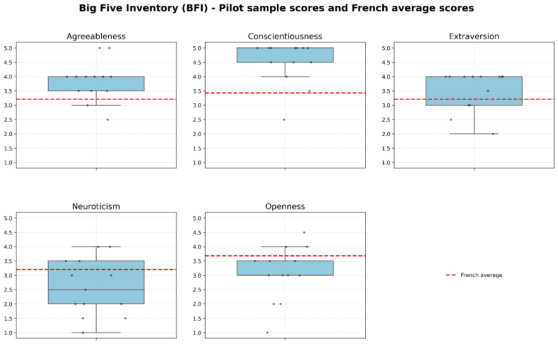
We compared the BFI scores of our sample with those reported for a representative sample of the French general population by Courtois et al. (Courtois et al., 2020). Conscientiousness scores in our sample were substantially higher than the French normative values (M = 4.50, SD = 0.76 vs. M = 3.43, SD = 0.98; ΔM = +1.07). Only one pilot in our sample scored below the French average (see Figure 1). Neuroticism also appeared lower among pilots compared with the French normative sample (M = 2.57, SD = 0.99 vs. M = 3.20, SD = 1.18; ΔM = −0.63). In addition, within our sample of trained pilots, agreeableness appeared higher than the French normative values (M = 3.84, SD = 0.68 vs. M = 3.21, SD = 0.95; ΔM = +0.63), while extraversion was only slightly higher (M = 3.53, SD = 0.69 vs. M = 3.21, SD = 1.11; ΔM = +0.32). In contrast, openness to experience was lower among pilots than in the French reference sample (M = 3.07, SD = 0.95 vs. M = 3.68, SD = 0.88; ΔM = −0.61). Note that these comparisons are descriptive only (i.e., no statistical comparison).
Figure 1: Big five descriptive results. Red dash lines represent French average from Courtois et al. (2020).
Raw
Trait PSS NASA TLX
State STAI
Openness STAI
Neuroticism BFI
Extraversion BFI
Conscientiousness BFI
Agreeableness BFI
Experience BFI
Deviation Age Gender Flight
Table 1: Raw data for all variables. “—” = missing data.
Table available in the original PDF paper.
ID Vertical
1 3.48 22 M 350 4 4.5 3.5 1.5 3.5 32 35 23 76.66
2 11.02 22 M 200 3.5 5 2 3.5 4.5 33 33 25 —
3 11.43 19 M 250 2.5 4 3 3 3 38 48 33 77.50
4 12.01 22 M 300 4 4.5 4 3 4 30 32 24 64.16
5 3.16 21 M 450 3.5 4.5 4 1.5 4 33 33 21 56.66
6 2 21 F 260 4 5 2.5 2 3 22 35 22 69.16
9 17 42 F 1500 4 5 4 4 1 26 27 19 56.66
10 2.64 23 M 210 4 5 4 2 2 — — 19 61.66
12 3.48 22 M 260 5 3.5 4 2 3.5 24 32 21 62.50
13 12.02 30 M 1300 3 5 4 4 2 27 36 25 63.33
14 3.52 25 M 900 3.5 5 4 1 3.5 21 29 22 76.66
15 3.25 58 F 5300 4 2.5 3 3.5 3 63 40 33 80.83
16 3.52 — M 16000 5 5 4 2.5 3 25 32 19 52.5
Correlation Analysis Spearman correlations between flight performance (vertical deviation) and all variables showed that only the level of neuroticism correlated significantly with the flight performance after the S&S event. None of the other correlations reached the significance level (p > .05), see Table 2.
Table 2: Correlations with flight performance (vertical deviation) following startle and surprise.
Table available in the original PDF paper.
Variable N Spearman’s ρ p-value Age 12 0.29 .362 Flight experience 13 0.22 .472
BFI Openness 13 –0.12 .704 STAI State 12 0.02 .948
STAI Trait 12 –0.25 .433 PSS 13 0.22 .464
NASA TLX RAW 12 –0.08 .794
CONCLUSION
In this study, we examined the relationships between personality traits, stress, state and trait anxiety, mental workload, and flight performance following a S&S response. Performance degradation is believed to roughly affect one- third of pilots after S&S (Martin et al., 2015). We measured this degradation using the aircraft’s vertical deviation from the planned descent trajectory. Among all variables evaluated, including flight experience, neuroticism was the only factor that significantly correlated with post-startle & surprise flight performance. None of the transient states (stress, state anxiety, or mental workload) showed a significant relationship with aircraft trajectory control. While this finding remains clearly exploratory due to our small sample size and the lack of correction for multiple comparisons, it suggests that performance degradation post-startle may also be closely tied to stable personality traits like neuroticism, beyond temporary psychological states.
Interestingly, this contrasts with findings by Schwartz et al. (2025), who observed an effect of trait anxiety on performance but no effect of neuroticism. This discrepancy suggests that the influence of anxiety and personality traits may be task-dependent. Indeed, Schwartz et al. (2025) used a cognitive task (Toulouse N-Back task) instead of a flight simulation. Future research should aim to replicate these results across different flight scenarios and tasks, with a larger sample size.
From a descriptive point of view, we observed that the group of pilots studied exhibited an overall profile characterized by high conscientiousness, suggesting a population that is particularly organized, disciplined, and slightly more emotionally
The Influence of Neuroticism on Startle and Surprise Response 37 stable than a sample of the French general population. Indeed, only one pilot scored below the average of the French participants from the reference study (Courtois et al., 2020). Neuroticism was also lower than the French norm from Courtois et al. (2020), indicating a reduced tendency toward negative emotions and a better capacity to manage unexpected events. We also found higher-than-average agreeableness, slightly elevated extraversion, and openness to experience that was somewhat below average. Overall, the pilots studied displayed a personality profile characterized by emotional stability and high conscientiousness, along with lower openness. Speculatively, this profile may reflect a greater tendency to adhere to procedures, rules, and established methods.
REFERENCES
Breuer, S., Ortner, T. M., Gruber, F. M., Hofstetter, D., & Scherndl, T. (2023). Aviation and personality: Do measures of personality predict pilot training success? Updated meta-analyses. Personality and Individual Differences, 202, 111918. Campbell, J. S., Castaneda, M., & Pulos, S. (2009). Meta-analysis of personality
assessments as predictors of military aviation training success. The International Journal of Aviation Psychology, 20(1), 92–109. Causse, M., Dupuy, M., Duchevet, A., Matton, N., Schwartz, F., Imbert, J.-P., & Deniel, J. (2026). Startle and Surprise in Aviation: Insights From Physiological Measures and Personality TraitsStartle and Surprise in Aviation: Insights From Physiological Measures and Personality Traits (Issue 1, pp. 26–41). Hogrefe Publishing. https://doi.org/10.1027/2192-0923/a000317 Cloninger, C. R. (1986). A unified biosocial theory of personality and its role in the
development of anxiety states. Psychiatric Developments, 3(2), 167–226. Cohen, S., Kamarck, T., & Mermelstein, R. (1983). A global measure of perceived stress. Journal of Health and Social Behavior, 385–396. Cook III, E. W., Davis, T. L., Hawk, L. W., Spence, E. L., & Gautier, C. H.
(1992). Fearfulness and startle potentiation during aversive visual stimuli. Psychophysiology, 29(6), 633–645. Corr, P. J., Wilson, G. D., Fotiadou, M., Kumari, V., Gray, N. S., Checkley, S., & Gray, J. A. (1995). Personality and affective modulation of the startle reflex. Personality and Individual Differences, 19(4), 543–553. Courtois, R., Petot, J.-M., Plaisant, O., Allibe, B., Lignier, B., Réveillère, C., Lecocq, G.,
& John, O. (2020). Validation française du Big Five Inventory à 10 items (BFI-10). L’Encéphale, 46(6), 455–462. https://doi.org/10.1016/j.encep.2020.02.006 De Pascalis, V., Cozzuto, G., & Russo, E. (2013). Effects of personality trait emotionality on acoustic startle response and prepulse inhibition including N100 and P200 event-related potential. Clinical Neurophysiology, 124(2), 292–305. Deniel, J., Dupuy, M., Duchevet, A., Matton, N., Imbert, J.-P., & Causse, M. (2023).
An In-Depth Examination of Mental Incapacitation and Startle Reflex: A Flight Simulator Study. In D. Harris & W.-C. Li (Eds.), Engineering Psychology and Cognitive Ergonomics (pp. 46–59). Springer Nature Switzerland. https://doi.org/ https://doi.org/10.1007/978-3-031-35389-5_4 Deniel, J., Neubert, J., Schwartz, F., & Causse, M. (2024). Impact of Startle Reflex on Cognitive Performance, Face Temperature and Brain Activity. 36–50. Duchevet, A., Dong-Bach, V., Peyruqueou, V., Garcia, J., Causse, M., & Imbert, J.-P.
(2024). FOCUS: An Intelligent Startle Management Assistant for Maximizing Pilot Resilience. Proceedings of the 2nd International Conference on Cognitive Aircraft Systems (ICCAS 2024), 5–12. https://doi.org/10.5220/0012915600004562
Duchevet, A., Imbert, J.-P., Garcia, J., Lamirault, B., & Causse, M. (2025).
Investigating the Independent and Combined Effects of Startle and Surprise in a Simulated Flight Task. Human Factors: The Journal of the Human Factors and Ergonomics Society. https://doi.org/10.1177/00187208251342100 EASA. (2015). EASA_Research_Startle_Effect_Managements_Final_Report.pdf. https://www.easa.europa.eu/sites/default/files/dfu/EASA_Research_Startle_ Effect_Managements_Final_Report.pdf Gambiraža, M., Popović, S., M. Kurtak, Jovanovic, T., Norrholm, S., & Ćosić, K. (2025). Prediction of Pilot Performance During Startle Events Based on Neuropsychophysiological Features of Stress Resilience and Cognitive Task Scores. IEEE Access, 13, 137525–137539. https://doi.org/10.1109/ ACCESS.2025.3594493 Hart, S. G., & Staveland, L. E. (1988). Development of NASA-TLX (Task Load
Index): Results of empirical and theoretical research. In Advances in psychology (Vol. 52, pp. 139–183). Elsevier. https://doi.org/https://doi.org/10.1016/S0166- 4115(08)62386-9 Hidalgo-Muñoz, A. R., Mouratille, D., El-Yagoubi, R., Rouillard, Y., Matton, N., & Causse, M. (2021). Conscientiousness in pilots correlates with electrodermal stability: Study on simulated flights under social stress. Safety, 7(2), 49. Kinney, L., & O’Hare, D. (2020). Responding to an Unexpected In-Flight Event:
Physiological Arousal, Information Processing, and Performance. Human Factors, 62(5), 737–750. https://doi.org/10.1177/0018720819854830 Kumari, V., Corr, P. J., Wilson, G. D., Kaviani, H., Thornton, J. C., Checkley, S. A., & Gray, J. A. (1996). Personality and modulation of the startle reflex by emotionally- toned filmclips. Personality and Individual Differences, 21(6), 1029–1041. Landman, A., Groen, E. L., Van Paassen, M., Bronkhorst, A. W., & Mulder, M.
(2017). Dealing with unexpected events on the flight deck: A conceptual model of startle and surprise. Human Factors, 59(8), 1161–1172. Landman, A., van Middelaar, S. H., Groen, E. L., van Paassen, M., Bronkhorst, A. W., & Mulder, M. (2020). The effectiveness of a mnemonic-type startle and surprise management procedure for pilots. The International Journal of Aerospace Psychology, 30(3–4), 104–118. Martin, W. L., Murray, P. S., Bates, P. R., & Lee, P. S. (2015). Fear-potentiated startle:
A review from an aviation perspective. The International Journal of Aviation Psychology, 25(2), 97–107. https://doi.org/10.1080/10508414.2015.1128293 Rivera, J., Talone, A. B., Boesser, C. T., Jentsch, F., & Yeh, M. (2014). Startle and surprise on the flight deck: Similarities, differences, and prevalence. 58(1), 1047–1051. Schwartz, F., Deniel, J., & Causse, M. (2025). Effects of startle on cognitive
performance and physiological activity revealed by fNIRS and thermal imaging. Scientific Reports, 15(1), 6878. Spielberger, C. D., Gorsuch, Rl., Lushene, R., Vagg, P., & Jacobs, G. (1983). Manual for the state-trait anxiety inventory. Palo Alto, CA: Consulting Psychologists. Vlaskamp, D., Landman, A., van Rooij, J., & Blundell, J. (2025). Recovery from
startle and surprise: A survey of airline pilots’ operational experience using a startle and surprise management method. International Journal of Industrial Ergonomics, 107, 103733. https://doi.org/10.1016/j.ergon.2025.103733 Vlaskamp, D., Pollitt, A., Blundell, J., Landman, A., Groen, E. L., Paassen, R., Stroosma, O., & Mulder, M. (2025). Startle and surprise in helicopter operations: Reported prevalence and application of mitigation strategies.
SEARCH THE AHFE DIGITAL BOOKSTORE BY ISBN
Explore the complete digital volume
Human Factors in Design, Engineering, and Computing
Read this individual research paper free through the original publisher, or explore the full digital proceedings book.