Michael P. Jenkins (2026). Flying While Coordinating: A Work Domain Analysis of Goggles-Only FPV Pilots as Nodes in a Scalable Strike Element. In: Human Factors in Design, Engineering, and Computing. AHFE Open Access, vol. 238, pp. 328–338. https://doi.org/10.54941/ahfe1008266
This paper presents a Work Domain Analysis of coordinated military first-person-view (FPV) small uncrewed aircraft operations, framed from the viewpoint of a single strike pilot who must simultaneously fly an immersive analog video feed and act as one node within an element of dozens to hundreds of 1:1 pilot-drone pairs. Drawing on Rasmussen's Abstraction Hierarchy and the Cognitive Work Analysis tradition formalized by Vicente and by Burns and Hajdukiewicz, we construct a five-level Abstraction-Decomposition Space of 70 nodes and 165 means-ends links, spanning functional purposes (coordinated mass strike, immersive flight fidelity, resilient shared picture, signature survivability, auditable human authority) through abstract functions (finite attention budget, latency and throughput conservation, kill-chain integrity) to the physical functions and forms of goggles, body-worn radios, common operating picture systems, and dispersed team roles. The analysis foregrounds GNSS denial, localized electronic-warfare jamming bubbles, tens-of-milliseconds latency margins, network saturation, and the competition between immersion and coordination awareness for one operator's attention, and finds that current interfaces externalize coordination almost entirely onto an adjacent navigator, leaving the in-goggle pilot a perceptually impoverished node. We derive ecological interface design requirements that push filtered, latency-bounded coordination cues into the field of view without disrupting terminal flight, and present a front-end prototype of a monitoring-class goggles overlay whose configural, emergent encodings—a route-conflict glyph, a coordination-budget polygon, freshness halos with a picture-confidence band, and a human-authority kill-chain ribbon—are each traced back to specific Abstraction Hierarchy nodes.
Coordinated military FPV small uncrewed aircraft system (sUAS) operations, as crystallized in the Russia-Ukraine war, employ large numbers of independent 1:1 pilot-to-drone strike pairs that must behave as a single coordinated element at scales of dozens to hundreds of simultaneous pairs. Each pilot flies an inexpensive drone through immersive goggles showing an analog-dominant first-person video feed, executing precision terminal strikes against armor, vehicles, and personnel. Because per-drone lethality is limited—often ten to fifteen FPVs are needed to disable a heavily modified
Flying While Coordinating: A Work Domain Analysis of Goggles-Only FPV Pilots 329 armored vehicle—mass is essential, and mass demands deconfliction of airspace, targets, and timing across many active pairs.
The domain is acutely complex because the operator’s primary task, manual flight requiring deep immersion, is in direct tension with the coordination awareness needed to function as an element node. Today an adjacent navigator/coordinator holds most situational awareness, while the pilot is largely blind to peer-pair positions, target claims, and sequencing intent. Operations occur under GNSS denial, localized electronic-warfare (EW) jamming bubbles, intermittent links, and a latency margin where 20 versus 100 milliseconds can decide strike success. Positive identification (PID) via electro-optical/infrared (EO/IR) sensors is the legal engagement gate, battle damage assessment (BDA) must close the kill chain, and signature management trades survivability against coordination reach.
Existing FPV interfaces present little beyond raw video and basic telemetry, leaving the in-goggle pilot unable to perceive peer-pair positions, target claims, sequencing prompts, or airspace deconfliction cues directly. No published constraint-based analysis maps what such a pilot-as-node must perceive and decide to deconflict airspace, hand off targets, and sequence coordinated effects while flying under GNSS denial, EW contestation, and tens-of-milliseconds latency. This paper addresses that gap with a formal Abstraction Hierarchy (AH) that exposes the functional structure of the work domain and grounds requirements for goggles-only human-machine interfaces (HMIs) that preserve immersive flight while enabling scalable coordination.
The study (1) constructs a five-level AH of 70 nodes and 165 means-ends links from the goggles-only pilot’s perspective; (2) identifies the abstract- function balances—attention budget, latency, throughput, electromagnetic signature, and kill-chain integrity—that govern coordination at scale; (3) derives ecological interface design requirements that push filtered coordination awareness into the field of view without degrading terminal flight; and (4) exposes where human PID and rules-of-engagement (ROE) authority must be represented when the pilot may never see the target and AI assumes terminal control. The scope is the tactical strike pair as a coordinating node—peer awareness, airspace and target deconfliction, handoff, sequencing, the shared picture, GNSS-denied navigation, attention management, link and EW status, signature awareness, and pilot–navigator–tactical operations center (TOC) handoffs—excluding munition design, guidance algorithms, autonomous swarm logic that replaces the human, counter-EW hardware, airframe engineering, spectrum governance, and acquisition.
THEORETICAL BACKGROUND Cognitive Work Analysis (CWA), developed by Rasmussen and colleagues and formalized by Vicente (1999), is a constraint-based framework for analyzing complex sociotechnical systems. Rather than prescribing what operators currently do, it models the ecology of constraints within which activity unfolds—what operators could do given physical, functional, and
330 Jenkins organizational boundaries. This emphasis on constraints rather than fixed procedures is essential where intermittent comms, jamming, and link loss make rigid scripts brittle. Of CWA’s five phases (work domain, activity, strategies, social organization and cooperation, and worker competencies analysis), this paper concentrates on Work Domain Analysis, which produces the constraint model that the later phases and interface design depend upon.
The Abstraction Hierarchy (Rasmussen, 1985) describes a work domain across five levels linked by means-ends relationships: Functional Purpose (system goals), Abstract Function (governing principles and priorities such as conservation laws and information-flow integrity), Generalized Function (the processes that achieve those principles), Physical Function (component capabilities), and Physical Form (material configuration and location). Moving up the hierarchy answers why a component exists; moving down answers how a purpose is realized. A part-whole decomposition axis complements it, forming the Abstraction-Decomposition Space (Vicente, 1999; Burns and Hajdukiewicz, 2004; Naikar, 2013), which describes the system from the whole dispersed element down to a single pilot-drone pair at any level of abstraction.
Ecological Interface Design (EID; Vicente and Rasmussen, 1992) translates the AH into display principles mapped to Rasmussen’s skills-rules- knowledge (SRK) taxonomy: time-space signals supporting direct perception and action for skill-based behavior (here, the immersive feed and spatially registered deconfliction cues acted on without deliberation during terminal dives); consistent one-to-one mappings between constraints and perceptual cues for rule-based behavior (color-status airspace states, claimed/struck target indicators); and an externalized functional structure for knowledge- based reasoning when links fail, jamming bubbles shift, or peer awareness degrades. This foundational literature establishes the method but not its application here: none of it treats distributed, attention-saturated operators acting as coordinating nodes under contested spectrum, immersive first- person manual control competing with coordination awareness for a finite attention budget, or goggles-only interfaces in which coordination overlays must be suppressed to preserve flight-critical perception.
METHODOLOGY
Work Domain Analysis was applied from the perspective of the single strike pilot within an immersive goggles-only HMI. The five-level AH answers, for this domain, why the system exists (purposes and value-priority measures), how those purposes are achieved through domain-independent functions and balances, and what physical objects and affordances realize them. The resulting 70 nodes and 165 means-ends links capture the event-independent constraints within which any pilot HMI must operate, representing the field of possibilities rather than prescribing procedures or widgets. The chosen granularity—dozens to hundreds of simultaneous pairs performing deconfliction, handoff, sequencing, and shared-picture maintenance under degraded communications—is detailed enough to drive design decisions while remaining cohesive around the pilot-as-node problem.
Flying While Coordinating: A Work Domain Analysis of Goggles-Only FPV Pilots 331 The analysis synthesizes 24 sources consulted during a structured deep- research phase: open-source reporting, defense analysis, and practitioner accounts of the Russia-Ukraine drone war, including analyses of attack- drone and loitering-munition employment, accounts of how Ukrainian FPV teams divide pilot, navigator, and coordinator roles, EW and counter-UAS technical reporting, and material on the evolution from drone mass toward systems warfare and collaborative-autonomy middleware. Where sources described emerging battlefield-management systems (Delta, Mission Control, Vezha, UA DroneID) and swarm middleware (Swarmer, Auterion Nemyx), these informed the Physical Function and Physical Form levels directly.
The AH was populated top-down using an LLM-assisted pipeline. We first elicited the Functional Purpose nodes and the value-priority measures (Abstract Function) that mediate trade-offs such as latency budget, attention budget, signature conservation, and kill-chain integrity. Generalized Functions were derived as the domain-independent activities (detect, identify, prioritize, deconflict, sequence, navigate, strike, assess) that achieve those purposes, followed by the Physical Functions and Physical Forms that afford them. Means-ends links were identified by asking, for each node, why it exists (linking upward) and how it is achieved (linking downward), with edges constrained to adjacent levels. Ambiguities were resolved through iterative refinement passes, each re-anchored to specific source citations and re-checked against the scope boundaries.
The graph was then subjected to deterministic structural validation: adjacent-level-only edges, orphan detection, duplicate-title detection, and citation-coverage verification against the 24-source evidence base, with failures corrected and re-validated. A final review examined the completeness of the level populations, the plausibility of the Abstract Function trade-off measures, and the fidelity of the structure to documented FPV practice.
THE ABSTRACTION HIERARCHY The analysis produced 70 nodes across five levels connected by 165 means- ends links; the node identifiers (N0001–N0070) are used throughout the paper and on the prototype display.
Functional Purpose (5 nodes). The element exists to deliver coordinated mass strike effect from many 1:1 pairs acting as one scalable element (N0001) while preserving immersive manual flight fidelity and terminal strike accuracy (N0002), a resilient shared picture integrated with the higher common operating picture (COP) (N0003), operator and position survivability through signature management (N0004), and auditable human authority over positively identified, ROE-compliant engagements (N0005).
Abstract Function (11 nodes). The value-priority measures mediating among these purposes are conservation laws and integrity principles: a finite pilot attention budget (N0006); information-flow integrity of the shared picture (N0007); latency budget preservation within the tens-of-milliseconds margin (N0008); electromagnetic signature conservation against emitted coordination data (N0009); network throughput conservation to avoid saturation (N0010); kill-chain closure integrity through PID, delivered
332 Jenkins effect, and BDA feedback (N0011); mass conservation for cumulative lethality against logistics cost (N0012); human authority and accountability conservation via an auditable PID/ROE trail (N0013); the balance of coordination richness against immersion, latency, signature, and throughput (N0014); deconfliction-state robustness under intermittent comms (N0015); and GNSS-denied localization reliability (N0016).
Generalized Function (18 nodes). The domain-independent processes that realize the balances: detect and acquire targets via reconnaissance and ISR handoff (N0017); confirm them via EO/IR PID (N0018); prioritize, assign, and hand off targets across pairs (N0019); deconflict shared airspace and routes procedurally (N0020); sequence simultaneous effects (N0021); navigate under GNSS denial via visual landmarks (N0022); execute the terminal strike by manual or AI-assisted control (N0023); assess and feed back battle damage (N0024); reorient and recover under comms, spectrum, and navigation degradation (N0025); integrate the pair’s picture into the higher COP (N0026); manage the pilot’s attention budget in flight (N0027); interpret link and spectrum/EW status (N0028); maintain peer-pair mutual awareness (N0029); claim and release targets via a shared state machine (N0030); coordinate pilot–navigator–TOC handoffs (N0031); triage incoming feeds by observable activity (N0032); manage emission signature (N0033); and distribute tasks and failover via collaborative autonomy (N0034).
Physical Function (18 nodes). The capabilities affording those processes span the pair’s own equipment—goggles with an on-screen-display/AR overlay (N0035), body-worn controller and radio (N0036), drone-side camera, video transmitter, and analog-dominant control link (N0037), optional fiber- optic tether (N0038), onboard visual/terrain-matching navigation module (N0039), and AI terminal-guidance handoff module (N0040)—networked systems (battlefield-management and COP systems, N0041; collaborative- autonomy middleware, N0042; AI video-triage tools, N0043; resilient SATCOM transport, N0044; networked targeting applications, N0045), and the display and data elements the HMI must realize: the coordination overlay and attention-suppression layer (N0046), procedural deconfliction cue and boundary-alert display (N0047), PID/ROE confirmation and engagement- authorization interface (N0048), link-status and jamming-bubble indicator (N0049), peer-pair position and target-claim state store (N0050), sequencing prompt and timing-window display (N0051), and BDA capture and feedback pathway (N0052).
Physical Form (18 nodes). The material configuration comprises the dispersed pilot control position 2–5 km behind the front (N0053), the adjacent navigator/coordinator position (N0054), supporting team roles (N0055), and the rear TOC (N0056); the airborne drone over contested terrain (N0057) in layered airspace shared with reconnaissance and relay drones (N0058); localized EW jamming bubbles (N0059); GNSS-denied terrain navigated by landmarks (N0060); procedural airspace divisions of altitude blocks, color-status zones, and route boundaries (N0061); the drone-to-pilot link span (N0062); higher COP and transport nodes across the network (N0063, N0064); the overhead ISR asset (N0065); displaced- antenna patterns (N0066); peer strike pairs in the same airspace (N0067);
Flying While Coordinating: A Work Domain Analysis of Goggles-Only FPV Pilots 333 the front-line target area (N0068); the relay-drone position (N0069); and the geometry of fiber-tethered flight (N0070).
The 165 links connect adjacent levels only (30 AF→FP, 54 GF→AF, 54 PFN→GF, 27 PFO→PFN), so that every process is justified by at least one balance and purpose and afforded by at least one physical capability. Kill- Chain Closure Integrity (N0011) has the highest degree (10), followed by N0001, N0008, N0010, N0012, and N0023 at degree 9. Eighty links were derived directly from the source analysis; the remaining 85 were backfilled during validation to satisfy the adjacent-level connectivity rule and carry only a generic rationale.
DISCUSSION
Key Findings Five findings follow from the structure. First, pilot attention is the binding constraint: N0006 links upward to every functional purpose, so coordination richness cannot be added without an explicit attention-cost accounting in the HMI. Second, immersion fidelity, latency budget, electromagnetic signature, and network throughput are tightly coupled in the Balance of Coordination Richness node (N0014): any coordination feature is a four-way trade-off rather than a simple addition. Third, deconfliction emerges not as a one- time action but as a robustness property under intermittent comms; the Claim and Release (N0030) and Deconfliction State Robustness (N0015) nodes show that correctness of distributed state, not richer maps, is the core design problem. Fourth, Kill-Chain Closure Integrity (N0011) is the highest- degree abstract function: PID, effect delivery, and BDA feedback form the structural spine connecting nearly all generalized functions to purpose, and auditable human authority (N0013) is inseparable from it. Fifth, GNSS- denied localization (N0016) is a standalone abstract function with dedicated physical means (N0039)—a first-class survivability and coordination dependency rather than a navigation afterthought.
Interface Design Implications Skill-based. At the Physical Form and Physical Function levels, preserve the immersive flying gestalt by encoding peer-pair positions, airspace blocks, and EW bubbles as spatially registered AR overlays anchored to the live scene, not as separate panels, and highlight landmark and terrain-match cues directly in view.
Rule-based. At the Physical and Generalized Function levels, encode procedural deconfliction and target-claim state as one-to-one signals and signs—color-status altitude blocks, boundary-alert cues, and a visible claim/ release token tied to the shared state machine—and show link/spectrum status so the pilot can map degraded comms to permitted actions.
Knowledge-based. At the Abstract Function and Functional Purpose levels, externalize the latency, signature, throughput, and attention trade-offs so the pilot or coordinator can reason about novel degraded states, and make kill-chain closure integrity and human-authority/PID audit state visible as functional gauges for when procedures break down under simultaneous EW and comms failure.
Node and edge semantics were seeded heuristically by automated methods, and node confidence scores are rule-based rather than empirically calibrated, so Abstract- and Generalized-Function placements require domain-expert validation. No edge carries citation evidence, 85 were backfilled, and node citations lack text anchors, limiting traceability to source material. The sources describe an active conflict whose doctrine, tactics, and technology evolve faster than the snapshot captured here; the single-pilot perspective may under-represent coordinator- and TOC-side constraints and the emergent failures of scale that no single node experiences; several hub nodes risk over- generalization; and the hierarchy has not been validated against operator performance data or live HMI prototypes.
Future work should validate the AH and its confidence scores through expert elicitation with experienced FPV pilots and coordinators, anchoring citations to source text; a protocol of 210 node-level validation questions— three per node, with the 27 nodes below 0.80 confidence flagged for priority review—has been prepared for this purpose. The proposed overlays and coordination-budget gauge should be usability-tested in immersive FPV simulators under degraded comms and GNSS; the analysis extended with the worker-competencies and social-organization phases of CWA to model pilot–coordinator–TOC task allocation at scale; the distributed claim/release state machine tested under realistic jamming and packet-loss profiles; and adaptive attention management that triages overlays on measured flight- phase workload investigated.
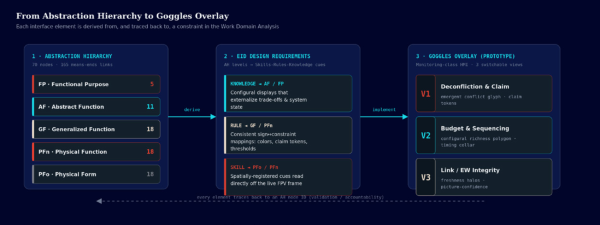
FROM ABSTRACTION HIERARCHY TO INTERFACE The value of the constraint model for EID depends on whether its means-ends structure can be carried, without loss of traceability, into an actual goggles display. To show that the translation is tractable—and to make the design implications concrete and testable—we implemented a front-end prototype of the goggles coordination overlay: a monitoring-class augmented-reality overlay atop a simulated first-person frame using representative mock data, with no live video, telemetry, radio link, or weapons function. Its purpose is design traceability rather than operational fidelity: every information element is derived from, and labelled with, the identifier of the AH node it serves, so the chain from constraint to pixel remains auditable (Figure 1).
Figure 1: The design translation. Abstraction Hierarchy constraints are mapped through ecological interface design (Skills-Rules-Knowledge) into three overlay views, with every display element traceable back to an AH node.
Flying While Coordinating: A Work Domain Analysis of Goggles-Only FPV Pilots 335 The AH supplies the constraints, EID maps them onto the SRK taxonomy, and the overlay realizes the resulting requirements as display elements. The abstraction level of a constraint governs the form of its cue: Abstract Function and Functional Purpose constraints—trade-offs and goals with no single physical locus—are externalized as configural, knowledge- supporting displays; Generalized and Physical Function constraints—target claims, airspace states, link thresholds—are encoded as rule-based signs with consistent sign-to-state mappings; and Physical Form and Physical Function constraints—peer positions, jamming bubbles, timing windows— are rendered as skill-level cues spatially registered to the live scene. The cues are organized into three switchable views: V1 (Generalized Function) for deconfliction, target claiming, and kill-chain gating; V2 (Abstract Function) for the coordination-richness budget and effect sequencing; and V3 (Abstract Function) for link, EW, and shared-state integrity. Because each element retains its node identifier, any cue can be traced back to the constraint that justifies it. The three views illustrate encodings in which a higher-order constraint becomes perceptible as a single emergent variable rather than a set of independent readouts.
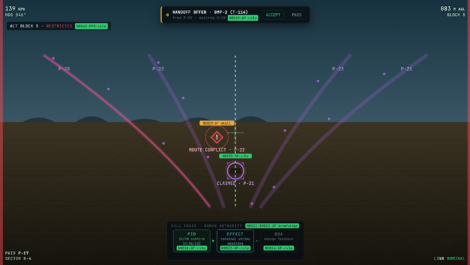
Figure 2: Case A (View V1, Generalized Function). Converging peer-route ribbons coalesce into a single emergent conflict glyph; the color-status zone band gives procedural airspace state; the kill-chain ribbon along the lower edge shows PID confirmed and the effect gate armed. Node-trace tags (e.g. N0029, N0030, N0061, N0011) are shown for illustration.
Case A—emergent route-conflict glyph and kill-chain ribbon (V1). Maintaining mutual awareness of peer pairs (N0029) and deconflicting shared airspace and routes (N0020, N0061) is, at the skill level, a requirement to perceive collision risk directly from the scene. In the overlay (Figure 2), each peer pair’s projected route is a translucent ribbon registered to the first- person frame and the pilot’s own intended path is a dashed track; when the two intersect, the crossing geometry coalesces into a single salient conflict glyph at the point of conflict. Collision risk thus emerges from the geometry itself, and the color-status zone band (N0061) supplies the procedural airspace context in the same glance, without spending the scarce attention budget (N0006).
The same view’s lower edge carries a third emergent feature: a kill-chain progress ribbon whose gates—PID (N0018), effect (N0023), and BDA (N0024)—externalize kill-chain closure integrity and human authority
336 Jenkins conservation (N0011, N0013). The ribbon advances only on a confirmed human positive identification, stamps an audit time at each gate, and flashes when a gate is attempted out of order or with ROE prerequisites unmet, so a skipped step reads as a break in the chain and the authority trail is visible alongside the target’s claim state.
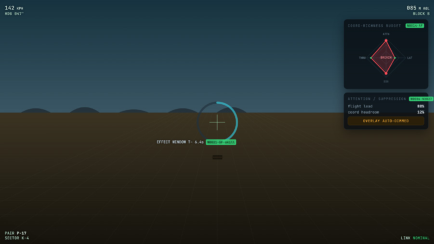
Figure 3: Case B (View V2, Abstract Function). The coordination-richness budget as a configural polygon (N0014): a regular shape is a balanced operating point; the distorted shape shown is a budget breach. Attention and overlay-suppression state at right; the overlay has auto-dimmed under high flight load.
Case B—configural coordination-richness budget (V2). The Balance of Coordination Richness node (N0014) expresses a four-way trade-off with no natural single readout: any coordination feature spends some combination of pilot attention (N0006), latency margin (N0008), electromagnetic signature (N0009) and network throughput (N0010), and four separate gauges would force the pilot to integrate them mentally under load. The overlay instead renders them as the four spokes of a configural polygon (Figure 3): a regular shape signifies a balanced, affordable operating point, while distortion signifies a budget breach. The emergent variable is the shape, not any single spoke—an imbalance is perceived as a deformation before any individual axis reaches alarm. Raising the coordination-richness setting visibly inflates the signature and throughput spokes, exposing the survivability and saturation cost of richer awareness; when mocked flight load is high the overlay auto- suppresses to protect the terminal-flight task (N0027), which the pilot may override by pinning it open.
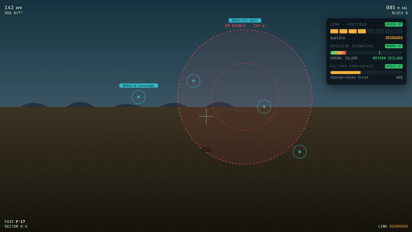
Figure 4: Case C (View V3, Abstract Function). Freshness halos decay with shared- state age and a global picture-confidence band (N0015) externalizes comms staleness; emission signature (N0009) is traded against confidence, with a jamming-bubble proximity cue (N0059) and link status (N0028).
Flying While Coordinating: A Work Domain Analysis of Goggles-Only FPV Pilots 337 Case C—freshness halos and picture confidence (V3). Deconfliction State Robustness (N0015) and Information-Flow Integrity (N0007) concern the trustworthiness of distributed state, not richer maps, so the age and confidence of the shared picture must be visible for the pilot to know how far to trust the cues the other views present. In V3 (Figure 4) each peer and claim marker carries a freshness halo that decays—fading and contracting—as its state ages, and a global picture-confidence band externalizes the link between communications gaps and overlay trust; the halos reveal a thinning picture before any individual marker is demonstrably wrong. The view also makes the survivability-versus-awareness coupling explicit: shifting the emission- control mode toward silent lowers the emission-signature gauge (N0009) but also lowers picture confidence, because the pair now emits less of the data that keeps the shared state fresh. Link and EW status (N0028) and jamming-bubble proximity (N0059) complete the picture, with a discrete abort advisory at critical link quality.
The prototype turns the design implications into manipulable artefacts that can be exercised against mocked degradations and, in the next phase, placed in front of experienced FPV pilots and coordinators. It is not validation— the values are representative and the configural mappings require empirical calibration—but it gives expert reviewers concrete displays to critique and shows that the AH’s means-ends structure survives the journey into the field of view with its traceability intact.
CONCLUSION
This Abstraction Hierarchy models coordinated FPV sUAS operations from the immersive single-pilot node perspective across 70 nodes on five levels connected by 165 means-ends links. Finite pilot attention is the binding constraint; coordination richness must be traded against immersion, latency, electromagnetic signature, and network throughput; and distributed deconfliction-state correctness and auditable kill-chain closure form the structural spine of the domain. These insights translate into concrete EID requirements—spatially registered overlays for skill-based flight, perceptually obvious claim and deconfliction signals for rule-based coordination, and trade-off and audit gauges for knowledge-based reasoning—which the accompanying prototype carries into a goggles overlay with their traceability intact. The result is a design-oriented constraint map for goggles-only HMIs that let many 1:1 pilot-drone pairs behave as a scalable coordinated element without sacrificing the immersive flying task, pending expert validation and prototype testing.
ACKNOWLEDGMENT
AI-assisted tools supported the construction and structural validation of the Abstraction Hierarchy and were used for copy review and formatting; the framing, interpretation, and conclusions are the author’s.
REFERENCES
Burns, C. M. and Hajdukiewicz, J. R. (2004). Ecological Interface Design. Boca Raton, FL: CRC Press. Naikar, N. (2013). Work Domain Analysis: Concepts, Guidelines, and Cases. Boca
Raton, FL: CRC Press. Rasmussen, J. (1985). The role of hierarchical knowledge representation in decision making and system management. IEEE Transactions on Systems, Man, and Cybernetics, 15(2), pp. 234–243. Vicente, K. J. (1999). Cognitive Work Analysis: Toward Safe, Productive, and Healthy
Computer-Based Work. Mahwah, NJ: Lawrence Erlbaum Associates. Vicente, K. J. and Rasmussen, J. (1992). Ecological interface design: Theoretical foundations. IEEE Transactions on Systems, Man, and Cybernetics, 22(4), pp. 589–606.
SEARCH THE AHFE DIGITAL BOOKSTORE BY ISBN
Explore the complete digital volume
Human Factors in Design, Engineering, and Computing
Read this individual research paper free through the original publisher, or explore the full digital proceedings book.