Miranda Cornelissen, Paul Salmon, Neville Stanton, Roderick McClure (2021). Life in the Wild? Using Ergonomics Systems Methods and Field of Safe Travel Theory to Evaluate Intersection Designs. In: Advances in Human Aspects of Transportation: Part II. AHFE Open Access, vol. 16. https://doi.org/10.54941/ahfe100690
1 University of the Sunshine Coast Accident Research, Faculty of Arts and Business, University of the Sunshine Coast, Maroochydore, Australia d Civil, Maritime, Environmental Engineering and Science Unit, Faculty of Engineering and the Environment, University of Southampton, Southampton, United Kingdom ↗
2 Civil, Maritime, Environmental Engineering and Science Unit Faculty of Engineering and the Environment University of Southampton, Southampton, United Kingdom ↗
3 Monash Injury Research Institute, Monash University, Melbourne, Australia ↗
A safe systems approach has been acknowledged as the underlying philosophy of contemporary road safety strategies. Despite this, systemic applications in road transport evaluation and design remain sparse. This paper explores the value of using Ergonomics design and evaluation methods such as Cognitive Work Analysis in conjunction with road transport theories such as the field of safe travel to provide easily interpretable analyses of road designs. The goal is that this would provide a facilitation platform for communication between Ergonomics analysts and road transport designers, aiming to facilitate systemic applications in road transport. The application of Cognitive Work Analysis and the field of safe travel theory in the evaluation of a new intersection design concept demonstrated that this proves a promising cross method collaboration. Cognitive Work Analysis provided the analytical detail of road user behavior possible as a result of the interaction between the intersection design, road users, vehicles and the environment. Subsequently, the field of safe travel theory provided a visual means to communicate these findings directly related to the intersection designs. The application furthermore provided additional insights into the constraints acting upon the field of safe travel and the paths that road users can possibly take within this field.
A safe systems approach has been acknowledged as the underlying philosophy of contemporary road safety strategies (Corben, Logan, Fanciulli, Farley, & Cameron, 2010; Johansson, 2009; Koornstra, Mathijssen, Mulder, Roszbach, & Wegman, 1992). Despite this, systemic applications considering more than just individual road user groups (e.g. drivers) or single countermeasures (e.g. road design) are sparse.
Systems-based methods from the discipline of Ergonomics have a key role to play in road transport design and evaluation. Outcomes of Ergonomics methods analyses are, however, often abstract representations. These include for example, hierarchies of goals (Hierarchical Task Analysis (Annett, 2004)) or complex networks and diagrams (e.g. Cognitive Work Analysis (CWA; Rasmussen, 1997; Vicente, 1999)) and Event Analysis of Systemic Teamwork (EAST; Stanton, Salmon, Walker, Baber, & Jenkins, 2005)). First explorations of representing such analysis in a real world context were promising (Cornelissen, Salmon, Stanton, & McClure, 2012), however, the absence of a visualization method translating abstract analyses to real world concepts made it difficult to conceptualize the outcomes and to communicate with, for example, design teams.
The field of safe travel theory (Gibson & Crooks, 1938) is a theory of driving relating the driver to the road transport environment and has underpinned application of Ergonomics methods such as CWA in road safety, e.g. designing in-vehicle warning systems (Jenkins, Stanton, Walker, & Young, 2007; Stoner, Wiese, & Lee, 2003; Young & Birrell, 2010). While current applications of the field of safe travel theory and CWA have focused mainly on interface design, the field of safe travel theory shows potential to translate Ergonomics methods analyses output to the road transport design context.
The aim of this paper is to examine the value of using Ergonomics systems analysis methods in conjunction with the field of safe travel theory to provide easily interpretable analyses of road environments and road design concepts. The ambition is that using a combination of these methods will provide a facilitation platform for communication between Ergonomics analysts and road transport designers.
Cognitive Work Analysis In the field of Ergonomics, the systems approach to road safety is beginning to be actualized through the application of systemic modeling methods such as CWA (Cornelissen, Salmon, McClure, & Stanton, 2013; Cornelissen, Salmon, & Young, 2012). CWA is a popular framework used for designing and evaluating complex sociotechnical systems. It describes system constraints and potential behavior possible within those constraints (Vicente, 1999). The framework’s five phases, as outlined by Vicente (1999), all model a different constraint set. First, Work Domain Analysis describes overall system constraints from physical objects to the functional purpose of the system. Second, Control Task Analysis describes situational constraints and decision making requirements. Third, Strategies Analysis models different ways in which activities can be carried out within a system’s constraints. Fourth, Social Organization and Cooperation Analysis describes communication and coordination demands resulting from organizational constraints. Fifth, Worker Competencies Analysis describes skills, rules and knowledge required by actors within the system.
CWA has been used successfully to examine the interactions of road users and road system components (Cornelissen et al., 2013; Cornelissen et al., 2012). Past applications, however, represent evaluations of road user behavior induced by existing road transport systems (Cornelissen et al., 2013; Cornelissen et al., 2012; Stoner et al., 2003) and design of driver support systems (Birrell, Young, Jenkins, & Stanton, 2011; Hilliard & Jamieson, 2008; Lee, Hoffman, Stoner, Seppelt, & Brown, 2006; Seppelt & Lee, 2007). Applying systems based methods such as CWA during the road design process will provide the opportunity to proactively address design issues and produce road design concepts that alight with the systems approach and support all road users. Whilst having a safety benefit there is also a significant cost benefit since road design concepts can be modified early in the design lifecycle before they are implemented in the real world. Moreover, changing the role of Ergonomists from ‘operational system problem solvers’ to ‘design concept problem solvers’ is one of the major challenges facing our discipline. One of the key facilitators of this is the development of Ergonomics methods that can identify safety-related problems early on in the design process.
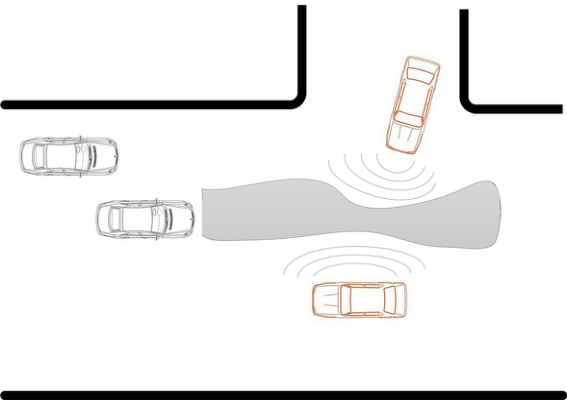
Field of safe travel The field of safe travel theory (Gibson & Crooks, 1938) is one of the earlier road transport theories attempting to describe the relationship between driver and the road transport environment. Driving is regarded a type of locomotion through a terrain or field of space. The function of locomotion is to move an individual from one point in space to another, the destination. To reach the destination, location must be modified to avoid obstacles. The field of safe travel stretches out in front of a road user, exists within the boundaries of the road and consists of the possible paths a road user may take unimpeded, see Figure 1.
Figure 1. Field of safe travel (Adapted from Gibson & Crooks, 1938) Cognitive Work Analysis & Field of safe travel
Gibson was a forefather of the ecological psychological movement of which CWA is a product. The field of safe travel has been cited to explain the relevance of constraint based approaches to describe complex systems such as road transport. Applications of field of safe travel and CWA to design in-vehicle systems have focused mainly on the first phase of CWA, Work Domain Analysis. These applications aimed to visualize obstacles, system constraints or the field of safe travel to drivers to help them appropriately modify and avoid obstacles (Jenkins et al., 2007; Stoner et al., 2003; Young & Birrell, 2010).
To support a systems approach, application of CWA beyond WDA is encouraged. This would explore a wider range of constraints influencing the task of negotiating a road transport system, the possible paths within the field of safe travel and the interaction between constraints and paths. CWA helps describe the field of safe travel of the road user based on the interaction of the road user with the road transport environment. The field of safe travel theory acts as a visual mediator between CWA outputs and road transport evaluations and design.
METHOD
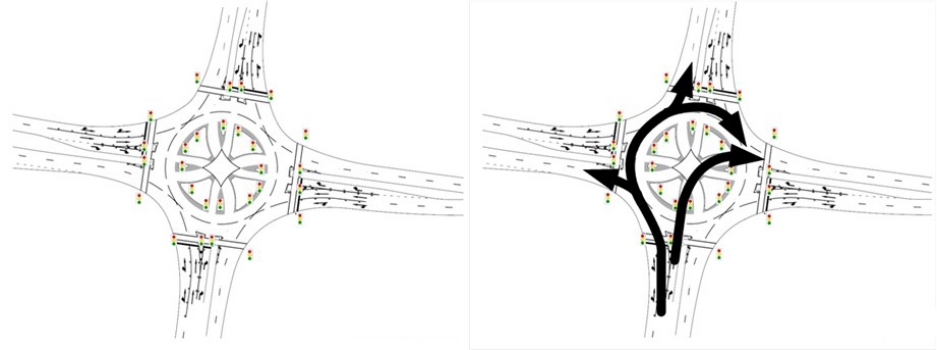
Intersections Two road designs were evaluated; an existing traditional Melbourne intersection and a newly proposed cut-through intersection design concept that was developed based on road transport safe-system principles, see Figure 2.
Traditional, arterial intersections in Melbourne are typically signalized, carry multiple lanes of traffic and speed limits on approach are between 60 and 80 km/hour. Often these intersections, if space permits, have a slip road to carry left turning traffic that can turn without using the signals. In Australia, road users travel on the left-hand side of the road. For right hand turns, road users that travel on the main road approach the intersection as close to the center of the road as possible and turn just right of the center of the intersection. Pedestrians and cyclists that turn right approach the intersection on the left hand side and use the pedestrian crossings to travel to the far right opposite corner of the intersection.
As part of a major road safety project, a new intersection design concept was produced aimed to improve intersection safety through infrastructure design (Corben, Candappa, Van Nes, Logan, & Peiris, 2010). The intersection design, named the cut-through intersection, has traffic islands fitted in the middle of the intersection. Right turning traffic is expected to use the cut-through lane created by the distribution of these traffic islands. Their turn is protected from oncoming traffic by the traffic islands and it changes the angle at which traffic meets to less than 90 degrees. To use the cut-through lane, road users have to be in the right hand lane before they approach the intersection. An additional traffic island separates right hand turning traffic wanting to use this lane from straight through traffic upon approach. The intersection has a similar footprint to the traditional intersection and due to the circular shape of this intersection no slip lane is fitted. Left turning traffic merges with and diverges from straight through traffic in the intersection.
Figure 2. Traditional Melbourne intersection (above) and cut-through design (below).
Data collection The analysis of the traditional intersection was based on data derived from an on-road study of different road users’ behavior at intersections (c.f. Cornelissen, Salmon, McClure, & Stanton, 2013; Cornelissen, Salmon, & Young, 2012) as well as document analysis of publically available documentation on Victoria’s road system (VicRoads, 2009, 2010, 2011). The on-road study data comprised verbatim transcripts of Verbal Protocol Analysis (VPA) and Critical Decision Method (CDM) obtained from drivers, motorcycle riders, cyclists and pedestrians as they negotiated intersections as part of a predetermined route through Melbourne.
The analysis of the cut-through design was based on the CWA analysis of traditional intersections. The analysis was complemented by information on those elements that were different as obtained from the design documents and discussions with the designers. For example, the removal of the slip lane, addition of traffic islands and change in traffic light design.
RESULTS
Cognitive Work Analysis The Abstraction Hierarchy (AH) was used to assess the system constraints of both designs. System constraints are the constraints set on the system by its purpose, functions that need to be carried out and physical objects. The main difference between the system constraints of the traditional intersection and the cut-through intersection is the physical objects of which the system is made up off. In particular, the slip lane is no longer available and the lane markings across the intersection are now replaced by traffic islands.
Situational constraints on road user interaction with the intersections were assessed using the Contextual Activity Template (CAT). The CAT was used to describe when certain functions can be executed (e.g. on approach, in the intersection or when exiting the intersection). This is where differences between the intersections became apparent. The distribution of the physical objects through the cut-through intersection, e.g. the traffic islands, results in changes to when decisions have to be made. For example, when turning right ‘determine a path’ across the intersection and ‘take a lane’ now have to occur on approach before road users encounter the additional traffic island and enter the cut through lane. Once in the intersection the traffic islands in the intersection prevent changes to these decisions.
Decision ladders were used to evaluate the decision making processes. Decision ladders were used to analyze the options road users have to execute the function, the information elements used to decide between the options and subsequently how the functions can be executed. For example, the options to turn right have changed due to the circular shape of the cut-through intersection and the creation of the cut-through lane. To turn right in traditional intersections, road users that travel on the road (drivers, motorcycle riders and cyclists) could do a hook turn, travel in a different direction and then do a u-turn or take the right hand turning lane. In the cut-through intersection, road users can also travel the long way around such as when travelling in roundabouts. Decision ladders further showed that while decisions to ‘determine a path and lane’ have to be made early on approach in the cut-through intersection, the information elements, e.g. traffic lane arrows, have not been provided at that time and place.
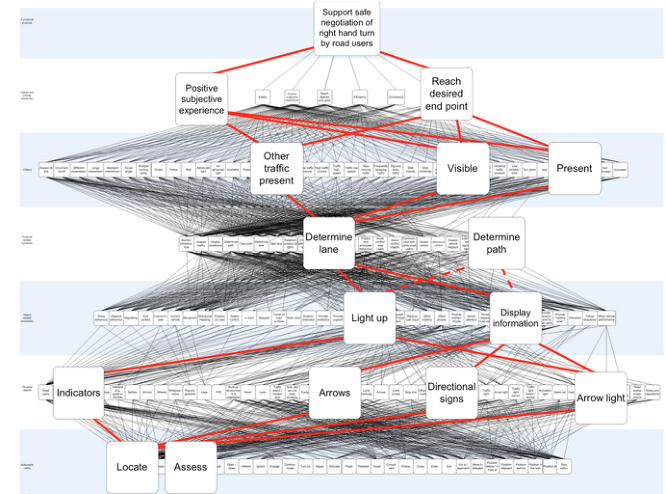
The strategies analysis evaluated the effect of intersection changes on road user behavior that was possible using the Strategies Analysis Diagram (SAD), see Figure 3 for an extract. The SAD was used to describe different ways in which functions could be executed within system constraints. The analysis shows that the range of behavior possible is different across the intersections. For example, the traffic islands in the cut-through intersection make it easier for drivers, motorcycle riders and cyclists to avoid conflict with other users while in the intersection as they are protected by the traffic islands as physical barriers. The traffic islands also influence behavior possible by pedestrians and cyclists (if they take the pedestrian route). The traffic islands, for example, allow protection and movement for these road users. This is the way they are designed to be used for pedestrian crossings on the outer ends of the intersection. The traffic islands in the middle of the intersection however afford the same protection and movement. Therefore pedestrians may use the traffic islands to travel diagonally across the intersection. These strategies are likely when traffic volumes are low or when traffic is stopped and pedestrians feel that this strategy satisfies both the efficiency and safety values. The SAD was used to evaluate complementary nature and redundancy of road user behaviors. For example, the CAT showed that decisions to ‘determine a path and lane’ had to be made earlier on approach in the cut-through intersection but that the information elements to make these decisions, e.g. traffic lane arrows, were not available. The SAD analysis demonstrated that road users can use alternative strategies to make the same decision, see Figure 3. For example, road users can assess other road users’ indicators, traffic lights or recall what the directional signs displayed to anticipate whether there will be a right hand turning lane. These strategies are however more complex and provide less certainty to road users about the lay out of the infrastructure and their expected behavior. Understanding such trade offs is essential in understanding the impact of intersection designs on road users.
Figure 3. Extract Strategies Analysis Diagram
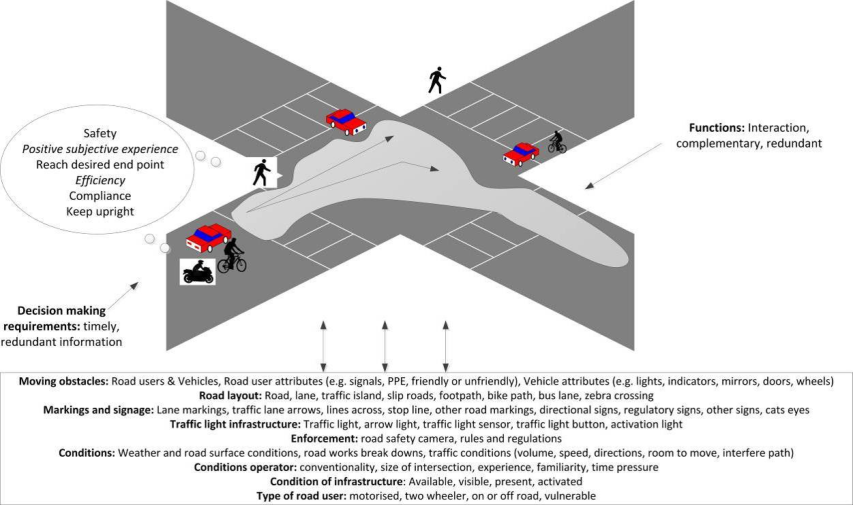
Field of safe travel The synergy of the CWA outcomes and the field of safe travel theory will now be explored. Through the CWA analysis we have demonstrated the presence of non-linear emergence within the intersections examined; that is, how small changes in system constraints can have large consequences for the behavior possible (decision making processes and strategies). Therefore small changes in system constraints will have large consequences for the field of safe travel and possible paths within it. The SAD analysis provided a comprehensive insight into the behavior possible within the cut-through intersection. We therefore now understand paths possible within the field of safe travel. Further through the values and priority measures and criteria, the CWA analysis demonstrated the different paths that can be taken by different road users under different circumstances. This further specifies the factors of influence on the paths possible and paths that are likely to be chosen within the field of safe travel. These high level outcomes are depicted in Figure 4.
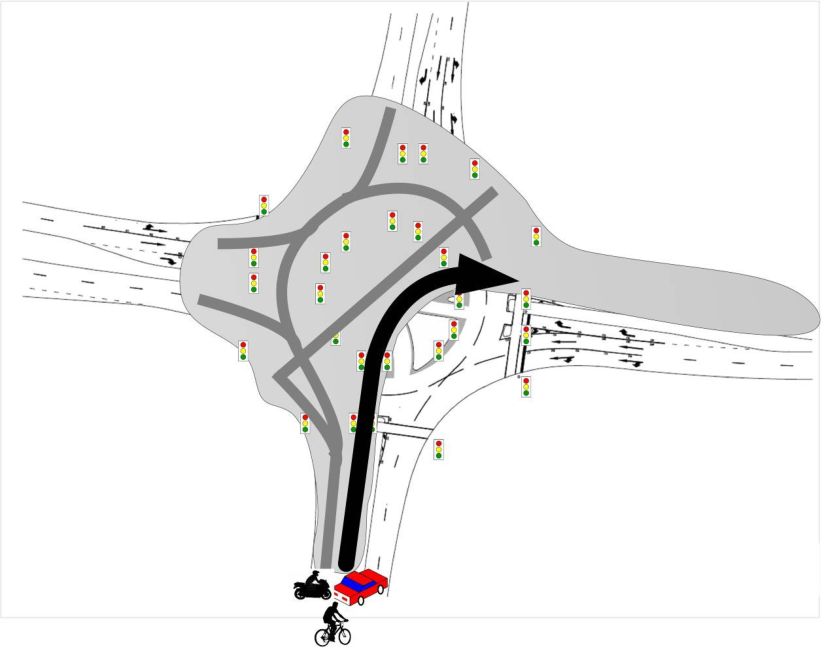
The field of safe travel can be used to visualize specific findings. For example, figure 5 communicates visually the CWA findings of emergent behavior; behavior that was not necessarily considered by the designers for evaluation. The designers intended that drivers, motorcycle riders and cyclists use the cut through lane to turn right. However, the CWA analysis demonstrated that road users have a range of other options, including using the intersection as a round about. The CWA analysis further demonstrated that cyclists and pedestrians can use the traffic islands in the middle of the intersection to cross diagonally. This behavior and the consequences of this behavior in interaction with other road users was not considered by the designers, and represents a form of emergent behavior that could potentially create conflicts between the different road user groups. Using the field of safe travel visualization quickly demonstrates how the paths these road users can possibly take is much larger than initially considered in the concept design phase. The field of safe travel then acts as a visual means to communicate the findings to the designers, making explicit design flaws
Figure 4. Insight factors shaping the field of safe travel.Figure 5. Field of safe travel Cut through design.
CONCLUSIONS
The aim of this paper was to explore the value of Ergonomics systems analysis methods in conjunction with the field of safe travel theory to provide easily interpretable analysis of road designs. Such synergy will facilitate communication between Ergonomics analysts and road transport designers. In particular, the combination of CWA and the field of safe travel theory were explored here.
The CWA analysis provided detailed insight into the system and situational constraints as well as decision making processes and possible road user behavior. The field of safe travel visually mediated the communication of these results by directly mapping it onto the intersection. The field of safe travel allows communication of the overall findings of constraints shaping the behavior as well as more specific findings, e.g. emergent behavior. The CWA analysis provided the analytical rigor to analyze the interaction between intersection design, road users, vehicles and the environment and the field of safe travel provides a visual platform to communicate these findings to a non- Ergonomics public, e.g. the designers.
This research represents a first step in better integrating Ergonomics methods in the early phases of the road design lifecycle. Following this successful exploration a full-scale application of the CWA analysis and the field of safe travel is encouraged. Future applications can also be used to further develop the field of safe travel theory.
REFERENCES
Annett, J. (2004). Hierarchical task analysis. In D. Diaper & N. A. Stanton (Eds.), The handbook of task analysis for human-computer interaction (pp. 67 - 82). Mahwah, NJ: Lawrence Erlbaum Associates. Birrell, S.A., Young, M.S., Jenkins, D.P., & Stanton, N.A. (2011). Cognitive Work Analysis for safe and efficient
driving. Theoretical Issues in Ergonomics Science, 13(4), 430-449. Corben, B., Candappa, N., Van Nes, N., Logan, D., & Peiris, S. (2010). Intersection Safety Study: Meeting Victoria's Intersection Challenge. Task 5 Generation of Intersection Designs within the Safe System Context. Melbourne, Australia: Monash University Accident Research Centre. Corben, B., Logan, D., Fanciulli, L., Farley, R., & Cameron, I. (2010). Strengthening road safety strategy
development ‘Towards Zero’ 2008–2020 – Western Australia’s experience scientific research on road safety management SWOV workshop 16 and 17 November 2009. Safety Science, 48(9), 1085-1097. Cornelissen, M., Salmon, P.M., McClure, R., & Stanton, N.A. (2013). Using cognitive work analysis and the strategies analysis diagram to understand variability in road user behaviour at intersections. Ergonomics, 56(5), 764-780. Cornelissen, M., Salmon, P.M., Stanton, N.A., & McClure, R. (2012). Human factors now showing in 3D. In N. A.
Stanton (Ed.), Advances in Human Aspects of Road and Rail Transportation (pp. 653-662). Boca Raton, Fl.: CRC Press. Cornelissen, Miranda, Salmon, Paul M., & Young, Kristie L. (2012). Same but different? Understanding road user behaviour at intersections using cognitive work analysis. Theoretical Issues in Ergonomics Science, 14(6), 592-615. Gibson, James J., & Crooks, Laurence E. (1938). A Theoretical Field-Analysis of Automobile-Driving. The
American Journal of Psychology, 51(3), 453-471. Hilliard, Antony, & Jamieson, Greg A. (2008). Winning Solar Races with Interface Design. Ergonomics in Design: The Quarterly of Human Factors Applications, 16(2), 6-11. Jenkins, D.P., Stanton, N.A., Walker, G.H., & Young, M.S. (2007). A new approach to designing lateral collision
warning systems. International Journal of Vehicle Design, 45(3), 379-396. Johansson, Roger. (2009). Vision Zero – Implementing a policy for traffic safety. Safety Science, 47(6), 826-831. Koornstra, M.J. , Mathijssen, M.P.M. , Mulder, J.A.G. , Roszbach, R., & Wegman, F.C.M. (1992). Naar een duurzaam veilig wegverkeer [towards sustainable safe road traffic]. Leidschendam: SWOV. Lee, J.D., Hoffman, J.D., Stoner, H.A., Seppelt, B.D., & Brown, M.D. (2006). Application of ecological interface
design to driver support systems Proceedings of the 16th World Congress on Ergonomics (IAE 2006). Maastricht, the Netherlands: Elsevier. Rasmussen, J. (1997). Risk management in a dynamic society: a modelling problem. Safety Science, 27(2-3), 183-
213. Seppelt, Bobbie D., & Lee, John D. (2007). Making adaptive cruise control (ACC) limits visible. International journal of human-computer studies, 65(3), 192-205. Stanton, N.A., Salmon, P.M., Walker, G.H., Baber, C., & Jenkins, D.P. (2005). Human factors methods: a practical
guide for engineering. Aldershot: Ashgate Publishing Limited. Stoner, H.A., Wiese, E.E., & Lee, J.D. (2003). Applying ecological interface design to the driving domain: the results of an abstraction hierarchy analysis. Paper presented at the Human Factors and Ergnomics Society 47th Annual Meeting, Santa Monica, CA. Vicente, K.J. (1999). Cognitive work analysis: Toward safe, productive and healthy computer-based work. Mahwah,
New Jersey: Lawrence Erlbaum Associates, Inc. VicRoads. (2009). Driving in Victoria: Rules and responsibilities. Kew, Australia: VicRoads. VicRoads. (2010). Road to solo driving. Kew, Australia: VicRoads. VicRoads. (2011). Safety & Rules. Retrieved 17/02/2011, from http://www.vicroads.vic.gov.au/Home/SafetyAndRules/ Young, M.S., & Birrell, S.A. (2010). Ecological IVIS design: using EID to develop a novel in-vehicle information system. Theoretical Issues in Ergonomics Science, 13(2), 225-239.
LISTED IN THE AHFE DIGITAL BOOKSTORE CATALOGUE
Explore the complete digital volume
Advances in Human Aspects of Transportation: Part II
Read this individual research paper free through the original publisher, or explore the full digital proceedings book.
ISBN 978-1-4951-2098-5
Explore this ISBN in the AHFE Bookstore ↗Listed in the July 2026 bookstore catalogue; search by ISBN to confirm current availability · Digital book purchase optional