Yuzheng Li, Weining Fang, Zhe Sun, Yirui Han (2026). The Effects of Task Similarity and Time Pressure on Task Performance Following Interruptions in Complex Human- Computer Interaction Systems. In: Human Factors in Design, Engineering, and Computing. AHFE Open Access, vol. 238, pp. 49–59. https://doi.org/10.54941/ahfe1008240
Task interruptions are common in complex human-computer interaction environments, particularly when users operate under time pressure or when interrupting tasks are similar to the primary task. Such interruptions may impair task performance and increase subjective workload, yet the combined effects of task similarity and time pressure remain insufficiently understood. The present study investigated their joint effects using a 2 × 2 within-subjects experimental design. Task similarity (high vs. low) and time pressure (present vs. absent) were manipulated, while response time, task accuracy, and subjective workload were measured. Task similarity and time pressure both showed significant main effects on the response time of the interrupted primary task, and both significantly increased subjective workload. No significant interaction was found for response time or task accuracy, whereas a significant interaction between task similarity and time pressure was observed for subjective workload. These findings suggest that task similarity and time pressure influence interruption performance largely through independent main effects, while their combined effect is evident primarily in subjective workload. These findings provide implications for interruption management and task design in complex human-computer interaction environments, with the aim of improving user performance and interaction efficiency.
Complex human-computer interaction (HCI) systems are open and dynamic systems comprising human organizations and technological components. With the rapid development of informationization and automation, the integration of information and operational complexity has resulted in increasingly complex HCI task environments, including healthcare, aerospace, manufacturing, and nuclear power (Zijlstra, Roe, Leonora, & Krediet, 1999). Task interruptions are common in such environments.
For example, rail transit dispatchers may need to handle unexpected scheduling or train-fault tasks while monitoring train operations, whereas nuclear power operators may need to respond to unexpected alarms during system fault diagnosis under time-critical conditions (Choi, Lee, Ha, & Seong, 2018). Such interruptions can divert attention from ongoing tasks and negatively affect performance (Couffe & Michael, 2017).
In human-robot interaction, research on task interruption has increasingly focused on human behavioral and psychological responses. Interruptions requiring urgent responses may cause distraction, increase mental workload, and impair performance (Brumby, Janssen, & Mark, 2019). Interruptions may also reduce productivity; for example, knowledge workers can spend substantial time dealing with unnecessary interruptions (Spira & Feintuch, 2005), resulting in decreased productivity (Gould, Cox, & Brumby, 2016). Therefore, understanding the factors that influence interruption effects is important for improving the efficiency and safety of complex HCI systems.
Task similarity and time pressure are two important factors influencing interruption performance. Task similarity refers to the degree of similarity between the interruption and primary tasks in terms of operational processes, goals, and required skills. Similar interrupting tasks may make it more difficult for operators to resume the primary task (Altmann & Trafton, 2002). Time pressure refers to the pressure to complete a task within a limited period. Under time constraints, operators may be required to make rapid decisions, potentially increasing error rates (Ordonez & Benson, 1997). However, existing research has largely examined these factors separately, and their combined effects on task performance and subjective workload remain unclear, particularly in complex HCI environments.
Therefore, this study investigates the effects and interaction of task similarity and time pressure in a complex task interruption environment. A two-factor cognitive task interruption paradigm was developed to examine their effects on response time, correctness, and subjective workload. The findings are expected to provide insights into mitigating the negative effects of task interruptions through task design and HCI strategies, thereby supporting more efficient and safer human-computer collaborative environments.
RELATED RESEARCH Task Similarity
Task similarity refers to the overlap of task nature and operating rules, with less overlap meaning lower similarity (Eyrolle & Cellier, 2000). As a key task characteristic affecting interruption effects, it is closely related to task performance and operators’ mental workload, and can also influence communication, task performance and collaboration in human-robot interaction.
High information similarity between primary and interrupting tasks causes working memory interference (Anderson & Milson, 1989), increasing attentional demands, misallocating working-memory resources and impairing task performance (Speier, Valacich, & Vessey, 1999). Excessive information diversity beyond cognitive capacity increases cognitive demands and decision time (Iselin, 1988), while similar information reduces cognitive processing resource consumption (Biggs, Bedard, Gaber, & Linsmeier, 1985).
The Effects of Task Similarity and Time Pressure on Task Performance 51 Wickens’ multiple-resource theory states that attentional resources are divided into multiple pools by task modality and processing characteristics, predicting that higher similarity between primary and interrupting tasks induces stronger interference and performance costs (Wickens, 2008). Consistent with this view, similar interruptions disrupt complex memory tasks more significantly (Gillie & Broadbent, 1989), and dissimilar interruptions facilitate better primary-task parameter recall (Czerwinski, Chrisman, & Schumacher, 1991). Similar task combinations also lead to longer completion time but higher accuracy than dissimilar ones (Choi et al., 2018). However, inconsistent findings exist: interruptions with different information content are more disruptive to complex task performance and prolong decision time than similar ones (Speier et al., 1999).
Overall, existing studies show inconsistent results regarding task similarity’s effects on interruption performance. This study therefore explores how task similarity between primary and interruption cognitive tasks influences task performance and subjective workload.
Time Pressure Time pressure refers to the subjective emotional and psychological experience perceived under time constraints (Szollos, 2009). As a common form of environmental pressure in HCI operational environments, time pressure may facilitate task completion under moderate constraints but impair performance when excessive.
Time pressure constrains cognitive capacity, impairs information processing and accuracy, yet can accelerate task completion and boost productivity. Relevant studies report mixed effects. Time pressure alters decision-making strategies (Ordonez & Benson, 1997), reduces task accuracy (Eyrolle & Cellier, 2000), and lowers reward outcomes and exploration behaviors (Wu, Schulz, Pleskac, & Speekenbrink, 2022). Conversely, it shortens emergency physicians’ response time without accuracy loss (Monteiro et al., 2015) and exerts no significant effect on task accuracy or response time in paper-folding tasks (Marzolla et al., 2024).
These findings suggest that the effects of time pressure may depend on task characteristics and contextual demands. Therefore, this study examines whether time pressure facilitates or impairs performance in cognitive interrupting tasks and investigates its effects on response time, accuracy, and subjective workload.
METHODS
Participants We performed an a priori power analysis using G*Power. To achieve an effect size of 0.25 with a statistical power of 0.80 and a significance level of 0.05, a sample size of N = 16 was deemed necessary. We recruited 20 students (10 male and 10 female) from Beijing Jiaotong University. The ages ranged from 21 to 27 years old (Mean = 22.05, SD = 1.71). All participants were right-handed; had normal visual acuity or corrected visual acuity
and no eye diseases such as color blindness or color weakness; did not have any behavioral or cognitive disorders; and did not have significant fatigue before the experiment. All participants were recruited voluntarily. Written informed consent was obtained from each participant prior to the experiment; participants were informed of the purpose and procedures of the study and of their right to withdraw at any time without penalty. No personally identifiable information was collected, and all data were stored anonymously. Participants received monetary compensation after completing the experiment.
Design The independent variables in this experiment were task similarity of the interrupting task to the main task and time pressure of the interrupting task, the task interface was programmed in E-Prime. A 2 × 2 within-subjects design was adopted. There are two levels of task similarity between the interrupting task and the main task: task similarity, task dissimilarity; and two levels of time pressure: time pressure, no time pressure.
There were a total of 20 main task stimuli in each group of experiments, and six interruption stimuli were randomly generated during the main task. When the interrupting task appeared, the interface completely covered the main task, and participants needed to perform the interrupting task immediately; the interrupting task interface would disappear immediately after the operator typed in the answer, and the experimental interface would revert back to the main task, and participants needed to continue with the main task. At least one uninterrupted main task exists between every two interrupted tasks to avoid too frequent interruptions.
The main task (Figure 1) presented a horizontal sequence of 12 mixed addition/subtraction operations, and the next main task stimulus will automatically appear in the experiment interface after the response is completed.
Figure 1: Main-task interface. Example: for the arithmetic expression “5+2-4-1+ 8+7+9-3+7-6-3+2” (correct answer = 23), participants sequentially computed the expression and input the result.
Figure available in the original PDF paper.
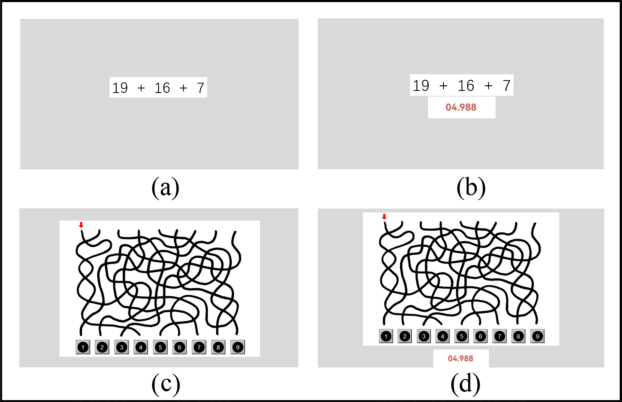
The interrupting tasks are shown in Figure 2, where the interrupting task appears suddenly at a random time and the participants is working on. There are 4 types of interrupting tasks: similar interrupting task without time pressure (Figure 2a), similar interrupting task with time pressure (Figure 2b), dissimilar interrupting task without time pressure (Figure 2c), and dissimilar interrupting task with time pressure (Figure 2d). The similar interrupting task involved adding a single-digit number to two two-digit numbers (11–19); the dissimilar interrupting task was a visual search task (linear maze test) in which participants were required to trace the black line with their eyes from the starting point indicated by the red arrow until
The Effects of Task Similarity and Time Pressure on Task Performance 53 the end point and quickly press the correct number key corresponding to the end point. The time pressure of the interrupting task was added as shown in Figures b and d. A bold red digital stopwatch with a duration of 5 seconds was added as a countdown timer below the arithmetic equation or the picture of the linear maze in the formal experimental interface, and participants were required to perform the computation or pathfinding and respond to it correctly within these 5 seconds. The experimental interface automatically returned to the unfinished main task interface whenever a response to the interrupting task was made.
Figure 2: Interfaces for the four interrupting-task conditions: (a) similar, no time pressure; (b) similar, time pressure; (c) dissimilar, no time pressure; (d) dissimilar, time pressure.
Response times and correctness were recorded for the primary-task trials. After each condition, participants completed the NASA-TLX questionnaire to assess subjective workload.
Procedure Participants were asked to rest sufficiently the day before the experiment. Upon arrival at the experimental site, they were introduced to the content of the experiment and informed of the instructions and precautions to be followed during the experiment. All participants were required to familiarize themselves with the experimental task and the interruption procedure before the formal experiment started to avoid the learning effect during the formal experiment. The experiment was a within-subjects design, in which all participants completed four experimental conditions in a randomized order. After each set of tasks, participants were required to complete the NASA- TLX scale for subjective workload assessment. The overall experiment took approximately 1 hour to complete, including 10 minutes for the practice
phase, 30 minutes for the formal experimental phase, and 20 minutes for questionnaire completion and breaks.
RESULTS
Before examining the joint effects of task similarity and time pressure, a paired-samples t-test compared performance between interrupted and non-interrupted primary-task trials. There was a significant difference between interrupted and uninterrupted primary tasks response times (p < 0.001), with interrupted primary tasks response times significantly higher than uninterrupted primary tasks response times; there was no significant difference between interrupted and uninterrupted primary tasks correctness (p = 0.517 > 0.05).
Response Time
Table 1 shows the descriptive statistics of the response time of the interrupted primary tasks, which was analyzed by 2 × 2 repeated measures ANOVA.
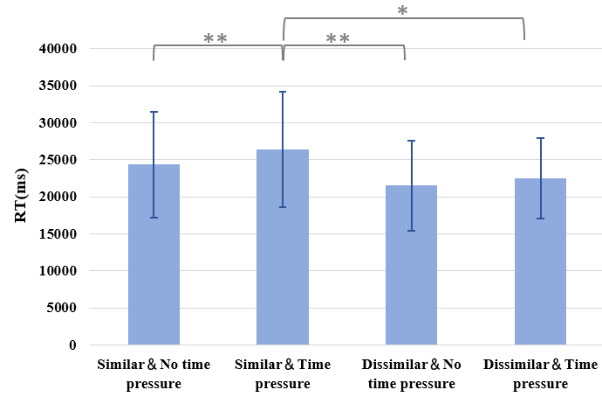
Based on the analysis of the data in Table 2, the similarity between the interrupted task and the primary tasks and time pressure both had a significant main effect on the response time of the interrupted primary tasks (p = 0.008 < 0.05; p = 0.014 < 0.05). As shown in Figure 3, participants took significantly longer to complete the interrupted primary tasks under the similar-interruption condition than under the dissimilar condition, and under the time-pressure condition than under the no-time- pressure condition. There was no significant interaction between task similarity and time pressure in response time to the interrupted primary tasks (p = 0.537 > 0.05).
Test Effect F Significance Similarity 8.721 0.008* Time pressure 7.403 0.014*
Two-factor interaction 0.395 0.537
Figure 3: Mean RT of the primary task under different task similarity and time pressure conditions.
Correct Rate
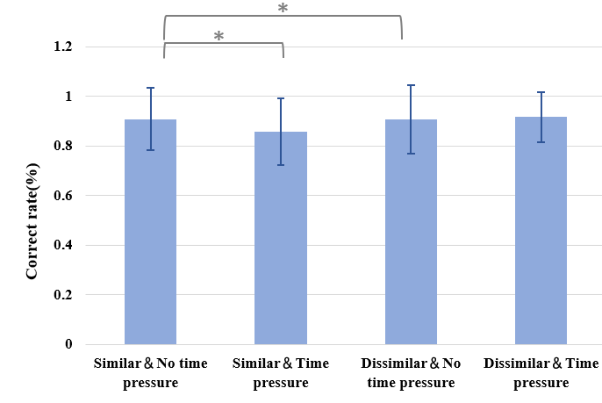
Table 3 shows the descriptive statistics for the correct rate of the interrupted primary tasks. A 2 × 2 repeated-measures ANOVA (Table 4) revealed no significant main effects of task similarity or time pressure, and no significant interaction, on correctness (p = 0.232; p = 0.367; p = 0.260). However, as shown in Figure 4, correct rates were similar across conditions and did not differ significantly.
Time pressure 0.856 0.367 Two-factor interaction 1.347 0.260
Figure 4: Mean correct rate of the primary task under different task similarity and time pressure conditions.
Subjective Workload
Table 5 presents descriptive statistics for participants’ NASA-TLX scores. A 2 × 2 repeated-measures ANOVA was conducted on subjective workload. Participants reported significantly higher subjective workload under the similar interruption condition than under the dissimilar interruption condition. Subjective workload was also significantly higher under the time- pressure condition than under the no-time-pressure condition. A significant interaction between task similarity and time pressure was observed for subjective workload (p = 0.022 < 0.05).
Group Mean SD Similar+no time pressure 47.3490 16.64377 Similar+time pressure 64.8835 15.82397
Dissimilar+no time pressure 40.5660 20.72888 Dissimilar+ time pressure 49.5665 16.81934
Table 6: Two-factor repeated-measures ANOVA for primary task subjective workload following interruption.
Table available in the original PDF paper.
Test Effect F Significance Similarity 12.079 0.003* Time pressure 37.818 < 0.001*
Two-factor interaction 6.169 0.022*
CONCLUSION
This study investigated the effects of task similarity and time pressure on task performance and participants’ subjective workload in task-interruption scenarios. The interruption tasks were cognitive in nature, involving arithmetic problems and a linear maze task.
The results showed that response times of the interrupted primary task were significantly longer when the interrupting task was similar to the primary task than when it was dissimilar. This result is consistent with the findings of most researchers, such as Lee and Duffy (2015). Response times of the interrupted primary task were also significantly longer under time pressure than without time pressure. Correctness rates remained at a relatively high and stable level and did not differ significantly between the similar and dissimilar conditions or between the time-pressure and no-time- pressure conditions, which is consistent with Eyrolle and Cellier (2000).
In human-robot interaction scenarios, the interaction between the user and the robot is often interrupted by multiple factors, such as unexpected events in the environment or autonomous behaviors of the robot. When the interrupting task is similar to the primary task, the two tasks’ goal-related information becomes more confusable, leading to greater interference between them. According to Wickens’ multiple-resource theory (Wickens, 2008), a similar primary task and interrupting task draw on the same pool of attentional resources; the sudden appearance of the interrupting task thus diverts attentional resources away from the primary task, making it more difficult for participants to reallocate attention to the primary task after completing the interruption. In addition, because visual working memory can accurately store only about three to four items (Luck & Vogel, 1997), an interruption whose content is similar to the primary task may interfere with the information already held in working memory, weakening participants’ ability to maintain and recall the primary-task information after the interruption. It therefore becomes particularly difficult to process the interrupting task while trying to preserve the primary-task information in memory. As a result, participants return to the primary task having largely forgotten the information encoded before the interruption; they must revisit and recompute the task content, which greatly increases the time needed to complete the primary task.
Similarly, time pressure also deserves attention in HCI operations. After completing a time-pressured interrupting task, participants find it difficult to redirect their attention from the interrupting task back to the primary task; this lingering attention residue (Leroy & Glomb, 2018) hinders resumption of the primary task and leads to longer response times on the interrupted primary task. In contrast, when the interrupting task is performed without time pressure, participants do not need to maintain such intense focus, so the level of attention residue may be much lower, and attention can be redirected to the primary task more easily. This result may also reflect reduced decision- making capacity under time pressure: participants may adopt a simpler decision strategy, focusing only on the task at hand so as to complete it as quickly as possible and to avoid errors. Such highly focused attention may, in turn, make it more difficult to switch from the interrupting task back to the primary task.
Two reasons may explain why correctness was not significantly affected by interruptions. First, error rates may be relatively insensitive to interruptions (Pankok Jr et al., 2017). Consistent with this, the comparison between uninterrupted and interrupted primary-task trials showed no significant difference in correctness, suggesting that, although task characteristics and environmental pressures may influence accuracy, interruptions themselves did not impair correctness in the present study. Second, according to Lee and Duffy’s speculation (Spira & Feintuch, 2005), the complexity of the primary task may not have been high enough to induce substantial mental load; if the primary task does not impose high cognitive workload or require additional mental resources, participants may maintain a high rate of correctness even in the presence of interruptions.
Therefore, these factors need to be considered in HCI application design and interaction strategies. For example, operators could be alerted in advance to the type and time constraints of an upcoming interruption, helping them allocate their attentional resources more effectively. In addition, providing progress cues during task switching could help operators resume the interrupted primary task more quickly. Future research could capture the physiological mechanisms underlying interruption effects by collecting additional physiological measures. Further research on interruption- management strategies designed to mitigate the impact of interruptions on primary-task performance may improve the efficiency of human-computer collaboration and user experience.
ACKNOWLEDGMENT
This work was supported by the National Natural Science Foundation of China [grant number 72271015].
REFERENCES
Altmann, E. M., & Trafton, J. G. (2002). Memory for goals: An activation-based model. Cognitive science, 26(1), 39–83. Anderson, J. R., & Milson, R. (1989). Human memory: An adaptive perspective.
Psychological Review, 96(4), 703. Biggs, S. F., Bedard, J. C., Gaber, B. G., & Linsmeier, T. J. (1985). The effects of task size and similarity on the decision behavior of bank loan officers. Management science, 31(8), 970–987. Brumby, D. P., Janssen, C. P., & Mark, G. (2019). How do interruptions affect
productivity? Rethinking productivity in software engineering (85–107): Springer. Choi, M. K., Lee, S. M., Ha, J. S., & Seong, P. H. (2018). Development of an EEGbased workload measurement method in nuclear power plants. Annals of Nuclear Energy, 111, 595–607. Couffe, C., & Michael, G. A. (2017). Failures due to interruptions or distractions:
A review and a new framework. The American journal of psychology, 130(2), 163–181. Czerwinski, M., Chrisman, S., & Schumacher, B. (1991). Interactive posters: The effects of warnings and display similarity on interruption in multitasking environments. ACM Sigchi Bulletin, 23(4), 38–39.
The Effects of Task Similarity and Time Pressure on Task Performance 59 Eyrolle, H. E. L. E., & Cellier, J. M. R. E. (2000). The effects of interruptions in work
activity: Field and laboratory results. Applied ergonomics, 31(5), 537–543. Gillie, T., & Broadbent, D. (1989). What makes interruptions disruptive? A study of length, similarity, and complexity. Psychological research, 50(4), 243–250. Gould, S. J., Cox, A. L., & Brumby, D. P. (2016). Diminished control in crowdsourcing:
An investigation of crowdworker multitasking behavior. ACM Transactions on Computer-Human Interaction (TOCHI), 23(3), 1–29. Iselin, E. R. (1988). The effects of information load and information diversity on decision quality in a structured decision task. Accounting, organizations and Society, 13(2), 147–164. Kahneman, D., & Tversky, A. (2013). Prospect theory: An analysis of decision under
risk Handbook of the fundamentals of financial decision making: Part I (99–127): World Scientific. Lee, B. C., & Duffy, V. G. (2015). The effects of task interruption on human performance: A study of the systematic classification of human behavior and interruption frequency. Human Factors and Ergonomics in Manufacturing & Service Industries, 25(2), 137–152. Leroy, S., & Glomb, T. M. (2018). Tasks interrupted: How anticipating time
pressure on resumption of an interrupted task causes attention residue and low performance on interrupting tasks and how a “ready-to-resume” plan mitigates the effects. Organization Science, 29(3), 380–397. Luck, S. J., & Vogel, E. K. (1997). The capacity of visual working memory for features and conjunctions. Nature, 390(6657), 279–281. Marzolla, M. C., Borghans, L., Ebus, J. E. T., Gwiazda, M., van Heugten, C., &
Hurks, P. (2024). The impact of noise exposure, time pressure, and cognitive load on objective task performance and subjective sensory overload and fatigue. Journal of Clinical and Experimental Neuropsychology, 46(10), 1001–1014. Monteiro, S. D., Sherbino, J. D., Ilgen, J. S., Dore, K. L., Wood, T. J., Young, M. E.,...
(2015). Disrupting diagnostic reasoning: do interruptions, instructions, and experience affect the diagnostic accuracy and response time of residents and emergency physicians? Academic Medicine, 90(4), 511–517. Moore, D. A., & Tenney, E. R. (2012). Time pressure, performance, and productivity. Ordonez, L., & Benson, L. (1997). Decisions under time pressure: How time constraint affects risky decision making. Organizational Behavior and Human Decision Processes, 71(2), 121–140. Pankok Jr, C., Zahabi, M., Zhang, W., Choi, I., Liao, Y., Nam, C. S., & Kaber, D.
(2017). The effects of interruption similarity and complexity on performance in a simulated visual-manual assembly operation. Applied Ergonomics, 59, 94–103. Speier, C., Valacich, J. S., & Vessey, I. (1999). The influence of task interruption on individual decision making: An information overload perspective. Decision sciences, 30(2), 337–360. Spira, J. B., & Feintuch, J. B. (2005). The cost of not paying attention: How
interruptions impact knowledge worker productivity. Report from Basex. Szollos, A. (2009). Toward a psychology of chronic time pressure: Conceptual and methodological review. Time & Society, 18(2–3), 332–350. Wickens, C. D. (2008). Multiple resources and mental workload. Human factors,
50(3), 449–455. Wu, C. M., Schulz, E., Pleskac, T. J., & Speekenbrink, M. (2022). Time pressure changes how people explore and respond to uncertainty. Scientific reports, 12(1), 4122. Zijlstra, F. R., Roe, R. A., Leonora, A. B., & Krediet, I. (1999). Temporal factors
in mental work: Effects of interrupted activities. Journal of Occupational and Organizational Psychology, 72(2), 163–185.
SEARCH THE AHFE DIGITAL BOOKSTORE BY ISBN
Explore the complete digital volume
Human Factors in Design, Engineering, and Computing
Read this individual research paper free through the original publisher, or explore the full digital proceedings book.