Yanjie Li, Weining Fang, Beiyuan Guo, Haifeng Bao (2022). Morning Boost on Alertness, Cognitive Performance and Mood with Dynamic Lighting. In: Ergonomics In Design. AHFE Open Access, vol. 47, pp. 601–608. https://doi.org/10.54941/ahfe1001988
The monotonous lighting environment in the windowless workplace as well as the heavy tasks during peak hours can seriously affect healthy individuals’ vitality and work performance, with the result of leading to decision-making errors and even human safety accidents. In this study, an exploratory experiment on the perception of lighting environment was conducted in an experimental windowless environment, aiming at comparing the non-visual biological effects of static lighting and dynamic lighting on alertness, cognitive performance and mood during the peak morning work period. Meanwhile, the effect of task difficulty on lighting environment perception was also taken into account. All 16 subjects containing 8male and 8 female (mean age = 23.63 years, SD = 1.088 years) were required to perform a set of cognitive tasks under static light (4000K, 500lx) and dynamic light(CCT between 4000 and 12000K, 500lx)for 50 minutes. During each lighting condition, participants completed a 5-min Psychomotor Vigilance Task (PVT), an n-back task including 0-back, 1-back, 2-back, and a MATB-Ⅱ containing low, medium, high trials. Seven testing methods that questionnaires(Karolinska Sleepiness Scale, Positive and Negative Affect Schedule), task performance(PVT, N-back, MATB-Ⅱ)and physiological methods(ERP, melatonin)were used to measure alertness, cognitive performance and subjective mood. The results indicated that a significant improvement in the subjective alertness and response speed to external stimuli under dynamic lighting vs. static lighting, which could depend on the duration of light exposure. N-back response time was significantly lower under dynamic lighting vs. static lighting and MATB-Ⅱ performance was also better under dynamic lighting which indicates that dynamic lighting has a significantly positive effect on individuals’ working memory and executive control function. Attention should be paid to the fact that the effect of dynamic lighting on cognitive performance was affected by the task difficulty. No significant difference was found between dynamic lighting and static lighting in P300, nor in the subjective mood. The findings from this study show the feasibility of dynamic lighting acting as an environmental intervention for supporting individuals’ psycho-biological wellbeing in a closed environment. Further study would concentrate on the non-image forming effects of dynamic lighting on alertness, cognitive performance and mood during the afternoon or night shift period.
Intelligent lighting systems integrating various algorithms, sensors, user demand and other elements are emerging (Chew et al. 2017) with the deve- lopment of solid-state lighting (SSL) and Internet of Things (IoT), which give rise to the application of dynamic lighting. Dynamic lighting refers to ligh- ting that lighting parameters (i.e. illuminance, spectral characteristics) are presented in different modes changing over time (Aries et al. 2020). Due to the highly dynamic and intelligent, dynamic lighting has greater advan- tages of biological effects than constant lighting. Firstly, dynamic lighting can be customized based on user preferences. Prolonged exposure to bright light or blue light can cause retinal damage although they had been pro- ved to improve alertness, cognitive performance, and mood in the traditional lighting studies (Chellappa et al. 2011). While the dynamic lighting system automatically adjusts the lighting parameters only when the user needs to stimulate his/her arousal. Secondly, dynamic lighting has stronger activation properties than constant lighting. Monotonous and saturated static lighting will lead to low-level sensory deprivation and disrupt the circadian rhythms
of the human body. However, dynamic lighting would induce more stable biorhythms, higher arousal and less fatigue with the result of higher job performance (Izsó and Majoros, 2001). Finally, dynamic lighting has the potential to balance the conflict between photobiological requirements and energy consumption by controlling artificial lighting intelligently for real- time compensation in the case of insufficient indoor daylight (Kandasamy et al. 2018). The trend in combination with daylight is likely to solve the problem of energy consumption caused by completely electric lighting.
A large number of studies have focused on the non-visual effects of dynamic lighting because of its characteristics. Nie et al. (Nie et al. 2021) demonstrated the support effect of simulated 24h light-dark cycle by dyna- mic artificial lighting on the circadian rhythm of shift workers through a 38-day confined environment experiment. In addition to the positive effe- cts of long-term intervention, the short-term effects of dynamic lighting have been explored. Sithravel et al. (Sithravel et al. 2018) found that 1h dynamic light exposure in the morning can effectively improve the alertness, visual performance and mood of day shift workers. But not all studies have yielded similar results. De Kort and Smolders (De Kort and Smolders, 2010) found no significant differences in vitality, alertness, visual fatigue, sleep quality and subjective performance when comparing the effects of dynamic and sta- tic light in a field study. Stefani et al. (Stefani et al. 2017) found that dynamic lighting, as a pre-stimulus, didn’t improve the response inhibition.
Based on the existing non-conclusive results in the dynamic lighting rese- arch, it is necessary to investigate the influence of dynamic lighting on psychophysiological health indicators. The purpose of this study was to com- pare the non-visual effect of short-term static light vs. dynamic light on alertness, cognitive performance, and mood in the morning. On this basis, the feasibility of applying the non-visual effects of daytime light as an impli- cit human-computer efficiency enhancement method is discussed. Moreover, the interaction between task difficulty and lighting environment was explored in this experiment.
METHODS
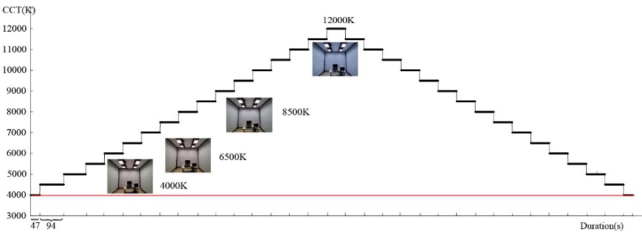
Lighting Conditions The lighting environment of the experiment was only provided by four LEDCube-I14 (Thouslite Ltd.) installed on the ceiling of the lighting room (L × W × H = 3 × 2 × 2.8m). The lighting stimulus contained static light (denoted as SL) and dynamic light (denoted as DL), with a constant illu- mination at approximately 500lx on the table surface. The correlated color temperature (CCT) of static lighting remained at 4000K, whereas the CCT of dynamic lighting changed between 4000K and 12000K. Both SL and DL were white light with high color rendering index (Ra ≥80). Figure 1 shows the specific parameters settings of SL (red line) and DL (black line).
16 college students (8 male, 8 female; Mean age 23.63 ± 1.088) were recruited for this experiment while lighting-related majors were excluded. All the participants had normal visual acuity or corrected visual acuity and none
Morning Boost on Alertness, Cognitive Performance and Mood with Dynamic Lighting 603
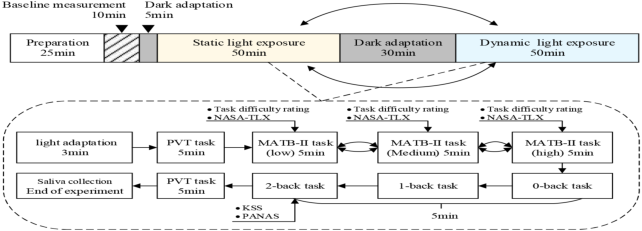
Figure 1: The parameters settings of static lighting (SL) and dynamic lighting (DL).Figure 2: The overview of the experimental procedure.
of them had traveled across time, stimulants/sedatives medication and smo- king/alcohol consumption. Those with extreme chronotypes were excluded in this study.
Figure 2 shows the experimental procedure. At the start of the experi- ment, the participants were required to complete the preparation work, such as registration, task/questionnaire training and EEG wearing. Subsequently, the ratings of KSS, PANAS and saliva were collected at baseline. Then the experimental light exposure started with the order of light exposure coun- terbalanced. Dark adaptation was arranged for 30 minutes between the switching of light conditions to alleviate the fatigue caused by tasks and get the participants back to their baseline levels as well as neutralize the residual effects of the previous lighting condition. The following procedure occurred in each lighting condition which started with a 3-min light adapta- tion, followed by performing PVT, N-back, MATB-II tasks and filling out the questionnaires, with a total duration of 50 min.
In this experiment, the psychological response, task performance and physiological marker were measured to investigate the alertness, cognitive performance and mood under dynamic light vs. static light. Participants were asked to complete the Karolinska sleepiness scale (KSS) (Åkerstedt and Gill- berg, 1990) and Positive Affect and Negative Affect Scale (PANAS) (Watson et al. 1988) during the baseline measurement as well as after experimen- tal light exposure to evaluate their subjective alertness and mood. Three types of tasks were applied in the experiment. A 5-min Psychomotor Vigi- lance test (PVT) (Dinges and Powell, 1985) was used to measure alertness,
Table 1. Mean and (standard deviation) of KSS and PANAS scores under different light conditions.
which assesses the individual’s perceptual sensitivity by measuring response time to sensory stimuli. A 5-min n-back task containing 0-back, 1-back and 2-back was used to test the memory update function. The Multi-attribute Task Battery II (MATB-II) divided into three difficulty levels was used to test executive control function with the duration of each level being 5min. The EEG was recorded from the 64 conductive electrode cap (NeuroScan Inc., Herndon, USA) using the international 10/20 system with electrode impeda- nces kept under 5 K. Melatonin in the saliva were detected with the human MT ELISA kit from JiangLai Bio (No.JL12764, Shanghai, China) was used to measure melatonin concentrations under each lighting condition. There was no further statistical analysis due to the damage of some saliva samples, as the remaining samples wouldn’t meet the statistical power.
RESULTS
Questionnaires Subjective data collected by KSS and PANAS scales was used one-way repeated-measures ANOVA.
Table 1 shows the Mean ± SD (standard deviation) of KSS and PANAS scales in different measurement stages. The difference of subjective alertness was statistically significant (F (2, 30) = 11.48, p < 0.001, η 2= 0.43). The KSS scores under SL were significantly higher than those under BL (p = 0.003) and DL (p = 0.006), but no significant difference between the KSS score under dynamic illumination and baseline (p = 1.000). The difference of subjective mood was statistically significant (F (2, 30) = 9.19, p = 0.001, η2=0.38). The positive mood under SL was significantly lower than that BL (p = 0.001), and the difference between DL and BL was marginal (p = 0.055), but no significant difference between static and dynamic lighting (p = 0.981). There was no significant difference in negative mood.
Task Performance Behavioral data contained the task performance of PVT, N-back, MATB- II. 11 valid samples for PVT and n-back, meanwhile, 15 valid samples for MATB-II task were finally obtained due to equipment failure. Table 2 shows the Mean ± SD (standard deviation) of task performance.
PVT was measured at the beginning and end of the experiment in dif- ferent lighting conditions. Before light exposure, there was no significant
Morning Boost on Alertness, Cognitive Performance and Mood with Dynamic Lighting 605
Table 2. Mean and (standard deviation) of task performance under different manipulations.
Table available in the original PDF paper.
PVT-RT (ms) N-back-RT (ms) MATB-II Before After 0-back 1-back 2-back Low Media High
Static lighting
453.37 (139.02)
467.90 (132.02)
503.58 (113.81)
639.08 (170.12)
719.99 (259.52)
2.36 (0.70)
2.38 (0.63)
2.25 (0.43) Dynamic lighting
476.56 (210.73)
422.21 (81.85)
518.16 (200.76)
553.14 (165.16)
666.43 (286.82)
1.44 (0.62)
2.92 (0.70)
2.30 (0.49)
difference in RT between SL and DL. However, the difference between SL and DL was statistically significant after light exposure (F (1,10) = 7.57, p = 0.02, η2 = 0.43). The RT under DL was significantly lower than that SL (p = 0.020).
The interaction effect of lighting condition * task difficulty was significant (F (2,28) = 21.24, p < 0.001, η2 = 0.60) in MATB-II. The low-difficulty task comprehensive scores were significantly higher under SL vs. DL indicating the performance under DL was significantly better than SL (p < 0.001). The medium-difficulty task comprehensive scores were significantly lower under SL vs. DL indicating the performance under SL was significantly better than DL (p = 0.011). There was no significant difference between SL and DL in the high-difficulty task comprehensive scores.
There was a significant effect of lighting condition * task difficulty (F (2,20) = 8.02, p = 0.003, η2 = 0.45) for n-back reaction time (RT). A signi- ficant effect of lighting condition on RT was found only in 1-back task (F (1,10) = 9.04, p = 0.013, η2 = 0.48). Multiple comparisons showed that the RT under SL was significantly slower than DL (p = 0.013). No significant main effects or interaction effect were found in accuracy.
ERP The EEG data were analyzed using the EEGLAB toolbox in MATLAB (2019b) of which 4 samples interfered by other signals in the experiment leading to the difficulty of eliminating the recorded EEG artifacts. Therefore, they were removed in the averaged ERPs. A three-way repeated-measures ANOVA of 3 (difficulty levels: 0-back, 1-back, 2-back) × 2 (lighting condi- tions: static, dynamic) × 4 (electrodes: PO5, PO6, PO7, PO8) was used to analyze the difference in P300 amplitude and latency.
The interaction effect of lighting condition and electrode site was signi- ficant for P300 peak amplitudes (F (3, 30) = 2.97, p =0.048, η2 = 0.23). There was neither a significant main effect of lighting conditions nor the interaction effect of lighting condition * task difficulty. The main effect of task difficulty was significant for P3 mean amplitudes (F (2, 20) = 4.67, p = 0.022, η2 = 0.32). The interaction effect of lighting condition and electrode site was significant for P3 mean amplitudes (F (3, 30) = 6.75, p = 0.001, η2 = 0.40). There were no significant main or interaction effects for P300 latency. Figure 3 shows the P300 waveform at PO7 and scalp map at mean latency.
-10 -10
-10 1-back 0-back 2-back -5
-5
-5 -200 0 200400600
-200 0 200 400 600
-200 0 200 400 600
0
0
0
5
5
5
DL SL
DL SL
DL SL
Dynamic lighting (DL)
380ms 400ms 398ms Static lighting (SL)
394ms 412ms 400ms
Figure 3: The P300 waveform at PO7 and scalp map at mean latency.
Figure available in the original PDF paper.
DISCUSSION AND CONCLUSION Alertness, cognitive performance and mood are discussed as follows:
Alertness: KSS and PVT were used to characterize. The KSS scores were lowest at baseline measurement which means the best subjective alertness and increased in varying degrees at the end of the experiment. The reason for this result was that prolonged cognitive tasks can induce fatigue and impair alertness (Sengupta et al. 2016). It is worth noting that subjective aler- tness was more effectively maintained in dynamic lighting than static lighting which indicates that dynamic lighting may alleviate the impairment of aler- tness caused by long-term cognitive tasks to a certain extent. And that’s why subjective alertness scores can remain as high as baseline levels after a 50-min experiment.
The PVT RT increased after static light exposure indicating that the sustai- ned attention and reaction speed decreased at the end of the experiment. However, these indicators were effectively improved after dynamic light exposure. It is important to note that DL didn’t play the intervention advan- tage at the beginning of the experiment suggesting that the effects of DL on sustained attention and reaction speed in healthy people depended on the duration of exposure. The current results found in PVT RT are consistent with the static lighting study of Smolders et al. (Smolders et al. 2019) which found PVT was performed better at the end of the intense light exposure.
Cognitive performance: MATB-II, N-back and P300 were used to characte- rize. The results of MATB-II showed that task difficulty affected individuals’ lighting perception being that significant improvement of DL was found in low-difficulty MATB-II as well as the significantly opposite effect was found in medium-difficulty MATB-II. The intervention advantage of dynamic lighting was not found in high-difficulty MATB-II, which was caused by the
Morning Boost on Alertness, Cognitive Performance and Mood with Dynamic Lighting 607
fact that task perception had covered up the lighting perception with the increase of task difficulty. Participants could pay more attention to the perce- ption of the surrounding environment when they performed simple tasks. The results of n-back showed that the effect of DL on working memory was influ- enced by task difficulty. The positive effect of DL on working memory was found in both 1-back and 2-back, but no significant difference was found in 0-back between SL and DL. The reason for this result may be that there was a “floor effect”. To sum up, dynamic lighting has a significant intervention advantage on executive control and working memory, but this intervention advantage may be affected by task difficulty.
Mood: PANAS was used to characterize. The positive mood scores were highest in the baseline, but declined significantly at the end of the experiment due to the fatigue and frustration increasing as the experiment progressed. The current results don’t provide sufficient evidence for the recovery effect of dynamic lighting on positive mood in the morning. Additional samples are needed to explore this conclusion in future work.
This study compared the non-visual effects of dynamic lighting on aler- tness, cognitive performance and mood in the morning. The present results proved that dynamic lighting can support the physiological and psychologi- cal indicators of healthy individuals in the peak morning work period. Future study would explore the non-visual effects of dynamic lighting on fatigued individuals in some extreme working environments, such as isolated and con- fined extreme environments (ICE), and further investigate the intervention effect of lighting as an implicit human-computer performance enhancement method on fatigue. Moreover, in the future, the combination of dynamic light and other sensory stimuli (e.g., light-smell combinations) should be considered to explore the intervention effect of multisensory stimulation on fatigue.
ACKNOWLEDGMENT
The authors would like to acknowledge Beijing Municipal Natural Science Foundation (No. L191018) for financial support for this study.
REFERENCES
Åkerstedt, T. and Gillberg, M. (1990), “Subjective and Objective Sleepiness in the Active Individual”, International Journal of Neuroscience, Vol. 52, pp. 29–37. Aries, M.B.C., Beute, F. and Fischl, G. (2020), “Assessment Protocol and Effects of
Two Dynamic Light Patterns on Human Well-being and Performance in a Simula- ted and Operational Office Environment”, Journal of Environmental Psychology, Vol. 69, p. 101409. Chellappa, S.L., Gordijn, M.C.M. and Cajochen, C. (2011), “Can Light Make Us Bright? Effects of Light on Cognition and Sleep”, Progress in Brain Research, Vol. 190, pp. 119–133. Chew, I., Karunatilaka, D., Tan, C.P. and Kalavally, V. (2017), “Smart Lighting: The
Way Forward? Reviewing the Past to Shape the Future”, Energy and Buildings, Vol. 149, pp. 180–191.
De Kort, Y. and Smolders, K. (2010), “Effects of Dynamic Lighting on Office Workers: First Results of a Field Study with Monthly Alternating Settings”, Lighting Research & Technology, Vol. 42 No. 3, pp. 345–360. Dinges, D.F. and Powell, J.W. (1985), “Microcomputer Analyses of Performance
on a Portable, Simple Visual RT Task during Sustained Operations”, Behavior Research Methods, Instruments, & Computers, Vol. 17 No. 6, pp. 652–655. Izsó, L. and Majoros, A. (2001), “Dynamic Lighting as a Tool for Finding Better Compromise between Human Performance and Strain”, Applied Psychology in Hungary, Vol. 3, pp. 83–95. Kandasamy, N.K., Karunagaran, G., Spanos, C., Tseng, K.J. and Soong, B.H. (2018),
“Smart Lighting System using ANN-IMC for Personalized Lighting Control and Daylight Harvesting”, Building and Environment, Vol. 139, pp. 170–180. Nie, J., Zhou, T., Chen, Z., Dang, W., Jiao, F., Zhan, J., Chen, Y., et al. (2021), “The Effects of Dynamic Daylight-like Light on the Rhythm, Cognition, and Mood of Irregular Shift Workers in Closed Environment”, Scientific Reports, Vol. 11 No. 1, p. 13059. Sengupta, A., Tiwari, A., Chaudhuri, A. and Routray, A. (2016), “Analysis of
Loss of Alertness due to Cognitive Fatigue using Motif Synchronization of EEG Records”, presented at the 2016 38th Annual International Conference of the IEEE Engineering in Medicine and Biology Society (EMBC), IEEE, Orlando, FL, USA, pp. 1652–1655. Sithravel, R., Ibrahim, R., Lye, M.S., Perimal, E.K., Ibrahim, N. and Dahlan, N.D.
(2018), “Morning Boost on Individuals’ Psychophysiological Wellbeing Indica- tors with Supportive, Dynamic Lighting in Windowless Open-plan Workplace in Malaysia”, PLOS ONE, Vol. 13 No. 11, p. e0207488. Smolders K. C. H. J., de Kort Y. A. W., van den Berg, S.M.J. (2013). “Daytime Light Exposure and Feelings of Vitality: Results of a Field Study during Regular Workdays”. Journal of environmental psychology, Vol. 36, 270–279 Stefani, O., Pross, A., Schöllhorn, I., Ilg, L. and Plischke, H. (2017), “The Impact
of Dynamic Lighting on Cognitive Processes”, In: European Lighting Conference. pp. 177–181. Lighting Engineering Society of Slovenia Press, Ljubljana. Watson, D., Anna, L. and Tellegen, A. (1988). “Development and Validation of Brief Measures of Positive and Negative Affect: The PANAS Scales”, Journal of Personality and Social Psychology, Vol. 54, pp. 1063–1070.
LISTED IN THE AHFE DIGITAL BOOKSTORE CATALOGUE
Explore the complete digital volume
Ergonomics In Design
Read this individual research paper free through the original publisher, or explore the full digital proceedings book.
ISBN 978-1-958651-23-0
Explore this ISBN in the AHFE Bookstore ↗Listed in the July 2026 bookstore catalogue; search by ISBN to confirm current availability · Digital book purchase optional