Xinliang Chen, Xin Xie (2026). User-Centered Transmedia Storytelling Design for Urban Landmarks: A Case Study of Shenzhen’s Bay Glory Ferris Wheel. In: Human Factors in Design, Engineering, and Computing. AHFE Open Access, vol. 238, pp. 556–567. https://doi.org/10.54941/ahfe1008288
Against the backdrop of media convergence and urban digital transformation, urban landmarks are increasingly evolving from physical attractions into cultural and experiential spaces integrating narrative experiences and public participation. However, existing practices often emphasize visual symbols or isolated media content, with limited attention to narrative continuity across media touchpoints. Grounded in transmedia storytelling theory, this study examines urban landmark design through three dimensions: storyworld, media touchpoints, and audience participation. A user-centered exploratory mixed-methods approach was adopted, combining field observation, semi-structured interviews, a user survey, and a participatory co-design workshop to investigate user experiences, narrative and interaction preferences, and media touchpoints. The findings were synthesized into design requirements and strategies for subsequent design development. The results reveal key concerns related to interaction gaps, digital engagement, urban narrative identification, emotional retention, and experiential value. The co-design process further translated these findings into experience directions and media touchpoints across different stages of the visitor journey. Based on these findings, the study proposes a user-centered pathway from user exploration and participatory co-design to design translation. It argues that urban landmark transmedia storytelling should move beyond repetitive multi-platform communication and instead construct coherent experiences through a shared storyworld and complementary media touchpoints, providing practical insights for more interactive and emotionally engaging urban landmark experiences.
Lynch (1960) regarded landmarks as important elements in shaping people’s image of the city. As digital media increasingly converge with urban cultural tourism experiences, urban landmarks are no longer merely physical facilities for spatial orientation and sightseeing, but are also becoming important carriers of city image communication, cultural expression, and public experience. However, the communication of some urban landmarks still relies heavily on visual symbols, popular elements, and formulaic content, making it difficult to create experiences with distinctive local identity and sustained emotional connection.
User-Centered Transmedia Storytelling Design for Urban Landmarks 557 Against this background, transmedia storytelling provides a new way of organizing content for the expansion of urban landmark experiences. Rather than simply repeating the same information across multiple platforms, it emphasizes the connections and complementarities among different media, enabling users to gradually construct a more complete experience through multiple touchpoints (Scolari, 2009). This approach also offers new possibilities for connecting urban space, cultural content, and user participation.
This study takes the Bay Glory Ferris Wheel in Shenzhen as its case. As a representative modern urban landmark in the Greater Bay Area, its distinctive form and coastal location give it strong visual recognition and communication potential (Su, 2024). However, its current visitor experience remains largely centered on sightseeing, photography, and visual communication, with relatively limited development of cultural narratives and sustained user participation. Recent research on digital cultural tourism has examined diverse digitally mediated forms, including virtual cultural tourism, smartphone-based experiences, historical-site reconstruction, and travel information services (Zheng et al., 2023). Therefore, the Bay Glory Ferris Wheel provides a suitable context for exploring how urban narratives, digital interaction, and user participation can be better integrated with existing landscape and communication resources.
Based on this, the study examines urban landmark experiences through three interrelated dimensions: storyworld, media touchpoints, and audience participation. A user-centered exploratory mixed-methods approach was adopted, combining field observation, semi-structured interviews, a questionnaire survey, and a participatory co-design workshop to progressively identify users’ practical needs, narrative expectations, and media preferences. These findings were then translated into directions for transmedia experience design. The study aims to explore a design pathway for urban landmark transmedia experiences progressing from user exploration and needs integration to participatory co-design and design translation.
RELATED WORK
Transmedia Storytelling From the perspective of digital narrative, Ryan (2001) examined immersion and interactivity, providing an early theoretical basis for understanding user engagement with narrative worlds. Building on the development of media convergence, Jenkins (2008) conceptualized transmedia storytelling as the coordinated distribution of narrative elements across multiple media, with each medium making a distinctive contribution to the overall story. Scolari (2009) further emphasized narrative expansion, highlighting how different media can complement and extend a shared storyworld, while Evans (2011) examined how media content extends across different platforms
558 Chen and Xie and how audiences engage with these transmedia forms. Ryan and Thon (2014) subsequently extended the discussion of storyworlds from a media- conscious narratological perspective, emphasizing how different media shape the representation and experience of narrative worlds. Together, these perspectives highlight the interconnected roles of storyworld construction, media coordination, and audience participation in transmedia storytelling.
As transmedia storytelling research has developed, its application has gradually expanded from fictional domains such as film and games to cultural communication, museums, tourism, and place-based experiences. Dionisio and Nisi (2021) demonstrated how interconnected media can engage tourists with a destination’s cultural and natural heritage. More recent studies have further explored digital storytelling in cultural and heritage contexts. Kasemsarn et al. (2023) reviewed the intersection of cultural tourism, inclusive design, and digital storytelling, proposing an initial framework aimed at enhancing visitor motivation and diversity. Shim et al. (2024) showed that value-based digital storytelling can communicate interconnected sociocultural values beyond the physical attributes of heritage sites and deepen visitors’ heritage interpretation. More recently, Song et al. (2025) examined transmedia storytelling in XR-enhanced museum experiences, highlighting the potential of interactive narratives to shift cultural engagement from passive observation toward more participatory experiences.
Despite these recent developments, further research is still needed on how modern urban landmarks, which simultaneously possess spatial, cultural, and public experiential attributes, can construct continuous and participatory narrative experiences across different media touchpoints. Accordingly, drawing on existing theories, this study adopts storyworld, media touchpoints, and audience participation as three interrelated analytical dimensions to guide the research and design of transmedia experiences for urban landmarks.
METHOD
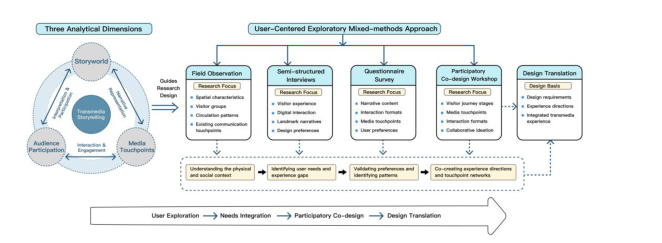
This study adopts a user-centered exploratory mixed-methods approach combining field observation, semi-structured interviews, a questionnaire survey, and a participatory co-design workshop. Field observation was first used to understand the spatial context, visitor activities, and existing communication touchpoints. Semi-structured interviews then explored users’ experiences, needs, and expectations regarding landmark narratives and digital interaction. Building on these qualitative findings, the questionnaire survey further examined user preferences for narrative content, interaction formats, and media touchpoints. Finally, the co-design workshop refined the relationships among visitor journey stages, interaction formats, and media touchpoints, providing a basis for subsequent design translation. Overall, the research follows a progressive pathway of “user exploration → needs integration → participatory co-design → design translation.”
Figure 1: Integrated analytical and methodological framework of the study.
FIELDWORK This study first conducted on-site observation of the Bay Glory Ferris Wheel in Shenzhen. The landmark has a distinctive visual identity and strong symbolic presence as an urban landmark. It is a popular destination for photography and also reflects Shenzhen’s coastal city image.
The field study focused on visitor activities, circulation patterns, photography behavior, the surrounding environment, and existing communication touchpoints. Observations showed that visitor activities were mainly centered on photography, Ferris wheel rides, nighttime sightseeing, and social sharing. Despite its strong visual appeal, the current experience remains relatively limited, with few opportunities for visitors to further engage with or understand the landmark’s associated stories and cultural meanings.
Table 1: Summary of field observations.
Table available in the original PDF paper.
Research Direction On-Site Photos Observation Landmark image and site environment
High visibility and a strong visual focal point in the coastal area.
Visit and Service Process
Smooth ticketing, waiting, and boarding, but mainly guided by functional information.
Taking a ride and enjoying the views
A scenery-centered experience with limited active participation.
Mainly basic information, event notices, and photo-sharing content.
On-site information and communication touchpoints
(Continued)
Table 1: Continued.
Table available in the original PDF paper.
Research Direction On-Site Photos Observation Remembrance and Departure Continuation
Limited post-visit extension; souvenirs and sharing rely largely on spontaneous user behavior.
Visitor groups Mainly couples, families with children, and groups of friends.
SEMI-STRUCTURED INTERVIEWS Based on the preliminary field observations, young people aged 16–35 were identified as the primary target group and recruited on-site at the Bay Glory Ferris Wheel and its surrounding area. Semi-structured interviews followed the overall visitor journey and focused on five aspects: (1) landmark awareness and visit decision-making; (2) visitor behaviors and immediate experiences; (3) post-visit evaluation; (4) needs for narrative content and digital interaction; and (5) supplementary questions tailored to different user contexts.
A total of 12 participants were interviewed for approximately 15–20 minutes each, including seven teenagers, two participants in the couple category, two parents, and one out-of-town visitor. Among them, seven had completed the Ferris wheel ride, while five had mainly experienced the surrounding area.
The interview data were analyzed using thematic analysis (Braun and Clarke, 2006). Through comparison, categorization, and integration of the initial codes, 16 subthemes were identified and further synthesized into five major themes, as shown in Table 2.
Table 2: Thematic analysis of interview data.
Table available in the original PDF paper.
Main Themes Representative Codes Representative Quotes Experience Duration and Interaction Gaps
“After sitting there for about 30 minutes, it does get a little boring.”
Limited experience activities; boredom during the 30-minute ride
“Some people might think it’s a virus and be afraid to participate.”
Acceptance of Digital Interaction and Design Principles
Exploration guidance; lightweight interaction and trust needs
Narrative Identification and Landmark Image Preferences
Shenzhen elements; landmark associations and local identity
“I think it still has some elements that are characteristic of Shenzhen.” Commemorative Consumption and Emotional Retention
Digital souvenirs; physical merchandise and collection
“An AR-generated video just for you… something you can keep as a souvenir.” Value Trade-offs in Consumption Decisions
Price sensitivity; perceived experience value
“If you have to spend several hundred yuan per person just to play the game… it doesn’t seem worth it.”
User-Centered Transmedia Storytelling Design for Urban Landmarks 561 The results indicate that participants recognized the Bay Glory Ferris Wheel for its coastal landscape and landmark value, but viewed the current experience as largely limited to sightseeing, with the approximately 30-minute ride lacking sustained content and interaction. Participants were generally receptive to digital interactions such as AR, exploratory tasks, and story-based guidance, while preferring lightweight and easy-to-use formats closely connected to the Ferris wheel and its surroundings. They also expected narrative content to incorporate local elements such as Shenzhen’s coastal scenery, skyline, and everyday memories, and showed interest in digital souvenirs and shareable content.
These findings highlight design opportunities in integrating urban narratives, lightweight interaction, and experience retention, while also informing the subsequent survey and the development of content, interaction mechanisms, and media touchpoints for the participatory co-design workshop.
USER SURVEY Building on the field observations and interviews, a questionnaire survey was conducted to examine users’ preferences regarding transmedia narratives, media touchpoints, digital interaction formats, and narrative content. The questionnaire was distributed via Wenjuanxing in April 2026, primarily targeting respondents from Guangdong Province and those with prior residential experience in Shenzhen. After excluding invalid responses, 204 valid questionnaires were obtained, with a valid response rate of 82%. Participants were aged 16–35 and represented different levels of experience with the Bay Glory Ferris Wheel.
Table 3: Characteristics of survey respondents.
Table available in the original PDF paper.
Characteristic Category Frequency (n) Percentage (%) Gender Male 86 42.2%
Female 118 57.8% Age 16–24 135 66.2%
25–35 69 33.8%
Yes 168 82.4% No 36 17.6%
Awareness of the Bay Glory Ferris Wheel Visit Experience Completed the Ferris wheel ride 44 21.6%
Visited the surrounding area only 77 37.7% Aware of it but never visited 47 23.0%
First learned via this survey 36 17.6% A representative urban landmark 96 47.1%
105 51.5%
Sightseeing-oriented urban landscape facility
Perceived Positioning of the Bay Glory Ferris Wheel
3 1.5%
A general entertainment or recreational facility
562 Chen and Xie Regarding landmark awareness and visit experience, 82.4% of respondents had previously heard of the Bay Glory Ferris Wheel. Most respondents perceived it as either a representative urban landmark or a sightseeing- oriented urban landscape facility, indicating a relatively clear landmark- oriented identity rather than a general recreational facility. In terms of visit experience, 21.6% had completed the Ferris wheel ride and 37.7% had visited the surrounding area without taking the ride. Overall, the sample included both actual and potential visitors, supporting further analysis of preferences for transmedia narratives and interaction design.
First, a 7-point Likert scale was used to assess respondents’ overall acceptance of transmedia storytelling for urban landmarks.
Table 4: Descriptive statistics of transmedia storytelling acceptance.
Table available in the original PDF paper.
Item Content N Mean (M) SD
204 5.89 1.056
TNP1 I believe that urban landmark stories can be presented across multiple media, such as short videos, on-site interactions, AR, and printed materials.
204 5.68 0.994
TNP2 I would be more willing to learn about the story if the content presented across different media complemented rather than repeated one another.
204 5.88 1.046
TNP3 Compared with a single media channel, I find transmedia storytelling experiences more engaging.
The results indicate an overall positive acceptance of transmedia storytelling, with respondents particularly favoring multi-platform presentation, engaging experiences, and complementary content across different media.
Building on the overall acceptance of transmedia storytelling, the study further used multiple-choice questions to examine respondents’ specific preferences regarding media touchpoints, digital interaction formats, and narrative content.
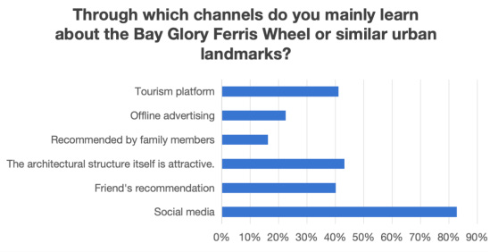
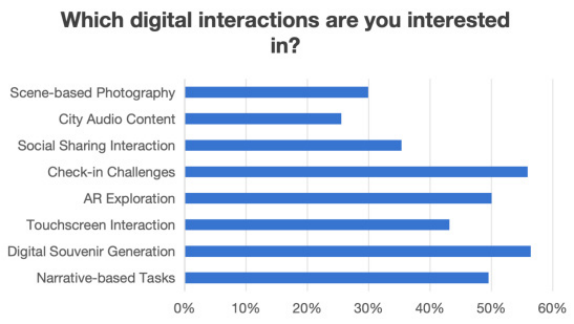
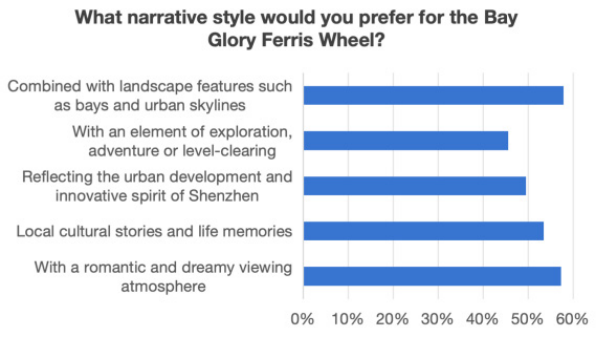
Figure 2: Through which channels do you mainly learn about the Bay Glory Ferris Wheel or similar urban landmarks?Figure 3: Which digital interactions are you interested in?Figure 4: What narrative style would you prefer for the Bay Glory Ferris Wheel?
Overall, respondents showed certain preference patterns regarding media touchpoints, digital interaction formats, and narrative content. Social media was the primary information channel, supplemented by the landmark itself, tourism/map platforms, and recommendations from friends. Preferred interactions included check-in challenges, digital souvenirs, AR exploration, and narrative tasks, while narrative interests mainly involved coastal landscapes, the city skyline, a romantic atmosphere, and local everyday memories.
PARTICIPATORY CO-DESIGN WORKSHOP Building on the interview and questionnaire findings, this study conducted a participatory co-design workshop structured around different stages of the visitor journey. The workshop involved 10 participants and lasted approximately 1.5 hours. Through card selection, discussion, and collaborative design activities, participants further refined media touchpoints, interaction
564 Chen and Xie formats, and the connections between them. The workshop outcomes were used to identify key interaction points and transmedia pathways across different stages of the experience, providing a basis for subsequent design development.
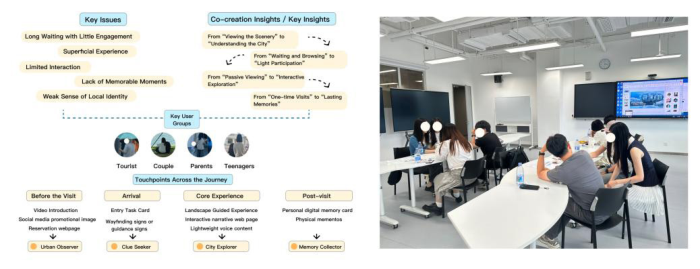
Figure 5: Key insights and outcomes from the participatory co-design workshop.
The workshop transformed fragmented user needs into a staged experience framework, defining key touchpoints and user roles across the visitor journey.
FROM USER INSIGHTS TO TRANSMEDIA STORYTELLING DESIGN Design Implications
Based on the integrated findings from the interviews, questionnaire, and participatory workshop, four key design implications were identified: active participation, urban narrative, connected touchpoints, and lasting memory. These implications emphasize the transformation of the landmark experience from passive viewing to active engagement, from scenery appreciation to urban understanding, from isolated media interactions to a continuous visitor journey, and from a one-time visit to an extended experience with lasting memories.
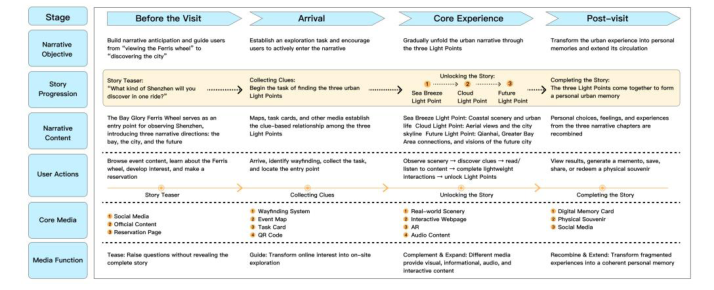
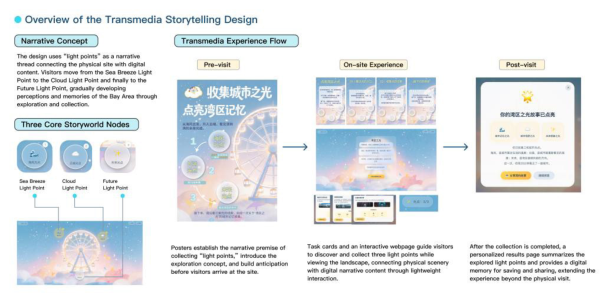
Transmedia Narrative Scheme Based on the preliminary user research and analysis of site characteristics, this study further organized the urban narrative of the Bay Glory Ferris Wheel into three narrative nodes: the Sea Breeze Light Point, Cloud Light Point, and Future Light Point. These correspond respectively to the coastal environment, aerial urban landscapes, and future visions of the Greater Bay Area. Combined with the spatial experience of ascending, reaching the highest point, and overlooking the city from the Ferris wheel, they form a narrative progression from perceiving the urban environment, to understanding urban space, and extending urban imagination. The three Light Points serve as recurring narrative clues across different media touchpoints, guiding users to gradually explore and collect the urban story.
Figure 6: Transmedia narrative scheme across the visitor journey.
Building on the narrative structure described above, this study further translated the three “Light Point” nodes into a transmedia design that users can access and participate in. Rather than repeating identical content across different media, each medium serves a distinct function along the user journey: posters establish initial awareness and narrative expectations; task cards and interactive webpages provide clues, initiate exploration, and support Light Point collection; after the experience, a results page transforms the completed journey into a digital memory that can be saved and shared.
Overall, the design establishes a continuous pathway from narrative introduction and exploration to participation and memory retention. Posters, task cards, and webpages serve complementary roles across different stages, while the three Light Points provide a consistent narrative thread across media, transforming the urban narrative from one-way information delivery into an experience that users can progressively explore, participate in, and retain.
CONCLUSION
This study explores how transmedia storytelling can support more coherent and participatory urban landmark experiences. Rather than simply increasing media channels, transmedia design should coordinate different touchpoints
566 Chen and Xie and forms of participation around a shared storyworld. Based on the research process, the study proposes a user-centered pathway of user exploration → needs integration → participatory co-design → design translation, translating user needs into narrative content, interaction mechanisms, and stage- specific media touchpoints. The findings further highlight the relationship among storyworld, media touchpoints, and audience participation. Urban landmarks can serve as narrative carriers connecting urban content, spatial experience, and personal memory, while complementary media roles can support continuity across the visitor journey.
This study is limited by its focus on a single landmark and the conceptual nature of the proposed design. Future research should conduct in situ prototype testing and examine its applicability across different urban and cultural contexts.
ACKNOWLEDGMENT
This research was supported by the Stable Support Program for Higher Education Institutions (General Program), Shenzhen Science and Technology Innovation Commission (GXWD20220817131619001).
REFERENCES
Braun, V. and Clarke, V. (2006). “Using thematic analysis in psychology”, Qualitative Research in Psychology, 3(2), pp. 77–101. https://doi.org/10.1191/1478088706qp063oa. Dionisio, M. and Nisi, V. (2021). “Leveraging transmedia storytelling to engage
tourists in the understanding of the destination’s local heritage”, Multimedia Tools and Applications, 80(26–27), pp. 34813–34841. https://doi.org/10.1007/ s11042-021-10949-2. Evans, E. (2011). Transmedia Television: Audiences, New Media, and Daily Life.
New York: Routledge. Jenkins, H. (2008). Convergence Culture: Where Old and New Media Collide.
Updated and with a new afterword. New York: New York University Press. Kasemsarn, K., Harrison, D. and Nickpour, F. (2023). “Applying inclusive design and digital storytelling to facilitate cultural tourism: A review and initial framework”, Heritage, 6(2), pp. 1411–1428. https://doi.org/10.3390/heritage6020077. Lynch, K. (1960). The Image of the City. Cambridge, MA: MIT Press. Ryan, M.-L. (2001). Narrative as Virtual Reality: Immersion and Interactivity in
Literature and Electronic Media. Baltimore, MD: Johns Hopkins University Press. Ryan, M.-L. and Thon, J.-N. (eds.) (2014). Storyworlds across Media: Toward a Media-Conscious Narratology. Lincoln: University of Nebraska Press. Scolari, C.A. (2009). “Transmedia storytelling: Implicit consumers, narrative worlds,
and branding in contemporary media production”, International Journal of Communication, 3, pp. 586–606. Shim, H., Oh, K.T., O’Malley, C., Jun, J.Y. and Shi, C.K. (2024). “Heritage values, digital storytelling, and heritage communication: The exploration of cultural heritage sites in virtual environments”, Digital Creativity, 35(2), pp. 171–197. https://doi.org/10.1080/14626268.2024.2313585. Song, Z., Whyke, T.W., Sun, X. and Evans, L. (2025). “A phenomenology study of
transmedia museum storytelling and gamification through XR technologies”, Digital Applications in Archaeology and Cultural Heritage, 38, e00444. https:// doi.org/10.1016/j.daach.2025.e00444.
User-Centered Transmedia Storytelling Design for Urban Landmarks 567 Su, F. (2024). “Juma Group: A creator of world urban landmarks”, Xiaokang, (3),
pp. 14–16. Zheng, D., Huang, C. and Oraltay, B. (2023). “Digital cultural tourism: Progress and a proposed framework for future research”, Asia Pacific Journal of Tourism Research, 28(3), pp. 234–253. https://doi.org/10.1080/10941665.2023.2217958.
SEARCH THE AHFE DIGITAL BOOKSTORE BY ISBN
Explore the complete digital volume
Human Factors in Design, Engineering, and Computing
Read this individual research paper free through the original publisher, or explore the full digital proceedings book.