Yihan Dong, Xin Xie (2026). AHP-Based Cultural Gene Extraction and AIGC-Assisted Immersive Museum Experience Design for Chenghai Lantern Riddles. In: Human Factors in Design, Engineering, and Computing. AHFE Open Access, vol. 238, pp. 931–941. https://doi.org/10.54941/ahfe1008324
With the growing use of AIGC in cultural creative design, issues such as weakened regional context, cultural misinterpretation, and superficial symbol reproduction have become increasingly evident in traditional cultural content generation. Chenghai lantern riddles, as a local intangible cultural heritage, embody distinctive dialect features, ritual rules, and spiritual meanings, requiring a more systematic culture-constrained approach for digital translation. This study takes Chenghai lantern riddle culture as its object, applies cultural gene extraction and the AHP to identify core cultural factors, and translates them into AIGC generation constraints and immersive experience design elements. Accordingly, it proposes an innovative framework of “cultural gene extraction—AIGC translation—immersive experience design.” In practice, the study develops museum-oriented immersive narrative content and integrates riddle learning, creation, sharing, and solving into an interactive process, enabling a transition from cultural cognition to behavioral participation. User evaluation results show strong performance in decorative symbol presentation, riddle ritual expression, narrative communication, and emotional identification, suggesting the potential of cultural-gene-guided AIGC generation. This study provides a quantifiable and traceable design method for the digital design of intangible cultural heritage and offers practical reference for cultural communication and living heritage transmission in museum-based immersive exhibitions.
Chenghai lantern riddles are a distinctive intangible cultural heritage that use local dialect homophones, folk sayings, and regional allusions, covering daily life, customs, and history. Although they carry rich humanistic and cultural value, their digital inheritance faces challenges. Digital design must accurately present complex cultural elements and internal logic, while also considering audiences’ different cultural knowledge and cognitive abilities. Therefore, the digital translation of Chenghai lantern riddles should go beyond surface reproduction and further reveal their cultural core.
932 Dong and Xie AIGC has been widely used in cultural creative design, however, it may generate traditional cultural content with interpretive bias, weakening regional features and cultural meanings. Thus, using AIGC to support the creative transformation, systematic protection, and living transmission of intangible cultural heritage has become an important issue (Li et al., 2025).
To address this, this study proposes an AIGC-assisted immersive design framework based on cultural gene extraction and the Analytic Hierarchy Process (AHP). By clarifying the hierarchy and weights of cultural genes, the framework guides AIGC to generate content aligned with the cultural core and applies it to museum immersive experience design. It provides an operable method for cultural digital design and a methodological reference for digital heritage design.
The main contributions are:
1. Constructing a cultural-gene-guided AIGC-assisted framework for
immersive experience design; 2. Evaluating the potential of high-weight cultural factors to guide AIGC generation through quantitative user feedback; 3. Proposing a reusable generation strategy for the digital design and
immersive presentation of intangible cultural heritage.
RELATED WORK
Application of AHP in Culture and Design The AHP is a multi-criteria decision-making method that derives weights through hierarchical modeling and pairwise comparison, providing quantitative support for complex design decisions. In cultural and museum design, it has been applied to visitor experience evaluation, exhibition layout optimization, and digital technology selection (Ruan et al., 2024). However, existing studies mainly use AHP for evaluation, with limited exploration of how AHP-derived cultural elements can guide AIGC-based cultural content generation.
Application of AIGC in Cultural Heritage Content Generation AIGC can generate multimodal content such as text, images, and audio, offering new approaches for cultural creative design, including heritage reconstruction, immersive scene generation, and participatory cultural symbols. Prior studies show that AIGC can enhance participation and cultural identity in rural cultural revitalization and cultural symbol generation (Zhang et al., 2025). Nevertheless, AIGC may produce interpretive bias when generating traditional cultural content, weakening regional characteristics and cultural meanings, especially in minority cultural memory and local language contexts. Current research focuses mainly on technical implementation or experience enhancement, lacking systematic methods to constrain AIGC generation with structured cultural elements.
Museum Immersive Experience Design Immersive technologies enhance attention, cultural understanding, and emotional engagement in museums (Hao et al., 2026). Key factors include
AHP-Based Cultural Gene Extraction and AIGC-Assisted Immersive Museum Experience 933 narrative, participation, sensory atmosphere, and cultural coherence. However, existing studies focus on technology or experience assessment, lacking systematic frameworks to translate core cultural elements into immersive scenes and interaction. AHP aids layout optimization and visitor evaluation, yet integration with AIGC is limited. AIGC holds promise for cultural content generation, but biases and contextual distortions persist. This study combines AHP-based cultural gene extraction with AIGC to create a museum-oriented immersive design framework, reducing generation bias and offering a replicable method for digital heritage design.
METHODOLOGY
Theoretical Framework In cultural hierarchy studies, various theoretical models have been proposed. Among them, the three-level theory of culture is widely applied due to its broad adaptability and analytical depth (Gao et al., 2026). Malinowski divided culture into three levels: spiritual culture, living culture, and material culture. This theory has been widely used in design research to guide practice, support methodological innovation, and enrich the contemporary expression of traditional culture.
The Analytic Hierarchy Process (AHP), proposed by Thomas L. Saaty in the 1970s, is a multi-objective decision-making method that decomposes complex problems into hierarchical goals, criteria, and alternatives. In cultural heritage and cultural creative product design, AHP is often combined with cultural gene theory to build multi-level evaluation models, quantify cultural elements, and support design decisions (Chen et al., 2025).
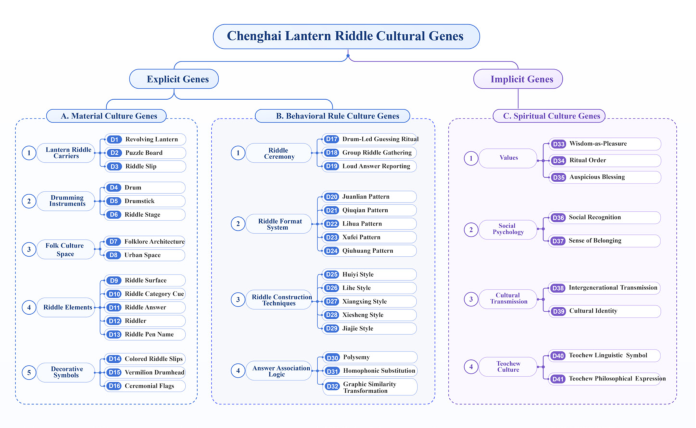
Construction of Chenghai Lantern Riddle Cultural Genes Based on cultural hierarchy theory, this study classifies Chenghai lantern riddle cultural genes into three levels: material culture genes, behavioral rule culture genes, and spiritual culture genes. Through literature review, field investigation, and interviews, factors at each level were extracted to construct a cultural gene map. An AHP-based model is then used to calculate factor weights and map high-weight cultural genes into design elements, forming a process from cultural gene identification to design translation.
Material and behavioral rule culture genes are regarded as explicit genes, while spiritual culture genes are implicit genes carrying cognitive logic and values (Lin, 2007). Material culture genes include lanterns, riddle slips, folk cultural space, and drum-guided guessing tools. Behavioral rule culture genes include ritual procedures, interaction forms, and riddle pattern systems, reflecting the logic of Chinese character form, sound, and meaning. Spiritual culture genes include wisdom-as-pleasure, collective belonging, intergenerational identity, and festival-related cultural values. Based on these factors, this study constructs a hierarchical genealogy of Chenghai lantern riddle cultural genes, as shown in Figure 1, providing the basis for subsequent evaluation.
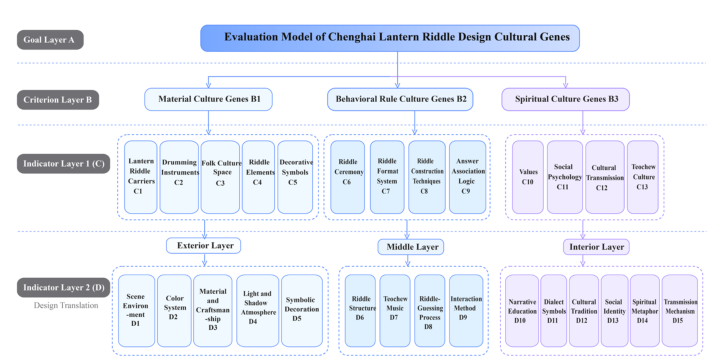
Figure 1: The cultural gene spectrum of Chenghai lantern riddles.Figure 2: The hierarchical evaluation model of cultural genes in Chenghai lantern riddles.
Evaluation and Selection of Chenghai Lantern Riddle Cultural Genes Based on the genealogy of Chenghai lantern riddle cultural genes, this study establishes an AHP-based model tree with four levels: goal layer, criterion layer, cultural indicator layer, and design factor indicator layer. These levels are coded as A, B, C, and D, respectively. As shown in Figure 2.
Factor importance was then evaluated. The criterion layer was defined as B = {B1, B2, B3}, the cultural indicator layer as C = {C1, C2, …, C13}, and the design factor indicator layer as D = {D1, D2, …, D15}. Judgment matrices
AHP-Based Cultural Gene Extraction and AIGC-Assisted Immersive Museum Experience 935 were constructed for each layer, and a questionnaire was developed using the 9-point scale method. A total of 15 participants, including 7 design students, 3 design teachers, 2 immersive experience enthusiasts, and 3 Teochew participants, rated the importance of Chenghai lantern riddle cultural genes to improve the diversity and representativeness of evaluation perspectives.
Based on the questionnaire scores, judgment matrices and weight tables were constructed for different levels. The weights were calculated using SPSSAU, and the results for the three levels are shown in Table 1. To ensure data accuracy, a consistency test was further conducted. The CR values of all factor layers were below 0.1, indicating that all matrices passed the consistency test and the data were reliable.
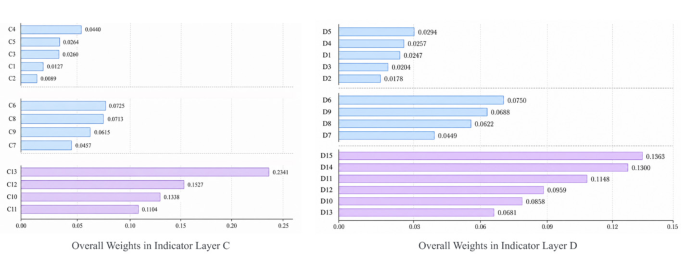
According to the evaluation results, spiritual culture genes have the highest weight in Criterion Layer B (0.631), followed by behavioral rule culture genes (0.251) and material culture genes (0.118). This indicates that the values, thinking patterns, and aesthetic meanings embedded in Chenghai lantern riddles form their cultural core, while material carriers and behavioral rules play supporting roles. It also suggests that, as both an intellectual game and a folk ritual, spiritual transmission may play a more prominent role in cultural vitality than material preservation. The overall weights of Indicator Layer C and Layer D were further ranked, as shown in Figure 3.
Table 1: The calculation results of cultural factor weights.
Based on the overall weight analysis, this study selected the core design factors: material culture genes include C4, C5, and C3; behavioral rule culture genes include C6 and C8; spiritual culture genes include C13, C12, and C10. In design practice, the material layer emphasizes lighting atmosphere, decorative symbols, and scene environmentto create a regional and
936 Dong and Xie immersive scene. The behavioral rule layer enhances participation and guidance by simulating riddle structure, guessing process, and interaction methods. The spiritual layer conveys cultural context and emotional resonance through Teochew language, cultural transmission, and spiritual metaphors, enabling users to perceive the spiritual core of Chenghai lantern riddles during the experience.
Figure 3: Comparison of overall weights in indicator Layer C and Layer D.
Based on the weight analysis, this study identifies the core factors for Chenghai lantern riddle immersive design across material, behavioral, and spiritual layers. Material culture factors include C4 Riddle Elements, C5 Decorative Symbols, and C3 Folk Cultural Space, providing direct visual and spatial elements for the exterior layer. Behavioral rule culture factors include C6 Riddle Ceremony and C8 Riddle Construction Techniques, forming the core of the middle layer. By simulating the guessing process and interaction methods, the design strengthens user participation, guidance, community interaction, and ritual atmosphere. Spiritual culture factors include C13 Teochew Culture, C12 Cultural Transmission, and C10 Values, forming the core of the interior layer. Teochew culture is expressed through dialect narration and visual puns to enhance cultural authenticity; cultural transmission reflects intergenerational interaction and knowledge continuity; values and spiritual metaphors are conveyed through immersive narrative and atmosphere design to strengthen emotional resonance and cultural identity.
This study follows the chain of “high-weight cultural factor selection → AIGC factor translation → immersive experience design” to systematically map material, behavioral, and spiritual elements into museum-based immersive scenes. High-weight factors are used to constrain content generation and scene design, ensuring cultural authenticity and logical coherence. By integrating interaction, visual expression, and narrative, this framework forms a closed-loop method from factor identification to immersive presentation, supporting cultural communication and emotional
AHP-Based Cultural Gene Extraction and AIGC-Assisted Immersive Museum Experience 937 transmission. It also provides a systematic and replicable practice for the living presentation of traditional culture in museum contexts.
Design Factor Coding To ensure that AIGC-generated content accurately represents the cultural core of Chenghai lantern riddles, this study systematically translates the extracted high-weight cultural factors into design factors. Through Factor- Coded Constraints and Hierarchical Weight Control, each factor is assigned a unique code and weight label, which are embedded into AIGC prompts to guide the model to prioritize core cultural elements and reduce generation bias. These codes are used not only for AIGC-assisted scene and visual generation, but also as references for subsequent interaction design, ensuring consistency among visual expression, interaction, and cultural meaning. The prompt design follows three principles: (1) generated scenes or interactions should include high-weight material, behavioral, and spiritual cultural factors; (2) different factor layers should be controlled by weight priority to maintain cultural logic; and (3) multimodal references should be integrated to improve accuracy and cultural authenticity.
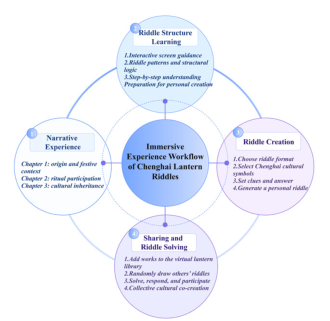
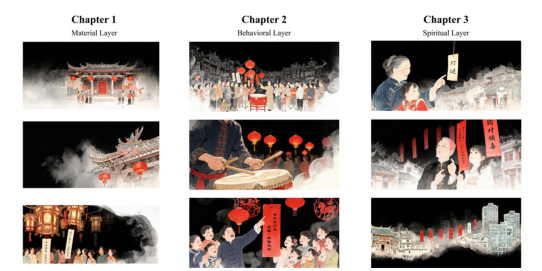
Design Translation and Design Scheme Based on the design factor coding, this study develops an immersive experience scheme in which high-weight material, behavioral rule, and spiritual factors are mapped into three narrative chapters: Chenghai folk context and festive atmosphere, traditional riddle rituals and collective participation, and intergenerational transmission with emotional resonance. Together, they form a coherent audio-visual narrative and cultural experience loop.
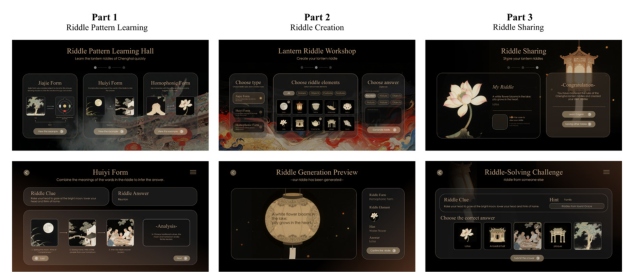
After the narrative experience, visitors use an interactive device to learn riddle structures, create personal lantern riddles by selecting riddle types, symbols, and answers, and add them to a shared riddle library as virtual lanterns. Visitors can also solve riddles created by others, forming a “learning–creation–sharing–solving” loop that transforms cultural cognition into behavioral participation. (Figure 4).
Figure 4: Design experience process.
938 Dong and Xie Based on the extracted design factors, this study uses the Seedream 5.0 Lite model as an image-generation tool for the visual translation of Chenghai lantern riddle design. Prompts are constructed according to factor priority and hierarchical logic to ensure the proper representation of material, behavioral rule, and spiritual cultural factors in the generated images. This process produces three core visuals for the narrative chapters, corresponding to a progressive cultural experience: festive atmosphere, traditional riddle rituals and community participation, and the continuation of cultural inheritance. These visuals progress in color, rhythm, and emotion, providing practical visual materials for the subsequent immersive experience design, as shown in Figure 5.
Figure 5: AIGC-generated narrative visuals.
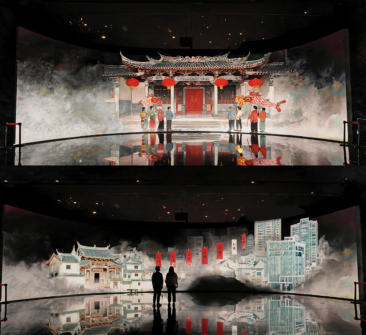
The final design is presented in a museum immersive projection hall (Figure 6), where multi-channel projection creates a three-sided immersive visual space. Visitors enter the hall with Teochew traditional music, festive soundscapes, drum rhythms, and simulated drum-guided guessing audio. Without active operation, they complete a cultural journey from perceiving origins to experiencing rituals and emotional resonance through audio-visual immersion. In particular, the second chapter recreates the distinctive “drum-guided guessing” ritual, transforming high-weight behavioral factors into perceivable sensory stimuli and enhancing cultural authenticity and participation.
Figure 6: Immersive experience exhibition hall of Chenghai lantern riddles.
AHP-Based Cultural Gene Extraction and AIGC-Assisted Immersive Museum Experience 939 After the narrative experience, visitors engage in immersive learning through an in-gallery interactive device. As shown in Figure 7, the interaction consists of three stages: riddle learning, riddle creation, and riddle sharing. To reduce cognitive load, the interface combines images and text to improve clarity and ease of operation. In the learning stage, three simple and common riddle forms are selected to provide a structured learning path. In the creation stage, visitors choose a riddle form and visual materials to generate personal lantern riddles. In the sharing stage, their riddles are added to a public riddle library, and visitors can solve riddles created by others. This forms a closed loop of cultural knowledge learning, creation, sharing, and communication, strengthening users’ understanding and identification with Chenghai lantern riddle culture.
Figure 7: Interactive core interface.
RESULTS AND EVALUATION To evaluate user acceptance and perceived effectiveness of the AIGC-assisted design guided by high-weight cultural factors, this study conducted a user evaluation following the proposed interaction process. After the experience, 26 participants completed a structured questionnaire using a 1–5 Likert scale. The questionnaire covered four dimensions: material culture layer, behavioral rule layer, spiritual culture layer, and user satisfaction, focusing on cultural understanding, user cognition, and cultural expression. The data were analyzed using SPSS. Reliability and validity tests showed that all Cronbach’s Alpha values were above 0.7, and the overall KMO value was 0.830, indicating acceptable internal consistency and sampling adequacy (Table 2).
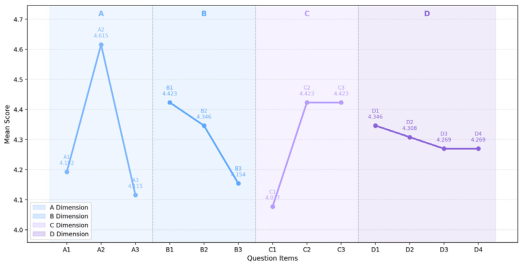
Descriptive statistics and mean scores were calculated, as shown in Figure 8. All items scored above 4.0, indicating positive user evaluations and good acceptance in cultural presentation, interaction experience, and satisfaction. A2 Decorative Cultural Expression received the highest score, suggesting that lanterns, flags, and Teochew patterns effectively enhanced festive atmosphere and cultural recognition. B1 Riddle Ritual Expression, C2 Narrative Communication, and C3 Emotional Communication also scored highly, showing that users understood the riddle activity process and developed emotional resonance and cultural identity.
940 Dong and Xie In contrast, C1 Spiritual Meaning Communication scored relatively lower (4.077), indicating that spiritual metaphors and deeper cultural values were less directly perceived. A3 Material Cultural Expression (4.115) and B3 Cultural Logic Expression (4.154) also reveal room for improvement. Future design should strengthen material and architectural details and use clearer animations, audio guidance, and visual reasoning to improve users’ understanding of cultural logic and spiritual meaning.
Table 2: Results of reliability and validity tests.
Table available in the original PDF paper.
Dimension Cronbach’s Alpha Overall KMO Material Layer A 0.904 0.830
Behavioral Rule Layer B 0.878 Spiritual Layer C 0.892
Satisfaction D 0.869 Total 0.913
Figure 8: Average score of each item.
CONCLUSION
This study proposes a museum immersive experience design framework for Chenghai lantern riddles based on AHP-based cultural gene extraction and AIGC-assisted generation. Using the three-level theory of culture, Chenghai lantern riddle cultural genes were classified, weighted through AHP, and screened to identify core cultural factors. These factors were then translated into AIGC generation constraints and immersive design elements, forming a design path of “cultural gene extraction–factor translation–AIGC generation–immersive experience.”
The design practice developed a complete experience process, including narrative viewing, riddle learning, riddle creation, and shared riddle solving. User evaluation showed strong performance in decorative symbol presentation, riddle ritual expression, narrative communication, and emotional identity, indicating that high-weight cultural factors potentially support culturally coherent AIGC content and positively influence user understanding and satisfaction.
AHP-Based Cultural Gene Extraction and AIGC-Assisted Immersive Museum Experience 941 By integrating cultural genes, AHP-based quantitative evaluation, and AIGC generation, this study provides a traceable framework for the digital design of intangible cultural heritage and an operable path for museum immersive exhibitions. Future research may expand the sample size, conduct stricter controlled experiments, and explore the framework in VR, AR, and real-time interactive cultural heritage contexts. In particular, comparing cultural-gene-guided AIGC design with directly generated AIGC content would provide stronger evidence for evaluating its effect on reducing cultural bias and improving user experience.
REFERENCES
Chen, W., Wu, D., Cai, S., et al. (2025). Cultural and creative product design of Minnan temple mural leather carving based on AHP and grounded theory. Leather Science and Engineering, 35(5), 105–111, 120. Gao, X., Song, Q., & Su, X. (2026). Intangible cultural heritage creative product
design of Ding porcelain based on cultural hierarchy and metaphorical cognition theory. Packaging Engineering, 47(2), 187–196. Hao, X., Xu, J., & An, G. (2026). Human-centric participation paradigm: exploring the enjoyment experience of cultural heritage virtual museum based on system usability and VR technology. Scientific Reports, 16, Article 14527. Li, W., & Li, Y. (2025). AI-empowered digital cultural and creative design of intangible
cultural heritage: A case study of Huaiyang “Ninigou”. Design, 38(12), 10–14. Lin, R. T. (2007). Transforming Taiwan aboriginal cultural features into modern product design: A case study of a cross-cultural product design model. International Journal of Design, 1(2), 45–53. Ruan, C., Qiu, S., & Yao, H. (2024). Enhancing cultural sustainability in ethnographic
museums: A multi-dimensional visitor experience framework based on AHP. Sustainability, 17(15), Article 6915. Zhang, D., Zhang, Y., & Xu, J. (2025). Research on user satisfaction with AIGCassisted museum scenario design. Scientific Reports, 15, Article 45482.
SEARCH THE AHFE DIGITAL BOOKSTORE BY ISBN
Explore the complete digital volume
Human Factors in Design, Engineering, and Computing
Read this individual research paper free through the original publisher, or explore the full digital proceedings book.