Tianmei Zhang, Jie Tan, Luyu Song, Jianbin Wu (2026). From Awareness to Action: Designing a Progressive Cross-Device Intervention Ecosystem for Sedentary Behavior Among Young Adults. In: Human Factors in Design, Engineering, and Computing. AHFE Open Access, vol. 238, pp. 633–643. https://doi.org/10.54941/ahfe1008295
Prolonged sedentary behavior is increasingly embedded in the daily routines of young adults. Although many young adults recognize its potential health consequences, awareness does not always translate into timely physical activity, particularly during cognitively demanding tasks. Existing reminders are often either too subtle to attract attention or too intrusive to preserve task continuity and perceived autonomy. This study investigates how a progressive cross-device intervention can balance intervention salience, task continuity, and user control. A formative mixed-methods study was conducted with young adults participants. An online questionnaire collected 208 valid responses on sedentary habits, behavioral barriers, and preferences for intervention timing, modality, and intensity. Semi-structured interviews with five participants further explored the awareness–action gap and acceptable forms of sedentary behavior intervention. Findings were interpreted through the Health Belief Model. Results showed that over 70% of respondents reported sedentary bouts exceeding one hour, while only 12.23% regularly interrupted sitting every 30 minutes. More than 90% considered external reminders potentially useful, yet preferences varied substantially across contexts and intervention intensities. Based on these findings, we designed a progressive cross-device intervention system integrating a modular wearable, ambient desktop cues, and mobile and desktop interfaces. The system visualizes accumulated sitting as metaphorical “health debt” and progressively escalates from peripheral ambient cues to explicit movement guidance, while retaining postponement and override controls. Guided micro-breaks provide restorative visual feedback. This study contributes empirical evidence of the sedentary awareness–action gap, a progressive intervention framework balancing salience, continuity, and autonomy, and a cross-device design concept combining quantified self-monitoring with affective feedback. Longitudinal evaluation is needed to assess sustained acceptance and behavioral effectiveness.
Prolonged sedentary behavior is increasingly embedded in the daily routines of young adults, particularly as work, study, entertainment, and communication are increasingly mediated by digital devices.Sedentary behavior refers to awake activities characterized by low energy expenditure while sitting, reclining, or lying down, and its accumulation has been associated with various adverse health outcomes (Owen et al., 2010). Although many young people recognize these risks, awareness does not necessarily translate into timely physical activity, particularly during cognitively demanding tasks.
Previous studies have explored digital approaches to reducing sedentary behavior, including computer pop-ups, smartphone notifications, vibration alerts from wearable devices, and activity tracking (Parés-Salomón et al., 2024). However, fixed and uniform reminders do not always provide effective support. Subtle prompts may be overlooked, whereas overly intrusive reminders can disrupt ongoing tasks and cause annoyance (Huang et al., 2019). Users also differ in their preferences for reminder timing, modality, and intensity. Sedentary behavior interventions therefore need to balance intervention effectiveness, task continuity, and user autonomy while progressively adjusting intervention salience to users’ current states.
This study adopts the Health Belief Model (HBM) as an interpretive framework for by considering perceived threat, perceived benefits, perceived barriers, cues to action, and self-efficacy (Rosenstock et al., 1988). In this context, these constructs help explain why users may recognize health risks yet postpone physical activity, as well as how external reminders, feasible activities, and immediate feedback may support action.
RQ1: What factors hinder participants from translating their awareness of the risks of prolonged sedentary behavior into timely physical activity? RQ2: What preferences do participants have regarding the timing, modality, and intensity of interventions intended to help them interrupt sedentary behavior and engage in physical activity? RQ3: How can these behavioral barriers and intervention preferences be translated into specific design requirements to help bridge the awareness– action gap in sedentary behavior?
FORMATIVE USER STUDY A user study combining a questionnaire survey and semi-structured interviews was conducted to examine participants’ everyday sedentary behavior, explore barriers to translating awareness of sedentary risks into timely physical activity, and identify their preferences and expectations regarding sedentary behavior interventions.
Study 1: Questionnaire Study All participants included in the study were born between 1995 and 2009. Data were collected through an online questionnaire comprising 40 items across five sections: demographic information, sedentary behavior characteristics,
From Awareness to Action: Designing a Progressive Cross-Device Intervention 635 psychological experiences during prolonged sitting, factors influencing sedentary behavior, and preferences for intervention preferences. A total of 208 valid responses were obtained. Female and male participants accounted for 65.89% and 34.13% of the sample, respectively. Office employees (45.67%) and students (41.35%) constituted the majority of respondents.
Table 1: Participant characteristics (n = 208).
Table available in the original PDF paper.
Characteristic Category n % Gender Female 137 65.89
Male 71 34.13 Occupation Office employee 95 45.67
Student 86 41.35 Freelancer 27 12.98
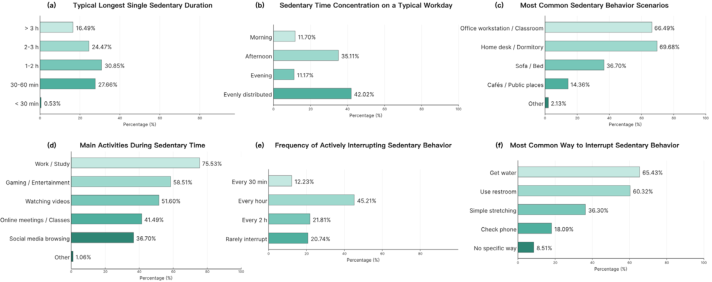
Respondents’ sedentary behavior was characterized by prolonged bouts, diverse contexts, high cognitive engagement, and infrequent intentional breaks. As shown in Figure 1, over 70% of respondents reported uninterrupted sedentary bouts lasting more than one hour, while only 12.23% intentionally stood up and moved approximately every 30 minutes. A further 20.74% reported that they did not regularly interrupt their sedentary behavior. Sitting occurred primarily at office workstations, in classrooms, and at desks at home, with over 70% of respondents engaging in cognitively demanding work or study while seated. Breaks in sitting were mainly associated with routine activities such as getting water, using the restroom, and simple stretching, suggesting that sedentary interruptions were largely incidental rather than deliberate, regular health-promoting behaviors.
Figure 1: Sedentary behavior characteristics of participants.
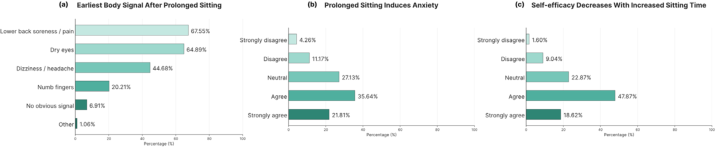
Prolonged sitting was associated with noticeable physical discomfort and negative psychological experiences. Following prolonged sitting, 67.55% of respondents reported back pain or soreness, while 44.68% reported dizziness or headaches. Only 6.91% reported no noticeable physical discomfort. Respondents also reported psychological discomfort during prolonged sitting, including anxiety and a distressing sense of being confined to their seats.
Figure 2: Physical and psychological discomfort during prolonged sitting.
The main barriers to interrupting sedentary behavior were difficulty disengaging from the current state, behavioral inertia, and insufficient external incentives. As shown in Figure 3, 64.36% of respondents perceived that taking a break became more difficult with prolonged sitting, while 60.64% reported difficulty interrupting sitting without external incentives and a similar proportion “wanted to move but found it difficult to act immediately.” These findings suggest that prolonged sitting reflects not only limited risk awareness, but also difficulty initiating action and insufficient cues to action.
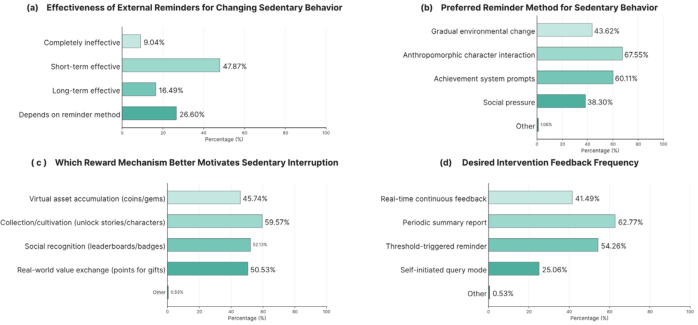
Figure 3: Perceived barriers to interrupting sedentary behavior.Figure 4: Preferences for sedentary behavior intervention and feedback mechanisms.
Respondents generally viewed external interventions positively, with only 9.04% considering reminders entirely ineffective. Periodic summary feedback (62.77%) and threshold-triggered reminders (54.26%) were the most preferred timing strategies. For reminder formats, anthropomorphic character interactions (67.55%) and achievement-based prompts (60.11%) were favored most, followed by progressive ambient changes (43.62%)
From Awareness to Action: Designing a Progressive Cross-Device Intervention 637 and social pressure mechanisms (38.30%). Overall, participants preferred context-sensitive interventions with feedback and motivational features over uniform, fixed-format reminders.
Study 2: Semi-Structured Interviews To examine why awareness of sedentary risks does not always lead to timely physical activity and to identify acceptable intervention preferences, semi- structured interviews were conducted with five representative participants. The interviews covered contexts in which interrupting sedentary behavior was difficult, reasons for ignoring or postponing reminders, experiences with existing reminder modalities, preferences for intervention modality and intensity, acceptance of activity-based compensation, and preferred feedback and incentive mechanisms.
All interviews were conducted online and lasted about 15 minutes. The data were analyzed using thematic analysis (Braun & Clarke, 2006). Initial codes related to behavioral barriers, intervention preferences, and feedback needs were grouped into broader themes. The Health Belief Model (HBM) was then used as an interpretive framework to examine perceived threat, perceived barriers, cues to action, self-efficacy, and perceived benefits.
Table 2: Characteristics of interview participants (n = 5).
Table available in the original PDF paper.
Participant ID Age Daily Sitting Time
Discomfort Due to Prolonged Sitting
Intention to Improve Sedentary Habits But Failure to Persist forget to stand up regularly
A1 19 > 6h Neck and shoulder stiffness A2 21 > 6h Low back pain Lack of reminders A3 22 > 6h tired eyes want to move but cannot
A4 25 > 6h Drowsiness lack of motivation A5 27 > 6h reduced concentration hard to sustain
Participants generally recognized the adverse effects of prolonged sitting, including lower back discomfort, leg numbness, and fatigue, but these signals did not always prompt immediate movement. High cognitive engagement and task continuity were recurring barriers. As one participant noted, “It’s really frustrating to be interrupted in the middle of coding, especially when I’m debugging. As soon as I stand up, I lose my train of thought” (A4). Similar concerns arose during intensive study, and workplace restrictions further limited opportunities to move. From an HBM perspective, these findings suggest that perceived barriers related to task continuity and time pressure may outweigh perceived threat, indicating that risk information alone is insufficient and that interventions should reduce the cost of interrupting ongoing tasks.
Participants also reported limited effectiveness of conventional vibration alerts and pop-up notifications. Repeated vibration became easy to ignore, while pop-ups were often dismissed during intense
concentration. One participant described wristband vibration as “like a mosquito bite” and noted that closing pop-ups had become “practically muscle memory” (A1). Reminder effectiveness therefore depended not only on whether a cue was present, but also on whether its modality and salience matched the context. Highly salient cues could create social pressure in meetings or offices, whereas subtle cues could be overlooked during deep task immersion.
Participants preferred physical activities that required little cognitive effort and could be integrated into daily routines, such as walking, stair climbing, simple stretching, and household chores. They also wanted clear guidance on what to do and for how long. One participant explained that 15 minutes of walking or stair climbing after work was more manageable than complex exercise (A2), while others emphasized the value of step-by- step demonstrations rather than exercise names alone (A1, A3). From the HBM perspective of self-efficacy, clear and feasible activity guidance may reduce uncertainty and support the transition from health awareness to physical activity.
FINDINGS AND DESIGN REQUIREMENTS The questionnaire and interview findings together suggest that respondents’ sedentary behavior was not primarily attributable to insufficient awareness of health risks, but rather to difficulties in translating risk awareness into action. According to the Health Belief Model (HBM), health behavior is influenced not only by perceived threat but also by perceived barriers, cues to action, self-efficacy, and perceived benefits (Rosenstock et al., 1988).
Immediate behavioral barriers hinder the translation of health awareness into action. Over 70% of respondents reported sedentary bouts exceeding one hour. Interview findings further identified task immersion, the need to maintain task continuity, and time pressure as key reasons for postponing physical activity. These findings suggest that even a high level of perceived threat may be insufficient to prompt action when perceived barriers associated with ongoing tasks take precedence.
Fixed, uniform reminders may fail to remain effective as cues to action. Immediate behavioral barriers can override intentions to engage in physical activity. Although most respondents acknowledged the potential usefulness of external reminders, interview findings indicated that participants became habituated to repeated vibration alerts and frequently ignored pop-up notifications. The level of reminder salience considered appropriate also varied across contexts.
Users need feasible activity guidance and perceptible benefits of action. Participants preferred low-effort activities, such as simple stretching and walking, and wanted clear instructions on specific movements and activity duration, together with feedback on completion. Clear, achievable activities may support self-efficacy (Bandura, 1977), while immediate feedback may make the benefits of action more perceptible.
Table 3: HBM-informed findings and design requirements.
Table available in the original PDF paper.
Design Requirement
Key Finding HBM Construct Perceived threat
Link risk awareness to immediate cues to action.
Users have some awareness of health risks, but awareness alone is insufficient to prompt action.
Perceived barriers
Minimize the cost of interrupting ongoing activities.
Users may ignore or become habituated to fixed reminders, and their preferences vary across contexts.
Adapt intervention modality and salience to the context and user responses.
Users prefer simple, low-effort activities with clear guidance.
Self-efficacy Provide actionable and context- compatible activity guidance.
Users value feedback, progress visualization.
Perceived benefits
Make the benefits of action perceptible both immediately and over time.
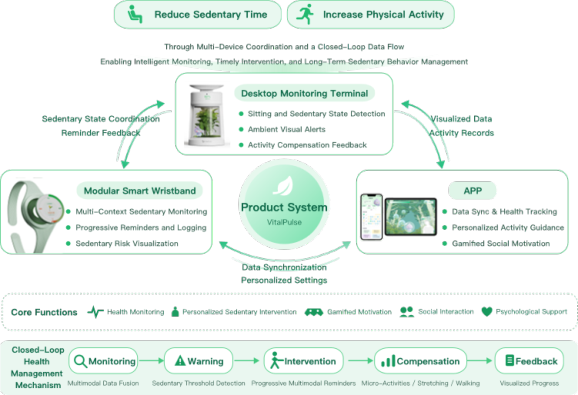
DESIGN To address the awareness–action gap identified in the user study, we developed a cross-device intervention system integrating a modular smart wristband, a desktop monitoring terminal, and mobile and desktop applications. The system forms a closed loop of monitoring, alerting, intervention, activity compensation, and feedback. The wristband enables cross-context sedentary monitoring and haptic reminders, the desktop terminal provides ambient cues and status visualization in primary sedentary contexts, and the applications offer activity guidance, data feedback, and gamified motivation. This system reflects users’ varying preferences for reminder modality and salience across contexts by delivering adaptive cues to action.
Figure 5: Vital pulse product system and closed-loop intervention mechanism.
Progressive Sedentary Intervention. Fixed vibration alerts and pop-up notifications were easily ignored or became less noticeable through habituation, while users’ acceptance of reminder intensity varied across contexts. During work or meetings, intrusive reminders could disrupt task continuity, whereas subtle cues might fail to attract attention during deep task immersion. Sedentary behavior interventions therefore need to balance salience and minimal disruption rather than consistently rely on a single reminder modality. The system adopts a progressive intervention mechanism, escalating cues to action from low-disruption prompts to more salient reminders. Three intervention levels are triggered at 30, 60, and 120 min of continuous sitting. At the initial level, changes in plant appearance, lighting, and wristband status displays provide ambient cues. If users remain unresponsive, desktop pop-ups, character-based prompts, and social reminders are introduced. At the highest level, more prominent visual feedback prompts users to take a short activity break. External reminders thus serve as cues to action, with escalation contingent on continued non- response rather than an unconditional increase in intensity. This approach aims to encourage action while preserving task continuity.
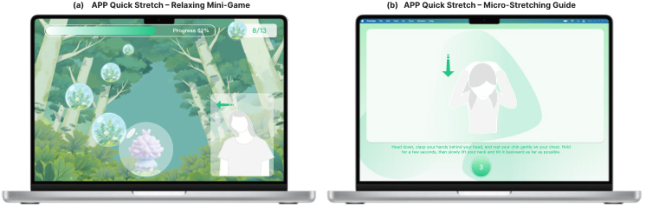
From Risk Awareness to Feasible Action. Users’ difficulties in initiating physical activity were not simply attributable to insufficient awareness of sedentary risks. Rather, task immersion, behavioral inertia, and uncertainty about how to act hindered the translation of awareness into action. Interviews further indicated that users preferred low-effort, feasible activities with clear instructions over generic exercise reminders. The design therefore focuses on reducing the effort required to move from awareness to action rather than merely reinforcing risk information. Accumulated sitting is visualized as metaphorical “health debt,” helping users maintain awareness of their sedentary state. Brief activities, such as stretching and walking, are accompanied by step-by-step guidance specifying what to do, for how long, and how to complete the activity. This guidance is intended to reduce decision-making demands, make physical activity easier to initiate, and support self-efficacy.
Figure 6: APP quick stretch: mini-game and stretch guide.
Activity Compensation and Feedback. Users preferred low-effort, feasible physical activities and wanted clear feedback after completing them. Because the health benefits of reducing sedentary behavior may not be immediately apparent, users may find it difficult to perceive the value of a single activity.
From Awareness to Action: Designing a Progressive Cross-Device Intervention 641 Interventions therefore need both to lower barriers to action and to strengthen perceived benefits. Following activity completion, the system reduces the displayed health-debt value and presents the results through plant recovery and periodic summary reports. Outside desk-based settings, the wristband continues to record activity data, while the app recommends activities based on the user’s sedentary behavior that day, maintaining continuous feedback across contexts. Plant recovery and progress visualization provide symbolic representations of activity outcomes, making the value of action more immediately perceptible.
Together, these mechanisms form a closed behavioral support loop linking risk awareness, cues to action, low-effort physical activity, and feedback on the benefits of action.
DISCUSSION
From Risk Awareness to Action. This study suggests that the difficulty young adult users experience in translating awareness of sedentary risks into physical activity is not simply attributable to insufficient health awareness. Rather, task immersion, behavioral inertia, time pressure, and the effort required to initiate action constitute immediate barriers. Health behavior is shaped by the interplay of perceived threat, perceived benefits, and perceived barriers, with perceived barriers often playing an important role in whether individuals take action (Janz & Becker, 1984). During cognitively demanding work or study, users may remain seated even after experiencing physical discomfort. Bridging the awareness–action gap therefore requires more than reinforcing risk information; it also requires reducing the effort involved in moving from recognizing a problem to taking action.
Intervention Strategies Should Be Context-Sensitive. Users did not express a uniform preference for intervention timing, modality, or intensity. Instead, they emphasized compatibility with ongoing tasks and the context of use. Fixed vibration alerts and pop-up notifications were easily ignored or became less noticeable through habituation, whereas overly intrusive reminders could disrupt task continuity and create social pressure. These findings are consistent with previous research identifying reminders as a common persuasive strategy in digital sedentary behavior interventions, while noting that fixed computer reminders alone do not consistently reduce sedentary behavior (Wang et al., 2017). Existing systems often combine scheduled prompts, automated feedback, mobile devices, and wearable technologies rather than relying on a single reminder channel (Huang et al., 2019). Building on these findings, we propose an intervention approach that begins with low-disruption cues, progressively increases salience in response to continued non-response, and allows different interaction modalities to complement one another.
Translating Behavioral Findings into Design. The identified behavioral barriers and intervention preferences informed three design principles: minimizing task disruption through initially unobtrusive cues to action that can progressively increase in salience; lowering barriers to action and supporting self-efficacy through clear, specific guidance for brief physical activities;
and using immediate visual feedback and gamified motivation to make the perceived value of activity more apparent despite the delayed nature of health benefits. This design rationale connects perceived barriers, cues to action, self- efficacy, and perceived benefits within the HBM. The cross-device intervention system represents one possible implementation of these requirements rather than a predetermined research premise. Multicomponent digital interventions combining prompts, behavioral feedback, informational support, and social influence may offer greater potential for reducing workplace sedentary behavior than single-strategy approaches (Iwakura, 2025).
CONTRIBUTIONS AND LIMITATIONS This study identifies an awareness–action gap in sedentary behavior among young adults, indicating that awareness of health risks does not necessarily translate into timely physical activity. It proposes a progressive intervention framework that seeks to balance intervention salience, task continuity, and user autonomy, and presents a cross-device design instantiation integrating quantified self-monitoring, affective feedback, and gamified motivation.
Several limitations should be acknowledged. As a formative design exploration, the present study does not establish the long-term effectiveness of the proposed system in changing behavior or improving health outcomes. The interview sample was also relatively small; therefore, the current findings primarily provide a basis for design rather than evidence of intervention efficacy. Future work should conduct longitudinal prototype evaluations to examine long-term acceptance, sustained use, and actual changes in sedentary time and physical activity patterns.
CONCLUSION
This study employed a mixed-methods approach combining a questionnaire survey and semi-structured interviews to investigate the awareness–action gap in sedentary behavior among young adults. Guided by the Health Belief Model, the findings indicate that task immersion, behavioral inertia, insufficient cues to action, and limited perceived benefits can hinder the transition from health awareness to actual physical activity. Based on these findings, a progressive cross-device sedentary intervention system was developed, using context-sensitive reminders, feasible activity guidance, and immediate feedback to support behavior change. The study provides a human-centered design approach for translating awareness of sedentary health risks into actionable interventions.
ACKNOWLEDGMENT
This work was supported by the National Social Science Fund of China Youth Project [Grant Number 25CKX049].
REFERENCES
Bandura, A. (1977). Self-efficacy: Toward a unifying theory of behavioral change. Psychological Review, 84(2), 191–215. https://doi.org/10.1037/0033- 295X.84.2.191 B Owen, N., Healy, G. N., Matthews, C. E., & Dunstan, D. W. (2010). Too much
sitting: the population health science of sedentary behavior. Exercise and sport sciences reviews, 38(3), 105–113. https://doi.org/10.1097/JES.0b013e3181e373a2 Braun, V., & Clarke, V. (2006). Using thematic analysis in psychology. Qualitative Research in Psychology, 3(2), 77–101. https://doi.org/10.1191/1478088706qp063oa Huang, Y., Benford, S., & Blake, H. (2019). Digital Interventions to Reduce
Sedentary Behaviors of Office Workers: Scoping Review. Journal of Medical Internet Research, 21. Iwakura, M., Ozeki, C., Jung, S., Yamazaki, T., Miki, T., Nohara, M., & Nomura, K.
(2025). An umbrella review of efficacy of digital health interventions for workers. NPJ Digital Medicine, 8. Janz, N. K., & Becker, M. H. (1984). The Health Belief Model: A decade later. Health Education Quarterly, 11(1), 1–47. https://doi.org/10.1177/109019818401100101 Parés-Salomón, I., Señé-Mir, A. M., Martín-Bozas, F., Loef, B., Coffey, A., Dowd, K.
P., Jabardo-Camprubí, G., Proper, K. I., Puig-Ribera, A., & Bort-Roig, J. (2024). Effectiveness of workplace interventions with digital elements to reduce sedentary behaviours in office employees: A systematic review and meta-analysis. The International Journal of Behavioral Nutrition and Physical Activity, 21(1), Article 41. https://doi.org/10.1186/s12966-024-01595-6 Rosenstock, I. M., Strecher, V. J., & Becker, M. H. (1988). Social learning theory and the Health Belief Model. Health Education Quarterly, 15(2), 175–183. https://doi. org/10.1177/109019818801500203 Wang, Y., Wu, L., Lange, J., Fadhil, A., & Reiterer, H. (2017). Persuasive Technology
in Reducing Prolonged Sedentary Behavior at Work: A Systematic Review. ArXiv, abs/1712.02547.
SEARCH THE AHFE DIGITAL BOOKSTORE BY ISBN
Explore the complete digital volume
Human Factors in Design, Engineering, and Computing
Read this individual research paper free through the original publisher, or explore the full digital proceedings book.