Maurício Manhães, Birgit Mager, Gregório Varvakis (2019). Prejudice and Innovation: A Critical Relation for Designing Potentially Innovative Solutions. In: Advances in The Human Side of Service Engineering. AHFE Open Access, vol. 8. https://doi.org/10.54941/ahfe100261
Contemporary organizations are increasingly interested in augmenting their capacity to innovate. The most commonly adopted frameworks for innovation among corporations are the ones based on co-creation processes, particularly the ones related to the “design thinking” practices (i.e, human-centered design, open innovation, service design, lean startup and business model generation). These frameworks have fundamentally in common the assumption that people are sensible enough to understand different points of view. And that these frames of work will enable organizational teams to free themselves of their prejudices and embrace the “different.” At the same time that a team’s prejudice can distort understandings, it also plays an important role in opening up what it is to be understood. This text advocates that by being aware of the impacts of prejudice, tradition and the interplays between pre-understandings and understandings, organizational teams should have better possibilities to innovate, i.e. to create new propositions that will be perceived as valuable by a determined social context. A metaframework and future research are proposed.
Contemporary organizations call often for the myth of creativity, novelty and diversity through banal rhetorical formulations. Which, most of the times, evade a confrontation with a real legitimization of something that “modernity sought to permanently delete in its necessary process of continuous renewal of the ephemeral: tradition and prejudice” (Ginoulhiac, 2009, p. 282). These same organizations, increasingly interested in augmenting their capacity to innovate, are adopting several frameworks based on co-creation processes, particularly the ones related to the “design thinking” practices (i.e, human-centered design, open innovation, service design, lean startup and business model generation). Besides their promises to spur innovations, these frameworks have an explicit and formal focus on creating awareness of different perspectives of reality, “making the familiar strange and the strange familiar” (Amabile, 1996), and on “creating a team-based approach to innovation” (Brown, 2008).
Fundamentally, all of them are based on the assumption that people are sensible enough to understand different points of view. That these frames of work will enable people to free themselves of their prejudices and embrace the “different”; that they will enable people to make the “fusion of horizons”, as described by the hermeneutical literature (Gadamer, 2004). Unfortunately, the necessary empathic understanding to “pivot” its own view of the world is not evenly distributed on a population. And, as the experiments described in this text are showing, a simple adoption of a design thinking framework may not be enough to free people of their own personal history (Kruglanski & Webster, 1996, p. 263): Specifically, individuals may desire knowledge on some topics and not others, and they may delimit their constructive endeavors to those particular domains.
And thus, it can happens exactly the opposite: some of these frameworks may actually promote particular kinds of visions and then not deliver on their promises to make “the familiar strange and the strange familiar” (Amabile, 1996). As it is known, there are several examples of organizations that adopted particular creative frameworks without resulting in any significant achievement towards fostering innovative propositions (Verganti & Öberg, 2013). Several researches emphasize that the process of listening to new and external interpreters “cannot be reduced to the application of a ‘method’” (Thompson, 1997).
But it seems that in some cases the use of these frameworks did help enact an empathic understanding and spur innovative solutions (Brown, 2008). One reasonable explanation for that may lie in the very group of people that developed a new value proposition towards becoming an innovation. Not in the framework itself.
PREJUDICE This present text advocates that one key ingredient for innovative efforts is the awareness of the prejudices at play on a determined social context. To understand what it is meant by the word ‘prejudice’ it is necessary to consider Gadamer‘s discussion about it. First, he advocates “that all understanding inevitably involves some prejudices.” And, by prejudice, Gadamer means “a judgment that is rendered before all the elements that determine a situation have been finally examined” (Gadamer, 2004, p. 272).
Although since the Enlightenment the concept of prejudice acquired the negative connotation familiar today, it does not “necessarily mean a false judgment, but part of the idea is that it can have either a positive or a negative value” (Gadamer, 2004, p. 273). For example, one of its positive senses lies in the fact that it enables us “to understand history as well as ourselves” (Dobrosavljev, 2002). To make sense of Gadamer’s detailed discussion on the subject, this text adopted the description of prejudice as a vantage point where human finite understanding is situated in a historical process.
Here enters the concept of horizon as “the range of vision that includes everything that can be seen from a particular vantage point” (Gadamer, 2004, p. 301), i.e. from a starting point where human finite understanding is situated. The concept of horizon can not be taken as a fixed condition faced by an individual (Alvesson & Sköldberg, 2009, p. 120). Although more research needs to be done about the possibilities offered by the design thinking frameworks, it is possible to assume that they should be entitled to offer the expansion and/or the fusion of horizons as their main byproduct result, at least potentially. This perception is corroborated by some streams of research that have linked the process of hermeneutical understanding to the one of innovation (Thompson, 1997; Verganti & Öberg, 2013) and to design practices (Jahnke, 2012).
The reading of Gadamer’s works also offers a particular possible linkage between the concept of fusion of horizons and the co-creation frameworks through the German concept of Bildung. In English this word corresponds to ‘formation’ and can be described as (Gadamer, 2004, p. 15):
[…] keeping oneself open to what is other – to other, more universal points of view. It embraces a sense of proportion and distance in relation to itself, and hence consists in rising above itself to universality.
Keeping oneself open to what is other can be considered a fundamental condition for co-creation efforts. But as explained by Kruglanski & Webster (1996), people “may delimit their constructive endeavors” to very specific particular knowledge domains. And, depending on the personal history of the participants at such effort, this is something that is not as simple avoiding as just by adopting a “co-creative” framework.
It follows that every person starts the understanding process from a particular historical stand point. Then, through a process of Bildung, they move “in a circular pattern centrifugally towards understanding” (Jahnke, 2012). Jahnke also explains that this movement starts from their own prejudices and goes on in encountering the ‘other’ in an interpretive process.
This text advocates that the understanding process is a key condition for driving a new value proposition towards becoming an innovation.
Prejudice and Innovation The contemporary corporative sensemaking discourses (Weick, Sutcliffe, & Obstfeld, 2005) have several examples and anecdotes that positively portrait the adoption of co-creation frameworks. One of these anecdotes, for example, was brought to life by Steve Blank (writer and lecturer at the Stanford University and at the University of California, both in the USA), who declared on an interview that Steve Jobs (one of the founders of Apple Computers, Inc) “was truly a renaissance man.” Describing that Jobs “actually talked to a lot of people from a variety of fields” (Cook, 2013). Maybe what Blank meant is that Jobs was just curious and interested in knowing different perspectives. As most of the design thinking frameworks suggest, organizational people should have to free themselves from their entrenched stand point and go “out there” to meet the ‘Other’, to meet the different.
Thus, these anecdotes about Steve Jobs are also appropriate to make sense of two characteristics endorsed by the hermeneutical perspective: the openness to the Other and the “sense of what is feasible, what is possible, what is correct, here and now” (Gadamer, 2004, p. xxxiv), what is appropriate for a determined context. In that sense, the fusion of horizons can be defined as a combined capability of “persistent posing of ultimate questions” (Gadamer, 2004, p. xxxiv) in one extreme, and having a sense of what is ‘feasible here and now’. That means that questioning endlessly a situation or focusing solely on what is feasible here and now will not commit persons in a determined social context to act. This commitment to act being understood as a sense making process (Weick et al., 2005) that produces new knowledge, which is the same as to say that it increases the capacity to act (Nonaka & von Krogh, 2009).
From a hermeneutical perspective, it is possible to describe the process of innovation as a social process of understanding and sense making. Thus, as a social process of interpreting and envisioning, and also of generative interpretation (Verganti & Öberg, 2013). One key aspect of this process of understanding is the fact that it does not proceed from a tabula rasa. So, to “understand presupposes preunderstanding.” Alvesson and Sköldberg (2009, p. 120) also explain that preunderstanding is an obstacle to understanding. And to prevent it from developing into a vicious circle they write that:
[…] the existential hermeneuticians advocate a constant alternation between merging into another world and linking back into our own reference system. By means of this movement back and forth, we can successively come to an understanding of the unfamiliar reference system, something which also leads to the gradual revising and/or enriching of our own: there is a 'fusion of horizons' […].
From that statement, an innovation process can be described as starting from a new value proposition created by and presented to a determined social context. This new proposition has to be understood by that same social context from the preunderstandings shared by that group. Where an understanding of a new part fosters a new understanding of a whole. This would happen first individually, with each member of a group going through an interpretative process based on his own horizon of understanding. Then, in an iterative process involving the other members of the group, innovation process proceeds until it express “a nexus of personal meanings that are formed in a complex field of social and historical relationships” (Thompson, 1997, p. 439).
NEED FOR CLOSURE - NFC If the central and critical role that prejudice plays in innovative efforts is accepted, the next step would be to devise how to enable organizations to act upon it. Several studies on innovation have focused on understanding “the new capabilities required to achieve a breakthrough” (Verganti & Öberg, 2013). One of these possible new capabilities might be the creation of Bilgung prone organizational groups. A particular stream of research based on the concept of Need for Closure (NFC) suggests that organizations can create groups with special characteristics that can emulate a kind of open-mindedness that relates to the concept of Bildung.
Need for Closure and Prejudice The assessment of individuals’ NFC levels are done with a self-report measure questionnaire “designed to tap stable individual differences in the motivation for cognitive closure” (Webster & Kruglanski, 1994). As described in a previous paper (Manhães, Mager, & Varvakis, 2013), the NFC assessment instrument used to support the present discourse is a validated questionnaire, with 41 items (Lykert-type) bipolar-response summated ratings scale measurements (Roets & Van Hiel, 2011a, 2011b). The NFC also can provide a quantitative vantage point from which can be observed the relationship between the perceived innovativeness of the products resulting from a creativity workshop and the level of open mindedness of its participants. From that point of view, NFC can be defined as the “simplest determinant” of the Bildung’s propensity of a person and a group. Briefly stated, it is possible to devise a personality continuum measure for the NFC scale as having at its extreme points the low and the high NFC characteristics and, at its center, the medium ones. Below are presented short descriptions of each of these continuum points.
High Need for Closure
This is a perfect match for efficiency-driven sense making discourse of organizations that focuses on “conformance, control, alignment, discipline and efficiency” as expressed by Dr Gary Hamel (Denning, 2012). It also can be related to what Verganti and Öberg (2013, p. 89) describe as the contemporary dominant theories of innovation: […] see problem solving as a process of progressive reduction of uncertainty (the earlier in the process the better, […]), and that assume that there is an optimal solution out there, you just need to find it […]
This characteristic of reduction of uncertainty, when enacted by a person, can have at least two different perspectives: “whereas the uncertainty-oriented persons approach uncertainty in order to resolve it, the certainty- oriented persons avoid it altogether” (Kruglanski 2004, p. 55).
Low Need for Closure On the other hand, individuals with low NFC are reluctant in adopting rule-based and linear frameworks. That is what, perhaps, makes them more creative. They are also psychologically more comfortable in ambiguous situations and tend to prolong precrystallization periods.
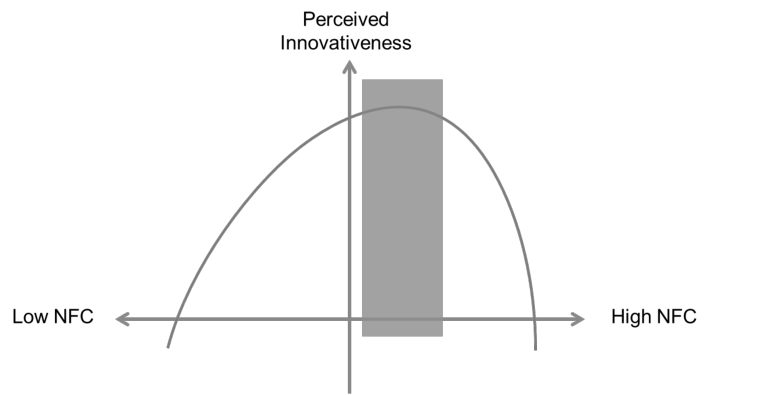
Medium Need for Closure What can be said upfront is that the Medium NFC level individuals will feel comfortable with or without a framework. This is because they will either (a) create, (b) adopt partially or (c) completely adopt a pre-given framework. These alternatives will be chosen based solely on their understandings of the actual lived moment. This malleability produces, as illustrated by the Figure 1, the best perceived levels of innovativeness.
The research described below is showing that it is possible emulate the characteristics of Medium NFC individuals on groups of people. And, as it takes into account a socio-cultural perspective, this possibility of designing groups presents a hermeneutically favorable characteristic.
FIGURE 1: NFC levels and perceived Innovativeness (Source: Autors)
NFC AND EXPERIMENTS The possibility of conducting innovative efforts through the design of groups based on NFC levels has the advantage of not need any pre-given “method” or enlisting only specific NFC level individuals for a team. Groups with members with diverse NFC levels seem to be able to create their own immanent logic (Adorno, 1965), which is a prerequisite to obtain the “original nonsense” of great works. The particular design of groups may also diminish the necessity of relying on “enlightened” leaders as the main driving force for innovative efforts. As advocated by Amabile (1996) and Verganti & Öberg (2013) the key role toward innovation should be played, primarily, by the highest levels of management (Amabile, 1996; Hennessey & Amabile, 2010; Verganti & Öberg, 2013). This assumption presupposes a “Renaissance” leadership, the existence of “enlightened” leaders throughout the organization. The possibility to design ad-hoc groups to lead innovative efforts seems to be a more pragmatic solution than the one of finding and hiring Jobs-like leaders. This is reinforced by the experiments related to this text that demonstrate that groups with a specific mean level of NFC create propositions that are perceived as more innovative during consensual assessments.
Experiments description The cited experiments are being done as part of a PhD research and the concepts and ideas that were used to support these arguments are based on an extensive literature review. For ethical considerations, it is necessary to highlight the fact that the related research has not yet reached its theoretical saturation. At this stage of the research there are no ideal mean NFC values established as a target for groups’ designs.
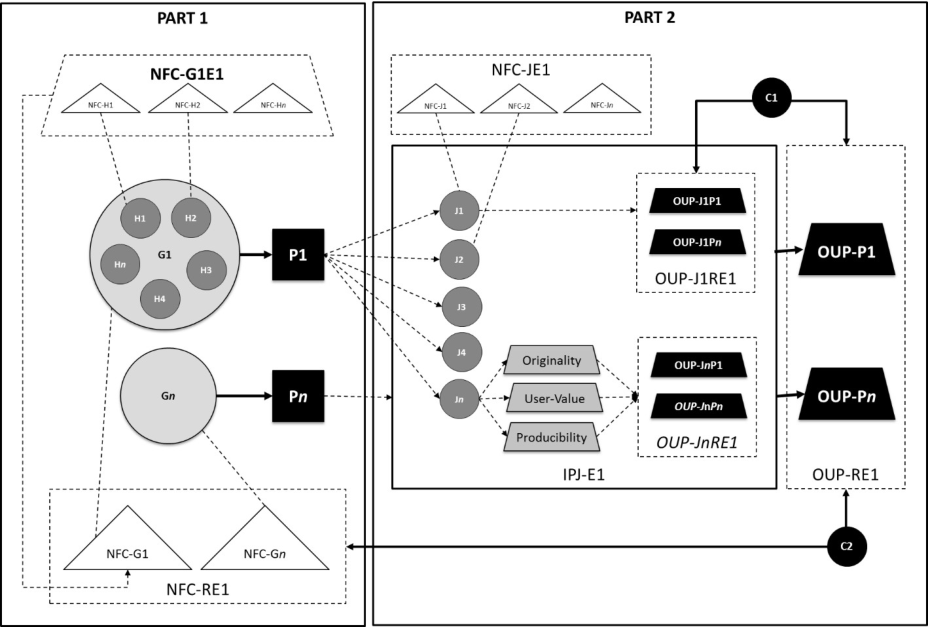
Magnusson, 2003). These judges (J1 to Jn) rate the products on three dimensions: Originality, Producibility and User-Value (OUP-P1 to OUP-Pn). For the sake of brevity, a detailed description of these experiments can be found in a previous paper (Manhães et al., 2013).
The numbers presented in this paper are the result of analyzing data sets from 4 runs of the cited experiment, involving 58 workshops’ participants (forming 12 valid groups from Germany, Brazil, India, Italy and Poland) and 15 judges (5 judges for each panel, coming from Brazil, Colombia, Germany, Italy, Sweden and United Kingdom).
NFC and Intergroup Contact Several studies of organisations, regions and nations indicate a connection between economic success and human capital diversity (Florida, 2003). Østergaard, Timmermans and Kristinsson (2011) explain that, as social context becomes more diverse, “...this creates possibilities for new combinations of knowledge.” And their research also indicates that there is a positive relationship between human diversity and the organisation’s likelihood to innovate. More precisely, diversity of backgrounds should give “groups a larger pool of resources that may be helpful in dealing with nonroutine problems” (van Knippenberg & Schippers, 2007). But, at the same time that diversity presents possibilities of innovation, it strengthens the need for intergroup interaction and communication and “might lead to conflict and distrust” (Østergaard, Timmermans, & Kristinsson, 2011). At this point the work of Allport supply an actionable approach to intergroup contacts negative perspectives (Roets & Van Hiel, 2011a).
FIGURE 3: Structure of the NFC/OUP Experiments (Source: Autors)
Negative Intergroup Contact The experiments that subsidize this present text, offered four different opportunities to witness what can happen when different NFC levels individual are asked to work on a same group. Coincidentally, in all four cases, it happened that one of the participants abandoned his or her group before the completion of the activities.
Several streams of research also indicate that cognitive diversity “may be detrimental to team satisfaction, affect, and members’ impressions of their own creative performance.” And that diversity can just as easily “lead to negative as to positive outcomes” (Hennessey & Amabile, 2010). These kind of events, that occurred during the experiments of this doctoral reseach, and previous research indicatives lead to tapping into intergroup contact literature. Specifically, to the work of Gordon W. Allport and the Four Key Conditions for intergroup contact (Allport, 1979). As presented by Pettigrew (1998): positive effects of intergroup contact occur only in situations marked by four key conditions: equal group status within the situation; common goals; intergroup cooperation; and the support of authorities, law, or custom.
In some of the experiments these conditions were tested and, as described by the literature (Pettigrew & Tropp, 2006; Roets & Van Hiel, 2011a), the level of attrition between the members of the groups were significantly reduced. Which prompted to the suggestion that the design of Bildung prone organizational groups should have to take into account the implementation of these Allport’s key conditions.
It is important to note that Allport’s research presents a particular use of the word prejudice as “an antipathy based on faulty and inflexible generalization. It may be felt or expressed. It may be directed toward a group or an individual of that group” (Allport, 1979, p. 10). In a Gadamer’s perspective, this definition would be related to its possible negative value and to the “discrediting of prejudice by the Enlightenment” (Gadamer, 2004).
As can be seeing in Figure 3, this text proposes a positioning between the NFC concepts and the definitions of Gadamer and Allport about prejudice from a hermeneutical perspective. From this stand point, the concept of Need for Closure can serve as a sensemaking discourse that fits into Gadamer’s notion of prejudice (with both its broad positive and negative connotations) and encompasses partially Allport’s description of prejudice, while avoiding relying exclusively on the outgroup perspective (i.e., racism, negative connotation).
FIGURE 3: Proposed positioning between NFC and Prejudices (Source: Autors)
Figure available in the original PDF paper.
Although the concept of NFC originates from outside the literature on prejudice (both from Gadamer’s and Allport’s perspectives), it has a “striking similarity to the prejudice-prone cognitive style proposed by Allport” (Roets & Van Hiel, 2011a). The necessity for high NFC individuals to satisfy their “need for quick, easy, firm, and stable knowledge about the world” leads them to “resort to essentialist categorization and authoritarian ideologies, which represent some of the most powerful, proximal determinants of stereotyping and prejudice” (Roets & Van Hiel, 2011a).
IMPLICATIONS FOR ORGANIZATIONS This singular approach to innovativeness efforts of teams can contribute to make sense of this important challenge facing organizations. At the same time that it maintains the innovativeness potential of teams – without relying on rule-based processes, it enables organizations to act by providing a scientifically supported metaframework. This action would be divided into simple steps like:
1. Assess the NFC levels of the potential individuals to be involved;
2. Design groups based on specific sets of diverse levels of NFC to lead the innovative effort and/or to evaluate it;
3. Adopt the Allport’s 4 key conditions of intergroup contact through governance policies;
4. Define a time frame and available resources;
5. Provide organizational autonomy for the designed groups.
The above-suggested metaframework should enable organizations to create Bildung prone groups where the imaginative productivity is richest because it will not be merely free. The specific horizons where those groups will stand, “as in the convolutions of the arabesque,” should provide “a field of play where the understanding’s desire of unity does not so much confine it as suggest incitements to play” (Gadamer, 2004, p. 41).
CONCLUSIONS
The sense making discourse that supports this metaframe, preliminarily named Prejudice Related Innovativeness Determinants – PRIDe (Manhães et al., 2013), can be summarized as: organizations that are aware of their prejudices are probably more likely to have better performance. Thus, it follows that whenever people from a social context have to open themselves up to the new, they will need to do it in terms of the ‘fore-structures' of understanding that they already possess. At the same time that a team’s prejudice can distort understandings, it also plays an important role in opening up what it is to be understood. Based on that proposed understanding, this text advocates that by being aware of the impacts of prejudice, tradition and the interplays between pre-understandings and understandings, organizational teams should have better possibilities to innovate, i.e. to create new propositions that will be perceived as valuable by a determined social context. Which, then, will generate a better organizational performance. This metaframework is reinforced by discourses like this one (Amabile, 1996): Finally, management practices for creativity include the ability to constitute effective work groups that represent a diversity of skills and are made up of individuals who trust and communicate well with each other, challenge each other's ideas in constructive ways, are mutually supportive, and are committed to the work they are doing […].
Innovation, taken as a social phenomenon that “contains the possibility of dialogue aiming to arrive at mutual understanding and agreement” (Alvesson and Sköldberg 2009, p. 150), can only arise “if and only if, for all participants, there is a symmetrical distribution of chances to choose and to apply speech-acts” (Habermas, cited by Alvesson and Sköldberg 2009, p. 152). The critical relation between prejudice and innovation, as a perspective, permits to view the ability of organizations to create new products in the light of the totality-subjectivity combination. At the same time, the PRIDe metaframework tries to avoid both (a) the constraints of a “method” for innovation and (b) proposing ‘tyrannies of structurelessness’. This ‘middle way’ takes into account the hermeneutic experience and invites those involved to play with the prejudices at stake. And, as a sense making discourse, a ‘play’ is precisely what innovation is: there is a risk that it “will not ‘work,’ ‘succeed,’ or ‘succeed again,’ which is the attraction of the game” (Gadamer, 2004, p. 106).
AKNOWLEDGEMENT The development of the PRIDe discourse is a result of an “open attitude to the vital importance of the interpretative dimension to social phenomena” (Alvesson and Sköldberg 2009, p. 304). All texts cited integrate the prejudices and horizons of the authors of the present one about the organizational context.
This text presents a summary of the preliminary findings of the doctoral research of Mauricio Manhães on Knowledge Management and Engineering at the Federal University of Santa Catarina – Brazil in cooperation with the Köln International School of Design / University of Applied Sciences in Cologne – Germany. This research is supported by CAPES foundation, an agency under the Ministry of Education of Brazil, and SEDES – Center for Service Design Research.
REFERENCES
Adorno, T. (1965). Functionalism today. Rethinking Architecture: A Reader in Cultural Theory, 1–12. Retrieved from http://scholar.google.com/scholar?hl=en&btnG=Search&q=intitle:Functionalism+Today#0 Allport, G. (1979). The Nature of Prejudice: 25th Anniversary Edition (p. 576). Perseus Books Publishing, L.L.C. Alvesson, M., & Sköldberg, K. (2009). Reflexive methodology: new vistas for qualitative research. Journal of
Advanced Nursing (Vol. 33, p. 361). Sage. Retrieved from http://books.google.co.uk/books?id=JrxxHr3LksQC Amabile, T. M. (1996). Creativity and innovation in organizations (pp. 1–15). Harvard Business School. Retrieved from http://mis.postech.ac.kr/class/MEIE780_AdvMIS/2012 paper/Part1 (Pack1-3)/02_sources of innovation/1-3) Creativity and Innovation in Organizations.pdf Brown, T. (2008). Design thinking. Harvard Business Review, 86(6), 84–92, 141. Retrieved from
http://www.ncbi.nlm.nih.gov/pubmed/18605031 Cook, J. (2013). Steve Blank: Lessons From 35 Years of Making Startups Fail Less. Bēhance. Retrieved July 10, 2013, from http://99u.com/articles/7256/Steve-Blank-Lessons-From-35-Years-of-Making-Startups-Fail-Less Denning, S. (2012). Gary Hamel On Innovating Innovation. http://www.forbes.com. Retrieved July 12, 2013, from
http://www.forbes.com/sites/stevedenning/2012/12/04/gary-hamel-on-innovating-innovation/ Dobrosavljev, D. (2002). Gadamer’s hermeneutics as practical philosophy. Philosophy, Sociology and Psychology, 2(9), 605–618. Retrieved from http://facta.junis.ni.ac.rs/pas/pas200201/pas200201-02.pdf Florida, R. (2003). Cities and the creative class. City & Community, 2(1), 3–19. Retrieved from
http://onlinelibrary.wiley.com/doi/10.1111/1540-6040.00034/full Gadamer, H.-G. (2004). Truth and Method (Second Edi., p. 601). London: Continuum. Retrieved from http://www.continuumbooks.com/books/detail.aspx?BookId=123519 Ginoulhiac, M. (2009). O ensino do projecto de Arquitectura Contribuições para um debate crítico em torno da
prática contemporânea. UNIVERSIDADE DO PORTO. Retrieved from http://repositorio-aberto.up.pt/handle/10216/65271 Hennessey, B. a, & Amabile, T. M. (2010). Creativity. Annual Review of Psychology, 61, 569–98.
doi:10.1146/annurev.psych.093008.100416
Hodson, G., & Busseri, M. a. (2012). Bright minds and dark attitudes: lower cognitive ability predicts greater prejudice through right-wing ideology and low intergroup contact. Psychological Science, 23(2), 187–95. doi:10.1177/0956797611421206 Isaacson, W. (2011). Steve Jobs by Walter Isaacson (p. 656). New York: Simon & Schuster. Jahnke, M. (2012). Revisiting Design as a Hermeneutic Practice: An Investigation of Paul Ricoeur’s Critical
Hermeneutics. Design Issues, 28(2), 30–40. doi:10.1162/DESI_a_00141 Kruglanski, A. W. (2004). The Psychology of Closed Mindedness (Essays in Social Psychology) (p. 208). New York: Psychology Press. Kruglanski, A. W., & Webster, D. M. (1996). Motivated closing of the mind: “seizing” and “freezing”.
Psychological Review, 103(2), 263–83. Retrieved from http://www.ncbi.nlm.nih.gov/pubmed/8637961 Magnusson, P. (2003). Customer-oriented product development: experiments involving users in service innovation.
STOCKHOLM SCHOOL OF ECONOMICS. Retrieved from http://hhs.diva-portal.org/smash/record.jsf? pid=diva2:221388 Manhães, M. C., Mager, B., & Varvakis, G. (2013). Innovation and Prejudice : a Pre-Study on Prejudice Related Innovativeness Determinants - PRIDe. In 10th European Academy of Design Conference - Crafting the Future (pp. 1–26). Gothenburg: European Academy of Design. Retrieved from http://www.trippus.se/eventus/userfiles/39738.pdf Marx, K. (1993). Gründrisse: Foundations of the Critique of Political Economy. (p. 912). London: Penguin
Classics. Nonaka, I., & von Krogh, G. (2009). Perspective - Tacit Knowledge and Knowledge Conversion: Controversy and Advancement in Organizational Knowledge Creation Theory. Organization Science, 20(3), 635–652. doi:10.1287/orsc.1080.0412 Østergaard, C. R., Timmermans, B., & Kristinsson, K. (2011). Does a different view create something new? The
effect of employee diversity on innovation. Research Policy, 40(3), 500–509. doi:10.1016/j.respol.2010.11.004 Pettigrew, T. F. (1998). Intergroup contact theory. Annual Review of Psychology, 49, 65–85.
doi:10.1146/annurev.psych.49.1.65 Pettigrew, T. F., & Tropp, L. R. (2006). A meta-analytic test of intergroup contact theory. Journal of Personality and Social Psychology, 90(5), 751–83. doi:10.1037/0022-3514.90.5.751 Roets, A., & Van Hiel, A. (2011a). Allport’s Prejudiced Personality Today: Need for Closure as the Motivated
Cognitive Basis of Prejudice. Current Directions in Psychological Science, 20(6), 349–354. doi:10.1177/0963721411424894 Roets, A., & Van Hiel, A. (2011b). Item selection and validation of a brief, 15-item version of the Need for Closure Scale. Personality and Individual Differences, 50(1), 90–94. doi:10.1016/j.paid.2010.09.004 Thompson, C. (1997). Interpreting Consumers: A Hermeneutical Framework for Deriving Marketing Insights from
the Texts of Consumers’ Consumption Stories. Journal of Marketing Research, 34(4), 438–455. Retrieved from http://www.jstor.org/stable/10.2307/3151963 Van Knippenberg, D., & Schippers, M. C. (2007). Work group diversity. Annual Review of Psychology, 58, 515–41.
doi:10.1146/annurev.psych.58.110405.085546 Verganti, R., & Öberg, Å. (2013). Interpreting and envisioning — A hermeneutic framework to look at radical innovation of meanings. Industrial Marketing Management, 42(1), 86–95. doi:10.1016/j.indmarman.2012.11.012 Webster, D. D. M., & Kruglanski, A. W. (1994). Individual differences in need for cognitive closure. Journal of
Personality and Social Psychology, 67(6), 1049–1062. doi:10.1037//0022-3514.67.6.1049 Weick, K. E., Sutcliffe, K. M., & Obstfeld, D. (2005). Organizing and the Process of Sensemaking. Organization Science, 16(4), 409–421. doi:10.1287/orsc.1050.0133
LISTED IN THE AHFE DIGITAL BOOKSTORE CATALOGUE
Explore the complete digital volume
Advances in The Human Side of Service Engineering
Read this individual research paper free through the original publisher, or explore the full digital proceedings book.
ISBN 978-1-4951-2091-6
Explore this ISBN in the AHFE Bookstore ↗Listed in the July 2026 bookstore catalogue; search by ISBN to confirm current availability · Digital book purchase optional