Maria Colurcioa, Bo Edvardssonb, Angela Caridàa (2019). Resource Integration in Innovation Processes: A Literature Review. In: Advances in The Human Side of Service Engineering. AHFE Open Access, vol. 8. https://doi.org/10.54941/ahfe100266
The aim of study is to provide a better understanding of the resource integration phenomenon through a bibliometric analysis conducted on 1072 ISI listed journal articles. The most important contribution of the study is the overview of what resource integration is, how it has been portrayed in marketing and management research and a deeper understanding of the six most important dimensions or topics and their theoretical basis. Furthermore, the analysis highlighted a clear division within the knowledge structure of RI, defining essentially two main research areas on the topic: the old school of goods-based logic and the recent school of service-based logic.
In the last decade cooperation between different subjects, different companies and different stakeholders has become a core topic both in literature debate and in managerial practices. Specifically, in literature the sharing of resources has been emphasized, although using different terminologies and intensities, in different areas of management research. From the practitioners point of view the recent book “Co-business” of Turiera and Cross (2013) showed the positive effects of the resources matching and integration by providing 50 examples of business collaboration between diverse parties (competitors, company/customer, supplier/company, companies of different industries) who combine resources (technologies, applications, services) that result in improved solution’s value.
In the field of strategic management studies, the term co-opetition coined by Brandenburger and Nalebuff (2011) encloses the essence of cooperation, even between competitors, as the authors stress that “in today’s business environment, most companies can achieve more success in a dynamic industry than they ever could working alone […] … business, unlike war, is not a winner takes all proposition. The objective is to maximize your return on investment - regardless of how well or how poorly other people or other companies perform”. However, studies on collaboration and sharing of resources in this area date back at the end of the 80s (Hamel, Doz and Prahalad, 1989) In innovation studies, a shifting from a closed view toward an open view of innovation emerged both in the R&D based (Chesbrough, 2006) and in marketing based research stream (Edvardsson, 2012; Mele, Russo Spena and Colurcio, 2010). Specifically the main contributions on the technological side (Chesbrough, 2006, Trott and Hartmann, 2009) pointed out that the development of strong relationships among different parties is a precondition for successful innovation. Essentially in a marketing perspective, innovation is a value co-creation process of interaction and resource integration (Ngo and O’Cass, 2009) and network actors can mobilize resources and thus become co-innovators (Mele, Russo Spena and Colurcio, 2010).
In a Service Dominant Logic (SDL) perspective, the interaction among the parties is a significant enabler of organizational learning and knowledge transfer (Lusch, Vargo, and Wessels 2008) which foster the integration of resource from one partner with the processes of other parties (Vargo and Lusch, 2008). SD logic suggests that value is fundamentally derived and determinate in use through the integration and application of resources in a specific context (Vargo, 2008; Vargo and Lusch, 2008). Edvardsson and Tronvoll (2013), recalling the FP 9 of Vargo and Lusch (2008) “All social and economic actors are resource integrators” define resource integration as the involved actors' activities and interactions when resources are integrated and operated upon.
Actors are resource integrators and resource integration requires process(es) and forms of collaboration. Edvardsson, Tronvoll and Witell (2013) argue that institutions shape how resources are becoming and are used by regulating and shaping actors’ resource integration and value co-creation efforts. Institutions enable and constrain resource integration and value co-creation in service systems (Edvardsson, Tronvoll, and Gruber, 2011).
Despite the prolific literature and the empirical evidence about RI, scholars are still far from a shared definition. Furthermore, despite the intuitive link between resource integration, value co-creation and innovation an integrated theoretical framework of these interdependent processes has been overlooked so far. In a commentary published on Marketing Theory in 2012 Kleinaltenkamp and others tried to shed some light on the nebula that envelops terminology and concepts of RI in the marketing studies by defining some key research challenges.
The aim is to contribute to the theoretical debate in marketing and service research by providing a better understanding of the dimensions of the resource integration phenomenon and investigating through a bibliometric analysis the link between RI and value co-creation.
RESEARCH DESIGN
Methodology
The research goal is to contribute to the ongoing discussion on actors’ resource integration by doing a systematic literature review. The focus is on describing different origins, topics and dimensions in research on RI as well as the enabling and inhibiting factors. , we deployed bibliometric methods to deepen and provide an overview of the knowledge structure of the RI research. We wanted to identify key elements and attributes that characterize the concept of RI throughout different contributions from both management and marketing studies. A better understanding of the phenomenon and the codification of its specific domains will allow us to draw theoretical implications about the relationship between RI and value co-creation (innovation) processes. In order to conduct the systematic literature review in the field of (RI), we deployed a bibliometric method. Specifically, to frame the state of the art of the (RI) issue, we employed different bibliometric measures: the publication activity and the co-word analysis (Benavides-Velasco et al., 2013). Indicators of the publication activity allow researchers to deepen the quantitative evolution of literature, by identifying the most representative journals, institutions and countries publishing in the discipline (Benavides-Velasco et al., 2013; Callon et al. 1983).
To perform the co-word analysis in the field of RI, we focused on the author-provided keywords. It allowed us to frame the conceptual structure of the topic and to obtain insight for future research that could contribute to the advancing, as well as, to the consolidation of this discipline (Benavides-Velasco et al., 2013).
Indeed, the co-word analysis technique (Benavides-Velasco et al., 2013; Muñoz-Leiva, et al., 2012; Callon et al., 1983) focuses on co-occurrence frequency of terms (e.g. keywords or subject headings). It allows researchers to identify and disclose the structural and dynamic aspects of scientific research area (Börner et al., 2003; Callon et al. 1991; Cooper, 1982), by discovering linkages among subjects in the field and tracing emerging research areas (Qin He 1999; Bhattacharya and Basu, 1998). As Qin He (1999) claimed, the co-word analysis is a powerful technique that offers a significant approach to knowledge discovery.
Data Collection To carry out the study, data were collected from ISI Web of Science and specifically from the Science Citation Index Expanded (SCI-EXPANDED) and the Social Science Citation Index (SSCI) databases.
The choice of ISIWeb of Science as data source is consistent with its reputation of being one of the most important bibliographic databases (Sakata, et al. 2013; Cobo et al., 2011).
In order to set the research domain, we searched for scientific articles using the terms “Resource Integration” as the query, as this keyword better represents the research domain under investigation (Sakata et al., 2013).
To chart the actual development of our research domain we selected just papers within two ISI Web of Science categories, Management and Business for the entire period for which databases provide online coverage. The dataset used, covers a period of 28 years because the oldest paper embedded in our research domain was published in 1985. It consists of a corpus containing 1042 scientific articles that have been published from 1985 to 2013.
We selected only articles and no other types of documents (e.g., letters, editorials, reviews, etc.) since articles best reflect the production of the original research (Benavides-Velasco et al., 2013).
Co-Word Analysis Keywords were extracted from the entire dataset and were selected on the basis of their frequency of occurrences to create co-word pairs. Because keywords were ranked on the basis of their maximum occurrence they are the most important concepts which informed research (Bhattacharya and Basu, 1998) on the investigated topics.
A total of 2649 unique keywords were collected from the selected articles (1072). Some keywords were revised and standardized, because they were expressed in different form but had the same meaning (Zhu and Guan, 2013). For example, (1) resource and resources were unified as resource; (2) innovation and innovations were unified as innovation; (3) value co-creation and value cocreation were unified as value cocreation etc. A total of 2554 keyword were included in the final dataset. The identification of the interrelationships among these terms has been carried out through the co-word analysis. To perform the co-word analysis the 41 most cited keywords with frequency >12 were chosen as the research sample. The selection of just 41 keywords satisfies two criteria: the selection of meaningful keywords on the base of their frequency distribution and the number of keywords suggested to get interesting results. On the point, Persson, Danell and Schneider (2009) claimed that around 40-50 keywords makes still quite nice maps, whereas a maximum is around 80-90 keywords.
In order to have a clearer picture of the scientific production of RI we adopted both the mapping and clustering techniques (Waltman, van Eck and & Noyons, 2010). Such techniques allow us to study the keyword co-occurrence network and to find which keyword was most useful in the course of knowledge exchange (Zue & Guan, 2013). Finally, we obtained a bibliometric map to show, in a visual way, strong associations and divisions between the several subfields of the RI stream of research (Muñoz-Leiva, et al., 2012).
Data Analysis Although the science mapping analysis can be performed using generic software for social network analysis (Cobo et al., 2011; Börner et al., 2010) we used the free software Bibexcel (http://www8.umu.se/inforsk/Bibexcel/), as it has been specifically developed to manage data from different bibliographic sources, such as ISI Web of Science (WoS), Scopus etc., and to build maps that can be read by software such as Excel, SPSS, VOSviewer, etc. (Cobo et al., 2011). Specifically, we used VOSviewer (version 1.5.4) to create map based on network data. The map has been created using the VOS mapping technique and the VOS clustering technique (Van Eck and Waltman, 2010).
FINDINGS The following tables and figures show some publication activity indicators (e.g. the publication trend, the most representative journals publishing in the discipline) and the research domains covered during the analyzed period. They offer some insights to frame the evolution of the literature on the topic of RI.
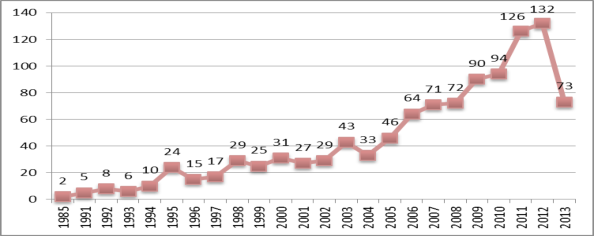
The figure 1 shows the annual distribution of articles on the issue from the 1985 to 2013.
Figure 1: Annual totals of papers on RI distributed across Management and Business and SSCI’s categories (1985-2013) (Our elaboration)
The scientific production on the topic shows an irregular trend. It has been characterized by a significant decrease in the 1996 (-38%), 2004 (-23%) and 2013 (-45%) and a significant growth rate during the 1995 (+140%), 1998 (+71%), 2003 (48%) and the 2011 (34%).
The increasing interest in the topic during the studied years ranges from many fields (e.g. marketing, management, operations, etc.), and many research interest (e.g. HRM, R&D, innovation, internet and the interactive communication technologies, the competitive advantage as strategic priority, the dynamic capability, etc.).
However, the first contributions on RI could be traced in 1985 (source ISI Web of Science), the increasing number of articles and the different domains emerging in the last years allow us to account for it as a new stream of research that is in an evolutionary stage.
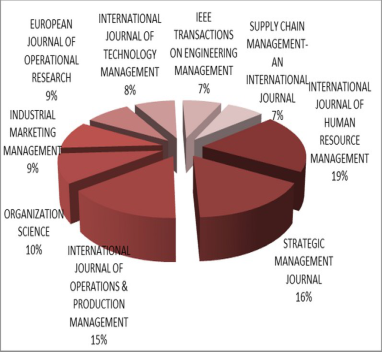
These reflections are confirmed by the analysis of the journals publishing papers within the field of RI. The 1072 papers included in our sample have been published by 186 different journals with an average of 5.76 papers per journal. Data reveal two opposite trends: the polarization and the significant fragmentation on the scientific production per journal. Indeed, 32% of the journals published more than five papers by producing 76% of the contributions in the field. Among these, the first ten journals (the most productive journals) covered 36% of the scientific production. On the other hand, data reveal that 48% of the journals included in our sample published 1 or 2 articles on the topic. As stressed above, we relate this phenomenon to the recent cross fertilization of the topic and to the emerging of new research domains that draw the interest of journals that are traditionally far from the topic. The process of cross-fertilization could have a positively impact on the development of a more comprehensive and interdisciplinary body of knowledge (Benavides-Velasco et al., 2013).
Specialized journals in the area of management as International Journal of Human Resource Management, Strategic Management Journal and International Journal of Operations & Production Management have published the largest number of publications (figure 2). This area dominates, indeed, 43% of the journals included in the sample relates the topic of management with a productivity rate of 57%. Differently, journals in the area of marketing as Journal of the Academy of Marketing Science, Marketing Science, Marketing Theory, etc. are less common. They represent the 7,5% of the sample and have a productivity rate of 2,6%.
USA with 465 papers (43,3% of the scientific production in the field) stands out as the most productive country (figure 3). In the second place and at the top of the European ranking we find England, while the other EU countries are positioned behind China, Australia, Taiwan, etc.
Figure 2: Most productive Journals on RI (Our elaboration) Figure 3: Most productive Countries on RI (Our elaboration)
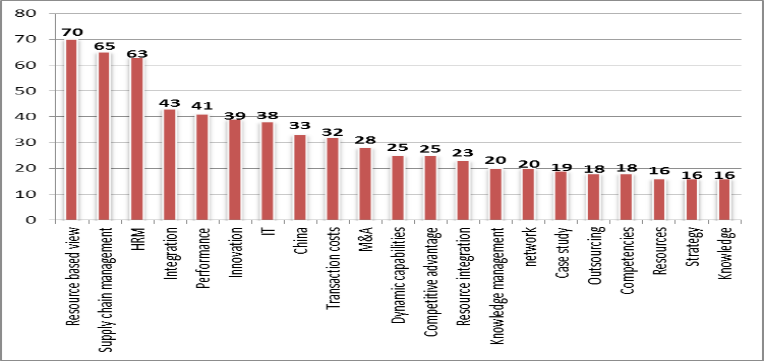
Figure 4 shows some interesting results about the frequency of the author provided keywords. It confirms previous results emerging from the analysis of journals and shows how well-established themes linked to the topic strategic management dominate within the contributions on RI.
By extending the analysis beyond the fifteen most cited keywords new themes emerge, such as, value co-creation, SDL, internet, service industries, sustainable, etc. The analysis shows the high heterogeneity of research in this field of study, as the 47% of the keywords are cited just one time. The low level of frequencies confirms the wide variety of information characterize researches on RI.
Figure 4: Most cited keywords (Our elaboration)
The Bibliometric Map To frame the state of the art, and to trace some trends in the research on RI, we adopted both the mapping and the clustering techniques. They allow us to analyze the keyword co-occurrence network by means of a bibliometric map that shows the divisions and associations between the main concepts in the field of RI.
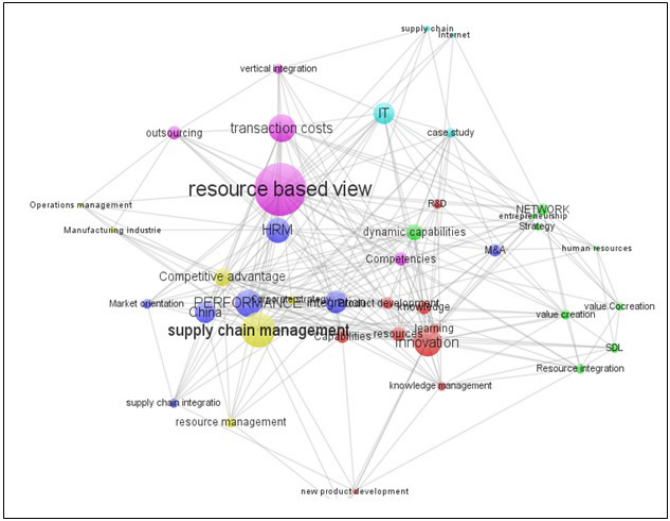
The following map (figure 5) identifies and discloses the structural and dynamic aspects of scientific research on RI. It shows descriptors (e.g. keywords) of the central concept (RI), and provides information on how they relate to each other (Pinto, Pulgarín and Escalona, 2014). The size of the colored bubble is straight linked to the number of descriptors occurrences. “The more important an item, the larger its label and its circle” (van Eck and Waltman, 2010, p. 256). Colors indicate the cluster to which a descriptor belongs to.
Figure 5: The concept map of Resource Integration (Our elaboration)
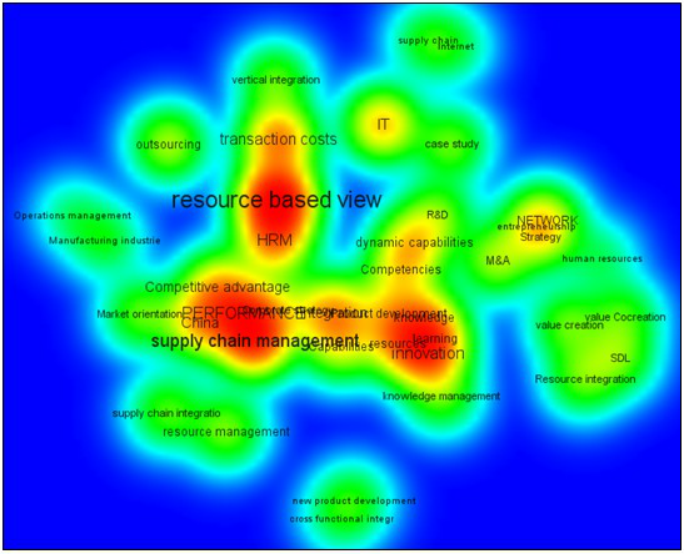
“Resource based view” is the central most important descriptor. It is characterized by the greatest number of links with other descriptors. It is followed by “supply chain management”, “innovation”, “performance”, “HRM”, “transaction costs” and “China”. First three significant descriptors belong to different clusters. Descriptors on the edge of the map, such as, “supply chain”, “internet”, “cross functional integration” etc. have little connection with other descriptors (this concept is more clearly displayed by the density map; figure 6). The map shows an ostensible nonsense. Indeed, “supply chain management” is a key descriptor of the research field, whereas “supply chain” has a scarce relevance, as it is on the edge of the map.
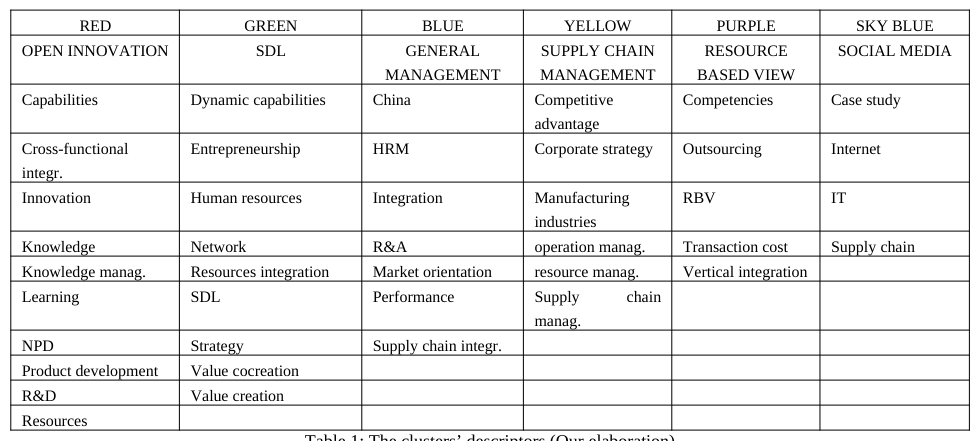
The map shows six clusters, distinguished by different colors, we labeled according the content after the analysis and the interpretation of data. The table below shows the main descriptors for each cluster. The proximity among clusters indicates a close relationship between their sub-fields, while clusters far from each other indicate only a weak relationship. The clusters distribution in the map is heterogeneous. The central area of the map is empty and all the descriptors are asymmetrically distributed around it.
Table 1: The clusters’ descriptors (Our elaboration)
The analysis of the normalized link strength of the central descriptors revealed some interesting aspects about the association strength of key concepts. This measure allows us to compare in a fair way the co-occurrence frequencies of concepts occurring in many and few abstracts (van Eck and Waltman, 2007).
“Resource based view” has the strongest relationship with “transaction costs” (3.68), “supply chain” (3.01) and “resources management” (2.32). “Supply chain management” has the strongest relationship with “resource management” (5.20), “operation management” (4.70) and “cross functional integration” (4.11). “Innovation” has the strongest relationship with “R&D” (4.72), “new product development” (4.02), “knowledge management” (3.76) and “network” (2.87). On the contrary it has a weak linkage with “resource integration”, “SDL” and “value creation” (1.18), as well as with “value co-creation” (1.43). Of course “resource integration” (green cluster) has the strongest relationship with “SDL” (17.36) and “value co-creation” (12.66), as it identifies a specific research domain. Furthermore, it is interesting to note the strong linkage with “new product development” (5.91) in contrast with the weak linkage with “innovation” (1.18).
Figure 6 shows the co-occurrence density map for the RI field. The color of each point in the map depends on the density of items at that point: “the larger the number of neighboring items and the smaller the distances between these items and the point of interest, the higher the item density. Similarly, the higher the weights of the neighboring items, the higher the item density” (van Eck and Waltman; 2010, p. 533). As stated by the authors, the density map allows us to get a quick overview of the important areas within the research field. Colors are assigned by default; red corresponds with the highest item density and blue corresponds with the lowest item density. “They indicate the amount of attention researchers pay to the research topics located in the various areas of a concept map” (van Eck and Waltman, 2007). The amount of researchers’ attention is evaluated according to the number of scientific articles concerned with the specific keyword (van Eck and Waltman, 2007). Red color identifies more investigated and well- established research topics, whereas, green/yellow color identifies new and emerging research areas.
Figure 6: The density map of Resource Integration (Our elaboration)
The density map shows three more important areas. Each of them relates the first three central descriptors of the study: “resource based view”, “supply chain management” and “innovation”. They are the most consolidate domains within the research field we investigated. The boundaries of each domain mark exactly the studies within these fields. Specifically, the map shows two opposite trends; on one hand, the strong separation of the “resource based view” area from the other ones, and on the other hand, the weak separation between the “supply chain management” and “innovation” areas. In this latter case a smaller research domain including the descriptors “integration” and “capabilities” creates a continuum between the two areas.
Other important research areas relate domains including: i) “dynamic capabilities”, “competencies” and “R&D”, at the top of the innovation domain; ii) “IT”, that is located very far from other research domains; and iv) “network”, “entrepreneurship” and “strategy”, that identify specific and consolidated research areas within the SDL cluster (green). The research area marked out by “resource integration” and “SDL” shows a lightweight green/yellow color. It could be defined as a new emerging domain within the general field of studies on resource. It reveals that the label “resource integration” doesn’t identify the general field of study but identifies a process within the general paradigm of SDL.
DISCUSSION
We conducted a bibliometric study to review the literature on the issue of resource integration in management and business studies. The literature review highlighted that the earlier contributions on the topic of resource integration were produced in the beginning of the 90ies, while the peak of interest and production are registered between 2011 and 2012. These first findings are very important in order to understand and also to interpret the evolution of the concept through time, and to draft its different domain. The earliest contribution on resource integration can be framed in the research stream on Resource Based Theory and have been published mainly in Strategic Management Journal and Organization Science on the wake of Barney’s work (1991) and consistently both with the scholar interest for the new themes of resources, competencies (Hamel and Prahalad, 1990), knowledge (Nonaka, 1991) and with the changing business models in many competitive organizations. Through time and consistently with the topic on the top of the scholars’ agenda and area of interest, the concept of RI has been borrowed from other domains such as technology management, supply chain management, operational management. Up to 2010, contributions in marketing journals are scant but starting from this decade the domain of Resource Integration extends to marketing studies and has its production peaks. The interest of marketing scholars and the proliferation of contributions on the topic of RI in these years might be explained by the emerging value co-creation research stream and specifically on the formulation and on proposal of the Service Dominant Logic perspective which broaden the concept of RI and amplify its intensity in the marketing theory. Starting from the statement of FP9 of Vargo and Lusch (2008) and thus the role of RI for value co-creation processes becomes more and more important for value-in-context. Recent contributions emphasize that resource integration requires process(es) and forms of collaboration even underlining the role of institutions in enabling resource integration and value co-creation in service systems (Edvardsson, Tronvoll and Gruber, 2011).
Through the co-word analysis we framed the knowledge domain of RI by identifying six different research clusters which highlight the cross-field feature of the topic. The clusters concern different research stream and affects diverse fields of management (strategy, operation, technology, marketing, social media and digital marketing): Open Innovation, SDL, General topic, Strategic Management, RBV, Social Media/Digital Marketing. Each cluster identifies a well-defined research stream which put first one or another element’s respect to others according to the school of thought or the specific field.
The cluster we labeled Open Innovation (red) is focused on the sharing of knowledge as the main condition for the success of innovation, and emphasize the integration of resource as a mechanism to trigger and foster learning processes. It encloses mainly contributions from the research area of Knowledge Management. Contributions which just sketch RI with regard to surface aspects belong to this cluster; they focus mainly on the typology, nature and process of formation of resources, knowledge and capabilities.
The cluster SDL (green) finds network, resource integration and value co-creation as its main descriptors. It is intuitive that this group encloses recent contributions from marketing scholars who emphasize the role of actors and the dynamic of sharing in the whole resource integration process. The visual analysis of the map (Fig. 5 and 6) shows that in comparison to other clusters SDL holds an edge position isolated from all other interlinked and in some cases (blue and yellow) overlapped clusters: this evidence marks out differences in the content and in the approach to the topic of RI.
We had some difficulties in labeling the blue cluster as it groups diverse cross-field elements, and represents a sort of a miscellaneous box. We named it General Management as we believe that it encloses various contributions which treat the issue of RI according to a common and general meaning without referring to a specific theoretical perspective (such as Resource Based View or Knowledge Management). Particularly the descriptor China stands out, consistently with the distribution per countries (Fig. 3). It confirms that the use of terminology “resource integration” in this cluster refers to a general topic of inter-firm cooperation and improvement of firm performance.
The cluster Supply Chain Management (yellow) encompasses contributions which emphasizes the role of relationship and of the integration according to a supply chain and an operation management approach. The focus is on the management of resources more than on its nature, dynamics and transformation processes and the context is surely the supply chain. The competitive advantage depends on the management of the process of resource integration between the actors of the supply chain; the potential of actors in transforming and integrating resources is still neglected.
The cluster Resource Based View (or Strategic Management) (yellow) gleans the label from its main descriptor. The emphasis is put on the type and on the quality of resources which determine the competitive advantage of firm. The process of resource integration is framed in a transaction cost perspective where it referred just to outsourcing processes rather than to real cooperation processes among actors.
Finally, the Social Media/Digital Marketing Cluster (blue sky) encloses studies and empirical research (as the descriptor case study points out) which identify the web tools and internet platforms as enablers for the cooperation and the integration of resources.
Furthermore the analysis highlighted a clear division within the knowledge structure of RI. The location of descriptors in the density map (figure 6) defines essentially two main blocks. Analyzing the content of the two areas defined by descriptors we identified the two blocks as the two main schools which produced contributions on the theme of RI: the old school of goods-based logic and the recent school of service-based logic.
Specifically, we believe that the descriptors located on the right identify depict a new course of knowledge in the studies on RI as this block encompasses the Open Innovation, the SDL and the Social Media/Digital Marketing clusters. On the other hand, the left side of the map embraces descriptors belonging to clusters such as Supply Chain Management, Resource Based View, General Management which depict the more traditional and consolidated goods logic.
CONTRIBUTION AND FUTURE RESEARCH The aim of this study is to provide a better understanding of the resource integration phenomenon through a bibliometric analysis. The focus is on what RI is and the link between RI and value co-creation. The paper contributes with an overview of marketing and management research in the area of resource integration. Six different clusters have been identified and a number of dimensions of RI in each of the clusters have been put forward.
We also find that the most important topics such as resource based view and supply chain management, both belong to the old school of goods-based logic but at least to some extent focus on dynamic phenomena. We also find that innovation is pretty much a topic isolated from resource based view and supply chain management. Thus, there seems to be very little cross fertilization between different research fields and topics in the area of resource integration research. Furthermore, there seems to be a wide range of definitions and conceptualizations of what RI is, as is the case with the theoretical foundations. This can be seen as an opportunity but also as if the field is becoming more and more fragmented. We can also see that IT is important but may be not as important or dominating as one might expect. This might be explained by IT or ICT being embedded in many if not all the other topic areas, and is most often not treated as a separate area or topic. Finally, Service-dominant logic (SDL) is developing and we show that resource integration is linked to dynamic capability and plays an important role and is dynamic in nature as well as linked to actors’ knowledge, skills and motivation during value co-creation. In a SDL perspective the collaboration between the involved actors is an important enabler as well as inhibitor in resource integration. To sum up, the most important contribution is the overview of what resource integration is, how it has been portrayed in marketing and management research, and a deeper understanding of the six most important dimensions or topics and their theoretical basis.
Future research should focus on the theoretical basis for what a resource is and how resources are becoming (Zimmerman, 1951, Vargo and Lusch 2008). Tronvoll and Edvardsson (2013) define resource integration as the involved actors' activities and interactions when resources are integrated and operated upon. This should be focused on in different contexts such as healthcare, higher education, financial services and service infusion in manufacturing. Since actors in SDL are viewed as resource integrators and resource integration requires process(es) and forms of collaboration, future research should empirically study how and why different forms are selected and how these forms are linked to more or less successful value co-creation processes. Another field for research is how actors’ knowledge and skills shape resource integration in different service systems contexts. Finally we see a need to focus research on the role of resource integration in service innovation.
LIMITS This paper adds value to the studies on marketing as by doing a systematic literature review of RI and by providing a clearer picture of it. However, some limitations, due to the bias that this analysis implies, affect the study. First, this study is based on the retrieved records from only ISIWeb of Science (ISIWoS) database. Although it is one of the most important bibliographic databases (Sakata, et al. 2013; Cobo et al., 2011), ISIWoS doesn’t provide a complete view of the literature on RI. Accordingly, future researches should include other bibliographic databases, such as, SCOPUS, Google scholar, etc. Actually, this limitation partly depends on the lack of specific and standardized tools to collect data more accurately and quickly (i.e., Google Scholar) (Meho and Yang, 2007). The second limitation of the study relates our preference for some specific bibliometric indicators and techniques: the publication trend, the most representative journals and countries publishing in the discipline, and the co-word analysis of highest frequency keywords. Future researches, should consider other bibliometric techniques (e.g., co- citation analysis), as well as, the comparison between different periods to complement this study.
REFERENCES
Barney, J. (1991), “Firm resources and sustained competitive advantage”, Journal of management, Volume 17 No 1, pp. 99-120. Benavides-Velasco, C. A., Quintana-García, C., Guzmán-Parra, V.F. (2013), “Trends in family business research”, Small Business Economics Volume 40 No.1 pp. 41-57. Bhattacharya, S., Basu P. K. (1998), “Mapping a research area at the micro level using co-word analysis”, Scientometrics
Volume 43 No 3 pp. 359-372. Börner, K., Chen, C., Boyack, K. W. (2003), “Visualizing knowledge domains”, Annual review of information science and technology Volume 37 No. 1 pp. 179-255. Brandenburger, A. M., Nalebuff, B. J. (2011), Co-opetition. Random House LLC. Callon, M., Courtial, J. P., Turner, W. A., Bauin, S. (1983), “From translations to problematic networks: An introduction to co-
word analysis”, Social science information Volume 22 No. 2 pp. 191-235. Callon, M., Courtial, J.P., Laville, F. (1991), “ Co-word analysis as a tool for describing the network of interactions between basic and technological research-the case of polymer chemistry”, Scientometrics Volume 22 No. 1 pp. 155-205. Chesbrough, H.W. (2006), “The era of open innovation. Managing innovation and change”, Volume 127 No. 3, pp. 34-41. Cobo, M.J., López-Herrera, A.G., Herrera-Viedma, E., Herrera, F. (2011), “Science mapping software tools: review, analysis and
cooperative study among tools”, J. Am. Soc. Inf. Sci. Technol. Volume 62 No. 7 p. 1382–1402. Cooper, H. M. (1982), “Scientific guidelines for conducting integrative research reviews”, Review of educational research Volume 52 No. 2 pp. 291-302. Edvardsson, B., Tronvoll. B. and Witell, L. 2013, A conceptualisation of service innovation as reconfiguration of actors,
resources and institutions, Paper presented at First International Workshop on Service Innovation Research, September 18- 20, University of Magna Gracia of Catanzaro. In proceeding volume ISBN 978-88-548-6301-9. Edvardsson, B., Tronvoll, B. (2013), “A new conceptualization of service innovation grounded in SD logic and service systems”.
International Journal of Quality and Service Sciences, Volume 5 No 1, pp. 19-31. Edvardsson, B., Tronvoll, B., Gruber, T. (2011), “Expanding understanding of service exchange and value co-creation: a social construction approach”. Journal of the Academy of Marketing Science, Volume 39 No. 2, 327-339. Hamel, G., Doz, Y., Prahalad, C. (1989), “Collaborate with your competitors”, Harvard business review, Volume 67 No. 1 pp.
133 139. Kleinaltenkamp, M., Brodie, R., Frow, P., Hughes, T. (2012), “Resource integration”, Marketing Theory, Volume 12 No 2, pp.
201-205. Lusch, R. F., Vargo, S. L., Wessels, G. (2008), “Toward a conceptual foundation for service science: Contributions from servicedominant logic”, IBM systems journal, Volume 47 No 1, pp. 5-14. Mele, C., Spena, T. R., Colurcio, M. (2010), “Co-creating value innovation through resource integration”, International Journal
of Quality and Service Sciences, Volume 2 No 1, pp. 60-78. Meho, L. I., Yang, K. (2007), “Impact of data sources on citation counts and rankings of LIS faculty: Web of Science versus Scopus and Google Scholar”, Journal of the american society for information science and technology, Volume 58 No 13, pp. 2105-2125. Muñoz-Leiva, F., Viedma-del-Jesús, M. I., Sánchez-Fernández, J., López-Herrera, A. G. (2012), “An application of co-word
analysis and bibliometric maps for detecting the most highlighting themes in the consumer behaviour research from a longitudinal perspective”, Quality & Quantity Volume 46 No. 4 pp. 1077-1095. Ngo, L. V., O'Cass, A. (2009), “Creating value offerings via operant resource-based capabilities”, Industrial Marketing
Management, Volume 38 No 1, pp. 45-59. Nonaka, I. (1991). “The knowledge-creating company”, Harvard business review, Volume 69 No 6, pp. 96-104. Persson, O., Danell, R., Schneider, J. W. (2009), “How to use Bibexcel for various types of bibliometric analysis”, Celebrating scholarly communication studies: A Festschrift for Olle Persson at his 60th Birthday, 9-24. Pinto, M., Pulgarín, A., Escalona, M. I. (2014), “Viewing information literacy concepts: a comparison of two branches of
knowledge”, Scientometrics Volume 98 pp. 2311-2329 Prahalad, C. K., Hamel, G. (1990), The core competence of the corporation. Boston (MA), pp. 235-256. Qin He, (1999), “Knowledge Discovery Through Co-Word Analysis”, Library Trends, Volume. 48 No. 1 pp. 133-159. Sakata, I., Sasaki, H., Akiyama, M., Sawatani, Y., Shibata, N., Kajikawa, Y. (2013), “Bibliometric analysis of service innovation research: Identifying knowledge domain and global network of knowledge”, Technological Forecasting and Social Change Volume 80 No. 6 pp. 1085-1093. Trott, P., Hartmann, D. (2009), “Why 'open innovation' is old wine in new bottles”, International Journal of Innovation
Management Volume 13 No. 4, pp. 715-736. Turiera, T., Cross, S. (2013), Co-business: 50 examples of business collaboration, Infonomia. van Eck, N. J., Waltman, L. (2007), “Bibliometric mapping of the computational intelligence field”, International Journal of Uncertainty, Fuzziness and Knowledge-Based Systems Volume 15 No. 5 pp. 625-645. van Eck, N. J., Waltman, L. (2010), “Software survey: VOSviewer, a computer program for bibliometric mapping”,
Scientometrics Volume 84 No. 2 pp. 523-538. van Eck, N. J., Waltman, L. (2013), Manual for VOSviewer version 1 .5 .4 Vargo, S. L. (2008), “Customer integration and value creation Paradigmatic Traps and Perspectives”, Journal of service research, Volume 11 No 2, pp. 211-215. Vargo, S. L., Lusch, R. F. (2008), “Service-dominant logic: continuing the evolution”, Journal of the Academy of marketing
Science, Volume 36 No. 1, pp. 1-10. Waltman, L., van Eck, N. J., Noyons, E. (2010), “A unified approach to mapping and clustering of bibliometric networks”, Journal of Informetrics Volume 4 No. 4 pp. 629-635. Zhu, W., Guan, J. (2013), “A bibliometric study of service innovation research: based on complex network analysis”,
Scientometrics Volume 94 No. 3 pp. 1195-1216. Zimmerman, H. (1951). U.S. Patent No. 2,570,625. Washington, DC: U.S. Patent and Trademark Office.
LISTED IN THE AHFE DIGITAL BOOKSTORE CATALOGUE
Explore the complete digital volume
Advances in The Human Side of Service Engineering
Read this individual research paper free through the original publisher, or explore the full digital proceedings book.
ISBN 978-1-4951-2091-6
Explore this ISBN in the AHFE Bookstore ↗Listed in the July 2026 bookstore catalogue; search by ISBN to confirm current availability · Digital book purchase optional