Russo Spena Tiziana, Kallio Katri, Lappalainen Inka, Mele Cristina (2019). Knowledge and Learning in Practice-Based Studies: An Integrated Perspective to Understand Innovation. In: Advances in The Human Side of Service Engineering. AHFE Open Access, vol. 8. https://doi.org/10.54941/ahfe100269
This article goes in-depth in the conceptual analysis of knowledge and learning as social cultural phenomena. We focus on studying three practice-based learning approaches we named - “knowing-in practice”, “knowing-in-between practices” and “cultural-historical activity theory”- through their key concepts. More specifically we are interested in how these approaches interpret the creation of new social structures, learning processes, and practices in cultural-historic contexts for the creation of new knowledge, practice and activity. The study brings new conceptual insight to the topical phenomena about learning mechanisms and provides evidence on how these mechanisms have the potential to contribute to innovation. Thus, as our conclusion we state that we benefit on in-depth understanding about different elements of learning in and between actors in order to create better conditions for collaborative development, renewals and innovations to take place.
The contribution of knowledge and learning to innovation has been widely investigated in literature. It is generally agreed that innovation is a process of generating, combining and transforming knowledge (Nonaka and Takeuchi 1995) and innovation and learning have been addressed as most important drivers of business success (Lundvall and Johnson, 1994). However during the last decade innovation and knowledge theories have been transformed by a fervent debate and have moved significantly towards a new conceptualization of these phenomena. In some cases the evolutions are being led by authors who question the epistemological and ontological foundations on which innovation and learning have been grounded in the traditional studies.
On the innovation side, the main insights address to a broader conceptualization of innovation that overcomes the traditional discipline boundaries, as outlined by different authors (Carlborg et al., 2013; Edvardsson and Tronvoll, 2013; Rubalcaba et al., 2012,). They search for the development of new ideas and frameworks that more deeply explain the complex and multifaceted nature, structure and processes of innovation in a new service mindset (Vargo and Lusch, 2008). Innovation is said to nest both service and tangible goods into an integrated overarching service concept (Lusch and Nambisan, 2012; Ordanini and Parasuraman, 2011). It depends on open processes and it is conducted out in networks with external actors, including customers, and involves various employees and managers (Chesbrough, 2011; Rubalcaba et al., 2012, ) through both bottom-up and top-down processes (Rubalcaba et al., 2012, Toivonen and Tuominen, 2009). In addition, innovation exists in a process in which the service provider and service beneficiary (e.g., a customer), together with other social and economic actors re-bundle and integrate resources, values and schema (Edvardsson and Tronvoll, 2013) in a social system to create value for themselves and others, in new and better ways (Lusch and Namisan 2012). Consequently, some authors point out a shifting from positivism and linear innovation models towards socio-constructivism and complex social processes of interacting among multiple actors (Edvardsson et al., 2013). More attention is also being paid to social and work activities as venues for innovation (Toivonen and Tuominen, 2009), while innovation as a blurry, emergent and uncertain process takes center stage as more actors, both outside and inside of organizations, participate in the process (Chesbrough, 2011, Lusch and Nambisan, 2012, Rubalcaba et al., 2012).
On the knowledge and learning side, the main contradictions to the established knowledge theory within management and organization studies (Nonaka and Takeuchi, 1995) stem from practice- based learning studies. During the last decades, this research stream has started to affirm (Gherardi 2008) through a hard critique of knowledge understood according to the logic of possession (Cook and Brown 1999; Gheradi 2000). Practice based authors use the foundations of Lave and Wenger’s (1991) community of practice learning theory to suggest that practices or actions should be the critical point of analysis and that understanding knowledge requires examining the context in which it is used and developed (Brown and Duguid, 2001). Scholars within the service innovation research stream and practice-based learning theories posit many challenges to the theoretical debate. In some cases the new issues have decreased the uncertainty and the opacity of the topical concept they address. The debate within both research streams is still in progress and lacks a clear, well- established definition of what innovation means or what practice-based learning approaches entail.
Although generalization is difficulty, it is possible to trace some links across the literature on the evolution of both research streams. We see that both knowledge and innovation are no longer seen solely as things that can be created or possessed (e.g. scientific facts, physical output). Knowledge and innovation are co-constructed in social interaction by utilizing and integrating resources, schemas, artifacts and tools within and between individuals, groups and organizations in action and in practices (Engeström, 2004; 2007; Gherardi, 2000; 2009a; Svabo, 2009). However, although innovation and practice-based learning studies are potentially relevant to one another, we see that they have evolved independently with little theoretical integration.
The contribution of learning to new innovation traditions has remained somewhat ignored and therefore not problematized. According to Ellstrom (2010) the innovation research has focused too much on the idea of knowledge as a commodity acquired and transferred through formal learning processes (such as education and training programs). The informal or implicit social processes of leaning in everyday work are not taken in to account, as the knowledge and competences are not only used, but also created in the collaborative effort. In addition among practice-based learning theorists the debate is more focused on what the important characteristics of knowledge are and how knowledge is acquired in a social-cultural context. The result is the rise of multiplicity of studies (Gherardi 2009b) without unified perspective on knowledge and learning processes. In addition the debate lacks an understanding of which elements of knowledge and learning as social-cultural processes have critical implication in organizations and their innovation efforts. Moreover, some management researchers complain that too often, learning in organizations is seen as subjective and vague whereas new conceptual models might be needed (Zollo and Winter, 2002). .
The purpose of this paper is to go in-depth in the conceptual analysis of knowledge and learning as social cultural phenomena to understand how the mechanisms underlying learning processes have important implication in organizations and their innovation activities. This work is part of a wider research project on practice-based learning approaches to innovation aimed at investigating the benefit of a deeper discussion about the mechanisms and interfaces of innovation and learning. The project is still in progress. In the present work we address the first stage Human Side of Service Engineering (2019) of the research project. Here the focus is on clarify the learning conceptual constructs that have been defined in numerous ways across the wide array of practice-based studies (Gherardi, 2000). First we present an overview of the practice-based theory by introducing the epistemological foundation of practice and the different research streams it creates. Then, we build on the contribution of Nicolini et al. (2003) and Corradi et al. (2010) in distinguishing among the different perspectives on learning processes within the practice-based theories. The literature review proves useful by adding articles and other sources to our literature base. By deeply analyzing and integrating authors’ positions, we focus the study on three main approaches: “knowing-in-practice,” “knowing-in- between-practices” and “cultural-historical activity theory”. These approaches are aligned with Gherardi (2000), Ellström (2010) and other practice scholars (Brown and Duguid, 1999) who see the learning process as capable of enabling changes in practices that result in innovations. We then examine the approaches for their analyses of elements at the basis of learning and explore how the theories could converge to support a more robust learning framework for innovation. Finally we compare the approaches and explain the need for a more integrated perspective in which the theories complement each other and could contribute to the expansion of the domain of practice-based learning in innovation.
PRACTICE-BASED STUDIES An overview
Recent studies introduces to the practice-based lens as an epistemological choice to understand phenomena in organizations and society (Corradi et al., 2010; Gherard,i 2009a). Theory of practice is wide and fragmented (Gherardi, 2000). The practice-based approach engages researchers from organization and knowledge studies (Gherardi, 2000), strategy (Jarzabkowski 2003;Wittington 2003) and leadership (Carroll et al., 2008), markets (Hackley et al. 2009; Kjelleberg and Helgesson, 2007), marketing (Storbacka and Nenonen, 2011) and consumer research (Schau et al 2009; Tronvoll et al., 2011; Warde, 2005). Also, Korkman et al. (2010) draw from practice theory and Service-Dominant logic (Vargo and Lusch, 2008) to outline practices as resource integrators and thus as fundamental units of value creation.
Innovation studies have addressed the practice-based approach only marginally. Preliminary insights come from studies of Orlikowski (2002) and Dougherty (2004) which focus on practice-based knowledge and its link with innovation. Swan et al. 2007 also deal with practice based innovation stressing the relationships between objects, knowledge, work practices, social groups, and social contexts. Recently, Russo-Spena and Mele (2012) by using practice lens define innovating as a co-creation process that involves an array of factors, including actors, actions and resources, in addition to the mere innovation output itself.
A commonality in practice-based studies (PBS) is the discourse that the unit of analysis is a practice or a set of practices rather than an individual or organization. A practice has been defined as a way of doing that is embedded in inwardly and outwardly linked elements (Korkman et al., 2010). The practice lens joins the individual and collective dimensions and the human and technological elements, emphasizing doing and knowing.
Knowledge and learning insights The practice based learning approaches have become influential among researchers studying organization and organizational knowledge management. Characteristic to practice-based learning studies is that they are multidisciplinary in their search for non-rational-cognitive view of knowledge. According to Gherardi (2008) the practice turn is accomplished in the shift from knowledge (object) to knowing (activity) where the latter is something that peoples do together collectively and socially. Knowledge does not reside in people’s minds nor it’s a commodity that could be simply transferred from one context to another; rather it is an activity situated in social, working and organizational practice (Nicolini et al., 2003).
The practice scholars mainly follow Lave and Wenger’s community of practice learning theory (1991) that first questioned the difference between knowledge, which can be objectified and is independent and knowing which Human Side of Service Engineering (2019) implies a process or action whereby object, subject context and knowledge are indistinguishable. The concept of situatedness and the sociality of knowledge are encapsulated in the idea of community where practitioners are connected by joint enterprise, mutual engagement, and a shared repertoire of resources, experiences, stories, tools, and ways of addressing recurring problems (Wenger, 1998). Practitioners in a community have a shared understanding of what the community does, of how to do it, and of how it relates to other communities and their practices. It is only through the practice that the value of knowledge becomes apparent and knowledge is conceived necessarily as product of the activity, context, and culture in which it is used. Legitimate peripheral participation is a term Lave and Wenger (1991) have coined to refer to the progressive involvement of newcomers in a practice as they acquire competence (Nicolini et al., 2003) by practicing in a community and building a way of being a practitioner in the world. Competence and identity are intertwined and depend on recognized participation in a community of practice that is inseparable from doing.
The key insight, thinking of learning through participation in practice enables authors not only to shift focus to the spatiality of practices as situated in specific context (Cook and Yanow, 1983) but also to convey the aspect of fabrication and facticity of knowledge (Gheradi 2008 ). Gherardi (2008) remarks that knowledge is fabricated by the situated practice of knowledge production and reproduction and that participating in practice is consequently a way to acquire knowledge in action and to change and perpetuate such knowledge. This view reinforces the concept of practice as a working activity that transforms knowledge, activity and social relation (Brown and Duguid, 2001). In this sense the reverse concept of practices of communities (PoC) is used by Brown and Duguid (1991; 2001) to counteract the idea of practice as canonical way of work that converges towards the conventional tasks and jobs. The purpose is to show how informal groups form work around practices to improvise solutions to problems, when canonical accounts of work break down (Brown and Duguid, 1991). The practices of communities cut horizontally across vertically integrated organizations and emerge as a network of practices through collective learning activities. These are based on situated and improvisational work and on the simultaneous and interdependent construction of identity and community.
Similarly Østerlund and Carlile (2005) point out as community of practice is essentially a picture of how knowledge is socialized into a rather static practice community, while it does not consider the relationship between communities as a potential driver for change. Amin and Robert (2008) argue for the importance of differentiating among varieties of communities and refer to the epistemic community (Haas, 1992) to identify communities that create new knowledge never existing before and based on the mobilization of ambiguity, uncertainty, and changes. However, it is the activity theories perspective (Engeström 1987; 2004; Blacker et al., 2000) and the efforts of sociology of translation scholars (Gherardi and Nicolini, 2002) that has most thoroughly introduced the changing dimension needed to understand the dynamics of learning and practices. These orientations took place in the 2000s as a “counter trend” that entirely dissolves the idea of practice as routinized activities although they retain the idea of knowledge and learning always rooted in a context of action and interaction.
As the discourse on practice and learning has expanded, many learning scholars have taken a renewed interest in practice-based studies (Corradi et al., 2010). To illustrate how this discourse emerges and includes different perspectives and approaches, the next sections will compare and contrast the theories. The cross-comparison offers a basis for a framework that traces the progress in the disciplines and provides a guide for the development of practice-based debate on learning and innovation.
PRACTICE BASED LEARNING APPROACHES: A CATEGORIZATION Finding a framework to treat practice-based learning approaches as a homogenous strand of thought is really difficult, given that the approaches comprise many sometimes conflicting discourses (Corradi et al., 2010). Nicolini et al. (2003) in their attempt to provide a classification clustered practice-based learning approaches into four distinct traditions. These are the cultural interpretive tradition presented by Yanow (2000), social learning described by Wenger (2000), cultural and historical activity theory presented by Blacker et al. (2000) and Engeström 2004), and the sociology of translation presented by Gherardi and Nicolini (2002) and Shuman (2003).
Recently, Corradi et al. (2010) have also introduced a different way to categorize practice approaches by using different labels. More precisely they introduce three labels for sharing a common discourse on knowledge and Human Side of Service Engineering (2019) learning as concepts to define practice. These are the practice-based standpoint represented by Brown and Duguid (1991), the practice-based learning represented by organizational learning scholars (Carlile, 2004; Nicolini, 2007; Strati, 2007), and knowing-in-practice studies including Gherardi’s (2000) and Orlikowski’s (2002) studies.
The spread of the practice concept has led to a wide variety of definition and authors claim a more integrated perspective (Gherardi, 2009; Gherardi and Strati, 2012; Nicolini, 2011) to create a more accurate and complete depiction of the role of knowledge and learning in organization phenomena. Distinguishing between knowing in the practice and knowing the practice Gherardi (2003) provides an initial step forward in the understating of the knowledge as an institutionalized outcome and practicing as an institutionalizing process that changes the practices. However more still remains unknown about how the dynamic of practices has been addressed in the literature and on how practices and learning change either incrementally or radically through the application of situated knowledge in the social context. From a dynamic perspective of change in practice and learning three main approaches seem to emerge in the literature. We named these perspectives knowing-in-practice, knowing-in- between-practices and cultural-historical activity theory. Each of these approaches is composed of a number of characteristics that indicate what learning are and which are elements through which they unfold. We discuss these approaches and their elements in the next sections.
Knowing-in-practice approach In the literature on practice many authors differentiated by the use of the expression knowing instead of knowledge. Inspired by Lave and Wenger’s (1991) learning theory, knowing-in scholars have attempted to explore the link between knowledge and the practices of organizational members that is to examine what is termed a process of knowing in practice (McIver et al., 2012). Insights from ethnomethodology studies (Garfinkerl and Giddens, 1984) guide the research of knowing in-practice scholars (Brown and Duguid, 1991; 2001; Cook and Brown, 1999; Orlikowski, 2002; Tsoukas, 2005; Wenger, 2000) who see knowledge as applied and dynamically produced when actors regularly engage the world in practice.
Cook and Brown (1999) in distinguishing between epistemology of possession and epistemology of practice have placed knowledge in the former case and seen it as a tool in service of knowing, which is about activity and relationship as opposed to a substance, commodity or piece of information (Svabo, 2009). Knowing is seen as situated in the system of ongoing practices of action and it is different in the sense that is relational, mediated by artifacts, and always rooted in a context of action and interaction (Cook and Brown 1999, Brown and Duguid 1991, 2001). The relational nature of knowing is seen not only in the sense of Lave and Wenger’s (1991) and other social learning scholars (Wenger 2000) discussion about participation as identity building process. Knowing is also an aspect of individuals doing work in interaction with things and the activity of the social and physical world (Brown and Duguid, 1991; 2001). This means that to be acquired knowing requires some form of interaction in a situated socio-cultural and material context and these aspects also differentiate it from tacit knowledge and know how. This marks the difference from Lave and Wenger’s (1991) idea of knowledge as pre-existing to activities of practitioners and contained in a community of practice; knowing implies the idea of knowledge as continually produced by the ongoing activity of practitioners within practices through practicing (Brown and Duguid 1991; Cook and Brown, 1999). Knowing- in-practice scholars embrace a view of knowing that has to do not only with re-productive work of knowledge done by practice but mainly with an epistemic work inherent in action (Brown and Duguid 2001).
The distinction between practices as canonical (or espoused) and non canonical (divergent from conventions) task runs throughout Brown and Duguid’s (1991) arguments to clarify the distinction between working and learning. Meanwhile work practices often follow the prescribed lines of canonical communities, learning is more likely to emerge across the fault lines of communities. Learning becomes a sort of bridge between working and innovating, i.e., learning emerges in practice and is deeply implicated in the series of canonical and non-canonical practices that take place in the different communities of practices that compose the organization.
However knowledge is not omitted from the discourse on knowing as it is the interplay between knowledge and knowing that can generate new knowledge and new way of using knowledge (knowing) (Cook and Brown, 1999). Participation in practice is a way to acquire knowledge-in action but it also could be seen a way to change such knowledge and to produce and reproduce reality (emergent reality; knowledge as material activity). Practices are Human Side of Service Engineering (2019) not simply routinized actions because their execution involve a learning process that occur both through know how and know what in actions and as a result of the reflective activity of human actors. Stressing the social nature of knowing and learning does not mean dissolving the role of the agent in the practice. Common to the knowing-in practice scholars is the view that learning involves mainly understanding a dynamic interaction between the agent, knowledge and practice and this is only feasible by providing evidence of how knowledge and knowing mutually interact.
Orlikowski (2002) has encapsulated this concept in her knowing-in-practice perspective. Eschewing a distinction between knowledge that exists “out there”, encoded in external objects, routines, or systems and knowledge that exists “in here”, embedded in human brains, bodies, or communities (Orlikowski, 2006) she has emphasized the knowledgeability and reflexiveness of human actors. The knowing and learning happen as individual go about their tasks, monitor the subsequent flow of action and obtain new knowledge or adjust and update their existing knowledge according to these new experiences. Aligning with the social learning approach (Wenger, 2000) the cultural interpretive tradition developed especially by Yanow (2003) have focused on those practice mechanisms that sees individual acquiring knowledge in action in the form of participation in context. Contextual elements including language and objects are seen to shape how individuals learn and how they acquire knowledge and competence.
In summing up the knowing-in-practice perspective examines the specific activities that people engage in while solving problems during their daily interactions. Knowing-in-the practice and knowing the practice are seen as two side of the same coin. Knowledge and learning develop from and are manifested in practice, expertise and skills at work and are iteratively sustained by a mechanism of social interactions with the social and material world (Brown and Duguid, 2001)
Knowing–in-between practices approach Many practice based authors describe practices as a negotiated activity of ordering and resolving differences that depend on a range of spatially and distributed knowledge within knowledge communities (Lindkvist, 2005) or communities of practices (Gherardi, 2009b; Nicolini et al. 2003).
This perspective embraces the view of authors who look at the range of mechanisms through which local practices are constituted and connected within and across organizations embedded in their socio economic and institutional context, rather than considering practices as a purely organization accomplishment. The discussion of Gherardi (2008) about practices as a between in concept is of particular interest in this sense. The author argues that the concept of practices constitutes a bridge between antithetical concept because “practices lies in the habitual features but has also the characters of purposeful action” …and…” they are nor habit nor action” (Gherardi, 2008 page 523). Gherardi (2001; 2008) also highlights that this dynamic occurs on one hand as practices are internally changed. On the other hand the social dynamic is described as stemming from the ongoing conversation among practitioners on normative standards, that is, what makes a practice good or how it needs to be changed. The collective dimension of learning and practicing is emphasized, and it is conceived as the result of reflective activities emerging from a dialogue and questioning between and among practitioners (Gherardi, 2000; 2008; 2009a; Nicolini et al., 2003).
Practices signifying the set of recurrent activities governed by prescription norm and values in a prefixed and special social domain are in part overcome by the idea of practices that are capable of bridging the heterogeneity of skilful social undertakings and that allow for a certain degree of variance and changes in the interactive works (Bruni et al., 2007; Nicolini et al., 2003; Nicolini et al., 2012). The interest moves towards the analysis of social and collective learning that take place at the boundaries among different communities (Nicolini, 2011; Nicolini et al., 2012) as not a single, local practice but rather as a shift in the overall nexus of interconnected practices (Gherardi and Nicolini, 2002) . The attention is thus diverted from the practice itself to what Nicolini et al. (2003) call the texture of connection of practices in which it is immersed.
As Nicolini (2011) notes a dialectical mediated processes of learning take place not only in relation to individuals framing their understanding with practices, but also in relation to a dialectic process and a negotiation of established practice and knowledge, symbols and artifacts and mediated objects (Gherardi and Nicolini 2000; Nicolini, 2011; Nicolini et al., 2012) Organizational knowledge is seen as a the product and the process of a Human Side of Service Engineering (2019) translation made by an action network comprising individuals and communities, organizations and institution and their intermediaries. These intermediaries include human and non-human actors such as technologies and discourse carrying situated knowledge (Gherardi and Nicolini, 2002; Nicolini et al., 2003; Nicolini et al. 2012; Orlikowski, 2002). Insights from the Actor network theory (Latour 1987) inspire the works of social translation authors (Gherardi, 2008; Nicolini et al., 2012) in emphasizing the constitutive power of associations in the nexus-shaped context of practices. Any form of social order is stated to be an outcome of observable instances of ordering, and learning is also understood as mediated by comparison among the perspectives of all the co-participants in practices but does not necessarily involve merging and synthesis as a result. Carlile (2002; 2004) stresses the importance of observing discussing and acting in relationships with other actors and in connection among practices. In her approach the role of the boundary object emerges. Their bridging activity provides the communities of practitioners with a venue to communicate coordinate and collaborate. Boundaries objects are both means and products of interaction and of learning in and between communities (Carlile 2004). They are critical because they allow the emerging local knowledge of particular groups to be accessible to others within the broader epistemic communities (Gherardi, 2008; Nicolini, 2011).
What becomes apparent is that learning is sustained and created in multiple interactions and social practices. Cunlifee (2008) note that learning is intersubjectively and ongoingly created shared senses which participants see at the moment as providing acceptable orientations and way of moving on (page 133). Learning as dialogical process explores the different way of seeing and interpreting issues and in searching for a bridging and sharing, the possibilities for changes are created (Geiger and Kepler 2009; Geiger and Schreyögg, 2009). The discourse on practices and among practitioners or communities becomes a specific practice itself whose aim is not only to reach understanding or produce a collective action but also to foster learning by incorporating everyone’s perspective.
In summary, Gheradi's knowing-in-between (2008) concept provides a useful category to develop the idea of practices as a mode that is relatively stable in time and as socially recognized way of ordering heterogeneous items into a coherent set (Gherardi 2006 page 34) that remains attentive to emerging events. Learning and knowledge follow the same argument. They are not only situated in enclosed groups, but they are also distributed in and between groups and involve human and non-human actors (Gherardi, 2008). They develop through an in-between process of production and reproduction between stabilization and innovation (Gherardi, 2009a; 2009b)
Cultural-Historical Activity Theory Cultural-historical activity theory has much in common with contemporary anthropological, ethnometodological and actor network approaches (Blackler et al., 2000). However, its roots lie in Russian psychology. Engeström, the main developer of cultural-historical activity theory, built its conceptual framework on Vygotsky’s (1978) cultural- historical psychology and Leontjev’s (1978) activity theory, combining them with ideas from pragmatism and constructivism. Engeström introduced the theory to organization studies in the late 1980’s (Engeström, 1987). Its main starting point is that human capacities develop and abilities emerge in action with the historical and cultural setting in collaboration with others in the co-construct of social reality. The theory doesn’t follow only the actors, but takes into account the structures and systems dynamics, and focuses on the emancipation of thought and the creation of new skills, activity and practices. In this way it interprets practice as an activity and explores the links between events and context.
The most important key concepts of cultural-historical activity theory (Engeström 1987; 2004; 2007) relate to the view that human action is object-oriented and those actions take place in a socio-technical activity system as communities with certain tools, rules and division on labor. The object of activity is seen to differ from goals in that a “goal is conscious, short-lived finite aim of individual actions” whereas an “object is heterogeneous and internally contradictory, yet enduring, constantly reproduced purpose of a collective activity systems that motivates and defines the horizon of possible goals and actions” (Leontjev, 1978). For example, the object of activity for a doctor can be the treatment outcomes instead of just diagnosing symptoms. Moreover, a change in the activity, or the expansion in the object, means a tension and a change needs in some or all of the elements in the activity system. Typically, these tensions and conflicts trigger the need to change in the first place (Engeström, 1987).
Cultural-historical activity theory provides the ability to examine the daily life, development and learning practices from constructive and process-oriented perspectives for the creation of profound changes in the activity (Engeström, 1987; 2004). It approaches the process of learning as collective development, and is interested on the ‘expansion of the object’ (Engeström, 1987). Expansion of the object refers to the process in which the learner(s) focuses on not just the problem at hand but also on the wider context that generates those problems, and consequently, creates a broader horizon of possibilities (Engeström, 2001).
The expansive learning process (or learning by expanding) can be characterized as a conscious, step wise process for the expansion of the object that typically benefits different types of interventions with reflective material (Engeström, 2004). More precisely, the idea (Engeström, 2007) refers to a process in which an activity system, for example a work organization, resolves its internal and external contradictions by constructing and implementing a qualitatively new way of functioning for itself. This new way refers to a complex and time consuming learning process in which people come to recognize tensions within their activity systems, reflect on their origins, discuss alternatives, and collectively refashion an activity system around the reconceived object of activity (Blackler et al., 2000; Blackler and Regan, 2009). Typically the process includes five phases: 1) perceiving the contradictions in the current way of acting (need for change); 2) constructing new object and motive; 3) forming a work hypothesis or concept; 4) implementing (experiencing / experimenting) the new concept and 5) generalizing the qualitatively new way of functioning.
In his 2007 article Engeström emphasizes that expansive learning requires a strong personal involvement by the participants. It is possible that in certain “potential episodes” learners unite with specific situational solutions and ideas of general systemic change. The personal and the collective, as well as the immediate and the future oriented can merge in these phases, and the actors move (in their cognition) between actions and activity, and among past, present, and envisioned future. The pursuit of newness is central to the cultural-historical activity theory and is interested in the type of learning that requires radical exploration for the generation and reconceptualization of the type of activity that does not yet exist, and thus, may serve as a seed for innovations (Lounsbury et al., 2007).
Moreover, today learning among different activity systems is needed. Engeström (2004; 2007) calls this co- configuration (see also Victor and Boynton 1998) which requires continuous collaborative learning and creation of solutions according to customers’ and users’ needs. This requires flexible “knotworking” (viz. distributed collaborative expertise in pursuit of a task- Engeström et al. 1999) and takes place in heterogeneous patchworks of small and large, unnoticed and noticeable actions, in which no single actor has the sole, fixed authority or ready- made rules. Rather, real-time interpretation and the synthesizing of information between the parties require new dialogical and reflective knowledge tools, collaboratively constructed rules, and infrastructures (Engeström, 2004; 2007).
In his (2004) article Engeström writes that it is not so well understood how such forward-oriented expansive learning is intertwined with movement across activity systems. Concepts such as boundary crossing, multi-voiced dialogue, negotiated knotworking, and cognitive trail-blazing have been advanced. These concepts create good starting points for putting the idea of horizontal and inter-organizational dimension of learning in the center as seeds for collective innovations, but more research is needed to create the next generation of expansive learning theory for the inter-organizational and horizontal perspectives.
A COMPARISON AMONG PRACTICE-BASED LEARNING APPROACHES The literature analysis allows us to trace the content of the contributions of the three approaches to the development of practice-based theories on knowledge and learning. We want to move beyond the analysis within approaches and offer a comparison among the three approaches of knowing- in-practice, knowing-in-between practices and cultural- historical activity theory. A cross-comparison highlights similarities and differences and offers a basis to frame an integrated approach to practice-based learning.
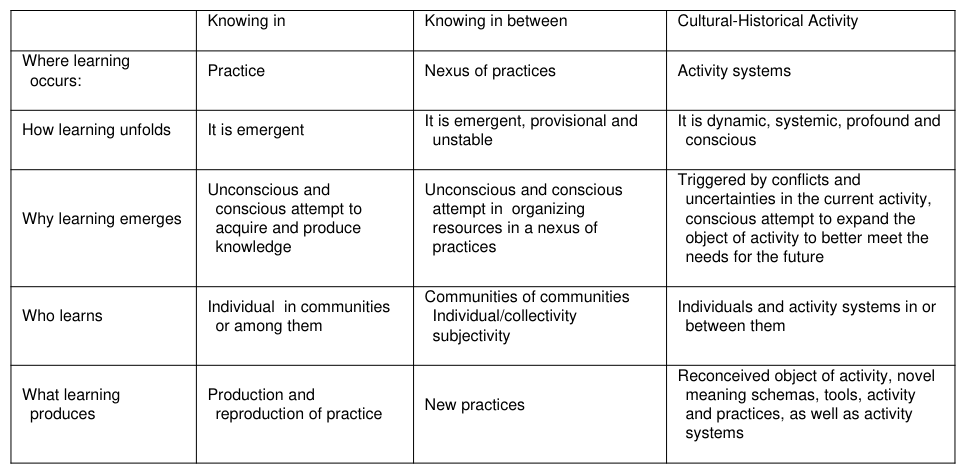
We started from Lundvall and Johnson (1994) who distinguished among four different forms of producing knowledge – know what, know how, know why and know who. Moreover by examining arguments of the different Human Side of Service Engineering (2019) approaches we identified an additional element- the “where”. This latter category shapes all the other forms of knowledge and learning and as in practice-based studies (PBS), the unit of analysis becomes the practice itself which is the locus of working and doing. The following table articulates the results of our analysis based on the set of elements we identified to address our comparison.
The first category concerns the dimension of where that is the locus where the knowing and learning are undertaken. In the knowing-in-practice approach the practice is the locus of learning that takes places in social relationships that normally occur in the workplace. Learning focuses on the way individuals interpret or make sense of their knowledge and experience at the work (Brown and Duguid, 1991).
Table 1. A comparison of the approaches Knowing in Knowing in between Cultural-Historical Activity
The knowing-in-between practices approach looks at nexus of practices as loci where individuals together construct an understating of what they have around them and learn from the social practice of collectively organizing and ordering resources for action (Gherardi and Nicolini, 2002). Practicing is not merely a process of recurrent events, it is a movement that develops and unfolds through the intensity of connections that drive the process of changing and learning. The cultural-historical activity theory (Engeström, 1987; 2004; 2007) sees learning taking place in collective interaction, in or between activity systems of certain cultural-historical context. Referring to the second category, the “how”, specific differences can be seen in the way that knowing and learning unfold. For the knowing- in-practice approach the source of knowledge and the learning process lies in the use of knowledge as a tool of knowing within situated interactions with both the social and physical worlds. Knowing and learning refers to the epistemic work that is conducted as part of action or practice; it is dynamic, concrete and relational. These ideas become enriched by knowing- in- between practices approach. This approach proposes the idea that knowledge and learning are not only based on social interactions but also on discursive behavior, which give rise to social order. This social order involves plurality and diversity, human and non human actants and comes about through discourse and negotiation. Knowing-in-practice and knowing-in between practices stressed the idea of learning happens in social interactions between people, alongside work-activity, in the flow of experience with or without awareness of it (Gherardi, 2000). The cultural-historical activity theory sees that the expansive learning is a profound and dynamic process. It refers to transformative learning that radically broadens the shared object by the means of novel tools, models, and concepts that are multilevel and integrated constellations (Engeström, 2004).
By looking at the “why” the learning process emerges, and we address significant differences between the both approaches on knowing on one hand, and the cultural-historical activity theory on the other hand. For example, the Human Side of Service Engineering (2019) knowing-in-practice, and the knowing-in-between practices approaches provide a basis for understanding learning as something that is led by unconscious and conscious attempts. In the first case the attempts are aimed to acquire and produce knowledge in the latter to organize the wider set of resources within a nexus of practices. As already mentioned, the knowledge and learning are viewed necessarily as emergent and dynamic, provisional and unstable (Nicolini et al,. 2003; Nicolini, 2011). The motivation behind learning in the cultural-historical learning theory is the conscious attempt to expand the object of activity to better meet the future needs f that is triggered by conflicts and uncertainties (Engeström 1987; 2004; 2007). This way, the learning mechanisms behind cultural-historical activity theory appear more normative. It shows that conscious aim and motive for learning as a change in the activity is needed in a more step-wise process. It refers to a rather radical exploration process of learning something that does not yet exist and thus it creates new knowledge and new practices for a qualitative transformation of the object and entire activity system. .
Referring to the “who” issue raises the question of the subject of the knowing and learning. The knowing-in- practice is understood as situated knowing formed by actors who act in a particular shared setting and engaging in an aspect of the social and physical worlds. Individual cognition is the basic learning unit and the context in which learning happens is somewhat predetermined (Gherardi, 2009b). The knowing-in-between practices approach takes a more intertwined view. Both the individual and collective dimension form a nexus of interdependence in knowing and learning and each dimension influences and is influenced by the other (Gherardi, 2006). The attention is devoted more at collective dimension of creation of situated discursive practices. In contrast to the knowing- in- practice that focused more on the individual who learns in a community or among communities; in the knowing in between practices, the communities or the collectives can be seen as central to how participants learn. The cultural- historical activity theory focuses on how an entire activity system and its actors transform and sees learning mostly as a collective phenomenon. Learning is described as occurring between different activity systems (Engeström, 2001; 2004; 2007).
Finally we address at the “What” people produce in their situated knowing and learning process. In the knowing-in practice studying the focus is on how practice are socially sustained through situated way of learning and on the criteria for appraising and situating the way of transmitting the practices. This means to look more at how practice is produced and reproduced within the community of its practitioners and it is internally changed (Gherardi, 2008). Knowing- in-between practices illuminates on the collective achievement that allows practitioners to evaluate the various performance of their working practice and in doing so to contest or negotiate a new order of actions i.e. new practices. The cultural- historical activity theory places its focus on the reconceived object of activity, novel meaning schemas, activity and practices, as well as activity systems. In other words, the creation of explicit concepts, models, and tools should lead to the implementation of those concepts and tools in horizontal boundary- crossing encounters. Learning can be understood as changes and emancipation both in cognition and in activity in practical and conceptual level in the activity systems (Engeström, 2004; 2007).
5. OPEN UP THEORIES TOWARDS AN INTEGRATED APPROACH
In this paper we examine how different streams of practice-based learning theories as 1) the “knowing-in-practice” approach (Cook and Brown 1999; Brown and Duguid, 1991; 2001) 2) the “knowing-in-between practices” approach (Gherardi and Nicolini 2002; Nicolini et al.,, 2003 Nicolini 2011) and 3) the “cultural-historical activity theory” (Blacker et al., 2000; Blackler and Regan, 2009; Engeström, 1987; 2004), address theoretically the processes on learning at workplaces, within and between different communities.
By exploring and comparing conceptually the key concepts of these theories our work offers three contributions to the practice-based theories discipline. First we conducted a literature review of most of the studies of each approach, synthesizing the main assumptions. Although we are already able to find some studies comparing practice-based learning theories, the theoretical contribution to an integrated approach on learning is still rather poorly explicated. As Corradi’s et al. (2010) highlighted, the perspectives taking the practice as a conceptual starting point for knowledge and learning has a wide and fragmented theoretical background. In any case, the multiplicity of labels proposed by authors grew mainly from the need to draw a path in the chronology of practice-based studies and the emphasis is more on different definitions under which practice has been discussed. By conceptualizing the intrinsic dynamic of practice the approaches we study, prove helpful in breaking down the aspects of practices - sometimes Human Side of Service Engineering (2019) used to describe repetitive routine activities- and shed light on the inherent reproductive and creative features of practicing. In doing so they offer a useful contribution by considering the critical processes of development and creation of changes and innovation strictly tied to discourse on practice.
Second, our study allows comparison among the different elements at the basis of learning within the three approaches. As a theoretical framework for comparison we utilized the four common forms of knowledge of Lundvall and Johnson (1994) and added the “where” dimension as it is proved to be central in the practice-based discourse (Gherardi, 2008).The framework provides simplified valuable guidance for addressing the different approaches to knowledge and learning. This framework compares the different loci where knowledge and learning unfold and provides evidence on how knowing- in- between practices approach assumes a complex and intertwined idea of context of practicing. In addition the framework allows us to highlights “how” learning takes place differently in the work-activity, and the “why” of learning process. The emergent and unconscious idea of learning in “the knowing-in-practice, and the “knowing-in-between practices approaches counteract an object-oriented view of the learning mechanisms behind cultural-historical activity theory. Furthermore, the framework addresses the different perspectives of “what”— production and reproduction, the creation of new and changes — and “who” — individual in communities or individual/collective subjectivity.
Also by comparing approaches we emphasize the importance of integrating the emergent and normative view of learning for a better understanding of how changes and innovation are produced in practice. From addressing the shortcoming of the knowing-in-practice and knowing-in-between practices approaches emerges the idea of practice in which actors engage in predominantly adaptive learning; in contrast the cultural-historical activity theory opens up to a creative process of learning. By concentrating on the idea of interplay in a nexus of practices our work want also to affirm the need for an integrated practice based learning approach enabling to better address the complex and multifaceted dimension of practices. Learning in a practice-based approach has to address the emerging and the purposeful attempts to acquire and produce knowledge and order as well as the attempts to expand and promote creative learning. In an integrated practice based learning view, learning can be described as a process that has multiple phases dealing simultaneously with the emergence of anomalous activity, the problematization of extant knowledge and practices, the social recognition of novel knowledge and the negotiation of processes that may involve resistance from incumbents as well as calls to legitimize the new knowledge and practices. However, further examination is still needed to specify tentative integrated theoretical framework and also gather empirical evidence to develop it even further.
As the final concluding remarks we state that the practice-based learning theories we compared provide answers to different ways of learning (more emergent/unconscious and more normative, planned and profound). Then an in- depth understanding of these different learning mechanisms creates the understanding that they are not exclusive, rather, they provide better understanding on how learning and innovation can take place differently from socio- cultural and practice-based viewpoints. In this way as theoretical and managerial implications we can see practice- based learning approaches having the potential to contribute to different kinds of innovations (Ellström 2010). Furthermore, from managerial perspective, it is important to be aware of different learning mechanisms in practice- based studies in order to create conditions to enhance innovations in different socio-cultural contexts.
REFERENCES
Amin, A., Roberts, J. (2008), “Knowing in Action: Beyond Communities of Practice”, RESEARCH POLICY, 37(2): 353-369. Barnes, B. (2001), “Practice as a collective action”: in The Practice Turn in Contemporary Theory (Schatzki, T.R., Cetina, K.K.
and Von Savigny, E. Eds.). Routledge, Oxon. pp.17-28. Blackler, F., Crump, N., McDonald, S. (2000), “Organizing Processes in Complex Activity Networks”, ORGANIZATION, 7(2): 277-300. Blackler, F., Regan, S. (2009), “Intentionality, Agency, Change: Practice Theory and Management”, MANAGEMENT
LEARNING, Vol. 40(2): 161–176. Bourdieu, P. (1990), “The Logic of Practice”. Trans. Richard Nice. Stanford, CA: Stanford University Press. Brown, J. S., Duguid, P. (1991), “Organizational Learning and Communities-of-Practice: Toward a Unified View of Working, Learning, and Innovation”, ORGANIZATION SCIENCE, 2(1): 40-57. Brown, J. S., Duguid, P. (2001), “Knowledge and Organization: A Social-Practice Perspective”, ORGANIZATION SCIENCE,
12(2): 198-213. Bruni, A., Gherardi D., Parolin, L. (2007), “Knowing in a system of fragmented knowledge”, MIND CULTURE AND ACTIVITY, 14(1): 83-102. Human Side of Service Engineering (2019)
Calborg, C., Kindström, D., Kowalkowski, C. (2013), “The evolution of service innovation research: a critical review and synthesis”, THE SERVICE INDUSTRIES JOURNAL., on line version. Carlile, P. R. (2004), “Transferring, translating, and transforming: An integrative framework for managing knowledge across
boundaries”, ORGANIZATION SCIENCE, 15: 555-568. Carlile, P.R. (2002), “A pragmatic view of knowledge and boundaries: boundary objects in new product development”, ORGANIZATION SCIENCE, 13(4): 442-55. Carroll, A.B., Levy, L., Richmond, D. (2008), “Leadership as practice: challenging the competency paradigm”, LEADERSHIP,
4:363–79. Chesbrough, H. (2011), “Open Services Innovation: Rethinking Your Business to Grow and Compete in a New Era”. Wiley:San Francisco. Cook, S.D., Brown, J.S. (1999), “Bridging epistemologies: The generative dance between organizational knowledge and
organizational knowing”, ORGANIZATION SCIENCE, 10(4): 381-400. Cook, S.D., Yanow, D. (1993), “Culture and Organizational Learning”, JOURNAL OF MANAGEMENT INQUIRY, 2(4): 373-
390. Corradi, G., Gherardi, S.,Verzelloni, L. (2010), “Through the practice lens: Where is the bandwagon of practice-based studies heading?”, MANAGEMENT LEARNING, 41(3): 265-283. Cunliffe, A. (2008), “Orientations to social constructionism: Relationally responsive social constructionism and its implications
for knowledge and learning”, MANAGEMENT LEARNING,. 39(2):123-139. Dougherty, D. (2004), “Organizing Practices in Services: Capturing Practice-Based Knowledge for Innovation”, STRATEGIC ORGANIZATION, Vol. 2 (1), 35-64. Dreyfus, H. (1991), “Being-in-the-World: A Commentary on Heidegger’s Being and Time”, Cambridge: MIT Press. Edvardsson, B., Tronvoll, B. (2013), “A new conceptualization of service innovation grounded in SD logic and service system”,
INTERN. JOURNAL OF QUALITY AND SERVICE SCIENCES, 5 (1): 19-31. Ellström, P-E. (2010), “Practice-based innovation: A learning perspective”, JOURNAL OF WORKPLACE LEARNING, 22(1 / 2), 27–40. Engeström, Y. (1987), “Learning by expanding: an activity theoretical approach to developmental research”. Orienta-konsultit,
Jyväskylä. Engeström, Y., Miettinen, R., Punamäki R-L. (1999), “Perspectives on Activity Theory”. Cambridge University Press, Cambridge, UK, 1999. Engeström, Y. (2004), “New forms of learning in co-configuration work”, JOURNAL OF WORKPLACE LEARNING, 16 (1/2):
11-21. Engeström, Y. (2007), “Enriching the theory of expansive learning: lessons from journeys towards co-configuration”, MIND, CULTURE AND ACTIVITY 14(1/2): 23–39. Engeström,Y. (2001), “Expansive learning at work: Toward an activity theoretical reconceptualization”, JOURNAL OF
EDUCATION AND WORK, 14(1), 133-156. Geiger D., Kepler J. (2009), “Revisiting the Concept of Practice: Toward an Argumentative Understanding of Practicing”, MANAGEMENT LEARNING, 40(2): 129–144. Geiger, D., Schreyögg, G. (2009). “Coping with the Concept of Knowledge: Toward a Discursive Understanding of Knowledge,
MANAGEMENT LEARNING, 40: 475-480. Gherardi S., Strati, A.(2012), “Learning and Knowing in Practice- based Studies”. Edward Elgar, USA. Gherardi, S. (2000), “Practice-based theorizing on learning and knowing in organizations”, ORGANIZATION, 7(2): 211-223. Gherardi, S. (2001), “From Organizational Learning to Practice-Based Knowing”, HUMAN RELATIONS, 54: 131–139. Gherardi, S. (2006). “Organizational Knowledge. The Texture of Workplace Learning”. Blackwell, Oxford. Gherardi, S. (2008), “Situated Knowledge and Situated Action: What do Practice- Based Studies Promise” in Barry D., Hansen H., The SAGE Handbook of New Approaches in Management and Organization, Sage Publication, London. Gherardi, S. (2009a), “Knowing and learning in practice-based studies: An introduction”, THE LEARNING ORGANIZATION,
16 (5): 352-35. Gherardi, S. (2009b), “Introduction the critical Power of the Practice Lens”, MANAGEMENT LEARNING, 40(2): 115-128. Gherardi, S., Nicolini, D. (2000), “To transfer is to Transform: the Circulation Of Safety Knowledge”, ORGANIZATION, 2: 329-34. Gherardi, S., Nicolini, D. (2002), “Learning in a constellation of interconnected practices: canon or dissonance?”, JOURNAL OF
MANAGEMENT STUDIES, 39: 419–436. Giddens, A. (1984), The constitutión of society. Outline of the theory of structuration. Cambridge, Polity Press. Haas, P. (1992), “Introduction: epistemic communities and international policy coordination”, INTERNATIONAL ORGANIZATION, 46:1, 1-35. Kimbell, L. (2009), “Design-as-practice and designs-in-practice”, Centre for Research on Socio-Cultural Change (CRESC),
University Press.
Lave, J., Wenger, E. (1991), “Situated Learning. Legitimate Peripheral Participation”. Cambridge, MA: University Press. Leontjev, A N. (1978), “Activity, consciousness, and personality”. Prentice-Hall. Lindkvist, L. (2005), “Knowledge communities and knowledge collectivities: a typology of knowledge work in group”, JOURNAL OF MANAGEMENT REVIEW, 42 (6):1189–210. Lounsbury, M.,Crumley, E. T. (2007), “New Practice Creation: An Institutional Perspective on Innovation”, ORGANIZATION
STUDIES, 28(7), 993-1012. Lundvall, B-Å., Johnson B. (1994), “The Learning Economy”, JOURNAL OF INDUSTRY STUDIES , 1(2): 23-42. Lusch, R. F., Nambisan, S. (2012), “Service Innovation: A Service-Dominant (SD) Logic Perspective”, Paper 1-51, http://air.eller.arizona.edu/docs/papers/2012/Service_Innovation_Lusch_Nambisan.pdf Nicolini, D. (2011), “Practice as the Site of Knowing: Insights from the Field of Telemedicine”, ORGANIZATION SCIENCE,
22(3): 602–620. Nicolini, D., Gherardi, S., Yanow, D. (2003), “Introduction: toward a practice-based view of knowing and learning in organizations”, in Nicolini, D., Gherardi, S. and Yanow, D. (Eds), “Knowing in Organizations: A Practice-based Approach”. M.E. Sharpe, New York, NY, pp. 3-31. Nicolini, D., Mengis, J., Swan, J. (2012), “Understanding the Role of Objects in Cross-Disciplinary Collaboration”,
ORGANIZATION SCIENCE, 23 (3): 612–629. Ordanini, A., Parasuraman, A. (2011), “Service innovation viewed through a service-dominant logic lens: a conceptual framework and empirical analysis”, JOURNAL OF SERVICE RESEARCH, 14: 3-23. Orlikowski, W.J. (2002), “Knowing in Practice: Enacting a Collective Capability in Distributed Organizing”, ORGANIZATION
SCIENCE, 13(3): 249–273. Orlikowski, W.J. (2006), “Material Knowing: The Scaffolding of Human Knowledgeability”, EUROPEAN JOURNAL OF INFORMATION SYSTEMS, 15(5):460-466. Østerlund, C., Carlile, P. (2005), “Relations in Practice: Sorting through Practice Theories on Knowledge Sharing in complex
organizations” INFORMATION SOCIETY, 21(2): 91-107. Rubalcaba, L., Michel, S., Sundbo, J., Brown, S.W., Reynoso, J. (2012), “Shaping, Organizing, and Rethinking Service Innovation: A Multidimensional Framework,” JOURNAL OF SERVICE MANAGEMENT, 23(5): 696-715. Russo-Spena, T., Mele C. (2012a), “Five Co-s’ in innovating: a practice-based view”, JOURNAL OF SERVICE
MANAGEMENT, 23(4): 527-553. Schatzki, T.R., Knorr-Cetina, K., Von Savigny, E. (2001), “The Practice Turn in Contemporary Theory”. London and New York: Routledge. Schau, H.J., Muñiz, A.M., Arnould, E.J. (2009), “How Brand Community Practices Create Value”, JOURNAL OF
MARKETING,73: 30-51. Skålén, P., Hackley, C. (2011), “Marketing-as-practice. introduction to the special issue. Scandinavian”, JOURNAL OF MANAGEMENT, 27(2): 189-195. Sole, D., Edmondson, A. (2002), “Situated knowledge and learning in dispersed teams”, BRITISH JOURNAL OF
MANAGEMENT, 13: 17-34. Sörensen F., Sundbo J., Mattsson J. (2013), “Organisational conditions for service encounter-based innovation”, RESEARCH POLICY, 42:1446-1456. Storbacka K., Nenonen S. (2011), “Markets as configurations”, EUROPEAN JOURNAL OF MARKETING, 45 (1/2): 241 – 258. Sundbo, J. (1996). “The balancing of empowerment - a strategic resource based model of organizing innovation activities in
services and low-tech firms”, TECHNOVATION, 16(8), 397-409. Svabo, C. (2009), “Materiality in a practice-based approach”, THE LEARNING ORGANIZATION, 16(5): 360–370. Swan, J., Bresnen, M., Newell, S., Robertson, M. (2007), “The object of knowledge: the role of objects in biomedical innovation”, HUMAN RELATIONS, 60(12): 1809-1837. Toivonen, M., Tuominen, T. (2009), “Emergence of Innovations in Services”, THE SERVICE INDUSTRIES JOURNAL, 29(7):
887-902. Vargo, S., Lusch, R. (2008), “Service-dominant logic: continue the evolution”, JOURNAL OF THE ACADEMY OF MARKETING SCIENCE, 36(1): 1–10. Victor, B., Boynton, A. C. (1998), “Invented here: maximizing your organization’s internal growth and profitability”. Harvard
Business School Press, Boston. Vygotsky, L. S. (1978), “Mind in society: the psychology of higher mental functions”. Harvard University Press, Cambridge. Wenger, E. (2000), “Communities of Practice and Social Learning Systems”, ORGANIZATION, 7 (22): 25-24. Whittington R (2003), “The Work of strategizing and organizing for a practice perspective”, STRATEGIC ORGANIZATION, 1(1):117–25. Yanow, D. (2000), “Conducting interpretive policy analysis”. Newbury Park, CA: Sage. Zollo, M., Winter S.G. (2002), “Deliberate Learning and the Evolution of Dynamic Capabilities”, ORGANIZATION SCIENCE,
13(3), 339–351.
LISTED IN THE AHFE DIGITAL BOOKSTORE CATALOGUE
Explore the complete digital volume
Advances in The Human Side of Service Engineering
Read this individual research paper free through the original publisher, or explore the full digital proceedings book.
ISBN 978-1-4951-2091-6
Explore this ISBN in the AHFE Bookstore ↗Listed in the July 2026 bookstore catalogue; search by ISBN to confirm current availability · Digital book purchase optional