Tiziana Russo-Spena, Marco Tregua, Francesco Bifulco (2019). Collaborative Practices in Innovation Ecosystems. In: Advances in The Human Side of Service Engineering. AHFE Open Access, vol. 8. https://doi.org/10.54941/ahfe100267
In management literature “ecosystem” idea is becoming more and more relevant and it appears as a useful way to describe the set in which organizations operate. This is even more common when referring to innovation, in order to describe contributions arising outside from organization boundaries. Our research interests start from innovation ecosystem and are even framed in the domain of practice-based studies, leading to the overlapping of these two streams of research and to the chance to define the collaborative practices to convey innovation in ecosystems. We investigated this approach through a case study based on an innovation context composed by a high number of actors linked to cultural heritage issues, known as DATaBenC. The results of our analysis give us the chance to define this context as set by the proposers and tagged as an innovation ecosystem after defining its identity. Then each actor defines its own identities in the ecosystem and finally the actions are described as a way to operationalize the objectives. By summing up the three practices shed some more light on how innovation takes place, with a detailed description on how actors collaborate to reach common aims driven by innovation.
This work addresses the recent idea of innovation ecosystem by taking a collaborative perspective to examine the mechanisms underlying a new way of doing innovation. Recent analyses on innovation processes pinpoint the need for collaboration and interaction (Nambisan and Sawhney, 2007). Innovation is mainly seen as a network issue raising by connections among a multiplicity of organizations that share common or complementary features (Nooteboom 2004, 2009; Chesbrough, 2011). The mechanisms or facilities to promote some forms of exchange of information and other resources have been recognized as critical for innovation (Lusch and Nambisan, 2012). Moore has proposed (1996) the concept of innovation ecosystem to refer to a loosely interconnected network of companies and other entities that co-evolves capabilities around a shared set of technologies, knowledge, or skills, and work cooperatively and competitively to develop new products and services. Other authors have defined innovation ecosystem as a network of relationships through which information and knowledge flow into systems of sustained value co-creation (Basole et al., 2008; Adner and Kapoor, 2010). A large number of different actors outside an organization boundaries are realized to be more and more needed (Bifulco, Russo-Spena, 2014), and they can be recognized as the main responsible for the processes of creating innovation and supporting its success (Michel et al., 2008; Chesbrough, 2011). Recently Lusch and Nambisan (2012) have used the ecosystem metaphor to describe the entangled system of actors, their interests and the activities surrounding an organization innovation context. The use of this metaphor is useful because it sheds some more light on how networked systems function and on how multiple actors interact to use and develop resources. These actors include not only organizations but also the institutional and cultural context within which different actors operate (Russell et al., 2011). The shared responsibility and contribution of different actors, both internally and externally to organizations, point out the increased level of complexity of innovation and posit new challenges to the management of innovation activity in networking context (Vargo and Lusch, 2008; Toivonen and Touminen, 2010). Collaborative and networking innovation has been differently approached in management literature. The “why” and the “how” of actors’ collaboration have had a primary focus of analysis in the literature debate. Well established is the discourse on the “why” as referred by Ketchen et al. (2007, p. 372) defining collaborative innovation as the “pursuit of innovations across organization boundaries” aiming to “close the gap between the level of innovation a organization is capable of creating and the level of innovation a organization needs to pursue strategic entrepreneurship”. The “how”, viz. the way, can be considered starting from Johnsen and Ford (2000) recognizing innovation as the result of combining different knowledge and expertise that exist within different organizations. The way this combination can happen is described by Miles et al. (2005) too as “the sharing of ideas, knowledge, expertise, and opportunities”. When an organization interacts for collaborative innovation lots of partners can emerge as potential contributors to reach the aims and the analysis has to be “broad enough” (Bedwell et al., 2012) to include further ties enhancing the expected opportunities for all of them (Möller and Rajala 2007; Möller, 2010). In order to enable innovation, the operational mode in this type of a network cannot be understood only as an approach too structured or formalized by the perspective of focal or hub organization. Some researchers view networks as truly emergent, resulting from the open-ended interactions between actors getting benefits from these relationships (Möller and Rajala, 2007). The value creating activities oriented and mobilized by the interest of a single organization are assumed to be radically changed and a mutual value creation system is established to be sustained by value creation processes for all actors involved (Vargo and Lusch, 2008). The focus moves on social process and social structures in ecosystems that consist of loose and tight ties that enable or enhance the interactions among several organizations and actors (Edvardsson and Tronvoll, 2013). Innovation is stated to deal with a social process of construction by a group of actors whereas resources including not only knowledge but also value, schemas and practices have been aligned and integrated to create something of new and better for all the actors involved (Lusch and Nambisan, 2012; Edvardsson and Tronvoll, 2013). However the debate is still growing around some themes including 1) the nature and the role of multiple actors interactions (Chesbrough, 2011; Russell et al., 2011; Lusch and Nambisan, 2012) 2) the relevant competence and management mechanisms (Dhanaraj and Parkhe, 2006) and 3) the effects on collaboration on innovation performance (Nooteboom 2004; 2009). Instead the literature still lacks in understanding how actors collaborate in ecosystems by establishing and stabilizing relationships towards collective and mutual aims. More investigation is needed to unravel the mechanisms enabling the multiplicity of actors to converge towards common aims and stabilized relationships in an innovation ecosystem. In order to fill this gap, our work aims at investigate the emerging of coordinated and collective actions promoted by differentiated actors around a common issue. We analyzed the collaborative mechanisms at the basis of the settlement of an innovation ecosystem. More specifically the focus is on practices and their elements - activities, competences, goals, tools, and so on (Schatzki et al., 2001) - promoting the collaboration for innovation and the mechanisms of integration that they employ. To address this aim we look at the potentiality of contributions grounded within the strand of recent conceptualization of practice-based studies. Practice scholars see the practices - nor an individual or an organization - as unit of analysis of organizational and business phenomena (Gherardi 2000; 2001; 2008). The practices are stated to be ‘a way of doing’ embedded in a social cultural context where interlinked subjective (actors) and objective elements (resources, tools, meanings, language, and so on) are strictly intermeshed (Schatzki et al., 2001; Brown and Duguid, 2001; Gherardi, 2008). More in detail we explore the contribution of those scholars who use the practice lens to explain and understand the mechanisms of collaboration within and between groups, organizations and communities. Many of these studies address only marginally the innovation issues and the collaborative way to join and manage efforts in innovation activity. However by directing the focus on how actors collaboratively practice to address innovation in a networking context we aim to bridge the business and management literature on innovation with the practice studies and to illustrate more in-depth which mechanisms are at the basis of collaborative practices in a networking innovation. The paper is structured as follows. After addressing collaborative activities in innovation from the management and business perspectives the paper opens up at the contribution of practice-based theory to collaboration. The methodology section introduces our empirical setting and method. Then we illustrated the collaborative practices around the issue of establishing a new ecosystem for innovation in cultural heritage value system – the DATaBenC district. We identified the focus on emergent ecosystems as essential for understanding the process by which a multiplicity of actors collaborate on the basis of peer-to-peer relationships in order to establish and enact ecosystem activities and act collectively as a member of an ecosystem. By bringing the concepts and ideas from business management and practice theories and going through empirical results we contribute to identify a set of practices and actions as starting point of analysis to understand how collaboration allows the emerging of an innovation ecosystem. Finally, we articulate the implications on the need to combine managerial and social perspectives both theoretically and empirically.
THEORETICAL FRAMEWORK Business and Network Perspective on Collaboration
The emergence of issues related to the fundamental questions of “why” and “how” networks origin has been earlier addressed in the context of business (Moore 1996; Iansiti and Levien, 2004) and network strategy fields (Blomqvist and Levy, 2006; Möller and Svahn, 2009). Network initiation and change are seen as created by mobilization of one or few main actors, which are more likely to occur in addressing new and uncertainty efforts (viz. innovation) when an opportunity is recognized by a large number of actors (Ritter et al., 2004; Möller, 2010). The focus is on dynamic processes of forming groups for the pursuit of an organization’s main goals (Nooteboom 2004, 2009). The organization takes the lead of the network when it is more proficient in interactively shaping and developing the rules that constitute and govern its relationships with others (Möller and Svahn, 2009). According to the business ecosystem literature, the strategy of a keystone is at the core of construction of network (Moore 1993, 1996). This can be defined as a strategy that the main actor (keystone) proactively shapes an innovation network, controls its health and benefits the performance of the organization by investing in capabilities, programs, tools, platforms and technologies that tie the network together (Iansiti and Levien, 2004). The core components of an effective keystone strategy are to facilitate value creation and share most of the value with others in the ecosystem. The key points or activities of a keystone are summarized as follows (Iansiti and Levien, 2004): build and share high-value common assets; promote and improve the innovation capabilities of the ecosystem; share value and keep some of the value for itself; promote competition and selecting the most valuable partners. All these activities are expected to improve the efficiency of managing the ecosystem and promote the evolution of ecosystem in a way to support its sustainability. From a different point of view other scholars provide evidence of more interconnected and dynamic relationships the organization experiences by being embedded in a complex innovation network. In an innovation network the dynamic at the basis of the emerging relationships is assumed to be placed on the conscious and explicit creation of new knowledge and activity (Möller and Rajala, 2007) with all different forms of resources, competences and activities flowing through the threads and nodes of the network itself. The dynamic aspect emerges as a specific feature of network scholars (Ritter et al., 2004; Möller, 2010) and it is quite far from the business ecosystem concept of network more tightly aligned around a new product/service by a specific shared profit goal. Diverse collaborative mechanisms are linked to innovation and organization performance in networking contexts. One of these mechanisms is the activation of relevant capabilities to manage and coordinate network (Dhanaraj and Parkhe, 2006; Hallikas et al., 2009). Johanson and Ford (1999) empirical study of five organizations have provided a starting point that this coordination capability is particularly relevant over time. They have described collaboration emerging from a wider set of activities including: identifying/selecting partners, mobilizing, and timing, assigning (human resources), informing, synchronizing, and co-coordinating. The authors also have shed some more light about the nature of some of the activities - most notably informing, identifying/selecting and assigning - as largely one- directional, i.e. the perspective is too much on the actions of the focal organization rather than on the interactions. Others authors have furthered the role of coordination or orchestrator (Heikkinen and Tähtinen, 2006) and have discussed it in term of capacity to support absorptive competences among the network actors, fostering articulation and codification of tacit knowledge when it is reasonable and possible, and developing long-term inter-organization relationships and network vision and identities for all members (Hurmelinna-Laukkanen and Natti, 2008). Dhanaraj and Parkhe (2006) have also joined this debate by dealing with orchestration as the ability to mobilize and manage diverse participants over time. Three basic and interactive categories of activities have been identified at the basis of orchestration capability. They are: articulating, dealing with the vision development and the search of relative technology, knowledge and other resources needed; network composition, including the scanning, filtering and matchmaking of new partners to access to missing resources; management, as the widest category of activities covering the enhancing of transparency, fostering reciprocity, building trust, monitoring progress, identifying problems, promoting mutual learning, and conflicts resolution. The point is that the highest-performing innovation networks mobilized different partners over time to make ties to new types of partners as new strategic imperatives emerge (Möller and Rajala, 2007). Moreover according to Story et al. (2011) networking innovations also deal with the creation of different membership role for each organization involved in a network. The authors have identified three main network-oriented roles, tagged as connecting roles, integrating roles and endorsing roles as needed to support and promote the innovation competences and innovation development in a network setting. Also service logic of innovation (Michel et al., 2008; Ordanini and Parasuraman, 2011; Lusch and Nambisan, 2012) has addressed mobilization in Actors-to-Actors or ecosystem view. In these contributions the focus is on resources that could be combined by a more collective action. Inspired by Normann (2001), Lusch and Nambisan (2012) have stated that enhancing the maximum density, i.e. the best combination of resources mobilized for a particular situation – is in the goal of service platform for innovation. Drawing on the ideas of modular structure the service platform combines tangible and intangible resources created in order to cope with a collectively perceived and shared issue. The ultimate goal of a service platform is to reinforce its members' abilities in resource integration and to produce collective benefit within the potentiality of combined resources to create something new and better overall the network.
Practice-Based Perspective and Collaboration The theoretical background of practice-based studies is vast and has a long tradition in philosophy and in sociology tradition (Gherardi, 2000). Recently different and numerous research domains have joined the practice approach including organization and learning (Gherardi, 2000), strategy (Whittington, 2003), leadership (Carroll et al., 2008), design (Kimbell, 2009), marketing (Skålén and Hackley, 2011), and innovation (Dougherty, 2004). However the variety of streams is so wide that it is not possible to identify a unified concept and tradition in the practice-based approach (Gherardi, 2008). Notwithstanding, a common characteristic in practice-based studies can be found as they are multidisciplinary in their search for a non-rational-cognitive view of organization and business phenomena. According to Corradi et al. (2010) in determining a point of departure for the so-called practice turn (Schatzki et al., 2001) we can go behind to Lave’s and Wenger’s (1991) social learning perspective and their meaningful concept of community of practices (CoP). The notion of communities of practice is useful in breaking down from a cognitive and individual vision of organization and learning and to move towards a social and situated perspective of organization and organizational learning. Corradi et al. (2010) note:
The CoP can be conceived as a form of a self-organization which corresponds neither to organizational boundaries nor to a friendship groups. It is based on sociality among practitioners and on the sharing of practical activities. Sociality is the dimension within which interdependence arise among people engaged in the same practices (page 267). The CoP has been recognized to provide new meaningful insights as the plurality of news concepts they conveyed, viz. the situatedness and the sociality of knowledge process, the central importance of working activities as locus of the knowing process, the existence of collective identities and the assumption about doing as the only way to become a practitioner (Brown and Duguid, 2001). Knowledge is seen as integrated and distributed in the life of the community and doing is an act of learning and belonging as depending on a competent and recognized participation in a community. Wenger et al. (2002) stated the emergence of personal relationships and ways of interacting in a community of practice, together with a sense of identity. Moreover, Wenger (2000) has already provided a more complex definition of what belonging and participating mean in the strand of practice studies. The author has distinguished between three modes of being part of a social (learning) system, viz. “engagement” (doing things together, talking, producing artifact), “imagination” (constructing an image of ourselves, our communities and of the world in order to orient ourselves, reflect on situations and explore the possibility) and “alignment” (making sure that local activities are sufficiently aligned with other processes so that they can be effective beyond practitioner’s own engagement). The concept of alignment is further explained by Wenger (2000) in detailing that it is not as a one-way of submitting to external authority, but as a mutual process of coordinating perspectives, interpretations and actions to realize higher goals (page 228). The identity issue has also contented by authors who claim for the reverse concepts of practices of communities (Brown and Duguid, 2001; Nicolini et al., 2003) and similar terms as the constellation of practices (Gherardi and Nicolini, 2002). It has been stated that individuals belong to more than one community with their own standards and modes of justification (Carlile, 2004) and that is not the community that pre-exist to its activities but the activities themselves generate a community when they are joined by different actors (Gherardi and Nicolini, 2002; Gherardi, 2009). In this sense the activities shape the glue which holds together a configuration of people in doing together and their social relations. Gherardi (2009) provides a more compelling definition of the practices to capture such complexity. She sees the practices as the loci of learning, of the performance of a social knowing, of contingent rationality and as mechanism ordering resources for action (Gherardi, 2009, page 356). Also Nicolini (2011) notes that the practice continuously changes, expands, and evolves. A dialectical mediated process of learning takes place as related not only to individuals in framing their understanding with practices, but also involving a dialectic process in a nexus of practices and a negotiation on established practices and knowledge, symbols, artifacts and mediated objects (Geiger and Kepler, 2009). The relevance of practices of communities’ contributions depends on their role in trying to develop a notion of practices as they unfold and focus on how it is reaching novel practices that are not yet established. In this sense Bjørkeng et al. (2009) investigated an alliance program based on a public-private partnership and suggested three important mechanisms in the becoming of a practice. The first mechanism is the “authoring boundaries” that means the processes by which activities are constructed as legitimate part of practicing; the second one is the “negotiating competences processes” by which practicing and practitioners are constructed as competent; and the third “adapting materiality processes” by which material configurations are enacted and entangled in practicing and constructed as essential elements of a practice. In a different way Orlikowsky (2002, 2006) in highlighting the essential role of human action in the knowing in practice perspective has provided some preliminary results in understanding how to get things done in a complex organizational working context. She has interpreted the findings of an empirical study conducted in a geographically dispersed high-tech organization and has identified a complex repertoire of practices, activities and knowing that generate and sustain a collective competence in distributed organizations. The categorization of practices includes: 1) sharing identity (maintaining coherence, commitment, and continuity across the multiple priorities and interests), 2) interacting face-to-face, 3) align efforts, 4) learning-by-doing, and 5) supporting participation. In debating these practices the author depicted them as overlapping and interacting at the same time and over the time in constituting practices through situated and shared actions.
AIM We derived two important conclusions from the previous literature review. Firstly business and ecosystem researches have a preeminent focus on the manageability of ecosystem and on how to strategize for its sustainability (Moore, 1996; Iansiti and Levien, 2004). In these research approaches the collaboration taking place among a highly differentiate network of actors is addressed mainly by the perspective of hub or main focal actor. This actor strives for build on an environment conducive to value and opportunities for itself and other actors involved. Secondly the practice-based studies (Gherardi, 2000) take into account a more collective perspective. CoP and its reverse concept (practices of communities) represent an ideal type of how ties emerge collectively from a multiplicity of actors joining an organization on the basis of a mutual engagement and a shared repertoire of resources including languages, routines, artifacts, concepts, discourses, and stories (Wenger, 2000; Brown and Duguid, 2001). Often these collaborative efforts are seen as taken for granted action in bounded or purposeful groups of actors who produce and reproduce well established practices (Gherardi, 2008). When the emerging of novel practice is investigated it is often understood in a context of specific and often time-based purposeful project (Orlikowsky, 2002, Bjørkeng et al., 2009). How collaborative efforts emerge, and how they shape networks of intricate relationships overcoming the boundaries to create new communities is not in-depth investigated neither are the managerial implications of these efforts. By dealing with shortcomings of both business management and practice- based theories and striving in the efforts towards an integrated framework we next explore empirically the practices - or the way of doing - of actors who collaboratively contribute in shaping an innovation ecosystem. We aim to analyze how the innovation ecosystem emerges through the collaborative practices. More in detail we want to know how practices unfold the collaborative efforts of a multiplicity of actors in organizing and ordering collaboratively resources for actions in an emerging community.
RESEARCH STUDY
Method
Underpinning the findings presented in this paper is a qualitative and longitudinal action research study (Ramos, 2002) of an emerging innovation ecosystem. More in detail the case involves a multiplicity of active actors setting up the new technologic district in the cultural heritage scenario named DATaBenC (High Technology District for Cultural Heritage). As it regards the research method, our choice to follow an action research study depends on the features of the topic, as this methodology is useful to depict contexts in which relationships among different actors, the system they compose and their perspectives have to be highlighted (Burns, 2006). DATaBenC is a project launched at the end of the 2011 to provide a strategic support to cultural and environmental heritage of one of Southern Italy region, namely Campania. The linkages to territory are one more reason supporting our choice of the research context, as practice of communities has a positive effect on resources generation and cost-effectiveness in local contexts (Fiszbein, 1997; Lazzaretti, 2008; Lazzaretti et al., 2012). To follow action research method we chose to conduct a participatory action research study (Greenwood et al., 1993). This specific method has the predominant emphasis on genuinely involving and researching with the participants of a community (Hou and Pong, 2006) and presented a number of advantages for investigating phenomena in this case study context (Greenwood et al., 1993). From the researcher perspective this methodology fits with the needs and the importance of sense making, in particular when changes are happening during the observation period (Burns, 2006). This method is suitable for contexts in which professional social researchers operate as collaborators with members of organizations, groups or communities in studying and transforming those groups or to support them in “seeking to improve their situation” (Ramos, 2002, p. 1). This method also proves its usefulness in targeting both individual and group levels to prompt social changes and it has an expansive focus on collective participation and way of doing together (Ramos, 2002). Finally an action research methodology has a simultaneous focus on developing practical social changes and in developing and refining theory (Greenwood et al., 1993). Moreover the investigated context is strictly connected to innovation and to collaborative innovation; our methodological choice can be confirmed as suitable by taking into account the research on innovation in networks carried on by Schwabe and Krcmar (2000) thanks to action research. Consequently, the participatory action research methodology provides a broader (as in number of participant investigators) and deeper (as in the cooperative opportunity to collect rich data) insights into the realm of practices in the investigated ecosystem. The steps of our research are aligned with methodological suggestions (Burns, 2006) and they contain both “building and evaluation” in the same process (Jarvinen, 2000). Empirical data was accumulated over 12 months (from July 2012 to July 2013 through undertaking multiple observations and through participation in plenary project meetings and brainstorming sessions related both to the whole set of partners and to teams resulting from the projects. We augmented data with information from serial semi-structured interviews and feedback sessions with the key actors; working sessions and workshop were organized in this sense too, with the researcher carrying on them; documentations reviews provided additional insights for our data analysis. It is useful to underline how these steps shape methods linkable both to qualitative research in its classical meaning, like participant observation and interviews, and to other methods more fitting with action research like inquiry groups (Burns, 2006). The transcripts of the interviews, working reports and all qualitative data collected were scrutinized for identifying patterns and recurring themes by all researchers involved in this paper. Then, the approach of Jarvensivu and Tornroos (2010) served to code data. The researchers identified the practices of collaboration as constructed by actors in setting up ecosystems, as well as, the elements related to the practices themselves. The identification of these elements took place thanks to a common analysis by all researchers of the empirical materials. We identified three practices and labeled them according to the common language emerging during the cooperative sourcing and analyzing of data research (Jarvensivu and Tornroos, 2010). These categories indicate a common way of doing, with shared language and similar set of actions and tools. The authors reviewed categories and discussed them in working session with participants to determine what further data collection was useful to provide a full description of the practices. The iterative process continued until the description of the practices was accurate.
Research context: The DATaBenC District DATaBenC is a project launched at the end of the 2011 to provide a strategic support to cultural and environmental heritage of Campania Region. Public funding opportunity had been presented through a public call by Ministry of University and Research to support interventions about cultural heritage thanks to European Union plans. Two universities from Southern Italy made a proposal focused on a poorly protected, underestimated and almost badly- communicated heritage of Campania, by defining the necessity of an integrated system approach. The universities performed an analysis of the cultural heritage context, by underlining its features, the state of conservation, the gaps to be filled and the intervention to be performed to safeguard it. In the same time they focused on the resources available in the area and a gap in innovation capabilities emerged, but the area had a potential because of knowledge, capabilities, and education, especially in relation to the cultural heritage domain. The proposal to the Ministry is helpful to fill the gap about financial resources and to support the creation of new relationships, like partnerships and highly specialized districts. The proposal submitted to the Ministry was shaped by four main objects: 1) strengthen the cultural identity and image of Campania Region; 2) define interventions to promote cultural heritage offering in an international context; 3) plan events based on service experience logic to increase users’ inclusion; 4) increase the collaborations between the public sector and the business context. DATaBenC wants to affirm that culture is able to generate creative and innovative processes for the development of local cultural and economic systems, in an integrated and sustainable way. The integrated approach is based on innovation as a network approach. This perspective depends on a multi-stakeholder vision of the innovating process, favored by the public-private partnership. Three research domains emerged from DATaBenC, and they are based on the features of the local context, leading to their testing in some projects to understand their suitability in supporting ideas on cultural heritage. Firstly integrated knowledge is a necessary and basic step as the actors have to know cultural heritage to be safeguarded before acting; the safeguard system has to be cognitive, thus it has to be based on mapping, risk assessment, education and divulgation itineraries. Secondly the diagnostic monitoring is needed to define a road towards a sustainable approach, by analyzing the present conditions of the cultural sites and by testing the effects of the pressures arising from different ways of usage on them; the finality of this research stream are defining analysis, testing and assessing the impacts of both touristic and other activities on cultural heritage. By summing up the conservation is based on data collection and elaboration and on human and environmental information. Finally the users’ interventions have to be set in a sustainable way and the usage of technology is considered as a necessary support; ICT tools are defined as suitable ways supporting fruition and to improve the quality of services leading to higher levels of satisfaction. This third set of activities is expected to be performed through virtual platforms, apps, and other digital tools, as they favor an interactive approach to the interaction for the users, by combining physical features and virtual contents. The approach led through ICT is confirmed by the choice
of partners too; ICT instruments are considered as the pillar shaping an interactive context in cultural heritage services. Moreover DATaBenC aims to safeguard cultural heritage through them and thanks to the common interventions of all partners addressed and to a wide range of subjects directly and indirectly linked to the knowledge-based economy.
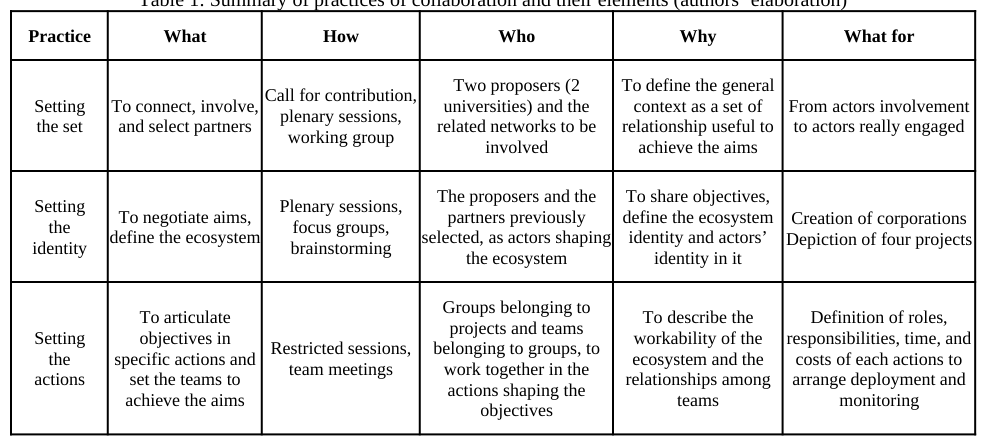
THE PRACTICES OF COLLABORATION We depicted practices on the basis of the suggestions offered by our literature review and by defining them into the research context we chose, namely DATaBenC district. Three practices emerge from the above cited approach and for each of them we described the “what” (the path to be followed to achieve the aims connected to it), the “how” (the ways the aims can be achieved), the “who” (the actors involved in the practice, with particular reference to the role they have in it), the “why” (the consequences emerging from the emergence of the previous elements), and the “what for” (the outcome of each practice thanks to the integration of the previous elements).
Table 1: Summary of practices of collaboration and their elements (authors’ elaboration) Practice What How Who Why What for
Setting the Set When describing the “setting the set” practice we depict the elements necessary to describe the general context hosting a series of relationships aiming to the achievement of the predefined aims. This practice is led by the two proponents and is based on connecting partners, involving them and shaping ties towards common aims. The expected results are defined, leading to a self-selection of the partners. After the acceptance of the proposal the DATaBenC project officially started and a network was set up, aiming to focus its resources on a cognitive- relational high technology program, capable of generating a significant socio-economic value, locally, nationally and internationally, with the creation of new enterprises (spin-offs, start-ups), new professionals, advanced training, and the skilled use of knowledge (patents, know-how). The DATaBenC aims to integrate heterogeneous routes of research-education-innovation, to act as a sustainable growth engine, by creating a synergy between the various knowledge, skills and regional relations, and pursuing the common goal of conservation and enhancing of the regional cultural heritage: territories, sites, assets, and activities. The two universities involved in the proposal started connecting actors to operate on the basis of the general aims and in order to develop the necessary set of relationships in the area, especially to fill a gap in strategies about cultural heritage, environment, and tourism to safeguard the wide set of resources of the region in an integrated approach. The focus on territory is necessary as the funding procedure was just addressed to some areas of the Southern Italy. The two universities kicked off DATaBenC by connecting actors as potential partners of the project, in line with the aims highlighted in the proposal to the Ministry presented above. The way they chose to involve partner was a call addressed to their research and business networks, in order to create a set based on the contemporary availability of several kinds of resources. At the beginning more than 150 actors showed their interest in taking part to this context, but time by time different selections took place, as we will underline in the following lines. DATaBenC was chosen as a suitable way to aggregate actors as it favors ties among several actors, like organizations, universities, research centers,
laboratories, consortia, and users too. In this wide range of actors, even some other partners (e.g. Italian Employers’ Confederation) had an important role, even if previous relationships acted as a filter in participating, because of different or unaligned interests and logics. Brainstorming and round tables were the most common ways of interaction in this part of the project, leading to a cooperative selection of the actors and to their engagement in the community. Apart from the actors leaving the project as soon as they crashed in competitors or in unwanted linkages, other ones decided to focus on the resources needed to decide if they can join the project and support its development and deployment. Hence the setting is composed by crossing different industries associated one another because of their ties to cultural heritage, both in an immaterial and in a material meaning, to favor the development of ideas to be performed together. The specialization of each industry is in focus anymore, but the combination of each specialization is crucial to draw the path towards the achievement of integrated knowledge, diagnostic monitoring and sustainable usage of the cultural heritage, namely the three research domains showed above. The network was being built through a competence-based approach, as the actors have to be aligned with the necessary competences. This leads to the involvement of a high number of subjects, namely about 70, showing two features: the availability of resources and the willingness to share them with other actors joining DATaBenC. The actors congruent with the two above cited characteristics are less than 50% of the whole number taking part to the in- progress context at the beginning.
Setting the Identity This practice is useful to deepen the identity of the context shaped by actors, relationships, aims and overall interests shared by all kind of actors involved. Moreover each actor defines its own identity in the community, by shaping it in line with the conceived projects and the resulting ties. Projects are relevant as they represent the empirical context to test how the aims shaping the proposal can be achieved. Hence the three projects are connected to experimenting areas that respectively are museums, historical centers, and archaeological parks, whilst the fourth provides the ICT services to all of them and collect all data emerging from the projects to better understand the subjects depicting the context. Finally this practice led to the definition of a knowledge- and competence-based ecosystem, aiming to define a set of actors supporting innovation. DATaBenC is shaped thanks to a wide range of actors, both from different organizations and independent actors of the same business as it was described in the first practice, depicting a setting built around competences and knowledge requirements. Indeed this set can be referred to as an ecosystem because of the common interests and efforts in making all members aware of the potential contributions arising from their participation to support cultural heritage safeguard. This aim can be approached through the formulation and the development of “context-aware” services, viz. services oriented to the features of the surrounding context. Context-aware services can be conceived and provided through the most recent ICT, viz. cloud computing and participatory sensing, to make cultural heritage usable in a better way. The ecosystem aims to define standards aligned to the “future internet”, to convey knowledge on the basis of each specific users, even by making cultural sites profitable in a full way, namely by taking into consideration the context. Moreover users’ activities in relation to cultural sites can be tracked to improve services provided thanks to new sensorial approaches, leading to new information. The 69 actors taking part to DATaBenC increased the number of gatherings in this phase, by having plenary sessions, meetings focused on specific aims to going deeper in defining the interests of the district and in creating workgroups properly shaped towards the established aims. The relations inside the district have to be defined even in a legal framework, so a legal status had to be chosen. The meetings lead to the necessity of creating an association based on limited responsibility in a cooperating approach; this kind of legal status is known in Italy as Limited Liability Consortium. The competence-based approach led to the identification of three main areas of interest, viz. ICT, restoration, and cultural heritage use. So three Limited Liability Consortia were created and SMEs, research units, and consortia took part to them. By the way conflicts emerged as big organizations did not want to take part to these aggregations; in order to solve these problems a fourth Limited Liability Consortium was created, grouping the big organizations and the three Limited Liability Consortia. The public-private partnership approach shaped in the above described way played a crucial role in defining specialized teams and coordinating mechanisms to make provisions for a fully functional context. The key partners for these two tasks were the consortium of restoration organizations, the ICT providers, the technology transfer experts, the consortium of computer devices, and the departments of the research centers. It is interesting to underline how teams have been defined; during a series of focus groups involving all partners the projects were deeply analyzed to define how competences have to be mixed to accomplish the expected aims. This intersection between competences and projects led to the set up of different teams and moreover to arrange coordinating mechanisms, supporting the workability of the community. One more result of this focus on competences needed in projects is the emergence of some conflicts among organizations. They have decided to leave the community first of all as they compare the needed resources with the available ones and perceive a gap. Some other organizations decided to leave DATaBenC due to how they perceived themselves in the frame shaped by the projects, viz. with a different vision from the expected one or because of difficulties occurred in their own business from a financial point of view. Thanks to the
debate on projects and competences the aims were properly defined and they can be summarized with reference to knowledge-based services, monitoring and cultural heritage, viz. the three research streams of the proposal. These aims lead to the collective definition of four main projects to achieve the planned aims. When depicting projects the organizations defined their identity inside the resulting ecosystem, as they chose which of the projects can benefit by the resources they carry and this is the reason why one more selection took place. Projects play one more fundamental role, as they act as testing areas for the contracted aims. Finally the ecosystem concept is useful to focus both on actors shaping it as partner in the project and on actors perceiving benefits from it. The cultural heritage is totally taken into account in the ecosystem through a smart and digital approach to it.
Setting the Actions In this third practice we portray how the aims are expected to take place through a detailed focus on the actions and on actors’ contributions. We even describe how teams are built in a knowledge-based approach and how these teams work together apart from their belongingness to a specific project, as mixing and matching competences are continuously working mechanisms, managed by project leaders, acting as coordinators. The definition of the projects in the above depicted practice is not enough to lead to the workability of the community, first of all to understand how to achieve the common aims related to projects implementation, to define suitable knowledge management models, and to conceive and apply integrated knowledge platforms. In order to define the ways in which the district can operate by making leverage on the wide set of available resources, knowledge, and relationships created, actions have to be defined. This can be done by starting from the four projects; first of all they are all organized in the same way and on two levels as a result of negotiation among the partners in specific meetings involving each time a lower number of partners, due to the focus on specialization. When organizing the projects firstly the “Objectives” are described, and ten objectives are used to articulate each project. Secondly the objectives are structured in actions, linked one another. In this case the articulation can be different from an objective to another, due to the features of each action to be performed. The knowledge emerges once more in focus as the actions are described by considering knowledge and resources and by looking at the matching between what is needed and what is available for each partner. The process here described takes place thanks to a structured data sheet. It is built on the basis of the funding institutions suggestions for this kind of projects, but the ecosystem actors in a couple of meetings decided to modify it in order to better describe the contribution each actor can give to the objectives in relation to the actions to be accomplished. This document collects a series of information for each of the actions shaping an objective; first of all the actor in charge is defined, to coordinate the actions of the other subjects. This action is not performed by a big organization, but a specialization on a resource or on a research domain is the way to define this task. Secondly the supporting actors are focused, to create a team built in a properly way as it regards competences and resources favoring the achievement of the tasks of each activity. Thirdly the expected time and the costs are defined, to prearrange the monitoring activity to be made when the actions will be in progress. Finally the impact of the research activity is compared with the one of the industrial activity to be compliant with the kind of contribution required to each actor. This way of organizing the actions makes it necessary to build a specific team as many times as many detailed aims there are. Once again this approach shows a deep focus on knowledge. By the way teams are still interlinked one another, so the resulting ecosystem can be described as a series of groups, and groups are composed by teams. Organizations belong to teams, but they are linked both to organizations shaping close teams and to organizations taking part to other groups in the ecosystem.
CONCLUSIONS AND IMPLICATIONS Our study opens up the business literature on networking innovation to the underexplored concept of practices and contributes to the emerging concept of ecosystem innovations in three main aspects. Firstly our study proves the usefulness in studying innovation ecosystem issues by looking at practice or better to a nexus of interconnected practices (Nicolini 2011), as unit of analysis instead of single organization or a network. Our research confirms that innovation is not created by governed and purposeful interactions among one main actor and its surrounding context. Instead it is a more emergent and negotiated process triggered by opportunities and uncertainties that a multiplicity of actors attempt to grasp by acting collaboratively. What becomes evident is that innovation is sustained and created in multiple interactions and social practices (Gherardi 2006, 2008). This contributes to shift the focus away from the consideration of the more static idea of structured networks of relationships within which actors have a unique and fixed role and positioning. The DATaBenC innovation community emerges as a form of orchestrating activities to which each actor contributes by providing opportunities and support for each other innovation goals (Orlikowski, 2006). The focus is shifted from strategy and competences of a single organization or a main actor to the set of interrelated practices where the working and doing takes place in ongoing collaborative efforts to organize resources and actions to better meet the future needs. As second result a set of three collaborative practices is
identified. These practices work as a sort of pick-lock to unravel mechanisms at the basis of constitution of new innovation ecosystem. The first practice we named “Setting the set” encapsulated the collaborative efforts to frame the set of actors setting up the DATaBenC innovation context. To build a sense of relatedness among all partners is the main content of this practice. The key question has been posed not by the business management perspective of the focal organization reasoning on who could be involved and mobilized for what, by what. And at the same time this practice includes not only issues of the engagement as stated by Wenger (2000). Instead it is more based on complex and negotiated sets of activities which hold together the configuration of actors, artifacts and social relations (Nicolini, 2011). Among these activities a great part of attempts concerns the knowledge flow and great efforts involve the partners into learning how to search for relevant members and each other knowledge bases. Collective mechanisms involve the process of eliciting competences with partners who evaluate each others as well as competences sharing processes become crucial to allow the setting up of the set (Wenger, 2000). Whether this process is perceived positively depends on a significant interaction and recognition between knowledge holders in their specific activities. Some actors such as university partners lay a sensitive role in the promotion of conscious interactions among actors, which draw partners into a deeper sense of their relatedness to each other (Nicolini, 2011). Relying on their knowledge of who knows who, the actors view each other as a partner to be engaged with in purposeful collaboration and to co-evolve together. Furthermore it has been argued that practices are in fact not only what the people do but are firstly the loci where entities come together and secondly the context in which meaning construction helps in recognizing one another that its practices are identity-forming and strategy setting activities (Wenger, 2000). In this sense we named “setting identity” the second practice; it addresses one of the main issues posited by scholars of practices. The key question as stated by Wenger (2000) is the need of practitioners to construct an image of ourselves, of the groups, and of the world in order to orient them, reflect on situation and explore the possibility. But it becomes evident as the identity building process emerges collectively as the attention of practitioners is directed at negotiated interests and aims. This process relies on the continuous evaluation and construction among the involved partners of what makes relevance in the context of practices and how to address these aims. Also the progress of knowledge integration at the boundaries of different projects is a specific result of this practice. In this case the attention is directed at the possibility to integrate competences, tools and meanings; parallel to this a wider knowledge basis is enacted in the collaborative context. The ecosystem identity comes from a continuous reasoning processes (Gherardi, 2008; Geiger and Kepler, 2009) involving actors in defining and negotiating aims, setting the projects and making explicit their contribution. This practice contributes to making a collective sense of the value and they foster a sense of ecosystem as partners recognize the need to be involved and dedicated to a new and wider project. It provides an accountable link, therefore, between the individual actors, members and the wider ecosystem context, and it provides a setting in which a collaborative practice emerges as a function of this link. The importance of depicting the identity of a community lies in the recognition that each actor’s role is not fixed and pre-given, that knowledge does not pre-exist actions, and that innovation develops by contextually enact knowledge and competences in a collaborative organizing activities (Nicolini, 2011). Finally we defined the last practice as “setting the actions” as it enables actors in bringing together heterogeneous practices and resources in a multiple context of collaborative actions and it gives continuity to interactions and sensing about the set and the identity of the innovation community. Although this practice is framed within the more formal projects established by DATaBenC the “setting the action” arranges, matches and combines all resources in an affordable pattern. Rather than prescribing the tasks to perform according to a rigid structure that needs to be adhered to, this practice works as a call for collective actions to be developed. The actions of all partners are arranged on the well- connectedness of different resources bases, and collective knowledge emerges by the shared context of practical working interactions and collaboration. Toward this end, knowledge and artifacts are managed to be adapted to the partners’ needs and constraints without ignoring the need to make them robust enough to establish a common point of reference among the partners. Finally concentrating on the idea of ecosystem innovation that emerges by the interplay of a nexus of three collaborative practices our work wants also to contribute to bridge the gap between management and practice-based literature. Our work provides insight on how an innovation ecosystem can capitalize and build its potentiality on its wide set of resources by collectively organizing resources to actions. The collaborative practices open up to the definition of the innovation ecosystem strategy as a complex and multiple process dealing simultaneously with the emergent establishment of actors’ set, social recognition and legitimating of actor’s contribution and negotiating activities. These processes may involve resistance and conflicts as well as call for both emergent and planned approaches to ecosystems strategy. The in-depth understanding of these different learning mechanisms creates the understanding about management and organizational efforts. However, further examination is still needed to specify the ecosystem innovation strategy and also to gather empirical evidence to develop it even further.
REFERENCES
Adner, R. (2006), “Match your innovation strategy to your innovation ecosystem”, HARVARD BUSINESS REVIEW, 84 (4): 98–107. Adner, R., Kapoor, R. (2010), “Value creation in innovation ecosystems: How the structure of technological interdependence
affects organization performance in new technology generations”, STRATEGIC MANAGEMENT JOURNAL, 31: 306–333. Basole, R.C., Rouse, W.B., McGinnis, L.F., Bodner, D.A., Kessler, W. (2011), “Models of Complex Enterprise Networks”, JOURNAL OF ENTERPRISE TRANSFORMATION, 1 (3): pp. 1-20. Bedwell, W. L., Wildman, J. L., Diaz Granados, D., Salazar, M., Kramer, W. S., Salas, E. (2012), “Collaboration at work: an
integrative multilevel conceptualization”. HUMAN RESOURCE MANAGEMENT REVIEW, 22: pp. 128-145. Bifulco, F., Russo-Spena, T. (2014), “Eco-sistema dell’innovazione e leverage imprenditoriale”, in Vona, R. (ed.) Technology Venturing. Stato dell’arte e prospettive di sviluppo del management dell’imprenditorialità e dell’innovazione tecnologica, SINERGIE QUADERNI n. 17. Bjørkeng, K., Clegg, S., Pitsis, T. (2009), “Becoming (a) practice”, MANAGEMENT LEARNING, Vol. 40 (2): pp. 115–128. Blomqvist, K., Levy, J. (2006), “Collaboration capability - A focal concept in knowledge creation and collaborative innovation
in networks”. INTERNATIONAL JOURNAL OF MANAGEMENT CONCEPTS AND PHILOSOPHY, 2 (1): pp. 31-48. Boateng, W. (2011), “Communities of Practice as Conduit for Knowledge Management: A Sociological Analysis of the Macro Level Health Care Decision-Making in Canada”, INT J OF HUMANITIES AND SOCIAL SCIENCES. 1: 29-36. Brown, J. S., Duguid, P. (2001), “Knowledge and Organization: A Social-Practice Perspective”, ORGANIZATION
SCIENCE, 12 (2): pp. 198-213. Burns, D. (2006), “Evaluation in Complex Governance Arenas: the potential of large system action research” in Williams, B.
and Imam, I. (eds.) System Concepts in Evaluation, Inverness, California, Edgepress. Carlile, P. R. (2004), “Transferring, translating, and transforming: An integrative framework for managing knowledge across boundaries”, ORGANIZATION SCIENCE, 15: pp. 555-568. Carroll, A.B., Levy, L., Richmond D. (2008), “Leadership as practice: challenging the competency paradigm”, LEADERSHIP,
4, 363–379. Chesbrough, H. (2011), “Open Services Innovation: Rethinking Your Business to Grow and Compete in a New Era” [Hardcover], San Francisco (Wiley). Corradi, G., Gherardi S., Verzelloni L. (2010), “Through the practice lens: Where is the bandwagon of practice-based studies
heading?”, MANAGEMENT LEARNING, 41, (3): 265-283. Dhanaraj, C., Parkhe, A. (2006), “Orchestrating Innovation Networks”, ACADEMY OF MANAGEMENT REVIEW, 31 (3), 659-669. Dougherty, D. (2004), “Organizing Practices in Services: Capturing Practice-Based Knowledge for Innovation”, STRATEGIC
ORGANIZATION, Vol. 2 (1), 35-64. Eckert, P. (2006). Communities of practice, Encyclopedia of language and linguistics – Elsevier. Edvardsson, B., Tronvoll, B. (2013), “A new conceptualization of service innovation grounded in SD logic and service system”, INTERN. JOURNAL OF QUALITY AND SERVICE SCIENCES, 5 (1): 19-31. Fiszbein, A. (1997), “The emergence of local capacity: lessons from Colombia”, WORLD DEVELOPMENT, Vol. 25, No. 7. Geiger D., Kepler J., (2009), “Revisiting the Concept of Practice: Toward an Argumentative Understanding of Practicing”,
MANAGEMENT LEARNING, 40(2): 129–144. Greenwood, D., Whyte, W., Harkavy, I. (1993), “Participatory Action Research as a Process and as a Goal”, HUMAN RELATIONS, 46 (2): 175-192. Gherardi, S. (2000), “Practice-based theorizing on learning and knowing in organizations”, ORGANIZATION, 7(2): 211-223. Gherardi, S. (2001), “From Organizational Learning to Practice-Based Knowing”, HUMAN RELATIONS, 54: 131–139. Gherardi, S. (2008), “Situated Knowledge and Situated Action: What do Practice- Based Studies Promise” in Barry D., Hansen
H., The SAGE Handbook of New Approaches in Management and Organization, Sage Publication, London. Gherardi, S. (2009), “Introduction the critical Power of the Practice Lens”, MANAGEMENT LEARNING, 40(2): pp. 115-128. Gherardi, S., Nicolini, D. (2002), “Learning in a constellation of interconnected practices: canon or dissonance?”, JOURNAL
OF MANAGEMENT STUDIES, 39: pp. 419–436. Hallikas, J., Kärkkäinen, H., Lampela, H. (2009), “Learning in networks: an exploration from innovation perspective”, INT. J.
TECHNOLOGY MANAGEMENT, 45 (3–4), pp. 229–243. Heikkinen, M., Tähtinen J., (2006), “Managed Formation Process of R&D Networks”, INTERNATIONAL JOURNAL OF INNOVATION MANAGEMENT, 10 (3), pp. 271-298. Hou Tay, B., Pong Lim, K. (2006), “Self-evaluation process for a Singapore railway service provider”, in Williams, B. and
Imam, I. (eds.) System concepts in evaluation, Inverness, California, Edgepress. Hurmelinna-Laukkanen, P., Nätti, S. (2008), Network orchestrator and knowledge mobility in innovation networks” Proceedings.
24th IMP conference, 4-6 September 2008, Uppsala, Sweden. Iansiti, M., Levien R. (2004), “The Keystone Advantage: What the New Dynamics of Business Ecosystems Mean for Strategy, Innovation, and Sustainability”, Harvard Business School Press. Järvensivu, T., Törnroos, J.Å. (2010), Case study research with moderate constructionism: Conceptualization and practical
illustration, INDUSTRIAL MARKETING MANAGEMENT, Vol. 39 (1), 100- 108. Johnsen, T., Ford, D. (1999), “An Initial Conceptual Framework for Managing Collaborative Innovation in Complex Business Networks” in McLoughlin, Damien. and C. Horan (eds.), Proceedings of The 15th Annual IMP Conference. University College, Dublin.
Johnsen, T., Ford, D. (2000), Managing collaborative innovation in complex networks: findings from exploratory interviews. The IMPGroup. Ketchen, D. J., Ireland, R. D., Snow, C. R. (2007), Strategic entrepreneurship, collaborative innovation, and wealth creation.
STRATEGIC ENTREPRENEURSHIP JOURNAL, 1. Kimbell, L. (2009). “Design-as-practice and designs-in-practice”, Centre for Research on Socio-Cultural Change, Manchester. Kotis, K., Vouros, G. A. (2006), “Human-centered ontology engineering: the HCOME methodology”. KNOWLEDGE AND INFORMATION SYSTEMS Vol. 10, Issue 1. Lave, J., Wenger, E. (1991), “Situated Learning. Legitimate Peripheral Participation”, Cambridge, MA:University Press. Lazzeretti L., (2008), “The cultural districtualization model”, in Cooke P. N., Lazzeretti L.(eds.), Creative Cities, Cultural
Clusters and Local Economic Development, Edward Elgar Publishing, chapt. 4, pp. 93-120. Lazzeretti L., Capone F., Boix R. (2012). “Reasons for Clustering of Creative Industries in Italy and Spain”, EUROPEAN PLANNING STUDIES, Vol. 20, Issue 8, pp. 1243-1262, Routledge Taylor & Francis. Lusch R.F., Nambisan S. (2012), Service Innovation: A Service-Dominant (S-D) Logic Perspective, paper: 1-51. Michel S., Brown S.W, Gallan A. S. (2008), “An expanded and strategic view of discontinuous innovations: deploying a service-
dominant logic”, J. OF THE ACADEMY MARKETING SCIENCE, 36: pp.54–66. Miles R.E., Miles G., Snow C.C. (2005), “Collaborative Entrepreneurship: How Communities of Networked Organizations Use Continuous Innovation to Create Economic Wealth”. Stanford University Press: Stanford, CA. Möller K, Svahn S. (2009) “How to influence the birth of new business fields- Network perspective”, INDUSTRIAL
MARKETING MANAGEMENT, 38: pp. 450-458 Möller K. (2010), “Sensemaking and agenda construction in emerging business networks”, INDUSTRIAL MARKETING MANAGEMENT, 39 (3): pp. 361-371. Möller K. Rajala A. (2007), “Rise of Strategic Nets - New models of value creation”, INDUSTRIAL MARKETING
MANAGEMENT, 36: pp.895-908. Möller, K. E., Svahn, S. (2003), “Managing strategic nets: A capability perspective”, MARKETING THEORY, Vol. 3(2): 201−226. Moore, J.F. (1993), “Predators and prey: The new ecology of competition”, HARVARD BUSINESS REVIEW, Vol. 71(3), pp.
75–83. Moore, J.F. (1996), “The death of competition: Leadership and strategy in the age of business ecosystems”. New York: Harper Business. Nambisan S., Sawhney M. (2007). “A buyer’s Guide to the Innovation Bazaar”, HARVARD BUSINESS REVIEW, pp.109-118. Nicolini, D. (2011). “Practice as the Site of Knowing: Insights from the Field of Telemedicine”, ORGANIZATION SCIENCE,
Volume 22 (3), pp. 602–620. Nicolini, D., Gherardi, S., Yanow, D. (2003), “Introduction: toward a practice-based view of knowing and learning in organizations”, in Nicolini, D., Gherardi, S. and Yanow, D. (Eds), Knowing in Organizations: A Practice-based Approach, M.E. Sharpe, New York, NY, pp. 3-31. Nooteboom B. (1999), “Innovation and inter-organization linkages: new implications for policy”, RESEARCH POLICY, 28 pp.
793–805. Nooteboom B. (2004), “Inter-organization collaboration, learning and networks; an integrated approach”, London: Routledge. Normann, R. (2001), “Reframing Business: when the map changes the landscape”, Chichester: Wiley Ordanini A., Parasuraman, A. (2011), “Service Innovation Viewed Through a Service-Dominant Logic Lens: A Conceptual Framework and Empirical Analysis”, JOURNAL OF SERVICE RESEARCH Volume 14: 3. Orlikowski, W.J. (2002), “Knowing in Practice: Enacting a Collective Capability in Distributed Organizing”, ORGANIZATION
SCIENCE, Volume 13(3): pp. 249–273. Orlikowski, W. J. (2006), “Material Knowing: The Scaffolding of Human Knowledgeability”, EUROPEAN JOURNAL OF INFORMATION SYSTEMS, Volume 15(5): pp.460-466. Ramos, J. M. (2002), “Action research as foresight methodology”, JOURNAL OF FUTURE STUDIES, 7, 1, August. Ritter, T., Wilkinson, I. F. and Johnston, W. J. (2004), “Managing in complex business networks”, INDUSTRIAL
MARKETING MANAGEMENT, No.33, pp. 175-183. Ritter, T., Wilkinson, I. F., Johnston, W. J. (2002), “Measuring Network Competence: Some International Evidence”, JOURNAL OF BUSINESS & INDUSTRIAL MARKETING, Volume 17 (2/3), pp. 119-138. Russell, M.G., Still K, Huhtamaki, J. Yu, C., Rubens, N. (2011), “Transforming Innovation Ecosystems through Shared
Vision and Network Orchestration In Triple Helix”, IX International Conference (July 2011). Schatzki, T.R., Knorr-Cetina, K., Von Savigny, E. (2001), “The Practice Turn in Contemporary Theory”, London and New York: Routledge. Schwabe, G., Krcmar, H. (2000), "Piloting Socio-Technical Innovation". ECIS 2000 Proceedings, Paper 27. Skålén, P., Hackley, C. (2011). “Marketing-as-practice. introduction to the special issue. Scandinavian”, JOURNAL OF
MANAGEMENT, Volume 27(2), pp. 189-195. Story V., O'Malley L., Hart S. (2011). “Roles, role performance, and radical innovation competences”, INDUSTRIAL MARKETING MANAGEMENT Volume 40, pp. 952–966. Toivonen, M., Tuominen T. (2009), “Emergence of Innovations in Services”, THE SERVICE INDUSTRIES JOURNAL, 29(7):
887-902. Wenger E. (2000) “Communities of Practice and Social Learning Systems” ORGANIZATION 7(2), 225-246 Wenger, E., McDermott, R. A., Snyder, W. (2002), “Cultivating Communities of Practice: A Guide to Managing Knowledge”, Harvard Business Press: Boston, Massachusetts. Whittington R (2003), “The Work of strategizing and organizing for a practice perspective”, STRATEGIC ORGANIZATION,
Vol.1(1), pp. 117–125.
LISTED IN THE AHFE DIGITAL BOOKSTORE CATALOGUE
Explore the complete digital volume
Advances in The Human Side of Service Engineering
Read this individual research paper free through the original publisher, or explore the full digital proceedings book.
ISBN 978-1-4951-2091-6
Explore this ISBN in the AHFE Bookstore ↗Listed in the July 2026 bookstore catalogue; search by ISBN to confirm current availability · Digital book purchase optional