Cheryl A. Kieliszewski, Laura Challman Anderson, Susan U. Stucky (2019). A Case Study: Designing the Service Experience for Big Data Discovery. In: Advances in The Human Side of Service Engineering. AHFE Open Access, vol. 8. https://doi.org/10.54941/ahfe100287
The purpose of this paper is to present early-stage results from three investigations we have undertaken to support the goal of collaborative innovation to scale discovery. This work is being conducted at IBM Research - Almaden in the recently announced Accelerated Discovery Laboratory. The motivation for this work was the need to experiment and investigate ideas of how to accelerate discovery in a real-world setting (at the very same time that we were learning what it means to “discover”). The underlying tenets borrow ideas from Service Science to build a framework for discovery in which the Participant’s service experience takes place across and within technical, social, and spatial systems. In the big picture view, our goal is to be able to capture project teams’ journeys through this framework and provide navigational assistance. We present results of the investigations to start identifying the resource and co-creative patterns of Participants – examining what it means to “discover” and perform work in a living lab, factors that impact information sharing by heterogeneous teams, and mapping of the service experience to establish a shared mental model.
Big Data is all the rage – abundantly generated from social, enterprise, and scientific sources and presenting an invitation to explore, combine, and analyze at a scale previously unachievable. This invitation, and all that it entails, enables the discovery of patterns in the data faster than people and computation have been able to do up to now. With the emphasis on using and analyzing big data to assist in accelerating the pace of discovery, innovation, and invention we will need to re-examine the enablement of the human effort and how to support it in this new context.
The purpose of this paper is to present early-stage results from three investigations we have undertaken to support the goal of collaborative innovation in order to scale discovery. This work is being conducted at IBM Research - Almaden in the recently announced Accelerated Discovery Laboratory (henceforth “Lab”)1. The vision of the Lab is to provide a computationally rich set of data and analytical technologies along with a physical and social environment, for research collaboration with business clients to accelerate discovery through data analytics. However, increasing the speed of discovery is not as simple as running a set of data through a specialized algorithm. Instead, it is a complex mix of human and technology interactions for a range of activities from exploration and hypothesis generation through implementation and running of enabling technologies to address a discovery 1 http://www-03.ibm.com/press/us/en/pressrelease/42169.wss Human Side of Service Engineering (2019) challenge. Examples of discovery challenges include the application of machine learning and natural language processing algorithms to aid in the discovery of new drugs to treat and cure diseases such as cancer, Alzheimer’s, and Amyotrophic Lateral Sclerosis (ALS; a.k.a., Lou Gehrig’s Disease)2; and the development of a water cost index that standardizes the measure of true water costs by identifying direct and hidden costs to estimate missing cost variables using advanced analytics3.
In this paper, we will be reporting on three early-phase activities to investigate and characterize the Lab’s service experience. Findings from these investigations will be used to inform the design of human, technology, and space interaction to fulfill the vision of collaborative innovation for discovery. We begin with a background of the Lab itself, to describe its purpose and provide a picture of its technological, service, and social structure. Then, we progress through the three investigations, exploring the facets of building and working in a living lab (Pentland, 2014) and what it means to “discover”, bringing together heterogeneous teams through information sharing, and mapping the service experience within the context of big data and discovery. We close the paper with a discussion of our early findings, plans, and ideas for future work, and conclusions.
BACKGROUND
The Lab is a service environment designed to facilitate research projects that deal with the most difficult and complex big data analytics issues faced by business, government, and universities. It is specifically targeted at enabling discovery through the use of data and analytics, and at enabling the subject matter experts who use the environment to focus directly on their investigation instead of the underlying hardware systems, software systems, and data curation.4 Discovery-as-a-Service Paradigm
The creation of the Lab is a large undertaking that includes teams of people with expertise in compute systems, software, data, and people in order to realize the formation of a Discovery-as-as-Service environment. As such, we believe that enabling deep collaboration across disciplinary and entity (i.e., business, government, university) boundaries is absolutely essential to the discovery process. Therefore, it is assumed that the formation of this environment requires the participation of subject matter experts in the areas of science, medicine, business, and society who bring the real-world challenges for which data and analytics can be applied. As one of the Lab’s first Client Principle Investigators expressed it, “…you know, I’m not sure how far you [the Lab] can go for a number of reasons with this big data and analytics center. There is an area where we [the Client] could probably generate a high amount of interest very quickly… and nobody here [the Client] can even come close to duplicating anything of that effort. So you [the Lab] are fully essential to doing this and on the other hand, you [the Lab] probably need a lot of help from us in figuring out how to actually go about demonstrating scientifically that it’s a useful…”
The technology system is being designed and built as a Cloud. As with other types of cloud systems, such as Infrastructure-, Software-, or Platform-as-a-Service (see Mell and Grance, 2012), the Lab’s technology foundation includes a compute platform and software stack as the runtime infrastructure (similar to a Platform-as-a-Service). Unique to the Lab is access to a library of datasets, analytical tools, and models, along with tools and intelligence to access expertise and know-how beyond that of the end user’s knowledge boundaries to enable a Discovery-as-a- Service paradigm.
In characterizing the Lab as a service environment, it is intended to be a setting in which both science and business can interact to explore potential solutions to solve challenges through the intersection of expertise, data, and analytics that goes beyond the purely technical notion of a cloud system and “X-”as-a-Service. Being a service environment requires actions to build a support infrastructure that includes the obvious: a compute environment that allows for the implementation and running of data and analytics (i.e., hardware systems, software systems, and the 2 http://www.research.ibm.com/client-programs/accelerated-discovery-lab/index.shtml 3http://worldswaterfund.com/wci-overview.html 4 http://researcher.ibm.com/researcher/view_project.php?id=4903 Human Side of Service Engineering (2019) applications that run upon them). However, it also needs to be able to support the not so obvious: social and spatial systems (i.e., the manner and the set of places in which work gets done) that allow experts from different fields who use different vocabularies and have different perspectives on a particular challenge the ability to work together and accomplish a common goal. These largely invisible social and spatial systems include elements beyond what one would find in a standard cloud service environment, elements such as interaction, communication, and the potential for co-opportunity (the purposeful, and sometimes serendipitous, exploration and identification of opportunities through cooperation) to transpire through networks of people, location, and timing.
Our role is to enable a supportive human experience for the communities of people who use, contribute to, and build the environment. For the purpose of this case, the Lab “users” grossly filter into three categories of Participant, that of: Partner, which is defined as IBM employees (essentially researchers, but also employees from other IBM divisions); Client, which is defined as IBM customers (that is, people who are not IBM employees); and Maker, which is defined as the people charged with designing, building, and enabling the Lab. This is a categorization of convenience where we have sub-divided Lab users by their affiliation.
Service-Dominant Context for Discovery The challenge we have is to design, develop, and deliver a service experience for discovery in the context of using big data. In order to do this, we needed to tease meaning from the building a compute environment and technology system rhetoric and chose to view the challenge through a service science lens. As such, we will emphasize the mutual nature of the co-creation of value, where Lab participants act jointly and cooperatively towards a common goal (Maglio and Sphorer, 2008). For example, very often, Clients share their data with the Lab so that Partners can operate on that data to tackle a challenging problem and then provide a product in the form of a report and/or analytical tool – representative of a goods-dominant model in which value creation is based on transaction and distribution (e.g., a unit of output) (Vargo et al., 2010).
However, part of the Lab vision is for there to be analytical tools and data sources that are collected and curated into libraries by the Makers and/or Partners. These pre-existing libraries then afford flexibility in partnerships with Clients to collaborate in a unifying environment on a particular analytical challenge. In this example, we provide two samples of service-dominant value co-creation: the first is the creation and keeping of libraries in which both Makers and Partners jointly participate and create assets for the Lab for future, easy access by all Participants; and the second, the affordance of business partnership models that invite and support the Client to have a direct stake in the development of a solution. This is representative of a service-dominant model in which value creation is based on relationships-of-exchange and the application of competencies by all parties involved (e.g., a process of all parties applying resources) (Vargo et al., 2010).
A Framework for Discovery The Lab is in the midst of evolving from a traditional transactive (goods-dominant) value model to a forward- looking resource (service-dominant) value model in the way that partnerships and work is formed and enabled. For this paper, it means designing a client experience that goes beyond technical infrastructure as a service and merely delivering insight as a unit of output, to providing resource elements (such as technology and expertise) that encourages and empowers joint participation and co-creation. As a service environment, the authors have chosen to view the Lab as a system-of-systems that are distinguishable, but not separable: technical, social, and spatial. We specifically chose this characterization to be able to make use of what has been understood about the design and development of services in the emerging field of Service Science (see Kieliszewski et al., 2012, for a discussion and example).
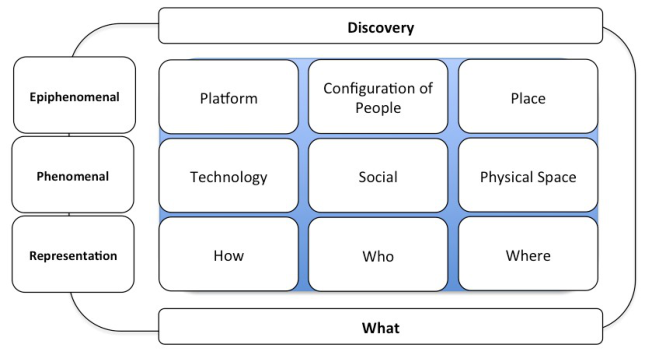
The Participant’s service experience is envisioned as seamless, taking place across and within the technical, social, and spatial systems (Figure 1). We have positioned the three systems within the context of discovery, or the “What” that is to be vested through co-creation. Discovery, on this view, is enacted as a route through this territory. Each system brings with it a set of resources, whether the resource is an algorithmic tool (technical), a team or individual (social), or a particular location (spatial), and Participant experience is represented as configurations of resources through time. Clients, Partners, and Makers interact with different patterns of resources as discovery is supported and takes place. For the Participants, the experience of the context of discovery should not seem disjoint. Indeed they may be, and arguably should be, completely unaware of certain resources that are in play for other Participants. Human Side of Service Engineering (2019)
Depending on their role, an individual’s interaction with the resources will be patterned differently, depending on the specific technologies, people, and places that are engaged. Ultimately, the phenomenon of discovery is expressed as a configuration of technology, social, and physical space with a common goal of co-creation. In the big picture view, we hope to be able to map project teams’ journeys through this space and to provide navigational assistance.
Figure 1. The Lab represented as a system-of-systems that are distinguishable, but not separable and that are representative of technical, social, and spatial elements for collaboration
The following sections discuss three early-stage investigations to explore and start to identify the resource and co- creative patterns of Participants. The first section discusses what it means to “discover” and perform work in a living lab. The second section focuses on bringing together heterogeneous teams through information sharing. The third describes mapping the service experience within the context of big data and discovery.
APPROACH The three investigations presented here have been conducted independently, but not without knowledge of the independent threads. Each has been undertaken to study and characterize the Lab service environment, and each investigation uses participant research and participatory design techniques to engage with Lab Participants. Although the investigations have different sole purposes, their combined intent is to bring forth insight from Participant views for enabling and executing “discovery”. They examine the experiential work environment that is user-centered and intended to support the co-creation of value.
What is Discovery?
As mentioned above, the Lab seeks to provide a client experience that accelerates discovery in the context of big data. From the outset, we knew that not only were there different discovery practices already in play in the larger context from which the idea of the Lab emerged, we also knew that a term such as “discovery” would already have many definitions. In an initial probe, we sought to understand what Lab Participants – Customers, Partners, and Makers – took discovery to be, broadly speaking. We began by interviewing Participants to investigate and establish an initial framework of discovery. This effort had three related purposes: to inform a next iteration of the service experience map (discussed in a following section), to inform the emerging management practices in the Lab, and to identify success factors for the three participant groups. In this paper we address findings only for the first two.
Interviews were conducted with eleven participants: five team leads of IBM research projects (Partners), five members of the Accelerated Discovery Lab team (Makers), and a Client Principal Investigator. (The latter who is part of a project that is widely viewed as a canonical example of what the Lab is setting out to accomplish.) The interviews were semi-structured allowing for ideas that arose in the course of the interview to be pursued or to probe further especially when the conversation took a turn. Each interview lasted 30 minutes and was intended to prompt reflection on their motivation for getting involved in the Lab, what counts as discovery for them and why, what Human Side of Service Engineering (2019) matters to the business and to science, and their perspective on criteria for success.
The data consisted of management presentations, research papers, and audio recordings of the interviews that were transcribed by a transcription service. The data were coded according to topics introduced in the interviews (e.g., motivation, criteria for success). An interpretive analysis was performed, resulting in a number of themes. Among the themes relevant to this paper were (1) the breadth of views about what counts as discovery (not in itself surprising, given the fact that this was during the first year of the Lab’s being actively working); and (2) the lack of awareness of who all was involved in the Lab, where they worked (in the Lab space, at Almaden (but outside of the Lab space), or at some other IBM location), and what technological resources were visible to them. By and large some Makers talked about technology, the founders (who count as Makers) talked about the vision, and the Partners talked about the problems they had in getting started using the resources of the Lab.
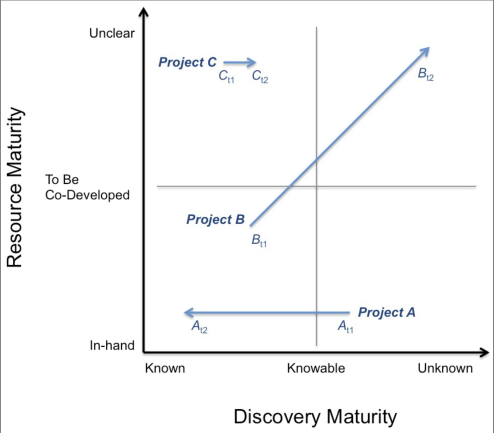
Two dimensions of discovery emerged out of this analysis. The first dimension is called the discovery maturity axis. The discovery maturity axis characterizes the extent to which a project team (generally composed of the three types of Participant) anticipates whether there are known answers to a question or challenge at one end of the spectrum, up to not knowing if the answer to a question or challenge is even knowable at the other end of the spectrum. Thus, at one end of the spectrum there is an assumption that the answers are known and need to be found. Then as a middle area, knowing there must be answers but they are not obvious nor is the way to find them obvious. At the other end of the spectrum are the “unknown, unknowns” – where the participants do not know what they do not know (Figure 2).
For instance, in the game Jeopardy! (a television game show started in the US in the 1960’s and still on the air today), IBM’s Watson technology bested the human contestants5. In this game each question asked is known to have an answer. For the human contestants, it was a matter of learning and memory. For the technology there was a similar approach, machine learning and search. This is not to say that it was not exceedingly difficult for both human and computer. Interestingly, some of our interviewees viewed the Jeopardy! version of Watson not to be a case of discovery, while others were willing to include it in the spectrum. (And, due to the complexity of the game show, this version of Watson would most likely qualify somewhere between what is searchable and known, and what is not obvious but knowable on the discovery maturity axis.) This disparity in viewpoints can be seen in the following two quotes from interviewees as they reflected on what counts as discovery for the Lab.
From a Partner (materials scientist): They [re: Watson] could be finding things that already exist that were hard to find…but for me…it’s [discovery’s] suggesting new connections between things…new material [that] might be good at doing something else because you found out that it has some similar properties.
From a Partner (computer scientist): But to me discovery is actually being able to find something you hadn’t thought about. …And in some ways one can do that – Watson does a piece of that. But we’ve got to take it to the next step and look for and try to deduce what we haven’t looked for yet and for which information is not yet available.
In contrast to the Jeopardy! version of Watson, machine learning and natural language processing algorithms have demonstrated value to aid the research of cancer treatments as mentioned above. Yet it has been assumed by the researchers that there could be additional unidentified p53 genes (a cellular tumor antigen) that may be of oncological value, but it was not known whether they could be found using these new technologies. This is representative of being closer to the other end of the discovery maturity axis that situates more serendipitous discoveries where someone is looking for one thing and stumbles onto another. Or in the case of big data, where the algorithms detect correlations across data sets that had not been suspected to exhibit relationships, as in the spatial and spatiotemporal data mining for insight into climate change (Zhou, Shekar, and Mohan, in press).
The second dimension is called the resource maturity axis. This axis characterizes the maturity of resources (e.g., analytic engines, capabilities or expertise of domain experts and data scientists). This axis anchors itself at one end of the spectrum as having existing tools, technologies, and expertise already available for use. In some cases it is known at the outset that new technologies will have to be developed. Already there are cases in the Lab in which the Client and the Partner have agreed to co-develop technologies. In others, the Partners agree to develop a new 5 https://en.wikipedia.org/wiki/IBM_Watson Human Side of Service Engineering (2019) technology but the Client does not participate directly – a very transactional relationship. As time passes, requirements shift. In one project the understanding of what technology would be needed began to morph shortly after an approach was defined, an agreement was made, and work started. In other cases, as with the discovery maturity axis, it is also unknown at the outset of some projects what additional assets need to be developed.
Figure 2. Project profiling matrix and sample project trajectories
These dimensions are meant to capture what each Lab project team is prepared to claim they know at the beginning of the project regarding (a) what they understand about what is to be discovered and (b) with what resources they will approach it. The intent is that placement and movement within the dimensions define a project profile that can help manage expectations of all three types of Participant. These dimensions should be revisited at regular intervals over the course of any project, and it is expected that the initial placement in the matrix will change as more is learned. For example, the Project A team (in Figure 2) determined, to the best of their knowledge when scoping the work, that a particular discovery challenge could be solved with existing tools, but the tool mix and/or expertise to enable the discovery was not well known. Only after starting the work and being introduced to other factors did they find that the discovery challenge could be hastened due to known solutions. By tracking these developments, the Lab will gain an understanding of the initial proposed discovery challenge and be able to establish profiles and predictable trajectories of the projects so as to better manage awareness and expectations among the three Participant parties.
Bringing Heterogeneous Teams Together This work was undertaken because sharing of information is an essential activity among members of a project team. With the array of big data and discovery projects entering the Lab (as sampled in the previous sections), implications of an increasingly interdisciplinary team composition needs to be better understood to guide the development of our collaboration processes and tools. Information and knowledge sharing has been extensively studied over the past decades, often with a homogeneous population and with a particular emphasis on specific contexts such as the academic environment, the healthcare setting, in a virtual team configuration, or of engineers (Sonnenwald et al., 2004; Fidel and Green, 2004; Talja, 2002; Ellis and Haugan, 1994). More recently, the challenge of knowledge integration in heterogeneous, interdisciplinary teams has become a focus as this type of team composition has become more prevalent in everyday work and play (Salazar et al., 2012). These challenges and opportunities of information sharing and integration within a heterogeneous team of varied backgrounds and expertise (Hsu et al., 2014) are key to co-creation within the context of big data and discovery activities. The purpose of this inquiry is to gain insight into the information sharing practices of the interdisciplinary Participants of the Accelerated Discovery Laboratory, starting with one project.
To begin this investigation, six one-hour interviews were conducted with six members of a single project team affiliated with the Lab, which had already been working together for one year, who represented two of the three Participant groups: Maker and Client. The Repertory Grid Interview Technique was used to structure and focus the interviews. Through this technique, participants are asked a minimal probe question to elicit a set of nouns (e.g., objects, states, or qualities) called “Elements”. After the Elements are named, successive trios of Elements are selected and the participant is asked to group the two most similar Elements together. Still working with the two selected similar Elements and remaining one unselected contrasting Element, the participant is asked to describe the characteristic thought to bind the two similar Elements and also provide the characteristic thought to describe the contrasting Element. This secondary exercise with the participant results in a set of adjectives that are used to form contrasting poles called Constructs. The data collected through this technique can then be analyzed for themes. The benefit of this technique is that the interviewee is able to directly express what and how they see and experience a subject completely in their own words and voice.
The interviews were conducted in person with the team members located at the Lab and through a combination of teleconferencing and web-conferencing with team members at remote locations. Our participants were asked a very minimal prompt of, “what is shared in the project?” This was done to elicit Elements and Constructs around the topic of information sharing within a heterogeneous project team. This also gave our Participants the opportunity to use their own vocabulary – both naming the nouns of what is shared, and the adjectives that describe them – to express their experience of information sharing in the team. The interviews were audio-recorded, transcribed, and then Leximancer (version 4.0)6 was used to perform content analysis and develop a concept map.
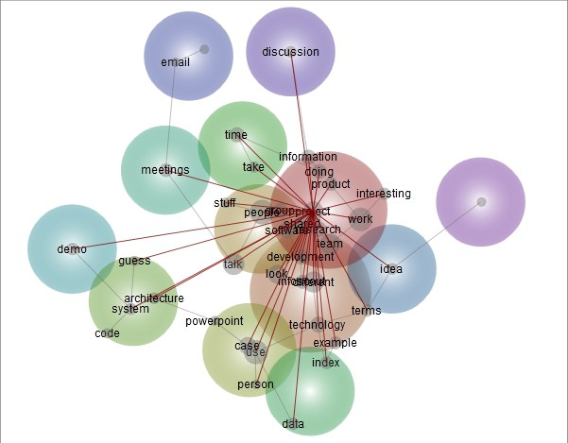
The largest concept cluster found was “work” (near the center in Figure 3). This was reassuring but not surprising given the interviews were focused on practices relating to information sharing to enable work. The concepts of team, project, shared, research, information, doing, and product also occurred frequently in the interviews and found to be closely related to the work concept. Less frequently occurring concepts such as system, demo, email, discussion, meetings, use case, and idea were also evident but did not occur as often (smaller circles) or as having as close a relationship to work (distance on the map).
Figure 3. A high-level concept mapping using Leximancer 4 of the six interview transcripts Three themes emerged after more detailed analysis: the dependence upon semi-structured, descriptive visualizations (such as presentations) particularly in the early stages of information sharing and teaming; the gradual unfolding of a shared vocabulary and an incremental building of common ground; and the use of the simplest collaboration tools throughout all stages of the team’s work. Following is a short description of the emergent themes and example
6 https://www.leximancer.com Human Side of Service Engineering (2019) content is provided for each.
Theme 1: dependence upon semi-structured, descriptive materials. At the start of a project, as the team members first come together, participants often utilized pre-existing materials, or material prepared in advance of a discussion (often by one person) in group discussions to introduce their ideas, viewpoints, and previous work. These often are unstructured or semi-structured PowerPoint presentations or documents presented in written form with a narrative. Examples of this include product road maps, planned direction, customer needs and requirements. Early on in the collaboration and teaming, these materials typically represent an individual view or particular facet of the work thought to be important and that ought to be taken into consideration by the team. As the team works together over time, there is more going back-and-forth between this individual work and iterative collaboration occurring in discussions. As one interviewee noted: "To some extent, specifically in terms of the way we work..., it’s not always collaborative in some sense. So it’s kind of we both present to each other.... we’re not using anything interactive so it’s pretty much premade PowerPoint."
Theme 2: the gradual unfolding of a shared vocabulary and an incremental building of common ground as a foundation for discovery, and for unique contributions. For this team, vocabulary is emergent in the work of the group together, and not formally defined at the beginning. Some team members may share a common background, and thus understand that they share a perspective and terminology. But when team members do not have that shared context, stories and examples are used as an aid to create context and bridge differences in how individual team members talk about the work. In this case, the interviewed participants were focused on software technologies and analytics, hence constructs such as scenarios (e.g., stories that illustrate work) and use cases (e.g., activities that define the work within the story) are used to evolve a shared team mental model and the words associated with aspects of the model. In the quote below, the interviewee first notes the shared understanding that exists with Co- leader A, and then describes the process to build a common vocabulary within the team with those from different contexts.
"Well some of the benefit actually of working with Co-leader A is that we share a common background. They used to be on the development side so they worked on some of the same products or within the same sort of product family. So we kind of share a strong vocabulary with them. But then as we expanded that group and brought in others on the research side I think the way we’ve typically reached a common vocabulary is just by working through different scenarios, use cases, and we kind of start to narrow down or converge on some common terminology or, you know, you said this, do you mean that or, you know, those sort of things, and reach some sort of consensus."
Theme 3: Simple and familiar collaboration tools are used throughout the project lifecycle to facilitate information and knowledge sharing. The participants on the team for this investigation do not all work at the same location. However, they work on the same continent, but in different time zones. Given these circumstances, they are dependent upon tools and technologies that afford remote information sharing and collaboration. What was found was that the simplest collaboration technologies (in particular, the use of conference calls) to bring remote team members into a discussion or meeting are typically used. The burden of setting up and getting everyone connected to a (more complex) collaboration tool is a significant obstacle and can consume precious minutes during a meeting. If the overhead is too high, the decision might even be made to abort the use of the collaboration tools (supporting Pirkkalainen and Pawlowski, 2014). Shared artifacts (e.g., photo of whiteboard drawing created during a discussion) are often sent out to attendees after the meeting is over. This may lend itself to being an additional barrier because the people who are not in the room are experiencing less in the meeting by not being able to see the whiteboard drawing during the meeting. The difficulty of utilizing collaboration tools for remote meeting attendees is highlighted in the following observation: [Talking about collaboration tools for meetings and using PowerPoint slides prepared in advance] “…at the moment sharing tools aren’t that good. They’re just clumsy to use, I think, slow and awkward.”
Negotiating the path to a shared understanding is only part of the work of an interdisciplinary team working on big data and discovery; the critical (and intangible) aspect is creating the capability for each individual to bring their unique expertise to bear on the objective of the group in a collaborative setting – but both are needed.
Mapping the Experience One of the core components to the vision of the Accelerated Discovery Lab was a streamlined and seamless Participant experience, where teams and individuals could work with data, analytical capabilities, and experts on big data and discovery research. The challenge in delivering on the vision early in the life of the Lab was that there wasn’t a shared view for what this vision meant from the Partner’s and Client’s point-of-view. This section describes the challenges that motivated the development of a service experience map to provide an end-to-end model as a reference for the Makers when communicating how different pieces of functionality would/could/should come together and to then locate requirements and dependencies between technical and interaction capabilities.
The Lab has multiple Maker teams working on pieces of functionality to enable the Lab’s service environment. This functionality ranges from finding-out about the Lab (e.g., web-presence and informational way-finding), to setting- up a project, to progressively exploring the library of data sources and analytical services and finding additional expertise, to contributing to the libraries, to departing. These, and other, pieces of functionality will impact how a Participant experiences the Lab capabilities and facilities and ultimately their overall discovery journey. Part of the general challenge in delivering services through a cloud-like environment is that little is known about user heuristics or success measures for such an environment (Väänänen-Vainio-Mattila et al., 2011), let alone one that is designed for a discovery paradigm.
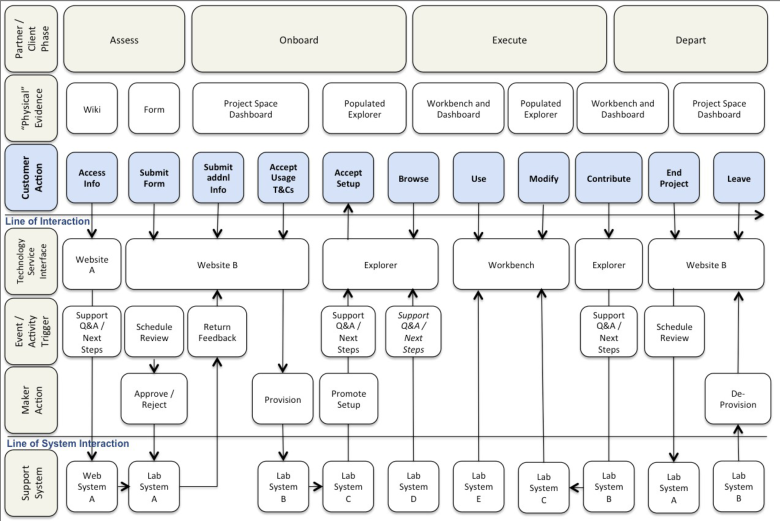
It turned out that, although the Makers had a systems architectural view of the Lab, what was missing was a shared awareness of the impact of the technological and communication interfaces on the actions or activities of all intended Participants – and in particular, upon the Partners and Clients. Due to this lack of common understanding and little user research guidance, we were motivated to create a common view of the connections between Participant actions and the supporting service ecosystem. The purpose of the experience map was to communicate a proposed end-to-end service experience from the point-of-view of our Partner’s and Client’s objectives and actions (i.e., the Customer Actions in Figure 4). More generally it was also designed to aid in establishing a shared mental model of the holistic service environment (e.g., Sætrevik and Eid, 2013; Wildman et al., 2012), and serve as a boundary object that teams could use when communicating their role and/or contribution to the overall vision (Carlile, 2002; Star and Griesemer, 1989).
The experience map is based on service blueprinting. The general service blueprinting methodology and examples are well documented in the field of service design (e.g., Shostack, 1984; Bitner et al., 2007; Patrício et al., 2011). As a technique, it can be used to communicate a range of service associations that range from strategic innovation to understanding operational and functional inter-connections (Bitner et al., 2007). This is different from an architectural diagram in that the actions of the customer (our Partners and Clients), instead of the capabilities of the technology, are central to determining all other interactions. In this case, service blueprinting was used as a technique to create a common view of the connections between the Partner and Client actions, Maker actions, technology interfaces, and hardware and software support systems.
Figure 4. Service experience map created to establish a shared mental model of the Lab’s functional connections with Partner and
Client (customer) actions
This particular service blueprint was created around fundamental customer actions as the focal point that would need to be supported as an end-to-end service experience. These fundamental, macro-level actions (such as accessing information about the Lab or browsing the data and analytical libraries) were linked to the physical evidence that enables the customer to perform an action (typically a website or software interface) and the alignment of early- stage and proposed technologies to support the actions (elements below the Line of Interaction in Figure 4).
Interviews, brainstorming, and participatory design activities with individual Makers and small groups were the techniques used to elicit the Maker’s perspective (most of whom have technical systems and software expertise and some of whom have expertise in user design and work practices) to create the initial Lab service blueprint. During the interview and participatory design activities, each participant had the Partner and Client in mind. This was evident by language such as, “we shouldn’t make the user have to do….” However, the initial contradiction in enabling the Partners and Clients was that the primary focus of the Makers was on ensuring the Support Systems would work – as one Maker stated: I do systems. …And computer science doesn't do systems. We do database or analytics or Big Insights. We tend not to worry about how you attach hardware, software, networking and OS and all that sort of stuff together.
Without a doubt, the development of the support systems is critical to the Lab. However, without a shared mental model of the interconnections (and interdependencies) to the support systems, the Partner and Client actions could easily and unintentionally be overlooked or dismissed as something to be addressed later in design, development, and implementation.
Resulting notes and drawings from the individual and small group activities were used as guiding input into the initial version of the service experience map, which was then socialized with key Maker stakeholders and decision- makers. Upon completion of the initial map, it was presented to all of the Makers at a weekly architecture meeting. The response was mixed, with some Makers voicing correction (in particular, with the lack of support system detail in the representation) – initially viewing the experience map as an architectural diagram versus an illustration of connections and interactions between Makers, Partners, and Clients with a common goal of enabling discovery. As such, each box on the diagram could easily be conceived of as a door to a set of architectural and interaction requirements in and of itself. However, as presentation, discussion, and time passed, the purpose of the map became Human Side of Service Engineering (2019) apparent and led to greater understanding by the Makers of the generalized discovery lifecycle that would need to be supported. The map is mentioned in discussions during Maker meetings, with Maker members sometimes waiving their hands and pointing to an invisible map that is in front of them with the assumption that it has informed and been internalized by the meeting attendees, referring to particular phases and activities that need attention or are being worked through.
DISCUSSION
A set of interviews early in the life of the Accelerated Discovery Laboratory revealed a sense of vagueness about what discovery in the Lab means to all its Participants (which should not be surprising for that point in the Lab’s development). They also revealed a fragmented understanding of who was part of the Lab, what they were doing, and how the work would unfold. The results of each of the investigations presented in this paper are early-stage and with on-going research continue to evolve and their ideas continue to mature. In the following, we provide additional insight into the findings of our work and ideas for future work.
The three investigations presented in this paper share a common theme of enabling the discovery service experience – examining what that means to scientists and business people, evolving the language and practices around the theme, and arriving at a shared viewpoint to enable the theme. We believe that central to the theme of discovery service experience are ideas that can be borrowed from Service Science, in particular those that explore concepts of service-dominant models and value co-creation, and that this experience can be represented as configurations of place, people, and technology through time.
The concept of project profiling was developed as a way to profile and track projects along two axes: discovery and resource. The two dimensions are meant to capture what the project team is prepared to claim they know at the beginning of the project regarding both what they understand about what is to be discovered and with what resources they will approach it. Future work is needed to validate these axes and perhaps to develop more. A tracking system that checks in on the course of any given project at regular intervals still needs to be developed. It is expected that initial project settings will change, but it will be important to begin to understand how they do and why. By tracking these developments, the Lab will gain an understanding of project profiles over time, and, ultimately the trajectories of the projects so as to better support and manage expectations among the three Participant types.
The study of heterogeneous group information sharing and integration is considered to be nascent, both in the literature and within the context of big data analytics and discovery. What we are finding is that teams need to negotiate a common team foundation, but nurture the unique disciplinary aspects of the team. Maintaining both is important and supports the notions of value exchange. The goal is not to make a team homogeneous in its expertise and thinking, but to better support and enable (and accelerate) cross discipline language and understanding. As this research progresses, we are further investigating the emerging themes and development of team practices to validate definitions or understanding, particularly early formation of a project. In addition, we will be focusing on the use and introduction of technology mediated practices for information sharing. Special attention is being paid to place and the temporal and engagement conflict between local and remote meeting attendees, and the techniques used by heterogeneous teams to build common ground across disciplinary boundaries.
Creation of the service experience map based on Partner and Client actions is considered a first step in establishing a common point-of-view and shared mental model of the service experience. In this paper, we report only on the first iteration of the map. Since it was communicated in mid-2013, the map is still referred to by Makers when context and a common view is needed. However, it has been almost one year since its inception and we’ve learned more about expectations of our Partners and Clients that need to be better captured in the map. In addition, the Maker teams have had a year to design and iterate on the development and implementation of capabilities – elements that also need to be revisited and revised. Future work includes updating this service experience map and also examining the larger service ecosystem – the context for which this map resides – to investigate ideas that start to establish constructs of accelerating discovery and patterns of relationships-of-exchange and how or if they result in value co- creation.
CONCLUSIONS
In this paper we discuss understanding the need to try out ideas of how to accelerate discovery in a real-world setting, at the very same time that we are learning what it means to “discover” using big data and analytics. It is our experience that there is something fundamentally different about the combined challenge of bringing together both big data capabilities and people who have different work practices and yet a shared, or at least a sharable, objective. It requires collaboration aimed at co-production amongst participant communities to manifest the co-creation of discovery. The authors’ goal is to inform and support a service environment through the design, development, and delivery of a service experience that will address and facilitate the goals of all Accelerated Discovery Laboratory Participants for the purpose of discovery. Design of the environment and support for each of the Participant communities is challenging on its own. For this endeavor to succeed we also need to be able to effectively bring people together across disciplines to share their intuition, knowledge, and expertise while working together in a computationally and data rich environment. Creating a framework that captures the journey through technology, social, and physical space with a common goal of co-creation will help us to better understand how discovery is practiced and to provide it meaning.
REFERENCES
Bitner, M.J., Ostrom, A.L., and Morgan, F.N. (2007). Service blueprinting: A practical technique for service innovation. Center for Services Leadership, Arizona State University. Carlile, P.R. (2002). A pragmatic view of knowledge and boundaries: Boundary objects in new product development.
Organization Science, 13(4), pp. 442-455. Ellis, D., and Haugan, M. (1997). Modelling the information seeking patterns of engineers and research scientists in an industrial environment. Journal of Documentation, 53(4), pp. 384-403. DOI:10.1108/EUM0000000007204 Fidel, R., and Green, M. (2004). The many faces of accessibility: engineers’ perception of information sources. Information
Processing & Management, 40(3), pp. 563–581. Hsu, J. S.-C., Chu, T.-H., Lin, T.-C., & Lo, C.-F. (2014). Coping knowledge boundaries between information system and business disciplines: An intellectual capital perspective. Information & Management, 51(2), pp. 283–295.
Maglio, P. P., and Spohrer, J. (2008). Fundamentals of service science. Journal of the Academy of Marketing Science, 36(1), pp.
18-20. Mell, P., and Grance, T. (2011). The NIST definition of cloud computing. National Institute of Standards and Technology (Special Publication 800-145). Available: http://csrc.nist.gov/publications/nistpubs/800-145/SP800-145.pdf Patrício, L., Fisk, R.P., Cunha, J.F., and Constantine, L. (2011). Multilevel service design: From customer value constellation to
service experience blueprinting. Journal of Service Research, 14(2), pp. 180-200. DOI: 10.1177/1094670511401901 Pentland, A. (2014). Social physics: How good ideas spread—The lessons from a new science. New York: Penguin. Pirkkalainen, H., and Pawlowski, J. M. (2014). Global social knowledge management – Understanding barriers for global workers utilizing social software. Computers in Human Behavior, 30, pp. 637–647. doi:10.1016/j.chb.2013.07.041 Salazar, M. R., Lant, T. K., Fiore, S. M., and Salas, E. (2012). Facilitating innovation in diverse science teams through integrative
capacity. Small Group Research, 43(5), pp. 527-558. Shostack, G.L. (1984). How to design a service. European Journal of Marketing, 16(1), pp. 49-63. Star, S. L., and Griesemer, J. (1989). Institutional ecology, "translations" and boundary objects: Amateurs and professionals in Berkeley's Museum of Vertebrate Zoology. Social Studies of Science, 19(3), pp. 387-420. Sonnenwald, D. H., Maglaughlin, K. L., and Whitton, M. C. (2004). Designing to support situation awareness across distances:
an example from a scientific collaboratory. Information Processing & Management, 40(6), pp. 989-1011. DOI:10.1016/j.ipm.2003.10.002 Sætrevik, B., and Eid, J. (2013). The “Similarity Index” as an indicator of shared mental models and situation awareness in field studies. Journal of Cognitive Engineering and Decision Making, December 17, pp. 1-18. DOI: 10.1177/1555343413514585 Talja, S. (2002). Information sharing in academic communities: Types and levels of collaboration in information seeking and use.
New Review of Information Behavior Research, 3, pp. 143-159. Väänänen-Vainio-Mattila, K.,Kaasinen,E.,and Roto, V. (2011). User experience in the cloud: Towards a research agenda. CHI 2011, May 7-12, Vancouver, BC, Canada. ACM 978-1-4503-0268-5/11/05. Vargo, S.L., Lusch, R.F., and Akaka, M.A. (2010). Advancing service science with service-dominant logic: Clarifications and
conceptual development. In P.P. Maglio et al., (eds.), Handbook of Service Sciences. New York: Springer. DOI 10.1007/978-1-14419-1628-0_8 Zhou, X., Shekar, S., and Mohan, P. (in press). Spatiotemporal (ST) change pattern mining: A multi-disciplinary perspective. In M-P. Kwan et al., (eds.), Space-Time Integration in Geography and GIScience: Research Frontiers in the US and China. Dordrect: Springer
LISTED IN THE AHFE DIGITAL BOOKSTORE CATALOGUE
Explore the complete digital volume
Advances in The Human Side of Service Engineering
Read this individual research paper free through the original publisher, or explore the full digital proceedings book.
ISBN 978-1-4951-2091-6
Explore this ISBN in the AHFE Bookstore ↗Listed in the July 2026 bookstore catalogue; search by ISBN to confirm current availability · Digital book purchase optional