Jim Spohrera, Alfonso Sianob, Paolo Piciocchib, Clara Bassanoc (2019). Reframing Innovation: Service Science & Governance. In: Advances in The Human Side of Service Engineering. AHFE Open Access, vol. 8. https://doi.org/10.54941/ahfe100288
If we believe in innovation, change that improves quality of life, and we believe that service innovation can accelerate these positive changes in business (for customers) and society (for citizens), then we need to ask what rules of the game help maximize service innovation? Our paper aims to reframe the Rules of Innovation from a Service Science perspective as the study of different, interconnected, complex “human-centered value co-creation systems” in business and society. As an emerging trans-discipline, Service Science draws on many existing academic disciplines, creating a new whole, while enhancing the parts without replacing them. This requires a change in perspective focusing on the fact that Service Innovation opportunities (in education, research, practice and policy) depend on the improving interactions with other service systems strictly connected to the capability to perceive the service context. Consequently, we believe that new governance mechanisms might support policy makers at any decisional level (regional, local, national) contributing the useful scaling of new service innovations in health, education, government, finance, hospitality, retail, communications, transportation, energy, utilities.
Over the years, there have been many approaches to innovation, created and re-invented on the basis of the ability of researchers and abductive pratictioners in different fields.
If we believe in innovation, change that improves quality of life, and we believe that service innovation can accelerate these positive changes in business (for customers) and society (for citizens), then we need to ask what rules of the game help maximize service innovation?
The purpose of our paper is to reframe the Rules of Innovation from a Service Science perspective as the study of diverse, interconnected, complex “human-centered value co-creation systems” in business and society.
Today, innovation moves towards sustainability. The innovation processes aiming at a sustainable chain involve many actors, such as research centers, governments, businesses, intermediary organizations and NGOs. Such innovation processes entail difficulties of improvement about the alignment of perspectives and about the reframing of issues, identities and processes in interaction between actors. Accordingly, in our study, the question is: What reframing processes within and between actors of the different whole service chains are useful to interpret a new conceptualization of innovation and how can be shared these reframing processes?
FRAMEWORKS FOR REFRAIMING INNOVATION: SERVICE SCIENCE AND GOVERNANCE The current trend - dominated by the services and coopetition logic (Zinledin, 1997) - shows that a new model of innovation emerges day-by-day increasingly connected and driven by social and environmental needs. In other words, innovation becomes a process linked to lifestyle characterised by the collective well-being and based on the collaborative and integrated efforts to achieve it.
Therefore, reframing innovation implies a shared and collaborative development investing global community and that requires continuous co-creative solutions between sub-systems involved. Addressing these trends is coherent with the assumption that the world is facing complex challenges that cannot be solved in individual or self- referential manner: it is about sharing the opportunity to interpret innovation as a co-evolutionary process among multiple consonance partners.
In this sense, the concept of innovation must go beyond the traditional ontological meaning and achieve a vision of sustainability. Primarily, sustainable innovation involves changes in approaches to environmental, social and economic factors that take into account more and more of the potential for widespread positive externalities and are able to suggest actions, especially enlightened governance (Piciocchi and Bassano, 2009) able to conceive, implement and share them. In fact, no individual, company or government may be so enlightened, so pervasive, so strong that it interpreted by itself any reframing. In other way, the contribution of each sectoral system, any system, central or peripheral is needed to define a cultural change coherent with a new conceptualization of innovation.
The first logical step is that sustainable innovation is able to provide solutions and new opportunities in respect of one of the basic assumptions of the SSME + D: Whole Service System is achieved through related capabilities for shared competencies (Spohrer et al., 2011). In this way, our work is a contribution in relation to how it can be turned on a sustainable innovation and who can take decisions and how to be able to develop interest and ensure collective benefits.
Service Science lays the foundation for understanding service systems in business and society. As an emerging trans-discipline service science draws on many existing academic disciplines, creating a new whole, while enhancing the parts without replacing them (Spoher et al., 2010).
This requires a change in perspective studies and management focusing on the fact that Service Innovation opportunities (in education, research, practice and policy) depend on the improving interactions with other service systems which are strictly connected to the capability to perceive the service context.
Unquestionably important is the relationship of interdependence between the economy, society and environment. (Giddings et al., 2002) advocate a holistic vision that breaks down boundaries between sectors and disciplines, it allows to reread and reinterpret economic dynamics from the perspective of coopetition: the interconnection is the key to sustainable development and, therefore, to achieve reframing innovation.
Sharing this setting means set innovative processes on a nested service model that can ensure switching and/or interconnection between the innovation of a certain system and innovation of the overall system which includes it.
Reframing innovation requires focusing on the perspective of complex systems and the management of complexity, Human Side of Service Engineering (2019) rejecting the simplifications induced by reductionism, anachronistically based on particular solutions (individual) and specific (micro).
If we agree with this reflections, then sustainable innovation can be defined through some key principles:
structuring system complexity in workable pieces, maintaining its entirety. This means recognizing the relevant sub-systems and components - not mere elements - of the whole system (value per position for value co-creation);
sub-systems, as ecological systems, should be seen in the frame, eco-systems that are able to survive and develop if and only the whole system evolves.
Both principles are consistent with the evolutionary logic win-win situation in which the sub-systemic components (actors) have an important role to play but complementary.
In innovation terms, the evolution of the innovative paradigm had the following dynamics:
Technology based vs Market based vs Social based
In the technology-based evolution, the key driver was the GDL: the need for the business to generate, through the production of material objects, punctual profits, neglecting social costs and negative environmental externalities. In this sense, innovation frame was coherent with win-loose relational logic.
In the market-based evolution, the innovative driver was the opening of the experience. The business must ensuring product customization through the emotional stimulus required to mitigate the GDL to the assumptions of the differential SDL. In this sense, innovation frame has been characterized by the gradual transition from the logic win- loose to win-win relational logic.
Based on the actual social evolution, the key drivers are the target of the overall well-being and the shared benefit, which is the definitive passage from GDL to SDL: the tendency to meet the social needs and build relationships and partnerships useful to increase the whole value and its equitable distribution is ensured by a new frame of innovation characterized by win-win relational logic, finally.
FINDINGS As Service Innovations impact individuals and institutions, from family to community to enterprise to district, city, country, state, nation, and continent we believe that new governance mechanisms might support policy makers at any decisional level (regional, local, national) contributing the useful scaling of new service innovations in health, education, government, finance, hospitality, retail, communications, transportation, energy, utilities.
Reframing innovation is coherent with social evolution. This means we have to interpret the transformation of business on the basis of two approaches (Prahalad and Krishnan, 2008):
1) personalized experience, defined in the market led evolution of innovation (Pexp);
2) access of resources, defined in the socially led evolution of innovation (Ra).
According to the first approach, competitive advantage of differentiation has led companies to move towards the centrality of the Individual and focus on its experience at a time to improve customization.
Equation reproduced from the original PDF.
Unfortunately, the breadth of the markets - induced by globalization and pervasiveness of ICTs - does not admit that any business entity, no matter how great and efficient it is, is not by itself able to interpret alone the first approach. This means that we need to rethink the business from the outsourcing perspective or move the focus on the ability to access resources and not necessarily to the allocation /ownership of resources themselves. In symbol, optimum is Ra = Gr.
Therefore, refraiming innovation in complex scenario implies business have to tend to realize both conditions of value creation optimum in global eco-service systems:
If Pexp tends to 1 and
Ra tends to be equal to Gr then
INNOVATION is viewed as well as a complex process of social nested networks
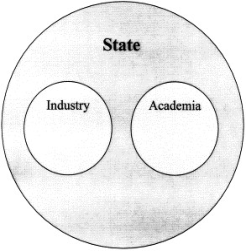
Neoclassical theory (Smith, 1990; Guston, 2000) explains production performance and competitive advantage of firms in terms of their relative resource endowments (Hall, 1994), while the role of knowledge was seen as exogenous to the production system (Freeman, 1995). The emergence of the ecological paradigm (Freeman, 1991; Lundvall, 1992) has shifted the focus on innovation systems justified by the triple helix model (Etzkowitz and Leydesdorff, 1997) – see Fig. 1 – , based on university-business-government relations. This model is interactive and virtuous for innovation, it is designed as well as sinergic recursive interaction between three institutions traditionally isolated, but now necessarily have to be connected in a cross-institutional relations (Sutz, 1997).
Figure 1. Triple Helix configurations (Etzkowitz and Leydesdorff, 2000)
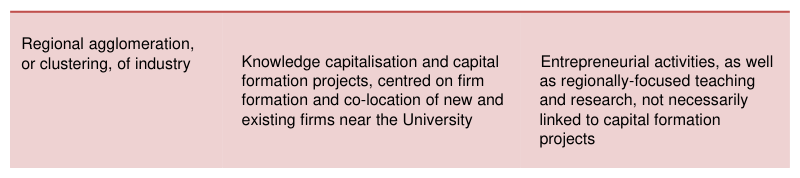
According to the model, in local service systems, while government plays a coordinating role in social development and local networks - regional leaders - the bridge university-business emphasis the concept of academic entrepreneurship focused on the processes of generation, accumulation and implementation of Knowledge for Innovation and Development (Chatterton and Goddard, 2000).
Functionality and applicability of the model propeller lies in the ability to interpret innovation in the light of: 1) local/regional network of companies and other organizations in a limited geographical area; complementary industries, availability of a stock of social capital/human governance collaborative based on trust and cooperation between actors (Lundvall and Johnson 1994; Niosi and Bas, 2001).
Table 1: The triple helix model – The role of institutional actors for reframing innovation in nested service system (Adapted from Gunasekara C., 2006)
Generative role Developmental role
Key element of regional innovation system
Stronger regional focus on
Human capital formation Integration of education and
student recruitment and graduate retention
knowledge capitalisation activities, specifically, firm formation, through teaching incubators;
Education programs
Development of generic, advanced
developed/adapted to meet regional skills needs
training programs to support firm formation and cross-institutional mobility by organisations and people
Learning processes regionallyinformed
The configuration of the triple helix and the excellent Pexp = 1 and Ra = Gr refers to a smart governance structure and dynamics of the relation between the actors university-government-business (Piciocchi et al., 2012).
In nested social networks,
- whether governance can be considered as the result of a continuous transformation of the governance structure and practices according to functional the new business and societal liberalism;
- whether Service Systems are: a) dynamic configuration of resources, b) a set of value co-creation mechanism between suitable entities, c) an application of competencies -skills -knowledge any person (s) in job roles or stakeholders, d) an adaptive internal organization responding to the dynamic external environment, d) ensure mutual learning and feedback to benefits or outcomes of value co-creation , etc. ) to enable complex viable structure to respond to environmental change, where environmental change is mostly generated by other systems viable, then Smart Mechanism of Governance (SMG) to assess skills and expectations mediated human needs a conceptual re- interpretation of government as an institution (structure) as well as practice (system) according to functional new deal of governance in service systems as we called governmentality (Foucault, 1991).
This reformulated governance conceptualization is coherent with the needed reframing innovation. In fact, the interpretation of innovation process in social way suggests to embrace the bottom-up logic in networking governance (Triantafillou, 2004; Piciocchi and Bassano, 2009), based on shared knowledge and trust.
This assumption implies a change of perspective in terms of service systems viability. If smart governance – according to the triple helix model – is able to create and develop value co-creation mechanisms and to guarantee systemic equifinality, based on a continuous process of mediation of stakeholder expectations (customers, citizens, etc.), then in nested service systems, innovation depends on the capability of a multilevel governance (Rosenau and Czempiel, 1992) useful to insure value co-creation and equifinality through a social cooperation and collaboration, in short coopetition (Spohrer et al., 2013).
PRACTICAL IMPLICATIONS The human perception of context of the service is a relevant element for recognizing and inspiring next generation service innovators and promoting service innovations. This is strictly connected to service logic which sees the world as interconnected people and organizations, participating in service systems and platforms, where providers, customers, citizens, governments, and other stakeholders work together to co-create value and co-elevate capabilities.
The sustainability of this social innovation needs relations based on established consonance to achieve integrated and synergic resonance (win-win logic). In trust terms, social innovation can support service systems viability if the interaction between government-business-university moves from calculus-based trust (win-loose logic) to identification-based trust (win-win logic).
As we have assumed the sustainability of social innovation, the three sub-systems university- business-government could evolve in nested service system if we are able to overcome their traditional overlap and accept a new deal of their proactive integration. This proactive integration of rules needs to create a collaborative relational structure adequate to interpret change according to a reformulated innovation in social extension.
The dynamic relationship of co-opetition - example in GM/Toyota, IBM/ Apple, Volvo/Mitsubishi , SAS/Lufthansa - justifying the need of reframing innovation are convincing academics and practitioners that the nested social service systems have a greater capacity to innovate. In particular, the best performance is explained in terms of: 1 ) the benefits of entrepreneurial spirit;
2 ) the benefits of synergistic effect; 3 ) the benefits of strengthening the brand and specialization;
4 ) the benefits of economies of scale at affordable cost; 5 ) the benefits of risk reduction;
6 ) benefits of information and experience.
If a business system integrated is able to have these powers, then the system itself and its sub- systems - as synergic and co-finalized components of the whole - are viable over time and may base their competitive advantage on a collaborative values system (CVS). In fact, CVS improves the viability of nested service systems on the basis of three elements (Faulkner, 1992):
1) strategic adaptation;
2) cultural adaptation;
3) organizational method, government structure and governance dynamics.
In this way, reframing innovation requires a new style to create nested service systems networks; this kind of networks allows to all interacting nodes - even independent - to work together for addressing the challenge of innovation in synergistic competitive manner.
The problem is the configuration and the stability of governance configuration.
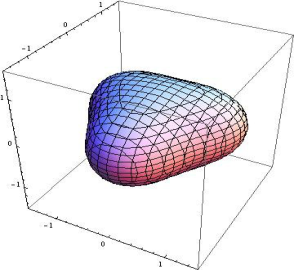
Figure 2 presents the creation of an “area of stem cells” adaptation (Ranga and Etzkowitz, 2013) of the ovals of Cassini (Hazewinkel, 2001), which shows four configurations of the transition from independent status to the interdipendent status: it represents equal the three sphere weight that rather in concrete could be differently played by each of the three components of multilevel governance, especially in terms of different role played in the innovative development of nested service network systems. The formalization of a space for innovation is achieved through relations and resources and the creation of new institutional formats.
Institutional spheres overlapped Institutional spheres apart in a balanced regime
Institutional spheres getting closer together Institutional spheres increasingly and starting to interact overlapping
Figure 2. Interaction between the Triple Helix institutional spheres in the formation of a Collaborative Space of Innovation (Adapted from Ranga and Etzkowitz, 2013)
Figure available in the original PDF paper.
Space of reframing innovation
Figure 3. Balanced multi-sphere as nested service systems network (Our elaboration)
Tri-lateral networks and hybrid organizations appear like balanced multi-spheres construction in structure and in system dynamics. In this way, we can assume both like a co-created and interactive space inside which it is possible to conceive the needed reframing innovation.
In fact, nested service network – based on knowledge, creativity and collaboration – represents “space of innovation” where complex organizations/institutions are related into hybrid network co-finalized to develop economic and social context through innovative activities: development of entrepreneurial potential, growing talent and building a sustainable competitive advantage.
CONCLUSIONS AND RESEARCH LIMITATION There is no such thing as a “new best service” - only “new service which is the best for a specific context” which is a proposition evaluated by multiple stakeholders. A service innovation culture where “presence” is cultivated (Senge et al. 2004) can help ensure that positive consonance/resonance is achieved for all stakeholders who directly or indirectly co-create service systems and partecipate to their value creation process.
In our work, we don’t know how the sustainability perspective applied for reframing innovation process is relevant to explain how the role of human resources will be critical in terms of Talent. In fact, in Service Science terms, the “shape of a professional’s” means the capabilities that professionals can apply when they are involved in problem solving and when they are communicating with other professionals as part of a project team (Spohrer et al., 2010:10). T-Shaped professionals are individuals with Talents for producing global value co-creation; this kind of professionals are able to manage decisional uncertainty in a complex scenario. The talent capability of to know “what to do” – targets and ends – and to do “what they know” – i.e. their competences and means – (Spohrer et al., 2010:12), is an essential human ingredient to interpret innovation in a social view and implement related virtuous process through a cultural transition of all components of nested service systems.
To establish mutually beneficial relationships with other service systems promoting the development of T-shaped people with both deep discipline-based problem-solving skills and broad multi-disciplinary communications skills.
REFERENCES
Candi, M. (2007), “The role of design in the development of technology-based services”, Design Studies, Cite SeerX: 10.1.1.127.9028 Chatterton., P. and Goddard, J.B. (2000) “The response of higher education institutions to regional needs”, European Journal of
Education. Vol. 35, No. 4, pp. 475-496. Chesbrough, H. and Spohrer, J. (2006), A research manifesto for services science. Comm. ACM 49(7):35–40. Chesbrough, H. (2011), Open Services Innovation: Rethinking Your Business to Grow and Compete in a New Era, Jossey-Bass. den Hertog, P. (2000), “Knowledge-intensive business services as co-producers of innovation”, 4, International Journal of Innovation Management. Edvardsson, B. (1997), “Quality in new service development: Key concepts and a frame of reference”, International Journal of
Production Economics, 52 (2): 31–46, doi:10.1016/S0925-5273(97)80765-7. Edvardsson, B., Olsson, J. (1996), “Key concepts for New Service Development”, 16, The Service Industries Journal, pp. 140–
164. Etzkowitz, H. and Leydesdorff, L. (1997), Universities in the Global Knowledge Economy. London: Continuum. Faulkner, D. (1992), Strategic Alliances: Cooperation for Competition, in: The Challenge of Strategic Management, D. Faulkner, J. Johnson , (Ed.). Kogan Page. Forfás (2006), Services Innovation in Ireland - Options for Innovation Policy . Freeman, C. (1991), Foundation for Economic Education, Irvington-on-Hudson, Vol. 41, New York. Freeman, C. (1995), “The National Innovation Systems in historical perspective”, Cambridge Journal of Economics, vol. 19, no.
1. Foucault, M. (1991). Governmentality, in: The Foucault Effect: Studies in Governmentality, Graham Burchell, Colin Gordon and Peter Miller (Ed.), Chicago, IL: University of Chicago Press, pp. 87–104. Giddings, B., Hopwood, G., O’Brien (2002), Environment, Economy and Society: fitting them together into Sustainable
development, Wiley Interscience. Golinelli, G.M. (2010), Viable Systems Approach (VSA): Governing Business Dynamics, CEDAM, Padova, Italy. Gunasekara, C., Reframing the Role of Universities in the Development of Regional Innovation Systems, Journal of Technology Transfer, 31: 101–113, 2006. Gummesson, E. (2009), Marketing as Networks: The Birth of Many-to-Many Marketing (Publishing House Djursholm,
Stockholm). Gummesson, E., Lusch, R., Vargo, S. (2010), “Transitioning from service management to service-dominant logic: Observations and recommendations”, International Journal of Quality and Service Science, vol.2, n.1, pp.8-22. Guston, D.H. (2000), Between Politics and Science. Cambridge University Press. Hazewinkel, M, ed. (2001), “ Cassini oval ”, Encyclopedia of Mathematics, Springer, ISBN 978-1-55608-010-4. Hawley, AH. (1986), Human Ecology: A Theoretical Essay. University of Chicago Press, Chicago. IfM and IBM (2008), Succeeding Through Service Innovation: A Service Perspective for Education, Research, Business, and
Government. University of Cambridge Institute for Manufacturing, Cambridge, UK. Locke, E.A, Schweiger, D.M. (1979), Participation in decision-making: One more look. Staw BM, ed. Research in Organizational Behavior, Vol. 1 (JAI Press, Greenwich, CT), 265–340. Lundvall, B-Å. (ed.) (1992), National Systems of Innovation: Towards a Theory of Innovation and Interactive Learning. London:
Pinter Publishers. Lundvall, B.-Å and Johnson, B. (1994), “The learning economy”, Journal of Industry Studies, Vol. 1, No. 2, December, pp. 23-
42. Macaulay, L, Moxham, C, Jones, B. Miles, I. (2010), Innovation and skills: Future service science education, in: Handbook of Service Science, Maglio PP, Kieliszewski CA, Spohrer JC, (Ed.). Springer, New York. pp. 717-736. March, J.G. (1991), Exploration and exploitation in organizational learning. Organ. Sci. 2(1):71–87. Miles, I. (2001), Services Innovation: A Reconfiguration of Innovation Studies. University of Manchester: PREST discussion
paper DP01-05. Miles, I. (2004), Service Innovation, in: Oxford Handbook of Innovation, Fagerberg et al. (Ed.). Oxford: Oxford University Press. Miles, I. (July/August 1993),“Services in the New Industrial Economy”, Futures (Futures) 25 (6): 653–672, doi:10.1016/0016-
3287(93)90106-4. Nijssen, E.J.; Hillebrand, B.; Vermeulen, P.; Kemp, R. (2006), “Exploring Product and Service Innovation Similarities and Differences ” , International Journal of Research in Marketing, 23 (3): 241–251, doi:10.1016/j.ijresmar.2006.02.001 Niosi, J. and Bas T. G. (2001), “ The Competencies of Regions. Canada’s Clusters in Biotechnology”, Small Business
Economics, 17 , pp. 31-42. Ostrom, E., Gardner, R., Walker, J. (1994), Rules, Games, and Common-Pool Resources. University of Michigan Press, Ann Arbor. Prahalad, C.K., Krishnan, M.S. (2008), The Age of Innovation. Driving co-created value through global networks. McGraw Hill. Piciocchi, P., Bassano, C. (2009), Governance and viability of franchising networks from a viable systems approach (VSA). 2009
Naples Forum Service: Service Dominant Logic, Service Science. Network Theory, Proc. Internat. Conf. (Giannini Editore, Napoli, Italy), http://www.naplesforumonservice.it. Piciocchi, P., Spohrer, J., Bassano, C., Giuiusa, A., (2012), Smart Governance to mediate human expectations and systems context interactions, in: Advances in the Human Side of Service Engineering, James C. Spohrer, Louis E. Freund. (Ed.). Taylor & Francis Ltd. (CRC Press), ISBN: 9781439870266, pp. 319-328. Ranga M, Etzkowitz E., “Triple Helix Systems: An Analytical Framework for Innovation. Policy and Practice in the Knowledge
Society”, Industry and Higher Education, Volume 27, Number 4, August 2013 , pp. 237-262(26). Ricketts, J.A. (2007), Reaching the Goal: How Managers Improve a Services Business Using Goldratt’s Theory of Constraints IBM Press, Indianapolis. Rosenau, J.N., Czempiel, E-O (eds) (1992). Governance Without Government: Order and Change in World Politics. Cambridge
University Press, Cambridge. Scharmer, C. O., Jaworski, J., & Flowers, B. S. (2004). Presence: Human purpose and the field of the future. Cambridge, MA: The Society for Organizational Learning. Sen, A. (2000), Development as Freedom. Anchor/Random House, New York. Senge, P., Flowers, B., Scharmer, O., Jaworski, J. ( 2004), “Presence: Human Purpose and the Field of the Future”, Society for
Organizational Learning, March. Simon, H.A. (1996), The Sciences of the Artificial. MIT Press, Cambridge, MA. Smith, N.C. (1990), Morality and Market. Routledge. Spohrer, J.,Picicocchi, P., Bassano, C. (2012). “Three Frameworks for Service Research: Exploring Multilevel Governance in Nested, Networked Systems”, Service Science, vol. 4, p. 147-160, ISSN: 2164-3970, doi: 10.1287/serv.1120.0012. Spohrer, J. Golinelli, G.M., Piciocchi, P., Bassano, C. (2010), “An integrated SS-VSA analysis of changing job roles”, Service
Sci. 2(1/2):1–20. Spohrer, J. and Kwan, S.W. (2008), Service science, management, engineering and design (SSMED): Outline and references. Spath, D. and Ganz, W. eds. (2008), The Future of Services: Trends and Perspectives. Hanser, Munich, Germany, 107–232. Spohrer, J. and Maglio, P. (2008), “The emergence of service science: Toward systematic service innovations to accelerate cocreation of value”, Production Oper. Management 17(3):238–246. Spohrer, J. and Maglio, P.P. (2010), Toward a science of service systems: Value and symbols, in: Handbook of Service Science,
Maglio PP, Kieliszewski CA, Spohrer JC, (Ed.). Springer, New York. pp. 157–196. Spohrer, J., Kwan, S., Fisk, R. (2013), “Marketing: a Service Science and Arts Perspective”, in: Handbook of Service Marketing Research, RUST & HUANG 9780857938848 PRINT. indd. Sutz, J. (1997). “The new role of the university in the productive sector”, in: Universities and global knowledge economy: A
triple helix of university–industry–government relations, H. Etzkowitz & L. Leydesdorf (Ed.). London, pp. 11–20. Pinter.Van Ark et al. (2003), “Services Innovation, Performance and Policy: A Review ” , Research Series N°6, The Hague. Triantafillou, P. (2004), “Conceiving Network Governance. The Potential of the Concepts of Governmentality and Normalization”, Working paper 2004/4, Centre for Democratic Network Governance, Roskilde, May. Vargo, S.L., Lusch, R.F. (2004), Evolving to a new dominant logic for marketing, Journal of Marketing, 68(1):1–17. Williamson O. (1996), The Mechanisms of Governance. Oxford University Press, Oxford, UK. Zineldin, M. (1997), Strategic Relationship Management. Almqvist & Wiksell International AB.
LISTED IN THE AHFE DIGITAL BOOKSTORE CATALOGUE
Explore the complete digital volume
Advances in The Human Side of Service Engineering
Read this individual research paper free through the original publisher, or explore the full digital proceedings book.
ISBN 978-1-4951-2091-6
Explore this ISBN in the AHFE Bookstore ↗Listed in the July 2026 bookstore catalogue; search by ISBN to confirm current availability · Digital book purchase optional