J. Fowler, J. Noyes (2019). Attitudes and Use of Mobile Phones in Tweens. In: Advances in The Human Side of Service Engineering. AHFE Open Access, vol. 8. https://doi.org/10.54941/ahfe100244
As mobile phones become more and more ubiquitous, their use for various communication modes continues to increase. Ownership and use is most prevalent in young people (Baron, 2010, Cotten, 2009, Kasesniemi & Rautaninen, 2002, Ling & Yyttri, 2002, Rees & Noyes, 2007, Pew Project, 2011) and younger and younger individuals are owning and using mobile phones (Geser, 2006). Many studies have looked at mobile phone use and behaviour in 11-25 year olds but little research has been carried out with tweens (8-11 year olds). Attitudes to mobile phone use and perceptions of use towards mobile phones are investigated in tweens (8-11 year olds). 136 pupils in seven schools completed two questionnaires and 20 pupils carried out small group interviews. User behaviour with mobile phones is discussed with reference to the type of information that is communicated by voice and text. It is suggested that mobile phone use is increasing in tweens (8-11 year olds) and the way mobile phones are used are challenging traditional values and behaviours of social practice, for example, many tweens prefer to contact each other through texting rather than face to face or calling on the mobile phone.
The mobile phone has been characterised by its ubiquitous nature since its inception and has now become an everyday tool for many people (Chantal de Gournay, 2002). Ownership and use of mobile phones is most prevalent in young people (Baron, 2010, Cotten, 2009, Fedoricz et al, 2010, Kasesniem & Rautaninen, 2002, Lin & Yttri, 2002, Pew Internet and Life Project, 2011 Rees & Noyes, 2007). Smartphone use continues to increase amongst all ages, especially by the under 25 year olds. A survey of American teens (12- 17 year olds) showed that 37% owned a smart phone (Pew Research Internet Project, 2013). This is an increase of 14% from a survey carried out the by the Pew Centre in 2011 which showed that 23% of this age group owned a smart phone.
It has been suggested that the reasons for the success of the mobile phone are due to its portability, its multipurpose use and its constant accessibility and reachability. The latter has lead to terms such as “always on” (Baron, 2008) and “perpetual contact” (Katz and Aakhaus, 2002) as a way of describing the way users interact with this technology. There is no doubt that the mobile phone has had a large impact on people’s lives. Brown (2011) commenting on a behavioural study by Motorola (2008) endorses the impact mobile technology has had on people’s lives of “permanently changing the way we work, live and love” (p.1). It has been claimed that mobile phones are “redefining careers, the family unit and social intercourse” (Arbitron Inc and Jacobs Media, 2011, p. 1). The mobile phone facilitates people in the organisation of their lives. Ling and Ytrri (2002) introduced the terms micro- coordination and hyper-coordination to help understand the way users organise their lives through using their mobile phone. Micro-coordination refers to the flexibility that can occur with a mobile phone when arranging meetings; it is possible to change & adapt the agreement as the need arises thus the when and where of meetings can be changed Human Side of Service Engineering (2019) https://openaccess.cms-conferences.org/#/publications/book/978-1-4951-2091-6 through the mobile phone. Hyper-coordination refers to micro-coordination and the expressive use of the mobile for social & emotional communication. This connectivity from hyper-coordination refers to work, family and personal relationships.
Geser (2006) has documented the ever increasing use of the mobile phone by younger and younger users and the importance of text messaging culture. The rapid increase in mobile phone use has been discussed in many studies and also the creation of a mobile phone communication culture ( Chantal de Gournay, 2002, Skog, 2002, Kaseiniemi and Rautainen, 2002). Madell and Muncer (2004) found that the most important uses for mobile phones amongst teenagers were for making and receiving calls and texting. Baron’s study looked into the attitudes of users towards talking face to face, texting or calling on the mobile (Baron, 2009) and found that users preferred texting as their method of communicating with each other.
Text messaging was introduced into the domain of communication technology almost by accident. In 1982, a voice mobile telephone system that would work throughout Europe was created by a multinational European initiative known as Group Special Mobile, or GSM. This came into operation by 1992. A bit of leftover bandwidth was made available so that users could create short messages on the keypad by tapping the number keys between one and four times to produce alphabetic characters. This was SMS texting (Short message system) and very quickly became popular amongst young adults and teenagers.
One of the key factors that have been observed in many studies of mobile phone use and behaviour in adults and young people is that the very function that people enjoy from using their mobile phone is also the very function that has a negative aspect to them. For example, a major benefit of the mobile phone is the freedom offered by the ability to be able to be contacted at any time, but this constant connectivity and accessibility brings with it the problem of being “always on” (Baron, 2008) leading to a sense of dependence and in extreme cases, addiction. “Constant accessibility translates to greater efficiency and more comfort, but also increased stress” (Arbitron inc and Jacobs Media, 2011). “One may be dependent on connection and feel constant worry over accessibility, as though one were addicted to the connections the mobile phone makes possible”(Kopooma, 2001, P. 27) Such negative characteristics range from “disruptive sleep to carpel tunnel syndrome (from constant texting), distraction form the cognitive or social task at hand, or clinical addiction” (Baron, 2009).
The present study continues the exploration of this conundrum in a young age group, tweens (8-11 year olds). Drawing on studies of teenager’s use of mobile phones, this is explored to find out how younger ages are using their mobile phones and also to find out what their attitudes are. Are ‘the contradictory pulls’ of the mobile phone experienced by adult and teenage users the same for tweens? The hypothesis that is explored is that tweens will, in fact, experience similar contradictory pulls of mobile phone use that older users do.
The study also wanted to find out if young users: tweens (8-11 year olds) own a mobile phone and what they use it for. The hypothesis that text messaging will be the most popular way of communicating is tested to see if tweens, like teenagers find texting most popular. As the mobile phone becomes more popular by younger and younger users, is face to face contact no longer the favoured means of communicating with each other?
METHOD
Participants Participants were 136 male and female pupils in Year 4 (age 8/9), Year 5 (age 9/10) & Year 6 (age 10/11) from seven primary schools in Somerset. Interviews were then carried out with 20 male and female pupils in Year 5 (age 9/10) and Year 6 (age 10/11) from two schools. Letters were sent to parents to invite pupils to participate in the research and ethical approval for the study was given by the university.
Materials and Design Questionnaires were presented to the pupils as A4 booklets. They were designed to find out how young people use mobile phones and their attitudes to their use of them. Four age group categories were created so that questionnaires
Human Side of Service Engineering (2019) https://openaccess.cms-conferences.org/#/publications/book/978-1-4951-2091-6 could be adapted for the needs of different age groups. The four age groups were 8-11 year olds, 11-14 years, 14-18 years and 18-25 year olds. This paper considers the 8-11 year old group.
The motivation for the questionnaires came about as a way to gather data from a large sample of participants and to see if and how the mobile phone had impacted on participant’s everyday lives. A literature survey provided the background for the questionnaires and various studies influenced the choice of questions (Baron, 2009, Van Biljon, 2006). Questions were adapted for the age of participants. The first questionnaire asked participants questions about their mobile phone use and their attitudes towards their mobile phones. The second questionnaire asked about mobile phone usage with reference to voice and text and also asked who was contacted.
Questions in the questionnaire included open ended and direct questions depending on the sort of response that was being looked for. Some questions required a direct response whereas other questions offered a choice of response on a 3 point lickert scale.
Two schools were selected to carry out interviews with Year 5 and Year 6 children. The selection for this was random. Children were interviewed in groups of three. Due to the age of the children, it was felt that the children would feel ‘safe’/relaxed in a group this size. The group would be large enough to encourage dynamic interaction amongst participants but small enough for each child’s voice to be heard. It was felt that interviewing individuals might feel too intense for them. Interviewing children in a group of three was a group size endorsed by Foolproof (UCD conference, November, 2012) who regularly work with children for assessing user centred design products.
Interview questions included open ended and direct questions depending on the sort of response that was elicited. The first question was open ended inviting children to tell the interviewer what they thought about mobile phones. This was followed by a question “Why do you think the mobile phone has become such an important part of everyday life?” This question was adapted from Madell and Muncer’s study (2007) where a focus group of seven teenagers were asked, “Why do you use different communication media, such as the internet and mobiles phones in your social lives?” It was important to gain a broad view of how the children perceived mobile phones in their everyday lives rather than just their social lives. Asking children about their everyday lives would include their social life but not restrict their consideration of the use of their mobile phone only to their social lives. Interactions with their family could also be considered. The children were asked about whether they preferred to text or call. They were then asked, “What makes you decide to text rather than ring?” followed by “What makes you decide to call rather than text?”
Procedure Pupils completed the questionnaires in small groups in their year groups. The setting for the questionnaires was informal and varied from a small study room or a space in the library. Children had the opportunity to ask questions. The questionnaires took about 20-30 minutes to complete.
A pilot study was carried out with ten primary school pupils. Children in each year group were asked whether or not they thought any of the questions or the language in the questions should be changed in any way. As a result, some changes were made. For example, the question, “What technological devices do you own?” was changed to “What electronic gadgets do you own?” The Year 4 children said they found this easier to understand. It was important to make sure the questionnaires were suitable for the ages of the children. Discussion with the Year 6 pupils (age 10/11) suggested that the questionnaires would be suitable for Year 5 (age 9/10) and Year 4 (age 8/9) children to fill in. The Year 6 pupils also suggested that it was easier if the questionnaires had ‘boxes’ for them to put their answer in so they knew where to put their responses. The questionnaires were originally on A4 paper. Year 4 pupils suggested that the questionnaires would be easier to fill in if they were in the form of a booklet.
The setting for the interviews was informal and flexible. Interviews were carried out in a small study room or space in the school. Face to face semi-structured interviews aimed to extract a rich account of personal opinions from the participants’ own unprompted observations. Pupils had the opportunity to ask questions. Audio recordings of the interviews were transcribed verbatim. Interpretative phenomenological analysis (Smith and Osborn) 2003 was then used to analyse the data.
Human Side of Service Engineering (2019) https://openaccess.cms-conferences.org/#/publications/book/978-1-4951-2091-6
RESULTS
Some results of the questionnaires completed by 8-11 year olds and interviews carried out with 27 pupils are reported. Descriptive statistics show that 95% per cent of 8-11 year olds have access to a mobile phone whereas 66% own a mobile phone. Most of the phones owned by tweens are smart phones.
The majority hold mainly positive attitudes towards their use of mobile phones, for example, 90% of tweens believe that mobiles are fun to use.
The most popular uses The most popular use of mobile phones is for sending and receiving texts (81%) followed very closely by making and receiving calls (80%). The most popular reason for calling (79%) and texting (77%) is to keep in touch with family. Over three quarters of pupils said they liked to play games on their phone (79%) and three quarters of pupils liked to listen to music (75%). Less than three quarters of pupils said that they used the mobile phone to access the internet (70%).
What do tweens prefer to do? Talk, Text or Face to Face Comparing the percentages for talking face to face with each other with talking or texting on the mobile phone, tweens prefer face to face contact (51%) However, if the cumulative frequency of always and sometimes is considered together, the most popular form of contact is talking on a mobile (84%), followed closely by texting (82%) and then face to face to contact (81%).
Table 1: Which communication mode do tweens prefer?
Table available in the original PDF paper.
Talking face to face Texting Talking Mostly 50.7 47.1 35.1 Sometimes 30.1 36.0 48.5 Never 19.1 16.9 16.2 Cumulative frequency of mostly & sometimes 80.9 83.1 83.8
Organising schedules and changing plans on the move Fifty seven percent of tweens said they use their mobile to arrange when and where to meet friends. Forty two per cent used their mobile to change plans quickly. Seventy one per cent of tweens say they call or text to say where they are or check where someone else is.
When tweens were asked if they liked to be able to use a phone to keep in touch no matter where they were 80% said they did like to use their phone in this way.
Always on Tweens were asked about whether or not they liked to have their phones on all the time. Sixty seven per cent said they did. Seventy six per cent liked to be able to be text or called at all times whereas Seventy nine per cent liked to be able to use a phone to keep in touch no matter where they were.
When tweens were asked if they liked to be able to use a phone to keep in touch no matter where they were 80% said they liked to use their phone in this way. Looking further at this desire to be able to be contacted ‘any time, any place’, tweens were asked about whether or not they kept their phone on when they went to bed. 53% slept with a phone next to their bed. 35% leave their phone on when they go to bed and 66% turn their phone off when they go to bed.
The interviews
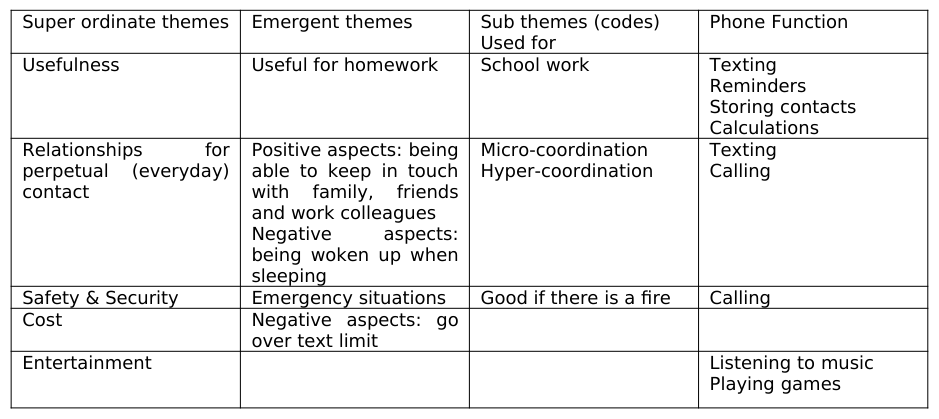
Table 2 shows the themes identified by using interpretative phenomenological analysis (IPA).
Human Side of Service Engineering (2019) https://openaccess.cms-conferences.org/#/publications/book/978-1-4951-2091-6
Table 2: IPA analysis
Some comments from the interviews are reported.
Question: What do you think about mobile phones?
“They are good for keeping in contact with people. They are important for us because we are going off to different schools”.
“They are good for keeping in contact with your family. I talk to my family a lot.”
“I don’t use the phone much except for phoning and texting my parents” “Good to stay in touch with your parents”
“It’s good for communicating but I know people who are addicted to their phones” “Mobile phones keep you safe”
“Good for calling if there is a fire”
Question: Why do you think mobile phones have become such an important part of everyday life?
“It’s a good way to keep in touch” “Good for communicating”
“They’re useful for texting about school work” “They keep you in touch with your family so if it’s raining, for example, I can call my Mum to come and get me.”
“You can use them if you’re bored” Human Side of Service Engineering (2019) https://openaccess.cms-conferences.org/#/publications/book/978-1-4951-2091-6
Question: Do you prefer to call or text?
More tweens prefer to text ((13) than talk (11) and three pupils said they didn’t have a preference to whether they called or text on the mobile phone.
Question: What makes you decide to text rather than call?
“Calling is hard if you are doing something but if you are texting, you can carry on with what you are doing” Texting is like a way of getting out of an argument. You wouldn’t say it as a real person but by texting, it’s like it protects you like a bubble, so you can say it in a text”
“What’s good about texting is that you can send a photo with your text.
“I don’t want to waste credit calling; I just save ringing for an emergency.”
“I would text if I was angry” “Cheaper to text”
“I would text if there is an emergency. If you text, you know the message has gone through. If you call, the person might not answer.”
“It’s more private to text” “It’s cheaper to text”
“And quicker, and it gives you time to think. If you’re speaking on the phone, you might forget what you’ve said or arrange but with texting, you have it in front of you so you have time to think about what you want to say”
Question: What makes you decide to call rather than text?”
“When you talk to someone, you can give them your expression” “When you call, you can get straight through or not at all but with texting you don’t know if you have got through”
“If there was an emergency, say if your house was burning down, then I would call” “I don’t want to hurt my thumb bones by texting”
“Sometimes texting can take too much time and yeah, texting can hurt your thumbs” “When you text, it doesn’t capture the real thing like when you call and speak to someone else so I like to use a call because sometimes people don’t text back. It might hurt your fingers if you text too much. It might hurt your fingers if you text too much.”
“I prefer to ring to hear their voice and because it’s more like face to face contact.”
“Because I like to hear my parent’s voice” “It is comforting to hear someone’s voice if you are feeling down”
“Voice is more descriptive than a text”
Human Side of Service Engineering (2019) https://openaccess.cms-conferences.org/#/publications/book/978-1-4951-2091-6
“You get the tone in your voice by talking.”
DISCUSSION
The results from the questionnaires show that 66% of tweens in this study own a mobile phone. This is a surprisingly high number of tweens with a mobile phone, for example, compared to the Pew Survey ‘Teens and Technology 2013’ where it was found that 78% of teens, (12 to 17 year olds) owned a mobile phone.
Five main themes have been identified in the IPA analysis of the interviews. These are the usefulness experienced from using a mobile phone, the facilitating capacity of organising schedules, for micro-coordination and hyper- coordination with family and friends, safety in an emergency and security, cost and the use of the mobile phone for entertainment.
The ‘contradictory pull’ of factors participants like about mobile phones but at the same time experience a negative effect can be seen on many occasions. When asked “What do you think about mobile phones?” one participant said mobile phones: “are good for keeping in contact with people. Because we are going off to different schools (referring to secondary schools), they are important for us”
but then referring to the cost of the phone, she said: “The bad thing is I go over my text limit in my contract because I text too much”
In response to the question, “What do you think about mobile phones?” another participant said: “I think it is quite good. I like to text, carry it around, do stuff on it”
Later on in the conversation, she said: “Sometimes I’m asleep and it wakes me up. It vibrates and wakes me. That’s not good”
The questionnaires showed that the most popular use of mobile phones is sending and receiving texts (81%). Geser (2006) and Madell and Muncer (2004) identified the significance of texting as the most popular use of the mobile phone amongst teenagers. Calling was almost as popular as texting. 80% identified calling as a reason for using their phone. Over three quarters of pupils said they liked to play games on their phone (79%) and three quarters of pupils liked to listen to music (75%). The Pew Research Internet Project (2013) found that 74% of teens (12-17 years) access the internet on a tablet, mobile phone or other mobile device and that 25% access the internet mostly on their mobile phone. The tween’s responses revealed that 70% access the internet on their mobile phone.
Comparing the percentages for talking face to face with each other with talking or texting on the mobile phone, tweens prefer face to face contact (51%) However, if the cumulative frequency of always and sometimes is considered together, the most popular form of contact is talking on a mobile (84%), followed closely by texting (82%) and then face to face to contact (81%).
The results for whether or not children decide to text rather than call or call rather than text are similar to the results found by other studies (Baron, 2009, Geser, 2004). The reasons tweens gave to the question “Why do you prefer to text rather than call?” show how users experience many benefits to texting. For example, texting information allows users time “to choose what information to include” in a text. Baron ((2009) found texting meant the message could be “kept short, and talking takes too long” (P.14) Texting meant that users wouldn’t have to become entrapped in extended conversations. By texting information, they could also choose what information to include.
Other advantages that interviewees expressed are: “Calling is hard if you are doing something but if you are texting, you can carry on with what you are doing”
“I don’t want to waste credit calling; I just save ringing for an emergency.”
Human Side of Service Engineering (2019) https://openaccess.cms-conferences.org/#/publications/book/978-1-4951-2091-6
“It’s cheaper to text” “And quicker, and it gives you time to think. If you’re speaking on the phone, you might forget what you’ve said or arrange but with texting, you have it in front of you so you have time to think about what you want to say”.
The questionnaires showed that the most popular reason for calling (79%) and texting (77%) is to keep in touch with family. Wajcman et al. (2008) showed in their study that the main purpose of mobile phone calls was to maintain continuing connection with family and friends. In the interviews, the importance of the mobile phone in family life is revealed.
“My Dad’s away a lot so I like to call him to hear his voice” “I like to call my Dad when he is going on his lorry”
Children with separated parents value the use of their phone to keep in touch with the other parent.
“I have a phone because my parents are split up” In this context, tweens prefer to call rather than text so they can hear the other parent’s voice.
The results show that tweens use their mobile phones for micro-coordination in their lives. 57% arrange when and where to meet friends. 42% of tweens used their mobile to change plans quickly. 71% of tweens say they call to say where they are or check where someone else. This is backed up by the interviews: “My Mum got a phone so I could go up the park”
“I go up the park” “They keep you in touch with your family so if it’s raining, for example, I can call my Mum to come and get me.”
With reference to being “always on”, 67% said they liked to have their phones on all the time and 80% said they liked to be able to use a phone to keep in touch no matter where they were . 76% liked to be able to be text or called at all times. With reference to the negative quality of addiction, 53% of tweens slept with a phone next to their bed, 35% left their phone on when they went to bed whilst 66% turn their phone off when they go to bed.
Individuals make decisions on whether to text or talk depending on what information is being expressed and also what the purpose of the message is. This was also found by Baron (2009) and Ling and Yttri (2002). Although texting is the most popular means of communicating, many participants are aware of the limitations of texting: “Texting can be awkward. If you have an argument when you are texting, you can get a wrong impression from a text. You can get more meaning and expression in calling”
Another participant refers to the time delay in getting a response when texting: “I like calling because you can get more information and you know the answer straight away but with texting, you don’t get the answer straight away”
In conclusion , the decision to talk or text is complex and varied. It is based on individual differences and individual perceptions and understanding of how participants perceive different functions and features on the phone. For example, one participant wants to text in an emergency because: “I would text if there is an emergency. If you text, you know the message has gone through. If you call, the person might not answer”
whereas another individual will call because they want to make sure they get through. It is important to them that they can express the level of the emergency by the “tone in their voice”. Another participant appreciates the value of calling in an emergency: “If there was an emergency, say if your house was burning down, then I would call”
Human Side of Service Engineering (2019) https://openaccess.cms-conferences.org/#/publications/book/978-1-4951-2091-6
Participants like to hear the tone or expression in people’s voice when calling: “I like to hear people’s voices. Talking makes me feel like I’m with someone”.
“When you text you can’t hear the tone in someone’s voice, their expression” “I prefer to ring to hear their voice and because it’s more like face to face contact.”
“It is comforting to hear someone’s voice if you are feeling down” “Voice is more descriptive than a text”
“You get the tone in your voice by talking.”
This study has discussed ‘the contradictory pulls’ of using the mobile phone in tween’s everyday lives; for example, constant accessibility creating a ‘perpetual contact’ culture as evidenced by tweens being woken in their sleep. Future studies could explore this further.
Some traditional ways of communicating are changing. For example, many tweens prefer to communicate by texting. This is the case for particular types of communication, for example, for micro-coordination in their lives and sometimes for avoiding face to face contact. It is easier to text. One of the advantages of texting is that it allows the user to think through what they want to communicate. They can also multitask and carry out other activities at the same time. Hyper-coordination, however, facilitates calling as the preferred means of communication because tweens like “to hear the tone or expression in people’s voices”. The interviews indicate that when participants want a more ‘meaningful’ contact, they call their family or friends. Although texting I the favoured wa of communicating by many tweens, face to face contact and the characteristics of ‘real life’ contact with each other are important and valued by tweens.
REFERENCES
Arbitron Inc. and Jacobs Media. [Guest Blog]: The Impact of Smartphones on American Life, 1-3. Retrieved from http://redcrowblog.blogspot.com/2010/01/guest-blog-impact-of-smartphones-on.html Baron, N. S. (2009), Talk about Texting: Attitudes towards Mobile Phones, Conference Proceedings, London Workshop of
Writing, University of London. Baron , N. S. 2011, Concerns about mobile phones: A cross-national study, First Monday, 16 (8), 1-28. Retrieved from http://firstmonday.org/htbin/cgiwrap/bin/ojs/index.php/fm/article/view/article/3335/30 Brown, A., (2011). Cell Phone usage. Retrieved from http://www.compukiss.com/articles/cell phones-usage.html. Cotten, S., (2009), Old Wine in a new technology, or a different type of digital divide?, New Media Society, 11,(7), 1163-1186
doi:10:10.1177/1461444809342056. De Gournay, C., (2002), Pretence of Intimacy in France. In Katz, J. E. And Aakhus, M. (Eds.), Perpetual Contact: Mobile Communication, Private Talk, Public Performance. Cambridge: Cambridge University Press. Geser, 2006, Preen teen cell Phone adoption: consequences for later patterns of Phone usage and involvement, Sociology of the
Mobile Phone, Retrieved from http://socio.ch/mobile/t_geser2.htm Kasesniemi E. L. & Rautaninen P., (2002), Mobile Culture of children and teenagers in Finland, In Katz, J. E. And Aakhus, M.
(Eds.), Perpetual Contact: Mobile Communication, Private Talk, Public Performance. Cambridge: Cambridge University Press. Ling, R. & Yttri, B., (2002) Hyper-coordination via mobile phones in Norway. In Katz, J. E. And Aakhus, M. (Eds.), Perpetual Contact: Mobile Communication, Private Talk, Public Performance. Cambridge: Cambridge University Press. Madell D. & Muncer, S. J., (2004), Back from the Beach but Hanging on the Telephone? English Adolescents Attitudes and
Experiences of Mobile Phones and the Internet, Cyberpsychology & Behaviour, 7, 3, 359-367. Mary Ann Liebert, Inc. Madell D. & Muncer, S. J., (2007) Control over Social Interactions: An important reason for Young People’s Use of the Internet and Mobile Phones for Communication, Cyberpsychology & Behaviour, 10, 1, 137-140. Doi:10.1089/cpb. Pew Internet and American Life Project, Smith, A., ( 2011) Smartphone Adoption and Usage, Retrieved from
http://itcnetwork.org/2011/11/Smartphone adoption and usage-2011/ Pew Internet and American Life Project, Smith, A., ( 2012), 46% of American adults own smartphone owners, Retrieved from http://www.pewinternet.org/2012/12/46% of American adults own smartphones-2012/ Pew Research Internet Project, (2013), Teens and Technology 2013, Retrieved from http://www.pewintenet.org/2013/13/teens
and technology-2013/ Human Side of Service Engineering (2019) https://openaccess.cms-conferences.org/#/publications/book/978-1-4951-2091-6
Rees, H. & Noyes, J., (2007), Mobile Telephone s, Computers and the Internet: Sex Differences in Adolescents’ Use and Attitudes, Cyberpsychology & Behaviour, 10(3): 482-484. doi:10.1089/cpb.2006.9927. Skog, (2002) In Katz, J. E. And Aakhus, M. (Eds.), Perpetual Contact: Mobile Communication, Private Talk, Public
Performance. Cambridge: Cambridge University Press. Smith, J. A. & Osborn, M. (2003). Interpretative phenomenological analysis. In J. Smith (Ed). Qualitative Psychology, (pp. 51- 80). London: Sage Publications. Van Biljon, J. A., (2006) A model for representing the motivational and cultural factors that influence mobile phone usage
variety, PhD Thesis, Computer Science, University of South Africa. Wajcman, J., Bittman, M. And Brown, J. E., (2008) Families without borders: Mobile Phones, Connectedness and Work-Home Divisions, Sociology, 42 (4): 635-652. Retrieved from http://soc.sagepub.com/ doi: 10.177/0038038508091620
Human Side of Service Engineering (2019) https://openaccess.cms-conferences.org/#/publications/book/978-1-4951-2091-6
LISTED IN THE AHFE DIGITAL BOOKSTORE CATALOGUE
Explore the complete digital volume
Advances in The Human Side of Service Engineering
Read this individual research paper free through the original publisher, or explore the full digital proceedings book.
ISBN 978-1-4951-2091-6
Explore this ISBN in the AHFE Bookstore ↗Listed in the July 2026 bookstore catalogue; search by ISBN to confirm current availability · Digital book purchase optional