Xing Xiao, Yuxuan Liu, Yue Zhu, Xinmiao Nie, Haining Wang (2023). Grasping Posture Study in One-Handed Touch Screen Operations Based on Posture Coding. In: Ergonomics In Design. AHFE Open Access, vol. 77, pp. 699–705. https://doi.org/10.54941/ahfe1003430
The ergonomic design of the thermal comfort of smartphones requires a greater understanding of the user's preferred grasping postures. This study examined the users' preferred grasping postures in three one-handed and high-heat-generating smartphone applications(short video browsing, video chatting, and video recording). The grasping postures of 50 participants in 3 smartphone application scenarios are photographed. The grasping position is encoded by the smartphone locations (left: L, right: R, top: T, bottom: B, front: F, back: K) and the number of fingers at each contact position. The grasping posture frequency distribution of smartphone application scenarios will be of use to guide the determination of the optimal thermal layout of smartphones in specific application scenarios.
With the advent of the 5G era, the problem of overheating is well-known in the electronics sector. In a competitive smartphone market, manufactu- rers constantly enhance computing performance and diversify functionalities, which could result in generating a great amount of heat (Kang, S. et al., 2019). The integration of functions and the need for long periods of user use have placed higher demands on the thermal management of smartpho- nes, and the thermal comfort of the user’s grip has become a pressing issue in the ergonomic design of smartphones.
Smartphone devices are in close contact with the human hand and there are differences in heat sensation thresholds between different areas of the human hand. Hagander, L. G. et al. (2000) experimentally noted that the greater thenar eminence has a higher sensitivity than the rest of the hand and the fingertips have a lower sensitivity. The impact of smartphone heat issues on user experience in real-world scenarios can be reduced if heat distribution is based on the user’s preferred Grasping posture information. Improperly designed locations of mobile phone hotspots may allow hand areas with high heat sensitivity to be in prolonged contact with the hotspot during use, leading to more intense thermal discomfort for the user at the same tempe- rature level. Since the one-handed operation has more usability issues than the both-handed operation in terms of grip pressure and comfort. Therefore,
the ergonomic design of smartphones for thermal comfort requires a grea- ter understanding of the Grasping posture that users prefer when operating high-heat-generating applications with one hand.
Grasping posture was investigated by previous studies for the design of mobile devices., Choi, Y. et al. (2020) coded and clustered mobile phone grip- ping postures in a hard key operation scenario to obtain three main postures, and proposed that the enlarged grip of mobile phone size would favor one of the postures. Although previous studies have analyzed the main grasping postures of mobile devices, the grasping postures under real workloads of smartphones have not been systematically investigated. The present study was intended to identify the user’s preferred grasping postures in one-handed smartphone applications. Grasping postures captured by cameras were enco- ded by the locations of a smartphone and the number of fingers at each contact location and the frequencies of grasping postures were analyzed.
EXPERIMENTAL METHODS Participants
Fifty-one participants (25 males and 16 females; age = 23.1 ± 3.1; hand length = 180.6 ± 10.7 mm) were recruited. They were all smartphone users with more than one year’s experience using their right hand primarily for one-handed manipulation and without a history of visual impairment or musculoskeletal disorders in the hand.
Apparatus and Experimental Applications The experiments were carried out on a prototype mobile phone. The dimen- sions of the phone were 163.7 mm * 73.9 mm * 8.8 mm; it had a 6.7-inch touchscreen and weighed 218 g. It ran applications realistically in the expe- riment to provide a graphical user interface while participants simulated smartphone tasks.
Applications that require video encoding especially generate excessive heat quickly (Kang, S. et al., 2019). In addition, we considered experimental appli- cations often In addition, we considered experimental applications often used in our daily lives, ranging from instant messaging to cameras. There- fore, short video browsing, video chatting, and video recording were chosen as representative high-heat task scenarios. For short-form video browsing, we chose Tiktok, which has over one billion daily active users worldwide (TikTok, 2021). For video conversations, we chose WeChat because it is the most popular video chat application in China. For video recording, we used the default app on the prototype smartphone.
Procedures Introduction phase: Explaining the purpose and procedures of the experiment to participants, followed by obtaining written informed consent.
Task familiarisation phase: Participants used the prototype phone to ope- rate three experimental applications to familiarise themselves with the size and weight of the prototype phone through exercises, as shown in Table 1.
Grasping Posture Study in One-Handed Touch Screen Operations 701
Table 1. Major experimental applications and corresponding actions.
Table available in the original PDF paper.
Experimental Applications Actions Short video browsing 1. Grasp the phone; 2. Swipe up and down to navigate through the twee- ted video 3. Tap to pause/resume playback 4. Swipe left and right to adjust the progress of the video Video recording 1. Grasp the phone; 2. Swipe to adjust the focal length of the camera; 3. Click to start/stop recording Video chatting 1. Grasp the phone; 2. Click to start/stop recording
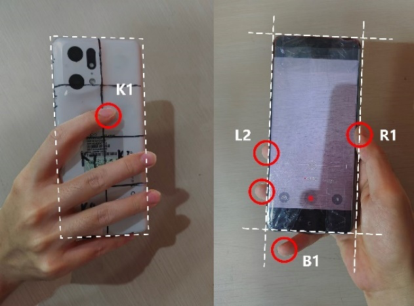
Figure 1: Encoding of smartphone grasping postures.
During the exercise, participants were required to perform a specified set of operations to familiarize them with the prototype phone. For example, a short video browsing scenario requires 4 actions to complete: (1) Grasp the phone; (2) Swipe up and down to navigate through the tweeted video; (3) Tap to pause/resume playback; (4) Swipe left and right to adjust the progress of the video.
Main experiment phase: Participants experienced three task scenarios in random order, each lasting 10 min, during which they could adjust their grip to their most comfortable position according to their usage habits. The participant’s grasping posture was measured using a handheld camera immediately after each task scenario.
Posture Coding The grasping posture was manually encoded by counting the number of fin- gers in each part of the device (left: L, right: R, top: T, bottom: B, front: F, back: K) (Choi, Y. et al., 2020). For example, the grasping posture captured for the one-handed video scene in Figure 3b was coded as L2-R1-B1-K1 (two fingers on the left, one finger on the right, one finger on the bottom, and one
702 Xiao and Liu
finger on the back of the model). A total of 153 images from 51 participants in three scenes were analyzed using the same method.
RESULTS
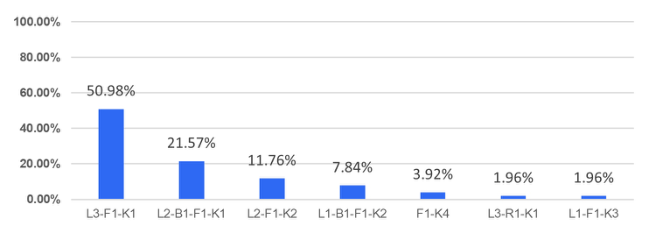
A total of seven different grasping postures were found for short video brow- sing. Three of the grasping postures (L3-F1-K1, L2-B1-F1-K1, and L2-F1-K2) dominated, accounting for a total frequency of use of 84.31%, as shown in Figure 2. In the measurement of the grip position for the short video viewing scenario, L3-F1-K1 (holding the left side of the smartphone with three fingers, the right side with the thumb, and the back with the index finger) domina- ted with a frequency of 50.98%. In addition, L2-B1-F1-K1 and L2-F1-K2 were the second and third most dominant grasping postures, accounting for 21.57% and 11.76% of the frequency of short video browsing operations respectively.
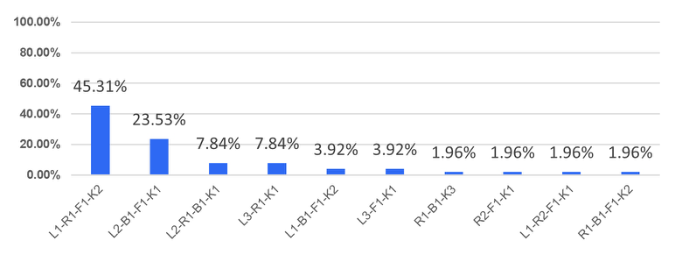
A total of ten grasping postures were identified from the experiment for short video recording, and of them, two grasping postures (L1-R1-F1-K2, L2-B1-F1-K1) make up the majority, accounting for 68.84%, as shown in Figure 3. L1-R1-F1-K2 (1 finger on the left side of the smartphone, 1 finger on the right side, thumb on the front side, and 2 fingers on the back side of the device) dominated, accounting for 45.31% of the total usage freque- ncy. In addition, L2-B1-F1-K1 was the second most dominant grip position, accounting for 23.53% of the short video recording operation frequency.
Figure 2: The use frequency distribution of grasping posture for short video browsing.Figure 3: The use frequency distribution of grasping posture for video recording.
Grasping Posture Study in One-Handed Touch Screen Operations 703
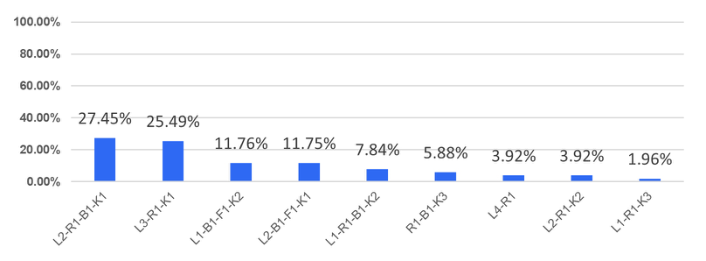
A total of 9 grasping postures were found for the video chat scenario. L2- R1-B1-K1 (27.45%) and L3-R1-K1 (25.49%) grasping postures accounted for more than half of the total and were identified as the predominant gra- sping postures (see Figure 4). L2-R1-B1-K1 is a grasping posture in which the user holds the left side of the smartphone with 2 fingers, the right side with the thumb, the index finger on the back, and the little finger supporting the bottom, while L3-R1-K1 is a grasping posture in which the user holds the left side of the smartphone with 3 fingers, the right side with the thumb, and the index finger on the back. The main difference between these two dominant postures is whether the bottom of the phone is supported by the little finger.
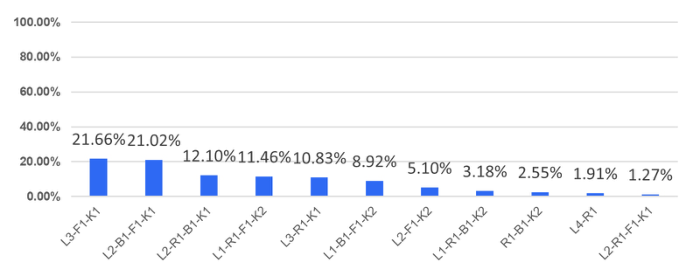
According to the frequency distribution of the grip postures in the three scenarios, L3-F1-K1 and L2-B1-F1-K1 are the two most popular grasping postures, as shown in Figure 5. Both postures allow the screen operation to be easily done by the thumb while the device is held firmly. In both postures, the thumb can be flexibly moved to the right side of the smartphone to quickly switch to L3-R1-K1 and L2-R1-B1-K1 when touchscreen operation is not required.
Figure 4: The use frequency distribution of grasping posture for video chatting.Figure 5: The combined frequency distribution of the grasping poses in all three scenes, excluding the poses with a very small percentage of frequency <2 times.
704 Xiao and Liu
DISCUSSION
This study analyzes the preferred grip positions of users with different hand sizes and their frequency when operating three high heat-generating applica- tions (short video browsing, video chatting, and video recording) with one hand, which is necessary to determine the optimal thermal layout of smart- phones in specific application scenarios to improve thermal comfort. Based on the analysis of the user’s preferred grip position, a rational design of the thermal location can reduce discomfort when the smartphone heats up at the same temperature level.
Of the two dominant grips in the video recording scene, L1-R1-F1-K2 (pinky on the left, index finger on the right, thumb on the front of the smart- phone, last two fingers on the back of the smartphone) is a one-handed horizontal grip, L2-B1-F1-K1 (last two fingers on the left, pinky on the bot- tom of the smartphone, thumb on the front of the smartphone, index finger on the back of the smartphone) is a one-handed vertical grip. Both grips, while differing significantly in orientation, have the pinky finger at the bot- tom of the smartphone to support the device more firmly and thus allow the thumb to be flexible for touchscreen operations on the front.
In the short video viewing scenario, the two main grip positions, L3-F1- K1 (three fingers on the left side, thumb on the front of the smartphone, and index finger on the back of the smartphone) and L2-B1-F1-K1 allow the thumb to flexibly touch the screen on the front of the screen while the device is held firmly in place. In particular, L3-F1-K1 had the highest frequency of 50.98%. The difference between the two dominant grips for video chatting, L2-R1- B1-K1 (27.45%) and L3-R1-K1 (25.49%), which are close in proportion, is whether the pinky is supported on the bottom of the smartphone, as the thumb in the video recording is barely required for touchscreen operations and can grip the phone firmly against the right side. Compared to the other two scenarios, the total percentage of non-dominant grip positions in the video chat scenario, excluding the top two dominant grip positions in terms of frequency, is 47.06% (27.45% for short video viewing and 31.16% for video shooting). This indicates that in the video chat scenario, users are freer to adopt their desired grip positions as they are hardly restricted by the position of the interface interaction components on finger positions.
Next, the results of this study need to be validated with a broader age range of users whose hand sizes may be outside the hand size range of this study, and in usage environments other than standing. This study measured the com- fortable grip posture of users while sitting, but other use environments such as sitting, lying, and walking need to be considered to check whether the distribution of grasping posture varies with the use environment.
Finally, it needs to be investigated how the determined primary grasping posture can be used to determine the optimal heat generation layout of the smartphone. When using the identified primary grasping posture, the appro- priate location of the phone’s hotspot can be determined by identifying the actual area where the user is in contact with the smartphone, avoiding brin- ging areas of the hand with high thermal sensitivity into prolonged contact
Grasping Posture Study in One-Handed Touch Screen Operations 705
with the hotspot during use. The ergonomically determined location of the heat generating point can be evaluated based on the user-verified thermal comfort.
CONCLUSION
This study examined users’ preferred grasping postures in three one-handed smartphone applications. short video browsing, video chatting, and video recording were chosen as representative high-heat task scenarios. Grasping postures were coded by the location on the smartphone (left: L, right: R, top: T, bottom: B, front: F, back: K) and the number of fingers at each contact loca- tion. The study identified three scenarios and the corresponding dominant grasping postures as follows: short video browsing (L3-F1-K1: 50.98%, L2- B1-F1-K1: 21.57% and L2-F1-K2: 11.76%); video recording (L1-R1-F1 -K2: 45.31%, L2-B1-F1-K1: 23.53%); video chatting (L2-R1-B1-K1: 27.45%, L3-R1-K1: 25.49%). The frequency distribution of grasping postures for smartphone application scenarios will be used to guide the development and evaluation of optimal thermal layouts for smartphones in specific application scenarios.
ACKNOWLEDGMENT
This work was supported by a research project on the thermal comfort of mobile phones. Thanks to the staff of the Laboratory of Anthropometry and Wearable Device Design at Hunan University. Special thanks to the participants who took part in this study. The authors also thank the anony- mous reviewers for their comments, which helped to refine this paper for publication.
REFERENCES
Choi, Y. et al. (2020). Effects of Smartphone Size and Hand Size on Grip Posture in One-Handed Hard Key Operations. Applied Sciences, 10 (23), p. 8374. Hagander, L. G. et al. (2000). Quantitative sensory testing: effect of site and skin
temperature on thermal thresholds. Clinical Neurophysiology, 111 (1), pp. 17–22. Kang, S. et al. (2019). Fire in Your Hands: Understanding Thermal Behavior of Smartphones. In: The 25th Annual International Conference on Mobile Com- puting and Networking. 5 August 2019. Los Cabos Mexico: ACM. pp. 1–16. TikTok (2021) Thanks a billion. Website: https://newsroom.tiktok.com/en-us/1-bill
ion-people-on-tiktok (Accessed: 30 January 2023).
LISTED IN THE AHFE DIGITAL BOOKSTORE CATALOGUE
Explore the complete digital volume
Ergonomics In Design
Read this individual research paper free through the original publisher, or explore the full digital proceedings book.
ISBN 978-1-958651-53-7
Explore this ISBN in the AHFE Bookstore ↗Listed in the July 2026 bookstore catalogue; search by ISBN to confirm current availability · Digital book purchase optional