Yuxuan Liu, Xinmiao Nie, Jing Zhou, Xing Xiao, Haining Wang (2023). The Effects of Gender Differences on User Experience of Smartphone Vibration. In: Ergonomics In Design. AHFE Open Access, vol. 77, pp. 223–232. https://doi.org/10.54941/ahfe1003380
Smartphone vibration is widely used in a variety of scenarios to provide information to users through the sense of touch. The user experience of smartphones is greatly influenced by haptic feedback. In this study, an experiment and an interview were conducted to investigate the effects of gender differences on the smartphone vibration experience. The vibrations of 5 smartphones were compared in 4 different scenarios, with 30 participants (16 males and 14 females) taking part in the study. Based on evaluation dimensions, the analysis showed that females were more sensitive and more accepting of smartphone vibrations than males. In certain scenarios, significant differences were found between males and females in their evaluation of vibration comfort. Based on the comparison and analysis of smartphone vibration, different preferences for males and females were identified for each scenario. The specific preferences were summarized based on the content of the interviews.
With the development of information technology, the touch screen has become the primary operating interface for smartphones, and the tactile feedback of the smartphone is an important aspect of the user experience (Tan et al., 2019).
Smartphone vibration can be used in several scenarios, including system operation feedback, information notifications (Pasquesi and Gorlewicz, 2021, Saket et al., 2013, Sahami et al., 2008), virtual keyboards (Kung et al., 2021, Brewster et al., 2007, Hoggan et al., 2008), games (Choe et al., 2013), “3D Touch” (Gordon and Zhai, 2019) and so on. Vibration can enhance the effectiveness of interaction. Tactile feedback means that information can be received in any situation, and it has a very strong sense of “intrusion” on the skin (Sahami et al., 2008). Additionally, appropriate vibration feedback can improve input efficiency and reduce error rates on the virtual keyboards (Kung et al., 2021), and it can also improve the accu- racy of performing tasks that involve clicking on obscured items (Gordon and Zhai, 2019). Vibration can also enrich the interactive experience in usage sce- narios. One reason is that vibrating smartphone keys have the same feel as
traditional buttons, and can generate and transmit complex information that enriches the user experience through different actuator technologies (Syme- onidis, 2014). In addition, haptic feedback provides an effective way for multimodal interaction on touchscreens, providing tactile graphical informa- tion and also assisting the blind or visually impaired (Kokkonis et al., 2019, Palani et al., 2018, Chu and Zhu, 2018).
The tactile feedback of vibration is crucial for user acceptance and pre- ference of smartphones (Liu and Yu, 2017). The user experience can be influenced by various vibration factors, including frequency (Chen et al., 2011), intensity (Shiraga et al., 2016), time intervals (Tan et al., 2019) and so on. It should be noted that gender differences can also affect the subje- ctive experience of vibration. A study investigated gender differences in the subjective experience of arm vibration and tested four frequency levels and four intensity levels. The results showed that females scored higher scores on perceived intensity and discomfort and were more sensitive to arm vibration than males (Neely and Burström, 2006).
In fact, several studies have shown that females are more sensitive than males in terms of their physical sensations. For example, it has been repor- ted that females have a lower pain threshold in the first dorsal interosseous muscle (Chesterton et al., 2003). Research on VR device wearers has shown that females are more sensitive to discomfort in the nose and ears (Du et al., 2022). However, to the best of our knowledge, gender differences in smart- phone vibration have not been investigated in existing research. Most current tests have not accounted for gender differences, and some studies have focu- sed only on males (Choe et al., 2013). Nevertheless, there are smartphones on the market that are primarily targeted towards females, or that allow for customisable vibration settings.
In this study, an experiment was conducted in different usage scenarios to explore differences in vibration comfort between males and females. Addi- tionally, design suggestions for smartphone vibration were proposed for the target users. The structure of this paper is organized as follows: Section 2 introduces the participants and materials in the experiment and introdu- ces the subjective evaluation method and test procedure. Section 3 provides an analysis of the study. Section 4 contains a discussion of limitations, and Section 5 concludes with a summary.
MATERIALS AND METHODS
Participants The experiment involved 30 volunteers, including 16 males and 14 females, with ages ranging from 18 to 27 years old (mean = 22.6, SD = 2.01). All the participants had good sensitivity and extensive experience with smartphone vibration. Before the test, all participants gave their informed written consent to the experimental procedure. The study was carried out in compliance with the ethical principles for research involving human subjects expressed in the Declaration of Helsinki and its later amendments, and was approved by the Institutional Review Board of Hunan University.
The Effects of Gender Differences on User Experience of Smartphone Vibration 225
Evaluation Scenarios During the experiment, participants experienced four types of scenarios on five smartphones respectively. The scenarios included low-frequency key operation, high-frequency key operation, slide operation and result feed- back. Representative events included system setting switch, telephone dialling key, compass scale adjustment and USB connection successful, as shown in Table 1.
Apparatus Five types of smartphones were wsed in the experiment, including the One- Plus 9R, Meizu 18, Xiaomi 11 Ultra, Samsung Galaxy S21 Ultra, and iPhone 12 pro, as listed in Table 2. Each of the five smartphones employed in the experiment had its own distinctive vibration style. All of the vibrations were set in representative events of the selected smartphones, except for the iPh- one 12 pro. There was no vibration in the event of telephone dialling key in iPhone 12 pro.
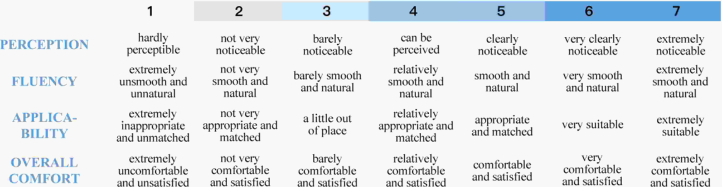
Subjective Evaluation Dimensions A 7-point Likert scale was used to measure the ratings, which included perception, fluency, applicability, and overall comfort (Fig. 1). Perception
Table 1. The experiment scenarios and representative events.
Table available in the original PDF paper.
Experiment scenario Representative event Low-frequency key operation System setting switch High-frequency key operation Telephone dialling key Slide operation Compass scale adjustment Result feedback USB connection successful
Table 2. The experiment smartphones.
Table available in the original PDF paper.
Figure 1: 7-point Likert scale.
measured the degree to which the vibrations were easily perceived and noticed. Fluency measured the degree of smoothness and naturalness. Appli- cability measured the degree of adaptation between vibration experience and usage scenarios. Overall comfort measured the degree of comfort and satisfaction brought by the vibrations in the usage scenarios. Since diffe- rent smartphones may affect perceived discomfort, the participants were emphasized to base their ratings solely on their feelings of vibration.
Experimental Procedure The experiment procedure was as follows. Firstly, basic information about the participants was collected and they were given a brief introduction to the experiment. Secondly, participants attempted five different smartphones in turn to establish an impression. Thirdly, participants experienced the vibra- tion of five competing smartphones in each scenario in a randomised order, with prescribed postures for holding and handling. They were instructed to focus only on the smartphone vibrations and to provide subjective ratings for each smartphone. Finally, informal interviews were conducted to under- stand their preferences and the perceived necessity of smartphone vibration in specific scenarios.
Statistical Analysis Statistical data analysis was performed using SPSS software version 26.0 (SPSS Inc., Chicago, IL, USA). Mean values and standard errors were presen- ted. Independent sample t-test was employed to analyse the impact of gender on the subjective evaluation of dimensions in vibration scenarios. An alpha level equal to or <0.05 was accepted as significant for all statistical tests. Finally, according to the rating and interview conclusions, the preferences of smartphone vibration of males and females were explored in this study.
RESULTS
Subjective Evaluation in the Event of System Setting Switch
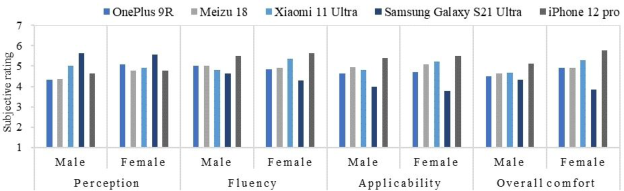
Table 3 shows the gender differences in the evaluation of the different smart- phones for the system setting switch event (low-frequency key operation scenario). The differences in mean scores are shown in Fig. 2. Based on the results of the independent samples t-test, a significant difference in perception
The Effects of Gender Differences on User Experience of Smartphone Vibration 227
Table 3. Independent sample t-test of system setting switch based on genders.
Table available in the original PDF paper.
Smart-phone Perception Fluency Applicability Overall comfort t-value p t-value p t-value p t-value p
OnePlus −3.121 0.004** 0.429 0.672 −0.226 0.823 −1.059 0.299 Meizu −1.21 0.237 0.192 0.849 −0.519 0.608 −0.884 0.384 Xiaomi 0.237 0.814 −1.539 0.135 −1.08 0.29 −1.477 0.151 Samsung 0.154 0.878 0.63 0.534 0.446 0.659 0.856 0.399 iPhone −0.518 0.608 −0.434 0.669 −0.36 0.722 −1.87 0.072 **Correlation is significant at the 0.01 level. *Correlation is significant at the 0.05 level.
Figure 2: Subjective rating under the system settings switch event.
ratings was only observed for the OnePlus 9R. According to Fig. 2, the vibra- tion feature of the iPhone 12 Pro was preferred by both genders in terms of fluency, applicability, and overall comfort. The four vibration modes were ranked highly consistent in terms of satisfaction. According to the interviews conducted, the participants expressed contentment with the soft, smooth, crisp, simple, and rubber hammer-like vibrations during the event.
Subjective Evaluation in the Event of Telephone Dialling Key
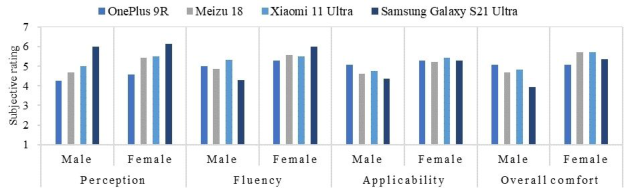
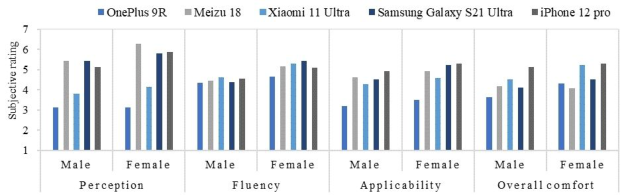
Table 4 shows the gender differences in the evaluation of the different smart- phones for the telephone dialling key event (high-frequency key operation scenario). The differences in mean scores are shown in Fig. 3. The results of the independent samples t-test showed that significant gender differences were observed in the ratings of Meizu, Xiaomi, and Samsung. In terms of overall comfort ratings, females on average scored higher than 5 (comfor- table and satisfied), while males rated the comfort as poor. Males preferred the vibration of the OnePlus 9R, whereas females preferred the Meizu 18 and Xiaomi 11 Ultra. Males and females rated the Samsung Galaxy S21 Ultra in the opposite direction. During this event, males preferred light, soft, and responsive vibrations, while females favoured short, bouncy, and brisk feelings.
Subjective Evaluation in the Event of Compass Scale Adjustment
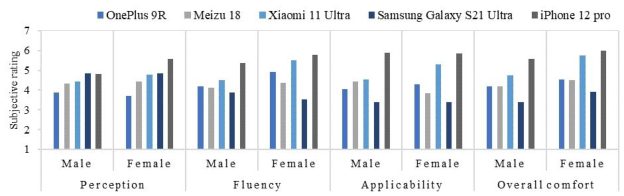
Table 5 shows the gender differences in the evaluation of the different smart- phones for the compass scale adjustment event (slide operation scenario). The differences in the mean scores are shown in Fig. 4. Based on the results
Table 4. Independent sample t-test of telephone dialling key based on genders.
Table available in the original PDF paper.
Smart-phone Perception Fluency Applicability Overall comfort t-value p t-value p t-value p t-value p
OnePlus −1.002 0.327 −0.7 0.49 −0.488 0.63 −0.019 0.985 Meizu −2.346 0.026* −2.188 0.037* −1.607 0.119 −3.296 0.003** Xiaomi −1.331 0.194 −0.796 0.435 −2.583 0.015* −3.334 0.002** Samsung −0.51 0.615 −4.22 0.000** −1.874 0.073 −2.899 0.007** **Correlation is significant at the 0.01 level. *Correlation is significant at the 0.05 level.
Figure 3: Subjective rating under the telephone dialling key event.Table 5. Independent sample t-test of compass scale adjustment based on genders.
Table available in the original PDF paper.
Smart-phone Perception Fluency Applicability Overall comfort t-value p t-value p t-value p t-value p
OnePlus 0.489 0.629 −1.708 0.099 −0.44 0.663 −0.818 0.421 Meizu −0.347 0.732 −0.494 0.626 1.093 0.285 −0.681 0.501 Xiaomi −1.081 0.289 −2.914 0.007** −1.739 0.093 −3.668 0.001** Samsung −0.042 0.967 0.821 0.419 0.032 0.975 −1.222 0.238 iPhone −2.462 0.02* −1.162 0.255 0.059 0.954 −1.494 0.146 **Correlation is significant at the 0.01 level. *Correlation is significant at the 0.05 level.
of the independent samples t-test, significant differences were observed betw- een genders in their evaluations of some dimensions of Xiaomi and Apple. From the evaluation results, both genders preferred the vibration of iPhone 12 Pro, which was accurate, smooth and agile according to the interviews. Females were also satisfied with the clear, coherent, and resilient vibrations of the Xiaomi 11 Ultra.
Subjective Evaluation in the Event of USB Connection Successful
Table 6 shows the gender differences in the evaluation of the different smart- phones for the USB connection successful event (results feedback scenario). The differences in the mean scores are shown in Fig. 5. Based on the results of the independent samples t-test, significant differences were observed betw- een males and females in their evaluations of Meizu, Xiaomi, Samsung, and Apple for some dimensions. According to the results of evaluations and inte- rviews, the vibration of iPhone 12 Pro was highly satisfactory for its slight delay and the sensation of transmitting current and energy. The vibration of
The Effects of Gender Differences on User Experience of Smartphone Vibration 229
Figure 4: Subjective rating under the compass scale adjustment event.Table 6. Independent sample t-test of USB connection successful based on genders.
Table available in the original PDF paper.
Smart-phone Perception Fluency Applicability Overall comfort t-value p t-value p t-value p t-value p
OnePlus −0.051 0.96 −0.78 0.443 −0.682 0.501 −1.531 0.137 Meizu −3.299 0.003** −2.014 0.054 −0.849 0.407 0.289 0.775 Xiaomi −1.148 0.265 −2.002 0.055 −0.863 0.396 −2.377 0.025* Samsung −1.177 0.249 −2.645 0.013* −1.668 0.107 −0.865 0.394 iPhone −2.885 0.007** −1.038 0.309 −1.087 0.291 −0.334 0.741 **Correlation is significant at the 0.01 level. *Correlation is significant at the 0.05 level.
Figure 5: Subjective rating under the USB connection successful event.
the Xiaomi 11 Ultra was preferred by females for its simplicity, bounce and compatibility with visual and tactile sensations.
General Results In most events, females rated higher on all dimensions than males in the same situation. For overall comfort, most males scored below the comfort and satisfaction line (5 points), while females’ scores were higher or closer to this line. In general, the iPhone 12 Pro and Xiaomi 11 Ultra had higher comfort and satisfaction ratings for vibration. Ratings for the Samsung Galaxy S21 Ultra were consistently high for perception but low for comfort.
DISCUSSION
The main aim of this study was to investigate gender differences in the expe- rience of smartphone vibration during smartphone use. Specifically, the study focused on four different vibration scenarios in five different smartphones. A
total of 30 participants were recruited, consisting of 16 males and 14 females. Through this experiment, the study obtained subjective evaluation differences and preference differences among the participants.
Higher ratings were observed for females in all four dimensions for each scenario in terms of evaluation differences. Specifically, in most events, females had higher perception scores compared to males when the same vibration parameters were used. This suggests that females are more sen- sitive to smartphone vibrations than males, which is similar to previous studies (Neely and Burström, 2006). Moreover, fluency, applicability, and overall comfort ratings were consistently higher for females than for males, indicating that females have a higher tolerance and a wider acceptance of smartphone vibrations with low rejection. For vibrations that were perceived as strong, comfort ratings tended to be lower, indicating that overly strong vibrations can cause discomfort to the user. Previous research has shown that vibrations of medium intensity are more acceptable to more people (Shiraga et al., 2016). From the results of the interviews on the necessity of vibrations, it was concluded that in most cases, vibrations on smartphones are neces- sary, and previous studies have made the same point (Symeonidis, 2014, Liu and Yu, 2017). However, in high-frequency key operation scenario, vibra- tion can also be replaced by visual or auditory feedback. Therefore, existing smartphones offer users a high degree of freedom of choice. In addition, a bet- ter user experience in each scenario is also provided by vibration with good responsiveness and speed, as well as good visual feedback and interaction (Liu and Yu, 2017).
Different preferences were observed between males and females in some vibration scenarios. In the event of system setting switch (low-frequency key operation scenario), no significant differences in terms of comfort were found between males and females. In this scenario, users receive one vibra- tion after each click, and a relatively clear vibration feedback, such as tapping the button without a noticeable sensation, is considered comfortable. There- fore, users are satisfied with soft, crisp, and simple vibrations, while smooth vibrations can add refinement and delight to the user experience. In high- frequency key operation scenarios, such as telephone dialling key, users need to continuously tap buttons and the process involves the connection between buttons. Males generally prefer light, soft, and responsive vibrations, while females prefer short, bouncy, and brisk feelings that are similar to clicking a real button. Appropriate vibration stimulation can help with key positio- ning and improve input efficiency (Kung et al., 2021, Ma et al., 2015). Users’ perception of fluency is most pronounced when the interface is in a slide state (Tan et al., 2020). Therefore, in the event of compass scale adjustment (slide operation scenario), the requirements for fluency and smoothness are high. Since there is greater uncertainty involved in this operation than in button operation, accuracy is also important. Users prefer a smooth preci- sion instrument feel, so clear and smooth vibrations are preferred. Users also appreciate the detailed handling of coarse and fine scales in this scenario, such as those offered by the iPhone 12 Pro. In the event of USB connection successful (result feedback scenario), smartphone vibrations serve a functi- onal purpose by reminding the user whether the operation was successful.
The Effects of Gender Differences on User Experience of Smartphone Vibration 231
Stronger vibrations can create an unpleasant feeling and a sense of impati- ence (Shiraga et al., 2016) and are suitable to act as an alarm in this event. Therefore, strong and bouncy vibrations are satisfying. The intensity and vibration texture of the iPhone 12 Pro satisfies more users in this scenario, while the Xiaomi 11 Ultra has a lower perception but a better interaction. In this scenario, the coordination of operation, vibration, and dynamic effects is important due to the feedback function.
The study has several limitations. Firstly, all participants were from youn- ger generations, but smartphone users come from a wide range of age groups, so it is meaningful to recruit more participants from different age groups. Secondly, this study only focused on subjective ratings, and further research could be conducted on objective data during the experience of mobile phone vibration.
CONCLUSION
This study highlighted the influence of gender differences on smartphone vibration experience. The results indicated that females are more sensitive and accepting of smartphone vibration than males. It was also observed that males and females have different preferences in some vibration scenarios, which should be taken into consideration when designing vibration. Ove- rall, the results of this study are helpful for improving user satisfaction and comfort in smartphone vibration design, considering different usage scena- rios and gender differences. The design requirements of smartphone vibration can be improved according to the target users based on the design process and conclusions of this study.
ACKNOWLEDGMENT
This work was supported by a research project on mobile phone vibration comfort. Thanks are due to the staff in the Anthropometry and Wearables Design Lab at Hunan University. Special thanks are given to the participants involved in this study. The authors also appreciate the anonymous reviewers’ comments in helping to refine this paper before publication.
REFERENCES
Brewster, S., Chohan, F. & Brown, L. Tactile feedback for mobile interactions. Proceedings of the SIGCHI conference on Human factors in computing systems, 2007. 159–162. Chen, H.-Y., Park, J., Dai, S. & Tan, H. Z. 2011. Design and evaluation of identifiable
key-click signals for mobile devices. IEEE Transactions on Haptics, 4, 229–241. CHESTERTON, L. S., Barlas, P., Foster, N. E., Baxter, G. D. & Wright, C. C.
2003. Gender differences in pressure pain threshold in healthy humans. Pain, 101, 259–266. Choe, P., Liao, C. & Schumacher, D. 2013. The Hedonic Effects of Smartphone Vibrations in Mobile Gaming for Male Users. Journal of the Ergonomics Society of Korea, 32, 363–370. Chu, S. & Zhu, K. 2018. Designing a vibrotactile reading system for mobile phones.
Journal of Information Processing Systems, 14, 1102–1113.
DU, Y., Liu, K., Ju, Y. & Wang, H. 2022. A comfort analysis of AR glasses on physical load during long-term wearing. Ergonomics, 1–15. Gordon, M. L. & Zhai, S. Touchscreen haptic augmentation effects on tapping,
drag and drop, and path following. Proceedings of the 2019 CHI Conference on Human Factors in Computing Systems, 2019. 1–12. Hoggan, E., Brewster, S. A. & Johnston, J. Investigating the effectiveness of tactile feedback for mobile touchscreens. Proceedings of the SIGCHI conference on Human factors in computing systems, 2008. 1573–1582. Kokkonis, G., Minopoulos, G., Psannis, K. E. & Ishibashi, Y. Evaluating Vibra-
tion Patterns in HTML5 for Smartphone Haptic Applications. 2019 2nd World Symposium on Communication Engineering (WSCE), 2019. IEEE, 122–126. Kung, C.-H., Hsieh, T.-C. & Smith, S. 2021. Usability study of multiple vibrotactile feedback stimuli in an entire virtual keyboard input. Applied Ergonomics, 90, 103270. Liu, N. & Yu, R. 2017. Identifying design feature factors critical to acceptance and
usage behavior of smartphones. Computers in Human Behavior, 70, 131–142. Ma, Z., Edge, D., Findlater, L. & TAN, H. Z. Haptic keyclick feedback improves typing speed and reduces typing errors on a flat keyboard. 2015 IEEE World Haptics Conference (WHC), 2015. IEEE, 220–227. Neely, G. & BurströM, L. 2006. Gender differences in subjective responses to hand–
arm vibration. International journal of industrial ergonomics, 36, 135–140. Palani, H. P., Giudice, G. B. & Giudice, N. A. Haptic information access using touchscreen devices: design guidelines for accurate perception of angular magnitude and line orientation. Universal Access in Human-Computer Interaction. Meth- ods, Technologies, and Users: 12th International Conference, UAHCI 2018, Held as Part of HCI International 2018, Las Vegas, NV, USA, July 15-20, 2018, Proceedings, Part I 12, 2018. Springer, 243–255. Pasquesi, J. & Gorlewicz, J. L. Investigating Multi-Touch Vibrations on Mobile Tou-
chscreens. 2021 IEEE World Haptics Conference (WHC), 2021. IEEE, 955–960. Sahami, A., Holleis, P., Schmidt, A. & Häkkilä, J. Rich tactile output on mobile devices. European Conference on Ambient Intelligence, 2008. Springer, 210–221. Saket, B., Prasojo, C., Huang, Y. & Zhao, S. Designing an effective vibration-based
notification interface for mobile phones. Proceedings of the 2013 conference on Computer supported cooperative work, 2013. 149–1504. Shiraga, S., Kinoshita, Y. & GO, K. Designing smartphone feedback based on vibration impression. Proceedings of the 2016 CHI Conference Extended Abstracts on Human Factors in Computing Systems, 2016. 3190–3196. Symeonidis, S. 2014. The use of tactile feedback for mobile devices. Tan, J., Ge, Y., Sun, X., Zhang, Y. & Liu, Y. User Experience of Tactile Feedback
on a Smartphone: Effects of Vibration Intensity, Times and Interval. International Conference on Human-Computer Interaction, 2019. Springer, 397–406. Tan, Z., Liu, X., Chen, J. & Li, F. 2020. Perception Experience Based on Smoothness in Smartphone Operation. Packaging Engineering, 41, 125–131. (in Chinese).
LISTED IN THE AHFE DIGITAL BOOKSTORE CATALOGUE
Explore the complete digital volume
Ergonomics In Design
Read this individual research paper free through the original publisher, or explore the full digital proceedings book.
ISBN 978-1-958651-53-7
Explore this ISBN in the AHFE Bookstore ↗Listed in the July 2026 bookstore catalogue; search by ISBN to confirm current availability · Digital book purchase optional