Tamara M. James (2021). The Current State of Obesity in Healthcare: A Perfect Storm. In: Advances in Human Aspects of Healthcare. AHFE Open Access, vol. 13. https://doi.org/10.54941/ahfe100533
Obesity is a growing public health problem in the United States. Obese individuals are at greater risk for early death as well as chronic diseases such as cancer, diabetes, cardiovascular disease, and musculoskeletal disorders. The economic costs related to obesity are substantial and are impacting society as a whole. More specifically they are having an impact on healthcare workers since obese individuals use healthcare services at a greater rate than normal weight individuals. The risk of injury to healthcare workers is also growing as this patient population increases. To date, much of the focus on injury risk to healthcare workers from obese patients has been in the area of patient handling at the bedside. However, there are other disciplines with increasing injury risks due to the growing needs of obese patients in surgery, OB/GYN, ultrasound, radiology, and even morgue/autopsy. It is difficult to control patient weights but more emphasis could be placed on maintaining healthy weights of healthcare workers. Previous research has demonstrated a relationship between workers BMI and injury rates. Thus the risks of working with obese patients coupled with growing obesity among healthcare workers is creating a “perfect storm” that can negatively impact the delivery of quality healthcare.
Two out of three US adults are believed to be overweight and more than 25 percent of the population is obese. Between 5 and 10 million of those people suffer from morbid obesity (CDC, 2013; Racette et al, 2003; Gallagher, 2004). However those numbers are increasing. Research published in 2007 by Wang and Beydoun estimated that by the year 2015 more than 75% of US adults will be overweight and 41% will be obese. Studies have shown that obese individuals spend more time in the hospital when they require medical treatment. One study of Australian public hospitals found that for some specialties, severely obese patients stay up to 4 days longer than normal size patients. (Hauck et al, 2010). They also have a greater use of hospital services and greater hospital costs when compared with normal weight individuals (Folmann, 2007).
The problem is that obesity is found not only in patients, but in the health care workers who care for them. The number of healthcare workers is also rapidly growing, with over 18 million workers in the US and over 59 million worldwide (CDC, 2012). Researchers at the University of Maryland School of Nursing found that 55% of female nurses were obese. The most important contributing factors were job stress, sleep deprivation, and long irregular hours (Han, Trinkoff, Storr, & Geiger-Brown, 2011). Similarly, one study in South Africa found that 75% of health care workers had no exercise program and 81.5% were at a low fitness level (Skaal, 2011). Lindberg et al, (2013) found nurses and other non-physician healthcare workers were fairly evenly distributed among three BMI categories (normal weight, overweight, obese). On the other hand, physicians were more likely to report a normal weight (55%), and were least likely to be obese. Physicians were also more likely to report regular exercise at least once per week (85%) than the other healthcare workers. Research has shown that healthcare workers tend to accept occupational pain and injury as part of their job, with 52% to 63% of nurses reporting musculoskeletal pain that lasts for more than 14 days (Nelson et al, 2007). Yet studies have shown that pain can be reduced through weight loss since there is less biomechanical stress on load-bearing joints, thereby reducing pain responses (Kotowski, 2010). Another study found that weight loss in obese individuals with knee osteoarthritis reduced pain and improved function (Lee, 2012.) So the question we should be asking is: what is the impact on healthcare quality as obesity rates for both patients and healthcare workers increase and more of these workers care for their patients while they are in pain?
THE PERFECT STORM Musculoskeletal Risk in Healthcare Workers
Healthcare is a unique, challenging, and physically demanding industry. Consequently healthcare workers have a high risk of work-related musculoskeletal disorders and disabilities. According to the US Bureau of Labor Statistics (2011), the incidence rate for musculoskeletal disorders among nursing aides, orderlies, and attendants was 249 per 10,000 full-time US workers in 2011, the highest among all reported occupations.
Occupational musculoskeletal disorders among healthcare workers has been a concern for decades (Stubbs et al, 1983; Harber et al, 1985). Lagerström et al. (1995) surveyed hospital nurses in Sweden and found a prevalence of self-reported musculoskeletal symptoms in the neck, shoulders, low back, hands, and knees of 48%, 53%, 56%, 22%, and 30%, respectively. Low back pain (LBP) is the most common musculoskeletal disorder among healthcare workers (Stubbs et al, 1983; Harber et al, 1985; Lagerström et al, 1995). Stubbs et al. found the annual prevalence of LBP among nurses was about 45% in England and Wales. A recent study of hospital workers (Dennerlein et al, 2012) found the prevalence of self-reported musculoskeletal symptoms in the past 3 months among nurses and patient care assistants was 74%, with 53% reporting pain in the low back. These studies indicate disabling back conditions, primarily resulting from patient handling activities. LBP has also been found to be a significant contributor to the nursing shortage (Faber et al, 2010).
Patient Attributed Risk Factors With a rise in obesity of the US population, care of obese patients has also increased in hospitals. The obesity epidemic has brought greater attention to the needs of obese patients and the large number of resources required to care for them. One study by Folmann (2007) found that obese patients use hospital services at a greater rate and at greater cost as compared to normal weight individuals. When using waist circumference (WC) as the measure of obesity, average hospital costs were nearly 34% greater among obese women and over 45% greater among obese men in a 3-year period. When using BMI to measure obesity, obese men had significantly greater hospital costs (nearly 58%) than normal weight men. When measured by WC, obese men and women had an increased number of hospital visits compared with normal weight individuals including inpatient admissions, outpatient visits, and emergency department visits.
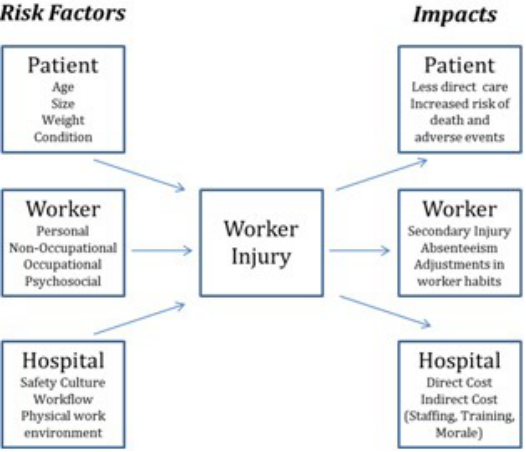
Physical demands related to lifting, repositioning, and mobilizing obese patients are also much greater than for normal weight patients. In fact, physical demands for all services across the healthcare continuum are greater for obese patients. This includes transport, ultrasound, radiology, surgery, OB/GYN and even morgue/autopsy, creating a greater risk of injury and increased musculoskeletal disorders among all healthcare workers. Miller (2013) states no single risk factor is responsible for injury but rather it is due to the complex interaction of worker, patient, and hospital characteristics (See Figure 1.) The frequency and severity of injuries is higher in healthcare workers who care for patients in bariatric units. A disproportionate number of occupational injuries occur in these units, with the majority of injuries occurring while performing manual patient handling tasks. Those patients who are morbidly obese pose an even greater risk, creating significant physical challenges that often result in lost and restricted work- days for healthcare workers. (Randall et al, 2009).
Figure 1: Characteristics of the Worker, Patient and Hospital as Risk Factors and Impacts of Worker Injury (Miller,
2013)
Musculoskeletal Risk in Obese Healthcare Workers A study conducted by researchers at Duke University (Østbye, et al. 2007) found a significant relationship between the BMI of workers in various occupations and rates of workers compensation claims. Employees with BMI≥40 had nearly 12 claims per 100 FTEs, while normal weight employees had less than 6. For lost workdays the higher BMI employees had over 183 per 100 FTEs vs. just over 14 for normal weight employees. Likewise, medical costs for the high BMI group was over $51,000 per 100 FTEs vs. just over $7500 for the normal weight employees. The claims for the higher BMI workers were typically for the lower extremity, wrist or hand, and back. The most common nature of injury was pain or inflammation, sprain or strain, and contusion or bruise. The most common cause of the injury was falls or slips, lifting, and exertion. The researchers found that the combination of obesity with high risk occupation was particularly harmful. Much higher rates of claims were observed for physically demanding jobs involving lifting or other ergonomic risk factors. High rates of claims were observed for inpatient nurses and nursing assistants, which the researchers attributed to tasks such as patient lifting and repositioning. When the body mass of both the nurse and patient are combined during patient handling tasks, the resulting force on the nurse’s spine is markedly greater.
CONCLUSIONS
The risks to healthcare workers who are caring for growing numbers of obese patients combined with their own increasing obesity is creating a “perfect storm” that can negatively impact the delivery of quality healthcare. The costs of injuries in healthcare are well documented and injury prevention programs are commonplace. However, there is much less known about the impact of healthcare workers injuries on patient safety. More studies are starting to show a strong correlation between patient safety and occupational safety, yet most hospitals still view these as separate programs or initiatives.
Injuries in healthcare cause pain and lost work time and can ultimately lead to disabilities and fewer trained staff. When healthcare workers are out of work with an injury or have restrictions, lower staffing levels result and the remaining workers must perform more work than normal. These increased workloads can impede the delivery of high quality patient care. There is a demonstrated relationship between high injury rates among nursing staff and nursing shortages as well as reduced time at the bedside (Charney & Schirmer. 2007). Reduced staffing further increases the risk of injury which further contributes to a decrease in quality patient care.
Healthcare administrators need to take immediate action to “quell” this perfect storm. There is very little that can be done to change the patient risk factors (Figure 1). However, the healthcare industry as a whole can greatly influence and change the hospital risk factors through improving the safety culture and investments in the physical work environment. Healthcare workers must have access to proper engineering controls such as adjustable height exam and treatment tables, roll-on weight scales, motorized wheelchairs, in addition to patient lift equipment.
The healthcare industry can also positively influence worker factors by providing greater incentives for obese workers to reduce to a healthy weight. Worksite-based programs targeted at healthcare workers have been shown to be successful. One example in Australia is a workplace-based weight-loss program which included group-based financial incentives was found to facilitate significant weight loss and health outcomes in overweight/obese male shift employees (Morgan et al, 2011). Another program looked at female overweight/obese healthcare workers and found a significant decrease in body weight, body fat, waist circumference and blood pressure along with increased fitness through diet, exercise and cognitive training (Christensen et al, 2011). To promote and help maintain healthy weights, worksite-based wellness should be part of every employee health program throughout the healthcare industry.
REFERENCES
Bureau of Labor Statistics (2011). US Department of Labor: Nonfatal occupational injuries and illnesses requiring days away from work. 2011. http://www.bls.gov/news.release/archives/osh2_11092011.pdf (November 19, 2013). Centers for Disease Control and Prevention [Healthcare Workers]. Atlanta, GA 2012. http://www.cdc.gov/niosh/topics/healthcare/ (November 19, 2013). Centers for Disease Control and Prevention [Obesity and Overweight], Atlanta, GA, 2013.
http://www.cdc.gov/nchs/fastats/overwt.htm/ (February 15, 2014). Charney W, Schirmer J. (2007). Nursing injury rates and negative patient outcomes-connecting the dots. AOHN J Nov;55(11):470–5. Christensen, J. R., Faber, A., Ekner, D., Overgaard, K., Holtermann, A., & Søgaard, K. (2011). Diet, physical exercise and
cognitive behavioral training as a combined workplace based intervention to reduce body weight and increase physical capacity in health care workers-a randomized controlled trial. BMC public health, 11(1), 671. Dennerlein, J. T., Hopcia, K., Sembajwe, G., Kenwood, C., Stoddard, A. M., Tveito, T. H., & Sorensen, G. (2012). Ergonomic practices within patient care units are associated with musculoskeletal pain and limitations. American journal of industrial medicine, 55(2), 107-116. Faber A, Giver H, Stroyer J, Hannerz H (2010). Are low back pain and low physical capacity risk indicators for dropout among
recently qualified eldercare workers? a follow-up study. Scandinavian Journal of Public Health, 38(8):810–816 Folmann, N. B., Bossen, K. S., Willaing, I., Sørensen, J., Andersen, J. S., Ladelund, S., & Jørgensen, T. (2007). Obesity, hospital services use and costs. Advances in health economics and health services research, 17, 319-332. Gallagher, S. (2004). Bariatrics: considering mobility, patient safety and caregiver injury. Back Injury Among Healthcare
Workers. Boca Raton: Lewis Publishers, 139-158. Han, K., Trinkoff, A. M., Storr, C. L., & Geiger-Brown, J. (2011). Job stress and work schedules in relation to nurse obesity.
Journal of Nursing Administration, 41, 488-495. Harber P, Elizabeth B, Gutowski M, et al. (1985). Occupational low-back pain in hospital nurses. Journal of Occupational Medicine, 27:518–24. Hauck K, Hollingsworth B. (2010). The impact of severe obesity on hospital length of stay. Med Care. Apr;48(4):335-40. Kotowski, S.E., et al. (2010). Influence of weight loss on musculoskeletal pain: Potential for short-term relevance. Work, 36(3),
295-304. Human Aspects of Healthcare (2021)
Lagerström M, Wenemark M, Hagberg M, et al. (1995). Occupational and individual factors related to musculoskeletal symptoms in five body regions among Swedish nursing personnel. International Archives of Occupational Environmental Health, 68:27–35. Lee, R., et al. (2012). Obesity and knee osteoarthritis. Inflammopharmacology, 20(2), 53-58. Lindberg, N. (2013). Variation in the Self-Care Behaviors of Healthcare Personnel: Physicians, Nurses, and Others
HMO Research Network 2013, CM&R 2013 : 3 (September) Miller K (2013). Risk factors and impacts of occupational injury in healthcare workers: A critical review. OA Musculoskeletal Medicine, Mar 01;1(1):4. Morgan, P. J., Collins, C. E., Plotnikoff, R. C., Cook, A. T., Berthon, B., Mitchell, S., & Callister, R. (2011). Efficacy of a
workplace-based weight loss program for overweight male shift workers: The Workplace POWER (Preventing Obesity Without Eating like a Rabbit) randomized controlled trial. Preventive medicine, 52(5), 317-325. Nelson, A. L., Collins, J., Knibbe, H., Cookson, K., De Castro, A. B., & Whipple, K. L. (2007). Safer patient handling. Nursing management, 38(3), 26-32. Nelson, CC, Wagner, GR, et al (2014). Physical Activity and Body Mass Index: The Contribution of Age and Workplace
Characteristics. American Journal of Preventive Medicine 2014;46(3S1):S42–S51. Østbye, T., Dement, J. M., & Krause, K. M. (2007). Obesity and workers' compensation: results from the Duke Health and Safety Surveillance System. Archives of Internal Medicine, 167(8), 766-773. Racette SB, Deusinger SS, Deusinger RH, (2003). Obesity: overview of prevalence, etiology, and
treatment. Physical Therapy;83:276–288. Randall SB, Pories WJ, Pearson A, Drake D. (2009). Expanded OSHA 300 log as metric for bariatric patient-handling staff injuries. Surgery for Obesity and Related Disorders, Jul–Aug;5(4):463–8. Skaal, L. (2011). Factors influencing healthcare workers participation in physical activity in one public hospital in South Africa:
Do healthcare workers have barriers to exercise? African Journal for Physical, Health Education, Recreation and Dance, 17, 612-623. Stubbs DA, Buckle PW, Hudson MP, et al.(1983). Back pain in the nursing profession. I: Epidemiology and pilot methodology.
Ergonomics, 26:755–65. Wang, Y., & Beydoun, M. A. (2007). The obesity epidemic in the United States—gender, age, socioeconomic, racial/ethnic, and geographic characteristics: a systematic review and meta-regression analysis. Epidemiologic reviews, 29(1), 6-28.
LISTED IN THE AHFE DIGITAL BOOKSTORE CATALOGUE
Explore the complete digital volume
Advances in Human Aspects of Healthcare
Read this individual research paper free through the original publisher, or explore the full digital proceedings book.
ISBN 978-1-4951-2093-0
Explore this ISBN in the AHFE Bookstore ↗Listed in the July 2026 bookstore catalogue; search by ISBN to confirm current availability · Digital book purchase optional