Noradrenalina Isah, Nor Fadilah Mohd Soid (2021). Analysis of Factors Associated with Speeding Among Road Users in Malaysia. In: Advances in Human Aspects of Transportation: Part I. AHFE Open Access, vol. 15. https://doi.org/10.54941/ahfe100656
Road User Behavioural Change Research Centre, Malaysian Institute of Road Safety Research, Lot 135, Jln TKS 1, Tmn Kajang Sentral, 43400 Kajang, Selangor, MALAYSIA ↗
Speeding is a serious threat to traffic safety. Similar to other nations, speeding is the leading causes for road traffic crashes and fatalities in Malaysia. The present study was designed to explore the factors associated with speeding among road users to ensure better strategies can be formulated in encouraging drivers to comply with the speed limit. A cross-sectional survey using questionnaire was conducted among 1194 road users. Logistic regression was performed to analyse the association of speeding behaviour with ten independent variables. Seven factors were significantly associated with speeding behaviour. Belief yielded the highest odds ratio (OR) 3.6 and followed by the experience of being summoned by an enforcement officer for speeding (OR: 2.3). In contrast, perception of being caught for speeding was negatively associated with speeding (OR: 0.94) followed by gender (OR: 0.60) and race (OR: 0.52). Type of vehicle and attitude were also significantly associated with speeding, OR were 0.28 and 0.14 respectively. The study revealed that enforcement activities and belief on speeding play a very important role in reducing speeding behaviour. This study highlights the need to identify the main factors at the community level for instance enforcement activities in order to design effective intervention programme.
Traffic crashes are a problematical issue with 462,423 road crashes and 6917 deaths in the year 2012. There has been a gradual increase in the number of crashes and fatalities since 2008. Speeding is a serious threat to traffic safety. Similar to other nations, speeding is the leading causes for road traffic crashes and fatalities in Malaysia (Royal Malaysian Police, 2012). However, the public has a laid back attitude towards speeding violation and many assume that a slight violation is not associated with an increased risk of crashes as long as they drive safely. According to National Road Safety Plan 2006-2010, there were nine strategic intervention programmes covering the pre-crash, crash and post-crash planned for implementation to further reduce the number of severely injured and deaths among accident victims. Automated Enforcement System or AES was one of the strategic intervention programmes that proven to reduce the number of fatalities and injuries from crashes in a cost-effective manner. The programme was successfully implemented in September 2013. The installations of the cameras were conducted in several phases. At present, the cameras were installed at 14 locations; 10 locations for speeding violation and 4 locations for red light running. For instance, in Great Britain, the AES was first introduced at the start of the 1990s (Carnis, 2007) where a total of 7,000 units of unmanned cameras in operation for speeding and red-light running (Mountain et al., 2004). In the United States, New York was the first city in 1992 with an automated red-light enforcement programme to issue summonses by mail. As of 2003, there were 534 units of red-light cameras in operation (McGee and Eccles, 2003). In Germany, on the other hand, as of April 1996 there were 593 units of unmanned cameras in operation (Glauz, 1998), while in Victoria, Australia, speed cameras were first introduced on Human Aspects of Transportation I (2021) a trial basis in 1985 (Delaney et al., 2005).
Given the proven effectiveness of AES in reducing the number of deaths and injury cases, it was a matter of national interest to embark on the AES in Malaysia to promote and measure to drive within the speed limit. As a result, the aim of this study was to explore factors associated with speeding among road users to ensure better strategies can be formulated in encouraging driver to comply with the speed limit.
Potential Factors Associated with Speeding Behaviour In recent years, there has been an increasing amount of literature on speeding behaviour. Among the main offence committed by the road users is driving over the speed limit and this has been proven by a number of local and international studies (Warner et al., 2009; Yannis et al., 2013; Vardaki and Yannick, 2013) and such scenario are caused by a number of reasons. Warner et al. (2009) points out drivers consider speeding to be a significantly greater safety threat as they can drive comfortably with a high speed compared to a low speed. In a local study done by Kulanthayan et al. (2013), have proven that type of day (weekend and weekday), time of day and posted speed limits (90 km/h and 110 km/h) can be the major determinants to speeding among drivers. Yannis et al. (2013) have concluded several causes of speeding behaviour – first, they found that drivers speed because they see other people is doing the similar driving behaviour, second, they speed as they want the enjoyment of driving fast and third, the greater engine capacity of the car.
In another study, Dinh and Kubota (2013) have provided a different perspective where they managed to identify three behavioural factors namely attitude, subjective norm, and perceived behavioural control as the major impingement factors for speeding among road users while Warner and Aberg (2006) have looked into self-reported speeding and subjective norms as the impingement factors for driving. Forward (2010) in the other hand has looked into the impacts of driving frequency as one of the caused for speeding intention - the more frequently people drive, the more likely they intend to speed. Interestingly, Beullens and den Bulck (2008) have confirmed the impacts of more news viewing on speeding behaviour among road users. Furthermore, the same study has confirmed that music video viewing was negatively correlated with speeding among road users.
A study done by Mannering (2009) in Indiana, United States on the probability of being caught for speeding found that on average, the 988 drivers involved in the study did not think they would get a speeding ticket or perceived that they would only be fined for speeding if they drove 10.88km/h over the speed limit. Jorgensen and Pedersen (2005) claims that the probability of being caught for speeding offense is useful because it indicates whether it is beneficial to provide better information about enforcing rules. If the results show that drivers’ perceived magnitudes of fines for speeding and detection rates differ greatly and are significantly lower than the true values, a campaign, aiming to inform people about these figures, may reduce average speed as well as speed variations. In this case, the campaign will have a positive effect on safety.
Individual factors such as gender and age groups have always been the impingement factors with male and young drivers are always associated with speeding behaviours (Vardaki and Yannick, 2013; Knight et al., 2013). In study done by Knight et al. (2013) have confirmed that speeding behaviour was considered as acceptable and inevitable among young rural people. They further added that male young drivers in rural area viewed speeding to be less risky compared to females and those who lived in a semi-rural area. A recent local study conducted by Wong (2011) found that young male Malaysian motorcyclists are more likely to speed which then resulted in possibilities for them to involve in another problem – illegal racing. Elsewhere, Cestac et al. (2011) in their study have looked into the intention of male and female drivers to speed whereby they have managed to confirm male possess a slightly higher intention to speed compared to female and further added that male speed as they want to experience the impact of sensation seeking and injunctive norms while self-descriptive variables had contributed significantly on female intention to speed.
Another local study done by Yeoh et al. (2009) have looked into the practices of safe driving among older drivers as they possess a higher driving knowledge and positive driving attitude which then lessen their risks of being involved traffic crash. In studies done by Rimmo and Hakamies-Blomqvist (2002) claim that factor of health have impinge Human Aspects of Transportation I (2021) the older drivers to display aberrant driving behaviour such as speeding.
METHOD
Participants and Setting The study was conducted in four states representing two regions of Peninsular Malaysia. For the Northern region, the sites chosen were Ipoh and Sungkai (Perak) as well as Kota Setar and Sungai Petani (Kedah). The selected sites in the Central region were Putrajaya and Kuala Lumpur. This study was carried out in public areas such as government agencies, shopping malls, learning institutions, petrol stations and government offices. They were chosen as the site locations in order to fulfil the demographic profile allocated. Out of 1,200 questionnaires disseminated, only 1,194 of them were answered at six sites chosen. The respondents were chosen based on purposive sampling method, whereby the respondents must have legal license and live in the area of interest. They were informed about the objectives of the study and were assured that the information obtained would remain confidential. No names or identification card numbers were recorded to keep the questionnaire anonymously. Data collection was completed within two weeks (1st August to 10th August 2012).
The Questionnaire A questionnaire was developed in the national language and examined for face and content validity. Four researchers with experience in road safety research, particularly on road user behaviour research, reviewed both the relevance and the content of the questionnaire. Face validity was tested on three other researchers in the same institute. Attitude and belief scales of the questionnaire demonstrated acceptable Cronbach’s α coefficients (Cronbach’s α). The Cronbach’s α for attitude and belief scale were 0.604 and 0.738, respectively. Cronbach’s α is a reliability coefficient that measures the internal consistency of the items on a scale. Ideally, the Cronbach’s α should be above 0.7 (DeVellis, 2003). An acceptable Cronbach’s α indicates each item in the respective scale is appropriate measuring the intended objective under the same scale.
The theoretical framework used for the development of the questions was the PRECEDE-PROCEED model that has been used extensively in health research, policy development and analysis for the construction of health promotion interventions (Chiang, Huang and Lu, 2004; Chang, Brown, Nitzke and Baumann, 2004; Yeo, Berzins and Addington, 2007). The model attempts to identify factors that predispose, enable and reinforce behaviours for individuals to engage in risky behaviour, in this case, the speeding behaviour whether complying with the speed limit or exceed the speed limit. Additionally, the questionnaire asked about the type of vehicle instead of basic demographic variables (age, gender, race, academic status and monthly income).
Attitude is defined by six (6) items (a. driving over the speed limit is more fun; b. driving fast makes me follow the rhythm of the traffic better; c. driving fast makes me arrive at my destination faster; d. exceeding the speed limits with more than 10km/h is reckless; e. exceeding the speed limits with more than 20km/h is reckless; and f. speeding is macho behaviour); belief is defined by three (3) items (a. motorists should be encouraged to obey the speed limit in built up traffic enforcement cameras areas; b. traffic enforcement cameras are successful in reducing speeding; and c. traffic enforcement cameras may cut down speeding in crash prone areas). All items were scored on a Likert scale of 1 to 10, strongly disagree (1) to strongly agree (10). Meanwhile, the perception of being caught or POBC for speeding were scored on a Likert scale of 0 to 10, strongly unlikely (0) to strongly likely (10). The experience of being summoned by an enforcement officer for speeding was measured as ‘yes’ and ‘no’ responses.
Data Analysis Data were entered by trained officers into a database using Scan Pro software. Then, data cleaning was done by researchers before analysis using SPSS statistical software. Frequencies were calculated and cross-tabulations were performed, and 95% CI were calculated. A stepwise logistic regression using Backward: LR method with a probability of entry at 0.05 and removal at 0.10 was run. For the purpose of logistic regression analysis, the speeding behaviour was then categorised to dichotomous outcome variable (Likert scale 1 to 10 responses were recorded as ‘drive exceed the speed limit’, while Likert scale 0 was recorded as ‘drive within speed limit’ responses). The ten
Human Aspects of Transportation I (2021)
(10) independent variables were (a. attitude score; b. belief score; c. the experience of being summoned by an enforcement officer for speeding; d. their POBC by an enforcement officer for speeding; e. age; f. gender; g. race; h. academic status; i. monthly income; and j. type of vehicle). The scores for attitude and belief were categorised to create a scale that would have a more meaningful interpretation for the purpose of prevention. Cut-points were chosen based on the spread of results to reflect the three groupings that appear in the data. These scores were categorised as low, moderate and high.
RESULTS
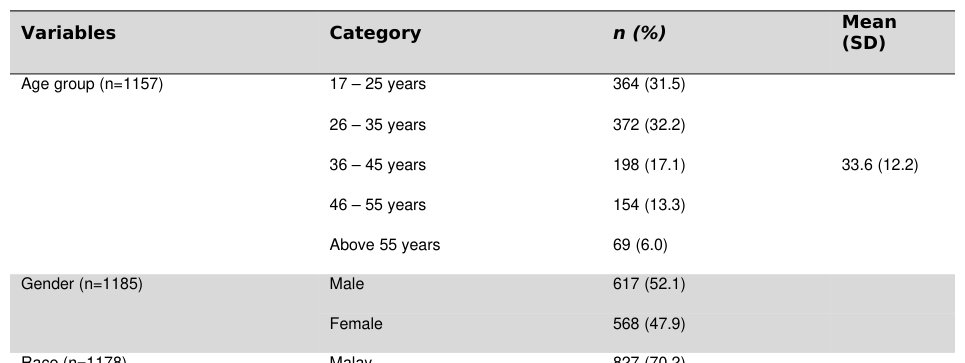
Table 2 presents the summarised statistic of the survey respondents. Out of 1200 questionnaires handed out, 1194 (99.5%) were completed. Of 1185 respondents answered, 617 (52%) were males and 568 (48%) were females. The age distributions were predominantly represented by the younger age group with an overall mean (SD) age of 34 (12.2) years. The primary educated group was under represented (4%) as compared to secondary (47%) and tertiary (48%) educated groups which were roughly equally represented in the survey. The majority of respondents obtained a moderate to high score for attitude and belief. In contrast, only 23% of respondents reported drove within the speed limit in the past month.
As can be seen from Table 3, the table below indicates the outcome of the logistic regression analysis where the speeding behaviour was the dependent variable. The results of the analysis revealed that seven variables (belief, experience of being summoned by an enforcement officer for speeding, their POBC for speeding, gender, race, type of vehicle and attitude) were significantly associated with speeding behaviour after controlling for other variables.
Under the category of cues to action or reinforcing factors for speeding behaviour, both variables related to enforcement activities, the experience of being summoned by an enforcement officer for speeding and their POBC by an enforcement officer for speeding violation showed a negative significant association with the outcome.
There were two variables which were viewed as the predisposing factors that could lead an individual to make a decision whether to comply with the speed limit or not. The variables or predisposing factors are attitude to speeding behaviour and belief in the usefulness of enforcement of speed limits. High level of attitude towards speeding behaviour and positive belief in the usefulness of enforcement of speed limits were significantly associated with complying with the speed limit with odds ratio 0.137 (p value of 0.008) and 3.630 (p value of 0.001), respectively.
From the demographic variables, gender (odds ratio 0.60 and p value of 0.004), race (odds ratio 0.52 and p value of 0.009) and type of vehicles (odds ratio 0.28 and p value of 0.006) were negatively associated with the outcome.
Table 2. Summary statistic of the survey respondents (n=1194) Variables Category n (%) Mean (SD)
Equations and mathematical formulas are available in the original paper PDF.
Human Aspects of Transportation I (2021)
Moderate 338 (28.7) High 771 (65.6)
Yes 879 (73.6)
No 315 (26.4)
Human Aspects of Transportation I (2021)
Table 3: Odds ratio associated with speeding behaviour
DISCUSSION AND CONCLUSION The results of this study found that 77% of respondents admitted driving above the speed limit in the past month. This finding is in agreement with Lahausse et al. (2010) findings which showed that 63% (n=2348) of the respondents in Victoria, South Australia, Western Australia and Tasmania confessed to driving above the speed limit at least some of the time. Previous study (Yannis et al., 2013) highlighted several causes of speeding behaviour which included speeding makes them follow the rhythm of the traffic better, they speed as they want the enjoyment of driving fast and greater engine capacity of the car.
The present study has identified seven factors that are significantly associated with speeding behaviour. Two factors show significant positive association, while the remaining five factors revealed a significant negative association. Based on PRECEDE-PROCEED model, these factors can be categorised into demographic factors (gender, race and type of vehicle), and predisposing factors that functions as barriers or enablers for an individual to change behaviour which include belief and attitude. Another category covers external factors that act as reinforcing factors or cues to actions which include their POBC for speeding and the experience of being summoned by an enforcement officer for speeding. Enforcement activities have the second highest impact of the speeding behaviour. These results are consistent with other research which found that enforcement activities is effective in reducing speeding (Mannering, 2009; Blincoe, et al., 2006; Glendon and Cernecca, 2003; de Waard and Rooijers, 1994). The present findings seem to be consistent with other similar local studies related to traffic offences which revealed that as the enforcement activities increases, the compliance rate of seatbelt wearing will also increase (Norlen et al., 2011; Kulanthayan, 2001). In terms of gender, male is more likely to drive exceeds the speed limit than female. This finding supports with previous research which showed that male posses higher intention to speed compared to female (Knight, et al., 2013; Wong, 2011; Cestac et al., 2011).
This study highlights the need to identify the main factors at the community level for instance enforcement activities in order to design effective and strategic intervention programme in addressing speeding related issue. A sustainable and reliable enforcement activities such as increasing the POBC by enforcement officers and implementation of AES are essential in encouraging drivers to comply with speed limits.
REFERENCES
Boyle, J., Dienstfrey, S., Sothoron, A. (1998), National Survey of Speeding and Other Unsafe Driving Actions: Volume III: Countermeasures. National Highway Traffic Safety Administration. Final Report. Retrieved on 7 October 2013 from http://ntl.bts.gov/lib/26000/26000/26001/DOT-HS-808-750.pdf. Beullens, K., den Bulck, J.V. (2008), News, music videos and action movie exposure and adolescents’ intentions to take risks in
traffic. ACCIDENT ANALYSIS & PREVENTION, Volume 40 No. 1, pp.349-356. Blincoe, K. M., Jones, A. P., Sauerzapf, V., & Haynes, R. (2006), Speeding drivers’ attitudes and perceptions of speed cameras in rural England. ACCIDENT ANALYSIS AND PREVENTION, Volume 38, pp. 371–378. Carnis, L. (2007), The automated speed enforcement system in Great Britain: Between a technical revolution and administrative
continuity. INTERNATIONAL REVIEW OF ADMINISTRATIVE SCIENCES, Volume 73 No. 4, pp. 597-610. Cestac, J., Paran, F., Delhomme, P. (2011). Young drivers’ sensation seeking, subjective norms, and perceived behavioural control and their roles in predicting speeding intention: How risk-taking motivations evolve with gender and driving experience. SAFETY SCIENCE, Volume 49 No. 3, pp. 424-432. Chang, M. W., Brown, R. L., Nitzke, S., Baumann, L. (2004), Development of instrument to assess predisposing, enabling, and
reinforcing constructs associated with fat intake behaviours of low-income mothers. JOURNAL OF NUTRITION EDUCATION AND BEHAVIOUR, Volume 36, pp. 27-34. Chiang, L. C., Huang, J. L., Lu, C. M. (2003), Educational diagnosis of self-management behaviours of parents with asthmatic children by triangulation based on PRECEDE PROCEED model in Taiwan. PATIENT EDUCATION AND COUNSELLING, Volume 49, pp. 19-25. Corbett, C., Caramlau, I. (2006), Gender differences in responses to speed cameras: Typology findings and implications for road
safety. CRIMINOLOGY AND CRIMINAL JUSTICE Volume 6, pp. 411-433. DeVellis, R. F. (2003), Scale development: Theory and applications (2nd edn). Thousand Oaks, California: Sage. de Waard, D., Rooijers, T. (1994), An experimental study to evaluate the effectiveness of different methods and intensities of law enforcement on driving speed on motorways. ACCIDENT ANALYSIS AND PREVENTION, Volume 26 No. 6, pp. 751– 765. Delaney, A., Ward, H., Cameron, M. (2005), The history and development of speed camera use. Report No. 242. Monash
Human Aspects of Transportation I (2021)
University Accident Research Centre. Retrieved on 7 October 2013 from http://www.monash.edu.au/miri/research/reports/muarc242.pdf. Dinh, D. D., Kubota, H. (2013), Speeding behaviour on urban residential streets with a 30 km/h speed limit under the framework of the theory of planned behaviour. TRANSPORT POLICY, Volume 29, pp. 199-208. Forward, S. (2010), Intention to speed in rural area: reasoned but not reasonable. TRANSPORTATION RESEARCH PART F,
Volume 13, pp. 223-232. Glauz, W. D. (1998), Review of automated technologies for speed management and enforcement. Managing speed. Review of current practice for setting and enforcing speed limits. TRB Special report 254. (Appendix D), pp. 359-390. Washington, D.C.: National Academy Press. Retrieved on 7 October 2013 from http://onlinepubs.trb.org/onlinepubs/sr/sr254.pdf. Glendon, A. L., Cernecca, L. (2003), Young drivers’ responses to anti-speeding and anti-drunk-driving messages.
TRANSPORTATION RESEARCH PART F, Volume 6, pp. 197-216. Jogensen, F., Pedersen, H. (2005), Enforcement of speed limits – actual policy and drivers’ knowledge. ACCIDENT ANALYSIS AND PREVENTION, Volume 37, pp. 53-62. doi: 10.1016/j.aap.2004.06.004. Knight, P. J., Iverson, D., Harris, M. F. (2013), The perceptions of young rural drivers in NSW, Australia of speeding and
associated risk: A mixed methods study. ACCIDENTS ANALYSIS AND PREVENTION, Volume 55, pp. 172-177. Kulantahayan, S. (2001), Modelling of compliance behaviour of motorcyclists to proper usage of safety helmet. Doctoral Thesis.
JOURNAL OF CRASH PREVENTION AND INJURY CONTROL, Volume 2, pp. 239–246. Kulanthayan, S., Ang, B. J., Hayati, K. (2013), Determinants of speeding among bus drivers in Malaysia. INJURY PREVENTION. Retrieved on 7 October 2013 from: http://injuryprevention.bmj.com/content/18/Suppl_1/A159.3. Lahausse, J. A., Nes, N. V., Fildes, B. N., Keall, M. D. (2010), Attitudes towards current and lowered speed limits in Australia.
ACCIDENT ANALYSIS AND PREVENTION, Volume 42, pp. 2108-2116. doi:10.1016/j.trf.2008.08.004. Mannering, F. (2009), An empirical analysis of driver perceptions of the relationship between speed limits and safety.
TRANSPORTATION RESEARCH PART F, Volume 12, pp. 99-106. doi:10.1016/j.trf.2008.08.004. McGee, H. W., Eccles, K. A. (2003), The Impact of Red-Light Camera (RLC) Enforcement on Crash Experience. ITE JOURNAL, pp. 44-48. Retrieved on 7 October 2013 from http://onlinepubs.trb.org/Onlinepubs/nchrp/nchrp_syn_310.pdf. Mountain, L. J., Hirst, W. M., Maher, M. J. (2004), A detailed evaluation of the impact of speed cameras on safety. TRAFFIC
ENGINEERING AND CONTROL, Volume 45 No. 8, pp. 280-287. Retrieved on 7 October 2013 from http://eprints.whiterose.ac.uk/3388/2/Costing_lives_saving_lives_secure.pdf. Norlen, M., Muhammad Fadhli, M. Y., Noradrenalina, I., Ilhamah, O., Sharifah Allyana, S. R., Noorfaradilla, P. (2011), Analysis of factors associated with seat belt wearing among rear passengers in Malaysia. INTERNATIONAL JOURNAL OF INJURY CONTROL AND SAFETY PROMOTION, Volume 18 No. 1, pp. 3-10. doi: 10.1080/17457300.2010.487153. Retting, R. A., Farmer, C. M., McCartt, A. T. (2008), Evaluation of Automated Speed Enforcement in Montgomery County,
Maryland. TRAFFIC INJURY PREVENTION, Volume 9 No. 5, pp. 440-445. Rimmo, P., Hakamies-Blomqvist, L. (2002), Older drivers' aberrant driving behaviour, impaired activity, and health as reasons for self-imposed driving limitations. TRANSPORTATION RESEARCH PART F: TRAFFIC PSYCHOLOGY AND BEHAVIOUR, Volume 5 No. 1, pp. 47-62. Royal Malaysian Police (RMP). (2012), Statistical Report on Road Accidents in Malaysia. Traffic Department, Police
Headquarters, Bukit Aman, Kuala Lumpur, Malaysia. Vardaki, S., Yannick, G. (2013), Investigating self-reported behaviours of drivers and their attitudes to traffic violations.
JOURNAL OF SAFETY RESEARCH, Volume 46, pp. 1-11. Warner, H. W., Ozkan, T., Lajunen, T. (2009), Cross-cultural difference in drivers’ speed choice. ACCIDENT ANALYSIS AND PREVENTION, Volume 41, pp. 816-819. Warner, H. W., Aberg, L. (2006), Drivers’ decision to speed: A study inspired by the theory of planned behaviour.
TRANSPORTATION RESEARCH PART F: TRAFFIC PSYCHOLOGY AND BEHAVIOUR, Volume 9 No. 6, pp. 427- 433. Wong, L. P. (2011), Socio-demographic and behavioural characteristics of illegal motorcycle street racers in Malaysia. BMC Public Health. Retrieved on 7 October 2013, from: http://www.biomedcentral.com/content/pdf/1471-2458-11-446.pdf. Yannis, G., Louca, G., Vardaki, S., Kanellaidis, G. (2013). Why do drivers exceed speed limits? EUROPEAN TRANSPORT
RESEARCH REVIEW, Volume 5 No. 3, pp. 165-177. Yeo, M., Berzins, S., Addington, D. (2007), Development of an early psychosis public education program using the PRECEDE PROCEED model. HEALTH EDUCATION RESEARCH, Volume 22, pp. 639-647. Yeoh, S. F., Norazizan S. A. R., Chan, Y. F. (2009), Driving Practices of Older Malaysian Drivers: The Influence of Knowledge,
Attitude and Confidence. EUROPEAN JOURNAL OF SOCIAL SCIENCE, Volume 12 No. 1, pp. 65-75. Zulkifli, M.S. (2013), People perceptions towards AES. Retrieved on 7 October 2013, from: http://prezi.com/k0vj6zcl7ymj/people-perception-towards-aes/.
Human Aspects of Transportation I (2021)
LISTED IN THE AHFE DIGITAL BOOKSTORE CATALOGUE
Explore the complete digital volume
Advances in Human Aspects of Transportation: Part I
Read this individual research paper free through the original publisher, or explore the full digital proceedings book.
ISBN 978-1-4951-2097-8
Explore this ISBN in the AHFE Bookstore ↗Listed in the July 2026 bookstore catalogue; search by ISBN to confirm current availability · Digital book purchase optional