David Soole, Barry Watson, Judy Fleiter (2021). A Review of International Speed Enforcement Policies and Practices: Evidence-Based Recommendations for Best Practice. In: Advances in Human Aspects of Transportation: Part I. AHFE Open Access, vol. 15. https://doi.org/10.54941/ahfe100658
Extensive research has highlighted the positive and exponential relationship between vehicle speed and crash risk and severity. Speed enforcement policies and practices throughout the world have developed dramatically as new technology becomes available, however speeding remains a pervasive problem internationally that significantly contributes to road trauma. This paper adopted a three-pronged approach to review speed enforcement policies and practices by: (i) describing and comparing policies and practices adopted in a cross-section of international jurisdictions; (ii) reviewing the available empirical evidence evaluating the effectiveness of various approaches; and, (iii) providing recommendations for the optimisation speed enforcement. The review shows the enforcement strategies adopted in various countries differ both in terms of the approaches used and how they are specifically applied. The literature review suggests strong and consistent evidence that police speed enforcement, in particular speed cameras, can be an effective tool for reducing vehicle speeds and subsequent traffic crashes. Drawing from this evidence, recommendations for best practice are proposed, including the specific instances in which various speed enforcement approaches typically produce the greatest road safety benefits, and perhaps most importantly, that speed enforcement programs must utilise a variety of strategies tailored to specific situations, rather than a one-size-fits-all approach.
Trauma resulting from traffic crashes is a significant problem worldwide and is associated with substantial economic and social costs. Each year more than a million people are killed, and an additional 50 million are seriously injured on roads throughout the world (Peden et al., 2004; Richter, Berman, Friedman, & Ben-David, 2006). It has been estimated that traffic crashes cost nations throughout the world approximately $518 billion each year (Richter, et al., 2006). Speed is regularly cited as being a major contributing factor in traffic crashes and there is extensive evidence highlighting the positive and exponential relationship between increased vehicle speeds and increased crash risk and severity (Aarts & van Schagen, 2006; Kloeden, McLean, & Glonek, 2002; Lynam & Hummel, 2002). Despite the abundant literature highlighting the negative health and safety impacts of increased vehicle speeds, there remains, arguably, a general ‘social acceptance’ of speeding behaviour (Fleiter & Watson, 2006). Thus, speeding remains a pervasive road safety problem internationally.
As a result, a number of speed reduction countermeasures have been developed and evaluated in terms of their ability to reduce speed-related fatalities and injuries. These countermeasures include speed enforcement (including the use of various types of speed cameras), road engineering and speed calming devices, lower speed limits and intelligent transportation systems (Richter, et al., 2006). Speed enforcement, and in particular speed cameras, have received considerable attention, both in terms of implementation and evaluation. This paper seeks to review the
1 Human Aspects of Transportation I (2021)
Edited by T. Ahram, W. Karwowski and T. Marek empirical evidence regarding the effectiveness of various approaches to speed enforcement. Drawing from this evidence, a number of recommendations for best practice speed enforcement are proposed.
METHODOLOGY
This paper adopted a three-pronged approach to review speed enforcement policies and practices adopted by various motorised countries throughout the world. Specifically, the objectives of the research were to: (i) describe and compare the speed enforcement policies and practices used in a cross-section of jurisdictions; (ii) review the available empirical evidence evaluating the effectiveness of various approaches to speed enforcement; and, (iii) provide recommendations for the optimisation of speed enforcement policy and practice.
In the first phase of the research, attempts were made to collate information regarding the speed enforcement practices and policies from large highly-motorised or rapidly motorising countries from a variety of continents. This information was obtained through stakeholder consultations (via email) with key transport authorities, police agencies and road safety research and/or government/community organisations in each country as well as from information available in published papers. Given that the primary objective of this paper was to develop best- practice principles for speed enforcement efforts, there was a focus on countries with more impressive road safety records, however attempts were also made to contact stakeholders in low and middle income countries and countries with poorer road safety records. Perhaps not surprisingly, responses were much more difficult to obtain from these latter countries. The final sample included in the review consisted of 12 countries from four regions of the world (Australasia; Europe; North America; Asia). Specifically, the countries included in the review were: (1) Australia; (2) New Zealand; (3) United Kingdom; (4) Austria; (5) Finland; (6) France; (7) Italy; (8) Netherlands; (9) Switzerland; (10) the United States of America; (11) Canada; and (12) China.
In the second phase of the research, the empirical evidence evaluating the effectiveness of a range of speed enforcement approaches was reviewed. The specific enforcement approaches of interest included: (1) average speed cameras (also commonly referred to as section control, trajectory control, point-to-point, or time-over-distance); (2) automatic fixed speed cameras; (3) overtly operated mobile speed cameras (e.g., stationary marked speed camera vehicles); (4) covertly operated mobile speed cameras (e.g., stationary unmarked/hidden speed camera vehicles); (5) hand-held speed radars/lasers; (6) moving-mode radars/lasers (e.g., attached to moving police vehicles); and (7) routine traffic patrol. The literature review was conducted using key road safety and public health search databases, internet searches, consultation with key stakeholders for identifying grey literature, and cross-referencing. An iterative search process using key words such as “speed camera” and “speed enforcement” was employed. Drawing from the results of the second phase of the research, a number of best practice principles for effective speed enforcement were developed. This represented the third and final phase of the current research project.
RESULTS
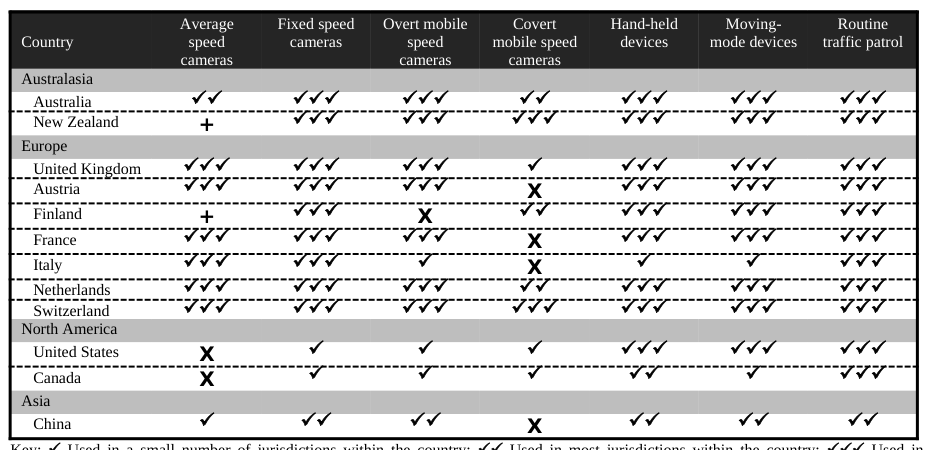
Use of speed enforcement approaches Speed enforcement has become a key component in road safety strategies throughout the world. Traditionally, police traffic patrols were largely responsible for this function. However with advances in technology came a new era of speed enforcement. Not surprisingly, the speed enforcement methods employed differ substantially from country to country, and indeed even between jurisdictions within a single country. These differences exist in terms of the types of enforcement conducted, the intensity in which various approaches are used, and the specific policies and operational procedures that dictate how enforcement is conducted, such as levels of visibility and signage, enforcement tolerances and site selection criteria. Table 1 provides a general overview of the type and degree of speed enforcement approaches used in a cross-section of 12 countries from four regions of the world. The following sections discuss speed enforcement operations in these countries in more detail. Unless otherwise stated, information presented was sourced from personal communication with key stakeholders from each country, as per the consultation phase of the research outlined in the methodology.
Australasia
2 Human Aspects of Transportation I (2021)
Edited by T. Ahram, W. Karwowski and T. Marek In Australia and New Zealand, there has been an increasing tendency to rely largely on automated approaches to speed enforcement. Mobile speed cameras are arguably the most common method of enforcing speed limits. They were first introduced in Australia in 1985 in Victoria and were being used in all jurisdictions by 1997. Fixed cameras are also becoming increasingly popular and are also used in all jurisdictions. A number of jurisdictions are beginning to trial or implement average speed cameras, including Victoria, Queensland, New South Wales (heavy vehicles only), the Australian Capital Territory, South Australia and New Zealand (trial only). However, more traditional methods of speed enforcement such as routine patrols and held-held and moving-mode radar use still remain an integral part of the speed management program of each jurisdiction. There is substantial between- jurisdiction variation in the level of visibility of enforcement efforts, ranging from the highly overt operations typical in Queensland and New South Wales to the more covert approaches adopted in Victoria, although this trend is now beginning to change as other jurisdictions incorporate covert operations into their speed management strategies. Enforcement tolerances differ from jurisdiction to jurisdiction; however
Table 1. Overview of speed enforcement approaches used in a cross-section of countries.
Key: [Equation or mathematical symbol available in the original paper PDF] Used in a small number of jurisdictions within the country; [Equation or mathematical symbol available in the original paper PDF] Used in most jurisdictions within the country; [Equation or mathematical symbol available in the original paper PDF] Used in all jurisdictions across the country; X Not used within the country; + Trialled only.
they exist in all Australian jurisdictions in an unpublicised manner. However, the enforcement tolerance, which was recently reduced from 10% to 4% over the summer holidays period, is publicised in New Zealand. Intentionally not publicising the threshold level aims to negate the creation of a de facto speed limit, whereby motorists drive faster than the posted speed limit, to a speed that they perceive to be within the tolerance (Elliott, 2001). However, studies suggest that many drivers do tend to drive at speeds consistent with the perceived enforcement tolerance threshold (Fleiter & Watson, 2006; Soole, 2012). Enforcement site selection is typically based on traffic crash data and speed profiles, and some jurisdictions randomly schedule enforcement activities within predetermined locations based on risk. Some states also operate combination red-light/speed cameras.
Europe In the United Kingdom, a wide range of enforcement approaches are used across the entire road network. Average speed cameras have been in use across the country for approximately 16 years. While a number of systems are predominately employed to support safety in work zones, other systems have been installed for more general road safety purposes. In addition, the use of fixed speed cameras has been widespread since 2003, with almost 4,000 currently used throughout the country, and many being upgraded from wet film to digital technology. Overt mobile speed camera use has also been widespread since 2003, while covert cameras are used less frequently and only in support of visible enforcement efforts. Over recent decades, more traditional approaches to enforcement have been reduced as safety camera partnerships have become stronger; however the supporting use of these approaches is still
3 Human Aspects of Transportation I (2021)
Edited by T. Ahram, W. Karwowski and T. Marek widespread across the country. An enforcement tolerance of 10% plus an additional 2mph is employed, while site selection typically is based on crash data and speed profiles.
In Austria, a wide range of enforcement approaches are used across the entire road network. Average speed enforcement has been employed since 2003, while fixed and mobile speed cameras have been in use since as early as 1992 and more traditional approaches have been used for significantly longer periods. Enforcement tolerances are publicised and differ depending on the device being used and speed limit of the road in question, ranging between 3- 10km/h for roads with speed limits up to 100km/h and between 3-10% for roads with speed limits greater than 100km/h. Site selection criteria are typically based on crash data and speed profiles, but also consider public complaints and information from road safety expert analyses. Covert speed enforcement is not typically conducted in Austria.
In Finland, fixed speed cameras were first introduced in 1993 and are used primarily on rural main roads (e.g., not on motorways), with a number of cameras also used in urban areas. Interestingly, mobile speed cameras are typically operated in a covert manner only, with 15 vehicles currently equipped with enforcement technology and the program set to expand in the coming years. The use of hand-held and moving-mode speed detection devices and speed management as part of routine traffic patrol is also commonplace throughout the country. While average speed cameras were tested for a short period in 2010, they have not yet been implemented in a full enforcement capacity. The enforcement tolerance in Finland represents a technical margin (e.g., tolerance for device inaccuracies), and is 3km/h for all speed enforcement approaches, with speeding by 3-7km/h over the speed limit earning drivers a written warning, offences within 8-20km/h attracting a fixed penalty, and offences of over 20km/h attracting a fine, the amount of which is determined according to the net income of the motorist. The recent reduction in enforcement tolerances in Finland (accompanied by a media awareness campaign) produced substantial reduction in vehicle speeds (Luoma, Rajamäki, & Malmivuo, 2012). In France, a wide range of enforcement approaches are used across the entire road network. Specifically, average speed cameras have been used since 2012 and fixed speed cameras since 2003, while overtly operated mobile speed cameras, hand-held devices and routine patrols have been used for over a decade. Moving-mode devices have only recent been employed, while covert operation of mobile speed cameras is not used. The enforcement tolerance represents a technical margin, and is 5km/h on roads with a speed limit less than 100km/h or 5% for roads with speed limits greater than 100km/h. Site selection criteria are primarily based on crash data, speed profiles and the need to balance pedestrian safety with vehicle movement.
In Italy, a wide range of enforcement approaches are used across the entire road network. Average speed cameras were first introduced in 2004 and are currently used on a large proportion of the major highways and motorways throughout the country. In addition, fixed speed cameras were first introduced in 1990 and are currently used on both rural roads and in urban areas, while overt mobile speed cameras (introduced in 2000) and hand-held and moving-mode speed detection devices (introduced in 1998 and 2012, respectively) are typically used less frequently and restricted to rural roads. Average speed cameras are operated by national traffic police, while all other approaches are the responsibility of local traffic police. Covert speed enforcement is not allowed under Italian legislation. Enforcement tolerances are publicised and differ depending on the speed limit in question, with a 5km/h tolerance on roads with a speed limit up to 100km/h, and 5% for roads with a speed limit greater than 100km/h. Enforcement sites are selected primarily based on crash data.
In the Netherlands, four main speed surveillance methods are used across the entire road network, of which three result in the sanctioning of offending drivers. These methods are: 1) average speed cameras (which were the first of their kind introduced in 1997), 2) fixed and mobile speed cameras in which offenders are penalised, 3) the use of more traditional speed enforcement measures (e.g., hand-held and moving-mode devices and traffic patrols), and 4) the use of automatic speed checks using fixed or mobile speed cameras where offenders are warned but not sanctioned. Traffic enforcement is part of the basic police task. Enforcement tolerances are publicised and are based on the speed limit of the road in question and represent both a technical margin and enforcement tolerance. Specifically, enforcement tolerances are set at 7km/h for roads with a speed limit up to 100km/h (including a 3km/h technical margin) and 8km/h for roads with a speed limit greater than 100km/h (including a 4km/h technical margin). Enforcement sites are typically selected based on crash data and speed profiles, and where there is a clear and plausible link between crashes and speed, after accounting for traffic volume. Public complaints are also considered when determining enforcement site selection.
4 Human Aspects of Transportation I (2021)
Edited by T. Ahram, W. Karwowski and T. Marek In Switzerland, a wide range of enforcement approaches are used across the entire road network. This includes average speed cameras (introduced in 2012), fixed and mobile speed cameras (introduced in 1977 and 1971, respectively), hand-held and moving-mode speed detection devices and speed measurement with tachographs. Tachographs are special traffic monitoring systems installed in police vehicles which can target drivers who are speeding and/or tailgating. These more traditional approaches have been in use for decades. Enforcement tolerances are publicised and differ depending on the device being used and the speed limit of the road in question, and range between 3-15km/h.
North America In the United States and Canada, there has been a greater tendency to rely on more traditional forms of speed enforcement, such as routine traffic patrol and the use of hand-held and moving-mode speed detection devices. However, more automated approaches are increasingly being adopted throughout both countries at differing levels, primarily at the discretion of the appropriate transport and/or police authorities within the jurisdiction in question (e.g., State, Province), which are responsible for their own activities. Hand-held speed detection devices, and to a lesser extent moving-mode devices, are the most common speed enforcement methods employed within the United States, and have been used in all states since as early as the 1960s. Speed management as part of routine patrol activities is also commonplace in all states. Automated fixed speed camera programs were first introduced over a decade ago and currently exist in a total of 134 communities in 15 states (Alabama, Arizona, Colorado, District of Columbia, Illinois, Iowa, Louisiana, Maryland, Missouri, New Mexico, New York, Ohio, Oregon, Tennessee and Washington), including state-wide applications in work zones in Illinois, Maryland and Washington. Overt operation of mobile speed camera vans are also commonplace in communities with fixed speed cameras, however some jurisdictions limit their use to work zones only. Covert operation of mobile speed cameras is far less common. Typically, enforcement efforts are targeted at locations determined as having elevated crash risks, where speed has been a contributing factor, as well as high traffic volumes.
Similarly in Canada, hand-held and moving-mode devices, as well as routine traffic patrol represent the most common approaches to speed enforcement and have been used in the country for decades. That said, speed cameras have been used since the mid-1990s in a number of jurisdictions, although the recent political climate has seen the popularity of speed cameras diminish, with the exception of speeds at intersections and in work zones and areas populated with children. Enforcement tolerances and site selection criteria are adopted and are developed at the discretion of the police service undertaking the enforcement. Site selection criteria are typically influenced by public complaints, crash data and location characteristics. Average speed cameras are not currently used anywhere in North America, however a number of jurisdictions in both the United States and Canada have implemented combination red-light/speed cameras.
Asia In China, authorities for each of the 34 provinces within the country are responsible for conducting enforcement activities under a number of national laws and local regulations. While speed enforcement activities are conducted in all provinces, there is limited information about the precise approaches being used (He, King, Watson, Rakotonirainy, & Fleiter, 2013). Bhalla and colleagues (2013) have noted that in 2012 an average speed enforcement system incorporating 19 cameras was tested and implemented for the purposes of enforcement on an urban, elevated highway with a speed limit of 60 km/hr. A number of provinces also had extensive automatic speed camera programs (including both fixed speed cameras, mobile speed cameras and red-light/speed cameras), while in other provinces automated cameras are used but to a lesser extent (Bhalla, et al., 2013; He, et al., 2013). More traditional approaches to speed enforcement, such as hand-held and moving-mode devices and routine patrol are also used in China, however limited information exists regarding the extent of their use. Covert speed enforcement activities are not currently permitted in China. With regard to enforcement tolerances, legislation states that drivers who exceed the speed limit by more than 50% will be fined, however speeding drivers can also be fined lesser amounts for driving at speeds that are less than 50% over the posted limit. It is likely that, in practice, enforcement tolerances differ substantially across different parts of the country (Fleiter, Watson, Lennon, King, & Shi, 2009) and that speed enforcement approaches will continue to develop throughout China as the level of motorisation continues to rise.
A review of the empirical literature of the effectiveness of speed enforcement approaches
5 Human Aspects of Transportation I (2021)
Edited by T. Ahram, W. Karwowski and T. Marek The empirical literature suggests strong and consistent evidence that police speed enforcement, in particular speed cameras, can be effective in reducing vehicle speeds and subsequent traffic crashes. The following sections highlight key research studies which have evaluated a range of speed enforcement approaches. Given the scope of the existing body of research, a comprehensive systematic review is not possible in the context of this paper; however the reader is directed to a number of research projects conducted by the authors which have more comprehensively reviewed the existing research (Soole, 2012; Soole, Watson, & Fleiter, 2013).
Average speed cameras There is consistent evidence suggesting the positive impact of average speed enforcement on vehicle speeds, crash rates and a number of other key road safety and public health outcomes. A comprehensive review of these findings was recently published in a paper by the authors (Soole, et al., 2013). While the existing research should be considered in light of the poor standard of methodological quality evidenced in the majority of studies, the consistency of the evidence is nonetheless promising.
Specifically, there is considerable evidence of an influence of average speed enforcement on reducing vehicle speeds. These findings have included large reductions in mean speeds, 85th percentile speeds, the proportion of speeding vehicles in the traffic flow and speed variability (A77 Safety Group, 2008; Autostrade per l'Italia, 2009; Bhalla, et al., 2013; Collins & McConnell, 2008; Gains et al., 2005; Galata, 2007; Malenstein, 1997; Schwab, 2006; Speed Check Services, 2009; Stefan, 2005, 2006; Stephens, 2007; Transport Scotland, 2009). The approach has also been found to be particularly effective in reducing excessive speeding behaviour. As will be discussed later, reductions in speed variability associated with average speed camera systems have been found to significantly improve the homogenisation of traffic flows through reduced vehicle headway. Moreover, average speed enforcement has been found to have a positive impact on crash rates. Specifically, reductions in fatal and serious injury crashes between 33% and 85% have been reported, while other injury crashes have been reduced by 15% to 60% (A77 Safety Group, 2008; Autostrade per l'Italia, 2009; Collins, 2010; Galata, 2007; Highways Agency & Consultants, 2009; Keenan, 2002; Kuratorium fur Verkehrssicherheit, 2007; Rijkswaterstaat Directie-Zuid-Holland, 2003; Speed Check Services, 2009; Stefan, 2006).
Finally, average speed enforcement has been shown to serve a number of ancillary benefits. These include improvements to traffic flow (associated with reductions in speed variability and reduced headway between vehicles) and reductions in traffic noise and vehicle emissions (Cascetta & Punzo, 2011; Collins, 2007; Collins & McConnell, 2008; Malenstein, 1997; Schwab, 2006; Stephens, 2007; Stoelhorst, 2008; Thornton, 2010). Evaluations of the approach have also shown reductions in journey travel times, particularly during peak periods (Cascetta, Punzo, & Montanino, 2011; Collins & McConnell, 2008). In addition, average speed cameras have typically been found to be associated with high levels of public acceptance (Malenstein, 1997; Stefan, 2005).
Fixed and mobile speed cameras Despite the widespread global use of speed cameras as a police law enforcement tool for speed management, there is still much debate regarding the perceived effectiveness of such methods. According to Willis (2006; p.6), the logic behind speed cameras as an effective tool for reducing crash rates is simple: “if illegal speeds increase the risk of crashing and crash severity and if speed cameras reduce illegal speeds … then, all other things being equal, speed cameras should reduce speeding-related crashes and crash severity”. Typically, studies review enforcement efforts at a macro level. Thus, the ability to precisely quantify the effects of speed cameras is problematic, given that it is inherently difficult to partial out the impact of confounding factors, such as other enforcement operations and initiatives, changes to the road environment and general shifts in driver behaviour and attitudes. Nonetheless, a number of systematic reviews of the available literature have demonstrated that speed cameras are an effective tool for reducing vehicle speeds in close proximity to camera locations and reducing road crash fatalities and casualties, particularly those that are speed-related.
In a Cochrane Collaboration review, 26 studies evaluating the effectiveness of speed enforcement detection devices on speed and crash outcomes were reviewed (Wilson, Willis, Hendrikz, Le Brocque, & Bellamy, 2010). Twenty-two of the reviewed studies employed controlled before-after studies, while four used interrupted time-series designs. Thirteen studies evaluated fixed cameras, eleven evaluated mobile cameras and two evaluated a combination of both. All but one study reported a reduction in mean vehicle speeds associated with speed cameras. Reductions
6 Human Aspects of Transportation I (2021)
Edited by T. Ahram, W. Karwowski and T. Marek ranged from 1-15% for all vehicles and 14-65% for excessive speeders (greater than 15km/h over the speed limit), when compared to control locations. Those studies with crash outcomes all reported reductions associated with enforcement. Injury crashes were reduced by 8-46%, fatal crashes by 40-50%, and all crashes by 14-72%. Diffusion of benefits across the entire road network were also noted.
In a recent review of the extensive speed camera partnerships that operate throughout the United Kingdom, Allsop (2010) reported primarily from the research of Gains et al. (2005), who evaluated 502 fixed and 1,448 mobile speed camera sites during the period 2000 to 2004. The analysis revealed significant reductions in both vehicle speeds and crash rates associated with both types of cameras, however larger effects were observed in relation to fixed cameras. Specifically, results showed an overall 6% reduction (2.2mph) in average vehicle speeds at camera sites (15% at fixed sites and 3% at mobile sites); a 7% reduction in 85th percentile speeds (18% at fixed sites and 3% at mobile sites); a 31% reduction in the number of vehicles exceeding the speed limit (70% at fixed sites and 18% at mobile sites); and, a 51% reduction in the proportion of vehicles travelling more than 15mph over the speed limit (91% at fixed sites and 36% at mobile sites). Overall, there was a reduction of 42.1% in the number of fatality and serious injury crashes at camera sites (49.5% at fixed sites and 34.6% at mobile sites); 22.3% for other injury crashes (23.6% at fixed sites and 20.9% at mobile sites); and 32% for fatalities (29% at fixed sites and 35% at mobile sites). The authors argue that these effects, while undoubtedly influenced by regression-to-the-mean, remain substantial even when accounting for this bias. Furthermore, reductions in both vehicle speeds and crash rates appeared to be sustained over time. Finally, the use of speed cameras was found to be cost-effective, with a cost-benefit ratio of 2.7:1. The findings are consistent with previous reviews highlighting the localised effects of speed cameras.
Similar findings were also reported in an international review of fixed and mobile speed camera effectiveness. The review included 13 studies assessing the impact of speed cameras (four fixed, eight mobile and one mixed) on traffic crashes and vehicle speeds (Decina, Thomas, Srinivasan, & Staplin, 2007; Thomas, Srinivasan, Decina, & Staplin, 2008). For fixed cameras, estimated reductions in injury crashes in the order of 20% to 25% were reported. For mobile speed enforcement, studies revealed crash reductions of 16% for covert approaches, while overt approaches were reported to reduce all crashes by 9% to 18% and injury crashes by 21% to 51%. Diffusion effects were observed in two studies, with reduced crash rates in non-enforcement sites also reported. However, the authors noted the lack of control for regression-to-the-mean and other confounds in many studies, and highlighted that those studies that did account for these factors showed evidence of the impact of such factors on crash rates and the importance of controlling for these confounding factors.
In an earlier review, Pilkington and Kinra (2005) systematically reviewed 14 observational studies, of which most employed before-after methodology. Of these, six analysed the impact of fixed cameras, four the impact of mobile cameras and four the impact of a combination of both. The outcome variables of interest were road traffic collisions, deaths and injuries. All the reviewed studies suggested positive effects for speed cameras, however to varying degrees. Results revealed reductions in collisions between 5 and 69%, reductions in injuries between 12 and 65% and reductions in fatalities (in close proximity to camera sites) between 17 to 71%. In addition, reductions in fatalities over the entire road network were also reported in a number of studies. The authors, however, note the relatively poor methodological quality of a lot of the literature.
Harrison (2001) also reviewed the evidence and made a number of interesting conclusions. Firstly, he highlighted that speed cameras are typically associated with site-specific effects, particularly at fixed speed camera locations, and that time (less than 3 days) and distance (less than 5km downstream) halo effects are not uncommon. Specifically, halo effects occur when the impact of a speed camera on vehicle speeds extends beyond the site of the camera (distance halo effect) or speeds are impacted at the site even after removal of the camera (temporal halo effect). This finding is consistent with other research (Champness, Sheehan, & Folkman, 2005; Keenan, 2004; Li, Graham, & Majumdar, 2013). Secondly, a number of operational characteristics were argued to increase the effectiveness of speed camera programs including ensuring the program is highly intensive and operated in a random fashion, such that the locations and timing of enforcement operations are unpredictable. Finally, covert speed camera operations were argued to have few immediate impacts on vehicle speeds, however are associated with long-term reductions. A number of studies have highlighted the effectiveness of covert speed camera operations, particularly when used to support overt operations (Diamantopoulou & Cameron, 2002; Dowling & Holloman, 2008; Keall, Povey, & Frith, 2001, 2002).
Numerous other studies have also been conducted in various countries showing the effectiveness of both fixed and mobile speed cameras in reducing vehicle speeds and/or subsequent traffic crashes. Indeed, positive evaluations
7 Human Aspects of Transportation I (2021)
Edited by T. Ahram, W. Karwowski and T. Marek have been conducted in: Australia (D'Elia, Newstead, & Cameron, 2007; Diamantopoulou & Corben, 2001; New South Wales Centre for Road Safety, 2013; Newstead & Cameron, 2013); the United Kingdom (Christie, Lyons, Dunstan, & Jones, 2003; Hess & Polak, 2004; Jones, Sauerzapf, & Haynes, 2008; Keenan, 2004; Mountain, Hirst, & Maher, 2004); the Netherlands (Goldenbeld & van Schagen, 2005; SWOV Institute for Road Safety Research, 2011); France (Carnis & Blais, 2013); Sweden (Swedish Road Administration, 2009); Norway (Vaa, 1997); Belgium (De Pauw, Daniels, Brijs, Hermans, & Wets, 2014); Spain (Perez, Mari-Dell’Olmo, Tobias, & Borrell, 2007); the United States (Retting, Kyrychenko, & McCartt, 2008; Shin, Washington, & van Schalkwyk, 2009); and Canada (Chen, Meckle, & Wilson, 2002; Chen, Wilson, Meckle, & Cooper, 2000). For a comprehensive review, see Soole (2012).
In summary, there is growing evidence of the effectiveness of fixed and mobile speed cameras to reduce vehicle speeds and subsequent speed-related traffic crashes; however effects tend to be highly localised to the camera site. Nonetheless, fixed and mobile speed cameras located at crash black-spots and locations with speed-related problems have the potential to provide significant road safety benefits. Recent evidence has suggested that increasing the covert nature with which operations are conducted can produce additional benefits, particularly in support of overt operations (Cameron, 2008). In addition, operations that are intensive and scheduled to random locations across the road network, so to increase unpredictability, have also been found to be more effective. That said, the methodological quality of the majority of the research is typically poor and there is a fundamental need for more rigorously designed studies to bolster the evidence regarding the impact of speed cameras.
Traffic patrol and radar/laser use Few studies have been conducted specifically to evaluate the impact of traffic patrols on speed-related outcomes. In addition, there is little research evaluating less automated technologies such as hand-held and moving-mode radars. However, a number of Australian studies have produced positive results. In Victoria, an evaluation of hand-held radar operation was found to produce reductions in crash frequency, but not severity, on urban roads, as well as localised impacts on vehicle speeds (Diamantopoulou, Cameron, & Shtifelman, 1998). In addition, the use of moving-mode radar devices were found to be effective in reducing casualty crashes on open roads in rural areas; however their effect in more metropolitan areas was reported to be negligible.
In Queensland, the Random Road Watch Program, developed from an American model of police patrols, was evaluated (Newstead, Cameron, & Leggett, 1999). The program involved the deployment of highly visible police patrols according to a random schedule. While not solely restricted to speed enforcement (e.g., targeted other risky driving behaviours also), the program produced a number of positive effects on crash outcomes, including reductions in fatal crashes (33%), injury crashes (25%) and non-injury crashes (22%). It was suggested that widespread use of such a program at low to medium intensity, compared to more intense efforts in fewer areas would increase the positive crash effects of the program. Similarly, the Queensland Road Safety Initiatives Package, which involved intensified road safety enforcement of high-risk behaviours and a public education campaign, has also been evaluated (Newstead, Bobevski, Hosking, & Cameron, 2004). Results suggested significant reductions in fatal and hospital admission crashes (13.1%), crashes requiring medical treatment (14.2%) and overall crashes (8.8%). Both programs produced significant reductions in road trauma and were reported to be highly cost-effective.
Limitations Numerous methodological shortcomings have been highlighted in the study of the impact of speed cameras and other approaches to speed enforcement. One of the most important factors regularly cited as reducing the reliability of speed camera evaluations is regression-to-the-mean (Willis, 2006). This factor is particularly pertinent to speed cameras, which are routinely implemented at sites with increased crash histories. In addition, confounding variables such as differences in the penalties and sanctions applied to speed offenders, as well as the influence of other concurrent road safety interventions, media campaigns and overall changes in driver attitudes are difficult to control (Watson, Siskind, Fleiter, & Watson, 2010). Thus, quantifying the precise contribution of speed enforcement efforts to observed changes in outcome variables is inherently problematic. While researchers acknowledge a number of significant methodological shortcomings present in many evaluative studies, the consistent positive findings suggest that any methodological errors are unlikely to negate the direction of the observed effects.
CONCLUSIONS
8 Human Aspects of Transportation I (2021)
Edited by T. Ahram, W. Karwowski and T. Marek Overall, there are a number of critical challenges to reduce vehicle speeds and related crashes. Specifically, speeding is, by its very nature, a transient, frequent and evasive behaviour. As a result, many enforcement approaches are likely to detect only a small proportion of all speeding offenders. Prior experiences of avoiding detection or penalty while speeding may reinforce the behaviour, thereby increasing the likelihood of speeding in future (a concept known as ‘punishment avoidance’ as described by Stafford & Warr, 1993). Therefore, police must increase perceptions about the risk of detection and reduce the ability for offenders to adopt strategies to avoid detection (Fleiter, Watson, & Lennon, 2013). Non-automated approaches, such as police patrol and radar operation, are typically associated with low rates of detection however produce other benefits by also targeting a range of other illegal behaviours. In many jurisdictions there is a tendency to rely heavily on automated approaches, such as speed cameras, which are able to detect a larger proportion of offending drivers. Automated approaches also tend to be more cost-effective, given the relative costs associated with both implementing operations, and in regards to the revenue raised by subsequent fines.
Recommendations for best practice in speed enforcement From the available research, a number of best practice principles for the implementation of speed enforcement operations, and particularly speed cameras, are evident.
Speed enforcement programs need to utilise a variety of enforcement strategies which are tailored to specific situations There is growing evidence to suggest that a mixture of covert and overt, as well as automated and more traditional operations produces the greatest road safety benefits; however the precise optimal combination of approaches is difficult to ascertain from the available research. Indeed, as identified in the work of Cameron (2008), a one-size- fits-all approach is unlikely to be as effective as one which incorporates a range of enforcement methods and is tailored to the variety of roads and situations across the road network. Typically, automated methods are most effective in crash black-spots, given the limited distance and time halo effects commonly associated with such approaches and the fact that observed effects are generally localised to the camera site only. On the contrary, more traditional approaches are most beneficial in instances where more network-wide approaches are desired, however such approaches are burdened by lower detection rates and relative costliness. Increased use of average speed cameras may provide a solution to this problem; however is a costly approach to implement.
Overt operations serve a primarily general deterrent effect and clearly create an enforcement presence, however are commonly associated with halo effects. In contrast, covert operations appear to increase the unpredictability of enforcement operations and minimise the impact of punishment avoidance strategies and halo effects. Such approaches are ideally implemented in conjunction with intensive publicity campaigns. Indeed, it has been shown that well constructed publicity of covert operations can lead to perceptions of high levels of police enforcement activity, even when actual enforcement levels are relatively moderate (Cameron, Delaney et al., 2003). Covert enforcement methods are also likely to represent an effective approach to the detection and apprehension of more deviant offenders and thus serve an important specific deterrence purpose.
Fixed speed cameras are most effective at locations with localised speed-related problems and where other speed enforcement approaches are not practical or safe Fixed speed cameras are likely to produce the greatest benefits at crash black spots or at locations with high speeding offence rates. While the automated, stationary nature of fixed cameras often results in localised effects of vehicle speeds and crash rates, this still represents an effective approach when speed-related problems are also localised. In addition, fixed cameras also provide an appropriate enforcement method at locations where other speed enforcement approaches are not safe or practical, such as on limited access roads, freeways and in tunnels. Finally, fixed cameras provide the optimal approach at locations requiring consistent enforcement.
Operations should be sufficiently intensive so as to produce an “atmosphere” of enforcement presence and be randomly scheduled to increase unpredictability of enforcement activities Obviously, a perceived enforcement presence is critical to the success of any speed enforcement approach. Operations must be implemented with a sufficient level of intensity such that the driving population perceives their likelihood of exposure to enforcement activities as being high, thus increasing the risk and reducing the benefits
9 Human Aspects of Transportation I (2021)
Edited by T. Ahram, W. Karwowski and T. Marek associated with exceeding the speed limit. In addition, there is evidence to suggest that optimal levels of effectiveness are achieved when enforcement operations are randomly scheduled, such that unpredictability of enforcement activity is increased (Leggett, 1997). Random scheduling can involve directing available resources across a number of pre-selected sites, such as mobile speed camera sites chosen on the basis of speed-related criteria, or across the entire road network, in the case of more traditional approaches, such as routine patrol.
More wide-spread implementation of innovative approaches, particularly average speed cameras, will likely produce more network-wide effects on vehicle speed and crashes Average speed cameras have been found to be extremely effective in reducing vehicles speeds and increasing compliance with speed limits. More widespread use of this approach would likely result in more network-wide impacts (reductions) on both vehicle speeds and crash rates. In addition, the evidence that such an approach is perceived as being more fair and legitimate by drivers, as well as the ancillary benefits such as reduced traffic congestion, suggests that this speed enforcement approach has the potential to result in substantial changes to underlying attitudes regarding speed choices if drivers are able to regularly associate driving at the posted speed limit with smoother traffic flows and reduced congestion. However, the relatively high cost of the approach calls for careful consideration in regard to locations where such systems are used.
Policy and practice regarding the operation of speed cameras should be highly transparent and public education of the role of speed cameras to improve road safety must be clearly conveyed Accompanying speed enforcement operations with publicity campaigns has been shown to bolster the effectiveness of operations. Moreover, publicity campaigns present a unique channel of communication between traffic authorities, the police and the general driving public. As such, the communication of messages to debunk stereotypes and misconceptions regarding speed enforcement policy and practices may increase the perceived legitimacy and transparency of enforcement efforts, and in turn encourage greater levels of voluntary compliance, rather than simply reactive compliance (Fleiter & Watson, 2012).
The feasibility of reducing and not publicising enforcement tolerance levels should be examined Enforcement tolerance levels should be set at the lowest possible level to increase the perceived certainty of detection and subsequent punishment associated with speeding behaviour, after taking into account necessary technical margins (which are likely to differ by approach and specific technology employed) and the capabilities of back-office processing of infringements. That is, drivers must be encouraged, through threat of punishment, to drive at or below the posted speed limit rather than at a de facto speed limit based on their perception of what the enforcement tolerance might be. One way to increase the perception of certainty of punishment, in this instance, is to not publish the tolerance level. By maintaining uncertainty about the actual tolerance level, motorists will be unaware at what speed they will be infringed, thereby promoting compliance with posted speed limits, rather than a perception that particular levels of exceeding the speed limit are tolerated and thus acceptable to drive too (a de facto speed limit).
The aim of any speed management program should be to deter, rather than catch, speeding drivers The fundamental principle of any speed management program must be the promotion of safe travelling speeds. That is, operations must be geared such that they are designed to deter drivers from exceeding the speed limit, rather than identifying the most effective way to apprehend speeding drivers. However, that is not to suggest that the apprehension of speeding drivers should not be an aim of speed enforcement; simply that it should be secondary to deterrence. Ideally, enforcement activities that are intensive, randomly scheduled and involve a mixture of approaches should create an atmosphere such that the general public is deterred from exceeding the speed limit. This will largely be achieved through increased perceptions of enforcement presence, unpredictability of operations and perceived risk of detection, apprehension and punishment.
Speed management programs must be multifaceted Speed enforcement represents one element of an effective speed management program. Speed management must involve a multifaceted approach incorporating enforcement as well as community initiatives, public education, media campaigns, offender rehabilitation programs and traffic engineering initiatives (e.g., reviewing speed limits).
10 Human Aspects of Transportation I (2021)
Edited by T. Ahram, W. Karwowski and T. Marek In addition, innovative approaches such as Intelligent Speed Adaptation (ISA) offer promising new approaches to managing speed. Finding the optimal mix of various components while balancing issues such as driver acceptability and perceived legitimacy and transparency of policies and practices, is an arduous task. Future empirical research should seek to rectify the methodological shortcomings of prior evaluations and identify the unique contribution of various approaches to road safety.
2008. Strathclyde, Scotland. Retrieved from http://www.a77safetygroup.com/. Aarts, L., & van Schagen, I. (2006). Driving speed and the risk of road crashes: A review. Accident Analysis & Prevention, 38(2), 215-224. doi: 10.1016/j.aap.2005.07.004. Allsop, R. E. (2010). The Effectiveness of Speed Cameras: A Review of the Evidence. London: RAC Foundation. Autostrade per l'Italia. (2009). Section control in Italy (Translated) Retrieved February 9 2009, from
http://www.autostrade.it/. Bhalla, K., Li, Q., Duan, L., Wang, Y., Bishai, D., & Hyder, A. A. (2013). The prevalence of speeding and drink driving in two cities in China: a mid project evaluation of ongoing road safety interventions. Injury, 44, 49-56. Cameron, M. H. (2008). Development of Strategies for Best Practice in Speed Enforcement in Western Australia.
Supplementary Report. Melbourne: Monash University Accident Research Centre. Cameron, M. H., Delaney, A., Diamantopoulou, K., & Lough, B. (2003). Scientific Basis for the Strategic Directions of the Safety Camera Program in Victoria. Melbourne: Monash Univeristy Accident Research Centre. Carnis, L., & Blais, E. (2013). An assessment of the safety effects of the French speed camera program. Accident
Analysis and Prevention, 51, 301-309. Cascetta, E., & Punzo, V. (2011). Impact on vehicle speeds and pollutant emissions of an automated section speed enforcement system on the Naples urban motorway. Paper presented at the TRB 2011 Annual Meeting. Cascetta, E., Punzo, V., & Montanino, M. (2011). Empirical evidence of speed management effects on traffic flow at
freeway bottleneck. Paper presented at the TRB 2011 Annual Meeting. Champness, P., Sheehan, M., & Folkman, L. M. (2005). Time and distance halo effects of an overtly deployed mobile speed camera. Paper presented at the Australasian Road Safety Research, Policing and Education Conference, Wellington, New Zealand. Chen, G., Meckle, W., & Wilson, J. (2002). Speed and safety effect of photo radar enforcement on a highway
corridor in British Columbia. Accident Analysis & Prevention, 34(2), 129-138. doi: 10.1016/S0001- 4575(01)00006-9. Chen, G., Wilson, J., Meckle, W., & Cooper, P. (2000). Evaluation of photo radar program in British Columbia.
Accident Analysis & Prevention, 32(4), 517-526. doi: 10.1016/S0001-4575(99)00071-8. Christie, S. M., Lyons, R. A., Dunstan, F. D., & Jones, S. J. (2003). Are mobile speed cameras effective? A controlled before and after study. Injury Prevention 9(4), 302-306. doi: 10.1136/ip.9.4.302. Collins, G. (2007). Traffic flow improvements with average speed enforcement. Paper presented at the International
Conference on Intelligent Transport Systems, Birmingham, United Kingdom. Collins, G. (2010). A14 Route Enforcement Scheme: A Case Study in Effective Average Speed Control. London: Speed Check Services. Collins, G., & McConnell, D. (2008). Speed harmonisation with average speed enforcement. Traffic Engineering
and Control, 49(1), 6-9. D'Elia, A., Newstead, S., & Cameron, M. H. (2007). Overall Impact During 2001-2004 of Victorian Speed-Related Package. Melbourne, Victoria: Monash University Accident Research Centre. De Pauw, E., Daniels, S., Brijs, T., Hermans, E., & Wets, G. (2014). An evaluation of the traffic safety effect of
fixed speed cameras. Safety Science, 62, 168-174. Decina, L. E., Thomas, L., Srinivasan, R., & Staplin, L. (2007). Automated Enforcement: A Compendium of Worldwide Evaluations of Results. Washington D.C.: National Highway Traffic Safety Administration. Diamantopoulou, K., & Cameron, M. H. (2002). An Evaluation of the Effectiveness of Overt and Covert Speed
Enforcement Achieved Through Mobile Radar Operations (pp. xiv + 42). Victoria, Australia: Monash University. Diamantopoulou, K., Cameron, M. H., & Shtifelman, M. (1998). Evaluation of Moving Mode Radar for Speed Enforcement in Victoria, 1995-1997. Melbourne: Monash University Accident Research Centre.
11 Human Aspects of Transportation I (2021)
Edited by T. Ahram, W. Karwowski and T. Marek Diamantopoulou, K., & Corben, B. (2001). The Impact of Speed Camera Technology on Speed Limit Compliance in
Multi-Lane Tunnels. Victoria: Report to LMT. Dowling, K. W., & Holloman, E. (2008). The effects of conspicuous traffic enforcement on speeding behaviors: a study of speed reduction response. International Social Science Review, 83(3-4), 181-188. Elliott, B. (2001). Why retain speed tolerances? Paper presented at National Speed and Road Safety Conference,
Adelaide. Fleiter, J., & Watson, B. (2006). The speed paradox: the misalignment between driver attitudes and speeding behaviour. Paper presented at the Australasian Road Safety Research, Policing and Education Conference Fleiter, J., & Watson, B. (2012). Automated speed enforcement in Australia: Recent examples of the influence of
public opinion on program sustainability. Journal of the Australasian College of Road Safety, 43(3), 59-66. Fleiter, J., Watson, B., & Lennon, A. (2013). Effective punishment experiences – a novel approach to conceptualising behavioural punishers and reinforcers in a road safety context. In N. Castro (Ed.), Psychology of Punishment: New Research (pp. 1-30): Nova. Fleiter, J., Watson, B., Lennon, A., King, M. J., & Shi, K. (2009). Speeding in Australia and China: A comparison
of the influence of legal sanctions and enforcement practices on car drivers. Paper presented at the Australasian Road Safety Research Policing Education Conference, Sydney. Gains, A., Nordstrom, M., Heydecker, B., Shrewsbury, J., Mountain, L., & Maher, M. (2005). The National Safety Camera Programme: Four-Year Evaluation Report. London: PA Consulting Group. Galata, A. (2007). La Prevenzione Nella Sicurezza Stradale: Risultati Tutor Primi 12 Mesi (Results of ‘Tutor’ After
12 Months). Italy: Autostrade per I'italia. Goldenbeld, C. H., & van Schagen, I. (2005). The effects of speed enforcement with mobile radar on speed and accidents: An evaluation study on rural roads in the Dutch province Friesland. Accident Analysis & Prevention, 37(6), 1135-1144. doi: 10.1016/j.aap.2005.06.011. Harrison, W. (2001, August 2001). What works in speed enforcement. Paper presented at the NRMA Insurance
National Speed and Road Safety Conference, Adelaide, Australia. He, J., King, M. J., Watson, B., Rakotonirainy, A., & Fleiter, J. J. (2013). Speed enforcement in China: National, provincial and city initiatives and their success. Accident Analysis & Prevention, 50, 282-288. Hess, S., & Polak, J. (2004). Analysis of the effects of speed limit enforcement cameras: Differentiation by road
type and catchment area Transportation Research Record, 1865(1), 25-33. doi: 10.3141/1865-05 Highways Agency, & Consultants, A. (2009). LNMS Evaluation Report. A14 Huntingdon to Cambridge Safety Cameras. London: Highway Agency. Jones, A. P., Sauerzapf, V., & Haynes, R. (2008). The effects of mobile speed camera introduction on road traffic
crashes and casualties in a rural county of England. Journal of Safety Research, 39(1), 101-110. doi: 10.1016/j.jsr.2007.10.011. Keall, M. D., Povey, L. J., & Frith, W. J. (2001). The relative effectiveness of a hidden versus a visible speed camera programme. Accident Analysis & Prevention, 33(2), 277-284. doi: 10.1016/S0001-4575(00)00042-7. Keall, M. D., Povey, L. J., & Frith, W. J. (2002). Further results from a trial comparing a hidden speed camera
programme with visible camera operation. Accident Analysis & Prevention, 34(6), 773-777. doi: 10.1016/S0001-4575(01)00077-X. Keenan, D. (2002). Speed cameras: The true effect on behaviour. Traffic Engineering and Control, 43, 154-160. Keenan, D. (2004). Speed cameras - How do drivers respond? TEC, March, 104-111. Kloeden, C. N., McLean, A. J., & Glonek, G. (2002). Reanalysis of Travelling Speed and Risk of Crash Involvement in Adelaide. Canberra: Department of Transport & Regional Services, Australian Transport Safety Bureau. Kuratorium fur Verkehrssicherheit. (2007). Summary and Publication of Best Practices in Road Safety in the
Member States. Thematic Report: Enforcement. Austria: European Commission. Leggett, L. M. W. (1997). Using police enforcement to prevent road crashes: The randomised scheduled mangement system. In R. Homel (Ed.), Policing for Prevention: Reducing Crime, Public Intoxication and Injury (Vol. Crime Prevention Studies, Volume 7). Monsey, New York: Criminal Justice Press. Li, H., Graham, D. J., & Majumdar, A. (2013). The impacts of speed cameras on road accidents: An application of
propensity score matching methods. Accident Analysis and Prevention, 60, 148-157. Luoma, J., Rajamäki, R., & Malmivuo, M. (2012). Effects of reduced threshold of automated speed enforcement on speed and safety. Transportation Research Part F, 15, 243-248. Lynam, D., & Hummel, T. (2002). The Effect of Speed on Road Deaths and Injuries: Literature Review. Prepared
for the Swedish National Road Administration. Sweden. Malenstein, J. (1997). Automated Video Speed Enforcement and Trajectory Control Combined with Fully Automated Processing. Driebergen, Netherlands: Dutch National Police Agency, Traffic and Transport Division
12 Human Aspects of Transportation I (2021)
Edited by T. Ahram, W. Karwowski and T. Marek Mountain, L. J., Hirst, W. M., & Maher, M. J. (2004). Costing lives or saving lives: a detailed evaluation of the
impact of speed cameras. Traffic Engineering and Control, 45(8), 280-287. New South Wales Centre for Road Safety. (2013). Annual NSW Speed Camera Performance Review. Sydney: Transport for NSW. Newstead, S., Bobevski, I., Hosking, S., & Cameron, M. H. (2004). Evaluation of the Queensland Road Safety
Initiatives Package. Victoria: Monash University Accident Research Centre. Newstead, S., & Cameron, M. (2013). Crash effects of the Queensland Camera Detected Offence Program. Paper presented at the Australasian Road Safety Research, Policing & Education Conference, 28th – 30th August, Brisbane. Newstead, S., Cameron, M. H., & Leggett, M. (1999). Evaluation of the Queensland Random Road Watch Program.
Melbourne: Monash University Accident Research Centre. Peden, M., Scurfield, R., Sleet, D., Mohan, D., Hyder, A. A., Jarawan, E., & Mathers, C. (Eds.). (2004). World Report on Road Traffic Injury Prevention. Geneva: World Health Organization. Perez, K., Mari-Dell’Olmo, M., Tobias, A., & Borrell, C. (2007). Reducing road traffic injuries: Effectiveness of
speed cameras in an urban setting American Journal of Public Health 97(9), 1632-1637. doi: 10.2105/AJPH.2006.093195. Pilkington, P., & Sanjay, K. (2005). Effectiveness of speed cameras in preventing road traffic collisions and related casualites: Systematic review. British Medical Journal, 330(7487), 331. doi: 10.1136/bmj.38324.646574.AE Retting, R. A., Kyrychenko, S. Y., & McCartt, A. T. (2008). Evaluation of automated speed enforcement on Loop
101 freeway in Scottsdale, Arizona. Accident Analysis & Prevention, 40(4), 1506-1512. doi: 10.1016/j.aap.2008.03.017 Richter, E. D., Berman, T., Friedman, L., & Ben-David, G. (2006). Speed, road injury and public health. Annual Review of Public Health, 27(1), 125-152. doi: 10.1146/annurev.publhealth.27.021405.102225. Rijkswaterstaat Directie-Zuid-Holland. (2003). Evaluatie 80 km/uur-Maatregel A 13 Overschie: Doorstroming en
Verkeersveiligheid. Rotterdam, Netherlands: Rijkswaterstaat Directie Zuid-Holland. Schwab, N. (2006). For a better safety and traffic flow optimisation during peak periods: Speed control experimentation on the A7 motorway ASECAP Annual meeting. France: Autoroutes du Sud de la France. Shin, K., Washington, S. P., & van Schalkwyk, I. (2009). Evaluation of the Scottsdale Loop 101 automated speed
enforcement demonstration program. Accident Analysis & Prevention, 41(3), 393-403. doi: 10.1016/j.aap.2008.12.011. Soole, D. W. (2012). The Relationship Between Drivers' Perceptions Toward Police Speed Enforcement and Self- Reported Speeding Behaviour. Masters in Applied Science (Research), Queensland University of Technology, Brisbane. Soole, D. W., Watson, B. C., & Fleiter, J. J. (2013). Effects of average speed enforcement on speed compliance and
crashes: a review of the literature. Accident Analysis & Prevention, 54, 46-56. Speed Check Services. (2009). SPECS: Results Retrieved February 9 2009, from http://www.speedcheck.co.uk/ Stafford, M. C., & Warr, M. (1993). A reconceptualization of general and specific deterrence. Journal of Research in Crime and Delinquency, 30, 123-125. Stefan, C. (2005). Automatic Speed Enforcement on the A13 Motorway (NL): Rosebud WP4 - Case B Report.
Austria: Austrian Road Safety Board (KfV). Stefan, C. (2006). Section Control - Automatic Speed Enforcement in the Kaisermuhlen Tunnel (Vienna, A22 Motorway). Austria: Kuratorium fur Verkehrssicherheit. Stephens, P. (2007). Scheme 255: M5 Junctions 29 – 30, Exeter Speed Management. London: Highways Agency. Stoelhorst, H. (2008). Reduced speed limits for local air quality and traffic efficiency. Paper presented at the 7th
European Congress and Exhibition on Intelligent Transport Systems and Services, Geneva, Switzerland. Swedish Road Administration. (2009). The Effects of Automated Road Safety Cameras on Speed and Road Safety.
Borlänge: Swedish Road Administration. SWOV Institute for Road Safety Research. (2011). Speed cameras: how they work and what effect they have: Fact sheet Thomas, L. J., Srinivasan, R., Decina, L. E., & Staplin, L. (2008). Safety effects of automated speed enforcement
programs critical review of international literature. Transportation Research Record, 2078(1), 117-126. Thornton, T. (2010). Reductions in fuel consumption and CO2 emissions with specs average speed enforcement.
Paper presented at the Road Transport Information and Control Conference and the ITS United Kingdom Members' Conference - Better transport through technology, London. Transport Scotland. (2009). Average speed cameras Retrieved 9 February, 2009, from http://www.transportscotland.gov.uk/
13 Human Aspects of Transportation I (2021)
Edited by T. Ahram, W. Karwowski and T. Marek Vaa, T. (1997). Increased police enforcement: Effects on speed. Accident Analysis & Prevention, 29(3), 373-385.
doi: 10.1016/S0001-4575(97)00003-1. Watson, B., Siskind, V., Fleiter, J. J., & Watson, A. (2010). Different approaches to measuring specific deterrence: Some examples from speeding offender management. Paper presented at the Australasian Road Safety Research, Policing and Education Conference, Canberra, Australian Capital Territory. Willis, D. K. (2006). Speed Cameras: An Effectiveness and a Policy Review. Texas: Texas Transportation Institute. Wilson, C., Willis, C., Hendrikz, J. K., Le Brocque, R., & Bellamy, N. (2010). Speed Cameras for the Prevention of
Road Traffic Injuries and Deaths. Cochrane Database of Systematic Review(Issue 11). doi: Art. No.: CD004607. DOI: 10.1002/14651858.CD004607.pub4.
14 Human Aspects of Transportation I (2021)
LISTED IN THE AHFE DIGITAL BOOKSTORE CATALOGUE
Explore the complete digital volume
Advances in Human Aspects of Transportation: Part I
Read this individual research paper free through the original publisher, or explore the full digital proceedings book.
ISBN 978-1-4951-2097-8
Explore this ISBN in the AHFE Bookstore ↗Listed in the July 2026 bookstore catalogue; search by ISBN to confirm current availability · Digital book purchase optional