Alexii M. Reva, Sergii P. Borsuk (2021). Fuzzy Model of Air Traffic Controller Attitude to the Risk During Decision Making. In: Advances in Human Aspects of Transportation: Part II. AHFE Open Access, vol. 16. https://doi.org/10.54941/ahfe100710
Air traffic controllers (as “first line” operators) professional activity may be described as a continuous chain of decisions, being developed and implemented under influence of different natural factors, including risks of stochastic and deterministic type. Thus, taking into account air traffic control (ATC) influence upon flight safety, problem solution of ATC danger estimation that may appear under conditions of aircraft flight levels separation failure is permanently urgent. For that purpose term set of linguistic variable “risk level” was formed. This set includes terms “very high”, “high”, “above common”, “common”, “below common”, “low” “very low”. Using modified Cooper-Harper scale and information gather method that may be described as “point on research interval” along with membership function construction procedure based on “supplementary matrices”, fuzzy generic models of 132 ATC students attitude to 10-kilometer interval between aircrafts (for horizontal en-route flight in АС (Approach Control) ТМА (Terminal Control Area) with ATC AS (automated system)) violation was received. This allows to place in correspondence quantitative and qualitative factors of flight conditions and to define human factor influence upon acceptance of distances between aircrafts. Since formation of initial term set includes modifier “very”, use of procedures reverse to concentration and dilation may reduce term set to five terms in it. That is exact number of ICAO recommended quantity of danger identifiers. This allowed to transform correspondent membership functions. Received connections between quantitative and qualitative estimates of distances between aircrafts was basics for solving ICAO’s “risk triangle” in response to “event danger” parameter.
Nowadays both positive and negative influence of human factor (HF) on flight safety (FS) is widely acknowledged (Reva, 2006). Aviation “first line” operators, namely pilots and ATCs play the main role in this process. That’s why ICAO clearly recognized that ATCs, as air operators (AO) that execute specific proactive functions to control and overcome the threats, are “the last line of defense for minimizing the impact of threats on management of air traffic and support of the threshold levels of flight safety” (ICAO, 2008).
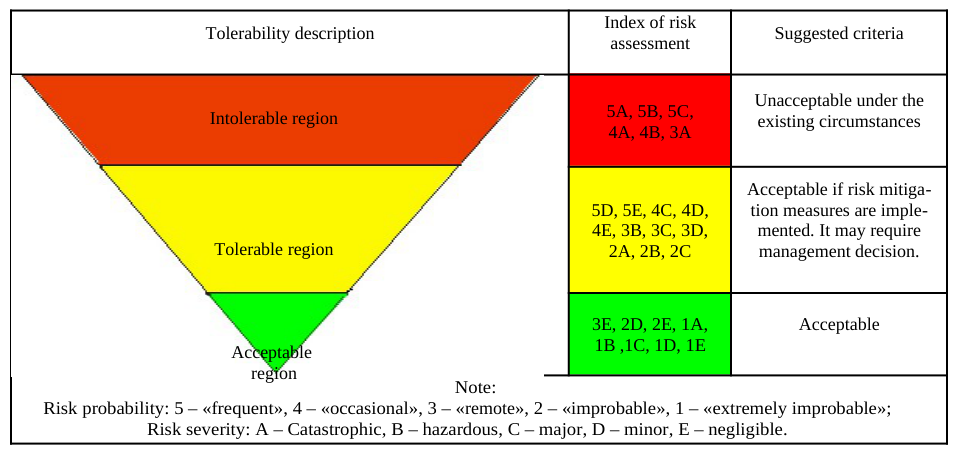
These FS threshold levels form ICAO’s “Risk Triangle” (Fig.1) (ICAO, 2009), solving which has a great scientific and practical urgency and importance. The term “risk” in the context of our research (Petrovskiy and Roshevskiy, 1990) means the capacity of some decisions (and actions that result from these decisions) to worsen the situation and lead to potentially dangerous conditions that may turn into an aviation accident (AA) and result in unwanted conse- quences. Risk may also be defined as the probability (chance) of the current situation turning into AA. From this point of view, every decision taken by ATCs influences risk as probability by increasing or decreasing its value.
Table 1. ICAO's Threats Classification
Intolerable region
Risk, unacceptable under any circumstances
Least practically possible level
Tolerable region
Acceptable, if risk mitigation measures are taken. This will require cost benefit analysis
Acceptable region
The risk is acceptable in its current form
Рiс. 1. "ICAO's Risk Triangle"
There are almost no situations without actions, which can significantly increase the risk or immediately turn the situ- ation, into AA. There are absolutely no situations without risk. Risk value may be vanishingly small and security may be based on several fault-tolerant systems but nevertheless risk always exists. It is also important to point out that there is a huge difference between situations where risk depends only on probability (“stochastic”, chance based situations) and situations where risk depends only on the subject’s capabilities (“habitual” situations). It was found that everything else being equal, AOs are more likely to risk in situations of “habitual” nature, but not in the chance- based ones. A possible explanation is that a person feels able to influence situations of “habitual” nature (ICAO, 2009; Kozeletskiy, 1975).
According to current ICAO paradigm of FS (ICAO, 2009), every AA is viewed not simply as an event caused by one specific reason but as an event whose causes could potentially be accumulated for a long time. Once a critical mass of reasons (regardless of their nature) is accumulated, the safety system reaches a bifurcation point, which leads to the destruction of the system and loss of its ability to respond to any kind of threat. In this situation, any ac - tion that should be parried by the safety system leads to an AA. This approach is also observed in Reason’s model (Fig. 2) (Reason, 1990; Reason, 1998). It should be noted that such behavior is inherent to systems that have one or more bifurcation points while moving along phase space.
SOURCES ANALYSIS The first mention of the “Risk Triangle” was made in the first edition of “Safety management manual (SMM)” (2006) without any recommendations about its solution. But in the same year, the solution was proposed by a Ukrainian scientist, professor Oleksiy Reva at the international ICAO, Airbus and MAK congress on the impact of human factor (HF) on FS. This solution was based on the specific points of utility estimating functions of AO’s professional activity (Fomenko, 2006; Reva, 2008).
OrganizationWorkplaceAircrew/TeamMeans of Defense Results
Conditions that Errors and
Organizational and management
lead to errors and violations
violations Events Dangerous actions
decisions
Aviation system defense means
Fig. 2. Reasons model
All further research on solution of the “Risk Triangle” is connected with the next SMM edition (2009) and is sum- marized in the paper by Reva et al (2013). This includes ICAO’s recommendations on qualitative solution of the “risk triangle” based on different combinations of qualitative linguistic indicators of the frequency of unwanted events with qualitative indexes of their danger (table 2). These recommendations were checked with the help of de- sirability coefficients of improved Harrington scale and respective Harrington functions. The paper by Reva et al (2013) found some important weaknesses of ICAO’s proposals as it showed that if they were true, desirability coef- ficients of event frequency and danger must change in a linear way, which is nonsense from the point of view of FS threshold levels.
This paper also confirmed the possibility to solve the “risk triangle” with the help of key-points of ATC’s profes- sional activity utility estimation functions built with the help of special procedures for the closed (limited number of points) and open (theoretically unlimited number of points) decision making (DM) tasks (Reva, 1998; Reva, 2007; Reva and others, 2013).
The paper by Chinchenko (2011) states that qualitative characteristics of probability (chances) of unwanted event and its consequences significance may be given with the help of term-set (TS) of corresponding linguistic variables (LV), that have their own membership functions (MF) built for fuzzy argument “danger level” that has no strict quantitative definition. Moreover it is not shown how to get an aggregated safety estimate with the help of fuzzy op- erations based on the partial estimates, how to defuzzyficate it and normalize it to the ICAO risk categories transi- tion.
The paper by Reva and Borsuk (2013), shows the research results on constructing the LV MF “danger level” for the distance between aircrafts of 10 km. This distance corresponds to the ICAO flight level norms for cases when air traffic control occurs for aircrafts on the same flight level (same path line or crossing path lines) using DME and/or GNSS. In this case, the forward aircraft must hold velocity, which exceeds that of the following aircraft by 27 km/h (20 knots) or more (ICAO, 2009). The size of correspondent TS is equal to 7 taking into account human psycho- physiological capabilities on following and tracing limited number of objects, which is Miller’s number (Kozelet- skiy, 1975; Miller, 1956; Gerasimov and Kamishin, 2009). On the base of fuzzy concentration and dilation opera- tions the initial size of the “risk of potentially conflict situation (PCS) appearance” LV TS was reduced to the ICAO requirements. The paper also provided defuzzyfication of the results and determined the distance norms that corre- spond to the ICAO’s “risk triangle” threshold values.
PROBLEM DEFINITION From the above analysis it is clear that ICAO’s “risk triangle” solution is possible with the help of building MF of corresponding LV as a fuzzy model of ATC’s attitude to the violation of flight level norms. It is important that the investigated value of 10 km. is not the only norm of air traffic flight levels. And it is obvious that violation of all these norms are unwanted states (potentially dangerous states), or such working conditions under which unpredicted air situation decreases FS threshold levels. Unwanted states that appeared as a result of ineffective control over threat factors or mistakes, can lead to the situations that threaten the whole flight or decrease FS threshold level of air traffic control.
Hence, proactive formation of ATC’s knowledge about the possibility of unwanted states occurrence and identifying their personal attitude to their threat should become an effective way of preventing AA at air traffic control. This is the goal of this paper.
Table 2: ICAO’s recommendations on “risk triangle” solution Tolerability description Index of risk assessment Suggested criteria
SOME PECULIARITIES OF ATC'S PROFESSIONAL ACTIVITIES Peculiarities, stated above, include ensuring continuous process of ATC’s decision making concerning control of the aircraft that ATC is responsible for. Taking into account the specificity of such control, ATC’s decisions could be divided into strategic, tactical, operational and extreme ones (Blom and Bakket, 2011; Kantas and Maciejowski, 2011).
Strategic decisions influence general en-route flight process and, as a rule, they are taken in advance, at least one hour before the DM point to the point of its highest influence on the flight process and safety. They don’t increase the AO’s stress level or the risk of emergency situations in the ATC’s responsibility area.
Tactical decisions are taken by ATCs in the air traffic control process with time reserve from an hour to 15 minutes, and have a significant influence on the flight process only for a small time interval. As a rule, they do not lead to a significant increase in the ATC’s or pilot’s stress level or to the risk of emergency situations in the ATC’s responsi- bility area.
Operational decisions are taken by ATCs in air traffic control process with the time reserve from 15 to 5 minutes both during ordinary situations as well as emergencies or situations that can lead to emergencies in a short time- frame. These decisions are associated with a significant chance of potential conflict and require ATCs to precisely estimate potential safety, current safety and alternative management control influences.
Extreme decisions are taken by ATCs within the time interval of 5 minutes or less. These decisions are associated with huge chances of not only potential conflict but also potential disaster and require ATCs to quickly estimate po- tential safety and alternative management control influence actions.
During DM, ATCs continuously estimate not only the chances of air emergencies but also any changes in the current situation as a result of the chosen action. This risk estimate is one of the most important components of the ATC’s work and its results directly influence general flight process safety. ATCs as any other human beings tend to esti- mate risks in a fuzzy way (“big risk”, “small risk”, etc.). Such estimation is best described in terms of fuzzy sets and LV, which appeared in the middle of the previous century, and is continuously used in humanistic systems sciences (according to Zadeh (Zadeh, 1976)), ergonomics, cybernetic, and others where human beings takes part. Moreover, we believe that the methods of the possibility theory, which is based on fuzzy mathematics, should receive more at - tention for estimation of ATC’s risk. The possibility theory is based on the foundations of the probability theory, the theory of fuzzy sets, as well as on the dependency of probability of the event’s occurrence on the subject’s knowl- edge about that event (Zadeh, 1976; Dubois and Prade, 1980; Dubois, Prade and Sandri, 1993; Dubois and Prade, 1995; Kaufman, 1982; Yager, 1986; Dubois and Prade, 1990; Pytiev, 2000].
Thus with the help of fuzzyfication/defuzzyfication procedures (Kamishin and others, 2012) of fuzzy notions it is easy to translate the notions easily understood by people into numbers and perform the necessary analysis. The re- sults of this analysis can provide the foundation for construction of the fuzzy model of ATC’s risk attitude.
RESEARCH RESULTS Research was carried out in the National Aviation University (Kiev, Ukraine) and Kirovograd Flight Academy (Kirovograd. Ukraine). It involved 131 students of 4-th and 5-th years of study. Their attitude to risk was checked by special questionnaire(Cooper-Harper rating scale (Cooper 1957; Dobrolenskiy and others, 1975) modified according to research requirements) where they had to estimate risk value of PCS appearance during flight level rules violation using the following linguistic scale (Fig. 3):
VH H
AA U
BA L
VL
T
Equations and mathematical formulas are available in the original paper PDF.
+high
+aboveaverage
+usual (average)
+below average
+low
+very low
Where « + » stands for terms logical aggregation.
VHHAAUBALVL
0Distance between aircrafts in km.10
Fig. 3. Application of Cooper-Harper's scale for expert information collection about flight safety during flight level rules violation
As it was already mentioned, we used the following premises choosing scale dimension. It is well known that people have significant psycho-physiological limits as to the number of objects or ideas that they can pay attention to simul- taneously. For the majority of human beings, this number ranges from 5[Equation or mathematical symbol available in the original paper PDF]9 objects or ideas, which form the space of the so-called “Miller’s magic number”. Keeping them in fast memory, human-operator (H-O) is able to manage them, analyze, combine, and unite into clusters or groups. To determine the relationship between each measured value and all possible terms of LV’s “risk level”, the respondent has to compare his/her subjective opinion about the measured values (distance between aircrafts) with the subjective opinion about this value’s belonging to a certain term, which provides a qualitative estimate about its risk level. At first, it seems that any number of LV terms may be taken for correct MF plotting but there is a reason to doubt this approach. Under the arbitrary number of LV terms greater than 9, ATCs as H-Os will face the problem of single distance correct comparison with all acceptable terms at the same time. In this case all comparing should be done rather in pairs or along with terms number subdivi- sion into groups with further necessity to compare value with group terms. It is obvious that appearance of second polling phase will increase additional complexity. For example, some comparing will be executed as if separate group is whole TS diapason, leading to the mistakes. Using 7 terms (taking 7 as average number of objects effi- ciently kept by human in mind at the same time) person will be able to make one comparison of given value with all LV terms at the same time and define the best fit.
During the poll respondents were proposed segment of 100 mm. as an equivalent of 10-km. distance between air- crafts in the space, where respondents were asked to mark distances (Fig. 3) that corresponds to risk levels according to the scale.
Given flight level norm of 10 km. is defined by ICAO for the aircraft flights that follow same route on same level in
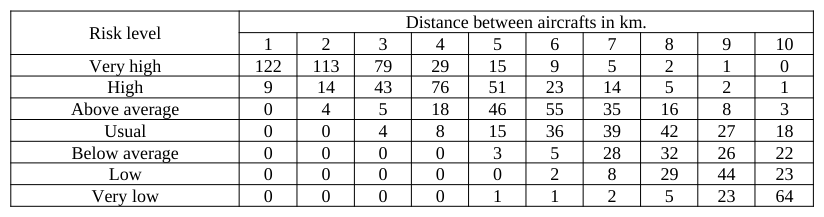
AC (Approach Control), TMA (Terminal Control Area) area using automated air traffic control system (ICAO, 2007). Respondent were asked to define risk levels for the distances. Given poll conditions and rules revealed great opportunities of firstly taking expert information with “point on the scale” scheme (Reva and others, 2010; Utkina and Kruchkov, 1988) and secondly use supplementary matrix (Reva and others, 2010; Borisov, Krumberg and Fyo- dorov, 1990). Results, received in this way are presented in the initial matrix (table 3).
Table 3: Initial poll results matrix
For normalization supplementary matrix S was found in following way. Let aij be matrix element received as a re-
m
❑ ,∀i where si is element of S
❑) ai
Using supplementary matrix we find matrix B, where each element max(ai
❑
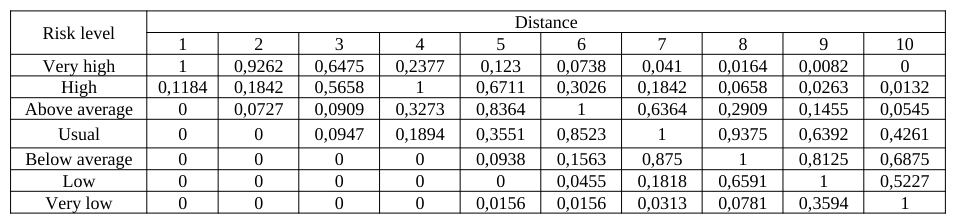
Second normalization step is to find maximal number in every row and to multiply all row values into that maximal. Values of calculated “risk level” LV MF are given in table 4.
Table 4: “Risk level” LV MF values
Figure 4 illustrate “risk level” LV MF as fuzzy model of ATC students attitude to the flight level rules violation. Lets analyze it starting from transition point proposed by L. Zadeh (Zadeh, 1976): μ~T i(s)=0,5. Now we consider that if any distance s between aircrafts in observed interval of 0÷10 km. will have value of MF greater than transition point μ~T i(s )>0,5, then it’s more likely to belong to corresponding term ~T i and it’s more likely not belong to
corresponding term, if μ~T i(s)<0,5.
Hence, according to Fig. 4, we notice that all intersection points of neighboring terms has greater values than transition point.
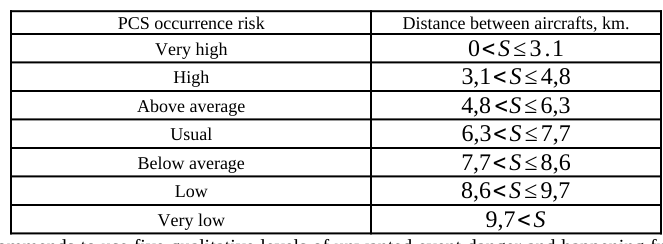
This means that polled students as future professionals makes clear difference in degreases of observed flight level rules violation danger and operates with qualitative-quantitative estimates comparing. It is easy to find numerical values for intervals which correspond to qualitative linguistic estimates (table 5).
Table 5: Quantitative-qualitative differentiation of PCS occurrence risk PCS occurrence risk Distance between aircrafts, km. Very high 0<S≤3.1
Very low 9,7<S Since ICAO recommends to use five qualitative levels of unwanted event danger and happening frequency (table 2) it is quite easy to present them as corresponding TS for danger and frequency: T M (risk probability )=frequent+occasional+remote+improbable+extremelimprobable
T
M (risk severity)=catastrophic+hazardous+major+min o+negligible In context of current paper researches let’s find out how to reduce scale used in polling to the ICAO scale size. Bear- ing on the fuzzy sets and LV theory (Zadeh, 1976; Kaufman, 1982; Yager, 1986; Reva and others, 2010; Utkina and Kruchkov, 1988; Borisov, Krumberg and Fyodorov, 1990) we will keep in mind the following.
Firstly during creation of “risk level” LV TS the “very” modifier was used, that may connect neighboring terms with help of fuzzy concentration and dilation operations. Thus, by inverting operations we may reduce initial polling scale by two terms.
2 (s )
Secondly there exists such aggregation operation that allows to unite terms in following way: ∀s∈S: μ~T k(s)=μ~Ti∪~T j=MAX [μ~Ti (s ),μ~T j(s)]
Where ~T i ,~T j are neighboring scale terms that are united, ~T k is new scale term received as a result of ~T i and ~T j ag- gregation operation. Taking into account all mentioned above initial pole TS indeed may be reduced into ICAO TM from figure 5. Analysis of that figure shows that intersection points in this case has also values greater than L. Zadeh transition point, that allows us to switch to the ICAO “tolerability matrix” solution (Fig. 6). Apparently from figures 5 and 6 according to ATC students opinions catastrophic risk appears if flight level rules violation reaches 40% of norm distance S=10km. between aircrafts and all unacceptable risk zone reaches 63% of that distance. At the same time acceptable zone takes 37%. It would be interesting to compare results with other flight leveling norms and with other opinions namely from real ATC.
HAAUBAL
Distance between aircrafts 1 2 3 4 5 6 7 8 9 10
Fig. 5. Terms/levels risk distances after LV MF terms aggregation
Catastrophic risk: s [Equation or mathematical symbol available in the original paper PDF] 4,8 km.
Intolerable region 4,8 km. < s [Equation or mathematical symbol available in the original paper PDF] 6,3 km.
Tolerable region 6,3 km. < s [Equation or mathematical symbol available in the original paper PDF] 7,7 km.
Acceptable region 7,7 km. < s [Equation or mathematical symbol available in the original paper PDF] 8,6 km.
Neglected risk: s > 8,6 km.
CONCLUSIONS
Taking into account scientific results achieved and presented in this paper we may state the fact of ICAO “tolerabil- ity matrix” solution with help of ATC students attitude to the aircraft flight level norm violation fuzzy models, that opens prospects of researching the whole family of such functions along total range of flight level norms. Special feature of given results that differs them from ICAO proposition is scientific base of quantitative relation between distance norm deviation and risk categories. Other results includes following. Number of ranks in the qualitative linguistic scale used to estimate risk during flight level norm violation was grounded basing on psycho-physiological capabilities of H-O memorizing and recognition of limited number of ob- served objects as well as on fuzzy mathematics methodology. Plotted “risk level” LV MF during flight level norm violation of 10 km. It was discovered that all MF intersection points of neighboring terms has values greater than L. Zadeh transition point value that proves about good respondents understanding of correspondence between qualita- tive risk levels and quantitative distance values. PCS quantitative-qualitative risk norm is found. Taking into account ICAO requirements developed experimental scale was reduced with help of fuzzy operations like concentration, di- lation and aggregation. MF received in this way allowed us to solve ICAO “tolerability matrix” in quantitative way.
Further researches should be held in following directions:
- receive MF family for all effective aircraft flight level norms to define regularity in ATC students opinions;
- receive MF family to define “normal” frequency of unwanted events occurrence during air traffic control and aggregate danger and frequency estimates;
- receive MF family from professional ATC and compare them with student-wise;
- carry out simulation in order to form ATC skills in conditions of flight level norms violations.
REFERENCES
Blom H. A. Safety of advanced airborne self separation under very high en-route traffic demand / H. A. Blom, G. J. Bakker // First SESAR Innovation Days, 29th November - 1st December 2011. - Toulouse, France, 2011. - P. 1-9. Borisov А. N. Decision taking basing on fuzzy models: usage examples/ А. N. Borisov, О. А. Krumberg, I. P. Fyodorov. – Riga :
Zinatne, 1990. - 184 p. Chinchenko Y. V. Riaks and threats estimation on the air traffic controllers workplace with help of fuzzy sets / Y. V. Chinchenko // National aviation university bulletin: scientific magazine. / Ministry of science and education of Ukraine, National avia- tion university – К.: NAU-print, 2011. - № 2. – P.44-49.
Cooper G. E. Understanding and interpreting pilot opinion / G. E. Cooper // Aeronautical Engineering Review, 1957. - N 3.- P.P.
47-51. Dobrolenskiy Y. P. Methods of engineering-psychological researches in aviation / Y. P. Dobrolenskiy, N. D. Zavalova, V. A.
Ponomarenko, V. А. Tuvaev; editorship. Y. P. Dobrolenskiy. – М. : Mechanical engineering, 1975.– 280 p. Dubois D. Fuzzy sets and systems - Theory and applications. / D. Dubois, H. Prade; Academic press, New York, 1980. – 393 p. Dubois D. On possibility/probability transformations / Didier Dubois, Henri Prade, Sandra Sandri // Proceedings of Fourth IFSA Conference, Kluwer Academic Publ. 1993. – p. 103-112. Dubois D. Possibility theory as a basis for qualitative decision theory. / D. Dubois, H. Prade. // In Proceedings of the 14th Inter -
national Joint Conference on Artificial Intelligence, Morgan Kaufmann, San Francisco, 1995 – p. 1924-1930. Dubois D. Opportunities theory. Appliance to knowledge presentation in informatics: translated from French. / D. Dubois, А.
Prade. – М. : Radio and communications, 1990. – 288 p. Fomenko Y. М. Risk triangle in system analysis of ait traffic controllers professional activity / Y. М. Fomenko // Problems of informatization and control: scientific digest. / Ministry of science and education of Ukraine, National aviation university. – К.: NAU, 2006. - № 3. – P. 147-151. Gerasimov B. М. Organizational ergonomics : Methods and algorithms of research and design: monograph/ B. М. Gerassimov.
V. V. Kamishin. – К. : Informational systems, 2009. – 212 p. ICAO: A unified framework for collision risk modelling in support of the manual on airspace planning methodology for the de - termination of separation minima: Cir. ICAO 319 – AN / 181 (Doc. 9689). – Montreal, Canada, 2009. ICAO: Threat and Error Management (TEM) in Air Traffic Control : Cir. ICAO 314 – AN / 178. – Montreal, Canada, 2008 ICAO: Safety Management Manual (SMM): Doc. ICAO 9859 – AN / 474. – Montreal, Canada, 2009 ICAO: Air traffic management: Doc. ICAO 4444 – AТМ / 501. – Montreal, Canada, fifteenth edition, 2007 Kamishin V.V. Estimation scales points fuzzification/defuzzification procedure / V. V. Kamishin, О.М. Reva, L.М. Makarenko,
О. М. Medevedenko // Electronics and control systems: scientific magazine. / Ministry of science and education of Ukraine, National aviation university.– К.: NAU-print, 2012. – № 3 (33). – P. 53-62 Kantas N. Analysis of conflict resolution needs of the A3 operational concept. [iFly Deliverable D5.2.] / N. Kantas, J. M. Maciejowski, A. Lecchini- Visintini etc. - 2011. - 4l p. Kaufman А. Introduction into fuzzy set theory: translated for French. V. B. Kuzmina/ А. Kaufman; editorship. S. I. Travkina. –
М.: Radio and communications, 1982. – 432 p. Kozeletskiy Y. Psychological solutions theory : translated from Polish. G. Е. Mintz, V. N. Porus / Y. Kozeletskiy; editorship B.
V. Biryukov. – М. : Progress, 1979. – 504 p. Miller G. The magical number seven, plus or minus two : some limits on or capacity for processing information / G. Miller // Psychological Review, 1956. – N 63. – P. 81-97 Petrovskiy A. V. Psychology: Dictionary /general editorship. А. V. Petrovskogo, М.G. Roshevskogo. – P. : Politizdat, 1990. –
494 p. Pytiev Y. P. Opportunity. Theoretical elements and appliance/ Y. P. Pytiev. - М. : Editorial YRSS, 2000. - 192 p. Reason J. Human Error / J. Reason // Cambridge University Press. - Cambridge, 1990. – 41 p. Reason J. Managing the Risks of Organizational Accidents / J. Reason; Ashgate Aldershot, 1998. – 266 p. Reva О. М. Fuzzy models of flight precision ergonomical qualimetry : monograph / О. М. Reva, V. V. Kamishin, V. А. Shulgin, S. V. Nedbay; editorship. О. М. Reva. – Rivne: Ovid, 2010. - 106 p. Reva А. N. Human factor and flight safety: (Research of proactive influence) : monograph / А. N. Reva, К. М. Tymishev, А. А.
Bekmuhmambetov; scientific editorship А. N. Reva, К. М. Tymishev. – Almati, 2006.– 242 p. Reva О. M. Proactive risk management on basis of human factor in civil aviation / О. М. Reva, S. І. Osadchiy, О. М. Medvedenko, Y. М, Fomenko // Railroad transport of Ukraine: theoretical and practical magazine, 2008. – № 6. – P. 54-59. Reva A. N. Urgent area of ICAO “risk triangle” solution proactive models development / А. N. Reva, V. I. Vdovichenko, S. P.
Borsuk [and others] // Modern transport power-plants, technologies and maintenance equipment: 4-th Ukrainian theoretical and practical conference. – Kherson, 9-11 october 2013, - Kherson: HDMA, 2013. – P. 334-338. Reva О. М. Methods of aviation operator a priori attitude to risk as human’s that takes decisions: lectures conspect on course «Grounding of decision taking theory» / О.М. Reva. – Kirovograd: DLAU, 1998. – 45 p. Reva О. М. Proactive estimate of aviation personnel attitude to risk and safe activities / О. М. Reva // National aviation univer-
sity bulletin: scientific magazine. / Ministry of science and education of Ukraine, National aviation university. – К. : NAU, 2007. – № 2. – P. 36-42. Reva О. М. Air traffic controllers pretension level with workload parameters / О. М. Reva, B. М. Mirzoev, P. S. Mukhtarov, S.
S. Nasirov// Air-space technique and technology: theoretical practical magazine. / Ministry of science and education of Ukraine, National airspace university named after M. E. Zjukovskiy «HAI». – H., 2013. - № 8 (105). – P. 273-281. Reva О. М. Fuzzy model of air traffic controller attitude to risk of potentially conflict situation happening / О. М. Reva, S. P.
Borsuk // Ministry of science and education of Ukraine, National airspace university named after M. E. Zjukovskiy «HAI». – H., 2013. - № 10 (107). – P.214-221. Utkina V.F. Reliability and efficiency in technique: reference book in 10 volumes. - V. 3 : Technical systems efficiency / general editorship V. F. Utkina, Y. V. Kruchkova. – М. : Mechanical engineering, 1988. – 328 p. Yager R.R. Fuzzy sets and opportunity theory : last achievements: translated from English. V. B. Kuzmina; editorship. S. I.
Travkina / editorship. R. R. Yager. – М. : Soviet radio, 1986. – 408 p. Zadeh L. The concept of a linguistic variable and its application to approximate reasoning: translate from English. N. I. Ringo / K. Zadeh; editorship. N. N. Moiseeva, S. A. Orlovskogo. - М. : Mir, 1976. - 165 p.
LISTED IN THE AHFE DIGITAL BOOKSTORE CATALOGUE
Explore the complete digital volume
Advances in Human Aspects of Transportation: Part II
Read this individual research paper free through the original publisher, or explore the full digital proceedings book.
ISBN 978-1-4951-2098-5
Explore this ISBN in the AHFE Bookstore ↗Listed in the July 2026 bookstore catalogue; search by ISBN to confirm current availability · Digital book purchase optional