Henrique da Fonseca Marques, Paulo Victor R. de Carvalho (2019). Safety Management in the Assembly of Telecommunication Towers. In: Advances in Safety Management and Human Factors. AHFE Open Access, vol. 5. https://doi.org/10.54941/ahfe100179
There are significant pressures to improve the infrastructure of the telecommunications business currently operating in Brazil motivated by challenges for the development of the country in the coming years. These pressures include, among other things, the need for expansion of the telecommunications network, providing grounds for extensive research in ergonomics and safety management. One of the areas in which these pressures have the greatest impact in occupational safety and ergonomics is in the planning and execution of works for deployment of new communication towers, which unfortunately does not follow good practices of work safety. Unfortunately, safety culture and accident prevention thinking are not widespread in a sector where there is a high demand to accomplish production targets that have to be met according the regulatory agency schedule. The purpose of this research is to understand tradeoffs and pressures identifying major nonconformity in towers assembly works, seeking for solutions and work practices that aim to mitigate or minimize the existing conditions of risk in the construction, operation and maintenance of towers for fixed and mobile telephony, which contribute decisively to the occurrence of work incidents and accidents causing lots of injuries and deaths in Brazilian workers.
In view of the increasing expansion of the telecommunication market in Brazil, a department that annually demands the installation of vertical structures to support antennas across the territory, together with the necessity to extend the Telecom infrastructure for coverage of major sport events that will happen in the country in the coming years - World Cup in 2014 ; America’s Cup in 2015 ; Olympics in 2016, justifying the approach proposed in this paper, where the main issue to be considered is the lack of safety of workers under pressure in assemble and operate these structures.
According to Moreira (2004) working at height, also called vertical work is a major cause of fatal work accident in Brazil and worldwide. Some branches of professional activities include in particular Building, Telecommunications, Manufacturing and Distribution of Electric Power, Conservation and Building Maintenance, Industrial Assembly Safety Management (2019) and others.
In fact the conception of projects to implement telephony in Brazil does not include the concepts of job safety over the concepts of operational quality of the structures, especially under schedule pressure situation. Unfortunately the preventing thinking is not widespread correctly in this segment, where there is much demand of production with goals to achieve with the regulator, and safety that does not have the due worthy space in Telephony segment ends up on the back burner.
Every year hundreds of professionals who develop risk activities often suffer fatal accidents due to lack of appropriate equipment or often because they do not know how to handle them correctly. These factors do not occur due to lack of ability, but due to lack of correct training that warn people about important details, and there is also a lack of good physical and mental condition of the worker, according to Moreira (2004).
METHODOLOGY
In this research we use concepts of Resilience Engineering to better understand a fatal accident that occurred in a assembling of a telecommunications tower. To describe the facts and accident timeline we use the Ishikawa diagram, and the human behavior was classified according to the SRK Rasmussen’s (1983) framework.
According to Hollnagel (2011) , resilience can be defined as the intrinsic ability of a system regulate its operation before, during, or in sequence of changes and disturbances, so that it can maintain necessary operations in both expected and unexpected conditions. Obviously this definition includes the classic definition of safety, since the ability to support required operations is equivalent to the "freedom from unacceptable risk". However, the definition of resilience also makes clear that safety cannot be seen independently from the activity or system process, hence is the emphasis on ability to work on "both expected and unexpected conditions" and not just to avoid failures.
The key term of this definition is the ability of the system to adjust its functioning. This working definition of resilience can be taken more detailed by realizing that it implies four main factors, each representing an essential ability for the system. The four factors or essential skills are (Hollnagel, 2011):
Know what to do, i.e., how to reply to normal and irregular interruptions and disturbances or by implementing an elaborated set of answers or by adjusting to normal operation. This is the ability to deal with reality.
Know what to look for, i.e., how to control what is or can become a threat in short term. Monitoring should include what happens in the environment and also what happens in the system itself, i.e., its own performance. This is the ability to deal with a critical situation.
Know what to expect, i.e., how to anticipate developments, threats and opportunities for the future, such as potential changes, disruptions, stresses and its consequences. This is the ability to deal with the potential.
Know what happened, i.e., how to learn with experiences, particularly how to learn the right lessons from the experience of successes right , as well as failures, i.e., the ability to deal with the factual.
To determine the contributing factors to the accident occurrence, referring to the case study described later on, the Ishikawa diagram was used, also known as cause and effect diagram. It is a method that allows identifying and analyzing the factors involved in the occurrence. The method aims to identify a problem on searching the multiple causes that contributed to the accident occurrence.
According to Rasmussen (1982), human behavior can be classified as:
- Level of skill (skill-based - SB): execution of routine tasks automatically. This is the way in which people tend to work most of the time;
- Level of rules (rule-based - RB): application of memorized or written routines consciously, in order to verify if the solution is appropriated or not;
- Level of knowledge (knowledge-based - KB): is a level at which people enter reluctantly in new situations only in the latter case, where neither routine nor rules are applied.
Among the features and differences of these levels of performance, it should be noted that at level of skill, errors usually precede the detection of problems, while at level of rules and knowledge, errors occur after or during the detection of the problem. (Costella, 2005).
STATISTICS OF WORK ACCIDENTS According to Oliveira (2009), work accidents affect economic productivity and are responsible for a substantial impact on the social protection system and influence the level of employee satisfaction and general well-being of population, as well as represent high human and social costs (worker, family thereof, companies, government and society), little known or valued, whether in the context of business management or in the governmental context.
According to the Anuário Estatístico da Previdência Social - AEPS (2012) it was found that in the work sector for generation and distribution of electric power and telecommunications, represented by Cadastro Nacional de Atividade Econômica - CNAE 42.21-9, an increase of the total number of accidents in the years 2010, 2011 and 2012 occurred. The same scenario was observed in the segment of industrial facilities and steel structures assembly, which is represented by Cadastro Nacional de Atividade Econômica CNAE 42.92-8.
Table 1: Amount of Work Accidents - Period 2010/2012. Source: AEPS 2012. Available at: < http://www.previdenciasocial.gov.br > Accessed on: Nov. 30, 2013.
Table available in the original PDF paper.
Summing amounts of accidents of two families of CNAE, we had a total of 7,961 accidents in 2010, 8,795 in 2011 and 9,439 in 2012. Based on Figure 1, it is possible to follow the evolution of accidents in this work segment from 2010 a 2012.
7,000 6,000
5,000 4,000
3,000 2,000
1,000
2010 2011 2012 0
CNAE 4221 CNAE 4292
Figure 1 - Evolution of Work Accidents
The statistics presented above show the high accident rate in activities involving the deployment of structures, in view that the fast expansion in the telecommunication market increasingly demands more speed in the construction of telecommunication towers, which means to reduce the assembly time of structures for antenna installation. As a consequence, there is an increase in the number of work accidents in this segment, which in many cases ends up victimizing workers.
CASE STUDY - ANALYSIS OF FATAL ACCIDENT This case study aims to raise the factors that determined the outcome of the investigation of a fatal accident in which the victim was the assembler X, an employee of the company A, which was contracted to perform a work of assembling a telecommunication tower by company B. The main goal is to identify the network of factors to prevent new occurrences of such severity and in similar work situations through the adoption of appropriate measures and procedures.
Qualification Company A - Economic Activity: Assembly of steel structures – CNAE: 4292-8/01
Company B - Economic Activity: Engineering Services - CNAE: 7112/0-00 Employee: X - Gender: Male - Age: 23 years - Status: Single - Function: Steel Structures Assembler - Time of company: 20 days.
Description of Accident Site The fatal accident occurred during the execution of the final assembly stage of a freestanding telephony tower of 100m high, in a telephone station located in a rural area of the city of a Brazilian state. According to information obtained in the physical checks, on the day of the accident the weather conditions for that activity were satisfactory. Figure 2, Freestanding Tower, shows that at the time of the accident, the metal structure was already 100% assembled, missing the installation of arrester and fall arrest system to the marking system.
Figure 2 - Freestanding Tower
Description of the Accident Around 8:30 am, the assembler X and five employees of the company A were working on the final step of the assembly process of a telephony tower 100m high. When X tried to change positions in the structure, he would have overbalanced himself at the time when was removing the lanyard from one point to anchor it in another, suffering a fall from a height of approximately ninety meters down the inside of the tower, and as a consequence, cutting off the right arm and the head by shocks with metal pieces that compose the structure of the tower, which would have caused his immediate death, besides multiple fractures throughout the body caused by the impact against the ground. The evidence after the misfortune showed that victim met with the safety latches of double lanyard in "Y " fixed in the front ribbons of safety belt , a fact which suggests that at the time of the fall the employee was with at least one of the lanyard hooks unattached to the tower structure.
Accident Analysis According to POSSI (2006), in 1953 Kaouru Ishikawa, Professor of Tokyo University, summarized the opinions of engineers from a factory diagrammatically, a kind of graphical meeting protocol. This example shows the cognitive importance of graphics on contraceptive processes and that despite we draw more than two thousand years, we are still able to unravel new and useful ways of representing the phenomena that challenge our imagination. The diagram used by Ishikawa, also called fishbone, has proved an excellent tool for several purposes, among them the creation of a theoretical referential model that allows you to decide what data to collect to answer a given question.
After data collection and ascertainment of facts related to this accident, it was possible to proceed with the investigation of the accident with the help of the Ishikawa diagram, and then data were stratified and the facts ascertained from the perspective of resilience.
Figure 3 – Ishikawa Diagram
After the systematization and analysis of information, the causal factors involved in the genesis of the event were established following the rule of “6Ms”: Materials, Methods, Manpower, Machinery, Environment and Measures.
Materials = include all aspects relative to materials as inputs, raw materials, spares, parts , etc., which can interfere with the process and consequently in its outcome . There was no abnormality observed in view of including the provision of personal protective equipment for employees of the work;
Methods = include all used procedures, routines and techniques that can interfere in the process and thus its result. It was found that the employee, the victim of the accident, does not properly set the safety lanyard connectors on the tower structure, setting up a error executing task. The procedure provides that one must not disconnect an attachment/ anchorage point before setting another point, especially when passing amendments, nodes, anchors of the track work. The technique of movement inside the towers is part of the basic content of the training relative to this activity. Although the company A does not have control of the workday, the testimony of two employees who worked in the job and the person responsible for providing food unanimously confirmed this irregularity . It was noted that other employees worked Sunday to Sunday, but they did not receive any extra value for it. In addition to the workload excess and no granting of a weekly rest, any assigned responsible for fulfillment of objectives of the standards of health and safety was observed;
Workforce = includes all aspects related to the staff that in the process can influence the target effect. The victim and other employees of the work were not submitted to admission training for the safe performance of the activity, as defined in NR 18 and NR 35 . The injured employee, as well as other employees of the work, did not undergo pre-employment medical examinations as defined in NR 07, mainly those complementary examinations related to work at height. Irregular subcontracting was verified by the company B, and company A has kept almost all of the employees who worked on this project off the books. It was also found that the company A hired three employees and simply dismissed them alleging delay in the start of the work, without even repay the severance pay, and two of these employees worked in the assembly and as acknowledged also worked off the books, did not undergo medical examinations and were not trained . One of the employees who also worked in the assembling work of this tower in a rural area said he had never worked at height, making clear the neglect with employees safety of the work, when he reported that he worked on the day of the accident on the top of the tower retightening the screws at about 75m in height;
Machine = includes all aspects related to machinery, equipment and facilities which may affect the process effect;
Environment = includes the environmental conditions or factors which can affect the process, moreover under a broader aspect includes the work environment. During the investigation we found that there was no drinking fountain, toilet and any place destined for taking meals in the place where the accident occurred. Such irregularities were confirmed by the two witnesses of the accident that worked in the work. With respect to this error, for example, it was also verified that other employees who worked on the assembly of the structure took their meals from home to work and ate them under trees, sitting on planks or on the floor, because there was no table nor chairs in the place; that there was not sanitary facility in the construction site for basic needs of the workers; that there was not drinking water supply by firms, even where the water had to be brought from home;
Measures = included the adequacy and implementation of preventive measures that impact the work process. Was verified by the company A, the failure to develop and implement the Program of Prevention of Environmental Risks - PPRA, the Program of Medical Control and Occupational Health – PCMSO, as the absence of a formal safety program against falls involving all employees the work.
In view of the Ishikawa diagram, through the rule of 6Ms, it was observed that the factors related to Methods and Workforce employed on the assembly work of the tower aligned with Labor Environment were predominant causes of the fatal accident of the study concerned.
The deficiencies identified in this case study demonstrate total negligence of Company B with respect to its oversight role of good safety practices, such as height training for employees, supply and appropriate use of Personal Protective Equipment – EPI, assurance of medical exams and compliance of labor laws.
GOOD SAFETY PRACTICES AT WORK IN TELECOMMUNICATION TOWERS Services performed in telephone towers should be performed only by people who received training of vertical techniques. The authorized professional must be enabled to perform the operation, as well as have the ability to work at height and have attended training and use required personal protective equipment. There are several conditions considered preclusion to complete activities in towers. It is forbidden to climb towers during torrential rain or lightning conditions, being also not recommended the execution of work on towers by a single person.
The climb on towers should be avoided when the worker is momentarily in unfavorable health conditions. Some of the factors that prevent this practice are: intake of alcohol, even in small amount, intense fatigue, intense influenza- like illness, nervous tension, use of tranquilizers, antihistamines and analgesics within the last 24 hours and immediately after meals.
The services in towers must be performed preferably during the daytime, when the work conditions to be performed permit. In the case of night work, it is necessary to ensure that employees keep contact with the ground crew at regular intervals; everyone involved using supplementary lighting to ensure that the works are carried out safely and in case of an emergency, the employee has a specific plan available that can be activated at any time. The occurrence of heavy rain, strong winds and lightning are factors that increase the risk of accidents, so they are impeding conditions to the achievement of tower climbing activities.
Medical Control For workers who include climbing towers among their tasks, it is recommended to perform different tests. The ability to work at height should be reflected in the Occupational Health Certificate - ASO. As a selection criterion or to stay in the present task, we recommend a minimum age limit of 19 years and maximum of 60 years. The employer must keep the records updated as to show the scope of the authorization of each person to work at height.
The medical evaluation should include, in addition to the main factors that may cause falls from high planes, other factors associated with the task as: demand of physical effort, visual acuity, restriction of movement etc. The employer must ensure that a medical examination turned to the pathologies that may cause sudden illness and falls at height be conducted, also considering psychosocial factors.
According to MOREIRA (2004), the occupational physician should perform detailed anamnesis thorough actual and previous clinical history, emphasizing the search for conditions that may contribute or determine fall from the same height or higher planes, as a history of fainting, dizziness, vertigo, cardiac arrhythmia, hypertension, seizures , or continuous abuse of alcohol and drugs , use of drugs that interfere with the nervous system or rhythm and cardiac frequency. After that, carry it out thorough physical examination with verification of the presence or absence of restriction on the movements, disorders of balance or motor coordination, anemia, obesity, hypertension, heart diseases and other disorders that may contribute to accidents involving falls from height.
Personal Protective Equipment – EPI For climbing towers it is necessary to use at least:
Safety Boots without Steel Toe, with anti-slip soles;
Helmet without flap;
Belt Safety Harnesses with horizontal and in Y lanyard;
Light or cowhide Glove of mechanical protection;
Protection Glasses;
Fall arrest.
The Personal Protective Equipment – EPI’s, accessories and anchoring systems shall be specified and selected according to their efficiency, comfort, load applied to them and their safety factor, in case of any fall . When selecting EPI we must consider in addition to the risks to which the worker is exposed, the additional risks.
The use of safety equipment is required for access to the towers, regardless of length of permanency in the same, being compulsory completing and signing the EPI sheet upon receipt thereof. The use of suspect safety equipment or in irregular condition, including without the CA – “Certificate of Approval” is prohibited.
People who are working under towers and poles where there is work at height should wear a helmet and be careful so that the isolation of the demarcated area is obeyed.
Safety equipments should undergo periodic inspections and be replaced whenever they present failures or wastages that can compromise safety. Before beginning work routine inspection of all EPI’s, accessories and anchoring systems should be performed. Inspection results shall be recorded periodic and routinely upon acquirement when the EPI, accessories and anchoring systems are refused.
The safety belt should be harness type and equipped with device for connection to the anchorage system. The main feature of the safety belt in this type of activity is the presence of a loop in the back, allowing the anchor without limiting the movement of the user. The lanyard and fall arrest device should be set above the waist level of the worker, adjusted to restrict the falling height and ensure the reduction of chances of workers clash with the bottom structure in an occurrence event. Workers should remain anchored to the tower throughout the time they remain in the structure, i.e., throughout the period of exposure to the risk of falling.
When the worker is moving in the tower he should NOT:
Allow the seat belt cord to be long enough for a free fall greater than 2 meters;
Anchor the cable harness in coaxial cables, antennas or in installed supports;
Secure the belt cable on the metal parts of the tower that have slashing edges.
Techniques of Displacement When using the seat belt, the worker must make sure that it is properly adjusted to your body using the settings of the legs, chest and waist. The helmet must have the adjustment strap buckled up correctly and should be correctly adjusted to the size of the worker's head. The lanyard must be affixed correctly to the side of the belt buckle and should be previously checked on the ground concerning its setting. The lanyard is the main safety equipment at the time the employee is in the structure. The fall arrest should be fixed on the central belt buckle during ascent on the structure. The fall arrest system must be tested before the ascent operation at ground level and, if necessary, at 0.50 m in height. Safety tapes and carabineers should be taken in order to fulfill anchor points for a safe activity during shifts.
The Double Lanyard in Y will ensure protection while the worker moves between the rungs of the ladders of the towers and therefore should be used in the ascent. Where external access of the tower is necessary the required number of rings / tapes and carabineers must be used in the construction of the safety line. During the climb we recommend the use of material support attached to the belt, if it is necessary to carry materials during displacement.
An attachment/ anchor point must not be disconnected before setting another point, especially when passing amendments, nodes, anchors on the work line. Attention should be paid to the movements step by step and help must be asked with any discomfort, always with one of the anchor points connected to the tower. The lanyard and all connection points in the tower should be positioned correctly before starting work.
The stairs are a quick way to reach the point of work. As a safety standard worker must connect himself to the wire rope or lifeline with his falling latch. The double lanyard in Y should be used during descent in displacement between the rungs of the ladder. He will always ensure a safe point during the displacement. It must be noted if Safety Management (2019) equipment and tools have been removed and stored. The descent must be started using the double lanyard in Y during displacement and must be performed through the same path of ascent to uninstall anchor points.
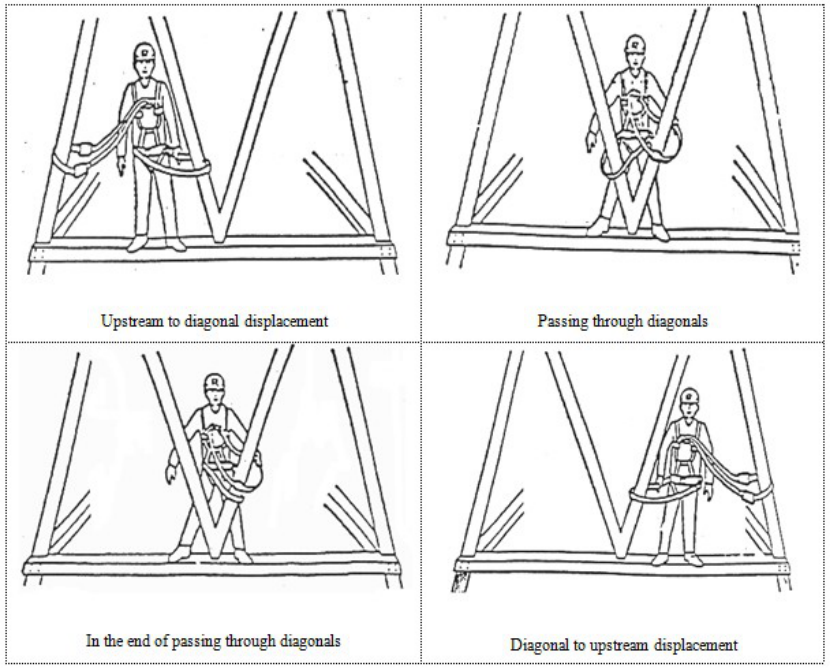
The horizontal displacement is the path performed between the ladder and the point where they will work in self- supporting tower. This displacement must be performed according to existing conditions in the tower. Strings of natural or synthetic fibers should not be used for buckling or displacement at height.
The set of safety equipment must be used for displacements, as shown on Figure below. In this situation, the additional lanyard attached to rods favors the crossing between distant points because it ensures worker safety since he gets stucked to a certain point in the structure all the time.
Figure 4: Displacement inside the tower
Capacity Every worker who performs work on towers should receive specific training for correct use of Personal Protective Equipment - EPI, knowledge of climbing techniques applied for structures, handling and transportation of tools and equipment, knowledge of rescue techniques and first aid. The recommended course load is 16 hours with mandatory eight (08 ) hours of practical activities, should be performed every two (02) years and whenever any of the following situations occur : a) change in procedures , working conditions or operations; b) event indicating the need for new training; c) return to work clearance for more than ninety days; d) change of company . In these cases, workload and program content must meet the situation that motivated it.
The purpose of training is to provide the equipment and techniques theoretical and practically, enabling employees to develop work at height safely and with agility, thus preserving the physical integrity, retraining them when required. The class must be attended by people who have the responsibility of executing activities that require the climb in towers, ERB’s or similar structures. Capacity should preferably be performed during regular working time, being counted as actual work time spent in training. The training must be taught by instructors with proven proficiency in the subject matter, under the supervision of qualified professional in work safety.
The pragmatic content of training must include the following topics:
Approach of regulatory rules and regulations applicable to work at height;
Systems, equipment and procedures for collective protection;
Presentation of personal protective equipment for working at height, how and why they are produced , how to use, selection, inspection, maintenance and use limitation;
Care with equipment;
Discussion of the situations encountered in everyday life and major difficulties in services performed on self-supporting standing towers and transmission poles;
Basic concepts of charge displacement in the towers, as antennas , RF cables, among others;
Lifeline installation and displacement;
Anchorage systems (points of attachment);
Fixing nodes;
Analysis of risks, critical points and hindering conditions;
Work Permission for non-routine activities;
Safety systems for climbing;
System safety for descent;
Horizontal and vertical displacement, movement and positioning in tower;
Potential risks inherent to working at height and measures of prevention and control;
Typical Accidents in specific telecommunication works at height;
Conducts in emergency situations, including notions of rescue and first aid techniques; Theoretical and practical reviews at the end of the classes
At the end of the training a certificate containing the name of the worker, pragmatic content, timetable, date, place where training was performed, name and qualifications of instructors and signature of the person responsible must be issued. The certificate must be given to the employee and a copy filed in the company, the training should be reflected in the employee's record.
CONCLUSIONS
The paper proposes a resilient approach from unsafe conditions of activities that involve working in telecommunication towers, demonstrating the clear inefficiency of methods of climbing and displacement in the structures, which ultimately lead to accidents of a serious nature, including fatalities in the environment work, specifically in the tower assembly process.
At the level of skill, the tasks are uneventful, the concentration level is low and errors are easy to detect, since the task itself is performed automatic and unconsciously. At the level of rules and knowledge level, the activity is basically the problem resolution, which is often difficult to detect and solve. However, on level of rules problems are automatically processed through the rules stored in the course of working life, while the problems managed in the knowledge level are usually new and are treated in a extremely conscious way (Reason, 1990).
Types of errors can be classified within each of these three levels of performance. At the level of skill, errors can be classified into lapses of attention or memory. Slips refers to attention and perception failures in observable actions, whereas lapses are internal events usually involving memory failures. An understanding of erroneous actions and assessments in the real world means that we can not put them in a pure causal category labeled "human error". It is essential to see that wrong actions and assessments should be taken as a starting point for an investigation, not an end.
If the worker who suffered an accident in the 100m high tower was not carrying seatbelt, the hypothesis that he might have forgotten to put on or that it could have been intentional (violation) would be in evidence. Although he was fulfilling its obligation to use EPI, in this case, we conclude that he was carrying the belt but stucked it up incorrectly, missing in task execution, setting up a slip of attention and noncompliance of the standard operating procedure, scene of a routine situation in skill level. Failure to use a secure method of locomotion in the towers under construction eventually leads workers to only anchor the seat belt after spending some time in the tower, which greatly increases the risk of serious and fatal accidents motivated by falling of these workers.
When the procedure and/or training is not followed, it is important to perform the substitution test, which is to assess subjectively if another worker would take the same attitude in the same situation. If this occurs, there is evidence that the error was strongly induced by existing problems in the production system, resulting in an accident in which there was not only the error of the injured.
According to RE principles Success and failure belong to the larger operating system and not just for an individual. The fail involves breakdowns in cognitive activities that are distributed across multiple practitioners and influenced by artifacts used by these professionals. Perhaps this is best illustrated by error detection and recovery processes, which play a crucial role in determining the reliability of the system in practice.
Under the ergonomic point of view, factors were verified as low level of work organization, result of an irregular subcontracting, work environment without the minimum health and safety requirements, physical effort , lifting and manual handling of loads, inappropriate posture, high rates of work, work performed in shifted turns, fatigue caused by long working hours . With regard to additional factors contributing to the accident occurrence, we can demonstrate the absence of capacity and fitness, physical and psychological fatigue, non-use of a safe method for climbing and locomotion in towers, momentary distraction or overconfidence in the method of work, which consequently causes reduced levels of perceived risks, causing workers to fatality as this one analyzed in this case study.
Considering the four pillars of resilience, there was no response ability to emergency cases, as no skill to monitor compliance with the safety standards of work was observed, there was no ability to anticipate, not existing safety plan able to mitigate new occurrences, as well as any evidence of the ability to learn with successful or failure results was observed. So that a resilient system exists, any of the four skills should be left aside.
The satisfactory management of resilience involves broad understanding of organizational performance. Accidents reflect the unexpected combination of overlapping conditions in time and which affect mutually. The management of resilience aims the establishment of a proactive monitoring / control environment on safety organizations. Thus, the factors that can interfere with the safety must be constantly accessed to prevent the occurrence of incidents / accidents.
Given the identified problems, the development of an effective fall protection program becomes critical for both safety management and resilience of the system. Each employer that has the inherent risk of working at height on his own work environment theoretically has operating procedures, which mostly essentially include the use of personal protective equipment, forgetting that some tasks during the tower assembly must have priority on prevention or correction measures of possible failures. Unfortunately the Brazilian legislation until the year 2012 did not provide a specific regulation for conducting activities at height, but with the implementation of Norm 35 - Working at Height, the trend is that the completion of this activity occurs more safely and healthy by workers all over the country.
ACKNOWLEDGMENTS
The authors would like to acknowledge the Conselho Nacional de Pesquisas - CNPq and the Fundação de Amparo a Pesquisa do Rio de Janeiro - FAPERJ for support to this research.
REFERENCES
Brasil. Ministry of Social Welfare (2012), “Social Safety Statistical Yearbook – AEPS”. Available at: http://www.previdenciasocial.gov.br Brasil. Ministry of Labour and Employment (2012), “Regulatory Standards”. Available at: http://www.mte.gov.br Costella, M. F. & Saurin, T. A. (2005), “Proposed method for identifying Types of Human Errors”. XXV ENEGEP – Porto Alegre, RS, Brasil. Hollnagel, E., Pariès, J., Woods, D. D. and Wreathall, J. (2011), “Resilience Engineering in Practice, A Guidebook”, Ashgate e-
Book. Moreira, W. C. (2004), “Suggested Medical Conduct Administrative - Complementary tests for workers working at heights”.
National Association of Occupational Medicine, ANAMT, Brazil. Oliveira, P. R. A. (2009). “NTEP-FAP – A New Look on Occupational Health”. São Paulo: LTr. Possi, M. (2006), “Managing Projects Professional Guide: Volume 3: Technical Fundamentals”. Rio de Janeiro. Brasport. Rasmussen, J. (1982), “Human errors: a taxonomy for describing human malfunction in industrial installations”. Journal of Occupational Accidents, Volume 4, pp. 311-333. Reason, J. (1990), “Human Error”. Cambridge University Press.
LISTED IN THE AHFE DIGITAL BOOKSTORE CATALOGUE
Explore the complete digital volume
Advances in Safety Management and Human Factors
Read this individual research paper free through the original publisher, or explore the full digital proceedings book.
ISBN 978-1-4951-2100-5
Explore this ISBN in the AHFE Bookstore ↗Listed in the July 2026 bookstore catalogue; search by ISBN to confirm current availability · Digital book purchase optional