Mario Cesar R. Vidal, Paulo Victor R. de Carvalho (2019). Ergonomics and Resilience in Crisis Management. In: Advances in Safety Management and Human Factors. AHFE Open Access, vol. 5. https://doi.org/10.54941/ahfe100176
1 Instituto Alberto Luiz Coimbra de Pós-Graduação e Pesquisa em Engenharia - COPPE Universidade Federal do Rio de Janeiro - UFRJ Rio de Janeiro, Brasil ↗
2 Instituto de Engenharia Nuclear - IEN Comissão Nacional de Energia Nuclear - CNEN Rio de Janeiro, Brasil ↗
The aim of this article is to discuss the crisis management from the ergonomics point of view, i.e., presenting useful and applied recommendations, coming from a joint process of diagnostic and conception, conducted by experts capable to produce significant changes in the organizations’ productive processes. The article is structured in three parts. In the first we present the historical evolution of the risk management concepts, since their military-strategic origins up to their actual definitions as a strategic and integrated part of the organizations business management processes. In the second part, we discuss some crisis management models and events from the ergonomics and resilience engineering point of view, i.e., the analysis inside the activity. We conclude this article based on resilience and ergonomic concepts, claiming how essential an adequate crisis management process is for the efficient functioning and even survival of any modern organization.
"in moments of crisis only imagination is more important than knowledge” Albert Einstein
The term crisis has a vast etymology, based on notions related with essential impact, decisive moment and phase or period of extreme difficulty. It has already been said in Sociology and Economy that the comprehension of the social structure basic mechanisms passes through the understanding of crisis, its starting components and its forms of routing to subject, control or bypasses its effects. Furtado (1972) points out that the decision of the Brazilian government of Old Republic (República Velha) to use the coffee surplus as fuel for trains contributed to stop the economic crisis caused by the attack led by foreign banks against the international coffee rating.
Crisis has been, historically, qualified. There are references to economic, social, political, logistical and, even, organizational crisis. In 1988, J. Burkhardt already tried to differentiate “a social crisis as opposed to a problem, tragedy, trend, or simple change in the structure”. In this sense, a crisis would be something which is always happening in a system, however, something special, which escapes from normality. Therefore, a crisis can be viewed as a situation that requires an original diagnostic, specific actions, and particular directions. From there, two questions emerge: (i) How to differentiate a pre-crisis situation from a daily life situation? (ii) What are the limits between a worrying disturbance and the emergence of a crisis?
More recently, the term crisis has been associated with urgency and crucially contents. We see a temporality until then unrelated to a crisis situation that brought a great complication, the complexity. The theory of complexity indicates that in a given organized system a structural combination of factors may cause the emergence of a problematic phenomenon, which allows more than one solution (in the sense of being a non-linear phenomenon), each one of them quite different from the other, and without a clear differentiation logic. Besides, the complexity is translated by the unpredictability (we do not know where, nor how, nor when this emergence can take place in the system) and, in general, many subsystems share causation of the phenomenon, which means that local actions will have little or no effect whatsoever (at the same time that more generalized actions will produce collateral and systemic effects). In other terms, the arrival of complexity framework to crisis situations not only revealed its obscure formation, but equally the difficulty of its treatment (previous, during and even post-fact).
The expression crisis management suggests the possibility to develop of a crisis response plan or a PDCA cycle. The Science of Administration defines the term management as everything which is object of application of a PDCA (plan-do-control-action) cycle. From the complexity point of view, however, it conducts us to a problem/paradox of temporality. How to make a PDCA for an emergent property (crisis) of a complex system, considering that the basic property of complex events is its unpredictability, a contrary property to each and every form of planning?
An answer would be technological mobilization. In this sense, High Technology companies, as well as laboratories and research networks have searched for the development of sophisticated computational support to elaborate simulators and other decision making tools in context of crisis. This is why we propose an ergonomic and systemic approach for crisis management: crisis management is a special decision making process in a complex domain. Comfort (1993), in a crisis specialized publication, summarized: “Decision processes in disaster environments pose a special challenge to rational problem solving. The urgency, complexity and uncertainty of disaster environments test the limits of human capacity for seeking, processing and disseminating information to support coordinated action”.
RESILIENCE AND CRISIS MANAGEMENT Depending on the view of the agent, the equation MANAGEMENT + CRISIS may have different meanings. Therefore, we should have a conceptual position of what comes to be a crisis management, so we can analyze the aspects of dynamism, flexibility and intelligence, which the organizational architectures should have.
The first point to analyze is that the systemic nature of errors and flaws, shifting the focus on human error prevention (taken as individual cognition instance) to a more global and structural approach (organizational and latent flaws). In this sense, error prevention programs like search for routine violations, implementation of defense in depth approach adding more and more barriers (procedures /actions to mitigate the consequences of events) should not be the only way to deal with accidents and incidents. Along with them, there should be place and space for an embryonic program of crisis management, understood as prevention and mitigation of problems in a sociotechnical context. Not coincidentally, this aspect prevails in companies that deal with high risk technologies, and the crisis management is embedded in the organizational safety culture.
The second point addresses the overcoming of the individual paradigm of cognition in an organization, which not only overcomes the localized and linked to the subject aspect, but migrates to the collective plane, social and distributed, generalizing the control room concept for integrated decision centers, even in domains where this architecture and the behavior that comes from it become different, which is the case of purchasing rooms, network monitoring centers, and repository instances of operational experience. In this sense, the decision making requires an analysis based in organizational contents which support the decisions that has been metaphorically called organizational intelligence or competence management.
The third point is about the dynamic and complex characteristics of the controlled object, or before that, from the object which we intend to maintain under control, or at least to monitor its evolution, avoiding the worsening of the situation routed to an amplification (catastrophe) or generalization of effects (disaster). The dynamic characteristic was well conceptualized by Hoc (1996), when he establishes as dynamic a situation in which the evolution does not depend exclusively on the operators’ actions, but combines these processes with others, which genesis would locate outside this scope. Under these conditions, a dynamic situation that involves human, technological and organizational aspects would not be entirely controllable from the cybernetic/mathematical point of view. These situations are, at best, manageable (as the existence of organizations proof), considering that its immediate future would result from independent processes combined with human actions, which would become the instruments of a possible management. The operator is in a situation of progressive evolution of work actions given that his actions have a past accreditation and to which the systems do not always offer adequate monitoring means for these actions’ results. Considering these last points, we establish the necessity of crisis management not only as a component of safety management – although rescuing some of its interesting contributions – but as way to cope with limit cases of dynamic management situations. For that we will use the characteristics of resilient organizations (Woods, 2006), and the ideas of organizational robustness (Dugdale et al. 2000), such as the systemic capacity of providing the best possible conditions for risk management. Although we can use some renowned concepts in catastrophe management and in civil defense, which points out that crisis management is not only about less complex events such as fires or minor collapses, but a structured way to dealing with all kinds of trouble. In this sense, the resilience can be taken as synonym or survival requirement. According to Woods (2006) the resilience of an organization can be assessed based in 5 properties:
Buffer capacity: size or kinds of situations that the system can cope or adapt without critically failing in their performance or structure;
Flexibility: system’s capacity to restructure itself in response to external events;
Margin: how much closer or farther the system is operating in comparison with performance indicators;
Tolerance: how the system behave in comparison with a performance indicator. Its performance degrades gracefully, as the problem rises or falls down abruptly when the pressure surpasses its adaptive capacity threshold?
Multi-scale or cross-scale interactions:
- Bottom-up: an adaptation problem that affects local actors, propagates to strategic objectives, and interactions. - Top-down: the way that organizational actors solves pressures, conflicts, can generate operational problems (Woods, 2006).
CRISIS MANAGEMENT AS CONTROL PROBLEM If a dynamic situation combines the autonomy of the operator (according to the level of accesses that the system provides) with the system autonomy (e.g. automatic actions out of scope of operators’ actions) it is to be suspected that the joint dynamic system presents open characteristics (not controllable by closed systems, such as automated feedback control loops). In this way, it is interesting the approach by Miller and Parasuraman (2007), which recommends the flexibilization of the relation man/automation in supervisory control systems, through delegation in the interaction man/automation (which already happens among people).
In dealing with crisis, these characteristics are presented in high level and with intensified variables. This means a great uncertainty on the organizational area that can be covered by the crisis management: if the issues and means of control are localized (local crisis), the blockage and containment actions will present efficiency and will be able to maintain the effects of the crisis under control. However, if the issues are located far from the processes and in an intangible location by remote access systems, the scenario becomes very complicated. The last is a standard case which characterizes the necessity of a shared and decentralized decision management, which can implicate in serious problems of social nature, especially relating to the prime of decisions. In fact, the failure of the application of emergency plans in great catastrophes (Katrina, Bhopal, Three Mile Island, among others) illustrate in a very worrying way situations in which an inappropriate support for a shared decision making, as well as the cultural diversity of the hundreds of agents/organizations involved jeopardize the emergency plan efficiency. In a study about critical decisions in a fatal accident Vidal et. al (1999) could show that the location of the decision-making center, distant from de epicenter of the phenomena resulted in fatality. It was an operation of deep water diving in which the communication system was mediated by a surface installation, incapable of taking account of important elements of the current condition (sensorial privation) and being called for action in very short periods of time (urgency). In other words, we observe that information management is a key and centralizing element of a crisis management system. In this way, for an adequate management of the crisis, more important than the communicative information about the incident, it is the pertinent contextual information to cope with the components of the crisis (instantaneous, determinants, and immediate actions results). This is effectively one of the main characteristics of resilience: the possibility of generation and distribution, in real time, of the necessary information for the good and correct decision-making in the most appropriate time.
The quality of information flow inside and in the core of the process of crisis management is recurrent, and it is assumed that the operational information – from the experience of the people as well as available information from the control system – is one of the central problems and requires responsiveness and intelligence. The management of this information should provide not only its availability – which would implicate on the adoption or privilege of a determined form of symbolic representation, assuming a previous knowledge of nature and kind of the information to be published, which is barely possible – but also forms of search and construction of ad-hoc information.
MANAGEMENT OF CRISIS The crisis considered as a limit situation show some powerful issues in terms of engineering:
How to recognize the reaching of a limit situation?
In the contrary, how to tell apart a real threat from false alarms?
How to establish the intensity of the crisis?
What procedures can be during the management of the crisis?
What actions to take afterwards?
Searching for these answers has as an empirical background the follow up of the crisis being managed, of which model we could establish some parameter or structural orientation. In this aspect, the main reference turns to causality management, especially in life saving situations. The most studied lifesaving actions are the ones referring to fire fighters performance (Klein et al., 1993), of aid in public roads (e.g. Barros & Mafra, 2003). The studies of Klein et al. (1993) show us a curious fact: that the decision-making of the lifesaving agent combines structured aspects (personal experience) with opportunistic decisions (perception of situation), fact that can be revalidated in situations of flight simulation training (Carvalho et al., 2003). In this sense, the perception of the arrival of a limit situation is not decisive for the driving the decisions and actions. It is the capacity of autonomy, of action possibilities or monitoring fields organizationally established that define the conduct pattern to be used. In this same sense, one can raise a possibility that the intensity of the crisis is a useless measurement, given that the agents do not consider it in their basic actions that intend to a change in a recognized state of potential disaster to a point where control or management become possible. In this context, the alarms and other indicators of emergency, gravity or intensity present a utility quite below the expectation, in the sense that the conduct of the operators is not determined by alarms, which in general with a more confirming than starter role in the action processes (Carvalho et al. 2006). Furthermore, these alarms point to ongoing or imminent crisis that characterize situations permanently anticipated (or attempted as such).
The actions performed during the crisis alternate between known and established procedures and heuristic actions (that are not necessarily of greater risk, but normally are not inventoried nor discussed during the development of an official procedure). Contrary to what is normally said, where such heuristic actions are seen as errors or violations, situated ergonomic analysis shows that these resources are essential for the management of greater problems, in detriment of follow strictly procedure actions. In the case of the action of fire fighters at large fires or multiple road collisions, this scenario repeats itself every time: beside procedures well established and written, the solution of the catastrophic situations requires the adoption of heuristic tactics, progressively decided in a dynamic context – which underlines its management character. The question here is to understand the factors that produce an oscillation from a predictable and ordinary scenario to an heuristic and unusual difficult situation.
In this last, command and control issues appear, as well as the social aspect of crisis management. The modern visions of safety culture say that in case of a crisis, the strict command relation (commander-subordinate) can and should be replaced by the situational factor – the proximity to the place of event determines the level of command. Such concepts are validated in commercial aviation by CRM (Crew Resources Management) practices that would have possibly positive repercussion in the previously mentioned deep-water diving case. What is important is that this hierarchy is established locally – in relation to the event – and opportunistically or situated – in relation to context. It is the issue raised by Rogalsky and Samurçay (1994) of the prevailing of reference knowledge upon doctrine knowledge. In this sense, crisis management is established upon an operational management that consists of five pillars:
Determination of possible maneuvers upon procedures of tactical thinking (plausible actions);
Line up and position the agents for action, as a virtual operational device, examined and revised as such before come to play;
Organize information logistics, of communications as well as of support for the pioneer or advanced agent;
Organize a system of operational support informing parameters and out of reach conditions and evaluation of certain agents;
Establishment of a shared representation system progressively updated.
ERGONOMICS AND CRISIS MANAGEMENT: AN EXAMPLE
To exemplify some concepts described earlier we will present an analysis of the Rio de Janeiro Integrated Command and Control Center (CICC) actions during the arrival of Pope Francisco in Rio de Janeiro for the World Youth Day (WYD). This analysis comparing the planning and what was really happened, allows visualizing the event details and then describe aspects that demonstrate resilience (how well the system was able to cope with disturbances in a smooth way) or fragility (what stressed the system to a point that it was not been able to handle easily). The analysis method was based on secondary sources like official information about the planning and from news media (TV, internet and newspapers of Brazil and the world), and in direct observations of the activities in the Integrated Command and Control Center, and in debriefing interviews with CICC workers. These data have informations about the security planning, logistics and of the developments of events during the WYD.
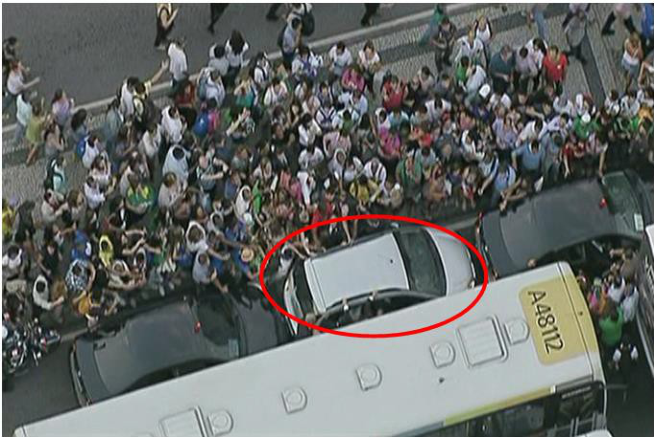
When arriving in Rio de Janeiro, the Pope goes on entourage from the Rio de Janeiro airport to the official reception ceremony at the Guanabara Palace. During the path the convoy was interrupted, because of a traffic jam in one of the major city avenues. In a short time the public got near the car of the Pope while he maintained the windows opened as shown in Figure 1.
Figure 1. Papal convoy stuck in traffic jam (source Brazilian press, 2013).
Security experts observed that the situation have exposed the pontiff to danger, once that hundreds of persons surrounded the vehicle. The Rio de Janeiro mayor claimed that the prefecture was working to avoid that the Pope Francis has transit problems again, after the arrival, when he was surrounded by the people in a traffic jam. “The Pope is a traffic jam creator”, joked the mayor, referencing the fact that the pontiff likes to be closer to the people and to be a challenge to the security. The mayor assumed and divided the fault to the problem in Presidente Vargas Avenue with the federal government. He said “the fails happened, but thank God the Pope has not had real risk”. He also doubted that in another country the Pope would be as well handled in a moment like that. Then he stated “the population of the city proved that they know how to treat the Pope and even protected him”. Again, in a talk with Pope Francis in the same day, the Pope said to the mayor that “his highest sin is to not follow the security rules”. Raising the question of how to build resilience in these kinds of events, where the people, or the Pope in this case, do not follow the safety rules created against people (and even church) underlying assumptions and culture.
In the CICC during the development of the event people became static, waiting for the end of the problem, showing that the system was not able to go beyond previous plan or procedures. The system was not capable to adjust itself to the situation searching for alternative actions that kept the system safe; there was no alternative route or other transportation means. The system resisted using the very same features (radio communication with field agents, observation of traffic video cameras), waiting for the traffic jam began to flow to conduct the Pope to his destined location. Indeed, once it was confronted with the external event there were not any alternatives paths, it lasts trying to keep the same functioning mode while the event lasted.
As we shown before, crises are developed as complex systems, requiring alternative plans before (new scenarios, and during the events to support actors in ad hoc interventions) neither has been done. The Pope was going downtown and chooses to use one of the routes with the most traffic and people flow in the city, generating huge traffic jams and security issues. The organization could have chosen an alternative route to minimize traffic jams and security issues, or they could interdict the street, causing the traffic jams but minimizing security problems.
Maybe because of the nature of this event, it was not possible to perceive a graceful degradation in the system’s performance during the evolution of the event. In the beginning everything seems going well and as shown in figure 1 the Pope car stopped in jam. The pope was being escorted, but the escorts didn’t (or even couldn’t under such planning) try anything different to enhance the pope’s security, like trying to change the route, making a cordon, among others. Maybe nothing could be done at that time. Anyway, the performance degradation occurred abruptly, especially regarding the pope’s safety.
To manage crisis the response coordinator should observe the emergency situation and identify the tasks necessary to cope with the situation. The tasks are composed by activities to be performed by the other agents involved. The coordinator is then required to follow the activities results and allocate suitable resources. Depending on the type of crisis, human resources could include people from different agencies involves in the response, firemen, doctors, nurses, policemen, and technicians, and hardware resources could include transportation systems, computing resources, communication means (such as PDAs or mobile phones), or other necessities like food or clothes. The agents are expected to report on the success or failure in carrying out the activities. The completion of all tasks would allow the crisis management process to be concluded. In recent studies, special emphasis was given on aspects of communication (Kuula et al. 2013, Calderon et al. 2013, Grant et al. 2013), knowledge management (Diniz et al. 2005) to learn on how to deal with unexpected, and infrastructure and integration (Botterell et al. 2012, Dekker 2006) in order to obtain better understanding and analyze crisis response and management from the perspective of resilience engineering.
As we seen, the crisis management scenario in CICC was triggered by the visualization of traffic cameras and by reports from field agents at the scene. However, the coordination at CICC, who should be in charge of organizing all required resources and tasks to initiate the crisis management process, was not able run this process. The coordinator has access to the camera surveillance system used to monitor traffic on the street, but the communication with field agents was poor (only by radios) and restricted to the specific agency the field agent belongs.
Therefore communication problems among agencies involved (Police, transport) contribute to find an adequate response. The city mayor said that the fault was due to the Vaticano security, because they chose the route. Later, minister of justice said that there was a communication error between the control center and the prefecture. In this case, there were no conflicts of opinion, because things happened really fast or really covered up. But it is inevitable to say that the communication between the various entities involved in the WYD event has a lot of problems and they influenced in the system’s performance in various areas. Even in the CICC the communications observed were only inside each agency (e.g. commanders of federal police using radios to talk with their filed agents). There was no dedicated information system support to improve the communications and interactions among stakeholders (police, security agents, civil protection, field agents, and so on) to follow the traffic ensuring to take the better itinerary.
CONCLUSIONS
We described two situations in which the system or organizations involved shown signs of brittleness dealing with different events, in both the planning was not enough to deal with the evolution of the situations, and there was no structured way to cope with complexity, left over to the people the search for solutions. In our first example, there was a catastrophe outcome – the dead of a worker – and in second one, the traffic jam poses the
Pope in real danger and the organization couldn’t do a thing to cope with the situation in a resilient manner, just hope that the people were not violent neither terrorists.
Therefore, we conclude that crisis management should be included in a structured way within the organizational culture sphere. Can we think of crisis management as a structural guideline of work organization in the company? The answer is necessarily situated, meaning, it depends on the type and nature of the organization and the specific context in which the term and theme of crisis take place. In the field of work organization, the priming of crisis management over the work process requires a radical change of organizational culture, either in a sense of culture of safety, or a strong appreciation of management systems certification, such as the path we recommend, a macroergonomics reorientation of the production systems, according to necessary and urgent adjustments on the many interfaces among people, technologies and organization. The basic question is that traditional safety engineering approach have concentrated efforts in weaknesses, flaws, errors, violations, in avoidable aspects, repressible and determined by systems of rules and controls often counterproductive. Now, perhaps, we need to focus on the ergonomics approach based on strength, triumph and opportunities, those issues that, in our view, lies on the autonomy of the operators, preservation and incentive to initiative.
ACKNOWLEDGMENTS
The authors would like to acknowledge the Conselho Nacional de Pesquisas - CNPq and the Fundação de Amparo a Pesquisa do Rio de Janeiro - FAPERJ for support to this research.
REFERENCES
Barros, S.R., Mafra, J.R.D. (2003). “Ergonomia e emergência na concepção do sistema de atendimento em vias públicas”. Ação Ergonômica, Volume 1, No. 4, pp 44-70. Botterell, A. Griss, M. (2012). “A Pragmatic Approach to Smart Workspaces for Crisis Management.”
Proceedings of the 9th International ISCRAM Conference. Burkhardt, J. (1998). “Crisis, argument, and agriculture”. Journal of Agricultural and Environmental Ethics, Volume1 No.2, 123- 138. Calderon, A., Johnson, P. Hinds, J. (2013). “Leading Cats: How to Effectively Command Collectives.”
Proceedings of the 10th International ISCRAM Conference, 32–41. Carvalho P. V. R., Vidal, M., Santos, I. L. (2006). “Safety Implications of Some Cultural and Cognitive Issues in Nuclear Power Plant Operation”. Applied Ergonomics, Volume 37No. 2, 211- 223. Comfort, L K (1993) “Integrating information technology into international crisis management and policy”.
Journal of Contingencies and Crisis Management, Volume 1,No. 1, 15-26. Dekker, Sidney. (2006). “Resilience Engineering: Chronicling the Emergence of Confused Consensus.”
In:Hollnagel, E.,Woods, D.D., Levenson,N. Eds. Resilience Engineering: Concepts and Precepts. Ashgate. Diniz, V. B. Borges, M. R. Gomes, J. O. Canós, J. H. (2005). “Knowledge management support for collaborative emergency response.” In Computer Supported Cooperative Work in Design. Proceedings of the Ninth International Conference on (Vol. 2) IEEE. 1188 – 1193. Dugdale, J., Pavard, B., Soubie, J.L. (2000). “A Pragmatic Development of a Computer Simulation of an
Emergency Call Centre”. Designing Cooperative Systems. Frontiers in Artificial Intelligence and Applications. (Eds.) Rose Dieng et al. IOS Press. Furtado C. (1972). “A formação econômica do Brasil”. Zahar editores, Rio de Janeiro. Grant, T. Van Fenema, P. Van Veen, M. Neerincx, M. (2007). “On Regarding 21st Century C2 Systems and their Users as Fallible ePartners.” Proceedings of the 12th International Command and Control Research and Technology Symposium. Hoc, J.M. (1996). “Supervision et controle de processus: la cognition en situation dynamique”. Presses
Universitaires de Grenoble, France. Klein G. A., Orasanu J., Calderwood R. E, Zsambock C.E. (1993). “Decision making in action: models and methods”. Norwood New Jersey. Kuula, J. Auvinen, V. Kauppinen, O. Kettunen, P. Viitanen, S. Korhonen, T. (2013). “Smartphones as an
Alerting, Command and Control System for the Preparedness Groups and Civilians: Results of Preliminary Tests with the Finnish Police.” Proceedings of the 10th International ISCRAM Conference. 42-51. Miller C.A. e Parasuraman R. (2007). “Designing for flexible interaction between humans and automation: Delegation interfaces for supervisory control”. Human Factors, Volume 49 No. 1, 57-75. RoglaskY J. & Samurçay R. (1993). “Analyzing communication in complex distributed decision making”.
Ergonomics, Volume 36, 1329-1343. Carvalho, R. J. M., Saldanha, M. C. W. ; Vidal, M. C. R. ; Lacerda, E. (2009). “Saberes e competências mobilizados na implantação de um Treinamento padronizado de segurança do vôo.” Ação Ergonômica, Volume 4, 1-28. Vidal M.C., Figueiredo M. G., Pavard B. Marchand, T. (1999). “Décision Collective en situation oú les
informations sont distribuées en fonction de leurs modalités.” Proceedings of the V Brazilian Ergonomics Association Meeting, ABERGO, Rio de Janeiro. Woods D.D. (2006). “Essential characteristics of resilience for organizations”. In: Hollnagel E., Woods D.D., Leveson N., Eds. Resilience engineering: concepts and precepts. Aldershot, UK: Ashgate.
LISTED IN THE AHFE DIGITAL BOOKSTORE CATALOGUE
Explore the complete digital volume
Advances in Safety Management and Human Factors
Read this individual research paper free through the original publisher, or explore the full digital proceedings book.
ISBN 978-1-4951-2100-5
Explore this ISBN in the AHFE Bookstore ↗Listed in the July 2026 bookstore catalogue; search by ISBN to confirm current availability · Digital book purchase optional