Mario Cesar R. Vidal, Renato José Bonfatti, Paulo Victor Rodrigues de Carvalho (2019). A Conceptual Debate Upon Ergonomic Point of View of Work Accidents. In: Advances in Safety Management and Human Factors. AHFE Open Access, vol. 5. https://doi.org/10.54941/ahfe100180
1 Instituto Alberto Luiz Coimbra de Pós-Graduação e Pesquisa em Engenharia - COPPE, Universidade Federal do Rio de Janeiro - UFRJ, Rio de Janeiro, Brazil b Centro de Estudos de Saúde do Trabalhador e Ecologia Humana – CESTEH, Fundação Oswaldo Cruz - FIOCRUZ, Rio de Janeiro, Brazil ↗
2 Instituto de Engenharia Nuclear - IEN, Comissão Nacional de Energia Nuclear - CNEN, Rio de Janeiro, Brazil ↗
The aim of this article is to discuss the statement of an ergonomic point of view in order to ensure the presenting useful and applied formulation of work accidents within contemporary foundations. In fact the expression ergonomic point of view outlines different approaches of work, working, work situation and work design. After a methodological frame, it is presented the conceptual evolution analysis of the work accident concept. Then it is discussed the expression “ergonomic point of view”. We conclude with a synthesis obtained from crossing the notable steps on work accident evolution and the distinct points of view claiming to be the ergonomic the best one Theoretical and methodological issues are also presented as a result of discussion.
CONCEPTUAL EVOLUTION AS A SUBJECT As a part of a specific community we expose our researches, its theoretical frame and their related methodological constructs to a set of words and/or expressions. Those communication devices are not unique. In fact, their meaning can widely vary even within near communities. This typically happen in ergonomics. Consequently, our research papers could have, depending on the reader, a precise contents or a strong vagueness. At times it is a challenge to choice in which sense of a word has the best use. In fact, when breakdowns in communication occur, it is often because two people are using the same word in different ways. Since speakers and listeners, as well as writers and readers, fall in communication breakdown, there is no longer a research being presented.
The essential problem is the process of appropriation of concepts by different communities, especially in the pragmatic (situated) dimension of speech. Hence, we are considering conceptual appropriation as a rich and complex process, having an epistemological equivalence to concept creation process. That very richness combined with the deep complexity make conceptual appropriation a challenging operation: at the same time it produce a concrete support for interactions, it can, on the other hand, introduce an undesirable effect of communication, the misunderstanding. The two core concepts of this paper – work accident and ergonomic point of view – are supposed to produce such effect. Thus, a conceptual evolution analysis of them is strongly needed.
The appropriation of a notion into a scientific community lies at the base of this process, but afterwards a debate should enlighten its uses in order to avoid pragmatic deviation. A single word like "activity" reveals a great vagueness; a current dictionary lists no less than six distinct senses under it. How do we decide among these senses? A cult reader typically decides instantly and without effort which sense of a word is right. He use hints deriving from (1) the grammar (is the word a noun, a verb, a direct object, and so on), (2) referring it to the larger context, the discourse, and (3) the pragmatic situation about what circumstances is the speaker talking. Therefore, what does he expect us to do in response? These three contextual factors – grammatical settings, discursive pertinence and situated properties – should be enough to reveal which of several senses of a concept is being used. In fact, these are the basis of the complementary looks for the conceptual evolution of analysis tasks. Briefly, the conceptual evolution analysis is the denotation of the debate around core concepts of the scientific discourse to avoid pragmatic deviation.
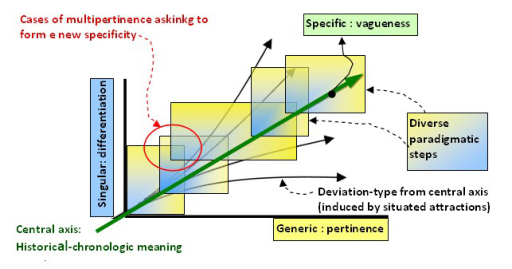
The methodological frame is presented as an heuristic (fig. 1). The conceptual evolution observatory targets have a set of diverse data sources, according to our essential keywords (work accident causality and ergonomic point of view). The composition of data set is initially formed by a subset with a list of experts, according to the subject. Those experts should agree about a list of significant official websites, as well as, core references related to the subject. Website analysis, the indications of the experts and adequate criteria to use inference engines produce an initial bibliographic list. The final list of references issues results from a pertinence analysis of this list.
Analysis consists in examining a core expression in its historic-chronological axis. An initial paradigmatic sequence is formed in order to allow a first partition of the chronological data. Then an assessment of the contents of gathered data through three or more categorizations is done. The partition criteria are:
in what extend they meet a general sense, bringing fourth the generic quality, the generality;
In what extend they exhibits a differentiation, characterizing its singularity;
In what extend they, combine a fuzzy pertinence between generic and singular properties under situated influences, outlining a specificity.
Figure 1. Schematic frame for conceptual evolution analysis.
According to propositions of paradigm conception (Kuhn,1962), a paradigm evolution can be metaphorized as steps of a ladder. Each paradigm is a step, and it is essentially compose by core concepts. A core concept evolves into the paradigm trying to fill the step as a whole. This can be attempted by wide concepts. A given wide concept is a particular explanation that solves the compromise between generality and singularity of their objects. Previous studies and applications (Saldanha et al., 1998, Vidal & Bonfatti, 2003; Carvalho et al., 2005) show that the specificity is the more adequate to establish a more widely conceptualization, by means of a pertinent management of the vagueness. Howsoever, the first step is a clear establishment of generic and singular characteristics of the initial gathered data. It follows that once the initial data gathering are available, it shall be organized an appreciation of the done lectures, the consulted websites and the heard testimonials to form the initial paradigmatic classes set.
For climbing to the upper next steps, the core concepts of the paradigm should be stressed within an extraordinary research. This extraordinary research issues a paradigmatic rupture that inaugurates a new paradigm set. Hence, as a progressing of the partition process, identifying the extraordinary concepts contribution to general goals of a theoretical frame is testing the structure of the paradigmatic sequence.
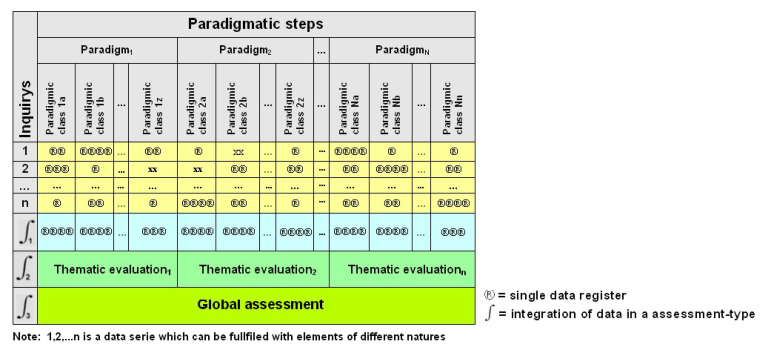
Gathered data are continuously organized into a specific device, the inserting matrix (Vidal & Bonfatti, 2003). Actually, we adopted a 2-D matrix, each row being dedicated to a data source (a writing, an website excerpt, an eyewitness testimony) and each column defined by a specific class in the paradigmatic sequence. Just like a big display, inserting matrix allows us an agile screening of the data universe, merging bibliography annotations with testimonials transcriptions. Figure 2 shows a facsimile of the generic inserting matrix for this study.
Multi-pertinences are the launchers for the formation of new categories: the more multi-pertinences occur, the more data rearrangements must be done. A rearrangement is done by adding a new column – what explains the name inserting matrix. Otherwise, rearrangement can be done several times during the analysis, including testing ad-hoc hypothesis. The more important is to ensure the lowest number of multi-pertinences since we are dealing with crisp analysis within a binary logic.
Figure 2. An insertion matrix for conceptual evolution data gathering.
The number of data suppliers (collected papers, inquired entities and the experts involved), was estimated by mean of a dedicated mathematical model. We show, here, a part of this model. Let n be the number of data suppliers. Let m be the total number of critical comments induced by the general explanation of the subject (referential speech). If so, it is possible to define the following events:
Equation reproduced from the original PDF.
Dij = a critical comment j is reported at least by one of the n data suppliers Thus, Dj = A1j U A2j U ... U Anj (eq. 1)
Considering pij = P(Aij ) and if the events Aij were collectively independents, so the events Dj would be also collectively independents. Hence, we will can write that: P(D) = 1 – (1-p1j)*(1-p2j)....* (1-pnj) (eq. 2)
As applying a list of eligibility criteria for suppliers set composition we can assume that all Aij are equally likelihood. Thus pij = p for any i and j. Consequently P (Dj) = 1 – (1-p )n (eq. 3)
Now, let qn = P(Dj). Ipso facto, let us define the following variables
Qn = number of critical comments reported by at least by one of the n data suppliers, where Qn = 0, 1, 2, ... , m
Mn = Proportion of critical comments reported by at least one of the n data suppliers, where Mn = (Qn / m)
Mn measures the representativeness of the data suppliers set related to critical comment screening. We also observe that Qn correspond to the number of success in m Bernoulli´s trials. In fact, The jth trial is the critical comment j concerning n sources. We consider the succes in the jth try as the event Dj . Since the events Dj are independents and equally likelihood, we infers that Qn has a binomial distribution with parameters m and qn. That means : Qn ~ Bi (m , qn ).
Equation reproduced from the original PDF.
V(qn) = m * qn* (1 – qn) = m * [1 – (1 - p)n] * (1 – p)n (eq. 5) Since Mn = (Qn / m), it follows that E(mn) = [ E ( Qn) / m ] and V(Mn) = [ V (Qn) / m2 ]
Hence, E(Mn) = 1 – (1 – p )n and V (Mn) = { [1 – (1 – p )n] * (1 – p )n } / m (eq. 6) Additionally if m > 10, m * [1 – ( 1 – p)n] > 5, so Qn has a sufficient adherence to normal distribution, as well as Mn . We can, now, state that the representativeness of the data suppliers set related to critical comment screening depends on the number of data suppliers (n), the probability of report of an pertinent critical comment by at least one data supplier (p) and the total number of critical comments potentially issued from a a problem upon analysis
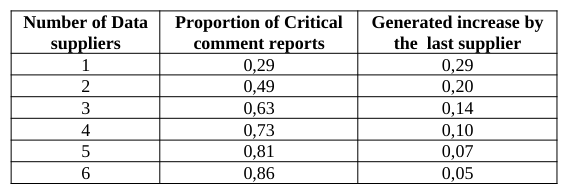
So, prior to define the size of sample set of critical comments, one must estimate the values p and m in the research context. Nielsen and Landauer (1993) search that estimation for interface quality evaluations using think-aloud tests. Table 1. shows the expected value of empirical results .
Table 1: Proportion of critical comments during think-aloud tests interface quality evaluations (Nielsen and Landauer, 1993).
Nielsen claims that the realization of think-aloud tests has generated adjust parameters between 0,12< p < 0,48. This author also pointed out that some systems having being object of interfaces improvements reported a number of critical comments 9 < m < 14. Hence, it looks acceptable to estimate, these values for our concerns. Finally the data supplier set should be : a) equilibrated between its sub-categories ( papers, organization and experts) and b) diversified into each subclass, considering the existing scientific and practice communities.
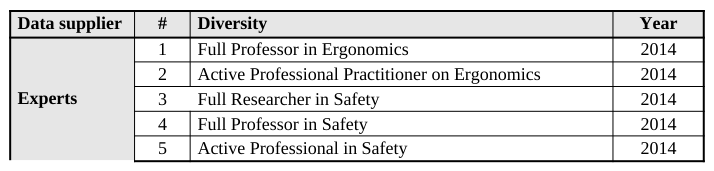
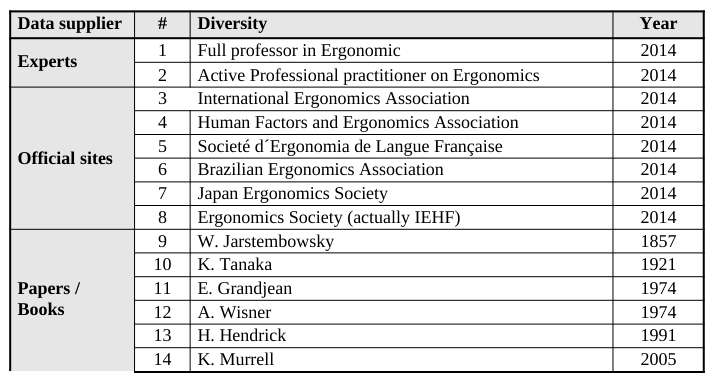
THE MEANING OF CONCEPTUAL EVOLUTION OF WORK ACCIDENT NOTION The notion of work accident is polissemic. In order to trait such polysemy, we organized an observatory around the explanation concerning the genesis of work accidents and the mechanism of a given work accident. The composition of data suppliers set for this particular conceptual evolution analysis also consists of: experts, official websites and selected papers. Table 2 summarizes the data supplier set.
Table 2: Data supplier set for conceptual analysis of work accident meaning.
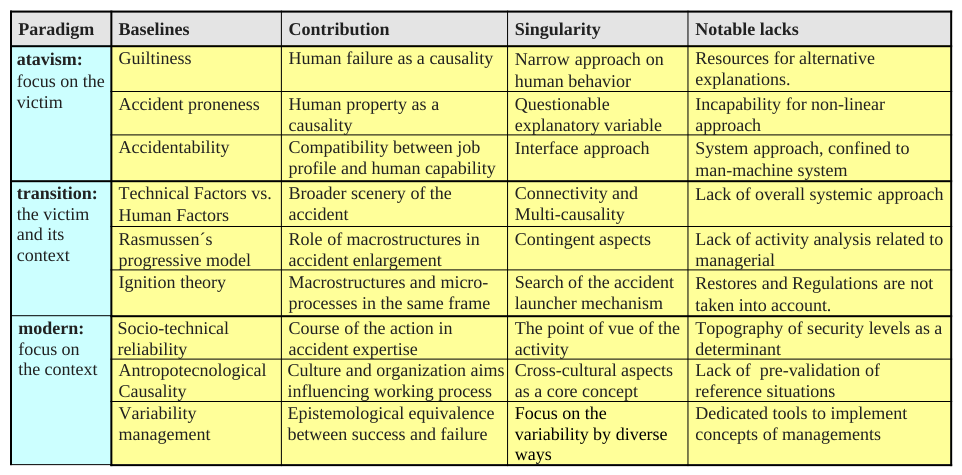
The plan of classification was produced by a generality – the causality of accidents – an immediate consequence – its contribution to common goal of accident prevention field - the singularities of each stream– the role of contextual variables in its particular causality – and its notable lacks – that are supposed to fulfill in a convergent proposition. It could be outlined nine work accident causality explanations, grouped into three paradigmatic sets: atavist conceptions, transitional views and contemporary approaches. Table 3 shows this arrangement.
Table 3: The three visions an the nine baselines of work accident causality explanations Paradigm Baselines Contribution Singularity Notable lacks
Atavism: focus on the victim
This group shares the common sense that a work accident derives from human properties (failures or misfit). “There is always an human error at the origin of disasters” is their favorite slogan.
In the first stream, guiltiness, an accident is explained as a result of misconduct, a bad job performing by the worker. This idea prevailed in labor systems of the medieval guilds. However, we have been hearing this comment during our ergonomic actions and field researches like in building (Vidal, 1985), plantations (Cartaxo, 1987), Refineries (Vidal & Duarte, 1992), aviation (Saldanha et al., 1998), and so forth.
The second one, accident proneness (Lahy & Kongorold,1936), where they tried to establish some scientifically basis to an hypothetical accident based behavior. Scientist of these times formulated the hypothesis that accident proneness was a human property particular to certain individuals, made evident by specific psychological tests. Some inconstancies of such research line were pointed out by Zurfluh (1957).
For the subsequent stream, acidentability (Adler,1951; Tiffin & McCormmick,1967) work accidents happen in consequence of the unsuitability of the workplace profile and the characteristics of its occupants. A real ergonomic appeal, once personal characteristics could become accident factors if confronted with antagonistic demands. Despite of the appearances, the preventive attitude was, essentially, to refine selection procedures in order to provide
“...the right man to the right place”. We remember that one of component of ergonomics common sense in to adequate working to worker, not the other. However, it brings out broader scenery of causality, with some other agents than the humans.
Transition view: the victim and its context This second paradigmatic group features the explanation of causality as occurring in the interaction of the person with the context in which he/she operates. Such frame allows a novelty: it was, from now on, to deal with the analysis of accidents in which the victim is not an active agent. Its initial stream (technical factors and human factors approach), this line brings a broader conception of causality. Technical factors assemble all the elements contributing for dangerousness, whereas human factors revamp the atavist notions around human errors and misfits. Despite of this revamp, this stream contributes for a better understanding of work accident by mean of two under definitions: connectivity and multi-causality. Connectivity means to deal with work accidents having no direct or indirect link with the victim. Multi-causality has a dialectic effect in work accident causality: on one hand we admit that one given accident can be a result of the concurrence of various processes, but, on the other hand, a same causal factor can be at the origin of different accidents.
The next stream has the Jens Rasmussen (1990) progressive model propose. This frame introduces two essential notions: the disturbance and the accident enlargement. Disturbance is related to accident genesis, referring to the phenomenon that transforms a normal situation in an abnormal one (fig. 3). The proposition suggests that several sectors of a company, including neighborhood policies must be engaged in accident management. Accident enlargement is the complementary concept which absorbs the involvement process triggered by the occurrence of a work accident.
Figure 3. Rasmussen´s progressive accident model.
Figure available in the original PDF paper.
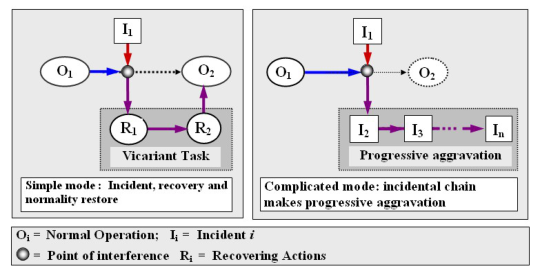
The transitional paradigm, ignition theory, shows that the complex relationship between an accident and its context. It is underlined that the majority of accidents happen in special circumstances whose added durations do not exceed the quarter of total worked time. Such circumstances have a common starting point, the occurrence of an operating incident. The transition from normal to abnormal process derives from the occurrence of one operating incident, but necessarily not a critical one. To bypass the operating obstacle created by the incident the operator deviates from their usual path, performing an unscheduled, vicarious task. Since it is not scheduled nothing could be planned, organized, provisioned to its execution. With the completion of vicarious task the worker can rescue the normality (success) or entering in a succession of incidents (failures). Figure 4 schematizes these two possibilities .Error: Reference source not found
Figure 4. Incidents: passage from normality to abnormality
This stream promotes the paradigmatic rupture as merging the two precedent ones. It solved the founded deadlocks by the creation of a new concept (the ignition of a work accident). It also leave us a legacy: The understanding of a given work situation cannot be restricted to the description in terms of normal situations, but also to situations of recovery. Contrary to what it may seem, these situations are not random or episodic, but also current work situations, therefore also normal according to Perrow’s (1984) view.
Modern views: focus on the context The assumption that an accident is an inherent phenomenon in a system functioning lays on the basis of the modern views. According to this understanding, accident causality should be searched in the proper system nature: its structure and its context. Three streams compose this group of causalities: (i) Sociotechnical reliability; (ii) anthropotechnological causality; and (iii) Variability management. The group has two common traces: (a) a dynamic approach, and (b) a complexity assessment.
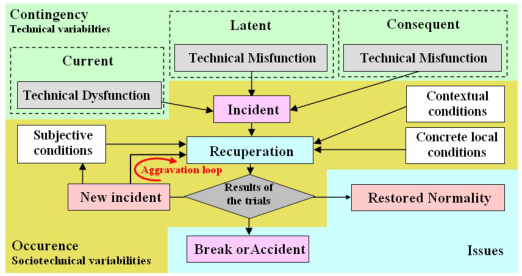
The search for sociotechnical reliability, merging nature and context of a working system conduced to the recovery of sociotechnical as extraordinary research. Its concern merges the originals concepts issued from Tavistocks Intitute formulations, some experiences of design using them, and the methodological frames of ergonomic work analysis and macroergonomics. It brings out the core concepts of regulation (Faverge. 1992, Leplat 2006), emergence (Holland, 1998), course of the action (Theureau & Pinsky, 1979, Theureau, 1992), and the triple dimensioning of an working system (people, technology and organization). In this stream, a work accident is produced by latent failures that are inherent to systems structures, and emerging in different modes according to specific contexts. Its textual formula is: the [latent failures] produce [incidents] that arises into a [particular circumstance] in which there is no enough resources to proceed to [recuperating actions]. Its prevention process lays over deep defenses, now including organizational elements. Figure 5 presents the schematic view.
Figure 5. Sociotechnical reliability model (Vidal, 1984, 1994, 2013)
The antropotechnological perspectives introduce cultural materials in the sociotechnical conception. Since sociotechnical systems are designed frequently elsewhere than the production system localization, there shall exist differences between representations of the designers and the final users. There are two singular cases: the introduction (in general scale up of innovations) and the transfers (replication of a ST in localization). Those differences grow with the social distance among work system agents in the case of introductions, also in cases of transfers. Culture, here, is taken as an integrated system of learned behavior patterns which are characteristic of the members of a society and which are not a result of biological inheritance. Introduction and transfers have two major dimensions: technical and organizational. This approach brings out the core concepts of variability, contingency, downgraded mode in order to connote the diverse impacts from introductions and transfers. The safety level depends on the extension and the depth of the cultural clash issued from a technological introduction or transfer. It textual formula is: [the contingencies] produce [variations] in work process, which turns into a [downgraded mode], the actual context for [the work accident chain]. Its prevention process lays over management of contingences and downgraded modes by continuous improvement of contingency process attenuation and fulfill of lack of recovery condition in downgraded mode chains.
The variability management stream composes the two precedent ones, as incorporating the complexity point of view. The opacity of emergent latent failures in cultural clash context compose a problem which has a joint resolution by the complementary approaches of robustness and resilience modes of engineering. According to Anderson & Doyle (2010) “A [property] of a [system] is robust if it is [invariant] with respect to a [set of perturbations]. Thus a robust engineering can be defined as the expertise of designing systems able to resist changes without adapting its initial stable configuration. In the work accident field this lead to property of the working system of maintains its structure even having been impacted by incidents. This characteristic requires that working system shall be designed considering incidents – typically unforeseen events – and integrate failures as a part of normal functioning – something heretic for classical engineering principles. The solution for this seeming a paradox and it is brought out by Holnagel (2011), when he proposes to lay down the classical antagonism between success and failures. Ipso facto, it formulated the core foundations of the Resilience Engineering frame: (a) Incidents do not necessarily brings up perturbation but emergent variations in a process; (b) success and failures are epistemological equivalents as process issues, once they have the same origin: the same process, the same context, the same crew; and (c) success and failures occurs by a particular and instantaneous combination of variabilities.
CONCEPTUAL EVOLUTION OF THE ERGONOMIC POINT OF VIEW Our second polissemic expression is “the ergonomic point of view”. Table 4 shows the composition of data suppliers set dedicated to this second conceptual evaluation.
Table 4: Composition of the data supplier set for “the ergonomic point of view.
The primordial definition of Ergonomics (Jarzstembowsky, 1857) refers to a science of work. The polish philosopher outlined a scientific program dealing with physical, aesthetic, rational, and moral dimensions of work; that is, work which is kinetic, emotional, intellectual and spiritual. This manifest was followed by a large absence. We found only two significant records: (i) The Science of Labour and its Organization published in 1919 by Józefa Joteyko, a Polish scientist, who dealt in detail with the measurement of occupational fatigue and principles in scientific management of labor and (ii) Research of Efficiency: Ergonomics published in 1921 at Japan by Kanichi Tanaka.
The discipline Ergonomics reappears after World War II in 1949, with the establishment of the Ergonomics Research Society, the first national society in our modern times. This triggered an international movement in Europe and North America which debouches with the creation of the International Ergonomics Association in 1959. During the remain of the XXth century we could see the emergence of several Ergonomic Societies and/or Associations. Actually, the intense and extensive connectivity makes the word ergonomics heard and spoken everywhere, making real the desideratum of the IXth IEA Congress: Designing for everybody, everywhere.
In the last years, we could see an interesting path of the conceptual evolution of the ergonomic notion. Data reveal points of view about what the discipline was supposed to be, passing by its general aims and arriving to the presentation of a set of criteria for ergonomic actions assessment. Even considering that the profession really exists, evidenced by research units activity, available training programs, professional organizations, and certification processes, the misunderstanding is not being reduced. So, the word ergonomics loses a part of its precision sense whereas the ergonomic field grows. The word ergonomics becomes polissemic.
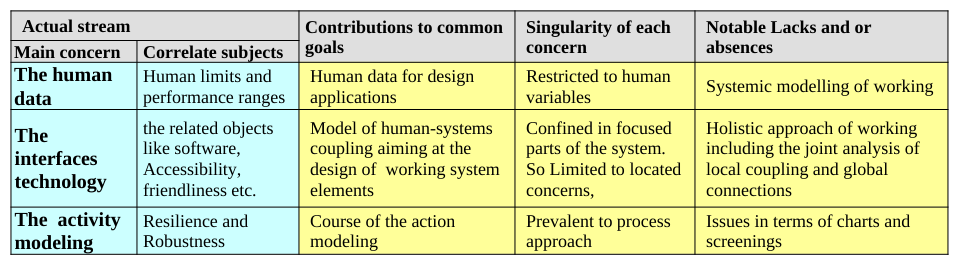
Our concern is to approach the meaning of an expression “the ergonomic point of view”. Hence, we must deal with the meaning of a set of words as a whole. But if we want to discuss the meaning of this whole, we must take into account the many ways in which the word set meanings occurs in a discourse upon ergonomics. We delimited our empirical field to ergonomics authority. It consist of texts and/or speeches produced by a professional practitioner of Ergonomics or an recognized entity (e.g a Society of Ergonomics). Thus, gathered data are composed by a set of papers, educational publications and excerpts of societies’ websites, as well as some personal communications. Data were organized in historical-chronologic order, as exposed above. It issued four current streams on ergonomics practice. The generic and common field is the entourage of human working. All the definitions and testimonies match a common goal described in each aim: to contribute to improve the working conditions. We progressed such understanding onto a contemporary aim, the well-functioning of the sociotechnical system. It includes people, technology end organization in a same reality. It is also added the correlate subjects, allowing the fulfilment of the three analytic categories: the contribution of common goals, the singularity of each concern and its lacks. Table 5 summarizes the confrontation of those diverse ergonomic points of view.
The generic and common field is the entourage of human working. The entire definitions and testimonies match a common goal described in each aim: to contribute to improve the working conditions. We progressed such understanding onto a contemporary aim, the well functioning of the sociotechnical system. It includes people, technology end organization in a same reality. It is also added the correlate subjects, allowing the fulfillment of the three analytic categories: the contribution of common goals, the singularity of each concern and the notable lacks or absences. Table 5 resumes this partition of our data set.
TABLE 5: INSERTING MATRIX OF ACTUAL STREAMS OF ERGONOMICS PRACTICE.
The interface group reads ergonomics as a technology of interfaces in a working system. It operates around the IEA definition: Ergonomics (or human factors) is the scientific discipline concerned with the understanding of interactions among humans and other elements of a system, and the profession that applies theory, principles, data, and other methods to design in order to optimize human well-being and overall system performance. It is composed by the development of solutions for systems components, as well as protocol configurations. This practice introduces the modularity in process design, recovering an old formulation of infinitesimal calculus. Modularity is a needed property for systems robustness.
The activity trend assembles the dynamic analysis, specially the current working models. This trend presents not only a large set of concepts but also specific method and technics, revisiting ethnography and psychology. The activity approach can dialogue with all precedent groups. Their leading concepts are synthetized by the concept of the course of the action.
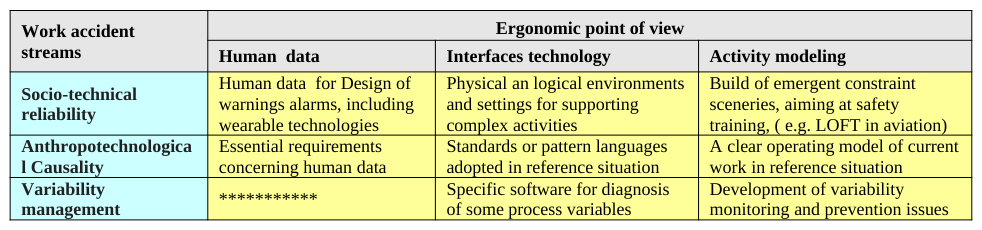
ERGONOMIC POINT OF VIEW OF WORK ACCIDENTS The two conceptual evolution analysis done has forwarded us to crossing the working accidents stream in what each ergonomic point of view can fulfill its notable lacks. This operation outlined a program for research and development of ergonomics in occupational safety. Table 6 shows these results. Under this formulation, an ergonomic point of view aiming at work accidents expertise and prevention, is supposed to:
a) Integer human data in each specification of requirements, knowing the sceneries built by course of the action analysis; b) Combine the design of working elements (tools. instrumentations, furniture) with the interfaces technology approach in order to provide an improvement of the resources available to monitor variabilities.; c) Drives analysis and expertise in a longwise mode, from macrostructure to activities flow, and comprehensive mode, having a broader approach of the macrostructure.
Table 6: Contribution of different ergonomic point of view to notable lack of work accidents modern streams.
CONCLUSIONS
According to our model, we shall discuss the generic aspects of the expression “the ergonomic point of working accidents”.
In the current general sense, accident is taken by an undesirable system output, a deviation from its major objectives. The major causalities in modern conception of work accident orbit this point. Difference are if consider work accident as intrinsic, extrinsic or emergent phenomena related to their functioning. The composed ergonomic point of view can produce a scientific and technological program upon variability management. As a decisive part of cost- effective evaluation, the sociotechnical reliability of a working system should be assured, by mean of a variability management capability that must rebound in the design centers and in the organization outlining centers.
In singular terms it is important to underline that the seminal (but pessimist) view of Perrow (1984) prone that in all complex systems accidents should be taken as normality. However, some organizations are more efficient than others, what has inspired a research line in High Reliability Organizations (Weick and Roberts,1993). This approach exhibits a considerable lack in considering the complexity frame and its essential property, the emergence. It simply does not take into account the occurrence of non-desired issues (accidents) and its necessary explanation as an overflow of the variability management capability of a system. Despite of complexity theory insurance that it is not always possible to clearly match causes as of the effects, it is deeply necessary to consider the different of process failures in human, technical and organizational parts of the sociotechnical system. Hollnagel (2011) assimilates success and failures as epistemic equivalents, and scopes it from the activity until the organizational level. They also infer that the modes and the context in which actions were done, as well as the principles whose they should be understood, are the same, independently of the positive and/or negative results yielded. However, it is not strongly emphasized the differences of systems components. This can entail a resurgence of the atavist notion of human error.
Their positive contribution is the enunciation: a particular accident is a specific instantaneous overlap of diverse variabilities. Hence, the variability management appears as the logical issue in work accidents prevention. However, to manage variabilities is not only registering and following them up. This should means an active interaction as if the path correction of a spatial vessel in the cosmos. In this sense, we outline a set of devices aiming at improve prevention in sociotechnical (ST) systems. Firstly, sociotechnical systems should have the availability of dedicated devices to provide this action field (device 1). The idea of the resilience should be completed with the robustness engineering producing structures that will resist up to a certain degree of variability (device 2). This must be complemented by the flexibility of resources, which could reinsert in a non-accidental path (device 3). These robust flexibleness settings for sociotechnical systems can allow the real conditions for effective aims in prevention: to manage variability effects in technical and organization components instead to keep on asking to the human dimension of ST systems to perform it. Concluding, an ergonomic point of view, as exposed, has consequences in theoretical and methodological plans. As theoretical issues work accidents becomes a phenomenon with three major characteristics :
a) In factual terms: work accident is not only the blesse or a damage of a worker: This means that a work accident cannot be reduced to moment or a place. Blesses or damages are just the pay-off of a progressive process. In the same way, it is not enough to classify areas by any kind of danger level. Examining the structure of the progressive process that will be tragically ended by a blesse or a damage of worker(s) in a given area produces better ways to assess the dangerousness. As examining a potential process, work accidents can be studied without the happening of tragedies. This opens a forensic perspective for work accidents studies.
b) In processing terms: A work accident supposes a mechanism in which a combination of diverse factors, not necessarily close to the accident´s place or moment. This introduces the notion of the systemic distance between a concurrent factor and the accident as a whole. An accident combines various factors having different distances of the final events. Those systemic distances are related to time, as if it combines a fact having occurred the day before and something that happened few minutes before the crash. They are also related to physical distance as if combining elements in place of the tragedy and some other brought away. This reinforces the low utility of contextual analysis of accidents limited of circumstantial approach. However, this consequence places emphasis on a enlarged causality component set, in temporal terms, as well as in topological ones.
c) Concerning its genesis: a work accident is produced by mechanisms arising from the work process. In an accident genesis the workers were surely doing the same things that they usually do. This means that success and failures have no genetic differences. Nevertheless some variations produce the inflexion toward an accidental issue. In order to find these factors and its specific combination, it is question of having a process view of working: a systemic view, but not the static one. Moreover the model for investigate accident should place the event accident in chronological and topological terms. It is the juxtaposition of a set of variabilities in normal processes that are in the genesis of accidents. A particular accident is a specific instantaneous overlap of diverse variabilities.
The methodological consequences are very significant. As taking the accident as a phenomenon under a systemic and dynamic approach, it follows that the explanations should be foreseen in the sociotechnical and anthropotechnological approaches for be established under a variability management conception, in a plan defined by the combination of the shifts brittleness-robustness and rigidity-resilience. Different levels of analysis can be launched: operational, technological, contingent, all them trying to understand the lacks of robustness and resilience in each level. In this sense the ergonomic point of view, as exposed above, can allows us the pertinent sceneries for sustain or eliminate the inferential explanation trials. In this sense it is essential to maintain a clear distinction between the annotated variation and its attribution as a systemic disfunction and/or its causal link with an external factor (outcome). In the same way, we cannot consider that nor a system was so perfectly designed in order to avoid any disfunction, neither it is also impossible to expect that a working system could be uneventfully.
An ergonomic point of view of the work accidents runs within a culture of variability management instead of the asymptotic search of stability. Many years ago, one of the authors (Vidal, 1985) could evidence that the working system in the building industry laid over its intrinsic variability. In such conditions performance is directly linked with the success in variability management by different modes and opportunistic structures. In synthesis, the old lemma keep on control should change to just keep under control. The ergonomics point of view of work accidents, as expressed above, can fully help to do it.
ACKNOWLEDMENTS Thanks for the Brazilian National Counsel of Technological and Scientific Development for the financial support and to AHFE 2014 organizers for propose the scientific challenge.
REFERENCES
Adler, A (1951), “Some analithical concepts related to occupational and personal accidents.” In: Journal of Applied psychology, Vol. 4, No 3, pp. 27-33 Alderson D. and Doyle, J. C. (2010), “Contrasting views of complexity and their implications for network-centric
infrastructures”. IEEE Transactions on Systems, Man, and Cybernetics - Part A: Systems and Humans, Vol. 40, No 4. Cartaxo C. J. (1987), “The battle of Josefa Moenda against Biu Metedor:Work conditions in sugar cane plantations at Brazilian nord-east region”. M.Sc. dissertation, Production engineering program, UFPb, Brazil (In portuguese). Carvalho, P. V., Vidal, M. C., & Luquetti, I. S. (2005). “Nuclear Power Plant Shift Supervisor's Decision-Making during Micro
Incidents”. International Journal of Industrial Ergonomics, Vol 35, pp. 619-644. Faverge J.M. (1992), “Work analysis within a regulation approach.” In: Leplat J, coordinateur. L’analyse du travail en psychologie ergonomique. Toulouse (France): Éditions Octarés, pp. 61-8. Faverge, J.M. (1980), “Working as recuperation activity”. In: Bulletin de psychologie, Vol. 33, No 314. Holland J.H. (1998), “Emergence: From Chaos To Order” . Redwood City, California: Addison-Wesley. Hollnagel E., Woods D. and Levenson N. (2006), “Resilience Engineering”, UK, Ashgate. Hollnagel, E. Pariès, J. Woods, D. D. & Wreathall, J. (Eds) (2011), “Resilience Engineering Perspectives Volume 3: Resilience
Engineering in Practice”. Farnham, UK, Ashgate. Jastrzebowski W. (1857), “Rys Ergonomji, czyli Nauki o Pracy”. Ergonomia, 1979 (2) 13-29 (Special translation for commemorating edition IEA 2000). Kuhn, T. (1962), “The Structure of Scientific Revolutions”. University of Chicago Press. Lahy J. M & Kongorold S. (1936), “Experimental research upon psychological causality of work accidents”. In: Le Travail
Humain No. 11, pp. 1-64. Leplat J. (2006), “The notion of regulation in activity analysis”. Pistes , Vol. 8, No 1. Nielsen, J. and Landauer, T.H. (1993). “A mathematical model of the finding of usability problems”, INTERCHI 93 Conference Proceedings, Amsterdam, ACM, pp. 206-213. Perrow C. (1984), “Normal accidents: living with high risk technologies”. New York, Basic books. Rasmussen, J. (1990). Mental models and the control of action in complex environments. In D. Ackermann, D. & M.J. Tauber
(Eds.). Mental Models and Human-Computer Interaction 1 (pp. 41-46). Elsevier Science Publishers. ISBN 0-444-88453-X Rasmussen J. & Svedung I. (2000) - Proactive Risk Management in a Dynamic Society, Swedish Rescue Services Agency, ISBN: 91-7253-084-7 Saldanha, M. C.W, Carvalho R. J. M., and Vidal, M.C. (1998). “PRO-LOFT: Line Oriented Flying Training Experimental
Program development in a Brazilian air company”. Proceedings of the 9th International Symposium on Human Factors in Organizational Design and Management ODAM, Guaruja, Brazil. Theureau J. (1992). “Le cours d'action: analyse sémio-logique. Essai d'une anthropologie cognitive située”. Berne, Peter Lang. Theureau J. e Pinsky L. (1979). “Analyse du travail en saisie chiffrement”. Research Report LENET/CNAM, Paris. Tiffin, J. e McCormmick, E.J. (1967). “Psychologie Industrielle”, Paris, PUF. Vidal, M.C. (1985). “Mason´working in France and in Brazil : sources and management of differences and variations.” Dr. Ing.
Thesis, Conservatoire National des Ats et Métiers, Paris. Vidal, M.C. e Duarte F.J. (1992). “The introduction of digital systems in the control rooms of oil refineries in Brazil”. In Shwarazan K. (ed.) Advances in Industrial Ergonomics and Safety IV, Taylor and Francis, Londres, 1447-1453. Vidal, M.C e Nunes A.M. (1994). “L'organisation du travail et l'interaction dans l' analyse collective en situation”. Proceedings
of the XIIth I.E.A. Congress, Toronto. Vidal, M.C. (1984). “The conceptual evolution of work accidents causality”. Proceedings of the IV National Meeting of undergraduated training of Production Engineering, Piracicaba, Brazil, (in Portuguese). Vidal, M. C. (2003) Guidelines for ergonomic work analysis in workplaces: a realistic, ordered and systematic methodology. Ed.
EVC Rio de Janeiro, Brazil. Vidal, M. C. R. & Bonfatti, R. J. (2003). “Conversational Action: an ergonomic approach to interaction”. In: Grant P. - Rethinking communicative interaction. Amsterdam : John Benjamin Publishing Company, pp. 108-120 Vidal, M.C. (2013) Socio-Technical System safety and Corporate Sustainability: a complexity approach. Opening Conference,
IV ERGONODIA. Natal, Brazil (in Portuguese) Weick, K. E., & Roberts, K. H. (1993). “Collective Mind in Organizations: Heedful Interrelating on Flight Decks.”
Administrative Science Quarterly, No 38, pp. 357-381.
Zurfluh, A. (1957). “Work accidents and safety training”, Paris, Dunod.
LISTED IN THE AHFE DIGITAL BOOKSTORE CATALOGUE
Explore the complete digital volume
Advances in Safety Management and Human Factors
Read this individual research paper free through the original publisher, or explore the full digital proceedings book.
ISBN 978-1-4951-2100-5
Explore this ISBN in the AHFE Bookstore ↗Listed in the July 2026 bookstore catalogue; search by ISBN to confirm current availability · Digital book purchase optional