Joanna Sadłowska-Wrzesińska (2020). Analysis of Psychosocial Risk in the Context of the Objectives of Macroergonomics. In: Advances in Social and Organizational Factors. AHFE Open Access, vol. 9. https://doi.org/10.54941/ahfe100328
The psychosocial risks in working environment can and must be coped with just like it would if they were physical, chemical or biological hazards. Yet the employer awareness in this field seems relatively small. One should recognize this as a fault because a working environment free of stress overload favors not only the workers' health but also may generate reasonable profit as enhanced productivity and increased quality of work may be noticed (Merecz, Potocka, Wężyk and Waszkowska, 2012). Ergonomic quality in contrast to previous does not depend on few strictly identified factors that may be influenced by user, but is a result of a number of elements of macro environment (Butlewski and Tytyk, 2012). It becomes necessary to better one's understanding of the concept of psychosocial hazard and risk connected with it to be able to evaluate and lessen the risks. In subject literature one can find many titles that suggest usage of risk managing paradigm to successfully manage psychosocial risk. According to this paradigm the correct identification of danger is most important and must be legible, simple and easy to apply. It seems so that the described in this paper checklists proposed by International Labor Office (ILO) meet these requirements.
The basic requirement in designing work is its safety. Creating safe working conditions requires knowledge concerning operation reliability of not only the technical systems but also man – his physical and mental abilities. Analysis of causes of work-related accidents and occupational diseases indicates a high number of risks emerging from human behavior and improper organization of work. Research concerning causes in the human factor shows that neglecting hazards and insufficient concentration on work, are among others, reasons for accidents. In Polish workplaces that underwent inspection through the National Labor Inspectorate abnormalities connected with breaching in the range of schooling in work safety regulations as well as workers obeying them were noted. In the context of striving for increase safety at work in Poland (also to decrease the index of accidents) job inspectors especially look at the assessment of occupational risk associated with workplace and its quality – a wrongful assessment is fostering the arising of work-related accidents as well as a opportunity fostering occupational diseases. It must be emphasized that nowadays the physical chemistry part of work is not in contrast to the psychosocial one the main source of occupational risk (Widerszal-Bazyl, 2009). And although there is no one generally accepted definition of the term psychosocial risk experts agree about the problematic aspects generated by the term.
PSYCHOSOCIAL RISKS AT WORK New risk factors
Over the years not only the types of risk occurring in the human environment have changed but also attitude towards safety. Work-related accidents as well as occupational diseases and pathological symptoms of behavior in a work place are the greatest factor suppressing market growth.
In the last decade huge changes occurred in organization and management of the work process. As a result, new risk factors arose as well as new challenges in the field of work safety regulations. Psychosocial risks are labeled as essential new coming risk factors (EU-OSHA, 2007; NIOSH, 2002). Changes in structure of the job market and the character of human activity have an impact on societies mental condition.
A decreasing number of employees is hired in sectors like heavy industry or agriculture, where the job in general is performed in difficult environment conditions and present many physical and chemistry hazards (noise, pollination, high temperature and so on) while employment in sector of services, performed often in big companies ; in foreign too, demanding closer than ever interpersonal contact It does matter that in the process globalization and related with it increase in competition. This forces employers to a more elastic approach to forms of employment. It also causes an increase in job intensity and a continuous willingness for change.
The feeling of overwork, too much responsibilities, falling behind on novelty, resistance to everlasting change, uncertainty of employment – all this is a more frequent with a worker today. As a result the physical chemical aspect of work is not the greatest source of occupational risk, but its psychosocial aspect is. Problems such as work- related stress or violence at a workplace that are related with psychosocial hazards are generally considered the main challenges for work safety (EU-OSHA, 2007).
International Labor Office defines psychosocial risk factors as the interaction between job content, management and organization of work process and other organizational or environmental factors on one hand and workers' needs and expertise on the other. In this aspect they correlate to the types of interaction that were proved that through workers' perceptions and experience are a threat to health (ILO, 1986). Psychosocial risks may also be defined in a simpler matter as such aspects of designing and managing work process along with the social-organizational which have the potential to cause mental or physical harm (Cox and Griffiths, 2005).
When saying hazard, one should have in mind every factor that may cause harm (http://psychostreswpracy.pl). A general division to physical risks (biological, biochemical, chemical and radiological) and psychosocial risk is accepted. When we consider the psychosocial factors as hazards we greatly widen the definition of work environment. Looking at the dynamic change in work conditions and the examined scale of exposure to psychosocial factors it becomes more often acknowledged that work environment consists of all material environment conditions (physical, chemical and biological factors) as well as non-material factors (psychosocial factors) within which work process takes place (Warchał, 2010). In contrast do classic hazards that are present in a work environment, ex. Chemical or physical hazards, one may not establish sanitary standards for psychosocial risks such as a TLV indicator (Threshold Limit Value) because the effects depend on both worker's trait (also hereditary) and specified configuration of the work environment (Merecz, Potocka, Wężyk and Waszkowska, 2012). Due to this one may not create a universal list of psychosocial hazards or in other words indicate the ones which cause stress to everybody and in every circumstances. In subject literature one meet with a listing of potential psychosocial occupational risks and many attempts to categorize them.
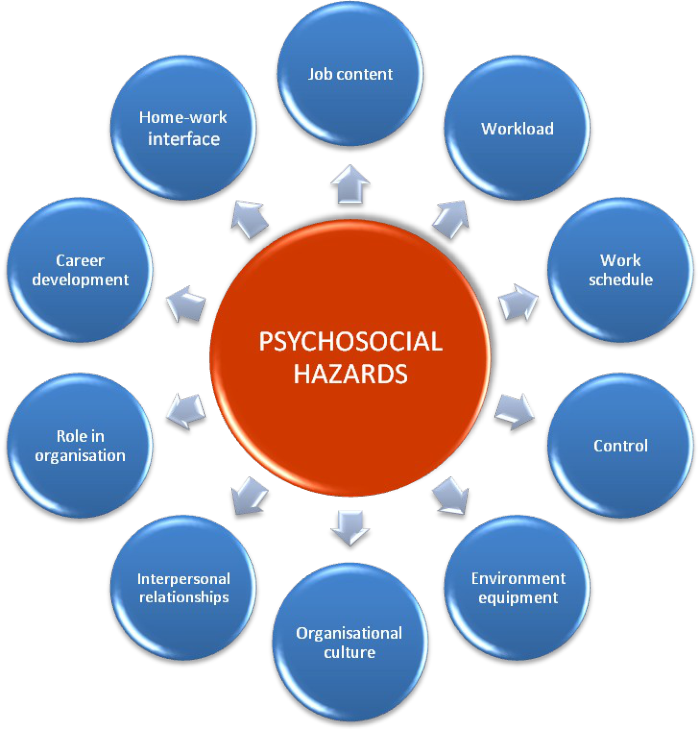
In the sphere of subject literature and based on performed research a safe set of psychosocial work environment factors that are experienced by workers and indicated stressful or potentially harmful was put together. This method reflected in creation of 10 separate categories concerning job characteristics, organization and management of work as well as other environmental and organizational factors that are potentially hazardous towards health. In specific conditions every one of the 10. aspects of work is causing stress and/or is directly hazardous towards health (WHO, 2010).
Figure 1. Psychosocial risks related to work (based on WHO, 2008)
Is stress a worker's personal matter?
Work-related situations are recognized as stressful when they are perceived as demanding significant requirements connected to work which not too well respond to the workers' knowledge and skills (competence) or their needs, especially if they have little influence on performed work and receive little social support in the workplace (Cox, Griffiths and Rial-Gonzalez, 2000). Work as a factor determining the wellbeing was a subject of extensive research that allowed to demonstrate relation between negative work conditions and health breakdown (ex. Floderous et al., 2009; Karasek et al., 1981; Wang et al., 2008). Wilkins and Beaudet (1998) examined work-related stress affecting the Canadian population of workers (n=9023).They found that among men work-related stress was accompanied by migraines and the sense of mental distress while among women – with work-related accidents. Employment insecurity was related to women' migraines. Large physical exertion was associated with work-related accidents regardless the gender. Little support from coworkers was related with men' migraines, and work-related accidents and sense of mental distress for women (WHO, 2010).
Work-related stress is a common effect that in a bigger or smaller way affects every employee. For most people a moderate stress level is beneficial – it energizes and motivates to action and increases effectiveness (Merecz,
Potocka, Wężyk and Waszkowska, 2012). However when stress becomes too big and/or long-lasting and exceeds the efficient way of coping with it there might occur problems which one may observe not only on the individual level but also the organizational level. Burden of the mind resulting from stress in some jobs has consequence not only for employee's results, his health and safety but also may be a critical factor for safety and health of others.
The mentioned earlier results documented diverse results of stress starting from changes in the emotional area and mental functioning, going through behavior and various somatic reactions. In the past it has been also proven that stress may be a risk factor for the development of infective processes, however it must be emphasized that a pathological stress influence arises when it is severe and/or long-lasting (Merecz, Potocka, Wężyk and Waszkowska, 2012). Somatic health disorders as well as mental health disorders (depression, anxiety disorder) are classified as chronic long term work-related stress product. It was shown among others that stress is a risk factor for disease development in the circulatory system, ailment of muscular-skeletal system (ex. lower back pain), escalates allergies, and is the reason for a decrease in body immunity (Merecz, Potocka, Wężyk and Waszkowska, 2012).
One must emphasize that results of work-related stress arising from the presence of psychosocial occupational risks in the work environment effect also employers. It was proven that workers who undergo stress show a negative reflection on team work, communication process in the company, decreases morale and commitment to work. Workers that are afflicted by work-related stress are less loyal to their employer, more often generate conflicts, are less productive (Tucker et al., 2009; Chen and Cunradi, 2008). Then absence due to illness caused by work-related stress usually takes longer than absence due to other reasons, and this also has a negative impact on a worker's productivity index (Merecz, Potocka, Wężyk and Waszkowska, 2012). Occupational stress due to its specificity is related to greater accident risk in during work; it is a deciding argument supporting the statement that attention to safety in work should also involve the elimination of psychosocial risks.
Psychosocial risk analysis – key elements Labor code obligates employers to evaluate occupational risk on job positions. Whereas the aim for evaluating occupational risks is to establish the correlation between harmful factors and their results as and also establishing the risk arising from exposure to these factors. Every evaluation of occupational risk should be previously analyzed for occupational risk. This kind of analysis consists of:
The next step is appointing admissibility of occupational risk where one may encounter barriers of a mental nature concerning measurable stress causing factors. Appointing the acceptance level for stress risk is another problem. Going back to the psychosocial risk one must notice that the process of gathering information about stress causing factors is most crucial. The method of obtaining information about exposure to such factors is at will, but not negligible. One can use ready-to-use questionnaire and checklists or work on own ones. It is emphasized in subject literature (Warchał, 2010; Zawieska, 2007), to keep the interview just it is better to use such a questionnaire that carries out the psycho-metrical characteristics, both questions and their answers reflect the status of organization and workers against the results in group (of a population) of other organizations and workers (we speak of a standardized questionnaire). It is worth emphasizing the undeniable quality of tools that are constructed individually – at the time there exists a possibility to take into account non-typical and at the same time characteristic for every individual workplace psychosocial risk factors. Such a tool should feature a sure level of generality thanks to which when creating a new job position it will not be necessary to make changes in the questionnaire. It is good to remember that the form should be simple and easy to understand as well as accepted by workers. The most common monitoring instruments and evaluation of stress causing factors in an organization are:
checklists (consisting of “YES/NO” type of question)
surveys (ex. NIOSH survey)
data analysis (ex. Productivity, diseases and accidents, fluctuation and so on).
STRESS – RECOGNITION, CONTROL, MODERATION Prevention approach to stress in a workplace
Practice shows that too extensive objective data analysis, ex .of absence level may by nearly effective during the analysis of stress causing factors stage. This type of data shows the effects and not the reason for stress. However usability of checklists during the stage of analyzing data has been confirmed – it is a effective instrument used for collecting basic information about the quantity manner, this means the exposure of a defined number of workers to stress causing factors. Alongside checklists questionnaires are used to estimate work-related stress in a job position. In Nofer Institute of Occupational Medicine two questionnaires were developed:
to evaluate job characteristics (for experts)
for subjective evaluation of work (for workers).
In the Central Institute for Labor Protection – National Research Institute (CIOP-PIB) developed a questionnaire for monitoring psychosocial work conditions. It examines firstly the demands that are required by work, the range of control over performed work, type and level of support that is given to a worker as well as the worker's state of being.
Checklists in the field of ergonomics are a common instrument for analyzing deciding factors when it comes to work conditions. Next to NIOSH checklist used to identify ergonomic risk factors and Ergonomics Checkpoints (ILO) one should especially notice that checklists included in International Labor Office report: Stress Prevention at Work Checkpoints (ILO, 2012). It includes experts opinion stating that there are methods allowing to reduce stress level at work – most importantly identifying stressors, then take control over them and moderation. It is suggested to take a prevention approach to stress in a workplace and easy-to-implement checklists were introduced. The presented solutions are grouped in 10. categories:
1. Leadership and justice at work 2. Job demands 3. Job control 4. Social support 5. Physical environment 6. Work–life balance and working time 7. Recognition at work 8. Protection from offensive behaviour 9. Job security 10. Information and communication.
Identifying stressors
The report Stress Prevention at Work Checkpoints is a sort of textbook that includes not only outlines the problematics of occupational stress and characteristics of the instrument but also detailed principles how to use checklists and practical pointers for those who perform such research. The list contains 50. checkpoints comprising 10 problematic issues. Authors suggest to develop your own list by choosing only the checkpoints that relate to the specific workplace. As a rule a list consisting of 20-30. is at its optimum. What rises particular interest are pointers from the authors concerning the initial process that predates usage of the list.
So in the report the necessity of a being well familiarized with the workplace is emphasized – gathering information about offered products or services, number of workers, working hours and so on. It is also important to design appropriately the field for research (company's department or organizational unit) – it is vitally important from the organizational point of view and especially when we have to do with a large workplace. Authors evidently and more than once encourage to spend time with workers (ex. during a break) and have a casual talk about stress before application of the checklist. It is very important to initiate discussion concerning difficult topics, prompt thought and reflection. Such behavior prepares grounds for careful filling out checklist by the workers and in a big matter guarantees the topic being treated serious.
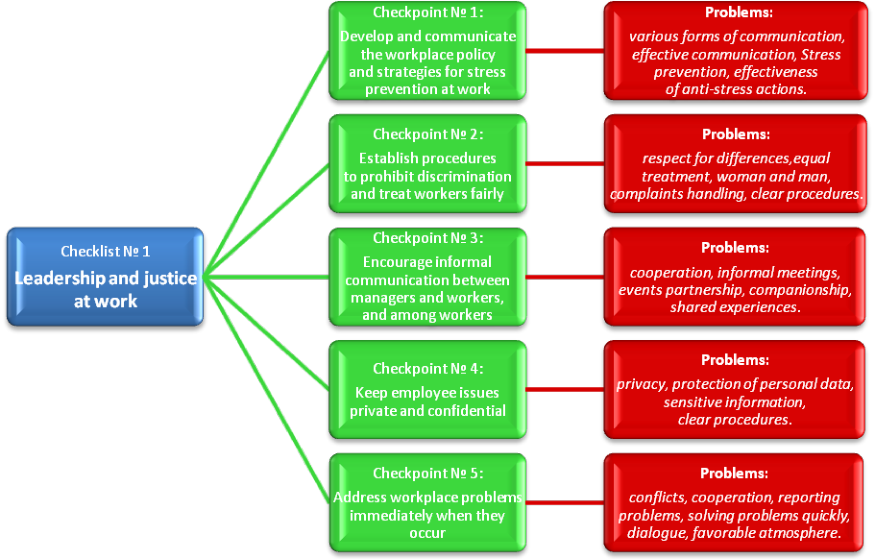
The authors of the report also emphasize the importance and meaning of post-control meetings – discussions about the choices made in checklist (YES/NO/PRIORITY) is a excellent way for sharing own opinions, remarks and also point out the organizational area of work that are correct and positively received by workers. The scope of content of problems covered in the checklist (Checklist No.1) can be presented with a scheme:
Figure 2. Checklist No.1: Leadership and justice at work (based on ILO, 2012)
Checklists proposed by the ILO are very detailed – the covered issues are explained in different contexts, overall they include pointers what to do next, many problems are illustrated. This instrument cannot require expertise knowledge – it should enable the employer to implement procedures or a group of company's workers (ex. work safety service) – being workers they know best the characteristics of their working environment. Carrying out the analysis of occupational risk in the aspect of dangerous stress causing factors it is good to cooperate with the ones it affects, the workers themselves. Practically in the past years it turned out that in workplaces in highly developed countries benefit from participatory ergonomics (Kucharska, 2011), which with the workers participating in forming their working environment enables the connection of continuous optimization of working conditions alongside with increasing efficiency.
Problems identified – what next?
Stress in a workplace is strictly connected with working conditions and the way work is organized. Preventing stress in a workplace should be based on clear policy and a strategy to assure worthy work. It is significant that these goals are clear to all workers and managers because a common effort is essential to continuously better working conditions and the way it is organized. In the report Stress Prevention at Work Checkpoints it is emphasized that a close cooperation between the board and workers is required on a regular basis.
Preventing stress should be a part of occupational safety and a health managing system at a workplace. Currently it is acknowledged that the participatory approach – participation of managers, directors, workers and their organizations – is the best method for stress reduction in a workplace. This stress involves many factors – work schedule, work methods, working environment, balance between professional and private life and others. Such numerous and differentiated factors require a multi-aspect intervention, thus the need for participatory approach.
Solutions regarding workers' health protection against exposure to psychosocial risks in working environment were developed in developed countries. W Poland this area of prevention action is still marginal, and this is a consequence of relatively liberal regulations in this area, no guidelines for realization such programs, no sufficient qualifications for conducting such actions, and also because of no knowledge among the managerial staff in companies regarding the relation between exposure to psychosocial factors in a workplace and efficiency.
A systemic approach to the issue of safety which participation of both workers and managerial staff is a part of is a trusted way of creating a culture of safety and including the matter of safe work in everyday practice (Jasiulewicz- Kaczmarek and Drożyner, 2011). It is not easy but possible. It requires however effort and an individual approach as well as cooperation with the companies' workers. In this context one must recognize that limiting psychosocial risk and promotion of well-being in a workplace is in the area of interest in macroergonomics. Man and his sense of well-being are supreme, and at the same time the engine for civilization development (Złowodzki, 2003).
Unfortunately, health is rarely viewed as a main area of interest in business. However workers' health in a great manner influences the financial state of a company and next the company's development. While the managerial staff is interested mainly in the influence of workers' state of being on the company's business efficiency the workers are interested in the managerial and and working processes that influence their health. Both aspects must be considered parallel. It is worth noticing that managing psychosocial risk a secure support from the top managerial staff and convincing that strategical management of psychosocial risks, so showing the health and business benefits, both in the context of saving costs as well as value added seem to be most important. This can be illustrated in a perfect way with the example of flexible working hours, possibility of working at home, actions eliminating discrimination and mobbing behavior – these actions have a direct influence on the workplace atmosphere satisfying both workers and the managerial staff (Pęciłło, 2011; Misztal and Butlewski, 2012).
CONCLUSION
Civilization generates many problems related with human work that cannot be solved by one branch of expertise treating issues in a fragmentary way only from one point of view. A synthetic knowledge concerning work, which ergonomic is (Stachowski, 2003), allows solving these dilemmas by connecting problematics of many fields, ex. physiology, psychology, technical sciences, economics. Organizational ergonomics concentrates on issues like systems optimization called macroergonomics (Pacholski and Jasiak, 2011). The most important issues here concern communication in human resource management, workplace design, organizational culture and so on. Assuming that the goal of ergonomics is to develop organizational and material framework for ensuring well-being of man kind – both physical and mental, the macroergonomic aspects will embrace even more areas concerning management, organizing work time, relation on the edge of axiology, sociology, psychology and pedagogy.
REFERENCES
Butlewski, M., Tytyk, E. (2012), “The assessment criteria of the ergonomic quality of anthropotechnical mega-systems”; in: Advances in Social and Organizational Factors, Edited by Peter Vink, CRC Press, Taylor and Francis Group, Boca Raton, London, New York. pp. 298-306. Chen, M., Cunradi, C. (2008), “Job stress, burnout and substance use among urban transit operators: The potential mediating
role of coping behavior”, Work & Stress., 22 (4), pp. 327-340. Cox, T., Griffiths, A. (2005), “The nature and measurement of work-related stress: theory and practice”, in: J.R. Wilson and N. Corlett (Ed.), Evaluation of Human Work (3rd ed.). London: CRS Press. Cox, T., Griffiths, A. i Rial-Gonzalez, E. (2000), “Research on work related stress”. Luxembourg: Office for Official
Publications of the European Communities. EU-OSHA (2007), Expert forecast on emerging psychosocial risks related to occupational safety and health. Luxembourg: Office for Official Publications of the European Communities. Floderus, B., Hagman, M., Aronsson, G., Marklund, S., Wikman, A. (2009), “Work status, work hours and health in women
with and without children”. Occupational & Environmental Medicine, 66, pp. 704-710. ILO (1986), “Psychosocial factors at work: Recognition and control” (Vol. 56). Geneva International Labour Office. Geneva. ILO (2010), “Ergonomic checkpoints: Practical and easy-to-implement solutions for improving safety, health and working conditions”. International Labour Office, Geneva. ILO (2012), “Stress prevention at work checkpoints: Practical improvements for stress prevention in the workplace”.
International Labour Office, Geneva. IMP (2013), Profilactic Program for psychosocial risks, Nofer Institute for Occupational Medicine in Łódź. Website: http://programyzdrowotne.pl; Jasiulewicz-Kaczmarek, M., Drożyner, P. (2011), “Preventive and Pro-Active Ergonomics Influence on Maintenance
zawodowych. Przewodnik dla specjalistów BHP, PIP, PIS, pracowników i pracodawców”, Instytut Medycyny Pracy im. J. Nofera, Łódź. Misztal, A., Butlewski, M. (2012), „Life improvement at work”, Publishing House of Poznan University of Technology, Institute of Management Engineering. Poznan. NIOSH (2002), “The changing organization of work and the safety and health of working people: Knowledge gaps and
research directions”. NIOSH (Vol. 2002-116): DHHS (NIOSH). Pacholski, L., Jasiak, A. (2011), „Makroergonomia”, Poznan University of Technology Institute of Management Engineering. Poznan. Pęciłło, M. (2011), „Occupational safety and health management and corporate social responsibility in the light of SA and
ISO standard””, in: Bezpieczeństwo pracy. Nauka i praktyka, 3/2011, Wydawnictwo CIOP-PIB, Warszawa, pp.19-21. Stachowski, W. (2003), “Organisational methods in teaching ergonomics. Work quality conditions in researches and education in ergonomics and labour protection”. Poznan University of Technology Institute of Management Engineering.Website: http://www.zie.pg.gda.pl/~wst/arty/z5pl.pdf Tucker, J. S., Sinclair, R. R., Mohr, C. D., Adler, A. B., Thomas, J. L., Salvi, A. D. (2009), “Stress and counterproductive
work behavior: Multiple relationships between demands, control, and soldier indiscipline over time”. Journal of Occupational Health Psychology,14 (3), pp. 257-271. Wang, J., Lesage, A., Schmitz, N., Drapeau, A. (2008), “The relationship between work stress and mental disorders in men and women: Findings from a population-based study”. Journal of Epidemiology & Community Health, 62(1), pp. 42-47.
Warchał, M. (2010), “Ocena ryzyka zawodowego – czynniki psychospołeczne”. Państwowa Inspekcja Pracy – Główny Inspektorat Pracy, Departament Prewencji i Promocji. Warszawa. WHO (2008), “PRIMA-EF: Guidance on the European Framework for Psychosocial Risk Management: A Resource for
Employers and Worker Representatives”. Institute of Work, Health & Organisations, University of Nottingham. WHO (2010), “Health Impact of Psychosocial Hazards at Work: An Overview”. Institute of Work, Health & Organisations, University of Nottingham. Widerszal-Bazyl, M. (2009), „Concept of psychosocial risk at work”, in: Bezpieczeństwo pracy. Nauka i praktyka, nr 6,
CIOP–PIB, Warszawa, pp. 6-8. Zawieska, W.,M. (Ed.). (2007), „Ryzyko zawodowe. Metodyczne podstawy oceny”. CIOP -PIB, Warszawa. Złowodzki, M. (2003), „Propedeutyka ergonomii z elementami antropometrii”, w: Zarządzanie Bezpieczeństwem i Higieną pracy. Tom III. Aspekty ludzkie w zarządzaniu bezpieczeństwem i higieną pracy, Tabor, Pieczonka (Ed.), Centrum szkolenia i Organizacji Systemów Jakości Politechniki Krakowskiej, Kraków, ss. 133-171. http://www.psychostreswpracy.pl/
LISTED IN THE AHFE DIGITAL BOOKSTORE CATALOGUE
Explore the complete digital volume
Advances in Social and Organizational Factors
Read this individual research paper free through the original publisher, or explore the full digital proceedings book.
ISBN 978-1-4951-2102-9
Explore this ISBN in the AHFE Bookstore ↗Listed in the July 2026 bookstore catalogue; search by ISBN to confirm current availability · Digital book purchase optional