Simon Reay Atkinson, Sven Carlsson, Liaquat Hossain (2020). From ICT-Machine Determinism to a Socio-ICT Organic Design of Knowledge Sharing Systems. In: Advances in Social and Organizational Factors. AHFE Open Access, vol. 9. https://doi.org/10.54941/ahfe100330
The transfer of knowledge between individuals, groups, practices, communities or systems is regarded as Knowledge Sharing (KS) in organizations. Research suggests that understanding social interaction between different interest groups within an organization is a critical component of effective KS. The relevance of social interaction approach has been debated in areas such as systems design, organizational process redesign, process improvement and artificial intelligence. Organizational science literature also highlights that information and communications technology (ICT) network structures provide insight about the communication patterns of individuals working in an organization. Therefore, an understanding of the ICT networks at play needs to be viewed as an essential element of the design of KS systems in organizations. We posit Mechorganics in terms of ‘the synergistic combination of civil mechanical systems engineering, social network dynamics, ICT and the management of interconnected knowledge, information (and data) infrastructures in the designing and composing of adaptive (resilient and sustainable) organizations’. It is further suggested that organization structures have both a formal and informal structure that may be considered to be a coalition of individuals, with implications for methods of communication and collective decision-making and taking, In this paper, we provide a background to organization as a network of people.
The transfer of knowledge between individuals, groups, communities or systems is regarded as Knowledge Sharing (KS) in organizations (Davenport and Prusak, 1998; Hansen and Von, 2001; Alavi and Leidner, 2001). Research suggests that understanding social interaction between different interest groups within an organization is a critical component of effective KS (Pickering and King, 1995; Ivari and Linger, 1999; Tuomi, 1999). The relevance of a social interaction approach has been debated in areas such as systems design, organizational process redesign, process improvement and artificial intelligence per se (Wigand, 1988; Nonaka and Takeuchi, 1995; Pan and Scarbrough, 1999; Davenport, 1999, 2000; Earl, 2001). The social approach for designing KS is based on the argument that communication between individuals, teams, groups, and communities is critical to the development and sustainability of a knowledge-creating organization (Argyris and Schon, 1978; Kogut and Zander, 1992; Watson, 1999; Levine, 2001). It is also suggested in studies that an appropriate structure of KS is essential for facilitating effective sharing in organizations (Davenport et al., 1998). Specifically, we suggest that KS is dependent on the structure of the social communication network at play in an organization (D’Eredita, Hossain, and Wigand, 2002; Hossain, D’Eredita, and Wigand, 2002).
We posit Mechorganics in terms of ‘the synergistic combination of civil mechanical systems engineering, social network dynamics, ICT and the management of interconnected knowledge, information (and data) infrastructures in the designing and composing of adaptive (resilient and sustainable) organizations’ (Hossain, et al. 2013). Mintzberg (1979) recognizes that organization structures have both a formal and informal structure. Meanwhile, organizational science literature suggests that every organization is a network of people (Cyert and March, 1963; Mueller, 1986; Charan, 1991; Nohria and Eccles, 1992; and Stacey, 1996). Consequently, an analysis of the ICT network can help us in understanding the information exchange, patterns, coalition and power of the individual members in an organization (Wigand, 1988; Bonacich and Bienenstock, 2000). In the legitimate network, interactions or links are either (i) formally and intentionally established by the powerful members of the organization or (ii) established well- understood, implicit guiding principles, which is accepted by the members of the organization (Stacey, 1996). On the other hand, the shadow network consists of links that are spontaneously and informally established by the individuals among themselves during the interaction process in the legitimate system (Stacey, 1996).
Organizational science literature also highlights that communication network structure provides insight about the communication patterns of individuals working in an organization (Wigand, 1988). An understanding of the communication network at play needs to be viewed as an essential part of the design of KS systems in organizations. There is also a tension in the organizational structure, strategy and process literature when applied to KS in organizations. Studies suggest that organizations should not start with structure but with a task-and-person based foundation that incorporates both authority and responsibility (Drucker, 1974). Consequently, the design of the KS structure should be based on the study of the existing communication structure. Communication networks may suggest how individuals, groups, communities or systems interact in an organization and can be used as a basis for KS process of an organization (Davenport and Prusak, 1998; Hansen and Von, 2001; Alavi and Leidner, 2001).
It is further suggested by Mintzberg (1979) that organization structure have both a formal and informal structure. Formal organizational structure is usually represented by the organization chart and widely accessible by the internal and external members. It is also suggested in the organizational science literature that every organization is a network of people (Cyert and March, 1963; Mueller, 1986; Charan, 1991; Nohria and Eccles, 1992; and Stacey, 1996). An analysis of the communication network can help us in understanding the information exchange, patterns, coalition and power of the individual members in an organization (Wigand, 1988; Bonacich and Bienenstock, 2000). The distinction between formal and informal organization structure can be drawn by looking at the types of interactions, or links, between individuals or agents in an organization. For example, the legitimate network refers to formal structure and the shadow network refers to the informal structure of an organization (Stacey, 1996). In the legitimate network, interactions or links are either (i) formally and intentionally established by the powerful members of the organization or (ii) established well-understood, implicit guiding principles, which is accepted by the members of the organization (Stacey, 1996). On the other hand, the shadow network consists of links that are spontaneously and informally established by the individuals among themselves during the interaction process in the legitimate system (Stacey, 1996). It is also evident that the shadow system does not coincide with the rigid boundaries of the legitimate system. Shadow systems are classified to have porous boundaries and are considered to be the principal route for interaction between individual agents in an organization or in an inter-organizational network (Stacey, 1996). We argue that the KS system needs to be designed by conducting a thorough requirement analysis of both the legitimate and shadow network (see D’Eredita, Hossain, and Wigand, 2002). This is important as the legitimate network may provide a normative view of how individuals should share knowledge while the communication network analysis of shadow network will assist KS system designers in understanding the descriptive view of individual agents’ communication patterns. This information could later be used to directly address issues of structural holes that may or may not exist in an organization or in a department (Burt, 1992).
In this paper, we first provide a background to organization as a network of people. A person or a group of people united for some purpose is considered to be a form of organization (Cyert and March, 1963; Arrow, 1974). Cyert and March (1963) suggest that organization needs to be viewed as a form of coalition. That is, an organization is considered to be a coalition of individuals, some of them organized into sub-coalitions. Arrow (1974) highlights that formal organizations, firms, labor unions, universities, or government, are not the only types of entities that represent the term ‘organization’. For example, the market system has elaborated methods for communication and collective decision-making and can be interpreted as an organization (Arrow, 1974). We first highlight that successful KS initiatives require (1) attention to communication patterns of individuals or groups working in different divisions of an organization and (2) the development of ICT systems that support both strong and weak ties between participants. In particular, we provide a distinction between different network structures as they relate to the concept of structural holes. We also highlight how types of network structures effect sharing of explicit and tacit knowledge. Additionally, strong and weak tie theories are applied to develop a framework for potential ICT-based initiatives aimed at addressing structural holes of communication. A set of propositions is proposed with their implication for designing KS systems in organizations.
DESIGNING KNOWLEDGE SHARING SYSTEMS KS systems design evolved from the traditional structured systems design literature. Scientists, engineers, technicians, and programmers initially performed the design of technology-based systems in the 1950s and 1960s (Yourdon, 1989; Kling et. al. 1998). Kling highlights that design flaws were the major impeding factor for ensuring the optimal use of computer-based information systems in organizations (Kling, 1991; Kling, 1993; Kling and Jewett, 1994; Kling et. al., 1998). The design of computer systems for supporting collaborative work requires careful attention in five key areas--planning, analysis, design, implementation and support (Avison and Shah, 1997; Whitten and Bentley, 1998). The importance of careful examination of these phases for ensuring the success of systems implementation has been addressed in organizational design literature as well (see Schon, 1967; Mintzberg, 1979; Mintzberg, 1989; and Mintzberg, 1994). Previous studies suggest that systems design is essentially a social process (see Kling, 1991; Kling, 1993; Kling and Jewett, 1994; Kling et. al. 1998). The social role of systems analyst is one of the critical success factors for the successful design and implementation of the system (see Forsythe, 1992, 1994; Suchman, 1996; Davenport, 1996). This social role is essential for the collection of relevant information from different disciplines and people during the requirements analysis phase of the systems development (Kling et. al. 1998). Hence, the design of technology-based products has to be in line with social and organizational dynamics (Kling et. al 1998). In fact, there is a danger of systems failure or not receiving high rate of user acceptance if systems design issues are considered separately from the organizational issues. This is a common problem for the implementation of multi-module software systems such as enterprise resource planning (Kling, et al. 1996).
A study by Wyatt (1997) suggests that the social systems design approach by Mauro Mauro Design Inc. improved the performance of the New York Stock Exchange trading systems. The systems analyst from Mauro Mauro Design Inc observed the traders at the Stock Exchange for six moths prior to start coding new software together with 30 iterations in testing their new systems (see Kling et. al., 1998). Kling and Star (1998) highlights that analyses that cover the complexity of social organization and the technical state of the art is critical to the design or use of human- centered computing. This analysis can provide the systems designers with insights both the technological characteristics of a computerized system and the social arrangements under which the system will be used (Kling, 1987). For example, it is highlighted in studies that understanding the distinction between the legitimate and shadow network structure is an important first step towards the design of the KS in organizations (D’Eredita, Hossain, and Wigand, 2002). Understanding the shadow network structure requires a communication network analysis so that the patterns of exchange between agents in a network can be understood. It is highlighted in previous studies that a successful knowledge creation process requires an established communication network (Hossain, D’Eredita, and Wigand, 2002). Communications network structure deals with individuals communication pattern in an organization or in a unit of work. KS design can be viewed as a social process because it requires interaction between all parties moving through developmental phases together in order to produce a system that is efficient and effective. It creates ownership in a system, which alleviates many of the problems traditionally associated with implementing a new system, resistance to change, resistance to imposed authority, training, etc. This serves as a basis for the development of a conceptual model of KS in organizations (Armbrecth, et. al., 2001).
Nonaka (1994) and Brown and Duguid (1998) also support that knowledge creation is essentially a social process. It is suggested in case studies such as Nucor Steel (Gupta and Govindarajan, 2000) and Buckman Labrotaries (Pan and Scarbrough, 1999) that understanding the interaction of individuals, groups, teams and communities in knowledge networks leads to a successful KS in organizations. Thus, it can be seen that there is a growing interest among social scientists to view KS as socially constructed and embedded in social networks and communities of practice (Pan and Scarbrough, 1999; Kogut and Zander, 1992). These findings clearly highlight that the dichotomy of KS systems design can be seen from three perspectives—technological determinism, systems rationalism, and socio design. In the following section, we provide a brief overview of the systems design literature as it relates to the design of KS in organization.
TECHNO DETERMINISM, SYSTEMS RATIONALISM AND SOCIO DESIGN Systems design literature can be divided into three distinct categories: ICT-machine determinism, systems rationalism and socio-organic design.
Here, ICT-machine determinism refers to the view that treats information and communication technologies as information processing systems whose technical characteristics cause specific social changes when they are adopted and used (Kling et. al. 1998). Kling et al (1998) further argued that this paradigm is applicable and useful when there is a high degree of control and short time frames. The value of technological deterministic approach to systems design is limited to a dynamic and complex situation. For example, technology for supporting KS is the most common form of KS systems existing in organizations. It is seen in studies that the introduction of KS has resulted in substantial bottom-line impact by companies such as Texas Instrument ($1.5 billion over 3 years), Chevron ($2 billion annually), and BP ($30 million in the first year) (Payne and Elliott, 1997; O’Dell et al. 2000). As a result, technology for supporting KS activities in organizations is becoming critical in search of near-term efficiency, productivity, and service quality improvements through knowledge reuse (Smith and Farquhar, 2000). However, this approach cannot adequately account for the interactions between technologies, people who design, implement, and use them, and the social and organizational contexts in which the technologies and people are embedded (Kling et. al. 1998).
Systems rationalism is seen as a useful starting point to develop an understanding of the value of technologies in organizational practices, social activities and work life per se (Kling, 1980; Kling et. al. 1998). Conceptualization of technologies as rule-bound and carefully structured process and then generalization of these characteristics to people, groups, and organizations is central to this approach. It further provides a simplification of the nature of technologies, the nature of people and their relationships, and the way in which people interact with technologies (Kling et. al. 1998). The backdrop of this approach is the simplification that tends to emphasize formalities by representing only the formal defined tasks and ignoring the process involves in performing the actual tasks (Kling et. al. 1998). This approach may be primarily useful in designing and implementing systems that have a narrow set of well-understood organizational problems and a high level of consensus about problems and solutions by the participants. For example, ERP automates the tasks involved in performing a business process—such as order fulfillment, which involves taking an order from a customer, shipping it and billing for it (Koch and Slater, 1999). With the use of ERP, a customer service representative can take an order from a customer about information necessary to complete the order (e.g. the customer's credit rating and order history, the company's inventory levels and the shipping dock's trucking schedule). Other employees in the company with a similar technology platform may access this through a single database that holds the customer's new order. When one department finishes with the order it is automatically routed via the ERP system to the next department; so providing easy access to client’s information.
Additionally, the changing technology landscape offers increasing integration across systems, knowledge bases and self-service for knowledge workers. It also provides opportunity to embed increasing amounts of knowledge in the systems themselves. These KS mechorganics can ensure that important background information is identified and captured. Once organizations recognize knowledge as a critical factor in their success, they can apply the planning, analysis, and process techniques needed to manage this valuable enterprise resource (Clark, 2001). For example, customer relationship management or CRM deals with collecting and sharing knowledge about the customer that flows into the organization via a wide variety of channels and personal and electronic exchanges. But achieving this seamless continuum of sales and support channels presents a significant systems integration challenge. Call center systems and electronic commerce servers must be linked to a company's enterprise resource planning (ERP) backbone, allowing sharing of information on a global scale and ensuring a professional and coordinated approach to dealing with each customer (Phillips, 1999). Sharing information is what transforms an ERP system into the backbone of a supply chain, and not just the backbone for a company. ERP installations need to provide a common and consistent foundation for capturing information internally. As most strategically significant information comes from external sources, ERP has to be well integrated into the wider inter-enterprise infrastructure (Phillips, 1999; Clark, 2001). One of the challenges of managing an ERP implementation is understanding that not all entities within the organization will instinctively see the value of knowledge capture and management. Consequently, a social design perspective of the systems must be well integrated for ensuing the optimal use of ERP in organizations.
Socio-organic design or social design refers to joint design of both the technological characteristics of an organisational system and the social arrangements under which it will be used (Kling, 1987; Bijker, 1997; Bijker and Law, 1992). Bijker (1997) argued that the development of technological systems should be viewed as a social process, not an autonomous occurrence where relevant social groups will be the carriers of that process. Kling et al (1998) further highlights that these social choices are considered to be an integral part of computerization, even though they are not formally decided or completely within the control of any one person. For example, company A is adopting portable computers so that they can improve the flexibility of people’s work situations and relationships. However, company A still insists that their employees report to work daily during the regular working hours. As a result, employees of company A have very little flexibility to work from a remote location even though they have access to the technology infrastructure provided by the company. In contrast, the underlying operational philosophy of company B is to allow its employees to work from remote location so that it provides maximum flexibility and optimal use of portable computing. This example illustrate that it is not only the technology that guide successful operation, but the guiding principles or social design of work practices that organizations decides to pursue.
Managers need to address the cultural side of change when implementing software systems such as ERP as it increases fear among managers that the availability of company wide information may challenge their authority (Wah, 2000). A study by Bock (1998) suggests that the biggest impediment to knowledge transfer is corporate culture and the biggest difficulty in managing KS is changing people’s behavior. Thus organizations need IT infrastructure to make progress or to provide the facilitation of knowledge networks, but the use of ICT for managing KS activities should be supported by introducing proper organizational processes, people and content (Pan and Scarbrough, 1999; Smith and Farquhar, 2000). There is also a growing interest in considering a social network approach to understand the KS design in organizations (Hossain, D’Eredita and Wigand, 2002). Social network analysis refers to the method of analyzing social structures and relational aspects of structures that exist in a communication network (Scott, 2000). It is highlighted in the previous section that communication network structure can be viewed as a legitimate or shadow network. That is, an organization’s structure may suggest how the legitimate communications network should work and the shadow network structure may suggests how the communication flow occurs at an organization. Therefore, social network analysis is continuing to play a significant role in developing a deeper understanding of the actual process of communication flow between individuals (Charan, 1991). Additionally, one can conclude from all of the above that social network analysis has the potential to play a significant role in the design and implementation of knowledge management systems (Cross and Prusak, 2002).
HSI experts work within the framework, consisting of processes and methodologies, provided by systems engineering to ensure successful human systems integration. Methodologies include the familiar, carefully structured approach to meeting the functional and nonfunctional requirements. The systems engineering team relies on each branch to assist in analyzing customer requirements (see Figure 1). Research has shown that HSI aspects and components remained, until today, with no established methodologies or integration tools to link various human aspects to systems engineering models due to two reasons (Meilich, 2008): lack of relevant taxonomy linkage to SE needs and poor domain languages.
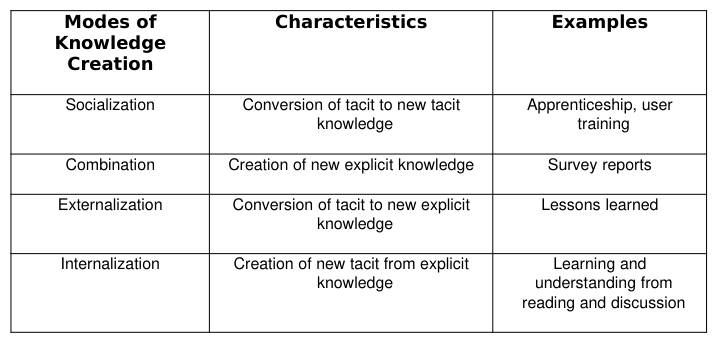
BUILDING INFO-CULTURE FOR KNOWLEDGE SHARING Socialization, externalization, internalization, and combination can be seen as a mechorganic creation of knowledge in organizations (Nonoka, 1994). Here, the socialization in organization refers to the conversion of tacit knowledge to new tacit knowledge through social interaction and shared experiences (Alavi and Leidner, 2001). The combination mode deals with the creation of new explicit knowledge by merging, categorizing, reclassifying and synthesizing existing explicit knowledge. Both the externalization and internalization mode refers to interactions and conversation between tacit and explicit knowledge where externalization deals with the conversion of tacit knowledge to new explicit knowledge and internalization deals with the creation of new tacit knowledge from explicit knowledge. Table 1 provides an overview of four modes of knowledge creation.
Table 1. An Overview of Four Modes of Knowledge Creation Characteristics Examples Modes of Knowledge
It can be seen from table 1 that knowledge sharing and creation is dependent on the modes of knowledge creation. Here, socialization is seen as an important aspect for the conversion of tacit knowledge into new tacit knowledge. For example, the development of an “infoculture” is the first essential step for creating knowledge-based organizations (Gupta and Govindarajan, 2000). The study of Nucor Steel highlights that three essential elements— superior human capital, high-powered incentives and a high degree of empowerment guide the knowledge creation process (see Gupta and Govindarajan, 2000). Nucor Steel used a group-based incentive mechanism to encourage people to start sharing knowledge that in fact lead to the development of an inforcultute in their organization. This mechorganic incentive was introduced at all levels of the organization so that Nucor could only reward group-based performance.
Social network analysis is increasingly used to develop a better understanding of the shadow system network that is considered to be a true representation of the communication patterns that exist in an organization (D’Eredita, Hossain and Wigand, 2002). Social networks can be defined as an individual’s relations and contacts with others (Burt 1992; BarNir and Smith, 2002). Social network analysis can be seen as a method that allows us to analyze social structures and relational aspects of the structures that exists in a communication network between individuals, teams, groups and communities (Scott, 2000). The argument advanced in this paper is that once the ICT-based KS systems are put into practice or implemented in organization, it becomes a social network. Consequently, the social design of this ICT-based KS should be established through a thorough analysis of both the formal and informal social networks that may exist in an organization. It is argued here that the design of ICT-based KS should be able to accommodate the facilitation of the communication patterns or flow process that exists in a department or in an organization. Therefore, the social dimensions of KS can be described from two perspectives—the first is the role of socialization and community building as a backbone social infrastructure for KS, and the second is the ICT-based KS systems. ICT-based KS systems are also considered as social systems as this KS systems link people as well as machines.
Wellman (1996) suggests that computer supported social networks help sustain strong, intermediate and weak ties which provide information and social support in both a specialized and broad-based relationships. It is also important to note that there are direct and indirect ties exist between agents or the participating agents engaged in KS. It is clear that these ties are embedded in both the legitimate and shadow network of an organization. This, when combined with what is known about computer supported social networks mentioned above, may provide valuable insights for the effective design of ICT-based knowledge management systems. This is discussed further in the following two sections.
KNOWLEDGE SHARING THROUGH STRENGHTS OF TIES It is indicated earlier that organizations can be viewed as a network of people. In particular, we discussed two types of networks—legitimate and shadow and its implications for the design and sustainability of KS provided. These networks consist of individuals working in an organization and can be seen as redundant or nonredundant. A structural hole is referred to as a relationship of nonredundancy between two or more contacts (Burt, 1992).
Nonredundant contact between individuals can be seen as disconnected either directly or indirectly. Here, the disconnected direct nonredundant contacts suggest that there is no direct contact with one another and the indirect contacts suggest that one has contacts that exclude the others. Burt (1992) further suggests that the two contacts provide network benefits as a result of the structural holes. Here, we discuss the concept of structural holes together with the strong and weak ties metaphor as it relates to KS systems design in organizations. Burt (1992) suggests that two criterion—cohesion and structural equivalence can be used as an indicator for detecting structural holes. Cohesion criterion refers to direct connection between the contacts. For example, two contacts A and B are redundant to the extent that a strong tie connects both A and B. Here, this strong tie between contacts A and B indicates the absence of a structural hole (e.g. the relationship between father and son, or people who frequently connects with each other for social occasions). However, structural equivalence concerns indirect connection by mutual contact. For example, both A and B are structurally equivalent to the extent if they both have same contacts.
Rate of Return from Players Investment
Structural Holes in Player’s Network Few --- Entrepreneurial Opportunities --- Many
Rate of Return from Players Investment
Structural Holes in Player’s Network Few --- Entrepreneurial Opportunities --- Many
Figure 1 Relationship between Rate of Return and Structural Holes (Burt, 1992) This nature of the contacts between the executives and persons in their network is referred to as strength of ties (Granovetter, 1973). Intense, emotion-laden, and reciprocal relationships that require time and energy to create and maintain can be a reflection of strong ties. Weak ties on the other hand, reflect loose networks and are best explained by the concept of a bridge (Granovetter 1973). The strength of the tie has traditionally been viewed as bearing on the overall amount and content of information associated with the contact. It is however suggested in previous studies that novel and nonredundant information is available through weak ties more than through strong ties (Granovetter 1973; Granovetter, 1974). Strong ties can be seen as advantageous because they allow for quick flow of information and social support. Furthermore, strong ties are reliable, easily available, and important when dealing with conflicts, crises, and uncertainty (Granovetter 1982; Krackhardt 1992; Nelson 1989). Granovetter's (1973) theory of strong and weak ties highlights the importance of weak ties in providing information. A weak tie is defined as a “casual acquaintance” and a strong tie is a formal relationship defined by a high-shared knowledge base and multiple interactions (Granovetter, 1973, 1974; Hansen, 1991). Burt (1992) further suggests that weak ties provide a useful mechanism for understanding the strength of structural holes in a communications network. We believe that both these types of ties offer unique opportunities for developing a theoretical base for the design of KS systems in organizations from both a theoretical and an applied perspective.
We considers that there are two predominant, coupled systems at play within contemporary organizations, one to do with collaborative social influence (CSI) in which the social drives the IT (S-IT) and the other to do with coordination, rule and control (CRC) in which the IT drives the social (IT-S) . These two systems have different and at times conflicting or antithetical characteristics, one to do with weaker social signals and influencing / responding, over time (CSI / S-IT); the other relating to stronger communication signals necessary for controlling / reacting, in time (CRC / IT-S) . The two systems also have different signatures, where CRC / IT-S systems are considered as strong-signal systems, in which: ‘System control (through switching) of Information, Data and Communication are the key variables’, (Hence also ICT) after, Castells (1996) and Sokol (2003) and weak-signal CSI / S-IT systems, in which: ‘System Influence (through shared awareness) of Information and abstracted social Knowledge are the key variables’, after Castells (1996) and Bunge (2010).
Studies suggest that weak relationships such as casual acquaintances, do not take as much time and effort to cultivate as friendships or community of practice (Hossain, D’Eredita and Wigand, 2002; D’Eredita, Hossain and Wigand, 2002). Thus, it is easy to have more acquaintances than friends. A larger number of acquaintances can provide access to information about more out-groups. Most importantly, acquaintances offer the potential for (1) a relationship that takes limited time and effort and (2) offers the most potential for non-redundant and, thus, valuable information and knowledge. Specifically, Burt (1992) proposed a direct relationship between the number of structural holes and the rate of return on player’s investment in terms of time and energy and social capital (Figure 3). Here, the shape of the curve is to indicate the general relationship between structural holes and human capital as opposed to any validated and specific function.
SUPPORTING KNOWLEDGE SHARING THROUGH SOCIAL
CAPITAL We propose above that the value of social interaction and social exchanges needs to be taken into consideration by a designer of an ICT-based KS system. We further propose here that the design of an effective ICT-based KS system should allow for an economic use of time and energy in the growth of social capital.
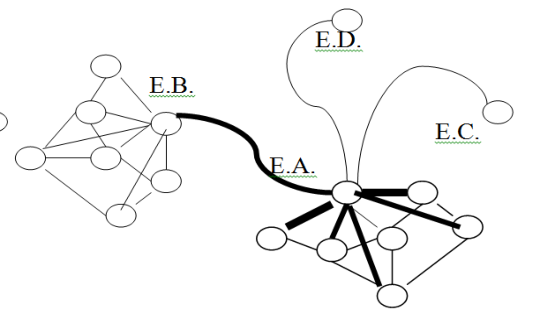
E. A.
Figure 2. Example of Social Network with proximal, strong ties (bold lines) To discuss the specific effects of an ICT-based KS system on social capital we will illustrate how one can increase capital by acting on the following eight propositions:
Figure available in the original PDF paper.
1. Maximizing weak ties in one’s network increases the potential for innovation and/or market penetration (Granovetter, 1973).
2. ICT-based KS systems are an effective means for establishing and maintaining weak ties (Wellman, 1996).
3. Maximizing the number of structural holes in one’s network increases the potential for innovation and/or penetration (Burt, 1992).
4. A finite number of strong ties can be maintained (Burt, 1992).
5. Minimizing the number of strong ties allows for more allocation of resources to the application and creation of new knowledge.
Assume “Entrepreneur A” (E.A.) has lived and worked in city “Home” for a number of years. During this time, E.A. has established a number of strong ties due numerous in-person exchanges (Figure 2.) E.A. soon realizes that both new ideas and/or potential markets for his product have become too redundant and that a larger network is required for further growth. E.A. decides to explore some potential new contacts via various forms of IT (Figure 3). After establishing a number of loose contacts, E.A. decides to strategically strengthen ties with those who offer the greatest number of resources. The inherent communication barriers associated with numerous forms of IT (for further discussion see Hossain, D’Eredita and Wigand, 2002) motivate E.A. to invest time and energy into more face-to-face interactions with one of the selected new contacts. E.A. spends weeks (or, perhaps, longer) on-site with new contact E.B. who resides in Home2 and begins to strengthen their tie. E.A. also spends times with some of E.B.’s contacts and establishes a number of new relationships. During this time, E.A. maintains his ties back home by using IT channels. The maintenance of these ties requires (1) relatively little effort given the established shared knowledge base and (2) a strategic approach as to which contacts from Home make the most “economic” sense to maintain. E.A. maintains other new contacts by using the same methods used while at home. E.A. takes special care to maintain a weak tie, or no tie, between E.B. and other new contacts (Figure 4). This process continues until E.A. reaches a maximum number of strong ties that can be maintained without having to “fill” in, or bridge, important structural holes due to a limited number of strong ties that can be maintained. E.A. eventually shows a significant amount of growth in social capital (see figure 3 below) and invests more time in managing the flow of knowledge and information rather than actively searching for more capital (Figure 6).
Figure 3. (LHS) Example of Social Network with proximal, strong ties, and new “distal”, weak ties Figure 4. (RHS) Example of Social Network with proximal, strong ties, distal weak ties, and a new distal strong tie
Figure available in the original PDF paper.
Figure 5. (LHS) Example of Social Network with proximal strong ties, new distal weak ties and strong ties Figure 6. (RHS) Example of Social Network with the same number of strong ties as shown in Figure 4, but with a significant increase in the amount of social capital.
Once the required shared knowledge base is established, E.A decides to move to Home3 to establish a stronger tie with E.C. E.A. maintains strong ties with Home and E.B. through efficient use of IT. Most importantly, E.A. maintains the structural holes between Home, E.B., E.C., and E.D. (Figure 5). One can better understand the demands of a system designer by combining an understanding of cognitive demands and limitations with the social behaviors and needs of end users like E.A. That is, for example, E.A. potentially realizes his cognitive capacity with the development and maintenance of 6 strong ties and the knowledge and information flow resulting from the increase in social capital. With every developed strong tie the demand imposed by the maintenance and utilization of a growing—and, thus, more complex—social network increases. The ultimate requirement of an ICT-based KS system becomes one of minimizing cognitive demand in the maximization and utilization of social capital. From this perspective, the ICT-based KS system complements the individual and increases the potential for innovation and knowledge creation.
CONCLUSIONS
We provided a discussion of the systems design approaches from a ICT-machine determinism, systems rationalism and socio-organic (suggested also as mechorganic) design in this paper. It is concluded that complex systems design such as knowledge sharing systems requires careful attention to the social context for which is systems is developed. Therefore, we suggest here that the designer of KS systems is required to develop the systems based on observations of the social interaction and social exchange needs of the individuals working in an organization. We further highlight that the design of KS should be based on an understanding of both the legitimate and shadow network structure of an organization. We recommend that social network analysis is a useful methodological paradigm for the purpose of eliciting the communication patterns for understanding the shadow network structure. It is suggested here that structural holes provide network benefits for developing social capital among participating members in knowledge sharing and conclude that strong and weak tie is a useful metaphor for fitting the structural holes. We further proposed number of propositions, which can be used to develop a better understanding about how to effectively and efficient leverage information technology for the development of social capital.
REFERENCES
Alavi, M., & D.E. Leidner. (2001). Knowledge management and knowledge management systems: Conceptual foundations and research issues. MIS Quarterly, 25(1), pp. 107-136. Armbrecth, F. M., and Chapas, R. B. (2001). Knowledge management in research and development. Research Technology
Management, V. 44, No. 4, pp. 28-48. Anderson, J. C., and Narus, J. A. (1984). A model of the distributor’s perspective of distributor--manufacturer working relationships, Journal of Marketing, Vol. 48, pp. 62-74. Anonymous (2000), ERP for the Internet age, Modern Materials Handling, Vol. 55, No. 9, pp. 43-47. Ansoff, H.I. (1975). Managing Strategic Surprise by Response to Weak Signals. California Management Review, Vol. XVIII, No.
2, pp. 21-33. Argyris, C., and Schon, D. (1978). Organizational Learning: A Theory of Action Approach, Reading, MA: Addison Wesley. Arrow, K. (1974). The Limits of Organization, Norton and Company, New York. Avison, D., and Shah, H. (1997). The Information Systems Development Life Cycle, The McGraw-Hill Co. Ltd. BarNir, A., and Smith, K. A. (2202). Interfirm alliances in the small business: The role of social networks, Journal of Small Business Management, Milwaukee, Vol. 40, Issue 3, pp. 219-232. Barney, J. (1991). Firm resources and sustained competitive advantage. Journal of Management, 17, 1, 99-120. Bijker, W. E. (1997). Of Bicycles, Bakelities, and Bulbs: Toward a theory of sociotechnical change, MIT Press. Bijker, W. E., and Law, J. (1992). Shaping technology building society: studies in sociotechnical change (Eds.), MIT Press. Bonacich, P., and Bienenstock, E. J. (2000). Patterns of coalitions in exchange networks: an experimental study, Rationality and
Society, Vol. 12, No. 3, 352-373. Brown, J. S., and Duguid, P. (1998). Organizing knowledge. California Management Review, 40, 3, pp. 90-111. Bunge, M. A. (2000). Ten Modes of Individualism - None of Which Works - And Their Alternatives. Philosophy of the Social Sciences, 30(3), pp. 384-406. Burt, R.S. (1992). Structural Holes: The Social Structure of Competition, Cambridge, Massachusetts: Harvard University Press. Castells, M. (1996). The Information Age. Economy, Society and Culture Volume I The Rise of the Network Society. Oxford:
Blackwell Publishers. Cats-Baril, W., and Thompson, R. (1997). Information Technology and Management, Irwin Group Inc. Charan, R. (1991). ‘How networks reshape organization-for results,’ Harvard Business Review, Sept.-Oct., 12, 479-494. Clark, Linda (2001), “A Stitch in Time,” http://www.intelligententerprise.com/001020/feat3_1.shtml Cole, R. (1998). Introduction. California Management Review, 40, 3, 15-21. Conner, K. R. (1991). A historical comparison of the resource-based theory and five schools of thought within industrial
organization economics: Do we have a new theory of the firm. Journal of Management, 17, 1, pp. 121-154. Cyert, R. M., and March, J. G. (1963). A Behavioral Theory of the Firm, Prentice-Hall Inc., NJ, USA. Davenport, T. H. (1996). Software as socialware. CIO Magazine, April 15, http://www.cio.com/archive/041597_think_content.html Davenport TH. (1999, 2000) The Future of Enterprise System-Enabled Organizations. Information Systems Frontiers August 2000, Volume 2, Issue 2: pp 163-180.
Davenport, T. H., DeLong, D., and Beers, M. (1998). Successful knowledge management projects. California Management Review, 40, 3, 195-208. Davenport, T. H., and Prusak, L. (1998). Working Knowledge: How organizations manage what they know, Boston,
Massachusetts: Harvard Business School Press. D’Eredita, M., Hossain, L., and Wigand, R. T. (2002). The Development and Sustainability of Knowledge Sharing Networks in Organizations. Submitted to Academy of Management Review Special Research Forum on Building Effective Network. Drucker, P. (1974). Management: Tasks, Responsibilities, Practices, Butterworth-Heinemann Ltd. Oxford. Earl, M. (2001). Knowledge management strategies: Toward a taxonomy. Journal of Management Information Systems, 18, 1,
215-233. Forsythe, D. (1992). Blaming the user in medical informatics. Knowledge and Society: The anthropology of science and technology, Vol. 9, pp. 95-111. Forsythe, D. (1994). Engineering knowledge: the construction of knowledge in artificial intelligence. Social studies of science,
Vol. 24, pp. 105-113. Granovetter, M. (1973). The strength of weak ties. American Journal of Sociology, Vol. 78, pp.1360-1380. Granovetter, M. S. (1974). Getting a job: A Study of Contacts and Careers, The University of Chicago Press, Ltd., London. Granovetter, M. S. (1982). The strength of weak ties: A network theory revisited. In: Structure and network analysis, edited by Peter V. Marsden and Nan Lin, Sage Publications, pp. 10540. Grant, R. (1996). Toward a knowledge-based theory of the firm. Strategic Management Journal, 17, Winter, 109-122. Gupta, A., and Govindrajan, V. (2000). Knowledge flows within multinational corporations. Strategic Management Journal, 21,
pp. 473-496. Hensen, M. T. (1999). The Search-Transfer Problem: The Role of Weak Ties in Sharing Knowledge Across Organization Subunits. Administrative Science Quarterly, 44, 1, 82-111. Hansen, M. T., and Von, O. B. (2001). Introducing T-shaped managers: Knowledge management’s net generation. Harvard
Business Review, March, pp. 38-49. Hicks, J. O. (1993). Management Information Systems: A User Perspective, West, Minneapolis. Hiltunen, E. (2008). Good sources of weak signals: a global study of where futurists look for weak signals. Journal of Futures Studies, Vol. 12 No. 4, pp. 21-44. Hiltunen, E. (2010). Weak Signals in Organizational Futures Learning. Helsinki School of Economics A-365. Hossain, L. (2002). Understanding the Relationships between RP Implementation, Knowledge Sharing, and Organizational
Performance. Paper Accepted for the 20th Annual International Conference of Association of Management, Quebec, Canada. Hossain, L., D’Eredita, M. and Wigand, R. T. (2002). Towards a Product Process Dichotomy for Understanding Knowledge Management, Sharing and Transfer Systems in Organizations. Submitted to Information Technology and People. Hossain L, S., Reay Atkinson, M., D’Eredita, & Rolf.T., Wigand. (2013) Towards a Mech-Organic Perspective for Knowledge
Sharing Networks in Organizations. UK Academy for Information Systems. Worcester College University of Oxford, 8-20th March 2013. Ivari, J., and Linger, H. (1999). Knowledge work as collaborative work: A situated activity theory view. in Proceedings of the Thirty-Second Hawaii International Conference on Systems Sciences, IEEE Computer Society Press, Los Alamitos, CA. Katz, E. (1957). The two-step flow of communication: An up-to-date report on a hypothesis. Public Opinion Quarterly, 21, 61-
78. Kling, R. (1980). Social issues and impacts of computing: from arena to discipline. Proc. Second Conference on Computers and Human Choice, Amsterdam, North Holland Publishing Co. Kling, R. (1987). Computerization as an ongoing social and political process. in Computers and Democracy: A Scandinavian
Challenge, Bjerknes, G., Ehn, P., and Kyng, M. (Ed.), Vermont: Gower Pub. Co. Kling, R. (1991). Computerization and social transformations. Science, Technology and Human Values, Vol. 16, No. 3, pp. 342-
367. Kling, R. (1993). Organizational analysis in computer science. The Information Society, Vol. 9, No. 2, pp. 71-87. Kling, R., and Jewett, T. (1994). The social design of worklife with computers and networks: an open natural systems perspective. Advances in Computers, Vol. 39, Marshall Yovits, Ed., Orlando, FI: Academic Press, pp. 239-293. Kling, R., Kraemer, K. L., Allen, J. P., Bakos, Y., Gurbaxani, V., and Elliott, M. (1996). Transforming coordination: the promise
and problems of information technology in coordination. in Coordination Theory and Collaboration Technology, Malone, T., Olson, G., and Smith, J. B. (Ed)., Mahwah, NJ: Lawrence Erlbaum. Kling, R., and Star, S. L. (1998). Human-centered systems in the perspective of organizational and social informatics. Computers and Society, March, Vol. 28, No. 1, pp. 22-29. Kling, R., Crawford, H., Rosenbaum, H., Sawyer, S., and Weisband, S. (1998). Learning from social informatics: Information
and communication technologies in human context, Center for Social Informatics, Indiana University, IN. Kling, R., and Lamb, R. (2000). IT and organizational change in digital economies: a socio-technical approach. in Understanding the Digital Economy--Data, Tools and Research, Kahin, B., and Brynjolfsson (Eds.), The MIT Press. Koch, C., and Slater, D. (1999). The ABC of ERP. www.cio.com/research/erp/edit/122299_erp.html Kogut, B., and Zander, U. (1992). Knowledge of the firm, combinative capabilities, and the replication of technology.
Organization Science, 3, 3, 383-397. Levine, L. (2001). Integrating knowledge and processes in a learning organization. Information Systems Journal, Vol. 18, No. 1, pp.21-33. Markovsky, B., Willer, D., and Patton, T. (1988). Power Relations in Exchange Networks. American Sociological Review, 53,
220-36.
Mintzberg, H. (1979). The structuring of organizations: a synthesis of the research. Prentice-Hall Englewood Cliffs, N.J. Mintzberg, H. (1989). Mintzberg on Management: Inside our strange world of organizations, Free Press: New York. Mintzberg, H. (1994). The rise and fall of strategic planning, Prentice Hall International (UK) Ltd. Mueller, R. K. (1996). Corporate Networking: Building channels for information and influence, New York: Free Press. Mullin, R. (2001), The Future is Now. Chemical Week, 163 (31), 3. Nahapiet, J. E., and Ghoshal, S. (1998). Social capital, intellectual capital and the organizational advantage. Academy of Management Review, 23, 2, 242-267. Nardi, B., and O’Day, V. L. (1999). Information ecologies: Using technology with heart, Cambridge, MA: The MIT Press. Nohria, N., and Eccles, R. G. (1992). Networks and organizations, Cambridge, MA: Harvard University Press. Nonaka, I. (1994). A dynamic theory of organizational knowledge creation. Organization Science, 5, 10, 14-37. Nonoka, I., and Takeuchi, H. (1995). The Knowledge-Creating Company: How Japanese companies create the dynamics of
Innovation, New York: Oxford University Press, Oxford. Pan S.L., & H., Scarbrough. (1999) Knowledge management in practice: an exploratory case study. Technology Analysis & Strategic Management 11 (3): 359-374. Penrose, E. T. (1959). The Theory of the Growth of the Firm, Wiley, New York. Pickering, J. M., and King, J. L. (1995). Hardwiring Weak Ties: Inter organizational Computer-Mediated Communication,
Occupational Communities, and Organizational Change. Organization Science, 6, 4, 479-486. Phillips, S. (1999). Using IT to Create Marketplace Differentiation. Chemical Week IT Compendium Supplement, April 21, pp.
24-25. Pidduck, A. B., and Dilts, D. M. (1999). Inter-organizational structures for knowledge sharing. in Proceedings of the ACM SIGCPR Conference on Computer Personnel Research, ACM Press, New York, pp. 135-137. Polanyi, M. (1975). Personal knowledge. in Meaning, M. Polanyi and H. Proscg (eds.), University of Chicago Press, Chicago,
22-45. Rice, R.E. (1990). Computer-mediated communication system network data: Theoretical concerns and empirical examples.
International Journal of Man-Machine Studies, 32, 627-647. Rice, R. E., and Aydin, C. (1991). Attitudes toward new organizational technology: Network proximity as a mechanism for social information processing. Administrative Science Quarterly, 36, 219-244. Sawyer, S., Eschenfelder, K., and Heckman, R. (2000). Knowledge markets: Cooperation among distributed technical specialists.
in Srikantiah, K. and Koenig, M. (Eds) Knowledge Management for Information Professionals, Medford, NJ: Information Today, pp. 181-204. Schon, D. A. (1967). Technology and change: the new Heraclitus, Delacorte Press, New York. Sokol, M. (2003). The ‘Knowledge Economy’: a critical view. Paper presented at the paper presented at the Regional Studies Association International Conference,12-15 April, Pisa. Stacey, R. D. (1996). Complexity and Creativity in Organizations, Berrett-Koehler Publishers, San Francisco. Suchman, L. (1996). Supporting articulation work. in Computerization and Controversy: Value conflicts and social choices, 2nd
Ed., Kling, R., (Ed.), San Diego, CA: Academic Press. Tuomi, I. (1999). Data is more than knowledge: Implications of the reversed hierarchy for knowledge management and organizational memory. in Proceedings of the Thirty-Second Hawaii International Conference on Systems Sciences, IEEE Computer Society Press, Los Alamitos, CA. Valente, T. W. (1995). Network models of the diffusion of innovations, Cresskill, NJ: Hampton Press, Inc. Wah, L. ( 2000). Give ERP a chance. Management Review, Vol. 89, No. 3, pp. 20-24. Walker, D., S., Reay Atkinson, & L., Hossain. (2012). Collaboration Without Rules - A New Perspective on Stability Operations.
Paper presented at the Presented at IEEE Cyber Conference, 14-16 Dec, Washington. Watson, R. T. (1999). Data Management: databases and Organizations (2nd ed.), John Wiley, New York. Wellman, B. (1996). For a social network analysis of computer networks: A sociological perspective on collaborative work and virtual community. Proceedings of the 1996 conference on ACM SIGPR/SIGMIS conference, Denver, Co. pp. 1-11. Wenger, E. C., and Snyder, W. M. (2000). Communities of practice: The organizational frontier. Harvard Business Review,
Jan/Feb, pp.139. Willer, D. (1987). Theory and the experimental investigation of social structures, New York: Gordon and Breach. Willer, D. (1999). Collective action and countervailing power. in Proceedings of International Sunbelt Social Network Conference, Charleston, SC, February. Wigand, R. T. (1988). Communication Network Analysis: History and Overview. In: Handbook of Organizational
Communication, G. Goldhaber and G. Barnett, Ablex Publishing Corporation, Norwood, New Jersey, 319-359. Whitten, J. L., and Bentley, L. D. (1998). Systems Analysis and Design and Methods, Irwin McGraw-Hill. Fourth Edition. Yourdon, E. (1989). Modern Structured Analysis, Englewood Cliffs, N.J: Yourdon Press.
LISTED IN THE AHFE DIGITAL BOOKSTORE CATALOGUE
Explore the complete digital volume
Advances in Social and Organizational Factors
Read this individual research paper free through the original publisher, or explore the full digital proceedings book.
ISBN 978-1-4951-2102-9
Explore this ISBN in the AHFE Bookstore ↗Listed in the July 2026 bookstore catalogue; search by ISBN to confirm current availability · Digital book purchase optional