Naoto Shojia, Yasuyuki Hochib, Hirotsugu Fujiia, Hiromitsu Moriguchia (2020). A Study of the Organizational Support for Building Resilience of the Fitness Club Employees. In: Advances in Social and Organizational Factors. AHFE Open Access, vol. 9. https://doi.org/10.54941/ahfe100354
The purpose of this study was to clarify the process of building resilience, to obtain the viewpoint of organizational support for building resilience in fitness club. We stand on asserting that was required to build resilience for making best use of human resources from perspective of career management. Interview survey was carried out targeting 32 employees who belong to five major the fitness clubs, 28 (15males, 13females) valid samples were used for this study. KJ-method was adopted throughout analysis to lead the process and the support for building resilience. As a result, the process for building resilience was led. It was found that adversity played an important role in the process, the difference in recognition toward adversities separate the process for building resilience. Additionally, a wide various supports were provided in the process. Especially, following three were shown as significant matters to support building resilience on the process. 1) It was that to construct mistake systems for promoting to challenge adversity positively, 2) It was that to promote creating inter personal relationship of employees and key persons, 3) It was that to structure a frame for collecting and managing feedbacks from the clients.
Recently, fitness club employees are required resilience for overcoming stress in daily operation. They provide a human service constantly. Human service’s emotional exhaustion is related to burnout (Kubo, 2007). Moreover, most of them were exposed career stress. Regular employees serve as administrators soon after joining a company at fitness club in Japan. Managerial post involves considerable stress (Tao, 2005), and administrators received excessive pressure to career development (Kanai, 2000). In Japan, about 80% employees are non-regular employment at the fitness club industry (Fitness industry association of Japan, 2009). They have not felt career perspective compare with regular employees (Mizuno, 2007). That is directly connected with career stress (Kanai, Social and Organizational Factors (2020)
2000). Thus, it is necessary that to build resilience from perspective of career management at fitness club. In other words, the organization is required to management employee’s career to make best use of human resource. However, knowledge about that how fitness clubs support for building resilience has never been revealed. Resilience is constructed by personal-resources and environmental-resources (Ihaya, 2010). Resilience is influenced by environment, so that discussing about how the organization supports for building resilience is important. Especially, it is necessary that to discuss how building resilience for fitness clubs including stressful environment caused human service.
A recent investigation indicates various subordinate concepts of resilience are clarified (Hirano, 2012; Shoji, 2009; Hauser, 2011). It is indicated that the factors constructing resilience are different in each individuals (Grotberg, 2003). Besides, the process of building resilience has never been clarified (Hauser, 2011). The study about building resilience included two streams. One of them is planned training or program like a Master Resilience Training (Seligman, 2011; Reivich & Seligman, et al., 2011) and Pen Resilience Training (Reivich, 2002). Knowledge about the training like them is accumulated sufficiently. Another is the study about transition through experience of adversity. Resilience can be perceived as a dynamic process. That is influenced by life events and challenges (Grotberg, 2003). However, the study about the process for building resilience through the experience has not been accumulated sufficiently.
The purpose of this study was to clarify the process of building resilience, to obtain the viewpoint of organizational support for the process of building resilience in fitness club. In this study, we stand on asserting that was required to build resilience for making best use of human resources. We discussed about essential resilience for career design. Hence, we followed studies about required resilience on work career (Reivich, 2002; Reivich & Seligman, et al., 2011). Resilience is the ability to persist in the face of challenges and to bounce back from adversity (Reivich & Seligman, et al., 2011). Moreover, organizational support is which the organization deliberately conducts to develop the skill and the ability from the perspective of career management.
METHODS
Participants Interview survey was carried out targeting 32 employees who belong to five major fitness clubs. Because one company was smaller than other four companies in size of the business and the number of employees, four employees belonging to the smallest company were except from the sample. Thus, 28 (15males, 13females) valid samples were used for this study. The average age of the participants was 27.68 years old (SD=±4.96, Range=19- 40). Their average years of continuous employment was 4.96 years (SD±=2.96, Range=1-12). They consisted of 16 full-time, 1 contract employee, 11 part-time employees. 6 full-time were administrative workers. They consisted of 3 general clerks, 8 comprehensive workers, and 17 instructors. Participants were collected by snowball sampling through the approval of the manager. The sampling was started from managers, department managers, and job trainers at branches.
Data collection Interview survey was carried out from October to November in 2012. Participants were required to answer semi- structured interviews, which ranged in duration from 30 to 50 minutes. There was one to one relationship between a participant and the first author. Semi-structured interviews were conducted at a conference room in the office and a classroom in the university campus. This study was carried out in accordance with the ethics committee at the university of the first author. Participants were explained the aim of survey. They could stop with an intention of themselves at any time. We were allowed to record interviews by IC recorder, and to publish in an anonymous. We got consent in writing by participants. When a participant was minor, consent was obtained in writing from both the participant and participant’s guardian.
We told the purpose of this study to participants’ managers and department managers by sending letters, e-mails, and telephone. Participants were introduced from managers and department managers who had agreed the purpose of this study. After that, we contacted participants to make an appointment to carry out interviews. Furthermore, we obtained participants’ consent for investigation in writing before interviews. Interviews were conducted to explore Social and Organizational Factors (2020) their experience of the process overcoming adversities during their career. Especially, we focused on experience of workplace, because the place mostly lurking adversity is workplace (Reivich, 2002). However, participants’ resilience might not be built or promoted by occupational experience. Thus, narrative unrelated workplace was treated like an experience related work. We also asked a question about non-occupational experience. When participants told about more than one event, they were asked about each experience in detail.
The interview included questions such as “Could you describe me adversities you had faced ever like an event involved great stress and a setback on work career?”, ”How did you overcome the adversity?”, “How did you change before and after the experience?”, “How do you think you had ever obtained ability to overcome adversities?” Structured-questions were above five questions. All of the interviews involved asking a series of open- ended questions and adopted a conversational tone. Main topics included the processes of overcoming the adversity which affected their resilience. "How do you think that looking back at the time?”, “What does that event mean to you?”, “How has that event influenced you?”, “Why could you keep on a challenge for overcoming the adversity at such a difficult situation?” The interview was flexible to allow the participant to describe events that were meaningful to them. About data collection, when interviews were looked like a stays off the subject, interviews were not pulled back to the subject. The interviews were continued with the flow (Kawakita,1996). We avoided questions which were just questions of “Yes” or “No” to except influence of cognitive bias. It did not include questions to confirm on facts. Structured-questions were conducted in reference to previous studies (Tamminen, 2013; Fletcher, 2012; Hauser, 2011) and an opinion of faculty researching about resilience. Interviews were conducted by the first author, and they were recorded and transcribed verbatim.
Data Analysis We used KJ-method for analysis. KJ-Method was a tool for abduction. In this study, the process of overcoming adversity was subject for analysis. The process included complex phenomena. KJ-method was used as a method for analyzing the process included complex phenomena.
Only qualitative data described spontaneously by participants were analyzable subjects in verbatim. Verbatim like a “Yes” or “No” to confirm the facts were expected from data of analysis. In qualitative data analyzed with KJ- method, one sentence in data description was treated as one data. However, when the sentence did not have a meaning and meant by only combining above and follow sentence, a few sentences were treated as one data. Additionally, a sentence showed two or three incoherent and extraneous meanings was treated as separated one data in every meaning. One data was treated as a label, about 1500 labels were made in this study.
Labels were organized and coded in every meaning as the first procedure before the first procedure. Labels were grouped preliminary in every keyword, because number of labels was enormous. After preliminary grouping, the grouping and coding involved identifying common concepts within the label and constructing categories represented the meaning. Then, categories classified as preliminary grouping were not considered the result of preliminary grouping, because the aim of preliminary grouping was to pigeonhole data. The aim of organizing groups was to collect labels vested one common meaning and to create label-bundle vested one common meaning. Every label- bundle was coded through the discussion to show meanings of each label-bundle. According to Kawakita(1996), the procedure of grouping label-bundles should be repeated until number of label-bundles is less than ten. Thus, the organizing groups were repeated on countless occasions until the best organizing group created and number of bundles was less than ten.
Interview survey included adversity out of workplace and the process of overcoming an adversity. In this study, a data of analysis was not confined to workplace. Narratives of adversities and processes of overcoming adversities at workplace and out of workplace were subject of analysis. It was assumed that labels were separated work career and life career. However, the process, support, and resource for overcoming adversity at work situation were judged identical or close resemblance with situation at out of workplace. Labels about adversities of workplace were regarded as equality, and treated like adversities over workplace at coding and organizing groups. The procedure was decided through a discussion by four analyzers. However, when labels urged about a phenomenon of a specific situation, the category was grouped and coded as a specific category. They were coded that to show identify singularity. Another reason was that we had an aim to obtain suggestions for building resilience from variety of perspectives. Since, the broad perspective about building resilience was needed to accomplish the purpose of this study. Social and Organizational Factors (2020)
After the organizing groups, we carried out to create special arrangement and illustrate (A type diagram) with codes created by organizing groups (Kawakita, 1996). Firstly, special arrangement of codes was discussed. Secondly, the relation of inter codes was discussed, and the relation was showed as illustration. The aim of these procedures was to lead A type diagram which included relation of every codes and the process of building resilience of fitness club employees. Moreover, B type describing was carried out for creating a story about findings from A type diagram. Analysis was carried out by three student of graduate school and one researcher of organizational psychology who train for using KJ-method usually. In discussion, we used narrative of employees as information.
RESULTS
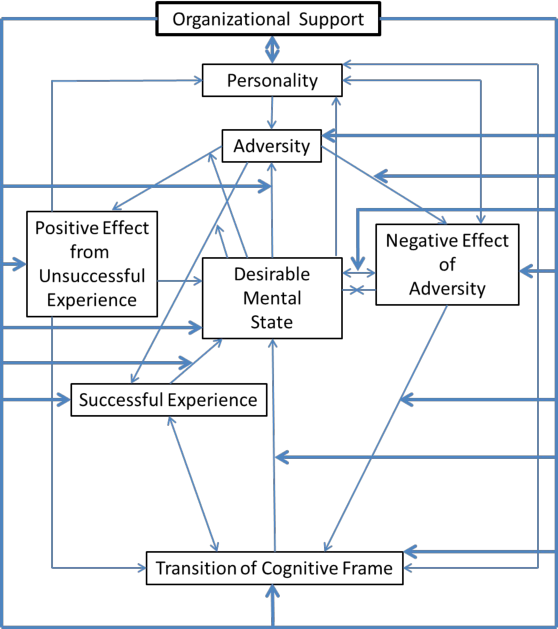
Organizing Groups Result that of first collecting codes, 133 codes were created. Moreover, following 8 final codes were led by second collecting. 1) Organizational Support, 2) Personality, 3) Adversity, 4) Positive Effect from Unsuccessful Experience, 5) Negative Effect of Adversity, 6) Successful Experience, 7) Transition of Cognitive Frame, 8) Desirable Mental State. Result of organizing groups, codes obtained from KJ-method analysis were structured codes about experience on work mostly. It was found a few codes that experience based on out of workplace such as sports and university entrance examination. Organizational support was constructed 30 factors. The 30 factors were categorized following 6 subordinate concepts. The 6 subordinate concepts were 1) Creating positive mood for support, 2) Application of feedback from the clients, 3) Leading to desirable mental state, 4) Promoting the challenge, 5) Promoting effort for helping themselves, 6) Official personnel policy.
A Type Diagram Next procedure was special arrangement of final 8 codes and illustration of A type diagram. As a result, the diagram was created that shows the process of building resilience (see Figure 1). The relation of inter codes was shown with arrows. Arrows about organizational support was shown with a thick line. The outline of A type diagram was shown as B type describing.
B Type Describing B type describing was carried out to describe about A type diagram. All phenomena showed with A type diagram was happened in the organization. Organizational support was illustrated most outside on the diagram. The most outside line started from organizational support was imagined store of the fitness club. When fitness club employees faced any adversity, the experience was recognized as successful or unsuccessful experience. When it was recognized as successful experience, successful experience influences directly desirable mental state or any transition of cognitive frame based on successful experience mediate desirable mental state. It was typical pattern resulted from successful experience.
By contrast, when the experience was recognized as unsuccessful experience, any positive aspect was found from the experience or fallen into disorder of mind or body. As well, also positive aspect was found with disorder. There were two typical patterns which promote building resilience from experience recognized unsuccessful. One of them was that positive effect from unsuccessful experience influences directly personality contributed to resilience. Another was that transition of thinking through experience mediate desirable mental state. These processes based on both successful experiences and unsuccessful experiences were found that adversity was a trigger. Adversity serves a function as a trigger at the process for building resilience. However, it sometime happens that adversity bring about negative effect of adversity to employees. It was thought negative effect of adversity was reduced by personality and desirable mental state. On the other hand, evil caused by adversity negatively influences to resilience, thinking, and cognition. Organization can provide a wide variety of support to all of the process for building resilience or overcoming adversity. Organization could intervene directly in event like adversity, and promote or reinforce transition of cognitive frame.
The organization supported for the process which employees overcome adversity. The support was wide variety of kinds. Especially, employees were received feedback, advice, encouraging, motivating and active listening by coworkers. Coworkers included bosses, elders, subordinates and coworkers joined in the same year. Moreover, Social and Organizational Factors (2020) employees received feedbacks by clients. Client’s feedbacks had significant influence. Client’s feedbacks had both positive and negative effect. It was important that employees were received feedback, advice, encouraging, motivating and active listening by coworkers and clients while the process of overcoming adversities. Additionally, employees were received supports at any time and any situation on the process of overcoming difficulties.
A type diagram and B type writing were attention making every effort to reject cognitive bias. However, they were led by subjectivity of four analyzers. We read description of data of interviews repeatedly and collated A type
Figure 1. The process of building resilience diagram with narrative of participants. As a result, A type diagram was inferred that it was possible to explain phenomena happening at fitness club. Additionally, it was inferred consistency of diagram.
DISCUSSION
We discussed A type diagram led by KJ-method. In addition, we discussed point of view to support based on the process shown as diagram for building resilience. The discussion was based on perspective of career management.
A Type Diagram Adversity was inferred that was trigger during the process of building resilience showed as A type diagram. According to Experiential Learning theory of Kolb(1984), learning cycle was structured concrete experience, reflective observation, abstract conceptualization and active experimentation. Adversity of A type diagram considered that adversity was looked like concrete experience. In this study, experience was separated successful
Social and Organizational Factors (2020) experience and unsuccessful experience by difference in cognition. Successful experience affects only desirable mental state. Beside, experience recognized unsuccessful affects personality and desirable mental state. Their influences were showed left side on A type diagram. In other hands, negative influence coded negative effect of adversity was showed right side on A type diagram. In previous study, resilience factors separated innate factors from acquired factors (Hirano, 2012). In this study, it was considered that we discussed about acquired factors. Acquired factors were separated personality from desirable mental state on A type diagram showed by this study. In addition, it was illustrated that a difference based on way of cognition to experience separated route to comeback to next adversity. For example, unsuccessful experience promoted to acquire problem-solving skills in personality. Successful experience promoted to acquire self-confidence in desirable mental state. Employees confronted next or progressing adversity using acquired desirable mental state and personality as resource to overcome it. It was consistent with previous study about post traumatic growth and growth following adversity that mental state and skill change through confronting adversity (Joseph,2005; Linley,2004).
Personality was showed as an only pair affecting mutually with organizational support on A type diagram. Organizational support was thought as the organization, and personality was thought as individuals. Because, we considered organization and individuals were affecting each other. For example, employees required organization to obtain feedbacks and supports.
The followings were about special arrangement on A type diagram. Successful experience was arranged under the positive effect from unsuccessful experience. Successful experience was separated two cases. One of them was a case recognized as successful experience immediately. Another was a case renewed cognition as successful experience subsequently to recognize as unsuccessful experience once. Similarly, there was the case that transition of cognitive frame mediates to renew cognition after to recognize as successful experience once. All adversities were considered to include any unsuccessful experience. Thus, positive effect from unsuccessful experience was arrangement firstly. Subsequently, successful experience was arranged distantly compare with positive effect from unsuccessful experience with being conscious of time series. It was considered Adversity included any failures, adversity influenced both positively and negatively. A flow affected the positive effect was arranged the left side, a flow of the negative effect was arranged the right side based on adversity arranged the center on A type diagram. Transition of cognitive frame was arranged the antithetical position from personality. Because, transition of cognitive frame had possibilities as critical transition present patterns of behavior and thinking. Personality and desirable mental state were been utterly different across from adversity, because they were completely different resources. Specifically, personality was considered stable resources, and desirable mental state was considered unsteady resources.
Organizational Support The process of building resilience started from adversity. Previous study showed similarly result, adversity was a trigger to outgrow (fletcher, 2012). Promoting the challenge was subordinate concept of organizational support. We discussed that how the organization promotes challenging for employees. The organization was required to evaluate positively if employees failed the challenge. The organization should not evaluate negatively to failure. The organization should show positive evaluation to challenge itself. At study of development leadership, that is shown as mistake systems (Moxley, 2011). We considered that mistake systems was possible to make a reference in this study. Mistake systems is to encourage, promote and give reward for individuals taking challenging experience which include many learnings and possibility of mistake and failure (Moxley, 2011). If employees did not confront difficult tasks, the process for building resilience did not start. Hence, it was important to create a positive mood which to challenge was encouraged. Additionally, the organization should show the norm to induce to confront adversity with system like a mistake system or official personnel policy.
Besides, Creating positive mood for support was found as subordinate concept of organizational support. The organization was required to promote creating inter personal relationship of employees to create positive mood for support. In the analysis, provider of supports was kind of variety. Bosses, elders, subordinates, coworkers, coworker joined company in the same year support for the employee challenging to overcome adversity. Those key persons served to feedback, advice, encouraging, motivating and active listening in the process of overcoming adversity. It was necessary that employees were served some supports for challenging adversity. Employees were required to create inter personal relation for being served formal and informal feedbacks at any time. The organization should support for that employees construct positive inter personal relationship to be served support at any time.
The organization was required to face contradictory two tasks. On the one hand the organization might consider Social and Organizational Factors (2020) building resilience using adversity, but on the other hand it was required taking care for restraining evils. Especially, it was found that client’s feedback influences employees significantly by interviews. The influence was covering both positive and negative side. Some employees fell into disorder as result of negative feedbacks from clients. On the other hands, there were cases which positive feedback may save disordered employees thinking about resignation. Application of feedback from the clients was found as subordinate concept of organizational support. At first sight, client’s feedback was not looked organizational support. However, it was found that client’s feedback had significant influence. Therefore, it was considered that how client’s feedback was used. It was important to structure frame for collecting and managing feedback. It was required that to feed systemically clients’ responses back to employees. Feedback from client had useful property to keep challenging at adversities. Some employees were encouraged and motivated by positive feedback from their client. Besides, it had a great impact for falling into disorder. There was a reason as following background. In fitness clubs, employees were required to make close relation between them and clients. Most employees actually realize that. The close relationship brings significant influence. Employees felt a great delight by positive feedbacks from clients. While, it was considered that employees was struck by emotional exhaustion on providing human service. That was significant negative affect by negative feedbacks from clients. A recent investigation indicates human service’s burnout is above emotional exhaustion (Kubo, 2007). According to such backgrounds, it was considered managing feedbacks was important.
CONCLUSIONS
It was found the processes of building resilience as A type diagram. It was found that the cycle which starting from adversity lurked in daily operation. Employees confront next or progressing adversity with obtained skill and ability through overcoming adversity. Based on the process, the view point of organizational support for building resilience was shown as followings. 1) It was required to construct mistake systems for promoting to challenge adversity positively, 2) It was required to promote creating inter personal relationship of employees and key persons, 3) It was required to structure a frame for collecting and managing feedbacks from the clients.
ACKNOWLEDGEMENT
This paper was reedited a master thesis of Juntendo University Graduate school of Health and Sports Science. We would like to thank all the participants who took part in the study.
REFERENCES
Fitness industry association of Japan. (2007), “fundamental data in fitness industry 2006”, Fitness industry association of Japan (in Japanese) Fitness industry association of Japan. (2009), “fundamental data in fitness industry 2008”, Fitness industry association of Japan
(in Japanese) Fletcher, D., Sarkar, M. (2012), “A grounded theory of psychological resilience in Olympic champions”, Psychology of sport and Exercise Volume 13, pp.669-678 Grotberg. E.H. (2003), “Resilience for Today: Gaining Strength from Adversity”, praeger. Hauser, S.T., Allen, J.P., Golden, E. (2008), “Out of the Woods: Tales of Resilient Teens”, Harvard University Press, (Nihei.S.,
Nihei.Y. 2011 (translate)), Kitaohji-shobo (in Japanese) Hirano, M. (2010) “A Study of Classification of Resilience Factors: Development of the Bidimensional Resilience Scale (BRS)”, The Japanese Journal of Personality Volume 19 No. 2, pp. 94-106 (in Japanese) Ihara, H., Ogata, H., Inuzuka, A., Ohta, N., Nagai, T., Mizuno, M., (2010), “Development and Psychometric Validation of the
Resilience Scale for Nurses in Japanese”, Jornal of General Hospital Psychiatry Volume 22 No.3, pp. 210-220 (in Japanese) Joseph.S.,Linley.P.A.(2005). “Positive adjustment to threatening events: An organismic valuing theory of growth through adversity” Review of General Psychology Volume 9 No. 3, pp. 262-280 Kanai.A. (2000). “A Study of Career Stress: Approach to Mental Health from Perspective of Career Development in
Organization”, Kazama Shobo. (in Japanese) Kawakita. J. (1996), “KJ Method: Making to Narrate in Made Chaos”, Chuokoronsha. (in Japanese) Kubo. M. (2007), “Burnout: Stress of Human Service”, Japanese Journal of Labor Studies Volume 49, No. 1, pp. 54-64 (in Japanese) Linley.P.A.,Joseph.S. (2011), “Meaning in Life and Posttraumatic Growth”, Journal of Loss and Trauma Volume 16, pp. 150-
159
Social and Organizational Factors (2020)
Margolis. J., Stoltz. P. (2010), “How to Bounce Back from Adversity”, Harvard Business Review article reprints Masten. A.S., Best. K., Garmezy. N. (1990), “Resilience and development: Contributions from the study of children who overcome adversity”, Development and Psychology Volume 2, pp. 425-444 Masten. A.S. (2001), “Ordinary magic:Resilience Process in Development”, American Psychology, Volume 56, p.233 Masten. A., Narayan. A. (2012), “Child development in the context of disaster, war, and terrorism: Pathways of risk and
resilience”, Annual Review of Psychology Volume 63, pp. 227-257 Mizuno. M. (2007), “A study on human resource management and maturity in the fitness club industry”, in: Practice Industrial / Organizational psychology, Kishida. T. (Ed.). pp. 255-268. Souseisha (in Japanese) Mizuno. M. (2011), “Career Design and Work-Life Balance: Work-Life Balance Opening Phenomenon”, Digest of Science of
Labour Volume 66, No. 2, pp. 18-22 (in Japanese) Mizuno. M. (2011), “Career Design and Work-Life Balance”, Digest of Science of Labour Volume 66, No. 12, pp. 18-22 (in Japanese) Moxley. R.S. (1998), “The Center for Creative Leadership: Handbook of Leadership Development”, Jossey-Bass Inc, (Kanai.
H., shimamura. N. 2011 (translate)), Hakuto-shobo (in Japanese) Nozaki. Y. (2012), “The Relationships among Resilience and Emotional Intelligence Based on a Distinction between the Self andOthers Domains”, The Japanese Journal of Personality Volume 20 No. 3, pp. 179-192 (in Japanese) Reivich, K.J., Shatte, A. (2002), “The Resilience Factor: 7Keys to Finding your Inner Strength and Overcoming Life’s
Hurdles”, Three rivers press. Reivich, K.J., Seligman, M.E.P. (2011), “Master Resilience Training in the U.S.Army”, American Psychologist Volume 66, No.
1, pp. 25-34 Seligman, M.E.P. (2011), “Building Resilience”, Harvard Business Review, July, pp.48-59 (in Japanese) Tamminen, K.., Holt, N., Neely, K. (2013), “Exploring adversity and the potential for growth among elite female athletes”, Psychology of sport and Exercise Volume 14, pp. 28-36 Tao. M. (2005), “Roll Changing and Stress of Administrator”, Japanese Journal of Labor Studies Volume 47, No. 12, pp. 29-39
(in Japanese)
Social and Organizational Factors (2020)
LISTED IN THE AHFE DIGITAL BOOKSTORE CATALOGUE
Explore the complete digital volume
Advances in Social and Organizational Factors
Read this individual research paper free through the original publisher, or explore the full digital proceedings book.
ISBN 978-1-4951-2102-9
Explore this ISBN in the AHFE Bookstore ↗Listed in the July 2026 bookstore catalogue; search by ISBN to confirm current availability · Digital book purchase optional