Sinem Kuz, Marco Faber, Jennifer Bützler, Marcel Ph. Mayer, Christopher M. Schlick (2020). Anthropomorphic Design of Human-Robot Interaction in Assembly Cells. In: Advances in The Ergonomics in Manufacturing: Managing the Enterprise of the Future. AHFE Open Access, vol. 12. https://doi.org/10.54941/ahfe100456
The objective of ergonomic systems design is to design the interaction between humans and machines in such a way that productivity, efficiency and humanity would not contradict each other. Hence, the human has to be considered as an integral part of the system. To use the full potential of this concept the system has to be accepted as a co-worker by the human. Anthropomorphism is an approach that is used in different areas to improve the acceptance of non-human entities as team-partners. The study within this work focuses on the effects of anthropomorphism in industrial environments. A virtual environment consisting of a robotized assembly cell was developed to conduct the experimental study. In order to simulate anthropomorphic movements, human pick and place movements were acquired using an infrared motion capture system. The data were used to drive the model of a virtual assembly robot. Within the experiment both anthropomorphic and constant speed profiles were compared. The main task of the participants was to predict the movement’s destination as accurately and quickly as possible. The reaction time and the prediction accuracy were analyzed to investigate the influence of anthropomorphic robot movements on human prediction in industrial environments. The results show that anthropomorphic movements lead to faster reaction times without more prediction errors.
Within the Cluster of Excellence "Integrative Production Technology for High-Wage Countries" at the Faculty of Mechanical Engineering of RWTH Aachen University, a research project has been established to study self- optimizing production systems. An experimental assembly cell with a gantry robot was designed where the robot carries out a certain repertoire of coordinated pick and place operations with small work pieces (Kempf et al., 2008). The understanding of self-optimization here is the ability of a system to adapt to changing situations and circumstances and to learn from experience. This behavior of the system can be regarded as goal-oriented and autonomous. However such a system can never reach the flexibility and the knowledge, skills abilities of a human being, so the human operator still has to be considered as an integral part of the production process. Therefore it is interesting to leverage the dexterity and versatility of humans and the ever-growing precision and repetitiveness of robots by enabling cooperation in manufacturing environments.
A true cooperation, however, is not possible today. Robots are still not capable of safely interacting with their human co-workers in variable tasks. Moreover from a user-centered point of view it is also important to establish a human-robot process that is perceived as a safe interaction by the human operator so that he/she can trust the system and accept it as a co-worker. Therefore, when working with a robotic co-worker, the level of stress or comfort of the human operator during the interaction is also a decisive factor for a safe and an effective collaboration (Billings et al., 2012 and Oleson et al., 2011). Concerning this fact anthropomorphism is a promising approach, i.e. simulating human characteristics by non-human agents like robots. For this reason, current work in the field of human-robot interaction focuses more and more on this concept. Recent research could prove that by transferring anthropomorphic features to robots, a higher level of safety and user acceptance can be achieved (Duffy, 2003).
Anthropomorphism in industrial environments is rarely investigated because the focus lies more on the design of fully automated systems that should operate robustly and efficiently without human interaction or cooperation. Nonetheless, focusing on scenarios with human-robot interaction or even cooperation, anthropomorphism might be an important design principle in order to achieve a safe, effective, and efficient cooperation between humans and robots in such environments. In order to investigate this, a laboratory experiment was conducted on the basis of a virtual simulation environment consisting of a gantry robot and a work place. The developed virtual simulation is similar to the experimental assembly cell as introduced e.g. by Kempf et al. (2008). The empirical study focuses on the effect of anthropomorphism in assembly environments, in particular in motion behavior of a gantry robot. This idea is mainly based on the scientific evidences concerning the neural activity of specific brain areas when watching a movement action. These special brain areas (mirror neurons) in humans and non-human primates are activated both by action generation and observation of other humans’ actions (Rizzalotti et al., 1996). Researchers hypothesise, that mirror neurons may explain a variety of social cognitive functions such as the recognition of the action and intention of others. Based on these results, Gazzola et al. (2007) have investigated human mirror neuron systems during the observation of simple movements of a robotic arm and reported a significant activation. Hence, the research question within this work focuses on how the execution of a movement (anthropomorphic vs. constant speed profile) of a gantry robot in an assembly cell might affect the predictability of its behavior in space-time by a human being. This paper focuses on the results of an empirical study with 29 male participants regarding the reaction time and the prediction accuracy.
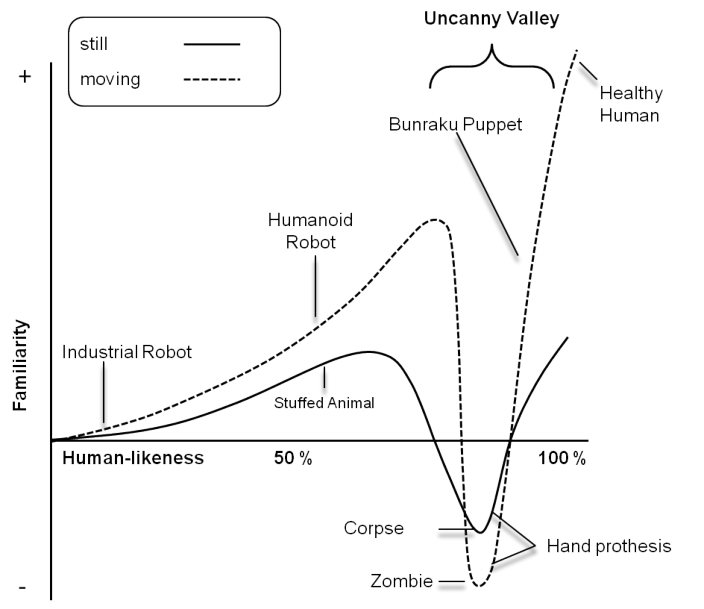
ANTHROPOMORPHIC DESIGN OF TECHNICAL SYSTEMS “Anthropomorphism” derives from the Greek “anthropos” for “human” and “morphe” for “shape” or “form”. It describes the attribution of non-human entities such as robots with human characteristics. Anthropomorphic design means a simulation of human characteristics. Luczak et al. (2003) have focused on this topic and already investigated the effects of anthropomorphic design in technical systems and were able to prove that people perceive technical systems with anthropomorphic characteristic friendlier than simple devices. Hinds et al. (2004) have considered robots and studied how an anthropomorphic appearance can affect human perception during collaborative working on tasks with the robot. Results showed that humans can transfer responsibility rather to robots with human like properties than to conventional ones. In a further study, Krach et al. (2008) could prove a positive correlation between the degree of human likeness and the perceived level of intelligence of a non-human entity. Nevertheless, it should be noted that a higher similarity to humans does lead to an increased familiarity, but at the same time it may result in negative consequences. The theory of the "Uncanny Valley" by Mori (1970) first describes an increase in familiarity with increasing human likeness, which at a certain point, before the degree of human likeness reached the maximum, decreases the familiarity and turns into rejection (see figure 1). However, there are no scientific proofs of the postulated effects of this model yet (Geller, 2008). Nevertheless according to the uncanny valley theory an increase in human likeness of an industrial robot with almost no human characteristics would initially have a positive effect on the familiarity.
Concerning industrial robot systems, a subarea of the European research project ROSETTA focused also on anthropomorphic design in order to increase the acceptance of humans when cooperating with such systems. The work of Zanchettin (2012) focuses on for instance on the motion control of an industrial robot during manipulation tasks. For each position of the end effector the anthropomorphic posture of the elbow joint can be calculated by a human movement pattern generation algorithm. Within an empirical study he could prove that by applying the motion pattern on a 7-degree-of-freedom (7-DOF) anthropomorphic manipulator, a reduction of the stress level of the humans working side by side with the robot could be achieved. Furthermore Huber et al. (2008) investigated how human cooperation characteristics can be transferred to human-robot cooperation scenarios. In this case, a handover process was used, in which the human-human, human-robot and human- humanoid cooperation were compared to each other. Within the study a human like motion pattern was used that was modeled after the maxim of a free flow as smoothly as possible. They compared the calculated trajectory to one that resulted from a trapezoidal velocity profile. Results of the analysis have shown that reaction times of the humans concerning human like motions were lower than the trapezoidal case. Anthropomorphic characteristics in appearance also lead to shorter reaction times. Because of the results concerning the appearance, the hypothesis was generated that human trajectories as opposed to trajectories based on simple inverse kinematics could lead to a further improvement of the reaction times. Nevertheless, the used movement data is based on estimated trajectories and does not consider natural anthropomorphic movements. In this regard, Kuz et al. (2013) conducted a first study with an industrial robot in a virtual environment to measure the effect of tracked human placing movements compared to conventional ones of a gantry robot on human prediction of target-oriented movements. The results showed significant effects considering the reaction times. However, a comparison of the velocity profiles remained unnoticed and is therefore the focus within this work.
Figure 1. The Uncanny Valley (referring to Mori, 1970)
Accordingly based on these results and the scientific findings concerning the mirror neurons, by applying an anthropomorphic speed profile to an industrial robot, we expect shorter reaction times and fewer prediction errors.
METHOD
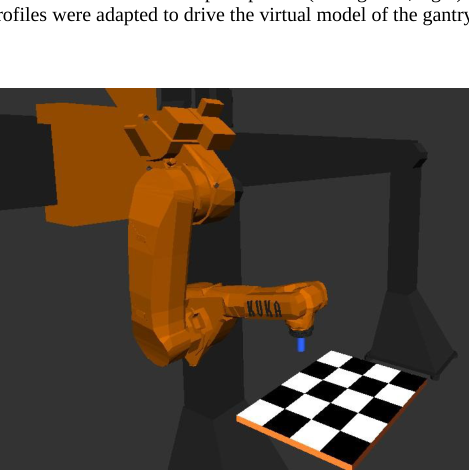
To address the aforementioned research question, an empirical study was conducted. We used a repeated measures design with two within-subject factors (speed profile and virtual target position) by means of a virtual simulation environment consisting of a KUKA KR 30 Jet gantry robot and a black and white grid with 20 fields to illustrate the virtual target position of the robot (see figure 2, left). Within the study the focus lies on how the speed profile (anthropomorphic vs. constant) of a gantry robot affects the predictability of its behavior. In order to generate the anthropomorphic movement data for the main empirical study, a preliminary experiment was conducted using an infrared optical tracking system. Therefore, human motion trajectories during placing an object were recorded and analyzed. For the execution, the participant was standing in front of a table, where black plastic discs were mounted at regular intervals for placing a cylindrical object. The participant always started in the same posture in front of the table and placed the object on the disks without changing the posture of the body. The data recorded by the motion tracking system represent the trajectory of the human wrist during the execution of the placing movements. In addition to the cartesian coordinates, the human velocity profile of the complete movement from the start position until placing the object was also tracked and analyzed. The tracked human motion data was then combined with two different speed profiles. One half of the testing movement data was combined with the human speed profile and the other half with a constant speed profile (see figure 2, right). Afterwards, the motion data with two different velocity profiles were adapted to drive the virtual model of the gantry robot in the simulation environment.
Time [s] constant
Distance[mm] Speed [mm/s]
Time [s]
Figure 2. The virtual testing environment and an example for the human and the constant speed profile in comparison (Mayer et al., 2013)
The speed profile (anthropomorphic vs. robotic) and the virtual target position were considered as independent variables, whereas the reaction time and the prediction accuracy were the dependent variables. The reaction time describes the elapsed time from the beginning of a movement sequence until the prediction of the participant. The prediction accuracy was analyzed in terms of correct, incorrect and missing predictions. Furthermore, the sequence of the testing conditions to be passed was permuted to avoid order effects. The statistical analysis in this work was calculated using the statistical software package SPSS Version 19.0. A repeated-measures analysis of variance was calculated to analyze differences between condition means. The chosen level of significance for each analysis was α=0.05.
Procedure
The main experimental study consisted of two phases. Within the first phase the personal data of the participants were collected, e.g. age, profession, experiences with 3D simulation environments (e.g. computer games) as well as with robotic systems. Afterwards, a visual acuity test, a stereo vision test, and a color vision test were carried out to control intervening variables related to visual perception. After completing these steps, the participants could get with the testing system and were seated in front of a TFT LCD 28" monitor, and asked to observe the gantry robot while performing different pick and place operations on the grid. To avoid learning effects, the virtual scene was presented from a different view and the grid consisted of only six fields. After this familiarization phase the main part of the study could be conducted. The task during the main part was to monitor the same gantry robot from a lateral view during pick-and-place operations on the grid and try to predict the target field by using a computer mouse. During the experiment, the virtual robot placed the cylinder on every field of the grid. And each of these 20 fields was approached by both the anthropomorphic and the constant speed profile so that we had altogether 40 motion sequences. To avoid order effects the simulation of the 40 motion sequences was permuted before each experiment. After predicting the field, the simulation was interrupted and the next movement could be started by the participants. For each participant the corresponding reaction time and the prediction per presented movement sequence were recorded by software for later examinations.
Participants A total number of 29 male participants, who are either taking part in an engineering bachelor/master program or have just graduated, participated in the study. The participants were aged between 22 and 37 years (mean: 26.48 years, SD: 3.15). 79% of the participants had already experience with 3D simulation environments. Almost 38% of the subjects had worked with robotic environments and even 28% of them for several months. All of the participants passed the visual acuity test, the stereo vision test, and the color vision test.
RESULTS
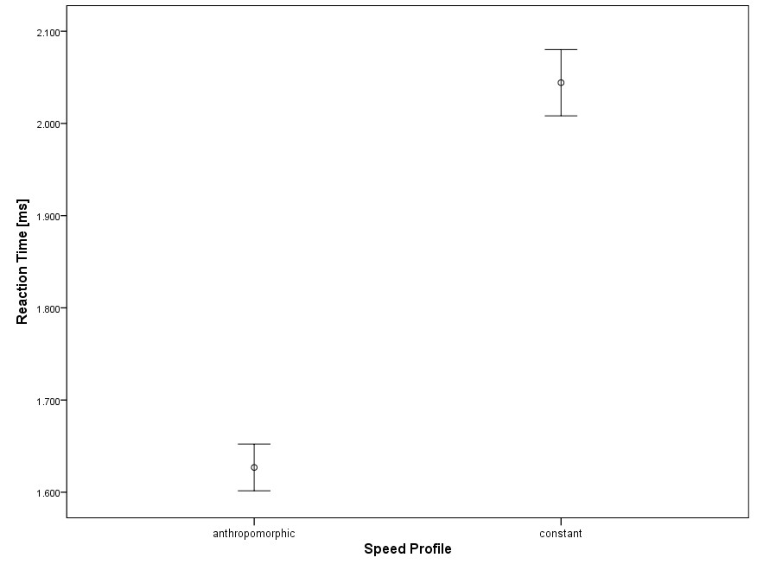
The average values for the reaction time concerning the constant speed profile is 2040 ms and the anthropomorphic speed profile 1630 ms (see figure 3). The significance test using an ANOVA with repeated measures on a significance level of α = 0.05 shows that the reaction time is not only influenced by the two different speed profiles (F (1.28) = 166.344, p <.001) but also by the virtual target position (F (8.832, 247.285) = 79.67, p <.001). Regarding the effect size, we have a strong effect of the speed profile (ω2 = 0.78) and a medium one (ω2 = 0.40) of the virtual target position. The analysis also shows a significant interaction effect (F (6.203, 173.684) = 10.12, p <0.001) between the two independent variables. However, due to an ordinal interaction both main effects can be interpreted separately. The reaction times for the fields that are farther away from the virtual robot are longer than the fields that are closer. Nevertheless, this effect is conforming to expectations, since the execution of a placement movement to more distant target positions actually takes more time.
Figure 3. Means and standard errors for both speed profiles
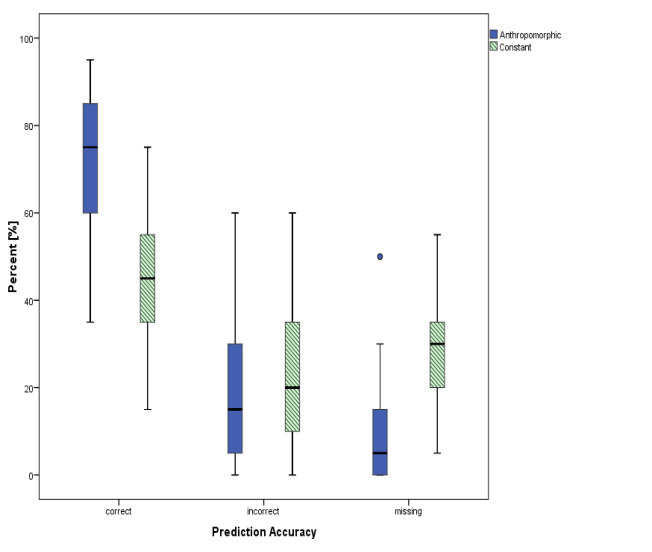
During the experiment the participants had to monitor a total number of 1160 motion sequences and try to predict the target field of the presented placing movement. According to the experimental setup, each cell was approached two times (human like trajectory combined with two different speed profiles). The number of correct predictions, i.e. the matches between the approached target field by the gantry robot and the selection of the participant is 676 on average. Figure 4 shows relative frequencies of correct, incorrect and the missing for both speed profiles. The comparison shows a much higher value of correct predictions (60.2%) for the anthropomorphic speed profile than for the constant one (39.8%). 258 of the 1160 predictions were incorrect. Comparisons between the different speed profiles reveal a higher number of incorrect predictions for the constant speed profile (54.7%) as for the anthropomorphic profile (45.3%). Concerning the missing predictions in 226 of 1160 cases, participants could not make a prediction of a target position in a timely manner, whereby the value concerning the constant speed profile (75.2%) is much higher than for the anthropomorphic one (24.8%). Further inferential analysis shows that the number of correct, incorrect and missing predictions are significantly different (χ² = 87.909, p < 0.001). Regarding the findings, the faster prediction time does not result in more prediction errors, so that a speed-accuracy trade-off can statistically be excluded.
Figure 4. Average values for the prediction accuracy (correct, incorrect and missing)
SUMMARY AND OUTLOOK The aim of this paper was to present the results of an experimental study with 29 participants investigating the impact of anthropomorphic motion patterns of a gantry robot on human prediction of target positions of placing movements. The study included the comparison between anthropomorphic and constant speed profiles by means of a simulation environment. Therefore, placing movements of the human were tracked by an optical motion capture system. The captured data were analyzed and adapted to control the articulated robot in the simulation. The reaction time and the prediction accuracy were analyzed as dependent variables during the evaluation process. Statistical analysis showed that the anthropomorphic speed profile leads to a significant shorter reaction time (α=0.05). Hence, the participants were able to estimate and predict the target position of the presented movement significantly faster when the gantry robot was controlled by means of the anthropomorphic speed profile. To test if there are more errors due to a shorter reaction time, the prediction results were examined in detail. This variable was divided into the missing, the correct and the incorrect predictions. Inferential analysis revealed that the correct and the missing predictions were significantly better for the human like speed profile. Based on the results a speed-accuracy trade-off can statistically be discarded. Furthermore we assume that the findings can be reasoned by the activation of the mirror neurons in the human brain by monitoring human like motion sequences. Because of this fact, it is easier for the human being to recognize the intention of the other.
A limitation of this empirical study was that it was conducted by means of a virtual environment; hence, the future work is the investigation of the effects of anthropomorphism on human prediction under real conditions in a shop floor environment. This will be done in the experimental assembly cell as introduced e.g. by Kempf et al. (2008). The study will be conducted under same geometric and kinematic conditions as presented within this work. The motion data that is already tracked and used for this study is adapted to control the gantry robot in the real assembly cell. Besides the reaction time and the prediction accuracy, the eye-movement data of the participants will be tracked and analyzed to investigate the attention when monitoring the different movement types.
ACKNOWLEDGEMENT
The authors would like to thank the German Research Foundation DFG for the kind support within the Cluster of Excellence “Integrative Production Technology for High-Wage Countries”.
REFERENCES
Billings, D. R., Schaefer, K. E., Chen J. Y. C., Hancock, P. A.: Human-robot interaction: developing trust in robots. In Proceedings of the 7th ACM/IEEE International Conference on Human-Robot Interaction, Boston, Massachusetts, USA, 109-110 (2012) Duffy, B. (2003): Anthropomorphism and The Social Robot. Special Issue on Socially Interactive Robots, Robotics and
Autonomous Systems, 42 (3-4), 177–190 Geller,T. (2008). Overcoming the Uncanny Valley. Computer Graphics and Applications (11-17). IEEE Hinds, Pamela J., Roberts, Teresa L., and Jones, H. (2004). Whose job is it anyway? a study of human-robot interaction in a collaborative task. Hum.-Comput. Interact. 19, 1 (151-181). doi: 10.1207/s15327051hci1901&2_7 Huber, M, Rickert, M., Knoll, A., Brandt, T., Glausauer, S. (2008). Human-robot interaction in handing-over tasks. In Proc. of
RO-MAN. München (107-112): IEEE Kempf, T., W. Herfs, and Ch. Brecher. 2008. Cognitive Control Technology for a Self-Optimizing Robot Based Assembly Cell.
Proceedings of the ASME 2008 International Design Engineering Technical Conferences & Computers and Information in Engineering Conference, American Society of Mechanical Engineers Krach, S., Hegel F., Wrede B., Sagerer G., Binkofski F., Kircher T. (2008). Interaction and perspective taking with robots investigated via fMRI. PLoS ONE. 3(7): e2597. doi: 10.1371/journal.pone.0002597 Kuz, S., Mayer, M. Ph., Müller, S., Schlick, C. M.: Using Anthropomorphism to Improve the Human-Machine Interaction in
Industrial Environments-Part I. In the Proceedings of the 4th International Conference on Digital Human Modeling and applications in Health, Safety, Ergonomics and Risk Management, Las Vegas, NV, USA (2013). Luczak, H., Rötting, M., Schmidt, L.(2003). Let's talk: anthropomorphization as means to cope with stress of interacting with technical devices. In Ergonomics, London (1361-1374). Mayer, M. Ph., Kuz, S., Schlick, C. M.: Using Anthropomorphism to Improve the Human-Machine Interaction in Industrial
Environments-Part II. In the Proceedings of the 4th International Conference on Digital Human Modeling and applications in Health, Safety, Ergonomics and Risk Management, Las Vegas, NV, USA (2013). Mori, M. (1970). The Uncanny Valley. In Energy, 7(4), S. 33-35, Translated by Karl F. MacDorman and Takashi Minato Oleson, K.E., Billings, D.R., Kocsis, V., Chen, J.Y.C., & Hancock, P.A. (2011). Antecedents of trust in human-robot collaborations. In Proceedings of the International Multi-Disciplinary Conference on Cognitive Methods in Situation Awareness and Decision Support (CogSIMA). Orlando, FL, USA (175-178): IEEE Zanchettin, A. M. (2012). Human-centric behavior of redundant manipulators under kinematic control, PhD Thesis. Politecnico
di Milano. Rizzolatti, G., Fadiga L., Gallese V., Fogassi L.: Premotor cortex and the recognition of motor actions. Cognitive Brain Research, 3, 131–141 (1996) Gazzola, V., Rizzolatti G., Wicker B., Keysers, C.: The anthropomorphic brain: The mirror neuron system responds to human
and robotic actions. Journal of Neuroimage, 35(4), 1674-84 (2007)
LISTED IN THE AHFE DIGITAL BOOKSTORE CATALOGUE
Explore the complete digital volume
Advances in The Ergonomics in Manufacturing: Managing the Enterprise of the Future
Read this individual research paper free through the original publisher, or explore the full digital proceedings book.
ISBN 978-1-4951-2103-6
Explore this ISBN in the AHFE Bookstore ↗Listed in the July 2026 bookstore catalogue; search by ISBN to confirm current availability · Digital book purchase optional