Ralph Hensel, Vera Hummel, Jan Schuhmacher (2026). Shaping Future Work Systems: A Framework for the Integration of Humanoid Robots. In: Industrial and Systems Engineering. AHFE Open Access, vol. 219, pp. 21–31. https://doi.org/10.54941/ahfe1007772
Advances in humanoid robotics, artificial intelligence, and autonomous control are accelerating the integration of humanoid robots into industrial and service‑oriented work systems. Their anthropomorphic kinematics, human‑scale reachability, and multimodal sensing enable operation within infrastructures originally designed for human workers. Yet, structured, theory‑based methodologies for their systematic integration into socio‑technical environments remain limited. This paper presents a human‑factors‑oriented framework supporting the selection, design, implementation, and evaluation of humanoid‑robot‑enhanced work systems. It integrates socio‑technical systems theory, human-robot interaction, and ergonomic design across five domains: robot selection, contextual diagnostics, work allocation and interaction modelling, system integration, and multidimensional evaluation. Industrial cases in automotive assembly and intralogistics demonstrate how humanoid robots can assume physically demanding tasks while humans retain decision‑intensive roles. The framework positions humanoid robots as flexible, modular automation resources and highlights future research needs, including interoperability standards and scalable safety architectures for industrial deployment.
Humanoid robotics is progressing rapidly, driven by advances in artificial intelligence, sensor fusion, autonomous control, and human-centric manufacturing paradigms. Recent research emphasizes that humanoid systems increasingly play a role in next-generation Industry 5.0 environments, where human-centeredness, resilience, and adaptability are essential design goals. As humanoid robots gain greater dexterity, perceptual intelligence, and multimodal interaction capabilities, their potential deployment in industrial and service-oriented work systems becomes more feasible. Their anthropomorphic kinematics and human-scale reachability allow them to operate within infrastructures traditionally designed for human workers, reducing the need for extensive reconfiguration and enabling new forms of human–robot collaboration (Hoda, 2025).
At the same time, research in human–robot collaboration (HRC) and human-robot interaction (HRI) shows that successful integration requires careful consideration of human acceptance, ergonomic factors, interaction modalities, and safety. Systematic reviews highlight that worker acceptance and ergonomic conditions significantly influence the effectiveness of collaborative robot deployment, underscoring the need for structured, human-centered design approaches. Foundational HRI literature further establishes the importance of intuitive communication channels, predictable robot behavior, and interaction models that reduce cognitive load and support cooperative task execution (Bajestani et al., 2025; Durmus Senyapar and Bayindir, 2025).
Despite these advancements, the field still lacks comprehensive, theory-based methodologies for integrating humanoid robots into socio-technical work systems. Existing research points to persistent methodological gaps, particularly in qualitative and socio-technical evaluation practices required to assess human factors, organizational implications, and emergent system-level interactions. This lack of structured integration frameworks leaves decision-makers uncertain about robot selection, task allocation, system design, safety requirements, and long-term organizational effects (Bartneck et al., 2024).
This paper addresses this gap by introducing a comprehensive, human-factors-oriented framework for selecting, designing, implementing, and evaluating humanoid-robot-enhanced work systems. The framework synthesizes principles from socio-technical systems theory, human–robot interaction, and ergonomic work system design into a unified methodological structure. Its goal is to enable safe, effective, and resilient collaborative systems that fully leverage the capabilities of humanoid robots while safeguarding human well-being and supporting organizational performance.
The following section reviews the technological, ergonomic, and human- interaction foundations required to contextualize this framework.
BACKGROUND AND RELATED WORK Humanoid robotics has progressed markedly over the past decade, transitioning from specialized research prototypes to increasingly capable systems with expanding industrial relevance. Comprehensive technical reviews document advances in actuation, locomotion, perception, and multimodal interaction, indicating that humanoid robots are nearing the maturity required for deployment in industrial and service settings. These developments align with broader shifts toward next-generation, human-centred production systems in which adaptable robotic agents operate within infrastructures historically designed for humans (Research and Markets, 2025).
Contemporary reviews underscore the strategic role of humanoid robots in future work systems. A consolidated synthesis of current progress and remaining challenges positions humanoid platforms as promising enablers of flexible, resilient, and intelligent manufacturing, while simultaneously highlighting persistent issues, including robustness, energy efficiency, and generalization across real-world conditions. These analyses emphasize the
Shaping Future Work Systems: A Framework for the Integration 23 importance of methodologies that conceive of humanoids not merely as technological artefacts but as integral elements of socio-technical systems (Bajestani et al., 2025).
In parallel, the HRI literature offers foundational insights into communication processes, behaviour modelling, and user perception in collaborative contexts. Multimodal communication, predictable robot behaviour, and cognitive-load-aware interaction design are repeatedly identified as central to establishing effective human–robot cooperation. In industrial settings, these considerations align with findings that collaborative systems must be not only technologically performant but also ergonomically and psychologically compatible with human operators (Durmuş Şenyapar et al., 2025). Meta-analytic evidence shows that trust calibration - driven primarily by consistent and transparent robot performance - is essential for sustaining appropriate human reliance (Hancock et al., 2011; Iodice et al., 2026). Ergonomics and human-factors research play a pivotal role in understanding how robotic systems - and humanoids in particular - affect operator well-being, workload, and performance. Reviews of ergonomic HRC underline that both physical and cognitive ergonomics must serve as primary design parameters; poorly structured task allocation and inadequate interaction modalities can introduce new risks. Complementary studies demonstrate that collaborative robotic systems can substantially reduce musculoskeletal strain when ergonomic principles are integrated from the outset, yet many industrial implementations lack systematic human-factors considerations (Urrea & Kern, 2025).
Cognitive ergonomics research further indicates that the allocation of roles and responsibilities between humans and robots directly modulates mental workload, attentional demands, and situational awareness. Assigning humans supervisory or decision-centric roles while delegating repetitive or physically demanding tasks to robots appears particularly beneficial, which is especially relevant for humanoid robots whose morphology and interaction capabilities support complex, intertwined task sharing (Tong et al., 2024).
Recent research has introduced adaptive, ergonomics-aware HRC frameworks that leverage real-time ergonomic risk monitoring and dynamic task adaptation to enhance safety and efficiency. The framework proposed by Iodice, De Momi, and Ajoudani (2026), for example, integrates advanced visual perception, continuous ergonomic assessment using ergonomic risk categories, and Behaviour-Tree-based decision-making to trigger robot intervention only under hazardous human postures. However, such approaches remain tailored to collaborative robot platforms in controlled laboratory contexts and do not yet address the broader socio-technical integration challenges associated with humanoids, whose full-body mobility, expanded task repertoire, and systemic embedding require more holistic methodological guidance.
Across these research streams, a coherent pattern emerges: while technological advancements in humanoid robotics and extensive ergonomic/ HRI scholarship exist, there is no comprehensive, theory-driven framework for systematically integrating humanoid robots into socio-technical work systems. The present contribution responds to this gap by synthesizing insights
from humanoid robotics, HRI, ergonomics, and work-system design into a unified, human-factors-oriented methodology for industrial application.
METHODOLOGICAL FRAMEWORK The proposed framework positions humanoid robots as components of socio-technical work systems rather than isolated technologies. In line with Partelow’s (2023) conceptualization of frameworks as integrative scientific tools that synthesize core concepts, structure empirical inquiry, and mediate between theory and application through processes such as empirical generalization, theoretical fitting, application, and hypothesis generation, the present framework provides a structured lens for aligning technological, organizational, and human-centred dimensions of humanoid-robot integration.
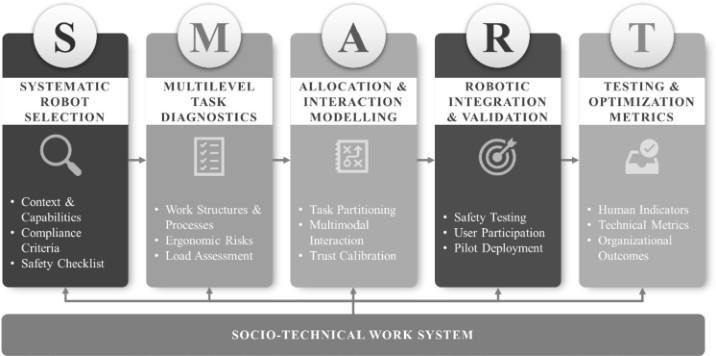
Figure 1 depicts the Human-Factors-Oriented Integration Framework, which organizes the introduction of humanoid robots into industrial work systems across five interrelated domains: from platform selection and task-analytic diagnostics to interaction modelling, system integration, and continuous evaluation. The model emphasizes that each domain operates within, and is shaped by, the broader sociotechnical context of the work system. In doing so, the framework ensures that human-centred, organizational, and technical considerations remain consistently aligned throughout the design and implementation process.
Figure 1: Human-factors-oriented framework for the integration of humanoid robots into work systems.
Domain S: Systematic Robot Selection (Context × Capabilities × Compliance) Objective. Identify a humanoid platform whose morphology, actuation, perception, and manipulation capabilities match task and environmental constraints while satisfying safety and regulatory requirements.
Shaping Future Work Systems: A Framework for the Integration 25 Evidence base. Comprehensive reviews of humanoid robotics detail state of the art subsystems (locomotion control, whole body manipulation, perception) and open challenges (robustness, energy efficiency), informing capability checklists and risk scenarios for candidate platforms (Bajestani, 2025; Research and Markets, 2025). Compliance. Selection must account for industrial robot safety standards. ISO 10218 1/2:2025 define safety requirements for robot manufacturers and system integrators; the current revision consolidates collaborative operation expectations. ISO/TS 15066 remains a key quantitative reference for power and force limiting (PFL) and speed and separation monitoring (SSM), including body region specific contact force/pressure limits and validation procedures.
Deliverables. Capability-Task-Context matrix; safety and conformity checklist (ISO 10218; TS 15066); risk register linking constraints to workstation hazards.
Domain M: Multilevel Task Diagnostics (Processes, Ergonomics, Load) Objective. Characterize organizational conditions, task structures, spatial constraints, and human workload/ergonomic risks to decide where humanoids add value without degrading human factors.
Evidence base (ergonomics). Reviews of ergonomic human-robot collaboration highlight that physical and cognitive ergonomics must be primary design inputs; otherwise, collaboration risks shifting burdens rather than mitigating them. Established assessment tools support early-stage diagnostics and later benchmarking (Urrea and Kern, 2025):
RULA for postural/upper limb risks in seated/precision tasks.
REBA for whole body postural risks, including dynamic tasks typical of assembly/logistics.
EAWS for comprehensive evaluation of posture, force, repetition, and manual handling demands in complex industrial tasks.
NASA TLX for perceived workload across mental, physical, temporal dimensions to verify that new allocations do not increase operator strain.
Evidence base (cognitive ergonomics). Experimental work on collaborative work roles shows that assigning humans supervisory/decision centric responsibilities and robots physically demanding subtasks can reduce mental workload and preserve situational awareness (Tong et al., 2024).
Deliverables. Task decomposition (manual vs. automatable segments), spatial/visibility maps, RULA/REBA/EAWS assessments, NASA TLX profiles, and a prioritized list of ergonomic pain points for robotic support.
Domain A: Allocation & Interaction Modelling Objective. Partition work between humans and humanoids to (i) remove ergonomic hotspots, (ii) stabilize quality and takt, and (iii) minimize cognitive load via predictable, explainable agent behaviours.
Evidence base. HRI fundamentals recommend multimodal interaction (speech, gesture, proxemics) and predictability of robot behaviour for seamless collaboration. Meta analyses show that robot performance and attribute factors are the strongest levers for trust - implicating transparent feedback, deterministic fallback, and consistent motion policies as design constraints. Human centred design per ISO 9241-210 requires user/task/ environment understanding and iterative user involved evaluation of the allocation and interaction concepts.
Deliverables.
Allocation map: Constraints aware mapping (capability × risk × takt) with gates for human override and exception handling.
Interaction contract: Modalities, timing, confirmation strategies, and escalation ladders aligned with workstation acoustics/lighting and PPE.
Trust & workload safeguards: Design rules for feedback granularity, motion legibility, and pause/hand over cues derived from the trust and workload evidence.
Domain R: Robotic Integration & Validation (Test by Measurement) Objective. Integrate the humanoid into new or existing workflows through iterative prototyping and simulation, validating functional fit and safety before scale up.
Evidence Base. Integration follows ISO 10218-2 lifecycle requirements (risk assessment, safeguarding, commissioning, change control). For collaborative modes, quantitative validation of PFL/SSM limits (forces, pressures, distances) must follow ISO/TS 15066 procedures - using calibrated measurement devices and body region specific thresholds.
Ergonomics aware control: Real time ergonomics sensing (e.g., EAWS /RULA proxies, posture estimation) can trigger assistance only under hazardous postures, preserving human primacy - validated in recent HRC frameworks.
Iterative user participation: Early, repeated operator involvement reduces acceptance barriers and uncovers micro barriers in line balancing, tool access, and line of sight constraints.
Deliverables. Prototyping plan; safety file with ISO 10218 conformity evidence; ISO/TS 15066 force/pressure test reports; usability test logs and change requests.
Domain T: Testing & Optimization Metrics Objective. Establish a comprehensive evaluation stack (human factors, technical, organizational) and a continuous improvement loop.
Evidence Base. Ergonomic risks (RULA/REBA/EAWS), workload (NASA TLX), and acceptance/trust measures to verify that the system reduces physical/cognitive strain and sustains appropriate reliance. Reliability/ uptime, task compliance, cycle time stability, safe stop/SSM responsiveness - benchmarked against the allocations and interaction contracts from
Domain A and the safety functions from Domain R. Productivity, quality defects, rework, absenteeism linked to musculoskeletal issues - interpreted alongside cognitive ergonomics findings on role distributions.
Deliverables. KPI set for human-factors, technical, and organizational indicators; consolidated evaluation report with RULA/REBA/EAWS and NASA-TLX deltas; performance and reliability dashboard; safety validation updates; continuous-improvement backlog with policy adjustments.
INDUSTRIAL CASE STUDIES To demonstrate the applicability of the proposed human-factors-oriented integration framework, two representative industrial domains were selected: final automotive assembly and intralogistics material handling. Both sectors exhibit high ergonomic loads, mixed repetitive and non-repetitive tasks, and increasing interest in integrating humanoid robots to support operators. Existing research in industrial ergonomics, collaborative robotics, and humanoid capabilities provides the foundation for extrapolating realistic integration scenarios.
Case Study 1: Automotive Final Assembly In the automotive final assembly context, the human-factors-oriented integration framework supports a systematic and ergonomically grounded deployment of humanoid robots in highly demanding production environments. Final assembly workstations typically involve a high density of repetitive, force-intensive, and posture-constrained tasks, including overhead fastening, underbody inspection, and operations in confined vehicle geometries, which are widely recognized as major contributors to musculoskeletal strain and long-term occupational health risks. Established ergonomic analyses consistently highlight overhead fastening, underbody inspection, and operations inside confined vehicle geometries as among the most physically demanding elements of final assemblies. In parallel, recent robotics research shows that humanoid robots - due to their anthropomorphic kinematic structure, human-like reach, and maturing whole-body coordination - are increasingly capable of operating in workspaces originally designed around human limb geometry and dexterity.
Applying the framework begins with a systematic diagnostic phase to identify high-risk tasks and quantify ergonomic loads. Ergonomic analyses reveal that many assembly tasks exceed safe thresholds: overhead screwing frequently involves shoulder elevation above 60°, underbody inspection requires severe trunk flexion. These findings provide a strong evidence base for reallocating posture-intensive sub-tasks to humanoid robots while preserving human responsibility for decision-critical actions, exception handling, and quality assurance. This division of labour aligns with cognitive ergonomics research, which shows that humans benefit when freed from high physical loads but retain meaningful supervisory control and task-level authority.
The integration and interaction modelling phase emphasizes the need for intuitive multimodal communication channels - particularly gesture and
speech-enabled by humanoid robot perception systems. Core HRI principles guide the design of predictable, legible robot behaviours and smooth handover cues, ensuring that human workers can anticipate robot actions and maintain situational awareness. Trust calibration is an essential aspect of this interaction design: meta-analytic evidence shows that consistency in robot performance and transparency in motion planning are decisive for establishing appropriate and stable levels of operator trust in collaborative settings.
From a systems engineering perspective, the deployment of humanoids also requires adherence to ISO 10218-2 safety lifecycle processes and quantitative biomechanical thresholds defined in ISO/TS 15066. In final assembly operations - especially overhead zones where contact risks are elevated - force- and pressure-limit validation is critical. These standards provide the procedural backbone for safe commissioning, although humanoid-specific challenges, such as dynamic whole-body balancing, fall outside their current scope and remain an ongoing research topic.
Post-integration evaluation reveals tangible benefits. Ergonomic risk levels could decrease substantially. NASA-TLX assessments indicate reduced physical and temporal workload, demonstrating that task reallocation effectively mitigates both biomechanical and cognitive strain. These results align with broader evidence from ergonomic HRC research, confirming that collaborative robotic assistance - when guided by systematic human-factors analysis - could measurably reduce musculoskeletal risks and support sustainable workforce health.
Overall, the automotive final assembly case study illustrates that humanoid robots can play a significant role in addressing persistent ergonomic challenges. At the same time, it underscores that successful adoption is contingent not solely on technical capability, but on holistic integration encompassing human-centred design, safety engineering, and socio-technical alignment. The framework ensures that deployment decisions are driven by demonstrable ergonomic and operational value rather than technological novelty.
Case Study 2: Intralogistics Material Handling in Werk150 In intralogistics, the framework demonstrates how humanoid robots can be integrated into dynamic, high-variability work environments characterized by continuous movement of goods, frequent load handling, and rapid task switching. These settings impose simultaneous physical and cognitive demands on workers, including repetitive bending, lifting, and reaching, as well as constant engagement in scanning, verification, and routing decisions. Werk150 of NXT at Reutlingen University is a research and education factory where researchers and industry partners collaborate in a real production environment to develop and test innovative manufacturing and digitalization solutions.
Research in industrial ergonomics consistently identifies manual material handling, high-frequency lifting cycles, and low-posture picking tasks as major
Shaping Future Work Systems: A Framework for the Integration 29 contributors to musculoskeletal strain and fatigue in logistics operations. At the same time, contemporary robotics literature describes substantial progress in humanoid capabilities - including bimanual manipulation, semi- autonomous navigation, adaptive balance control, and human-scale reach - positioning humanoid robots as valuable agents for tasks that exceed the flexibility of mobile manipulators or cobots (Sheng et al., 2025).
Applying the integration framework begins with ergonomic and task-analytic diagnostics. Assessments reveal that many intralogistics tasks fall into medium- to high-risk categories, particularly those involving sustained trunk flexion, repetitive lifting above recommended thresholds, or repeated crouching in low-shelf bin-picking workflows. NASA-TLX workload evaluations typically show elevated physical and temporal demands due not only to manual load handling but also to the cognitive burden created by simultaneous information processing. These findings indicate that humanoid robots could take over physically intensive subtasks - such as lifting, carrying, pallet loading, or replenishment runs - thus reducing workers’ biomechanical risk without altering the cognitive structure of systems that rely on human judgment.
Next, the case study demonstrates how interaction modelling and workflow integration must account for the dynamism of intralogistics environments. Unlike fixed assembly stations, warehouses involve continuous movement of people, equipment, and goods. Effective integration therefore requires multimodal interaction concepts, including gesture signals for spontaneous coordination, voice commands for high-variability tasks, and visual markers or AR overlays to support error-resistant communication. HRI research underscores the necessity of predictable behaviour in such settings: humanoids must maintain consistent navigation patterns, communicate changes in intent, and provide clear handover cues. Trust calibration is also essential, as workers must reliably anticipate robot behaviour, particularly during co-navigation or load sharing.
The integration process further highlights safety and compliance considerations. Although ISO 10218-2 and ISO/TS 15066 provide foundational safety requirements, intralogistics settings expose humanoids to unique challenges: mixed-traffic navigation, dynamic interactions across varying heights, and handling of irregular loads. While force-limiting remains important, humanoids require extended safety logic such as whole-body collision avoidance, posture-aware interaction strategies, and context-sensitive speed modulation. These needs exceed current normative guidance and point toward future safety frameworks tailored to humanoid mobility and manipulation.
Evaluation results reveal promising ergonomic and operational impacts. REBA and EAWS scores for manual handling tasks can be reduced by 30–50% when humanoids assume load-intensive segments, and NASA-TLX evaluations indicate lower physical workload and reduced time pressure. Although cognitive workload remains elevated in tasks requiring verification and routing decisions, overall fatigue decreases, contributing to improved consistency, fewer handling errors, and more stable throughput. This aligns
with wider robotics research showing that ergonomically beneficial automation often improves quality and reliability by mitigating fatigue-related errors.
Finally, the case study highlights broader socio-technical implications. Scaling from isolated pilot tasks to full warehouse integration requires coordination across IT systems, warehouse management software, layout planning, and workforce training. Because logistical workflows are highly variable, successful integration relies on ongoing monitoring, adaptation, and refinement rather than static task allocation. The case study thus underscores the value of the proposed integration framework: it provides structured processes, evaluation tools, and human-centred design principles that help ensure humanoid robots enhance rather than disrupt intralogistics operations.
CONCLUSION
The two industrial case studies demonstrate how the proposed human factors oriented integration framework supports a structured, socio technical approach to incorporating humanoid robots into real work systems. Several cross-cutting insights emerge that further contextualize the framework within current research, standards, and methodological challenges.
Despite its potential, the framework still faces several limitations. Humanoid robots require further advances in robustness, energy autonomy, and manipulation reliability to meet industrial demands. Standardized benchmarking protocols for humanoid-specific HRC are lacking, particularly regarding ergonomic sensing, pose estimation, and real-time risk detection. Existing safety standards (ISO 10218, ISO/TS 15066) provide a foundation, but do not yet address humanoid-specific challenges such as wholebody coordination and dynamic balance. Moreover, scaling humanoid integration from isolated pilot cells to complex factory ecosystems calls for new models of coordination, workflow orchestration, and socio-technical change management.
REFERENCES
Bajestani, M. S., Mahdi, M. M., Mun, D., & Kim, D. B. (2025). Human and Humanoid-in-the-Loop (HHitL) Ecosystem: An Industry 5.0 Perspective. Machines, 13(6). https://doi.org/10.3390/machines13060510 Bartneck, C., Belpaeme, T., Eyssel, F., Kanda, T., Keijsers, M., & Šabanović, S. (2024).
Human-Robot Interaction: An Introduction. Cambridge University Press. Durmuş Şenyapar, H. N., & Bayindir, R. (2025). Humanoid Robots, Public Trust, and Ethical Algorithm Design: A Multidisciplinary Framework for Societal Integration and Future Adoption. Journal of Computational Systems and Applications, 2(3), 17–28. https://doi.org/10.63623/x594v241 Hancock, P. A., Billings, D. R., Schaefer, K. E., Chen, J. Y. C., de Visser, E. J.,
& Parasuraman, R. (2011). A Meta-Analysis of Factors Affecting Trust in Human-Robot Interaction. Human Factors, 53, 517–527. https://doi. org/10.1177/0018720811417254 Hoda, R. (2025). Socio-Technical Qualitative Research in Human-Robot Interaction.
Proceedings of the 20th ACM/IEEE International Conference on Human-Robot Interaction (HRI), Melbourne, Australia, 2003–2005. https://doi.org/10.1109/ HRI61500.2025.10973908
Shaping Future Work Systems: A Framework for the Integration 31 International Organization for Standardization (2016). ISO/TS 15066:2016—
Robots and robotic devices: Collaborative robots. Geneva: ISO. International Organization for Standardization (2019). ISO 9241-210:2019– Ergonomics of human-system interaction – Part 210: Human-centred design for interactive systems. Geneva: ISO. International Organization for Standardization (2025). ISO 10218-1/2:2025–
Robotics: Safety requirements for industrial robots and robot systems. Geneva: ISO. Iodice, F., De Momi, E., & Ajoudani, A. (2026). Intelligent Framework for Human-Robot Collaboration: Dynamic Ergonomics and Adaptive Decision-Making. Journal of Intelligent & Robotic Systems, 112(5). https://doi. org/10.1007/s10846-025-02341-1 Partelow, S. (2023). What is a framework? Understanding their purpose, value,
development and use. Journal of Environmental Studies and Sciences, 13, 510– 519. https://doi.org/10.1007/s13412-023-00833-w Research and Markets. (2025). Industrial Robots Research Report 2025: Moving from automation to autonomy—Humanoid, collaborative & AI-driven robotics reshape manufacturing as BMW, Mercedes-Benz & Tesla pilot factory deployments. Business Wire, 7 November. https://www.businesswire.com/news/ home/ 20251107524093/en/Industrial-Robots-Research-Report-2025- Moving -from- Automation-to-Autonomy — Humanoid-Collaborative-AI-Driven- Robotics- Reshape-Manufacturing. Sheng, Q., Zhou, Z., Li, J., Mi, X., Xiang, P., Chen, Z., Xu, H., Jia, S., Wu, X., Cui,
Y., Ye, S., Yu, J., Du, Y., Zhai, S., Xu, K., Yang, Y., Lou, Z., Song, Z., Yin, Z., Sun, Y., Xiong, R., Zou, J., & Yang, H. (2025). A Comprehensive Review of Humanoid Robots. SmartBot. Vol. 1(1). https://doi.org/10.1002/smb2.12008 Tong, Y., Liu, H., & Zhang, Z. (2024). Advancements in Humanoid Robots: A Comprehensive Review and Future Prospects. IEEE/CAA Journal of Automatica Sinica, 11(2), 301–328. https://doi.org/10.1109/JAS.2023.124140 Tyagi, G., Sharma, A., & Verma, R. K. (2025). Human-robot interactions: A systematic
literature review and future research agenda for the experience economy. Issues in Information Systems, 26. https://doi.org/10.48009/3_iis_2025_2025_134 Urrea, C., & Kern, J. (2025). Recent Advances and Challenges in Industrial Robotics: A Systematic Review of Technological Trends and Emerging Applications. Processes, 13, 1–20. https://doi.org/10.3390/pr13030832
LISTED IN THE AHFE DIGITAL BOOKSTORE CATALOGUE
Explore the complete digital volume
Industrial and Systems Engineering
Read this individual research paper free through the original publisher, or explore the full digital proceedings book.
ISBN 978-1-964867-95-3
Explore this ISBN in the AHFE Bookstore ↗Listed in the July 2026 bookstore catalogue; search by ISBN to confirm current availability · Digital book purchase optional