Hana Pacaiova, Milan Oravec, Jan Kolesar (2018). RBI – Support Tool for Industrial Risk Prevention. In: Advances in Physical Ergonomics and Human Factors: Part I. AHFE Open Access, vol. 1. https://doi.org/10.54941/10024
Risk management requires a high level of knowledge, process and system approach, management culture and the organization in order to eliminate any non-conformity, that threaten organizational aims. Systematic approach to the management level is possible in the current conditions to create the most objective platform for decision-making process at all management levels of the organization. Changes in different areas of the external environment of enterprises carrying the legislative as well as other requirements in its internal environment, creating pressure for changes in management and decision-making processes, which must take new trends, especially in area of new emerging risks. Monitoring the critical equipments with progressive methods supported by risk management processes, allows reducing uncertainty and increase confidence in the management practices of employees but also all stakeholders.
Global financial crisis from 2008 started the necessity and importance to involve risk management into the management activities. Existence of few standardized management systems implemented into the organizations were oriented to support effective management for monitoring areas by company management, also as necessity or increase of customers’ trust. From quality to safety management information systems, the implementation of these became on one hand a support but on the other hand a bureaucratically tool, that covers a lot of administration, but worse, it also requires formal steps without real perspective of continual improvement (Nenadal, 2008). Control processes didn´t focus on the processes and preventive tools application but on searching for lack of documentations. Communication and feedback became useless or only limited tool for directive management in the company in good faith that all steps are “in conformity with standard requirements”. Deming’s affirmation that 85% efficiency is conditional by management system implementation and only 15% by workers´ experience, to lead to formalization and often to limitation of activities which results to improvements and mean progressive development (Nagyova and Markulik, 2010). In former times, there were issued a lot of standards, mainly as support for legislative requirements implementation (e.g. Machinery safety 2006/42/EC, Seveso III: Directive 2012/18/EU, et.), which define the term of risk regarding to possibility of human damage or major accident (Oravec, 2012). Approximately 16 years ago, Australia in cooperation with New Zealand created a new standard for risk management AS/NZS 4360. First time this standard described, that the change in the risk perception as a possibility to understand the risk not only as occurrence of negative event but as “the change of something happening that has an impact on objectives“. In Europe this standard was issued in to 2009, identified as ISO 31000.
RELATIONSHIP BETWEEN RISK AND MAINTENANCE MANAGEMENT Risk Management
European standard ISO 31000:2009 ¨Risk management, Principles and guidelines¨, in detail describes systematical and logical processes of risk management. This standard advises organizations to develop, implement and continually improve their structure, with the aim to integrate the risk management process to overall organizational control, to policy, strategy and plan, values and culture, management and communication. Risk management is often replaced by term “managing risk” (control risk), which according to its structure and tools creates the base for risk management processes, but through algorithms generates a structuralized process to manage, or control (after mitigation implementation) of specific risk, e.g. risk of system, machinery risk or activity (Pacaiova, 2009). In general, „risk management“ refers to the architecture for managing risks effectively, while “managing risk“ refers to applying that architecture to particular risks (see Figure 1).
Establish the Context Establish the Context
OBJECTIVES external – internal requirements
Risk Assessment
Implementing
Design of framework for managing
Risk Identification Risk Identification
risk management risk
Risk Analysis Risk Analysis
Continual improvement
Risk Evaluation Risk Evaluation
Monitoring and review of the framework
Monitoring and Review
of the framework
Communication and Consultation
PRINCIPLES creates value, integral part of organizational processess, part of decision making
Risk Treatment Risk Treatment
Figure 1. Framework of Risk Management and (ISO 31000, 2009)
Figure available in the original PDF paper.
Risk management according to ISO 31000 means to coordinate activities to manage an organization with regard to risk. Similarly, risk management policy is defined as a statement of the overall intentions and direction of an organization related to risk management. Risk is defined as an effect of uncertainty on objectives (ISO 31000, 2009). The process of integration of management systems to achieve set goals is now understood as the integration of components/subsystems based on their common characteristics. In terms of efficient management, important role is played by their integration based not only on common characteristics but also on the relations between them, which form these characteristics. It follows from these definitions, that for effective risk control it is important to specify the company objectives on strategic level and their tactical management on company’s lower levels (process, workstation).
Risk assessment In general, the principle of risk management comprises respecting the following fundamental steps:
- Determination of the object boundaries - Identification of threats and hazards, determination of likelihood and consequence - Risk estimation as a combination of Probability (P) and Consequences (C) - Risk evaluation - Risk assessment (acceptability, tolerability).
https://openaccess.cms-conferences.org/#/publications/book/978-1-4951-2104-3 Physical Ergonomics I (2018)
Risk control Process of risk control means effective establishment of measures, i.e. determination of barriers according to legislative requirements and internal regulations (ALARP system = As Low As Reasonably Practicable).
The selection of suitable methodology for risk assessment and control is based on:
- Effectiveness and simplicity of algorithm - Extent covering the scope and required functions of assessed system/operations - Comprehensibility - Transparent accessibility of conclusions - Feedback possibility.
Especially the matrix notation (the simplest is the 3 x 3 form for probability P and consequences C) is commonly used for quantitative, semi-quantitative, and quantitative risk analysis in practice, for the purpose of transparency and adherence to basic algorithm steps. For the purpose of health and safety at work management, the equation states, that risk is a combination of two parameters P (Probability) and C (Consequences). Sometimes additional parameter can be added (so called extended risk definition). The third parameter can be Frequency, Exposition or possibility of Averting. Nowadays, the implementation of risk assessment requires assessing the probability of human error (i.e. not only the failure of assessed system functionality) also by BS OHSAS 18001 standard (Pacaiova, 2013).
According to the manual IRM (A Structured Approach to Enterprise Management), the Risk management process is presented as a list of coordinated activities, represented by 7Rs and 4Ts:
- Recognition or identification of risks - Ranking or evaluation of risks - Responding to significant risks [Equation or mathematical symbol available in the original paper PDF]Tolerabe (To) [Equation or mathematical symbol available in the original paper PDF]Treat (Tr) [Equation or mathematical symbol available in the original paper PDF]Transfer (Tf) [Equation or mathematical symbol available in the original paper PDF]Terminate (Te) - Resourcing control - Reaction planning - Reporting and monitoring risk performance - Reviewing the risk management framework.
RISK MANAGEMENT IN MAJOR HAZARD PREVENTION Operation of chemical, metallurgical, petrochemical plants and other technologies bring a lot off hazards, which consequences often cross the enterprises borders. Health and safety hazards, public heath, environmental damages and often the economical stability losses in disaster area as a results of lost control, leakage of dangerous substances and theirs´ fire, explosion or/and toxically consequences. New materials and technologies increase existing risks (or create new ones) and pressure the management to consider all aspects to achieve defined objectives not to be on the level of image losses and enterprise existence. Directive SEVESO III, which is result of prevention major accident requirements development (SEVESO I, SEVESO II), specify the base framework of prevention based on risk assessment (Pacaiova, 2013). Major accident means an occurrence such as a major emission, fire, or explosion resulting from uncontrolled developments in the course of the operation of any establishment, which fulfill requirements of specification covered by Directive SEVESO III, and leads to serious danger to human health or the environment, or immediate or delayed, inside or outside the establishment, damage of property (in the establishment or outside) and involving one or more dangerous substances.
Risk assessment methods, applied in this area could be divide according to the evaluation limits demands and amount of input data as follow:
- Qualitative risk assessment use word expression to describe a different level of probability and consequences. It is used mainly to achieve global overview about the risks when the system (plant, equipment …) is principally simple or when is lack of data for quantitative analysis.
- Qualitative risk assessment use numerical explanation of probability (1 x 100000 cycles, 1 accident per 1000000 person hour …) and consequences of negative event (costs, measure of harm, political and ecological losses …). This approach is applied for precise risk assessment, mainly for machinery construction, by using dangerous substances, when possible damage is too wide.
- Semi-quantitative (relative) risk assessment is method, when qualitative and quantitative parameters are combined. This is useful for verification of workplace risk as the application of the adequate and effective measures.
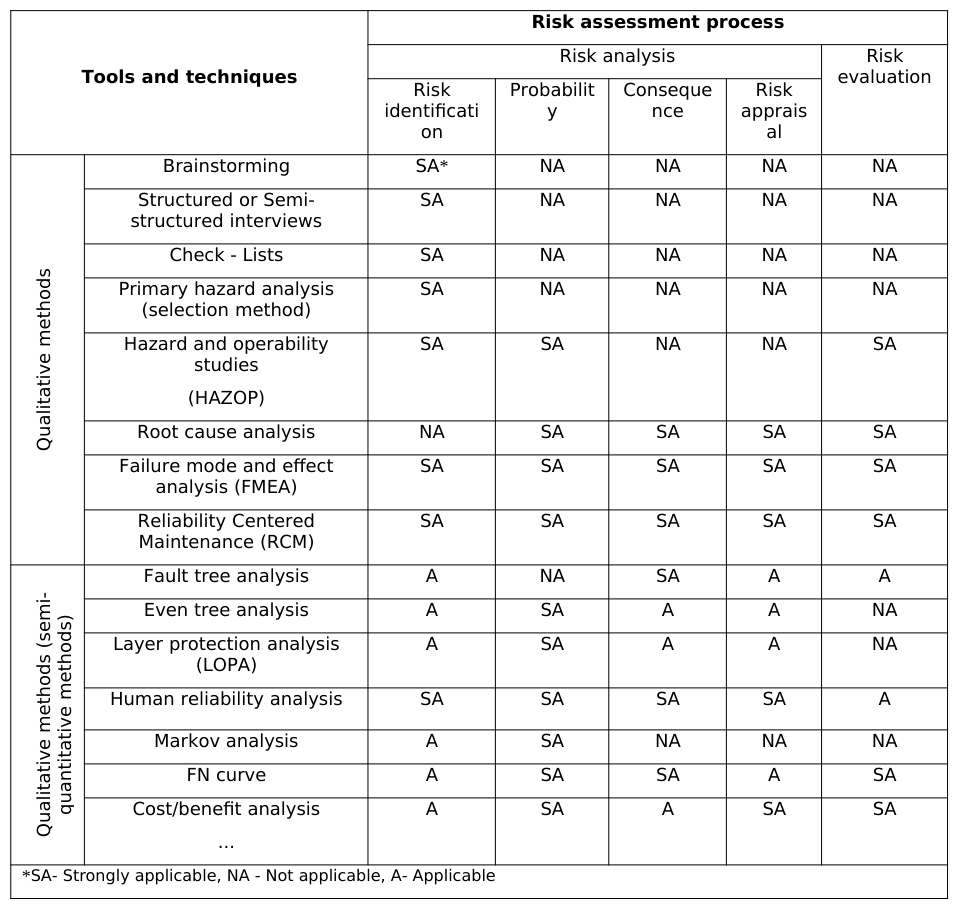
Process of risk assessment usually comes from qualitative to quantitative methods. No every applicable method allows to identify and estimate the importance of risk, i.e. is applicable for whole process of risk assessment. For assessor is very important to choose those methods, or their combination when evaluated data give authenticable information about the level of individual and societal risk (see Table 1).
Table 1: Sample of applicability of methods used for risk assessment (ISO/IECE 31010, 2009) Risk assessment process
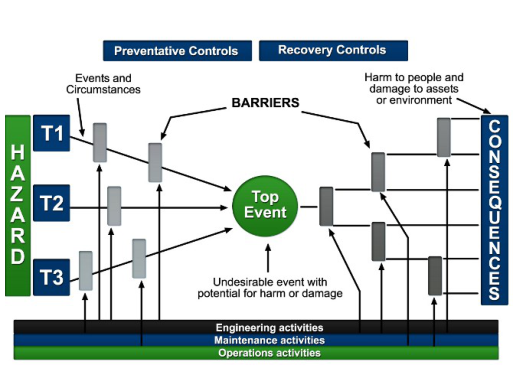
Principle of methods of major accident quantitative risk assessment is possible to describe through “bow tie” model (see Figure 2).
Figure 2. Risk Assessments and Reviews (SAACOSH, 2014)
From previous figure it is clear, that maintenance management has influence on decreasing (sometimes also “increasing” – in worse case) of major accident occurrence.
RISK BASED INSPECTION In the publication (Legat et al., 2013), physical asset management, as it was understood in the past, has been defined as a program of its acquisition, utilization and maintenance, based on set of rules, methods, procedures and tools for optimizing effects of costs, performance and risks during its life cycle (see Figure 3).
Corporate management
Asset management Maintenance management
Figure 3. Hierarchy of management processes (Legát at al., 2013)
Figure available in the original PDF paper.
Asset Management (AM) creates the relation between physical equipments (property) and company’s objectives/ strategies. Aim of AM is to achieve maximum benefit from each company’s physical property (Shah, M. and Littlefield, M., 2009). It´s methods are:
- Coordination of maintenance, operation, projects and inspections - Risk management and cost management during equipments life cycle - Constructional aspect identification, technologies, configuration, dimension and location - Asset management plan development.
Principles of RBI methodology Risk Based Inspection (RBI) is possible to define as a process, which supports the correct risk identification and assessment which has influence on safety, environment and business, coming from “active” and “potentional” damage mechanism of each equipment or enterprise pipes. Formally optimize inspection intervals of these equipments based on acceptable level of company risk and the state of integrity level (operational parameters), whereby to increase the risk of failure occurrence caused by the damage mechanism. This approach in maintenance management is oriented on these equipments (“static” equipments), which inspections, it means regular checking are covered under the legislation requirements e.g. into petrochemical, chemical area (usually on safety manner because according their functionality they can be source of major accident).
RBI is usually applicable for pressure equipments, pipes and tanks with dangerous substances. History of RBI comes from petrochemical area in USA, where through the standards API 580 and API 581 (author: American Petroleum Institute Houston and software application from API EEG company) are identifying causes (e.g. type of corrosion), which can lead to cracks or whole equipments rupture. All failure causes and possible consequences as leakage of dangerous substance are qualitative and quantitative evacuated and asses using the risk methodology and cover level of actual preventive and predictive maintenance activities. The result is delegation the level of risk (high, medium, low), for each assessing equipment (inventory group) according this the plan of maintenance activities optimalization – shorter or longer interval of inspection (see Figure 4).
Figure 4 Estimates of equipment risk (Dr A Muhammed and Mr J B Speck, 2002)
RBI introduces an effective planning of inspection based on risk assessment results!
Qualitative risk assessment each of assessed objects uses for risk evaluation Matrix type 5 x 5, where probability of failure is defined on summarization of 6 weight factors, as follow:
- number of components, - damage mechanism, - efficiency and practicality of inspection, - actual equipment state, - process characteristics, - safety construction and safety of tool.
The consequences of failure are evaluated, according to possibility of occurrence:
- fire, - explosion, - toxic dispersion.
Risk appraisal depends of each probability combination and possible consequence for each consequence under consideration (fire, explosion, toxic dispersion), where sum of these scenarios expresses overall value of risk of assessing object.
(2) For RBI application under negative event is understand loss of integrity of analyzing equipment. Between risk value and inspection activities is relationship, i.e. with increasing of inspection activities and combination of efficiencies methods, the level of loss integrity risk is decreasing. Risk management, mainly for the societal risk acceptance is describes by the ALARP principle (see Figure 5). Keystone of ALARP is to minimize level of risk “as too much as is reasonably practicable”, so measure activities changes the level of risk between non-acceptable and totally acceptable level – tolerable level. This approach was defined by HSE (Health and Safety Executive) in United Kingdom. For example, for nuclear industry, acceptable level of public individual risk is define less than 10 -6/year and tolerable less than 10-4 /year. Analogical individual risk for nuclear plant worker is state by the acceptable level less than 10-6/year and tolerable level less than 10-3 /year (Kotianova, 2010).
RBI -risk mineralization
Figure 5 ALARP Principle and RBI
CONCLUSION
RBI as a systematical process of operational risk assessment and management with aim of improving keeping of equipment through efficiency and effective inspection activities to assign companies possibility to increase high level of Health and Safety but also high level of Major hazard prevention, no less than sustainably development and good level of reputation. In the first step of implementation is the major negative aspect lack of knowledge and experience with risk management, formalism with data gathering, lack of methods and procedures knowledge - particularly in terms of their purpose in the process of risk assessment and an organizational structure (Department of Risk Management), which would be efficient to process and provide relevant information for the management of the company. RBI is an essential tool for integrated risk management system as a tool for reducing losses to the effective fulfillment of the organizations goals.
ACKNOWLEDGMENT
This paper was elaborated during realization of the project APVV-0337-11 “Research of new and newly arising risks in the industrial technologies in terms of the integrated safety as an assumption of a sustained development management.”
REFERENCES
API Recommended Practicle 581 (2008), “RBI. In.: The Equinity Engineering Group”. Milan, Italy. Dhillon, B. H. (2008). “Mining Equipment Reliability, Maintainability and Safety”. Springer Inc., London. pp.12–125. Grencik, J. et al. (2013). “Maintenance management. Synergy of theory and praxis”. Press Kosice: Slovak Maintenance Society.
p. 630. ISBN 978-80-89522-03-3.
ISO 31000 (2009). “Risk management - Principles and guidelines”. SUTN. IEC/FDIS 31010 (2009). “Risk management – Risk assessment techniques”. TMB Kotianova, Z. (2010). “Enterprises assessment with under limit value of dangerous substances”. Doctor of Philosophy work.
Publisher Košice: TU-SjF. Legat, V. at al. (2013). “Management and maintenance engineering”. Publisher Příbram: PBtisk Příbram. 570 p. ISBN 978-80- 7431-119-2. Muhammed, A. Speck, J. (2002). “Probabilistic remnant life assessment of corroding pipelines within a risk-based framework”.
TWI Website: http://www.twi-global.com. Nagyova. A. and Markulik, S. (2010). “Quality management system implementation in health service field”. Physiological Research, Vol. 59, No. 5, p. 40, ISSN 0862-8408. Nenadal, J. et al. (2008). “Modern Quality Management, Management Press”. Praha, p.377, ISBN 978-80-7261-186-7. Okstad, E. and Bye, R. (2009). “Maintenance KPIs in new started implementation for FPSOS”. In.: Euromaintenance. EFNMS
vzw, AIMAN, p.347. Oravec, M. and Kovacova, B. (2012). “Proposal of barrier models and selection of economic tools for their application”. 1 electronic optical disc (CD-ROM). In: Proceedings of 12th International Conference “Bezpečnost a ochrana zdraví při práci”, Ostrava. Pacaiova, H. and Sinay, J. and Glatz, J. (2009). “Safety and risk of technical systems”. SjF TU of Kosice, 246 p., ISBN978-80-
553-0180-8. Pacaiova, H. Nagyova, A. Bernatik, A. (2013). “Verification of Risk Assessment methodology in SME – Case Study”. In.: Integrisk 2013, Sturttgart, ISBN 978-3-943356-71-7. Shah, M. Littlefield, M. (2009). „Asset Performance Management“ Aberdeen Group, Inc.. Website www.aberden.com. pp 6-7. SAACOSH (Pty) Ltd. (2014). “Risk Assessment and review”. Website http://saacosh.com/index.php/site/page?view=risk-
assessments-and-reviews.
LISTED IN THE AHFE DIGITAL BOOKSTORE CATALOGUE
Explore the complete digital volume
Advances in Physical Ergonomics and Human Factors: Part I
Read this individual research paper free through the original publisher, or explore the full digital proceedings book.
ISBN 978-1-4951-2104-3
Explore this ISBN in the AHFE Bookstore ↗Listed in the July 2026 bookstore catalogue; search by ISBN to confirm current availability · Digital book purchase optional