Hana Pacaiova, Daniela Onofrejova (2022). Assessment of the Effectiveness and Safety of Exoskeletons in Industrial Workplaces. In: Safety Management and Human Factors. AHFE Open Access, vol. 64, pp. 117–124. https://doi.org/10.54941/ahfe1002636
Technical University of Kosice, Faculty of Mechanical Engineering, Department of Safety and Production Quality, Letna 1/9, 042 00 Kosice-Sever, Slovakia ↗
Machinery safety requirements are based on legislation and recommendations of harmonized standards (e.g. Directive 2006/42/EC, ISO 12100). A key aspect is the risk assessment, which considers the impact of hazardous situations and hazardous events on human lives and health. Risk analysis and assessment has traditionally been methodically supported by various tools, as Risk Matrix, Risk Graph, Failure Cause and Effect Analysis (FMEA), etc. A major problem in terms of meeting legal requirements is the assessment of exposure by factors such as noise, vibration and, in particular, the physical strain resulting from handling loads. Modern robotic workplaces are created by connecting several machines. On the positive side, high-risk hazardous situations (zones) are eliminated or minimized for the person working in such workplace. However, human activities are thus limited in particular to handling tasks, product quality control and withdrawal of finished products. Here, such influences arise that can affect human health in the long term, resulting from muscular load, which depends mainly on the design of the workplace, that means taking into account ergonomic principles already within workplace design. Measuring the physical load allows to "set up" the workplace so that the load is both immediate and long-term reduced by a suitable design solution, or by technical devices that reduce this load. Recently, research has focused on personalizing the reduction of musculoskeletal load not only by changing the workplace, but also by developing and testing special devices called exoskeletons. Exoskeleton’s interface is important to improve comfort, performance and of course personal health.
Damage to the musculoskeletal system is one of the most common work- related disorders. Recent research indicates that work-related musculoske- letal disorders (WMSDs) are one of the major health problems in the workplace, also with significant economic impact (Sultan-Taïeb et al., 2017), (Bevan, 2015). They affect millions of employees across Europe and repre- sent a cost in billions of euros for employers. Dealing with musculoskeletal disorders helps to improve the lives of workers, but it also makes business perspective.
The innovation potential in digitization and meeting growing demand, increase in productivity is wide ranging from increasingly sophisticated robots replacing workers in customer-oriented roles, to additive manufactu- ring technologies (3D printing) producing human organs (Costantino et al., 2021). The adoption of automation in industry has been growing over the last twenty years, intending to increase productivity while reducing the phy- sical workload required for human workers (Pacaiova et al., 2021). Also, according to OSHA (Occupational Safety and Health Agency), (Onofre- jova et al., 2021), and the implementation of robotics and exoskeletons, could also contribute to the improvement of working conditions. Pons (Pons et al., 2008) describes that the topic of exoskeletons is widely presented, including biomechatronic design, cognitive and physical human-robot inte- ractions, wearable robotic technologies, kinematics, dynamics, and control. New body-worn assistive devices - occupational exoskeletons (Theurel and Desbrosses, 2019) have been introduced in some workplaces to help wor- kers performing manual manipulation tasks while reducing the load on the muscular system (Pesenti et al., 2021). Currently, the interest in exoskeleton research has expanded into several areas. In particular, it has recently tran- sferred from the medical/rehabilitation field to the industrial sector. This is due to several reasons. On the one hand, the development of rehabilitation exoskeletons could reach a plateau because reliable and efficient solutions are available for these applications. On the other hand, Industry 4.0 is moving towards the concept of smart factories.
Many upper- and lower-limb wearable exoskeletons, which are mechani- cal structures worn on the body to enhance the strength of the wearer, have been developed and studied for their potential effect to limit exposure to physical load (DeLooze et al., 2015). Moreover, kinematics, postural con- trol, and discomfort in passive, lower-limb exoskeleton was studied in (Luger et al., 2019). Types of exoskeletons can be classified according to five crite- ria, which are: 1. what part of the human body the exoskeleton is designed for; 2. what element the exoskeleton is driven by; 3. how the exoskeleton is fixed; 4. how the exoskeleton is controlled; and, 5. what the exoskeleton is composed of.
Currently, most studies on exoskeletons demonstrate promising results. Authors (Maurice et al., 2019) investigated the PAEXO passive exoskele- ton for overhead work, the use of which effectively reduces physical effort and fatigue. Authors (Veslin et al., 2012) focused on the study of the upper arm exoskeleton and created a simulation in Matlab. Other study (Stei- nhilber et al., 2020) indicates that lower extremity exoskeletons, aiming to reduce physical load associated with prolonged standing, may impair workers’ postural control and increase the risk of falling. According to (Zam- pogna et al. 2020), and other studies about wearable technology (Teng et al., 2008), (Khakurel, et al., 2017) has been proving convincing and useful results in evaluating motor impairments of subjects suffering from (among others) Parkinson disease. Other studies argue that exoskeletons need to be closely linked to the manufacturing activities of Industry 4.0 organizations (Kadir and Broberg, 2021) as they will perform operations in collaboration with
Assessment of the Effectiveness and Safety of Exoskeletons in Industrial Workplaces 119
these advanced technologies (Onofrejova and Simsik, 2019). Authors (Mau- rice et al., 2018) in the study examined the opinion of factory workers and non-workers on three human-centered technologies aiming at impro- ving working conditions: collaborative robots, exoskeletons and wearable sensors. Workers and non-workers were mostly positive about these tech- nologies and agreed they would increase workers’ physical well-being. Not many studies have investigated poor mental well-being in the workplace due to work-related musculoskeletal disorders (Maakip et al., 2017). In the automotive industry, they investigated the Noonee chairless-chair, which is a passive device for workers that does not require power. It is supposed to be a practical device for workers who have to remain in ergonomically uncomfortable positions.
ERGONOMIC DESIGN OF WORKPLACE SUPPORTED BY SENSOR MEASUREMENTS AND EXOSKELETON DEVICES Here, such influences arise that can affect human health in the long term, resulting from muscular load, which depends mainly on the design of the workplace, that means taking into account ergonomic principles already at workplace and machinery design. Ergonomic risk assessment principles require such risks assessment coming from load handling, work tools, ligh- ting, ventilation, workplace noise, vibration from work equipment and other stressors. Quantitative measurement of physical activity based on standard criteria (e.g., ISO 6385, ISO/TS 20646, ISO 11228-1, 11228-2) requires the application of a suitable measurement system. Measuring the physical load allows to “set up”the workplace so that the load is both immediate and long- term reduced by a suitable design solution, or by technical devices that reduce such load.
Recently, research has focused on personalizing the reduction of muscu- loskeletal load not only by changing the workplace, but also by developing and testing special devices called exoskeletons. Exoskeletons interface are required to improve comfort and usability. However, some authors claim (Theurel and Desbrosses, 2019) that laboratory-based evaluations of exoske- letons justify different results, since the effect of an exoskeleton is task specific and they cannot be used as a basis for a decision on the universal application of the exoskeleton in practice. Perceived use of an exoskeleton, whether the exoskeleton is being safe or dangerous and the potential risks of wearing an exoskeleton have to be known prior to their application in the workplace. However, exoskeletons can have the unintended negative consequence of reducing human flexibility leading to new sources of musculoskeletal disor- ders (MSDs) and accidents. The three main risks can be identified, as getting caught by objects in the work environment, a risk of falling, and a concern for developing new musculoskeletal disorders, or muscular atrophy.
Some linkage is important to assess the risks associated with the activity and to reassess the risks following the application of the exoskeleton. The basic principle is that exposure to the workload must consider all risks and especially their long-term effects on the worker and verify whether such equi- pment (exoskeleton) reduces these risks or can be a source of new hazards to
120 Pacaiova and Onofrejova
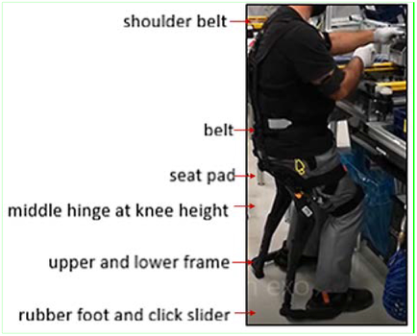
Figure 1: Lower body exoskeleton – Chairless chair 2.0 (CC 2.0). Exoskeleton was used in Experiment 2 (EXO): minimizing the physical load by ergonomic sit-stand pattern.
the activity. The methodology of risk assessment in practice requires a change of approach in its application in a particular work environment and even a certain modification considering the qualitative and even quantitative effects of stress factors in the use of the exoskeleton.
Measurement Design Our trial field experiment is based on comparing the occupational conditi- ons of workers in two states: a) standard work in standing position [STAND] (ENA); b) work with technical device – exoskeleton in standing/sitting posi- tion [EXO] (EWA). The introductory measurements were set in industrial workspace, where the worker’s job was to assemble the mounting nest by placing the outer and inner ring there, as well as inserting a metal stones into the marked holes in takt of 0.94 minutes. Synchro pre-assembly consists of 10 tasks, in each task handles 1 piece; mean manipulation time (TMmean) for manipulation per 1 piece is ~ 0.09 min. Particular assembly workplace with repetitive movements was chosen for exoskeleton deployment. The working height is solid with “elbow-floor” distance def equal to 1.22 m and wor- king distance “grasping arm” (sagittal plane) dga equal to 0.23 m. Workplace design couldn’t been changed during experiment and we intended to investi- gate, whether existing workplace is suitable for diverse group of workers, if there are any insufficiencies and the workplace posing a risk of developing MSDs to the employees. The workers as end-users were trained with safety instructions on the use of the exoskeleton CC 2.0. The training was perfor- med a day before experiments were conducted, and lasted ~ 30 minutes for each tested worker. The duration of one experiment was ~ 30 minutes. As a corrective measure, the industrial exoskeleton CC 2.0 was applied, as a support of lower body part.
The Chairless Chair® 2.0 (CC 2.0) (Figure 1) is a Wearable Ergonomic Mechanical Device intended for use in production and assembly lines. It allows users to take breaks and sit down occasionally while working.
Assessment of the Effectiveness and Safety of Exoskeletons in Industrial Workplaces 121
Table 1. Verification of measured motion data file normality is performed using the Shapiro-Wilk normality test. For each file we tested the null hypothesis: “The sample distribution is normal”. If the p-value is less than the significance level α, then the null hypothesis is rejected and the distribution is non-normal.
Table available in the original PDF paper.
Joint/Mean x [%] Green Area Orange Area Red Area Condition STAND EXO STAND EXO STAND EXO Neck 55.5 66.7 34.1 26.7 10.4 6.5 Lower Back 93.1 95.9 6.8 4.1 0.1 0.0 Right Shoulder 72.8 72.0 18.6 19.0 8.6 9.0 Left Shoulder 77.71 61.11 15.91 26.71 6.4 8.6 Right Hip 94.6 83.7 5.4 8.0 0.0 8.2 Left Hip 89.71 72.81 10.11 21.01 0.2 6.21
1 Values with significant impact on results.
Occupational exoskeleton was used in Experiment 2 (EXO) as a technical aid for improving the ergonomic postures of the worker and applying sit- stand pattern at work. Experiment 1 (STAND) preceded Experiment 2 (EXO) and served to measure the actual state of ergonomic workload of the worker.
For the assessment of the ergonomic risk, the wireless sensor ergonomic system TEA Captiv was used. Captiv enables an adaptable and scalable solution for capturing workers in their work environments thanks to a multifunctional analysis embodying body posture, carrying capacity, muscu- loskeletal limitations and repetitive movements and vibrations. The study was conducted according to the guidelines of the Declaration of Helsinki, and approved by the Institutional Review Board of the Technical University of Kosice (protocol code 8268/2021/R-OLP).
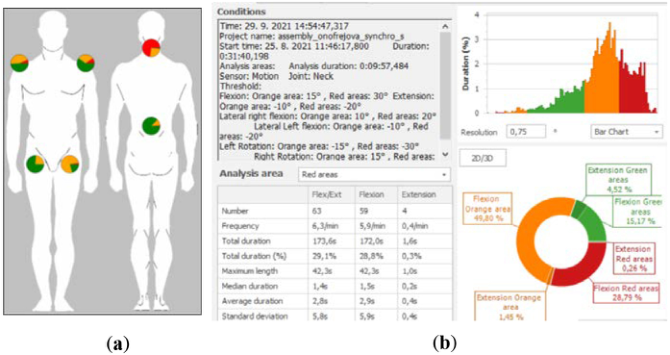
The measured data were displayed via 3D avatar (virtual human man- nequin), which offered animations of the provided task together with visu- alizations of system evaluation results by marking body segments with green/orange/red colors indicating fully customizable threshold values for reference angles. Green color means suitable conditions for a segment loa- ding; orange indicates a change in activity has to be considered, and red indicates inappropriate activity that needs an immediate correction.
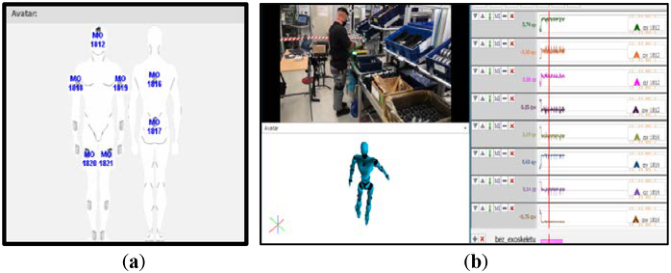
Figure 2a shows the placement of 7 motion sensors (MO) on the following segments: Head (forehead), Back (spine on T2), Pelvis, Left and right arms (humerus), Left and right forearms (radius, cubitus), Upper left and right legs (femur). The Captiv’s avatar represents worker activity, and his simultaneous joints angles with colors indicating which threshold values exceeded in the monitored joints, see Figure 2a and 2b, and Figure 3a and 3b.
CONCLUSION
We used the wireless sensor system Captiv for ergonomic risk assessment at the assembly workplace in the automotive industry in our first experi- ments with 7 motion sensors. Our tested workers repetitively performed assembly of synchronous units in the transmission in the fast pace. Measure- ment results indicated the unacceptable ergonomic risk in the neck, shoulder
122 Pacaiova and Onofrejova
Figure 2: Setting and the implementation of the measurement in the industrial work- space: (a) Placement of the Captiv wireless sensors on the body; (b) The captured data with Captiv sensor system before their evaluation, with synchronization of data and video recording, and avatar visualization.Figure 3: Results: a) Postures evaluation results for work activity; b) Detailed results of time duration in individual postures, in experiment with 1 worker using exoskeleton for neck flexion/extension.
and hip joints. To eliminate the physical load, the employee was applied a passive exoskeleton CC 2.0, which is designed to support the lower limbs. Improvement of the posture is evident in the upper body. Results from our trial measurements show positive impact on the workers when using exoskeleton; there is evident improvement in the position of workers, in flexion of neck the ratio (%) between zones green/orange/red was changed from 55.5/34.1/10.4 to 66.7/26.7/6.5; lower back was without significant changes, the ratio (%) between zones green/orange/red was changed from 93.1/6.8/0.1 to 95.9/4.1/0.0. The highest improvement was neck flexion/ex- tension. Right shoulder was slightly negatively influenced by lower position during sitting, the ratio (%) between zones green/orange/red was changed from 72.8/18.6/8.6 to 72.0/19.0/9.0; the worst situation was in horizontal
Assessment of the Effectiveness and Safety of Exoskeletons in Industrial Workplaces 123
internal/external rotation. The similar situation was in left shoulder. Left hip achieved worse results, the ratio (%) between zones green/orange/red was changed from 89.7/10.1/0.2 to 72.8/21.0/6.2, which can be an effect of a short period using a new equipment by the employees. The worst situation was observed in left hip rotation. For right hip we observed better conditions than in left hip, the ratio (%) between zones green/orange/red was changed from 94.6/5.4/0.0 to 83.7/8.0/8.2.
Exoskeleton manufacturers inform about positive effects usually based on experiments in the laboratory environment. Their effect in the industrial envi- ronment needs to be verified from a long time frame. The advantage of a multisensor system is the collection of complex data at the same time, which simplifies the evaluation and effectiveness of measurements. Awareness about the influence of exoskeletons on individual parts of the body and the right choice of work activities may be beneficial for the design of healthy modern workplaces based on individual risk assessment.
Further research will focus on developing a methodology for risk asses- sment, considering the stress factor associated with the use of the exoskeleton (specific types) on the one hand and its impact on reducing WMSDs hazards. The influence of the exoskeleton understood as safety devices must be examined as an emerging risk (Constantino et al., 2021) or as emerging opportunities for improving the working environment and thus the health of employees resulting from the new trends of Industry 4.0.
ACKNOWLEDGMENT
The authors would like to acknowledge for the support by the Slovak Agency Supporting Research and Development APVV-19-0367 and APVV-19-0290 and the Slovak Grant Agency KEGA 013TUKE-4/2020.
REFERENCES
Bevan, S. (2015). Economic impact of musculoskeletal disorders (MSDs) on work in Europe, BEST PRACTICE & RESEARCH: CLINICAL RHEUMATOLOGY Volume 29. Costantino, F., Falegnami, A., Fedele, L., Bernabei, M., Stabile, S., Bentivenga, R.
(2021). New and Emerging Hazards for Health and Safety within Digitalized Manufacturing Systems, SUSTAINABILITY No. 13. DeLooze, M.P., Bosch, T., Krause, F., Stadler, K.S., O’Sullivan, L.W. (2015). Exoskeletons for industrial application and their potential effects on physical work load, ERGONOMICS No. 59. Kadir, B.A., Broberg, O. (2021). Human-centered design of work systems in the
transition to industry 4.0. APPLIED ERGONOMICS No. 92. Khakurel, J., Pöysä, S., Porras, J. (2017). The Use of Wearable Devices in the Workplace—A Systematic Literature Review; Springer: Cham, Switzerland. Luger, T., Seibt, R., Cobb, T.J., Rieger, M.A., Steinhilber, B. (2019). Influence
of a passive lower-limb exoskeleton during simulated industrial work tasks on physical load, upper body posture, postural control and discomfort. APPLIED ERGONOMICS No. 80. Maakip I., Keegel T., Oakman J. (2017). Predictors of musculoskeletal discomfort: a cross-culturalcomparison between Malaysian and Australian office workers. APPLIED ERGONOMICS No. 60.
124 Pacaiova and Onofrejova
Maurice, P., ˇCamernik, J., Gorjan, D., Schirrmeister, B., Bornmann, J., Tagli- apietra, L., Latella, C., Pucci, D., Fritzsche, L., Ivaldi, S., Babiˇc, J. (2019). Evaluation of PAEXO, a novel passive exoskeleton for overhead work. COMPU- TER METHODS IN BIOMECHANICS AND BIOMEDICAL ENGINEERING No. 22. Maurice, P., Allienne, L., Malaise, A., Ivaldi, S. (2018). “Ethical and Social Considerations for the Introduction of Human-Centered Technologies at Work”, proceedings of IEEE Workshop on Advanced Robotics and its Social Impacts (ARSO), Genova, Italy. Onofrejova, D., Balazikova, M., Hovanec, M. (2021). “Consideration for Experi-
mental Verification of the Effectiveness and Safety of Exoskeletons” proceedings of 12th International Conference on Applied Human Factors and Ergonomics, AHFE 2021, Vol 19, ed P Arezes R Boring. New York: Lecture Notes in Networks and Systems. Onofrejová, D., Šimsík, D. (2019). Change in concept from conventional to digital factory of the future. MM SCIENCE Volume 12, No. 5. Paˇcaiová, H., Andrejiová, M., Balažiková, M., Tomašková, M., Gazda, T., Chomová,
K., Hijj, J., Salaj, L. (2021). Methodology for Complex Efficiency Evaluation of Machinery Safety Measures in a Production Organization. APPLIED SCIENCES Volume 11. Pesenti, M., Antonietti, A., Gandolla, M., Pedrocchi, A. (2021). Towards a functional performance validation standard for industrial low-back exoskeletons: State of the art review. SENSORS Volume 21, No. 3. Pons, J.L. (2008). Wearable Robots: Biomechatronic Exoskeletons. Wiley: Hoboken,
NJ, USA. Steinhilber, B., Seibt, R., Rieger, M.A., Luger, T. (2020). Postural control when using an industrial lower limb exoskeleton: Impact of reaching for a working tool and external perturbation. HUMAN FACTORS. Sultan-Taïeb, H., Parent-Lamarche, A., Gaillard, A., Stock, S., Nicolakakis, N.,
Hong, Q.N., Vezina, M., Coulibaly, Y., Vézina, N., Berthelette, D. (2017). Economic evaluations of ergonomic interventions preventing work-related muscu- loskeletal disorders: A systematic review of organizational-level interventions. BMC PUBLIC HEALTH Volume 17. Teng, X.F., Zhang, Y.T., Poon, C. C. Y., Bonato, P. (2008). Wearable medical systems for p-Health. IEEE REVIEWS IN BIOMEDICAL ENGINEERING Volume 1. Theurel, J., Desbrosses, K. (2019). Occupational Exoskeletons: Overview of their
Benefits and Limitations in Preventing Work-related Musculoskeletal Disorders. IISE Transactions Occupational Ergonomics and Human Factors. Veslin, E.Y. et al. (2012). Tracking Control in an Upper Arm Exoskeleton with Differential Flatness. Robotic Systems – Applications, Control and Programming. (1 st Ed.). InTech, China. Zampogna, A.; Manoni, A.; Asci, F.; Liguori, C.; Irrera, F.; Suppa, A. (2020).
Shedding Light on Nocturnal Movements in Parkinson’s Disease: Evidence from Wearable Technologies. SENSORS Volume 20.
LISTED IN THE AHFE DIGITAL BOOKSTORE CATALOGUE
Explore the complete digital volume
Safety Management and Human Factors
Read this individual research paper free through the original publisher, or explore the full digital proceedings book.
ISBN 978-1-958651-40-7
Explore this ISBN in the AHFE Bookstore ↗Listed in the July 2026 bookstore catalogue; search by ISBN to confirm current availability · Digital book purchase optional