Yu-Ching Yeh, Ming-Chung Chen, Hsiang-Ju Ho (2018). Design of Tablet Storybooks Adopting a “Universal Design for Learning” Approach to Assist Bilingual Learning. In: Advances in Physical Ergonomics and Human Factors: Part II. AHFE Open Access, vol. 2. https://doi.org/10.54941/ahfe100071
Prior studies have shown that information technology is effective for increasing children’s vocabularies and reading comprehension; however, its effects on bilingual or heritage language learning require further study. This article reports on a bilingual tablet storybook design using the Universal Design for Learning (UDL) approach. The electronic storybooks were written in two languages: Mandarin and Vietnamese. After the welcome page, the tablet storybooks include four parts: a story in Mandarin (including text and reading), a story in Vietnamese, Mandarin games, and Vietnamese games. The text contains frequently used vocabulary. The storybook apps provide the frequently used vocabulary with Mandarin and Vietnamese pronunciations and explanations (in picture, oral, and text forms). In the second part of the game, “Little Story Teller,” the tablet provides five different background pictures and the users select and arrange the objects and figures presented in the pictures. This study sheds light on the application of tablet storybooks to heritage language learning or bilingual learning. Tablet storybooks can serve as a supplement for bilingual or multilingual learning and encourage a learner-centered and self-directed mode of instruction.
Reading stories is a key element of preschoolers’ language learning and literacy acquisition process. However, reading stories is particularly difficult for children from immigrant families, because their parents may have inadequate education and most of them are socially and economically disadvantaged. Some immigrant families cannot provide sufficient educational resources, particularly storybooks. In order to improve young children’s literacy and expressive language ability, we designed tablet storybooks to motivate children to develop an interest in reading and to improve their literacy, and to encourage children to create their own electronic storybooks after reading.
Tablet computers and smartphones have become increasingly popular, to the extent that young children now live in Physical Ergonomics II (2018) an era of mobile computing with various electronic devices available (Godwin-Jones, 2008). How often parents are giving their young children smartphones and tablets, either for leisure or for learning, remains largely undetermined. Forty-two percent of middle-class mothers in Israel acquired e-book software for their young children to use at home (Korat, 2010). A newspaper report observed that the portion of children age 5 to 7 playing with smartphones and tablets in the USA had increased from 38% in 2011 to 72% in 2013 (China Times News, 8 November 2013). Another report, from the Korea Internet Security Agency, indicated that use of the Internet among three- to five- year-old children in South Korea had increased from 51.4% of the population in 2006 to 66.2% in 2011 (Ministry of Education, 2012). The phenomenon of the “electronic nanny” is thus becoming a popular but also an educationally challenging situation. Since the use of these devices has become so popular, educators must consider how to incorporate these tools to assist children’s learning. Developing a user-centered design approach involving electronic devices is the core idea of this study, with the goal of making language learning interesting and learner- directed.
Although an increasing number of parents and young children are familiar with tablets and e-books, some parents and nursery school teachers still prefer to read printed copies to young children, because they believe that the interactions between adults and children are beneficial in encouraging in-depth reading. Printed books are perceived by some researchers as more natural and intuitive (Liesaputra et al., 2009). However, printed books lack the capacity for video animation or listening to audio reading. Young children are attracted to e-books that contain visual and hearing stimulation, and electronic tests also challenge and interest young users. Godwin-Jones (2011) suggested that tablets will become widely used in the near future, and having language learning applications for the tablet will be highly desirable if the target audience has a marked preference for this platform. However, existing language applications are limited by problematic image and video displays, poor audio quality, and awkward text entry formats (Chinnery, 2006). Our aim is to design creative and interactive apps to assist children’s language learning.
DEVELOPING TABLET STORYBOOKS TO SUPPORT LANGUAGE LEARNING Language Learning with Technological Aids
Children are growing up in an era of mobile computing (Godwin-Jones, 2008) with many different kinds of electronic devices and tablet computers. However, Godwin-Jones (2011) indicated that mobile devices have their limitations in that they can be uncreative, pedestrian, and repetitive. Designing a creative and interactive e-storybook is thus important for enhancing children’s second language learning. Maor, Currie, and Drewry (2011) evaluated the effectiveness of assistive technology and found that most studies have shown consistently improved outcomes for children in spelling, reading, and writing. However, we need further evidence to verify the effectiveness of tablet storybooks in contributing to children’s heritage language learning. Even though some research has indicated ways in which information technology can assist second language learning (Golonka et al., 2014), the second language is usually taught in a professional and well-organized curriculum. Tablet storybooks designed for children of cross- national marriage families encourage immigrant parents to speak the heritage language with their children via the storybooks.
Recio (2011) used tablet storybooks to assist three- and four-year-old Spanish children in learning English. The results showed the effectiveness of tablet storybooks and indicated that English teachers regarded information and communications technology (ICT) as a positive strategy for children’s bilingual learning. The language course incorporating information technology increased learning motivation among the children, whose first language was Spanish. Some of the teachers expressed the view that English literacy training could be deferred until after further development of the first language, particularly when the young children were at the initial stage of learning Spanish. However, Recio’s (2011) study indicated that the young Spanish children could acquire the language skills needed to comprehend the English storybooks. When children develop a comprehension approach related to bilingual literacy, they can always apply the approach to other languages. Davison, Hammer, and Lawrence (2011) studied Physical Ergonomics II (2018) the receptive language development of 81 bilingual preschoolers who participated in a two-year Head Start program. The results showed that these children’s English and Spanish vocabularies and expressive language exceeded that of their classmates who were not in this program when they were in first grade. English literacy can serve as a predictor of preschoolers’ Spanish literacy and vice versa. Nursery school is an important stage for language and literacy development. Bilingual learning at this stage will contribute to the students’ literacy and expressive language development when they enter primary school.
Although Recio’s (2011) study indicated the possible benefit of electronic storybooks in developing young pupils’ bilingual literacy, some issues remain to be worked out. First, Recio adopted CD-ROM and audiovisual systems to read storybooks to all pupils, but development of literacy and expressive language needs to consider individual children’s abilities. Solomon (2011), who studied African American first-graders, indicated that the children’s imagination and thinking were inspired when they experienced digital stories with visual and audio stimulation. It also challenged school teachers’ approaches to teaching pupils literacy.
In Taiwan, the instruction of pupils from immigrant families in their parents’ native languages has become an important goal of government policy (National Immigration Agency, 2013). However, immigrant parents face limitations in terms of time and ability (National Immigration Agency, 2010). These factors create difficulties in conducting heritage language learning at home. Family support is a key element influencing children’s attitudes toward learning heritage languages (Yeh, 2012). Providing self-learning devices for heritage language learning helps to resolve this problem.
Universal Design for Language Approach The tablet storybooks in this study were designed using the Universal Design for Learning (UDL) approach and contain multiple means of representation, expression, and engagement (CAST, 2011). UDL is a set of principles for curriculum development that give all individuals equal opportunities to learn. It is not a single, one-size-fits-all solution, but rather a set of flexible approaches that can be customized and adjusted for individual needs (CAST, 2011). The UDL approach contains three concepts: recognition networks, strategic networks, and affective networks. Recognition networks emphasize the collection of facts and data, along with how the learners judge and classify the information. The aim of recognition networks is to understand whether the learners can present and organize the information and content in different ways. Strategic networks focus on the planning and the presentation of learning tasks, as learners show how they organize and present what they have learned. Affective networks deal with the issue of promoting learners’ interests and increasing their participations in learning (Jiang & Chen, 2011). The UDL approach is designed to meet all participants’ needs, but is not necessarily the best or the only way of learning. It can be adapted to multiple styles of presentation. Rose and Meyer (2002) suggested that this approach provides necessary support and sufficient challenges for learners, and furthermore that it motivates learners for self-directed learning through their participation.
We can increase learners’ understanding through a variety of sensual stimulations. For this study we designed tablet storybooks that apply multiple forms of visual, hearing, and tactile presentation. The users can touch the screen and drag objects to the preferred space. When they touch the icons or objects on the screen, the tablet initiates another function, such as sound or animation. The tablet allows more than one user to participate at the same time, and the learning process can be properly recorded. The users are no longer passive receivers because they can select multiple tablet functions to create their products. The tablet storybook was designed to motivate children to develop an interest in learning heritage languages, solve the problems resulting from the lack of adults reading to them, and encourage children to learn via electronic storybooks at home.
FRAMEWORK FOR TABLET STORYBOOKS The tablet storybooks, designed using the principles of UDL, encourage learners to explore the materials according
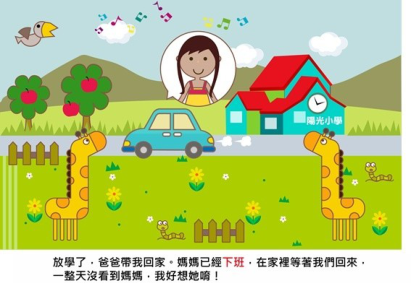
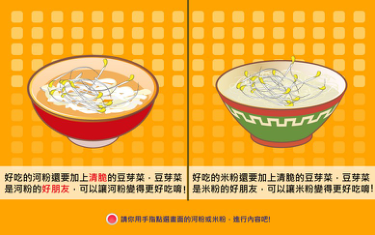
Physical Ergonomics II (2018) to their learning interests. The electronic storybooks, “Changeful Mothers” (Figure 1) and “Phở and Vermicelli,” are written in two languages, Mandarin and Vietnamese. (Phở is a traditional Vietnamese noodle and Vermicelli is a Taiwanese noodle.) The storybooks include a story written with Mandarin vocabulary items frequently used in first and second grade in Taiwan (Chen, Ko, & Chen, 2011). Key vocabulary words were marked in red. Their definitions and pronunciations can be read when users touch the highlighted vocabulary items. We considered that the children would be encountering Vietnamese for the first time and selected vocabulary words that are frequently used in the lower grades in order to decrease their frustration in learning Vietnamese. The content of the tablet storybooks is based on multicultural issues. For example, “Phở and Vermicelli” describes two traditional noodles in Taiwan and Vietnam. The tablet shows two empty soup bowls at the beginning of the story, and the user adds different ingredients and drags the picture objects to the appropriate soup bowl as the story continues (Figure 2).
Figure 1. The bilingual tablet storybook “Changeful Mothers”Figure 2. “Phở and Vermicelli,” in which the user drags different ingredients to the soup bowl
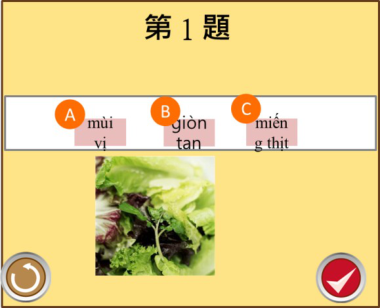
After the welcome page, the tablet storybooks include four parts (Figure 3): a story in Mandarin (including text and reading), a story in Vietnamese, Mandarin games, and Vietnamese games. The frequently used vocabulary words are inserted into the stories with links to their Mandarin pronunciations, Vietnamese pronunciations, and explanations for each word. Games using Mandarin and Vietnamese are provided with each storybook. The Mandarin games include a cloze test (consisting of single sentences and a short paragraph). The Vietnamese games include a picture- word matching test (Figure 4) and a single-sentence cloze test. The users choose a correct vocabulary word for each sentence and move it to the blank place. The tablet allows six seconds for the user to respond. When the user selects the vocabulary word, the tablet will indicate the correct answer and repeat the whole sentence. When the cloze test is completed, the tablet will count the number of correct responses. This activity provides an opportunity to practice frequently used vocabulary words. The system can detect whether the words have been used correctly in each sentence.
Physical Ergonomics II (2018)
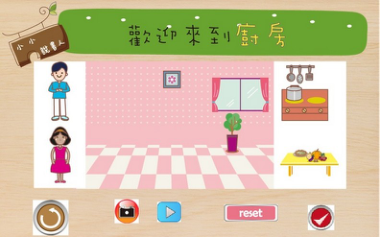
In the second part of the game, “Little Story Teller,” the tablet provides five different background pictures and the users select and arrange the objects and figures in the background picture (Figure 5). In the next step, the user clicks the picture and snapshot, and then he or she records a description of the picture by pressing the recording button on the screen. The system merges the five pictures into the child’s own storybook. The affective dimensions focus on how the learners are challenged, excited, and interested.
Welcome page
Mandarin Story Vietnamese Story Mandarin games Vietnamese games Picture-word
Figure 3. Structure of the tablet storybook
Figure available in the original PDF paper.
Figure 4. The Vietnamese vocabulary-picture matching game in tabletFigure 5. “Little Story Teller,” in which the user arranges the objects and figures in each background picture
Physical Ergonomics II (2018)
Characteristics of the Table Storybooks
The tablet storybooks have the following characteristics:
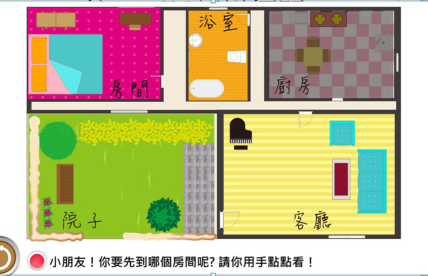
1. User-directed: The tablet users can decide which parts of the story to begin with. In “Changeful Mothers,” the users can decide which room to start in first. Once the room has been selected, it becomes dark (Figure 6). The user can start with a different room each time, resulting in a different story line. Labbo and Kuhn (2000) warned that in such cases children may be attracted by the animated objects instead of the story line. However, the story line was not the researchers’ primary concern in the tablet storybook design. Because the user can decide the order of the story, the user’s selection makes the story variable. The user can also create his or her own stories in the “Little Story Teller” section.
Figure 6. “Changeful Mothers”; the user can choose any room to start the story 2. Language learning based upon stories: Korat (2010) suggested that children’s vocabulary is the most important vehicle for reading comprehension. Children with a rich vocabulary will have better literacy and academic progress in later years. Another characteristic of the tablet storybooks is that they provide repeated vocabulary practice within the text and games. Each story contains key vocabulary words with highlighted marks. The users can also practice the key vocabulary in the game section, such as through the cloze test.
3. “Read for myself”: The game called “Little Story Teller” encourages young children to tell a story while the tablet records their voice. The users can pick their own book from the bookshelf at the welcome page. This function goes beyond the one-way textual reading provided by e-books. Young children can read for themselves instead of relying passively on adults or other devices to read to them. The chance to hear their own voice telling a story can stimulate their expressive language.
CONCLUSIONS
In this project we designed a bilingual tablet storybook in Mandarin and Vietnamese. The same system can apply to other languages such as English and German. The user-directed design encourages learners to create their own stories. The researchers have been able to follow how the young children’s expressive language ability has improved from the recorded storybooks. The design of the tablet storybooks is expected to increase young children’s literacy and expressive language. The following issues can be explored in the future:
1. Technological improvement: Correct pronunciation is an important element in bilingual learners’ expressive Physical Ergonomics II (2018) language. We would suggest the tablet storybooks can be equipped with the function of double-checking the user’s pronunciation. We expect that future systems will be able to compare the user’s soundtrack with the tablet’s own word list and indicate incorrect pronunciations. This may help learners to detect their faults and raise bilingual learners’ sensitivity to expressive language.
2. Inclusion of dialogue practice in games: The tablet storybooks that we designed emphasized vocabulary practice. Both the Mandarin and Vietnamese games included cloze tests to expand bilingual learners’ vocabulary via repeated practice. However, daily conversations and dialogues could be added to the tablet storybooks. Conversations are a frequent part of daily life and a basic component of expressive language. We would suggest including dialogues, starting at an easy level for beginning students. Animated characters interacting with each other could make the dialogues more interesting.
3. Parents’ involvement in assisting young children using tablet storybooks: The young children participating in this project expressed the view that the tablet storybooks are interesting. In order to encourage pupils’ second language learning, however, tablet storybooks are not enough. The UDL approach may attract young children at the beginning of the project, but the young children expected adults to accompany and work with them when they operated the tablet storybook. The technological devices can be an initial motivating factor, but parent support is a critical and long-lasting factor in young children’s second language learning.
REFERENCES
CAST (2011), Universal design for learning guidelines version 2.0, Wakefield, MA: CAST. Chen, M. C., Ko, C. C., & Chen, S. W. (2011), Chinese text entry training system developed based on core vocabulary approach.
Paper presented at the Asia-Pacific Conference on Technology Enhanced Learning, Xi-an, China. China Times News (2013), Watch Out Your Children! The Numbers of Children Using Smart Phones Grow Explosively in the USA (8 November). China Times website: http://www.chinatimes.com/realtimenews/20131108002035-260412 Chinnery, G. (2006), Going to the MALL: Mobile assisted language learning. Language Learning & Technology, 10(1), 9-16. Davison, M. D., Hammer, C., & Lawrence, F. R. (2011), Associations between preschool language and first grade reading
outcomes in bilingual children. Journal of Communication Disorders, 44(4), 444-458. Godwin-Jones, R. (2008), Mobile-computing trends: Lighter, faster, smarter. Language Learning & Technology, 12(3), 3-9. Godwin-Jones, R. (2011), Emerging technologies: Mobile apps for language learning. Language Learning & Technology, 15(2), 2-11. Golonka, E. M., Bowles, A. R., Frank, V. M., Richardson, D. L., & Freynik, S. (2014), Technologies for foreign language
learning: A review of technology types and their effectiveness. Computer Assisted Language Learning, 27 (1), 70-105. Jiang, C. H., & Chen, M. C. (2008), A discussion of the new trend of the universal design of learning in inclusive education. Yuling and Chiayi Special Educaion, 6, 8-15 (in Chinese). Korat, O. (2010), Reading electronic books as a support for vocabulary, story comprehension and word reading in kindergarten
and first grade. Computers & Education, 55, 24-31. Labbo, L. D., & Kuhn, M. R. (2000), Weaving chains of affect and cognition: A young children’s understanding of CD-ROM talking books. Journal of Literacy Research, 34, 478-493. Liesaputra, V., Witten, I. H., & Bainbridge, D. (2009), Creating and reading realistic electronic books. Computer, 42(2), 72-81. Maor, D., Currie, J., & Drewry, R. (2011), The effectiveness of assistive technologies for children with special needs: A review
of research-based studies. European Journal of Special Needs Education, 26(3), 283-298. Ministry of Education (2012), The South Korean society’s concerns about young children’s indulgence in smartphones and the negative effects on their personality. E-paper (24 February), Ministry of Education website, http://epaper.edu.tw/windows.aspx?windows_sn=9493 National Immigration Agency (2010), Survey of foreign spouses’ living condition and needs from Southeast Asian countries and
Mainland China in 2008. National Immigration Agency website, http://www.immigration.gov.tw/lp.asp?ctNode= 31540&CtUnit=17111&BaseDSD=7&mp=1 National Immigration Agency (2013), The National Torch Project for the cross-national marriage family. National Immigration Agency website: http://www. immigration.gov.tw/np.asp?ctNode=33976&mp=1 Organisation for Economic Co-operation and Development (2009), Migration, in Society at a glance 2009: OECD social
indicators, OECD Publishing. OECD website: http://dx.doi.org/10.1787/ soc_glance-2008-7-en Recio, A. (2011), Exploring the impact of using stories and ICT to teach English to 3- and 4-year-old Spanish children: Motivation and development. Paper presented at the EDULearn International Conference on Education and New Learning Technologies, 4-6 July 2011, Barcelona, Spain.
Physical Ergonomics II (2018)
Rose, D. H., & Meyer, A. (2002), Teaching every student in the digital age: Universal Design for Learning. Alexandria, VA: Association for Supervision and Curriculum Development. Solomon, M. J. (2011), The need for (digital) story: First graders using digital tools to tell stories. Unpublished Ph.D.
dissertation, University of Texas at Austin. Yeh, Y. C. (2012), A review of the execution of the mother-language policy among new immigrants. Educational Resources and Research, 106, 57-81 (in Chinese).
Physical Ergonomics II (2018)
LISTED IN THE AHFE DIGITAL BOOKSTORE CATALOGUE
Explore the complete digital volume
Advances in Physical Ergonomics and Human Factors: Part II
Read this individual research paper free through the original publisher, or explore the full digital proceedings book.
ISBN 978-1-4951-2105-0
Explore this ISBN in the AHFE Bookstore ↗Listed in the July 2026 bookstore catalogue; search by ISBN to confirm current availability · Digital book purchase optional