Yuki Ikenobo, Noriyuki Kida, Noriaki Kuwahara (2022). Analyzing the Difference Between Experts and Non-experts in Ikebana. In: Advances in Ergonomics In Design, Usability & Special Populations: Part I. AHFE Open Access, vol. 18. https://doi.org/10.54941/ahfe100801
Ikebana flower arrangement is a traditional cultural activity in Japan. It originates from the Buddhist tradition of flowers for the deceased and possesses a 1,500-year history. Ikebana skill has been handed down in the oral tradition from the master to the disciple, not in a systematic educational system. Also, the process of arranging flowers has not been evaluated quantitatively. Therefore, the object of the present study was to evaluate the process in Ikebana flower arrangement by extracting and examining the various operations, or steps. First, we divided four participants according to the number of years they have been practicing Ikebana, dividing them into expert and non-expert camps. The seated participants arranged three flowers and four materials using free-style Ikebana methods. The process was recorded by two video cameras (60fps). Using the obtained video images, we measured the frequency and time by classifying the operations involved in arranging flowers. We found that the process of flower arranging could be broken down into six operations; ‘Observing’, ‘Cutting’, ‘Bending’, ‘Coordinating’, ‘Inserting’, and ‘Modifying’. There were differences in the number of ‘Coordinating’ and ‘Modifying’ steps between experts and non-experts. The number of ‘Modifying’ steps for experts (15 times) was significantly less than that for non-experts (33 times). Also, there were differences in the time spent ‘Bending’, ‘Coordinating’, and ‘Modifying’ between experts and non-experts. The time spent ‘Bending’ for experts (93 seconds) was significantly shorter than that for non-experts (106 seconds). Second, we analyzed a Japanese high school contest for Ikebana flower arrangement. Seven teams of three students set to participate, and the process of Ikebana was recorded by two video cameras (60fps). As a result, it was possible to quantify the characteristics of the winning team. These results suggest the importance of the skill of ‘Bending’ and ‘Coordinating’ in the process of Ikebana flower arrangement.
Research Background: Ikebana Ikebana is a traditional form of Japanese culture with a history that spans more than 550 years. Although
Ergonomics In Design, Usability & Special Populations I (2022) https://openaccess.cms-conferences.org/#/publications/book/978-1-4951-2106-7 quintessentially Japanese, Ikebana's appeal has become international in recent years. Much of the focus in ikebana goes toward the finished product -- the flower arrangement -- but ikebana is also a spiritual practice known as the "way of flowers" that sets it apart from the Western art of flower arrangement. The material used in ikebana is not limited to bright and colorful flowers. Ikebana differs from Western flower arrangement in that a tapering stem, a branch, leaves and moss are all ikebana material.
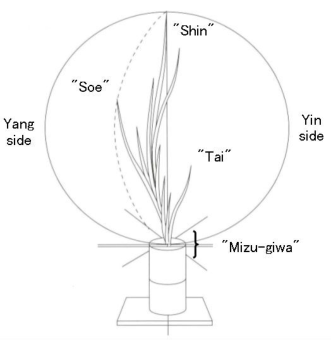
Figure 1. Model of Shoka style
Identifying the Problem Ikebana involves organic material that changes every day and with a limited lifespan. The tradition has endured to this day, evolving into several different styles through the years, thanks to a system where knowledge is handed down from master to apprentice. Ikebana is considered a spiritual practice for its focus on the process rather than the finished product.
Ergonomics In Design, Usability & Special Populations I (2022) https://openaccess.cms-conferences.org/#/publications/book/978-1-4951-2106-7 but has made next to nothing in the areas of natural science and scholarly inquiry. To this day, teaching ikebana has relied on the traditional idea of "watching and learning," or “staying attuned to what the instructor is doing”. This limits ikebana from spreading internationally to people with diverse languages and cultural backgrounds. There is a critical need for science to step in and bring some objectivity into the instruction and evaluation of ikebana skills.
Purpose of Research In recent years, the field of sports has embraced the concept of a fixed model as the most practical, efficient and even aesthetically pleasing way to acquire skills. The same can be said about Ikebana. The entire Ikebana process, from start to finish, needs to be systematized by identifying each task and recording the length of time it takes to complete them. One must also take into consideration the various experience levels of the practitioners and how that influences their work. The goal of this study is to observe ikebana by videotaping the process, organizing that process by tasks, then consider the effect a practitioner's experience has on the tasks themselves and how often those tasks are repeated.
METHODS
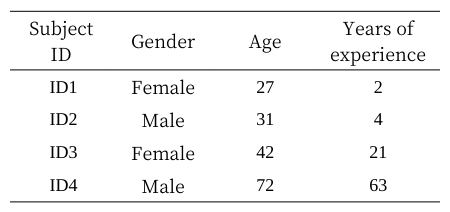
Research Subjects There are four subjects in this study: two men, two women. They are all veterans at Ikenobo. Table 1 shows the subjects' gender, age and years of experience. The subjects gave their informed consent and were briefed on the nature of the experiment and its procedures.
Table 1: Participants of experiment Subject ID Gender Age Years of experience
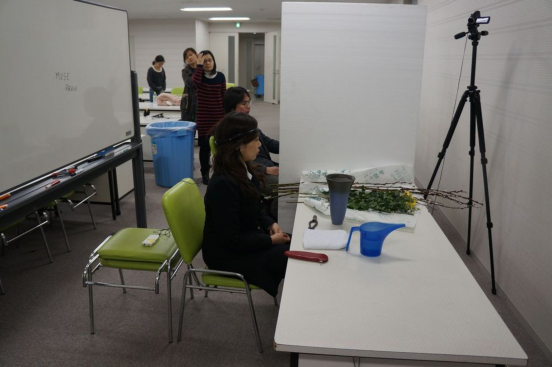
Research Environment and Methods The research took place in a conference room 5 meters wide and 15 meters deep. The sunny room with white walls faced south. In the conference room, each subject was asked to create an arrangement in the Shoka style. After the completion of each arrangement, the final product was removed to another space so that the subjects wouldn’t be able to view the work of others and be influenced by them (Figure 2).
Ergonomics In Design, Usability & Special Populations I (2022) https://openaccess.cms-conferences.org/#/publications/book/978-1-4951-2106-7 but the subjects were allowed the choice within those limitations of how many pussy willows or small chrysanthemums to use. They were also allowed unlimited time to create their ikebana arrangements.
Figure 2. The scene of the create an arrangement in the Shoka
Processing Data The subjects were recorded on two digital video cameras (Panasonic HDC-TM25) at 60fps. The video cameras were set up in the front and off-center to the left to get a full view of the subject's body and hands. For this study, we established that one task consists of a series of movements to complete one specific goal within the entire Ikebana process. We later used the footage to record the tasks along a time axis. The time it took to complete each task was recorded in units of 1/59.94th of a second. Each task was measured by how much time it took to complete it, and how many times it was repeated throughout the process. Repetitions per task by material and time spent per task were calculated to arrive at a central value for each subject.
RESULTS
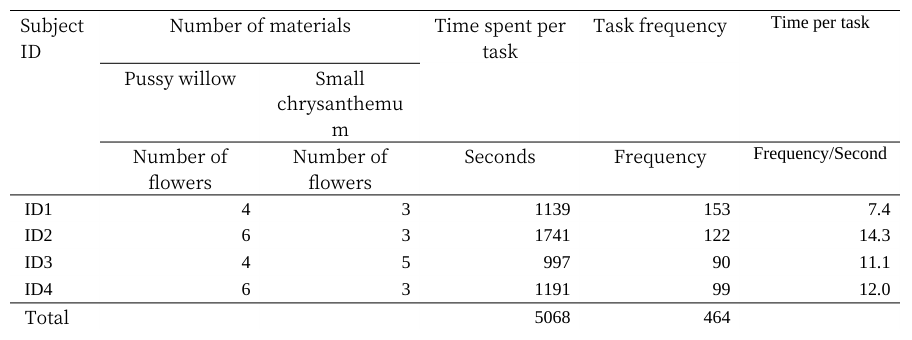
Table 2 shows the experiment's findings: the length of time it took to complete the Ikebana, the number of tasks involved and how long each task took to complete. Omitted from the study's data was the time the subjects took to spread out the material on the table, and clean up because they are not essential aspects of Ikebana.
Ergonomics In Design, Usability & Special Populations I (2022) https://openaccess.cms-conferences.org/#/publications/book/978-1-4951-2106-7
Table 2. Date of time, number of tasks to complete Number of materials Time spent per
Work Categories In organizing the content of each task, we were able to group them largely into main and supporting tasks. The main tasks refer to three activities that require the subjects to directly handle the flowers: Cutting, Bending, and Inserting. Cutting refers to cutting the stems to their appropriate lengths. Bending the stems into a desired shape creates a certain atmosphere to the flower arrangement. Inserting refers to inserting the flowers into the pin holder
Supporting tasks refer to the adjustments that take place before or after the main tasks: Observing, Coordinating, Modifying. Observing refers to looking at the material, deciding the length of each stem as it relates to the others, then observing again before moving on to the next set of tasks. Coordinating looks at the overall balance of the composition, and making length or volume adjustments where necessary. This doesn't include the work of inserting the flowers into the pin holder -- coordinating refers to the adjustments the subjects make while comparing the stems against each other. Modifying refers to a set of actions after the flowers have been inserted. It includes the finishing touches to the ikebana: observing the end product, and making final adjustments to the angle of the inserted branches.
Number of Tasks and Task Hours per Ikebana
Ergonomics In Design, Usability & Special Populations I (2022) https://openaccess.cms-conferences.org/#/publications/book/978-1-4951-2106-7
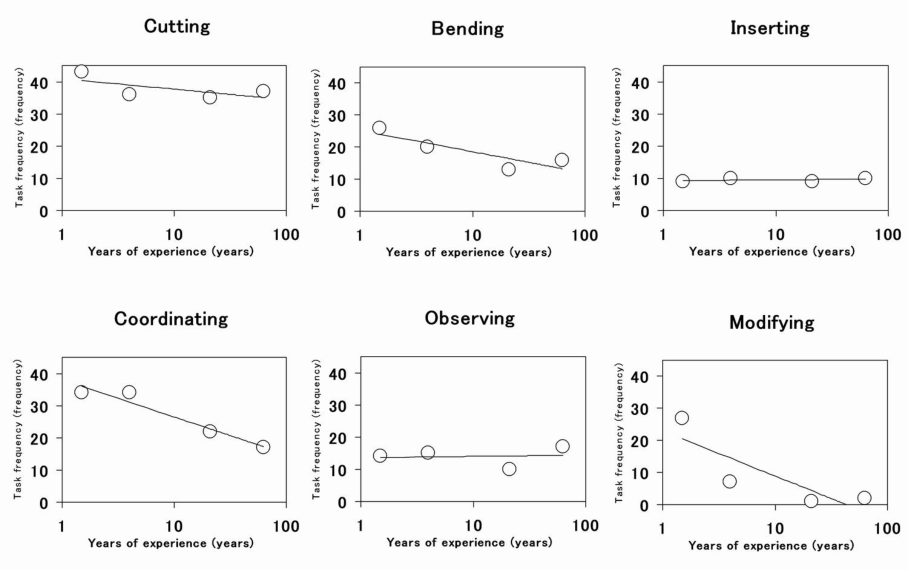
Figure 3. Relationship between Task Frequency and Years of Experience
Ergonomics In Design, Usability & Special Populations I (2022) https://openaccess.cms-conferences.org/#/publications/book/978-1-4951-2106-7
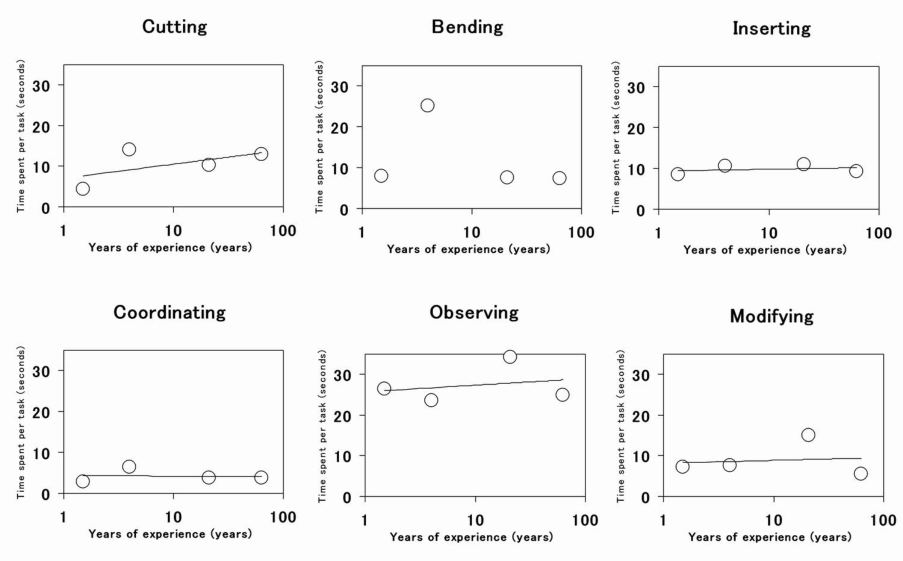
Figure 4. Relationship between Time Spent per Task and Years of Experience
Figure available in the original PDF paper.
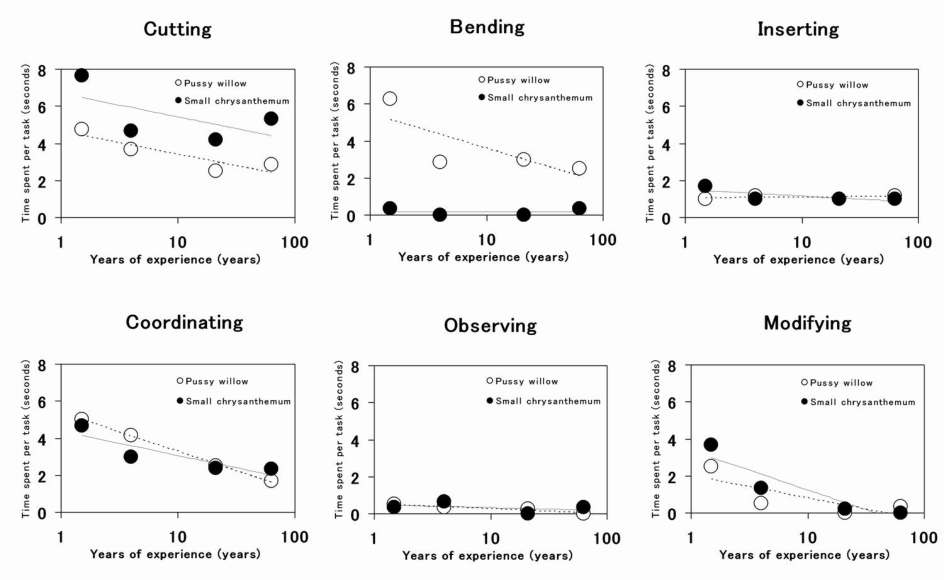
Figure 5. Relationship between Time Spent per Task and Years of Experience
Task Hours and Task Frequency per Stem, by Material We will consider task frequency and task content by material. Figure 6 looks at the relationship between years of experience and the average task frequency per material. In the main task category, the task of Inserting remained steady per stem for all subjects, regardless of years of experience. Subjects with more years of experience tended to engage in less Cutting of both types of material, although the pussy willow was handled with far less frequency than the small chrysanthemum. The task of Bending was seen only in the pussy willow and with less frequency as the subject’s experience level increased. With the supporting tasks, there was no difference with either stems. When combined, the task of Modifying happened less frequently the more experience the subject had.
Ergonomics In Design, Usability & Special Populations I (2022) https://openaccess.cms-conferences.org/#/publications/book/978-1-4951-2106-7
Figure 6. Relationship between Task Frequency per Material and Years of Experience
Ergonomics In Design, Usability & Special Populations I (2022) https://openaccess.cms-conferences.org/#/publications/book/978-1-4951-2106-7
Figure 7. Relationship between Time Spent per Task by Material and Years of Experience
Figure available in the original PDF paper.
DISCUSSION
Task Categories After studying the production process of the four subjects, it became clear that the process is made up of six types of tasks. They comprised two categories: three main activities that involve actual handling of the stems (Cutting, Bending and Inserting), and three supporting activities that take place before and after the main tasks (Observing, Coordinating, Modifying). In order to complete one Ikebana arrangement, one must complete these two varying sets of tasks -- or a total of six tasks. Typically, these activities take place rather randomly throughout the entire production process, but the tasks themselves are unique.
Task Frequency Considered the most crucial, the tasks of Cutting and Inserting have traditionally been the primary focus of Ikebana. However, from the standpoint of time and frequency of those tasks, the study showed little difference according to level of experience among the four subjects. On the other hand, Bending and Coordinating, which were not considered central to Ikebana, turned out to carry deeper meaning that only experience can begin to grasp. Greater awareness on and improving upon the tasks of Bending and Coordinating throughout the production process hold the key to honing one's Ikebana skills.
Time Spent Per Task Time spent per task for /Inserting and Cutting was virtually the same regardless of experience. These tasks are simple one-off activities and are not influenced by experience. On the other hand, Modifying was a task that diminished in time with experience. This can be explained by increased dexterity.
From the standpoint of Ikebana instruction, beginners tend to perform more tasks but spend less time on each, which translates into more wasted actions. From this, Ikebana teachers can incorporate efficiency into their instruction.
CONCLUSIONS
Ergonomics In Design, Usability & Special Populations I (2022) https://openaccess.cms-conferences.org/#/publications/book/978-1-4951-2106-7
Bending and Coordinating were tasks that subjects spent more time performing as their levels of experience increased. But after a certain amount of time, the subjects spent less time. This indicates that the two tasks are appreciated for their complexity by those with experience.
In the future, teaching methods can incorporate putting more care into the tasks of Bending and Coordinating, and helping beginners reduce wasteful motions and work efficiently.
REFERENCES
Ikenobo, S. (1999), “First Introduction to Ikenoubo Ikebana”, NihonKadousha. Ohi, M. (1962), “Flower arrangement : the Ikebana way”, Shufunotomo. Saruwatari, J. Hagiwara, M. (2005), “Ikebana support system reflecting kansei with interactive evolutionary computation”, in: ENTERTAINMENT COMPUTING - ICEC 2005: LECTURE NOTES IN COMPUTER SCIENCE. Volume 3711. pp. 456-467
Ergonomics In Design, Usability & Special Populations I (2022) https://openaccess.cms-conferences.org/#/publications/book/978-1-4951-2106-7
LISTED IN THE AHFE DIGITAL BOOKSTORE CATALOGUE
Explore the complete digital volume
Advances in Ergonomics In Design, Usability & Special Populations: Part I
Read this individual research paper free through the original publisher, or explore the full digital proceedings book.
ISBN 978-1-4951-2106-7
Explore this ISBN in the AHFE Bookstore ↗Listed in the July 2026 bookstore catalogue; search by ISBN to confirm current availability · Digital book purchase optional