Noriaki Kuwahara, Tsuji Airi, Taro Asada, Yasunari Yoshitomi, Jin Narumoto, Kazunari Morimoto (2021). The Development of a Mental Support System for the Elderly Living in Depopulated Areas of Japan. In: Advances in Affective and Pleasurable Design. AHFE Open Access, vol. 14. https://doi.org/10.54941/ahfe100576
We have studied a method to improve the QOL for the elderly receiving facility care, or home care in depopulated areas of Japan by taking advantage of information and communication technology (ICT). As part of these efforts, old photos of the elderly were digitized and uploaded to cloud services. We created an environment to make these images accessible to staff caregivers so that they could utilize the data in various long-term care settings. Multimedia, such as interactive digital photo albums and slide show videos were produced by using uploaded photos. The elderly, along with their families and caregivers enjoyed watching personal images which resulted in stronger relationships with family and the care staff. We also created an environment to introduce and promote video chat software in order to increase the opportunity of communication between the elderly and their significant others. Video chat software makes it possible for the person you are talking with to share reminiscent media, as described above, and to be able to listen from a remote location. Finally, we have organized human resources and collaborated with a local welfare service and a local hospital in order to provide support to the elderly living alone. A method was proposed to build a rapport between the elderly and their support systems..
Because one in four of the total population in Japan will become elderly in 2015, the establishment of quality care to support the dignity of the elderly is urgently needed. Elderly living alone are often subject to cognitive decline caused by brain disorders, anxiety and fear of disease, loneliness, and thoughts of a hopeless future. Due to anxiety and stress, many develop psychiatric symptoms. In particular, symptoms of depression were reported and resulted in about 15% of the elderly over the age of 60 having specific symptoms of depression, and about 5% were diagnosed as depressed. Depressive symptoms lead to the deterioration of physical function and cognitive decline. Inactivity led to the inability of self-care and the necessity for medication. Consequently, cognitive function declined even fur- ther as a result of the above mentioned data. Mental decline is a negative spiral, and results in the demise of the el- derly's life at home. According to the survey of Omori et al., about 30% of community-dwelling elderly were tested positive when given the screening test for depression. The risk of being certified in need of care from the public nursing care insurance system was approximately doubled in the depressed group (Ohmori 2010). In order to im- prove mental disorders such as depression and prevent cognitive decline of the elderly, it is important to stimulate their cognitive function by promoting communication with others. For example, by combining the intervention of suicide prevention with depression screening, suicide rates were reduced to about 50% (Ohyama 2010). Also, when you turn your eye to elderly facility residents, dealing with dementia such as Alzheimer's disease, which has soared in recent years, has become the most important issue for long-term care facility staff, as well as for the elderly.. So far, there is no radical treatment for most dementia. Therefore, supportive measures which include a combination of non-drug and drug treatments are generally used. Under these situations, we are conducting nursing care research by utilizing information and communication technology (ICT) for the purpose of QOL improvement for the elderly who reside at a facility or home. The content of this paper introduces the mental support system of the elderly living in the Tango area, north of Kyoto prefecture. A collaborated effort was established between our research, the local welfare center, the local hospital and nursing homes.
RESEARCH GOAL When considering the at home environment for the elderly, the local community, where the elderly previously gath- ered to socialize played an important role. However, maintaining local communities has become difficult due to rapid aging and a decline in the population. For this reason, mutual assistance between local residents is no longer functional. Such a phenomenon is noticeable in areas which experience a lot of snow, and also areas where settle- ments are scattered throughout a large region. The current care insurance service mainly serves those with physical disabilities, and does not provide care for those with mental disorders. In addition, a psychiatric specialist rarely col- laborates with the home care support team, which consists of a visiting nurse, care manager, and caregivers from the local elderly care management center. In particular, the aging rate of the Tango region where Kyoto Tango health center is located, reports a 28.9% of the overall average, and is noticeably far beyond the 20.1% national average. Numerous elderly live alone or as couples in this region. Due to scattered settlements, it is difficult to expand com- munity-based services as the traffic is often disrupted because of snow during the winter months. A few years ago, a heavy snowfall prompted many elderly living at home to call the local Tango district elderly care management cen- ter to express their anxiety. For this reason, the authors are in the development of an ICT system in order to support the mental health of the elderly. The system allows for communication between the elderly, local volunteers, the home support team, and a psychiatric specialist in the Kyoto Tango region. The aim is to rebuild the mutual aid function of the community by introducing the ICT system to the region. Our hope is that the psychiatric symptoms of the elderly will improve, and consequently delay the need for institutionalization. The field of nursing care, is im- portant and is based on good relationships established within the local community. Therefore, nursing homes ac- tively work on intercommunication with local residents. However, the frequent implementation of such intercommu- nication is difficult due to the busy schedules of the care staff. Also, the elderly with dementia, that reside in a nurs- ing home, experience memory problems which prevent them from sharing common experiences with the local com- munity. Therefore, it is our goal to reconstruct the family ties of the elderly with dementia, and build new ties be- tween the local community. Assisting in memory function, such as retention and recall of old memories and the for- mation of new memory by utilizing visual information is the goal.
MENTAL SUPPORT SYSTEM FOR THE ELDERLY
Related Work
Currently the ICT system is being used at home and abroad to study assistive technology for nursing care, and re- search and development in relation to the daily support of the elderly with dementia. A research and development project using network interaction therapy studied subjects with higher brain dysfunction. The project was sponsored by the National Institute of Information and Communications Technology in Japan (Kuwabara et al 2004). In this project, I was mainly engaged in research of remote care support technology. The project researched topics that in- cluded the implementation of assistive technology for subjects with higher brain dysfunction. The sensor network technology and media technology, which began in September 2003, and finished in March 2008 were fully used.
Recently, various studies including a partner robot study have been carried out to collect information regarding the support of people with dementia. Example (Inoue et al 2012).
However, such an engineering project which utilizes state-of-the-art technology usually encounters problems. De- ployment of the system to general households, and maintaining the operation of the system can be an issue. On the contrary, we are researching and developing a mental support system based on the remote assistance system that has already been proposed (Kuwahara et al 2010). This remote assistance system is available by using conventional technologies like broadband Internet connection and personal computers, and it is cost effective.
Overview of Our Proposed Mental Support System The ICT system supports the mental state of the elderly and consists of three subsystems. I will introduce each sub- system as described below.
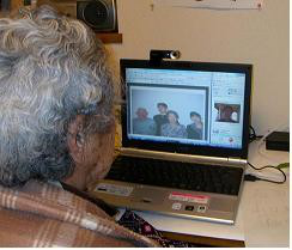
Remote Assistance System The remote support system consists of a remote active listening system and schedule reminder system, as shown in Figure 1. I continued my research after finishing the networked interaction therapy project. This system is available when a broad band internet connection and a personal computer are available.
Figure 1. A scene of remote active listening system usage
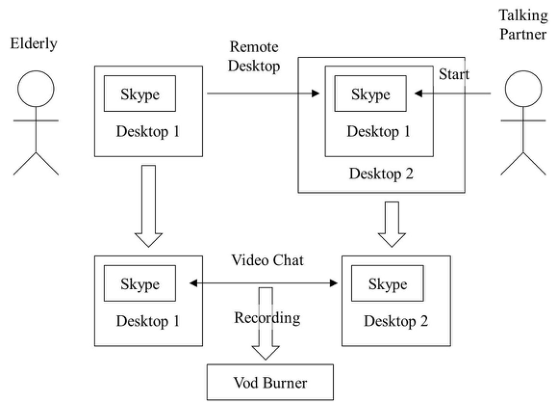
A remote active listening system assists those talking to the elderly during a video chat. In order to promote the con- versation, reminiscence contents like photos, videos, and music can be shared between the elderly and their talking partners. The elderly who show signs of depression and cognitive decline due to isolation, experience hypobulia. Less interaction and lack of brain stimulation results in a decline of life and cognitive function. By using this system, the elderly can experience exchanges with others while staying at home. Due to rapid progress of Internet technol- ogy, Skype® enables us to perform the same functions as those of our developed remote active listening system. It provides a video chat and also a remote desktop sharing function that makes it possible to share reminiscence con- tent, such as photos, videos, and music. Therefore, Skype® is used as our remote active listening system. In order to assist the elderly who are not familiar with technology, the partner talking with the elder can operate the elder's sys - tem remotely by using Chrome® remote desktop by Google Inc. Also, we introduced a Vod Burner® to record the video chat between the elder and the person they are talking with. Facial expressions and utterance rates of the el- derly were extracted from the recorded data, and used to perform an early screening for depression.
Figure 2. Configuration of remote active listening system
The schedule reminder system provides cues to the elderly reminding them to change clothes, eat a meal and take their medication by notifying them via video from a personal computer. This is a support system for the elderly who are in a preliminary group of depression, and are less likely to take care of themselves due to a lack of initiative to live independently (Kuwahara et al 2010). In addition, by using the remote assistance system, direct intercommuni- cation between the elderly at home and their talking partners is encouraged, resulting in fewer psychiatric symp- toms. It also prevents a decline in life style and promotes cognitive function.
Information Sharing System between the Elderly's Family, Medical and Welfare staff At present, the case conference system between care managers and psychiatric specialists using videoconferencing is currently operational in the Tango district, Kyoto prefecture (Narumoto et al 2011) as shown in Figure 3. We are adding a new function to this information sharing system in order to extract useful information to assess symptoms of depression in the elderly. Primary information, such as video and audio of the video chat data were collected from the remote support system described above. Specifically, when the elderly utilize our proposed remote support sys- tem, their fundamental frequency of speech, utterance rate, and facial expressions will be extracted from video and recorded audio.
Figure 3. A usage scene of information sharing system between family of the elderly, medical and welfare staff
Figure available in the original PDF paper.
Facial expressions are analyzed as follows. First, the area of the face is extracted from each frame by classifiers, and a front-view dynamic facial image is included in an Open-CV. The Haar-like feature parameters and Adaboost algo- rithm for learning are used as the classifiers. It is assumed that the distance between a subject and the camera gener- ally remains constant during a Skype conversation. Next, by using an Open-CV, the area of the mouth is extracted for a frame selected by certain face-area size criteria. The area of the mouth is chosen because the differences be- tween facial expressions of neutral and happy are distinctive in this area.
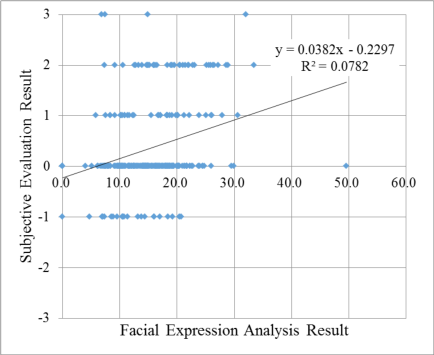
We compared the facial expression analysis results of one elderly person (gender: female, age: 80s) to the subjective evaluation of her facial expression. The subjective evaluation was conducted as follows. The evaluator scored the fa- cial expression in the recorded video by a seven point scale system from -3 (negative) to 3 (positive) every second. Figure 4 shows the result of the correlation analysis of five minute recorded video footage. The correlation coeffi- cient is 0.28 (p<0.01). So far, we obtained a weak correlation between the subjective evaluation results and the facial expression analysis results. We investigated by using these facial expression features to infer the mental state of the elderly subject.
Figure 4. Correlation Analysis Result between Subjective Evaluation and Facial Expression Analysis Organization of Human Resources for Our Proposed Mental Support System
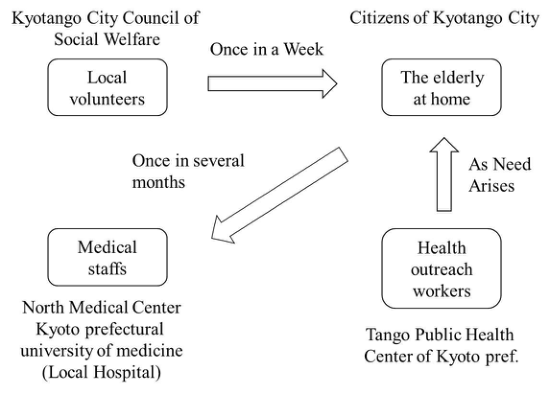
Figure 5 shows how we organized human resources for our proposed mental support system in the Tango district of Kyoto prefecture. The elderly living alone and experiencing depression usually see a psychiatrist from the local hos- pital once over a course of several months. Information regarding elderly in a delicate state of mental health is regu- larly shared between a psychiatrist, health outreach workers from the Tango public health center and local volun- teers. Local volunteers communicate with the elderly once a week by using the remote active listening system. . When local volunteers notice something different about the elderly during a remote non-drug intervention, they con- tact the health outreach workers to request the necessity of a visit to the elder's home. If a health outreach worker recognizes the need for medical intervention, they request that the elder go to the hospital.
Figure 5. Organization of Human Resources for Our Proposed Mental Support System MEDIA THERAPY: RAPPORT BUILDING BETWEEN THE ELDERLY AND OTHERS
Overview In order to operate our proposed mental support system, good relationships between local volunteers, care staff and the elderly are key. In collaboration with a UK university hospital and Microsoft Research, Inc., it was reported that a woman with moderate dementia had the ability to create new episodic memories by reviewing photographs of her husband (Hodges et al 2006). As a result, the couple could share common topics in their daily life, and their relation- ship was restored. We are researching media therapy as our proposed method to assist the elderly with memory by visualizing their episodes, and utilizing this visual information to build and restore good relationships between the elderly and others. In research on assistive technology in dementia care, the authors confirmed the effects on the emotional stability of individuals with dementia by using a reminiscence video (Kuwahara et al 2005). The above mentioned research indicates the effectiveness of a reminiscence video, not only for emotional stability of individu- als with dementia, but also for building good relationships between the elderly and others. This case shows that shar- ing memories is the key for building a rapport.
Based on this idea, we have devised media therapy. The first step to our approach is to use memorable photographs relating to the elderly while local residents and care staff carry out the active listening system portion with the el- derly. By creating media as a reminiscence video based on episodes obtained from the active listening, the elderly, local residents, and the care staff can share memories of the elderly by watching a video. In return, a rapport is built amongst the local residents and the care staff which supports the memory of the elderly at hand. In addition, we con- tinue to record exchanges, both in the real world and the virtual world with local residents and the elderly. We then store the data to the cloud service as a video archive. By utilizing records from the past and present, we attempt to help the memory consolidation of the elderly, and to build relationships between the elderly and others.
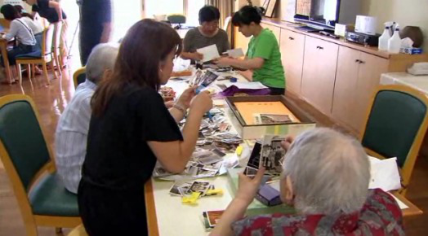
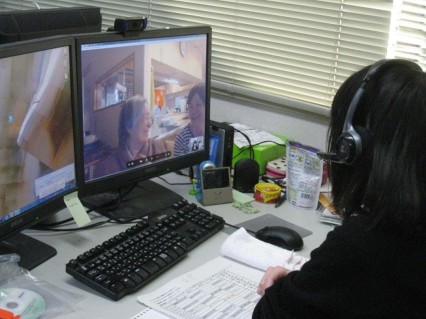
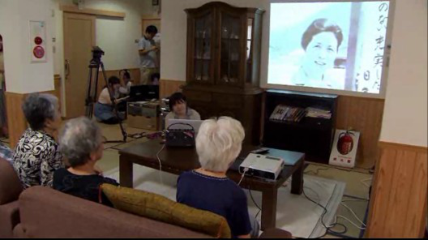
Case 1 From 2011, our students regularly visit the Kyotango city, Kyoto prefecture nursing home. They perform active lis- tening with residents from this facility. Students listen actively to a story behind each photograph of the elderly, and make a database of photographs with episodes taken from the elderly. They also create slide show videos for the el- derly by using this database. Then, a screening of the videos is held at the nursing home for the elderly, care staff and students. The video creates a new rapport between all parties. After a rapport has been established, our students use the remote active listening with residents from the University in Kyoto once a week in order to maintain a good relationship between them. Figure 6 and Figure 7 show student scenes of active listening and the remote active lis- tening. Figure 8 shows a screening of one of the created videos.
Figure 6. A scene where a student practices active listening with the residents of a nursing homeFigure 7. A scene where a student is performing remote active listening with the residents of a nursing homeFigure 8. Scene from a screening of one of the created videos
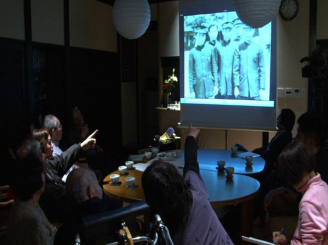
Case 2 A group home is one of the community-based services which is a part of the ‘‘Long-term Care Insurance System’’ in Japan. The home helps people with dementia continue to live their lives at ease. The care staff takes care of the el- derly with dementia 24 hours a day. In order to provide quality care to the residents, a trusting relationship between the residents, their family members and the care staff is essential. We are conducting other forms of media therapy in a group home called “Terado”, located in Mukoh city, Kyoto prefecture. The evaluation of the effect of our pro- posed media therapy, as it pertains to quality care is the focus of our research (Doi et al 2013). The media therapy includes interactive digital photo albums which have been created with a collection of old photos of each resident. The residents, their family members, and care staff got together in the multipurpose room of the nursing home and conversed freely about the resident's life by looking at the pictures projected on the large screen as shown Figure 9. At present, we have applied media therapy to three residents. All residents and their families have established a trusting relationship with the care staff, and consequently the quality of care for each resident has been achieved. This paper shows the result of media therapy for one resident and validates the improvement of her quality of life.
Figure 9. A scene of media therapy
A female resident in her 80s was difficult to manage because of her frequent agitation and delusional feelings throughout the day and night. As a result, her family became exhausted trying to take care of her and became apathetic when care was needed. The care staff and residents in the group home were affected in an adverse way to the ongoing demands of this female.
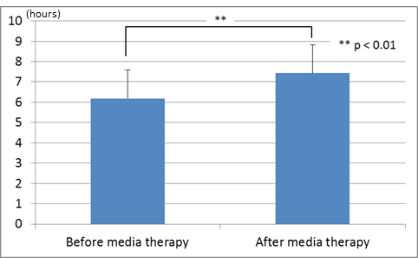
Media therapy was scheduled for her once a week over a course of six weeks. Each session did not exceed 60 minutes. Observations made by her primary care staff were as follows; reviewing her life history with family and the care staff seemed to make her happier than usual. She seemed to feel special because many people gathered to attend her 1st session. In the 4th session, emotional incontinence was observed. However, she became emotionally stable after the topic of the conversation changed to the days when she worked as a nurse for a university hospital. Recalling memories of her nursing career seemed to make her peaceful. Since this experience, a family member gradually expressed their appreciation for her. We compared the recorded data on nursing records when it came to the amount of time the resident slept, the resident's complaints and the amount of time the care staff spent coping with the resident's claims. Data was collected before / after media therapy. Figure 10 shows the comparison of her amount of time spent sleeping according to the nursing care record before / after the therapy period. The average time spent sleeping in a one month period before/after the media therapy remained constant.
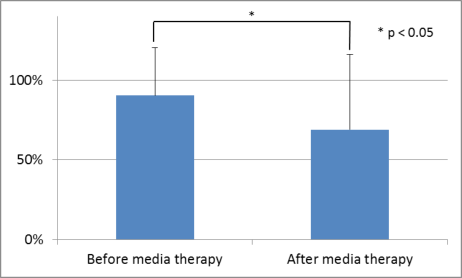
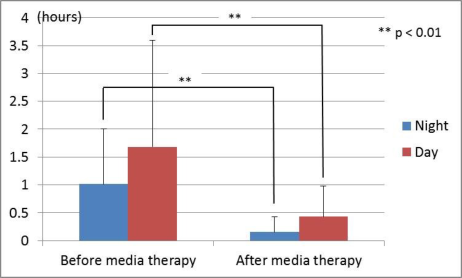
Figure 11 shows the comparison of the probability of the resident’s occurrence rate of complaints in a day for one month before / after the media therapy. The occurrence rate was calculated in a manner that the number of days when the resident’s complaints were observed by care staff was divided by the number of days in one month. Figure 12 shows the comparison of the average time the care staff spent coping with the resident’s complaints in a day, and at night for one month before/after the media therapy.
Through media therapy, she shared her history of her life with the care staff , and in return it helped build a more trusting relationship between them. Also, the media therapy gave her family the opportunity to rediscover and appre- ciate her as a person. In this case, prior to her media therapy sessions, the care staff found it difficult to cope with her agitated behavior, and felt seriously distressed when dealing with her. Because the care staff understood her life history and were exposed to her media therapy sessions, they obtained the skills and confidence to cope with her BPSD effectively. After our proposed media therapy, she established good sleep habits and complained less. Also, the care staff became very good at coping with her claims. These changes improved her quality of life.
Figure 10. Resident’s sleep time per one day for one monthFigure 11. Occurrence rate of resident’s claims per one day for one monthFigure 12. Time of care staff’s coping with resident’s claims per one day for one month
CONCLUSION
We introduced a mental support system for the elderly living in depopulated areas in Japan, and the human resource organization which can execute our proposed system. The key to success for this system is a trusting relationship be- tween the elderly and all those who support them. Therefore, we also propose utilizing media therapy to establish a rapport between the elderly and their support network.
The mental support system has been operational for almost a year. Four elderly people with mild depression have re- ceived remote intervention from local volunteers once a week during this period. Medical staff have evaluated their mental state by using several psychiatric evaluative indexes. Although data analysis is yet to be done, every subject retained a relatively good mental state. We coordinated a smooth transition between local volunteers and health out- reach staff. We also showed that media therapy was effective in building a rapport between the elderly and their sup- port group. Despite a few cases, the majority experienced a QOL improvement.
Through our research, we would like to contribute to the realization of a society where the elderly are able to spend their lives with dignity, even in a super-aged society like Japan.
ACKNOWLEDGMENT
This research was supported by JSPS KAKENHI Grant Number 24650037 and SCOPE of Ministry of Internal Af- fairs and Communications.
REFERENCES
Doi, T. et.al (2013), “Case Studies of the Service Quality Improvement in the Nursing Home - Media Therapy for understanding the History of Life of Residents”, Proc. of The 1st International Conference on Serviceology, Tokyo, Japan, pp.221-224 Hodges, S. et.al (2006), “SenseCam: A Retrospective Memory Aid”, Proc. of 8th Annual Conference on Ubiquitous Computing
(UbiComp 2006), pp. 177-193 Inoue, T. et.al (2012), “Field-based development of an information support robot for persons with dementia”, Technology and Disability, Vol.24, No.4, pp. 263-271 Kuwabara, K. et.al (2004), “Networked Interaction Therapy: Supporting Caregivers with Communication Network”, 20th Inter-
national Conference of Alzheimer’s Disease International, Kyoto, Japan, October. Kuwahara, N. et.al (2005), “A Method for Producing Reminiscence Videos by Using Photo Annotations: Application and Evaluation for Dementia Sufferers”, Transactions of the Japanese Society for Artificial Intelligence: AI, Vol. 20, pp. 396-405 (in Japanese) Kuwahara, N. et.al (2010), “Remote assistance for people with dementia at home using reminiscence systems and a schedule
prompter”, Int. J. of Computers in Healthcare, Vol. 1, No.2, pp.126-143 Narumoto, J. et.al (2011), “Psychogeriatric education program for care manager of long-term care insurance through teleconference system”, Japan Journal of Geriatric Psychiatry, Vol. 22, No. 1, pp.77-83 (in Japanese) Ohmori, K. et.al (2010), “Depression and the risk of long-term care insurance certification: The Tsurugaya Project”, Japanese
Journal of Public Health, Vol.57, No. 7, pp.538-549 (in Japanese) Oyama, H. et.al (2010), “A community-based survey and screening for depression in the elderly: the short-term effect on suicide risk in Japan”, Crisis, Vol. 31, No.2, pp.100-108
LISTED IN THE AHFE DIGITAL BOOKSTORE CATALOGUE
Explore the complete digital volume
Advances in Affective and Pleasurable Design
Read this individual research paper free through the original publisher, or explore the full digital proceedings book.
ISBN 978-1-4951-2109-8
Explore this ISBN in the AHFE Bookstore ↗Listed in the July 2026 bookstore catalogue; search by ISBN to confirm current availability · Digital book purchase optional