Kazunari Morimoto, Noriaki Kuwahara, Takao Suzuki, Yoshinari Gyoba (2021). Design of Studded Paving Block and Bollard Using LED for Assisting Walk of Low-vision People at Night. In: Advances in Affective and Pleasurable Design. AHFE Open Access, vol. 14. https://doi.org/10.54941/ahfe100578
Individuals with low vision tend to avoid going out at night. This is because moving around at night can be very dangerous. The number of individuals with vision-related ailments is increasing with the growing elderly population. There is a need to make moving at night safer for them. In this research, 2 devices using LED lights to guide pedestrians suffering from low vision are designed. The first device is a light emitting studded paving block. By blinking LED lights, the location of studded paving blocks can be confirmed from a distance. The second is a light emitting bollard between car lanes and sidewalks. Up until now, the position of bollards has been difficult to detect visually at night. Making bollards illuminate allows their position to be confirmed and creates a safer atmosphere for the pedestrian. In this research, the brightness level that individuals with low vision are most likely to notice was sought through experiment, and technology was developed to retain this light over a long period of time using minimal electrical current.
For many years, society has desired to create a safer environment for walking at night for the visually impaired (Kim et al., 2007). However, streets and roads have yet to be sufficiently equipped for ensuring the safety of elderly and the visually impaired pedestrians. In order to better support visually impaired pedestrians, studded paving blocks have been set up in the roads, at public facilities, at stations, at the entrances of stores, and in other places that may pose a danger to them. However, since they are almost hidden in the dark at night, it is very difficult for individuals with low vision to see them. There are even cases where they are painted with colors that do not stand out to preserve the scenery. In order to solve this problem, the authors of this research are developing light emitting blinking studded paving blocks and bollards. Because these can make intersections and sidewalks more visible, they are very effective at making night travel safer for individuals with low vision (Kobayashi et al., 2010, Oka et al., 2008). However, an objective evaluation of their visual detectability has not been made. In this research we have carried out an objective evaluation of the visual detectability of light emitting studded paving blocks and bollards and designed more detectable versions of them.
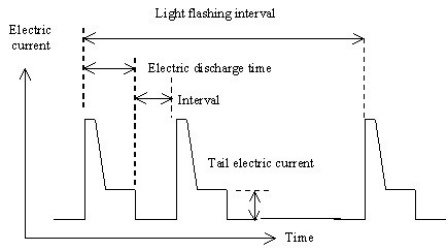
We will attain maximum detectability at minimum consumption of electricity by more meticulously controlling the control parameters that cause LEDs to blink. When driven by a general square wave, energy consumption is great and the energy supply is greatly depleted. In order to avoid this, we switched the drive to a pulse current. It is well- known that the brightness of the LED depends on the steep of the rising edge of the electric current in the LED (Morita et al., 2008). Figure 1 shows an example of a drive current waveform.
Figure 1. Pulse waveforms during discharge of LED
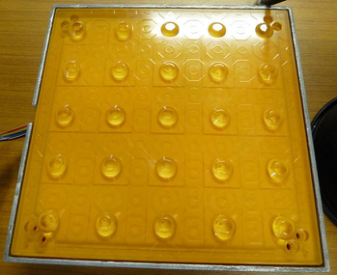
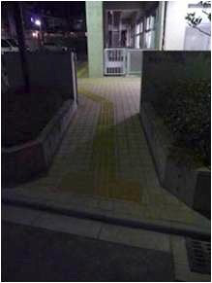
Figure 2 shows the light emitting studded paving block we developed. The surface colors of the ones we created were red, yellow, or green, but since we found out in preliminary visual detectability evaluations that yellow is the most easily detectable color, we decided to use yellow colored-blocks for performance evaluation testing. Figure 3 shows the nighttime visibility of conventional studded paving blocks and the ones we have developed.
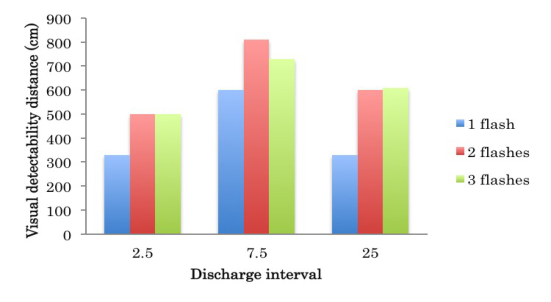
Visual Detectability of Light Emitting Studded Paving Blocks Fukuda et al. (2011) evaluated the visual detectability of studded paving blocks. They discuss the most suitable control formula for the parameters of interval of discharge and number of discharges. They tried 3 patterns where the number of discharges while the device is ON is set at 1, 2, and 3 times. The discharge interval between the 2 nd
and 3rd times was set to 2.5msec, 7.5msec, and 25msec. 10 individuals suffering from low vision were chosen as subjects. The 10 subjects were asked to walk towards the blocks which were 10 meters away from them. They were directed to stop in their tracks the moment they visually detected the blocks blinking. The distant between the stationary subjects and the studded paving blocks was then measured. This process was repeated 3 times for each subject. An interview was conducted with the subjects at the end of the experiment. As can be seen in figure 4, the results of this experiment showed that the ideal setting for maximum visual detectability was a discharge interval of 7.5 msec and 2 discharges.
Figure 4. Discharge interval, number of discharges, and visual detectability distance The following comments were given in praise of the blinking studded paving blocks: “I felt more aware that I needed to search for the blocks.”, “They are a beautiful color” “It is easy to see the blinking as it looks nothing like the lights of a billboard or headlights.” Many ideas about the area of illumination while blinking were heard from the individuals with low vision. For example, there were comments such as: “It’s better if the blinking area is wider.” “The lit up area should be larger.” “The area of the lit up area is important.” Also, there were comments suggesting that it was difficult to detect the blinking: “If I’m walking fast, I may not be able to find the blocks.” “It’s hard to find them.” “It’s difficult until they come into view.” These opinions were common among individuals with field of vision limitations. Moreover, there were also opinions concerning the way the blocks blinked: “All the blinking makes me feel a little ill.” “It’s too dark.” “The border isn’t very clear.”
DESIGN OF LIGHT EMITTING BOLLARD We received the following feedback from many visually impaired individuals, “We are thankful that the blinking studded paving blocks can help us judge where bus stops and intersections are, but it would be safer and we would be even more grateful if there were some type of hint to guide us in which direction to proceed.” So, we focused on the bollards which in recent years have been set up to protect the safety of pedestrians by separating walking lanes and bicycle lanes and also to keep cars from entering bus stops and intersections. That is, we made it possible for individuals with low vision to be able to make a judgment about which direction to proceed in by making bollards light emitting.
Problems with Already-existing Light Emitting Bollards The majority of already-existing light emitting bollards run on solar energy. These cannot be set up in the shadow of buildings, in the shade of road-side trees, in tunnels, or under shelters. The repetitive cycle of charging during the day with solar energy and using the stored charge at night shortens the operating time of these devices limiting their lifespan to about 3 years. In their current state, changing reusable batteries is not being considered, and the high maintenance cost of these devices is a problem. Also, it is difficult to consider the shape of the light emitting parts of these devices due to the positioning of solar panels above the equipment for reasons related to effective energy production. For this reason these devices are not necessarily the best choice for providing safe nighttime guidance to visually impaired individuals.
Realization of a Long Lasting Product through Battery Power The authors of this research developed a method to retain a high-luminosity blink for a ten year period in LEDs using the feeble electrical current of a primary lithium battery with a self-discharge rate of 1%. This makes it possible to create long lasting light emitting bollards for use in the shadow of buildings, in forests, in tunnels, in underground parking lots, and anywhere else. These will safely guide the movements of the visually impaired and elderly with eye trouble at night.
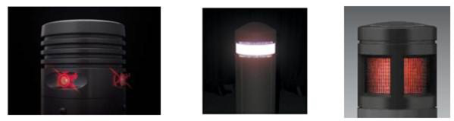
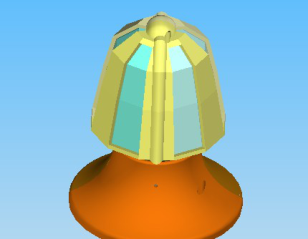
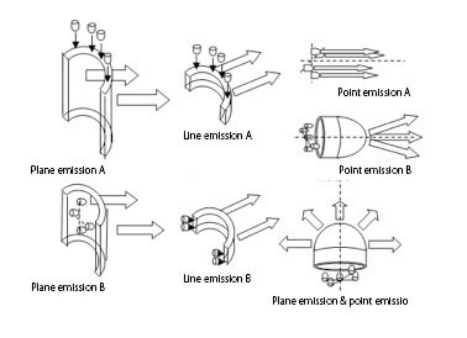
Realization of a Light Emitting Piece Easily Seen by Individuals with Low Vision The shape of already-existing light emitting bollards can be roughly divided into point emission, line emission, and plane emission (Figure 5). However, shape design of these parts are limited due to the necessity to set a solar panel on the top part of all of these bollards. In response to this problem, the light emitting bollard that we will develop has no such physical restrictions and, as shown in figure 6, introduces the possibility for designs unthinkable up until now. However, in order to equally produce sufficiently bright light, the design of the light-guiding panel, which guides the LED light to the light emitting part, is important. Therefore, as shown in Figure 7, we conducted a simulation grouping various shapes of light- guiding panels, LED arrangements, and light emitting piece designs, and then examined light emitting pieces easily seen by visually impaired individuals.
Figure 5. From the left: Point emission, Line emission, and Plane emissionFigure 6. New light emitting piece design for light emitting bollardsFigure 7. Examination of various light-guiding panels
CONCLUSIONS
Individuals with low vision tend to avoid going out at night. This is because moving around at night can be very dangerous. The number of individuals with vision-related ailments is increasing with the growing elderly population. There is a need to make moving at night safer for them. In this research, 2 devices using LED lights to guide pedestrians suffering from low vision are designed. The first device is a light emitting studded paving block. By blinking LED lights, the location of studded paving blocks can be confirmed from a distance. The second is a light emitting bollard between car lanes and sidewalks. Up until now, the position of bollards has been difficult to detect visually at night. Making bollards illuminate allows their position to be confirmed and creates a safer atmosphere for the pedestrian. In this research, the brightness level that individuals with low vision are most likely to notice was sought through experiment, and technology was developed to retain this light over a long period of time using minimal electrical current. Also, in order to install the light emitting studded paving blocks and bollards we developed in environments prone to continuous strong vibrations, such as roads, we adopted a battery powered drive system to reduce the risk of damage from wires snapping and taking in water. On top of that, we also realized a light producing method that minimizes electricity consumption and maximizes visual detectability, giving our devices a 10 years lifespan when used only at night. Hereafter, we presume this technology will develop into even more useful methods of displaying information not only for the visually impaired, but for able-bodied individuals as well, in various public signs, such as those in smoking areas, no entry areas, and the like.
REFERENCES
Fukuda H., Kuwahara N., Suzuki T., Morimoto K. (2011), “A Study on the Visibility of the Light Emitting Braille Block”, Proceedings HCI 2011, pp. 295-303, Springer Berlin Heidelberg. Kim, C., Song, B. (2007), ”Design of a Wearable Walking-guide System for the Blind”, in: Proceedings of the 1st
International Convention on Rehabilitation Engineering & Assistive Technology, pp.118-122. Kobayashi, M., Katoh, H. (2010), “Development and Installation of Programmable Light-emitting Braille Blocks”, In: Miesenberger, K., Klaus, J., Zagler, W., Karshmer, A. (eds.) ICCHP 2010. LNCS, Vol. 6180, pp. 271–274. Springer Heidelberg. Oka, M., Kano, T. (2008), “Basic Study on the Effectiveness of Light Emitting Curbstones of Nighttime Walking For
Persons With Low-Vision”, J. of Architecture and Planning, Vol. 73, No. 630, pp.1707-1713. (in Japanese) Morita, K., Abe, M., Motomura, H., Jinno, M. (2008), “Luminous Improvement by Pulsed LED Using Psychometric Effect”, The Institute of Electronics, Information and Communication Engineers, Vol.108, No.227, pp.35–40.
LISTED IN THE AHFE DIGITAL BOOKSTORE CATALOGUE
Explore the complete digital volume
Advances in Affective and Pleasurable Design
Read this individual research paper free through the original publisher, or explore the full digital proceedings book.
ISBN 978-1-4951-2109-8
Explore this ISBN in the AHFE Bookstore ↗Listed in the July 2026 bookstore catalogue; search by ISBN to confirm current availability · Digital book purchase optional