Germannya D. A. Silva, Tibério C. M. Tabosa, Ana Maria Q. Andrade, Virginia P. Cavalcanti (2022). Aspects of Ergonomics and Sustainability Design Applied to the Utilities Board for Café Tokyo’s in Recife, Pernambuco/Brazil. In: Advances in Ergonomics In Design, Usability & Special Populations: Part I. AHFE Open Access, vol. 18. https://doi.org/10.54941/ahfe100822
This paper presents the design method applied for the development of the product line created to meet the demand for utilities Café Tokyo’s table, headed by Matsumoto family, dedicated to oriental cuisine in Recife, since the '70s. The methodology strategies used for the project were organized in the following steps of research: analysis, synthesis and monitoring the production process. As a result, the Origami line utilities table has good usability, given the design of irregular geometry. Was produced with ceramic residue donated by a factory of sanitary wares and glazed with lead-free ceramic glaze composition which, besides ensuring good mechanical resistance of the pieces still provides environmental and economic sustainability of the group of artisans of Cabo de Santo Agostinho – Pernambuco, supported by The Imaginário Laboratory since 2003.
The Imaginário Laboratory is a multidisciplinary research and extension, linked to the Department of Design and Culture of the Federal University of Pernambuco comprised of professionals, professors and students from different fields of knowledge, working with focus on design1 as a tool in the service of environmental sustainability, economic and social sectors. It is the outcome of the evolution of research projects and extension efforts that figure up to the insertion of both the industrial design as handicraft context. Its mission is to provide design solutions based on research and who are committed to both the user and sustainable process development and systems.
The methodological approaches used by The Imaginário Laboratory, both artisanal as in the industrial environment, indicate a relationship between design and the sustainability from their specificities. In general terms, these approaches utilize the relation between design and sustainability, as Manzini argues in macro dimensions: economic 1 [...]creative activity, which has the objective of establish multiple qualities to objects, processes, services and systems throughout the their life cycle. However, design is the central factor of humanising technology and innovation crucial to the cultural and economic exchange factor ICSID - International Council of Societies of Industrial Design (2007). If the design has its onset connected to decoupling of design and execute [task delegated to the industry, who specialized in the repeating, fast and mass production], today perceives a rapprochement of the original performer: the craftsman. BARROSO [2005] points out that in recent years have begun to arise interventions, increasingly frequent and systematic, in the artisanal production, sponsored by several bodies of the public and private spheres, in almost all Latin American countries, whose main motivation has been to need to mainstream the economic life these countries in an activity for a long time, they have been marginalized and treated only in the perspective of social assistance.
and productive dimension and the social, environmental and cultural dimensions (MANZINI, 2005, p.50 e 55).
In the industrial context, the actions of the laboratory aim to strengthen the relationship between the University and the productive sector, aiming at the exchange of information between academia and enterprises, expanding the possibilities of action of the designers in Pernambuco State. In the artisanal approach, focus of this project, the guideline is to establish a handicraft activity in Pernambuco as sustainable livelihoods through interventions which respect the social, environmental and the cultural values of communities which producing handicraft.
This article reports the design method used by The Imaginário Laboratory to the development of origami line detailing aspects of the usability of parts, aesthetic articulation between traditional and contemporary from research ceramic material developed by the artisans group assisted by the Laboratory since 2003.
The relationship of The Imaginário Laboratory with pottery production in Cabo de Santo Agostinho The municipality of Cabo de Santo Agostinho congregates tourism attractions and economic potential which have repercussions in the development of the entire state. The production of pottery in Cabo de Santo Agostinho is one of the activities dating back to the colonial times. For centuries, the pottery-owned sugar mills produced only bricks and tiles to cater exclusively to the needs of the main economic activity in the south of Pernambuco. With the passing of time, the brickyards began manufecturing moringas, jars, pots, bowls and dishes from Curau2.
In 70 years, from the introduction of new paints and varnishes in utilitarian handmade pottery of Cabo de Santo Agostinho, the production had a significant growth. The increasing demand of production boosted the emergence of new brickyards. However, in the early 90s, the demand for the production started to decrease. The quality of the parts no longer matched the established standards by the market and the scarcity of new products difficult the maintenance and expansion of sales. Source of job creation and income for hundreds of families, many brickyards closed their doors.
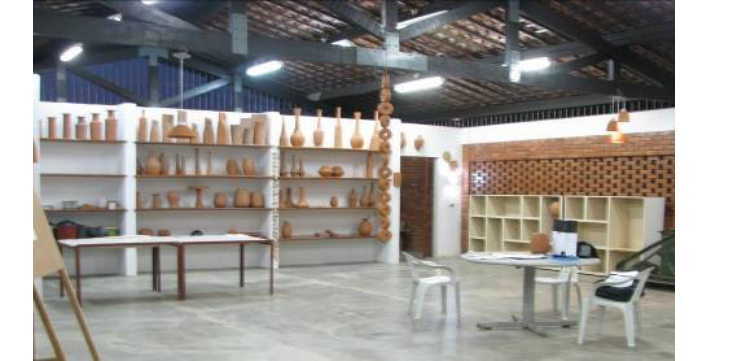
In 2003, The Imaginário Laboratory came into contact with this reality and based on diagnostic initiated actions, together with craftsmen and other partners to set a strategic approach to strengthen the handicraft production of utilitarian pottery in Cabo de Santo Agostinho. In 2008, was opened the Craft Centre Wilson de Queiroz Campos Júnior, built in partnership with the local city hall (Figs. 1 e 2). Based on the observations of technical, report of the artisans who craved to use new types of surface finishing and at the same time, the market demand for vitrified utilitarian pieces, a project to improve the ceramic production process was developed considering: beneficiation, modeling, enameling and flaring of ceramic pieces. Extruder, ball mill, electric sieves and agitators of dough: in the beneficiation stage treatment equipment of bulk ceramics in nature as they were incorporated. In the modeling stage appropriate ceramic lathes were developed to the physiology of the work of ceramist optimizing our production and decreasing the discomforts inherent in the task (Silva, 2012).
In 2010, another modeling technique was incorporated - the merger by collage by slip, which enabled the expansion and the inclusion of women and youth groups and improvement of quality of the finish of the pieces (Silva, 2011). For step-burning furnaces with thermal capacity of up to 1200oC, fueled with natural gas were purchased. In recent years, the Laboratory has concentrated efforts in order to test the vitrification technique with ceramic glazes without adding lead to improved mechanical strength and waterproofing of ceramics and ceramic research derived mass of industrial residues ceramic pieces as inputs in the artisanal production of Cabo de Santo Agostinho (Silva, 2008).
2 Curau - dishes that took the sugarcane planters for field use.
Figure 1. Façade of the Craft Center Architect Wilson Campos de Queiroz Junior (Source: The
Figure available in the original PDF paper.
Imaginário Archive, 2011).
Figure 2. Internal area of the Craft Center Architect Wilson Campos de Queiroz Junior (Source: The
Imaginário Archive, 2011).
To ensure sustainability of the Centre, it was elaborated a market research aiming at the identification, in the short run, the most appropriate niche market reality and potentiality of that productive group. The survey indicated the gastronomic segment in some of their specialties like the most promising niche.
The Metropolotina Region of Recife (RMR) is the third known gastronomic center of the country and the largest in the Northeast of Brazil. And, according to the Brazilian Association of Bars and Restaurants (ABRASEL), in Pernambuco, work about 6000 bars and restaurants. In the present scenario, the capital of Pernambuco, Recife, has potentialized the opportunity for new perspectives as the next realization of the 2014 World Cup.
For those focused its specificities dining establishments in the public consumer with higher purchasing power require unique efforts to enhance the consumption experience. From creative cuisine, personalized services, architectural and ambiance and communication, are added to the development of handcrafted ceramic utilities made by order. This was therefore chosen by the Laboratory to focus in the actions of development and manufacture of commercial table segment, reinforced by the following arguments presented below.
First, that the team of designers could have the opportunity to interact with the public targeted demanding and aware of its levels of demand. And secondly, to provide the group of artisans a genuine opportunity for generate income together with the most significant developing their productive capacities for lighter utilities, constructive details with delicate and requirements until then unusual in terms of quality and finish.
In 2013, the strategies of the Laboratory for approximate the consumer public more demanding at the same time craftspeople involved of a more rigorous production in terms of quality and delivery time was put into place to satisfy the demand Café Tokyo’s. Having regard to the development of the Matsumoto family operates in the oriental cuisine since the 70s. The initiative was the first line of customized handcrafted utilitarian products to be developed by The Imaginário Laboratory and produced by artisan group Center. THE DESIGN METHOD APPLIED TO CERAMIC LINE UTILITIES ORIGAMI
The methodology strategies used for the project were arranged through the stages of research, analysis, synthesis and monitoring the production process. Monitoring of the production of the pieces, observed the characteristics of the production process, the possibilities of color glazes considering especially those already developed and tested by craftsmen. Usability aspects have been considered throughout the development process (BÜRDEK, 1999; MORAES, 2006; BONSIEPE, G. 2011, CAVALCANTI, 2011).
For the assessment of usability, based on Nielsen (1993), the technique of field studies was used because analyzes the user and their interactions with the system / product, observing in detail diverse aspects that can only be identified in the environment and user context. Visits to competitors establishments were carried out for observation of users manipulating products with similar functions, as well as observations in the kitchen to understand the procedures for washing and stacking. About the conditions of the modes of takes the geometric configuration handling recommended for products that do not require physical effort was used, providing greater flexibility of use by different sorts of users - children, women and elderly (Filho Gomes, 2003).
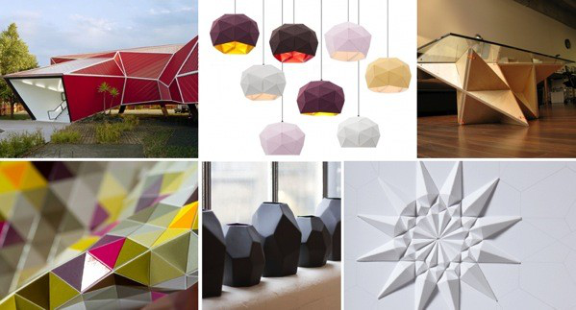
From the research and information analysis, was defined as projetual advantage the alignment of traditional and contemporary concepts, using as reference the Japanese paper folding - origami (Fig. 3).
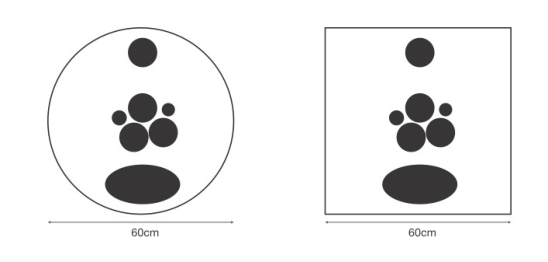
Figure 3. Reference images (Source: The Imaginário Archive, 2011).Figure 4. Layout of the perimeters of each piece on the table (Source: The Imaginário Archive, 2011).
The irregular geometry has configured the faces of the solid whose forms gave good usability of the products. The sizing was conditioned both by the use of the space and the support tables, whose diameter does not exceed 600mm (Fig. 4). Other specific requirements for each piece were studied separately during the development and prototipation.
Products The Origami line consists of containers for oil and soy sauce, saltshaker, sachet door, napkins and plates (Fig. 5). The angular drawings configure the phase of geometrical solids that are differentiated to ensure good usability. It should be mentioned that during the development of alternatives have made several tests with paper models for volumetric definition of proportion and usability (Fig. 6).
Figure. 6. Usability evaluation of pieces (Source: The Imaginário Archive, 2013).
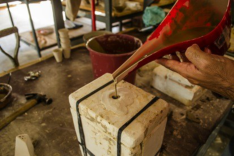
Production Procedures The pieces in the Origami line were produced by Moulding on by slip casting in plaster molds. The production process included the following steps: preparation of a plaster mold from a prototype or matrix, filling the mold with liquid ceramic mass off the mold, finishing, drying, firing, application of enamel and finally to second firing chemical reaction on the part of the enamel (Fig. 7). The entire production was done by hand in the Craft Centre with the technical supervision of the Laboratory professors designers.
Figure 7. Reproduction of matrices by bonding borbotina (Source: The Imaginário Archive, 2013).
The raw material used for manufacturing of the parts was the result of a study of ceramic materials developed by the Laboratory, from the use of waste ceramic industries of sanitary ware and ceramic tiles handmade process as input of the sector. The lead-free ceramic glaze used as surface treatment of the pieces (waterproofing and staining) was developed by group of artisans under the supervision of technical staff of the Imaginário Laboratory. All actions described above are part of an action plan which aims at environmental sustainability, and economic security of productive group.
Commercialization According to the concept harnessing of the consumption experience as a tool to increase the commercialization of utilities to the Tokyos customers, was of fundamental importance the collaboration and social sensitivity of the family-owned establishment that have inserted a panel showing pictures of the process development and production line in the ambience. It is worth mentioning that this is a marketing strategy already used for natural food products which are offered for sale in cycles within the same environment (Fig. 8). Simultaneously, the family-owners has articulated with the Laboratory professors the development of a kit containing two of the pieces that most interested the customers (Fig. 9).
To make attractive kit and expand its value added, special packaging that allowed good exposure and safe handling of the ceramic was developed. The future perspectives point towards the launch of new stuff to sale, which prolongs the cycle of sustainable production plus replacement of items and it opens a horizon of income for the community continuously.
Figure. 8. Pieces for use and sale in the Café Tokyos (Source: The Imaginário Archive, 2013).
Figure. 9. Objeto i kit made for sale in specialty shops decorating in Recife, Brazil (Source: The Imaginário Archive, 2013).
CONCLUSIONS
The relation craft-design has become ever more promising, especially when it is docked in the academic environment, where you can perform searches and make it available to society. The experience instigated among professors, technicians and students with an entrepreneurial attitude, with the creation of Objeto i, indicating the authorship of the design prepared by the professors, technicians and students, while the production was credited to the Craft Center. A respectful relationship between designers and artisans facilitated the exchange of knowledge throughout the experience and to have the artifacts available for use, also has facilitated the evaluation of the users possibility and consumers in the real scenario.
At the same time ensured a fair remuneration for artisans since the formulation of the cost was produced and discussed jointly between designers and artisans. The experience also configures an option of sustainability for the group of artisans who from contact with this niche market and acquired knowledge (concerning the form and usability, production and the market) can extend your performance in the labor market.
The disclosure of the Craft Center and its craftsmen in the products identified object i is another positive aspect that can be noted in the report on the experience, because with the company incorporated in the sensitivity ambiance of the restaurant pictures of the development and production process, simultaneously giving value to the designer and craftsman.
ACKNOWLEDGEMENTS
This work is part of the project ‘‘ Cerâmica Artesanal do Cabo de Santo Agostinho: Centro de Artesanato Arquiteto Wilson de Queiroz Campos Junior” sponsored by Programa Petrobras Desenvolvimento e Cidadania / Brazil.
REFERENCES
Barroso, E.: O design como ferramenta para o incremento da joalheria brasileira. http://www.joiabr.com.br/artigos/ebneto.html Bonsiepe, G.: Design, Cultura e Sociedade. Ed. Edgard Blucher, pp. 270, São Paulo (2011) Bürdek, B. E.: Diseño. Historia, teoria y práctica del deseño industrial. Ed. Gustavo Gili, Barcelona (1999) Bellen,H.M.V.: Indicadores de Sustentabilidade: uma análise comparativa. Ed. FGV, Rio de Janeiro (2007)
Cavalcanti, V. P., Andrade, A. M. Q., Silva, G. D. A.: Modos de fazer: uma experiência em processo de criação compartilhado e modelo de atuação transdisciplinar na relação entre design e artesanato. Virus, v. 6, p. 1-19 (2011) Filho Gomes, J.: Ergonomia do Objeto: Sistema Técnico de Leitura Ergonômica. Ed. Escrituras, São Paulo (2003) ICSID - International Council of Societies of Industrial Design. http://www.icsid.org/about/about/articles31.htm Imaginário Pernambucano: design, cultura, inclusão social e desenvolvimento sustentável. Coordenação: Ana Maria Queiroz
Andrade, Virginia Pereira Cavalcanti. Ed. Zoludesign, Recife (2006) Kazazian, T.: Haverá a Idade das Coisas Leves: design e desenvolvimento sustentável. Ed. SENAC, São Paulo (2005) Manzini, E., Vezzoli, C.: O desenvolvimento de produtos sustentáveis. Ed. Universidade de São Paulo, pp. 50 - 55, São Paulo (2005) Moraes, D.: Metaprojeto: o design do design. In: 7o Congresso Brasileiro de Pesquisa e Desenvolvimento em Design Paraná.
Anais de congresso. Curitiba (2006) Silva, A. C. R.: Desenvolvimento tecnológico da cerâmica artesanal do cabo de santo agostinho: um diálogo entre tradição e inovação. In: Congresso Brasileiro de Cerâmica, Anais de congresso, Porto de Galinhas (2011) Silva, G. D. A., Cavalcanti, V. P., Andrade, A. M. Q., Cordeiro, E. J. D.: Design and technology in the development of potter's
lathes for modeling with terracota: the case of Cabo de Santo Agostinho. Work (Reading, MA), v. 41, p. 1246-1251 (2012) Silva, G. D. A., Cavalcanti, V. P., Andrade, A. M. Q., Cordeiro, E. J. D. Refugo industrial como insumo para a cerâmica artesanal: uma alternativa sustentável para o artesanato do Cabo de Santo Agostinho – Pernambuco / Brasil. In: Congresso Internacional de Pesquisa em Design, Anais de Congresso, São Paulo (2008)
LISTED IN THE AHFE DIGITAL BOOKSTORE CATALOGUE
Explore the complete digital volume
Advances in Ergonomics In Design, Usability & Special Populations: Part I
Read this individual research paper free through the original publisher, or explore the full digital proceedings book.
ISBN 978-1-4951-2106-7
Explore this ISBN in the AHFE Bookstore ↗Listed in the July 2026 bookstore catalogue; search by ISBN to confirm current availability · Digital book purchase optional