Márcio F. Catapan ab, Maria Lucia Okimoto, Mateus Villas Boas, Roberto Waldhauer (2022). Tridimensional Study by Scanning the Variability Anthropometric Head Human Use of Ballistic Helmets. In: Advances in Ergonomics In Design, Usability & Special Populations: Part I. AHFE Open Access, vol. 18. https://doi.org/10.54941/ahfe100832
In the development of new products and improvements adequacy of the artifacts have been a concern for ergonomics, with a focus on the preservation of physical, mental and social integrity of the human being. The high competitiveness and the search for new technologies that distinguish industrial products indicate conducive to the use of new technology as an innovation factor environment. In the military arena, it is known that on the battlefield many soldiers did not consistently use the ballistic helmet due to his discomfort. Currently studies report that approximately half of the deaths in the battle fields is due to projectiles triggered in the soldier's head. However, other studies show that this artifact after a few minutes in continuous use, it becomes heavy and unstable for some users. In other words, it was proved that some soldiers do not wear a helmet when necessary is because even bothers. It is at this point that is the purpose of this paper. Through Scanner Tridimensional with computational analysis tools such as CAD, is seeking to capture images and data of the human head to a previously defined group of people. It is intended to verify the measures are consistent with ballistic helmets currently used in the military and also examine whether there are differences of these measures. With the process of Tridimensional Scanning are obtained with precision details of surfaces that traditional methods Caliper and anthropometric tape, which is not observed because their analysis is one-dimensional. Thus the technique proposed in this paper is presented as a tool capable of providing a differential for the design of ballistic helmets, creating new possibilities in their sizing.
We note that current anthropometric measures related to human head - called cephalometry, are determined by dimensional analysis. Adding to these first three shown in the previous paragraph, there is a questioning of the current analyzes of these measures. According to studies by Alves et al. (2011) measurements are made using equipment called flexible anthropometric tape and anthropometric caliper, whose uncertainty is the home of millimeters. Analyzing this context, the question is: How do you know with precision where the points are longer lengths the width and length of the subject's head? You can generate an error with the effort made by those who are measuring these regions? Here one can notice greater uncertainty measures, which is why the current methods for anthropometric analysis of the human head are insufficient and can be better defined.
Problematic According to Iida (2005), some products presently produced in certain countries, are marketed throughout the world, such as, planes, computers, TV sets, weapons, cars and others, which have practically worldwide standards. In terms of military alliances such as the Organization of the North Atlantic Treaty - NATO - and the Warsaw Pact, they required certain international standardization of military products, with several implications for industry in general.
According to Silva et al. (2006, quoted in Ahmed, 2012), the anthropometric survey of a certain population is an important tool in ergonomic studies, providing subsidies to scale and evaluate machines, equipment, tools and jobs. Also, their adequacy to the anthropometric characteristics of users will occur-in appropriate ergonomic criteria for the activity performed does not become a discomfort factor and damage to the health.
Objectives The general purpose of this study is to propose a method that analyzes human head three-dimensionally and identify the height of for the use of ballistic helmets.
The general purpose of this study is to propose a method that analyzes human head three-dimensionally and identify the height of for the use of ballistic helmets.
Current analyzes of the anthropometric measurements of the human head;
Development of a standardized method to analyze the tridimensional height of the human head for use ballistic helmets;
STATE OF THE ART Anthropometry
To Michels (2000) and Rodrigues-Añez (2001), cited by Klein (2009), anthropometry is the branch of science that studies the human body measurements, particularly the size and shape.
According to Iida (2005) in the field of anthropometry there are tendencies of global standardization, though no reliable anthropometric measurements for the world population. Most measures available is contingent of the armed forces, because almost all refer to the measure of adult males in the 18 to 30 years. However, the factor that most contributes to these measures differ from the measures of the global population, are the selection criteria adopted by conscription, which exclude, for example, people below a certain height.
Anthropometry of the head (Cephalometric) According to Iida (2005) anthropometry is the field of science that studies the human body measurements, particularly the size and shape. According to the same author in the field of anthropometry there are trends of worldwide standardization, though no reliable anthropometric measurements for the world population. Most measures available is contingent of the armed forces, because almost all refer to the measure of adult males in the 18 to 30 years. However, the factor that contributes most to these measures differ from the measures of the global population, are the selection criteria adopted by conscription, which exclude, for example, people below a certain height. However, the factor that contributes most to these measures differ from the measures of the global population, are the selection criteria adopted by conscription, which exclude, for example, people below a certain height.
The head Anthropometry (Cephalometric) Since this is the main dimensions of the head, Mandeira (2008) mentions that this is divided into the skull and face. As for the skull, focus of this research, one can summarize the main measures:
a) Head length (anteroposterior diameter): It is the distance between the glabella and opistocranio (external occipital). Corresponds to the anteroposterior diameter of the head.
b) Head width (transverse diameter): It is the distance between eurio on one side and the other on the opposite side. Corresponds to the transverse diameter of the head. c) head circumference: Is the measurement of the circumference of the head using the plane passing through the glabella and the opistocranio (external occipital).
Besides these measures, other important information regarding anthropometry of the head is still the cephalic index as quoted by Wood (2008). The head comprising the index is the ratio between the diameters of the head.
Equation reproduced from the original PDF.
length measuring profile
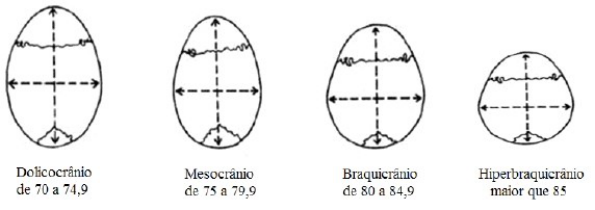
According to Williams et al. (1995), the cephalic index is presented in four groups: 1. dolichocephalic (narrow or long head): cephalic index ranging between 70 and 74.9. Nordic Caucasians (Scandinavian, English), African Negroid, Australoids;
- mesocefalos (intermediate head): index ranges between 75.0 and 79.9. Mongolian; - brachycephalic (rounded up): index between 80 and 84.9. Caucasians (European central) and -hiperbraquicefalos (very rounded heads): greater than 85 index.
In Figure 1 shows different types of head format as Ranked by craniometric cephalic index.
Figure 1: craniometric Classification according to the cephalic index, adapted from Fields and
Vanrell (2013).
As seen in this item and as described by Ball et al. (2010), traditionally the anthropometric measurements of the human body are one-dimensional, since the use of tape and caliper is common to survey demographics.
Until then, the results shown were fruits of measurements in 1D (one dimension). Currently, other studies report that 2D data can be collected by means of computed tomography and even 3D three-dimensional scanning. However, these technologies are not completely widespread in this area.
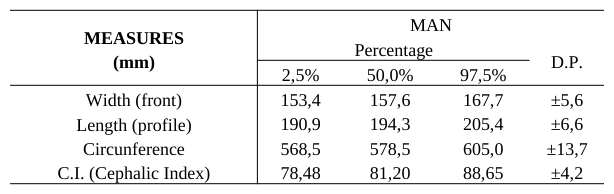
Most recent studies on this topic in Brazil is done by Catapan et al. (2014) which reports the anthropometric measurements of the human head as shown in Table 1.
Table 1: Measures of human head Brazilians, Catapan et al. (2014)
With these measures of human heads, is necessary to make a deeper analysis so that it can know whether mediated currently made are sufficient, or another method is needed to better define the human head. This more detailed analysis can be done through three-dimensional images in CAD systems, derived from 3D scans. Much need so pointed out is because the skull is responsible agent in the structure and protection of all vital parts that are inside. Thus it is of utmost necessity that has equipment or devices to ensure its integrity. Within this line of research are the personal armor and helmets, which here will be focused on combat helmets.
Combat Helmet According to Alves (2012), the combat helmet is also known as ballistic helmet, being employed in personal shield fighter, following the standards of preparation and approval of the Brazilian Army Command. According to Samil and David (2012), ballistic helmet is a standard infantry equipment that provides ballistic protection from projectiles to the head, ear and neck of the soldier. Also, Othman (2009), reports that the head and neck account for only 12% of the body area that is typically exposed in a battlefield. However receive up to 25% of all views and nearly half of all combat deaths are caused by head injuries.
Thus, one might suspect that the ballistic helmets are not being used as often as they should in combat troops. A starting point is to analyze whether this artifact is meeting their need to protect the soldier's head, while ensuring an adequate comfort for usage situations.
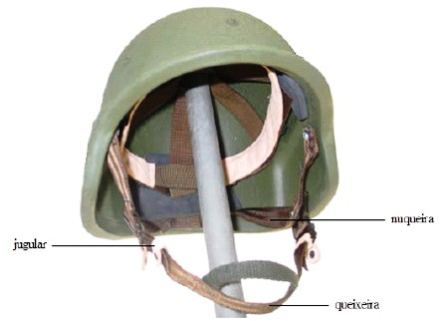
According to Alves et al. (2011), in Brazil many of the personal protective equipment are imported from other countries or when produced here, follow the anthropometric standards of the country of origin of the project. This is the case of ballistic helmets that are used by the Brazilian armed forces, the PASGT model (Personal Armor System for Troops Gound) of U.S. origin. This helmet is made of four parts: 1) hull, 2) suspension system, 3) fixation system, and 4) pillows for comfort and protection. Figure 2 shows a bottom view of the helmet, which inside is detailed. The numbers correspond to the indications of protection pads.
Figure 2: Ballistic Helmet, Alves (2012)
The total mass (or weight) of mounted combat helmets shall comply the standards detailed in the Ministry of Defence (2008), by size, with a tolerance of plus or minus 10%. Table 2 shows these values of weight in relation to the helmet size.
Table 2: Weight of helmets on the size, Ministry of Defence (2008).
Table available in the original PDF paper.
DESCRIPTION SIZES S M L XG Total mass of helmets (Kg) 1,30 1,40 1,50 1,70
Is worth mentioning that the mass of helmets, presented in Table 3, is statically. That is, in a situation where the user is in movement, for example running, there is an increase in the force of gravity, generating a pressure / force greater than the weight statically. According to Samil and David (2012), analyzing simulation done of a soldier running at a speed of 8 km / h (2.2 m / s) over a treadmill, after 180 seconds, the pressure it exerts on the helmet head arrives or 132.56 kPa to 1.3 kgf/m2. According to this author, the helmet has an internal area of 0.14 m2. Therefore, one can estimate that the generated weight is approximately 182,06 N, ie considering gravity 9.81 m/s2, an additional mass is 18.56 pounds.
Also according to Samil and David (2012) in his research with 70 users PASGT ballistic helmet model, it was observed that the soldiers feel this added pressure in different regions of the head. In Table 3 we can observe these with their percentage of responses.
Table 3: Regions of discomfort ballistic helmets and their percentages. (Adapted from Samil and David
Table available in the original PDF paper.
(2012)
Region answer number Perceptual (%) Frontal Area 16 21,9 Occipital Area 4 5,5 Parietal Area 40 54,8 Temporal Area 13 17,8
It is noticed that the region that the soldier feels a greater discomfort in the use of ballistic helmet is the parietal area. That is, the top of the head, further confirming what was explained above.
If you compare the anthropometric measurements of the ballistic helmet, PASGT model, it is known there is some dimension of helmet that is compromising the ergonomics of users. Table 4 shows these measures. We notice that the circumference values are divided into minimum and maximum values, this is due to the regulation that ballistic helmets have to leave them more or less tight as you need it.
Table 4: Anthropometric measurements of the PASGT helmet in relation to size, adapted from Ministry of Defence (2008).
Table available in the original PDF paper.
DESCRIPTION/SIZE HELMET SIZES(cm) SIZE S M L Width 16,0 16,0 17,0 Length 19,0 20,0 22,0 Internal Circunference: Minimum 47,0 50,0 54,0 Maximum 52,0 56,0 59,0 Cephalic index helmel 84,21 80,0 77,27
Notice that all measures of the helmet also limit the width, length, circumference and cephalic index. But none is the height of the helmet as a necessity measure, which contradicts current studies, as the Samil and David (2012) reported that most of the problems of discomfort on the part of users PASGT Helmet, is related to height the head relative to the helmet.
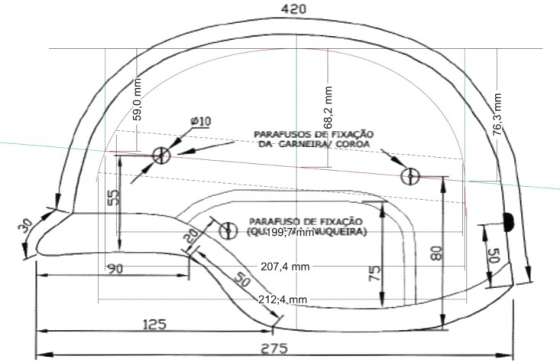
Analyzing the Figures and Tables in this session, we attempted to analyze the rule governing such measures PASGT Helmet of the Ministry of Defence (2008). Using the helmet design size "M" and, knowing the measurements of the positions of fixations, as the chamois and the thicknesses of foam for protection, it is possible to identify other measures the helmet with the use of CAD programs. These are shown in Figure 2, which shows the side view with its main steps and made some highlighted by computational analyzes.
Figure 2: Measurements of height PASGT Helmet, adapted from Alves (2012) Analyzing Figure 2, it is noticed that an arch was designed to represent a useful outline of the human head in ballistic helmet. That arc was the development through some information, such as, according to the Ministry of
Defence (2008), the PASGT helmet has a protective foam from the top of the head to the base of the helmet 10mm thick, and other information of this standard. Using an imaginary line of the fixing points of the headband on the helmet, it is possible to identify these points for the collection of measurements.
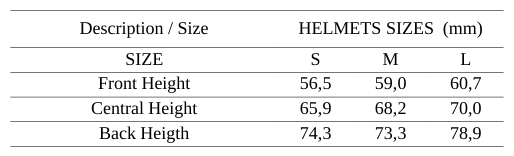
Thus, it is seen that the height of center of the fixing support the top of the head to the center line of the headband is approximately 68 mm for the helmet PASGT "M". It is known that the width of the ribbon chin strap, shown in Figure 2 with dashed lines, has 25 mm, it is possible to identify the location of the attachment area of the helmet on the user's head. The same analysis was also done for the P and helmets G. The final values of these analyzes are shown in Table 5.
Table 5: Measurements of distances from the heights of PASGT helmets Description / Size HELMETS SIZES (mm)
In Table 5 it can be seen that the heights are critical in the use of ballistic helmets, since they are directly related to the fixation of the helmet on the human head.
According to the Ministry of Defence (2008) the governing standard specification this helmet stresses that there is a height adjustment of the helmet, which is approximately 8mm for more and less.
METHODOLOGY AND APPLICATION Here the methodology and its application for analysis of the tall human head for use in ballistic helmets through photogrammetry is displayed. For a better understanding of how to achieve this, it was constructed a flowchart showing the method to be used and their practical application in pilot form without the appropriate number of samples, but already possible to verify this measure, which still does not exist. This method is illustrated in the flowchart of Figure 3.
Figure 3 - Method for tridimensional analysis of the height of the human head by three-dimensional
scanning.
Using the information allocated sequentially exposed the flowchart in Figure 3 below, it will explained all this methodology in order to have a structure of allied research in this experiment.
Step 1: Selection of Samples As there are variations of anthropometric measurements of the human head and knowing that there are no national standards for anthropometric measurements of artifacts, such as ballistic helmet here in Brazil, it takes a matter of necessity for this study.
To determine the samples in studies of people who Catapan et al will be selected. (2014) showed higher dimensional variations in each category of defined size (Sizes S, M and L). These will be chosen 3 samples of each size and made tridimensional analysis of the head.
With selected samples, are made a few steps to be able to identify the tridimensional anthropometric measurements of the head sample. These will be addressed below.
Step 2: Preparation of samples for tridimensional scanning For the preparation of the samples in this study are divided into the following aspects:
Signing the consent form for the research, which it is accepted disclose information anthropometric measurements of your head. In this term there is also a field where it is noted that there is a very strong light equipment, making the sample use a protective eye and avoid them open during the procedure;
Sit in a chair, upright and looking to its horizontal, so that the analyst can do to make scanning;
Wear cap to compress your hair. This cap will be the same for all samples, and its measure of negligible thickness for this search.
Thus, one can start the process of three-dimensional scanning will be explained below, however, one can see in Figure 4.
Figure 4 - Setting the tridimensional scanning
Step 3: Scan the upper region of the human head According to Karbacher (2001), the steps of scanning the physical model are described more broadly process following their practical experience over a number of years. Below are described some of them.
Data acquisition: Images range (range images) or photos (depending on the scan) are extracted from different views of the object to ensure full coverage of the same. These images consist of thousands of 3D coordinates (x, y, z).
Registration surface: A coordinate system is made from the transformed views and well aligned to each other.
Reconstruction of mesh: The views are merged into a simple object model, where the concordance of surfaces are a bit failures. The surface description is created using a mesh of triangles.
New mesh smoothing: Through the vertices of triangles and driving directions, a new representation of the point cloud is created. Dimensional errors, such as noise (failure), errors in calibration and registration, can be eliminated without destroying the object's geometry.
For surface errors are not definitive in the final model the mesh must pass through a stage of smoothing, where it consists of the reconstruction of the same considering an average deviation between the points of a given region (one being treated).
The second input data and resource, is a 3D scanner to scan the skull of the patient. In this case a 3D scanner, the model will be used ZScanner 700, as seen in Figure 5. This equipment is available UFPR the Laboratory of Ergonomics and Usability.
Figure 5 - 3D Scanner - Model 700 Handheld ZScanner
To Karbacher (2001), the object surface is reconstructed by registration of multiple views of range images. The images consist of an array of triple coordinates.
The surface of the object may be incomplete, but should have as much information as possible. From the scanning of the product, with a consequent obtaining point cloud passes to the packaging stage, in which various parts are unified and are transformed by the use of such a specific software application on a surface with less imperfections and closer to the real. Thus, reduces the number of points uniformly flat surfaces, and also they are unified in a specific manner, depending on the chosen product application, for example, increasing the density of points on the curves.
We see, indeed, that the function of this phase is to automatically detect the points of the scanned image that were discordant with the surface of the object in order to (a) reduce noise to the surface curvature, (b) maintain sharpness of characteristics, and (c) subsets of points fit forms, such as planes, spheres, cones, among others. After packing the points, move on to transform point clouds obtained by scanning in a 3D triangle mesh, yielding a phase of the procedure named "phase polygons".
A similar will be seen that in this step the image can be seen in Figure 6. It is noted that the image is visible to the presence of a set of polygons, as described above.
Figure 6 - Illustration of a face scanned three-dimensionally through meshes
Step 4: Treat the image and turn it into a 3D CAD image Through the vertices of triangles and driving directions, a new representation of the point cloud is created. Dimensional errors, such as noise (failure), errors in calibration and registration, can be eliminated without destroying the object's geometry.
For superficial errors are not definitive in the final model the mesh must pass through a stage of smoothing, where it consists of the reconstruction of the same considering an average deviation between the points of a given region (one being treated).
The software automatically detects and corrects errors in the polygon mesh. The number of detected errors can be seen in the display, and then detected the imperfections of the user viewing the changes occurred. Another important function for obtaining a smooth mesh triangularizada, where the purpose is to let the surface which has deficiency in the angles of triangles generated more regular and defined, is to specify the required degree of curvature of the polygon mesh, to keep a curvature more defined regions of the triangles where rays generated not form a smooth surface. An illustration of this is set out in Figure 7.
Figure 7 - Illustration of a face scanned tridimensionally treated
Step 1.5: Compare the Data Item 1.4 with the standard measures Dealt with the images it is possible to compare them to analyze their shapes. Thus, it is possible to see which regions of human heads are different and how they are. Figure 8 illustrates what will be done in this task as to overlap the images to a dimensional analysis of the heads. You can also create a virtual plane, the position of attachment of the headband, to verify the diameter of the heads.
Figure 8 - Illustration of section of human head through measurements of the height of the helmet
Thus it is possible to identify that the person having the same head size for a specific helmet size (S, M, L or XL), another would be the correct geometry or model artifact.
Step 1.6: Analysis of the height of the human head for use in ballistic helmet With the overlapping images shown in Figure 8, you can make a cut in these three-dimensional models, in the region where shall chamois holding the helmet on the user's head. As mentioned earlier, this position headband is fixed for all users depending on the size of your ballistic helmet.
Thus it is possible to analyze, through the same position nesting helmet heads, every head shape. Checking possible anthropometric variations that are still not measured, as a possible distance between the diagonals of the head, that only with this measurement method can be analyzed.
This may prove that the current ballistic helmets would not be adequate for the studied population.
CONCLUSION
In the present study in this paper stood out initially that anthropometry of the human head is based on measures of frontal and lateral profiles, their diameter and cephalic index. Furthermore, ballistic helmets PASGT model, which are imported and used by the armed forces of Brazil, are also scaled to these measures.
As described in the introduction, was achieved with a new method of measuring the human head, with anthropometric values that had never been determined.
To generate significant results with this method it is necessary to apply it in a statistically acceptable sample. For it is proposed some additional activities. They are:
Using the samples cited by Catapan et al. (2014), especially the samples showed great variation in height of the head, and call them to make experiments proposed in this article.
Analyze trdimensional ballistic helmet;
Using CAD programs, superimpose the images of human heads with the geometric model of the ballistic helmet and identify possible gaps or interference between the geometry.
Thus concludes an issue that still needs to be further this line of research. However, it is important to note that work is already being made in a doctoral thesis, which will heal all these unknowns shown in the above topics.
REFERENCES
Alves, H. A., et al.. Análises dos Parâmetros Antropométricos da Cabeça dos Militares da Força Aérea Brasileira no Projeto de Capacetes Balísticos. Revista Brasileira de Biomedicina, V.29, n.3, p. 472-492. 2011. Alves, H. A., Análise dos Parâmetros Antropométricos no Projeto de Capacetes Balísticos. Tese de Doutorado do Programa de
Pós-Graduação em Engenharia Biomédica da Universidade do Vale do Paraíba. São José dos Campos, SP. 2012. Ball, R., et al.. A comparison between Chinese and Caucasian head shapes. Applied Ergonomics 41, (2010). pag. 832–839. 2010 Campos, M. L. B., Vanrell, J. P. Idenficação Craniométrica. Disponível em: http://www.pericias-forenses.com.br/icranio.htm.
Acesso em: 30 março de 2013. Catapan, M. F., Okimoto, M. L. R, Villas Boas, M. N., Waldhauer, R. Análise Antropométrica da Cabeça Humana Para Identificação da Altura Adequada no Uso de Capacetes Balísticos. 14º ErgoDesign. Congresso Internacional de Ergonomia e Usabilidade de Interfaces Humano-Tecnologia. Joinville - SC. 2014 Iida, I. Ergonomia – Projeto e Produção.2. Ed. São Paulo: Editora Edgard Blucher, 2005. Karbacher, S. et al. Processing Range Data for Reverse Engineering and Virtual Reality. 3-D Digital Imaging and Modeling
Proceedings. Third International Conference on IEEE. 2011 Lee, H.J., Park, S.J., Comparison of Korean and Japanese head and face anthropometric characteristics. Human Biology 80, (2008). pag. 313–330. Madeira, M. C. Anatomia da Face: Bases Anatomofuncionais Para a Prática Odontológica. 6. ed. São Paulo: SAVIER, 2008. Ministério da Defesa – Norma do Exército Brasileiro – Capacete Nível III A. Norma (DMI) DS / C1 II, nº 009/2008 – Elaborado
pela Sec. Sup. C1 II / DS, 2008. Samil, F., David, N. V., Na Ergonomics Study of a Convencional Ballistic Helmet. International Symposium on Robotics and Intelligent Sensors 2012 (IRIS 2012). Malaysia. Engineering Procedia. Pag 1660-1666. (2012). Silva, K. R. et al. Avaliação Antropométrica em industrias do pólo moveleiro de UBÁ, MG. Rev. Árvore, Viçosa, v. 30, nº 4, p.
613-618, jul./ago. 2006. Williams, P. L., et al. Gray Anatomia. 37ª Edição. Rio de Janeiro: Guanabara Koogan, 1995. Yokota, M., Head and facial anthropometryof mixed-race US Armymale soldiers for militarydesign and sizing: a pilot study.
Applied Ergonomics 36, (2005). pag. 379–383.
LISTED IN THE AHFE DIGITAL BOOKSTORE CATALOGUE
Explore the complete digital volume
Advances in Ergonomics In Design, Usability & Special Populations: Part I
Read this individual research paper free through the original publisher, or explore the full digital proceedings book.
ISBN 978-1-4951-2106-7
Explore this ISBN in the AHFE Bookstore ↗Listed in the July 2026 bookstore catalogue; search by ISBN to confirm current availability · Digital book purchase optional