José Renato Taborda Ribas, Maria Lucia Okimoto, Aurora Dalpin (2022). Innovation By Design: Considering the Basic. In: Advances in Ergonomics In Design, Usability & Special Populations: Part III. AHFE Open Access, vol. 20. https://doi.org/10.54941/ahfe1001321
The study examines the Flux Theory and the influence of the disturbance from the workplace environment on the concentration capability of researchers and creative people, which will lead to innovation. Workers that handle mechanical activities will not suffer from the interference of the workplace environment as people who need to concentrate their mind on some intellectual and creative activity, but even these people, like industry workers, could bring ideas that result in innovation. The environmental comfort during long working hours may be the difference between extremely high and mediocre performances and results, for both kinds of workers. Also the task challenge proposed and the skills of people should be managed to reach the best use of their potential. To reach innovation, first it is necessary to produce conditions to flourish creativity. Basic concepts will help to discover why the results of so skilled employees are so poor. To show connections between theory and practice were used numbers and figures that represent the problem and give a clue about the dimension of it. The paper intends to start a line of research observing more basic concepts related to creative leap, innovation and workplace environment. Some results in built workplaces are presented.
The Flow Theory describes a psychological state of high productivity and motivation in executing activities, associated with the person skills and the challenge related with the activity. In this state people have the capability to create and have ideas enhanced. This is the first step to reach the creative leap that will produce an idea toward innovation. Certain environmental conditions are recommended to make easier to reach the Flow state, and obtain maximum performance from individuals and teams. Once this state is reached, it is very easy to be broken by mean of distractions and interruptions. It will result in wasting time to recover the productivity, if possible, and result in losses that can be avoided. To have a very skilled team is not enough to create ideas and innovations. It depends on how they are managed, how good is the workplace and if the objectives of the company match with the team’s objectives. Stupid rules, noisy environment, poor connection between the leader and the team are greatly responsible for low group performances and mediocre results for the company. Innovation is made by creative people and this kind of person does not like to be treated like a number. Maslow’s hierarchy of needs can give us a clue about how to manage creative people and get the best results.
Each one must be treated as a different individual and the manager needs to be able to feel how to communicate correctly with people that have their own idiosyncrasies. Brilliant minds are egocentric sometimes. Innovative companies not necessarily expend more money in R&D than their competitors. Sometimes they build an adequate environment for creativity and manage well their human resources. Simple and basic attitudes and strategies can make the difference on this matter.
INNOVATION AND MONEY How innovation is connected with R&D expenditures? This is a difficult question to answer if you base it on numbers and results only. In 2010 the Organization for Economic Co-operation and Development – OECD released the “FactBook” where we can find the Gross Domestic Product – GDP for the year 2008 (OECD, 2010), showing that Japan did the highest expenditure in R&D. Japan had applied 3,44% of the GDP in R&D. It represented an amount of 148 Billions of US dollars. During the same year, 2008, United States applied 2, 77% of the GDP in R&D. It represented an amount of 394 Billions of US dollars that is 2, 66 times the amount of Japan’s expenditures. Figure 1 shows 9 countries with correspondent perceptual expenditures in R&D. Japan was in the first position and US was in the third position on that ranking.
Besides this, the World Intellectual Property Organization – WIPO released as part of the 2010 Report, the amount of patents granted per million inhabitants in the year 2008. Figure 2, shows the rank of the same 9 countries presented in Figure 1.Surprisingly, US are not in the first position, which was expected due to its expenditures almost 3 times Japan’s expenditures. Japan got 1875 patents and US only 1639 patents instead.
WIPO 2010 Report - Granted Patent per Million Inhabitants - 2008
1875
Japan
1639
United States
654
Germany
482
South Korea
412
France
198
UK
37
China
3
Brazil
1
India
Figure 2. Granted patent per million inhabitants
Figure available in the original PDF paper.
Looking by this angle, one can conclude that money is not the only, neither the most important factor to incentive innovation for countries. Let’s see if in the smaller universe of the companies, money makes more difference than in the countries universe. During 2009, according with The Wall Street Journal, Microsoft applied in the R&D area, 1,39% of the money obtained in sales. In the same year Apple applied only 3, 8%. Figure 3, below, shows the volume of spending in R&D and the correspondent increasing/decreasing amount of expenditures. As we can see Apple had substantial increase its R&D expenditures (+20,2%) while Microsoft increased only 10,4% (WIPO, 2010).
Figura 3. R&D expenditures of top 100 Patent Cooperation Treaty – PCT applicants
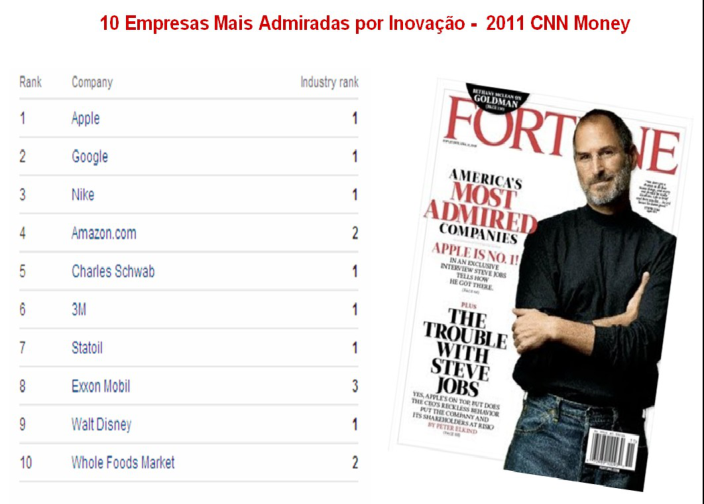
One year and few months later, Apple was elected the number one on the list of 10 most admired companies in Innovation by Fortune Magazine. Microsoft was not among this Top 10. Figure 4 shows the rank of Fortune.
Figure 4. America’s most admired companies Fortune Top 10
In May 26, 2011, Apple overtook Microsoft, according with Financial Post, reaching the value of 223 Billions of US dollar. Microsoft, that was the leader, stopped at 217 Billions of US dollar. It seems that the amount of investment in R&D is not enough to guarantee the creativity and innovation for countries and companies. This is exactly what the most innovative leader of this century, states in an interview for Fortune Magazine. In 1998, Steve Jobs said that "Innovation has nothing to do with how many R&D dollars you have. When Apple came up with the Mac, IBM was spending at least 100 times more on R&D. It's not about money. It's about the people you have, how you're led, and how much you get it." So, let’s investigate what is basic to provide a suitable environment for creativity and innovation.
FLOW AND ROLL There is a condition of deep, nearly meditative involvement that is a state of concentration or complete absorption with the activity at hand and the situation. In this state people are so involved in an activity that nothing else seems to matter (DeMarco & Lister, 1999). It is an optimal state of intrinsic motivation, where the person is fully immersed in what he or she is doing. This is a feeling everyone has at times, characterized by great absorption, engagement, fulfillment, and skill—and during which temporal concerns (time, food, ego-self, etc.) are typically ignored (Csikszentmihalyi, 1990). In the beginning of nineties, a Hungarian origin psychologist named Mihaly Csikszentmihalyi published the Theory of Flow, in which he describes the conditions that lead to a state of optimum concentration. To reach this state one have to be involved with activities that has some challenge and must have skill level enough to play it. Interviewed by Wired magazine, Csíkszentmihályi described flow as "being completely involved in an activity for its own sake. The ego falls away. Time flies. Every action, movement, and thought follows inevitably from the previous one, like playing jazz. Your whole being is involved, and you're using your skills to the utmost" (Geirland, 1996). In his book, he describes the Flow as a state that must have a balance between the challenge of the task and the skill of the performer. If the task is too easy or too difficult, flow cannot occur.
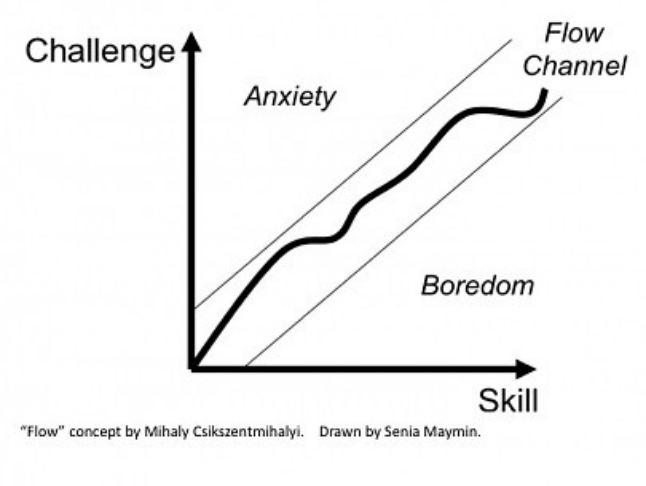
Both skill level and challenge level must be matched and high; if skill and challenge are low and matched, then apathy results. According to Dr. Csikszentmihalyi, people seem to concentrate best when the demands on them are a little bit greater than usual, and they are able to give more than usual. If there is too little demand on them, people are bored. If there is too much for them to handle, they get anxious. Flow occurs in that delicate zone between boredom and anxiety. Figure 5 shows the relationship between challenge and skills which create the possibility to reach the Flow.
Figure 5. Flow Concept and the relationship between challenges and skills
In 1986, James Brady published the Roll Theory stating that when an individual has access to the data necessary to perform the creative task at hand, when concentration is not broken by distractions, and when the individual has developed a consistent method of organizing the data, then ideas and solutions will suggest more ideas and solutions to successive steps of the creative process, in a rapid and orderly flow. Even nowadays we can find dozens of studies that shows the same conclusions of Brady and Csikszentmihalyi. If is difficult to reach the Flow, is easy to break that state. Interruptions from outside are particularly damaging to productivity because of their unexpected nature. A phone call answered, or even just heard, may cause the loss of a key idea, never again to be recalled. Or, at best, it could mean the loss of the effort to re-establish the state. An innovator should have means to shut off all but emergency communications. The phone ring, the knock on the door, the announcement on the intercom, and so on, should be mutable. The acoustics should minimize the intrusion of the argument in the next office. A colleague passing in front of your door or window, a movement of your roommate, a bird flying outside, can also interrupt the Flow. Meetings should not be spread throughout the week so that they hack the available time into small pieces. If this is not done the period between interruptions, which decrease exponentially with the size of the organization, will be less than the duration of the average period of Flux or Roll (Brady, 1986).
Interruptions The workplace is the key for higher productivity and for the creation of an adequate environment to push creativity and innovation. Of course it is not the only factor that will guarantee that a team starts to produce more and more results, but it is the most addressable for managers and companies. Physiological improvements, to make easier to get the flow state, are related to relaxing exercises, yoga, meditation, martial arts, trekking, etc. If the employee reaches the Flow state and start to produce good results, the main function of the manager is to keep the conditions to maintain the state. Noise is probably the most terrible factor to cause interruptions. After interrupted the employee spend at least 15 minutes to recover the state, if possible. Imagine that during the morning he receives 4 phone calls, 2 work colleagues come to talk about something, he goes 2 times in the bathroom and 2 times to grab a coffee. It makes 10 interruptions, times 15 minutes results in 150 minutes that means, 2 hours and a half. This is more than 50% of the working time available during the morning period. If the company uses open-plan offices, the amount of noise and interruptions will transform the workplace in a low productivity space. This is the reason why some employees arrive earlier or leave later than the working schedule establishes. Besides, the noise unconsciously stresses the employee resulting in overreactions and bad mood. It can destroy the team work. The amount of noise rises exponentially with the number of employees in the room. If the room does not have acoustic treatment (carpets, curtains, acoustic ceiling, etc.) the various sources of sounds will produce reverberation waves that will be added to the original noise. Depending on the kind of activity, there will be no condition to work in the space. Sometimes is possible to find colleagues working in the cafeteria, the library or the archive room.
Environmental comfort A study made by Professor Alan Hedge, from Cornell University, related low productivity with high or low temperature and lighting. In the occurrence of vibration, loud/annoying sound, poor indoor air quality and perceived or real absence of personal control. Results suggest that is possible to reduce errors by 44%, only applying correct actions over the workplace.
HVAC – Heat, Ventilation and Air Conditioning Heat, Ventilation and Air Conditioning System is one of the factors that cause impact in productivity. If the temperature is too cold or too hot, if the noise is too loud, if the equipment vibrates, if the air quality is poor, it will affect the productivity. Natural ventilation is a trend in office buildings that are located in suburbs. In standard height office buildings, the recommendation is to use windows that start at least near the table up to the ceiling, and from one to the opposite wall. The use of fanlight is also good to allow natural ventilation, even during rain periods.
Lighting system Same as ventilation, performance decreases when work environment is too dim or too bright. If the light reaches the employee making the environment too glaring it will also affect the performance. It is important to separate the lights for each people in the room and is recommended to allow two or three steps of intensity, or a dimmer, for each employee in the room. Figure 6 show an example of a work room that has some of the characteristics described before in the text.
Figure 6. Work room built according Ergonomic and Flow specifications
Figure available in the original PDF paper.
Nature views Another factor that contributes for the conditions that will facilitate the way to reach the Flow state is nature views outside the windows, like grass, trees, flowers, etc. Some studies suggest that green color contributes for the thinking process opening the conscience. Everybody already felt the sensation of a countryside environment with lots of green tones.
Focus on the wall It is not recommended locate tables facing walls. They should stay away from walls, at least 2 m, to allow eye focus muscles relax when user is looking to the wall. Normally when people work in front of a computer for many hours, they periodically look to a point far from the eye, instinctively, to change the focal distance relaxing the muscles that make the focus occur. This is important to avoid eye fatigue.
CONCLUSIONS
The preoccupation with the work environment is very important if you need to reach creative leap and innovation as a differential in business strategy. To know very well the skills of your team is mandatory to address tasks that will lead the team to create and innovate. Telephone is one of the most destroying items on reaching Flow state; money is not the way to innovate. Good people, good workplace and management are. Open-plan offices are not a good solution if you need to innovate.
REFERENCES
Brady, James, (1986), “A Theory of Productivity in The Creative Process”. IEEE CG&A Csikszentmihalyi, Mihaly, (1990), “Flow: The Psychology of Optimal Experience”. New York, Harper & Row Publishers Inc... DeMarco, Tom and Lister, Timothy, (1999), “Peopleware: productive projects and teams”. New York Dorset House Publishing. Financial Post, (2011), http://business.financialpost.com/2010/05/27/fp-tech-desk-apple-overtakes-microsoft-in-pictures/ Fortune Magazine, (1998), http://money.cnn.com/magazines/fortune/fortune_archive/ 1998/11/09/250834/index.htm. Geirland, John, 1996, Go With The Flow. Wired Magazine, September, Issue 4.09. Hedge, Alan, (2004), “Linking environmental Conditions to Productivity”, Cornell University, Ithaca, NY Maslow, Abraham, (1954), “Motivation and Personality”. New York, NY: Harper & Row Publishers Inc. OECD Factbook, (2010), “Economic, Environmental and Social Statistics” ISBN 92-08356-1 http://dx.doi.org/10.1787/820860264335 The Wall Street Journal – WSJ,
http://online.wsj.com/mdc/public/page/2_3022-macromkt.html WIPO - World Intellectual Property Organization - Report 2010
LISTED IN THE AHFE DIGITAL BOOKSTORE CATALOGUE
Explore the complete digital volume
Advances in Ergonomics In Design, Usability & Special Populations: Part III
Read this individual research paper free through the original publisher, or explore the full digital proceedings book.
ISBN 978-1-4951-2108-1
Explore this ISBN in the AHFE Bookstore ↗Listed in the July 2026 bookstore catalogue; search by ISBN to confirm current availability · Digital book purchase optional