Ofer Bergman, Or Perets (2026). Background Music Listening During Computer-Based Work: Frequency and Self-Reported Concentration. In: Accessibility, Assistive Technology and Digital Environments. AHFE Open Access, vol. 202, pp. 152–160. https://doi.org/10.54941/ahfe1007306
Background music (BgM) listening refers to playing music while performing another task. Although previous research has examined how different types of music affect the performance of various cognitive tasks, little is known about how frequently individuals choose to listen to BgM during everyday work. The present study examined the proportion of computer-based work time spent listening to BgM (BgM%) and its association with self-reported concentration. Seventy participants were recruited through personal contacts and social media. Participants included 37 women (53%) and 33 men (47%), of ages ranging from 22 to 64 years (M = 32.01, SD = 9.36). The recruitment request emphasized that the questionnaire was intended for both those who do and do not listen to BgM while working. Participants estimated the percentage of their computer-based work time spent listening to BgM. The mean BgM% was 41%, with substantial variability (SD = 32%). Contrary to expectations, the distribution of BgM listening was not bimodal. Only 18% reported never listening to BgM while working on their computers, and the remaining participants were almost evenly divided across low, medium, and high BgM-use categories. Participants also rated their agreement/disagreement with the statement “BgM helps me concentrate while working on the computer” on a Likert scale. A Spearman correlation analysis revealed a strong positive association between BgM% and perceived concentration, r(68) = 0.78, p < 0.001. This suggests that individuals’ beliefs about BgM’s impact on their concentration largely determine their BgM-listening behavior. Future research should test whether these subjective concentration assessments correspond to objective performance outcomes.
Music listening is a pervasive activity, commonly performed alongside other tasks, rather than as a primary focus (Bull, 2006; North et al., 2004; Stratton & Zalanowski, 2003; Randall & Rickard, 2017; Greasley & Lamont, 2011). BgM refers to music played while an individual’s primary attention is directed to a non-music task (Radocy & Boyle, 2012). Whether BgM supports or disrupts concentration and productivity remains unclear, given decades of contradictory and often inconclusive research (De La Mora Velasco & Hirumi, 2020).
Findings are divided into three patterns that highlight variability. BgM can impair performance (especially in verbal tasks, memory, reading, and Received January 19, 2026; Revised April 9, 2026; Accepted April 27, 2026; Available online July 20, 2026
Background Music Listening During Computer-Based Work 153 writing) consistent with interference accounts (Avila et al., 2012; Kämpfe et al., 2011; Iwanaga & Ito, 2002; Cassidy & MacDonald, 2007; Perham & Vizard, 2011; Vasilev et al., 2018; Thompson et al., 2012; Lehmann & Seufert, 2017; Ransdell & Gilroy, 2001). Conversely, BgM has been linked to reduced mind-wandering, greater engagement, faster processing, and less external interference, suggesting benefits in some contexts and circumstances (Kiss & Linnell, 2021; Jones, 2005; Serpian & Jusnawati, 2022; Bottiroli et al., 2014; Angel et al., 2010; Ferreri et al., 2015; Masataka & Perlovsky, 2013). Other studies report null effects, indicating no consistent shift across tasks or people (Burkhard et al., 2018; Kou et al., 2018). Overall, BgM is best explained via mechanisms and moderators rather than a single global effect (Kämpfe et al., 2011; De La Mora Velasco & Hirumi, 2020).
A common account that explains the negative effects is capacity limits, described as concurrent stimulation competing for shared resources (Miller, 1956; Marois & Ivanoff, 2005). Performance may decline when music and task performance demands overlap (Sweller, 1988; Wickens, 2002), especially in verbal tasks, because lyrics and vocal streams interfere with linguistic processing (Perham & Currie, 2014; Alley & Greene, 2008). Studies report poorer reading comprehension and working-memory performance under lyrical or vocal music than under silence, and verbal performance is often higher in silence than with BgM (Perham & Currie, 2014; Alley & Greene, 2008; Avila et al., 2012; Iwanaga & Ito, 2002; Ransdell & Gilroy, 2001; Vasilev et al., 2018; Thompson et al., 2012). Effects also increase in line with task complexity, since demanding tasks leave fewer resources to manage background stimulation (Campbell, 1988; Wickens, 2002; Topi et al., 2005; Sweller, 1988). Meta-analyses align with this view, with overall effects may be near-zero, yet small detrimental effects emerge for memory and reading (Kämpfe et al., 2011).
Positive accounts emphasize regulation of attention, mood, and arousal, suggesting BgM can support engagement in some conditions (Kiss & Linnell, 2021; Bottiroli et al., 2014; Ferreri et al., 2015; Angel et al., 2010). BgM has been associated with less self-reported mind-wandering and better sustained attention, particularly if the music is self-chosen (Kiss & Linnell, 2021; Kiss & Linnell, 2024). Benefits have also been reported for processing speed and some memory processes (Bottiroli et al., 2014; Ferreri et al., 2015; Mammarella et al., 2007). Emotional and physiological pathways may also contribute, as music can modulate affect and arousal in ways that indirectly support concentration for some individuals (Proverbio & De Benedetto, 2018; Liljeström et al., 2013; Taruffi et al., 2017; Nantais & Schellenberg, 1999; North & Hargreaves, 1999). However, perceived focus may reflect mood or arousal changes rather than reliable productivity gains (Haake, 2011; Lesiuk, 2005; Goltz & Sadakata, 2021). Mixed and null findings are often attributed to three moderators. Task type and complexity shape whether BgM helps or distracts, with language- heavy tasks found to be more susceptible to interference (Gonzalez & Aiello, 2019; Campbell, 1988; Kämpfe et al., 2011). Music characteristics (e.g., lyrics, genre, intensity) also matter (Shih et al., 2012; Yi-Nuo et al.,
154 Bergman and Peretz 2016; Perham & Currie, 2014; Alley & Greene, 2008; Mammarella et al., 2007; Liu et al., 2017; Thompson et al., 2012; Chou, 2010). Individual differences further contribute, including introversion-extraversion and self- regulation tendencies in BgM use (Cassidy & MacDonald, 2007; Furnham & Strbac, 2002; Furnham & Bradley, 1997; Deng & Wu, 2020; Eysenck, 1956; Eysenck & Eysenck, 1968; Goltz & Sadakata, 2021). Workplace evidence likewise shows both improved focus and distraction, underscoring a highly individual relationship between BgM and perceived concentration (Haake, 2011; Lesiuk, 2005; Cloutier et al., 2020; Cassidy & MacDonald, 2009). To the best of our knowledge, no previous study has systematically examined how much time individuals spend listening to BgM during computer-based work, nor whether this behavior is associated with their self- reported perceptions of BgM’s impact on concentration.
RESEARCH QUESTIONS
1. What is the distribution of BgM listening while working on a computer? 2. What is the relationship between the self-reported effects of BgM on concentration and the proportion of time individuals listen to BgM during computer-based work?
Preliminary observations suggested a consistent pattern in participants’ self-reports: individuals who listened to BgM during computer-based work commonly reported doing so because it helped them concentrate, whereas those who avoided BgM tended to report that it was distracting. Based on these observations, we hypothesized a positive correlation between the perceived effect of BgM on concentration and actual BgM listening during computer-based work.
METHOD
We used a questionnaire to measure both BgM percentage (BgM%) and self- reported BgM effect on concentration.
Participants We recruited 70 participants through personal connections and using a social media post (non-random selection). Of the participants, 37 (53%) identified as women and 33 (47%) as men. Their age ranged from 22 to 64 years old (M = 32.01, SD = 9.36). Of the participants, 35 were high-tech workers (26 programmers, 7 data analysts, and 3 held other technology-related jobs), 6 worked in government offices, 3 were freelancers, 2 were students, 15 held various other jobs and 8 did not report their occupation. During the recruitment process, we stressed that the questionnaire is designed for both people who listen to BgM while working and those who do not. We did so in order not to bias the results of RQ1 with more participants who listen to BgM while working than their percentage in the general population.
Background Music Listening During Computer-Based Work 155 BgM% Measurement
BgM% was measured using the following question: Some people frequently listen to BgM while they are working, some do it occasionally, and others do not listen to music at all while working on the computer. Try to think of all the occasions that you worked on your computer (e.g., in the last two weeks). This will be your 100%. Now try to estimate the percentage of that time during which you listened to music (if you do not listen to BgM while working, write 0). I listen to BgM during ____% of the time I work on the computer.
Perceived BgM Effect on Concentration To measure the perceived BgM effect on concentration, we asked our participants to what extent they agree/disagree with the following statement: “Music helps me concentrate while working on the computer” on a 1–5 Likert scale.
RESULTS
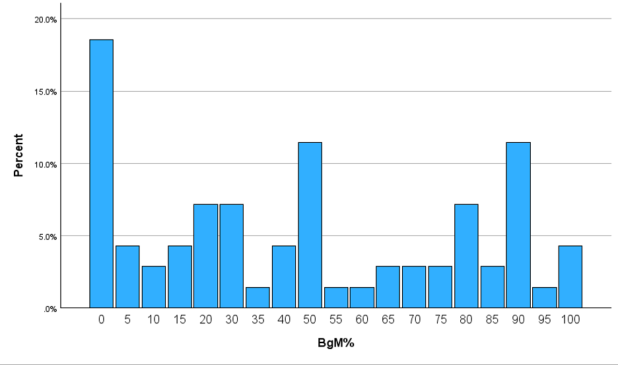
BgM% Distribution The distribution of BgM% is presented in Figure 1.
Figure 1: BgM% distribution.
Figure 1 illustrates that BgM listening behavior is not binary. Only 13 participants (19%) did not listen to BgM at all. The remaining participants were distributed relatively evenly across low, medium, and high BgM-use categories (see Table 1). The mean listening percentage was 44% with a relatively high standard deviation of 35%.
Table 1: The BgM% distribution divided into groups.
Table available in the original PDF paper.
Group Participants (%) No BgM (0%) 13 participants (19%)
BgM HELPS ME CONCENTRATE When we asked participants to what extent they agree/disagree with the statement “Music helps me concentrate while working on the computer” on a 1–5 Likert scale, their average answer was 3.16 (SD = 1.39). A Spearman correlation between “music helps me concentrate” and BgM% was significant and high, r(68) = 0.78 p < 0.001.
DISCUSSION
BgM% Variance is High and Requires Explanation Our results indicate that 81% of the participants listen to BgM while working on their computers. The average BgM% for all participants was 41%, which means that on average the participants listen to music for almost half the time that they work on their computers. This finding is consistent with broader research showing that music is frequently used as a secondary activity during other tasks, such as working or studying (Bull, 2006; Greasley & Lamont, 2011; North et al., 2004; Lonsdale & North, 2011; Watson & Mandryk, 2012; Stratton & Zalanowski, 2003). The variance (SD = 32%) is fairly high, which requires an explanation. Contrary to our expectations, the BgM% distribution was not binary, with 19% of the participants not listening to BgM at all, 24% with low BgM listening, 23% with moderate BgM listening, and 33% with high BgM listening.
The More Participants Believe That Bgm Helps Them Concentrate, The More They Listen To It An unusually strong correlation was found between the factor BgM helps me concentrate and BgM% (r(68) = 0.78 p<0.01). Importantly, the finding that individuals who believe BgM helps their concentration tend to listen to it more frequently does not imply that this belief accurately reflects actual performance benefits. This should be tested in future research. If our participants were right in their intuitive belief about the effect of BgM on their concentration, then individual differences - a factor that received little attention in previous studies (with the exceptions of Lesiuk, 2005; Furnham & Strbac, 2002; Hallam et al., 2001; Kämpfe et al., 2011; Haake, 2011) - are an essential factor explaining the effect of music on concentration. Failure to account for individual differences in BgM use and perceived effectiveness may help explain why prior research has yielded positive, negative, and null effects of BgM on cognitive performance (Kiss & Linnell, 2021; Jones, 2005;
Background Music Listening During Computer-Based Work 157 Serpian & Jusnawati, 2022; Bottiroli et al., 2014; Angel et al., 2010; Ferreri et al., 2015; Masataka and Perlovsky, 2013). Others found a negative effect (Avila et al., 2012; Ersin et al., 2021; Kämpfe et al., 2011; Iwanaga & Ito, 2002; Cassidy & MacDonald, 2007; Perham & Vizard, 2011; Vasilev et al., 2018; Thompson, 2012; Lehmann & Seufert, 2017; Ransdell & Gilroy, 2001) while still others found no significant effect (Burkhard et al., 2018; Kou et al., 2018). These discrepancies had no effect, according to a vote- counting direction analysis (Cheah et al., 2022). On the other hand, if our participants are wrong in their intuitions, then future research should study what causes this mistaken intuition that impacts their behavior.
CONCLUSION
To our knowledge, this is the first study to systematically examine the percentage of time that individuals spend listening to BgM during computer-based work, and whether this behavior is associated with their self-reported perceptions of BgM’s impact on their concentration. Contrary to our expectations, the BgM% distribution was not binary, with 19% of the participants not listening to BgM at all, 24% with low BgM listening, 23% with moderate BgM listening, and 33% with high BgM listening. An unusually strong correlation was found between the factor BgM helps me concentrate and BgM% (r(68) = 0.78 p < 0.01), indicating that the more participants believe that BgM helps them concentrate, the more they listen to it. Future research should test whether these subjective concentration assessments accurately reflect the actual BgM impact on performance.
ACKNOWLEDGMENT
The authors thank the participants for their time and effort. This research was funded by the Israeli Science Foundation, Grant No. 976/22.
REFERENCES
Alley, T. R., & Greene, M. E. (2008). The relative and perceived impact of irrelevant speech, vocal music and non-vocal music on working memory. Current Psychology, 27, 277–289. Angel, L. A., Polzella, D. J., & Elvers, G. C. (2010). Background music and cognitive
performance. Perceptual and Motor Skills, 110(3_suppl), 1059–1064. Avila, C., Furnham, A., & McClelland, A. (2012). The influence of distracting familiar vocal music on cognitive performance of introverts and extraverts. Psychology of Music, 40(1), 84–93. Bottiroli, S., Rosi, A., Russo, R., Vecchi, T., & Cavallini, E. (2014). The cognitive
effects of listening to background music on older adults: Processing speed improves with upbeat music, while memory seems to benefit from both upbeat and downbeat music. Frontiers in Aging Neuroscience, 6, 284. Bull, M. (2006). Investigating the culture of mobile listening: From Walkman to iPod. In Consuming music together: Social and collaborative aspects of music consumption technologies (pp. 131–149). Springer Netherlands. Burkhard, A., Elmer, S., Kara, D., Brauchli, C., & Jäncke, L. (2018). The effect of
background music on inhibitory functions: An ERP study. Frontiers in Human Neuroscience, 12, 293.
Management Review, 13(1), 40–52. Cassidy, G., & MacDonald, R. (2009). The effects of music choice on task performance: A study of the impact of self-selected and experimenter-selected music on driving game performance and experience. Musicae Scientiae, 13(2), 357–386. Cassidy, G., & MacDonald, R. A. (2007). The effect of background music and
background noise on the task performance of introverts and extraverts. Psychology of Music, 35(3), 517–537. Cheah, Y., Wong, H. K., Spitzer, M., & Coutinho, E. (2022). Background music and cognitive task performance: A systematic review of task, music, and population impact. Music & Science, 5, 20592043221134392. Chou, P. T. M. (2010). Attention drainage effect: How background music effects
concentration in Taiwanese college students. Journal of the Scholarship of Teaching and Learning, 10(1), 36–46. Cloutier, A., Fernandez, N. B., Houde-Archambault, C., & Gosselin, N. (2020).
Effect of background music on attentional control in older and young adults. Frontiers in Psychology, 11, 557225. De la Mora Velasco, E., & Hirumi, A. (2020). The effects of background music on learning: A systematic review of literature to guide future research and practice. Educational Technology Research and Development, 68, 2817–2837. Deng, M., & Wu, F. (2020). Impact of background music on reaction test and visual
pursuit test performance of introverts and extraverts. International Journal of Industrial Ergonomics, 78, 102976. Eysenck, H. J. (1956). Reminiscence, drive, and personality theory. The Journal of Abnormal and Social Psychology, 53(3), 328. Eysenck, H. J., & Eysenck, S. B. (1968). Eysenck Personality Inventory. Journal of
Clinical Psychology. Ferreri, L., Bigand, E., Bard, P., & Bugaiska, A. (2015). The influence of music on prefrontal cortex during episodic encoding and retrieval of verbal information: A multichannel fNIRS study. Behavioral Neurology, 2015(1), 707625. Furnham, A., & Bradley, A. (1997). Music while you work: The differential
distraction of background music on the cognitive test performance of introverts and extraverts. Applied Cognitive Psychology: The Official Journal of the Society for Applied Research in Memory and Cognition, 11(5), 445–455. Furnham, A., & Strbac, L. (2002). Music is as distracting as noise: The differential distraction of background music and noise on the cognitive test performance of introverts and extraverts. Ergonomics, 45(3), 203–217. Goltz, F., & Sadakata, M. (2021). Do you listen to music while studying? A portrait of
how people use music to optimize their cognitive performance. Acta Psychologica, 220, 103417. Gonzalez, M. F., & Aiello, J. R. (2019). More than meets the ear: Investigating how music affects cognitive task performance. Journal of Experimental Psychology: Applied, 25(3), 431. Greasley, A. E., & Lamont, A. (2011). Exploring engagement with music in everyday
life using experience sampling methodology. Musicae Scientiae, 15(1), 45–71. Haake, A. B. (2011). Individual music listening in workplace settings: An exploratory survey of offices in the UK. Musicae Scientiae, 15(1), 107–129. Iwanaga, M., & Ito, T. (2002). Disturbance effect of music on processing of verbal
and spatial memories. Perceptual and Motor Skills, 94(3_suppl), 1251–1258. Jones, K. (2005). Music in factories: A twentieth-century technique for control of the productive self. Social & Cultural Geography, 6(5), 723–744.
Background Music Listening During Computer-Based Work 159 Kämpfe, J., Sedlmeier, P., & Renkewitz, F. (2011). The impact of background music
on adult listeners: A meta-analysis. Psychology of Music, 39(4), 424–448. Kiss, L., & Linnell, K. J. (2021). The effect of preferred background music on taskfocus in sustained attention. Psychological Research, 85(6), 2313–2325. Kiss, L., & Linnell, K. J. (2024). The role of mood and arousal in the effect of
background music on attentional state and performance during a sustained attention task. Scientific Reports, 14(1), 9485. Kou, S., McClelland, A., & Furnham, A. (2018). The effect of background music and noise on the cognitive test performance of Chinese introverts and extraverts. Psychology of Music, 46(1), 125–135. Lehmann, J. A., & Seufert, T. (2017). The influence of background music on learning
in the light of different theoretical perspectives and the role of working memory capacity. Frontiers in Psychology, 8, 1902. Lesiuk, T. (2005). The effect of music listening on work performance. Psychology of Music, 33(2), 173–191. Liljeström, S., Juslin, P. N., & Västfjäll, D. (2013). Experimental evidence of the roles
of music choice, social context, and listener personality in emotional reactions to music. Psychology of Music, 41(5), 579–599. Liu, T., Lin, C. C., Huang, K. C., & Chen, Y. C. (2017). Effects of noise type, noise intensity, and illumination intensity on reading performance. Applied Acoustics, 120, 70–74. Mammarella, N., Fairfield, B., & Cornoldi, C. (2007). Does music enhance cognitive
performance in healthy older adults? The Vivaldi effect. Aging Clinical and Experimental Research, 19, 394–399. Marois, R., & Ivanoff, J. (2005). Capacity limits of information processing in the brain. Trends in Cognitive Sciences, 9(6), 296–305. Masataka, N., & Perlovsky, L. (2013). Cognitive interference can be mitigated by
constant music and facilitated by dissonant music. Scientific Reports, 3(1), 1–6. Miller, G. A. (1956). The magical number seven, plus or minus two: Some limits on our capacity for processing information. Psychological Review, 63(2), 81. Moreno, R., & Mayer, R. E. (2000). A coherence effect in multimedia learning: The
case for minimizing irrelevant sounds in the design of multimedia instructional messages. Journal of Educational Psychology, 92(1), 117. Moris, D. N., & Linos, D. (2013). Music meets surgery: Two sides to the art of “healing.” Surgical Endoscopy, 27, 719–723. Nantais, K. M., & Schellenberg, E. G. (1999). The Mozart effect: An artifact of
preference. Psychological Science, 10(4), 370–373. North, A. C., & Hargreaves, D. J. (1999). Music and driving game performance.
Scandinavian Journal of Psychology, 40(4), 285–292. North, A. C., Hargreaves, D. J., & Hargreaves, J. J. (2004). Uses of music in everyday life. Music Perception, 22(10), 41–77. Perham, N., & Currie, H. (2014). Does listening to preferred music improve reading
comprehension performance? Applied Cognitive Psychology. Perham, N., & Vizard, J. (2011). Can preference for background music mediate the irrelevant sound effect? Applied Cognitive Psychology, 25(4), 625–631. Proverbio, A. M., & De Benedetto, F. (2018). Auditory enhancement of visual
memory encoding is driven by emotional content of the auditory material and mediated by superior frontal cortex. Biological Psychology, 132, 164–175. Radocy, R. E., & Boyle, J. D. (2012). Psychological foundations of musical behavior.
Charles C Thomas Publisher.
160 Bergman and Peretz Randall, W. M., & Rickard, N. S. (2017). Reasons for personal music listening: A
mobile experience sampling study of emotional outcomes. Psychology of Music, 45(4), 479–495. Ransdell, S. E., & Gilroy, L. (2001). The effects of background music on word processed writing. Computers in Human Behavior, 17(2), 141–148. Serpian, S. F. A., & Jusnawati, K. H. (2022). Music at Workplace: Is it truly Improving
Employees’ Performance? Jurnal Office: Jurnal Pemikiran Ilmiah Dan Pendidikan Administrasi Perkantoran, 8(2), 369–378. Shih, Y.-N., Chien, W.-H., & Chiang, H. (2016). Elucidating the relationship between work attention performance and emotions arising from listening to music. Work, 55(2), 489–494. Shih, Y.-N., Huang, R.-H., & Chiang, H.-Y. (2012). Background music: Effects on
attention performance. Work, 42(4), 573–578. Stratton, V. N., & Zalanowski, A. H. (2003). Daily music listening habits in college students: Related moods and activities. Psychology and Education: An Interdisciplinary Journal, 40, 1–11. Sweller, J. (1988). Cognitive load during problem solving: Effects on learning.
Cognitive Science, 12(2), 257–285. Taruffi, L., Pehrs, C., Skouras, S., & Koelsch, S. (2017). Effects of sad and happy music on mind-wandering and the default mode network. Scientific Reports, 7(1), 14396. Thompson, W. F., Schellenberg, E. G., & Letnic, A. K. (2012). Fast and loud
background music disrupts reading comprehension. Psychology of Music, 40(6), 700–708. Topi, H., Valacich, J. S., & Hoffer, J. A. (2005). The effects of task complexity and time availability limitations on human performance in database query tasks. International Journal of Human-Computer Studies, 62(3), 349–379. Vasilev, M. R., Kirkby, J. A., & Angele, B. (2018). Auditory distraction during
reading: A Bayesian meta-analysis of a continuing controversy. Perspectives on Psychological Science, 13(5), 567–597. Wickens, C. D. (2002). Multiple resources and performance prediction. Theoretical Issues in Ergonomics Science, 3(2), 159–177.
LISTED IN THE AHFE DIGITAL BOOKSTORE CATALOGUE
Explore the complete digital volume
Accessibility, Assistive Technology and Digital Environments
Read this individual research paper free through the original publisher, or explore the full digital proceedings book.
ISBN 978-1-964867-78-6
Explore this ISBN in the AHFE Bookstore ↗Listed in the July 2026 bookstore catalogue; search by ISBN to confirm current availability · Digital book purchase optional