Charles Tijus, Javier Barcenilla, Marie Rougeaux, François Jouen (2022). Open Innovation and Prospective Ergonomics for Smart Clothes. In: Advances in Ergonomics In Design, Usability & Special Populations: Part III. AHFE Open Access, vol. 20. https://doi.org/10.54941/ahfe1001350
In this paper, we introduce our theoretical approach of Prospective Cognitive Ergonomics, our methodology and the results obtained through Homo Textilus, a project for designing what might be Smart Clothes, the future of interactions between people and their digital clothes. For collecting data, we used different kinds of inquiries (questionnaires, short interviews, brainstorming) resulting in more than 300 proposals about digital clothes involving many kinds of functions (ranging from textile properties to garments made of electronic parts such as sensors and actuators). We emphasize more precisely how counterfactual based reasoning may be a powerful tool to elicit responses about future objects by making people envisage alternative worlds by using, for instance, the “WHAT IF NOT” (WIN) method of creativity for innovation. Indeed, counterfactual reasoning plays an important role in predicting, planning and decision making and this kind of reasoning can be seen, at the same time, as a simulation mechanism (what could / would happen if…) and a computing mechanism (what I have to do to make it possible…). Finally, we demonstrate how the “WHAT IF NOT” method of creativity can be applied to objects, functions, procedures, and objects states to elicit new ideas about future things.
INTRODUCTION: DESIGNING FUTURE THINGS AND THE FONCTION OF COGNITIVE ERGONOMICS Defining what prospective ergonomics (PE) are, some authors (Robert, Brangier, 2012) argue that PE “relates to the future and does not come with a demand and a client. It is turned towards the creation of future things that have not been identified yet. Here the challenge is to detect existing user needs or anticipate future ones, and imagine solutions.” To face this challenge, they list a number of quantitative and qualitative foresight methods to address creativity of possible users of these things that could be foreseen.
This challenge is part of the process of open innovation developed in Living Labs. For an user centered approach of conception of future services and products, these are made for and by the people and then industrially manufactured, and, a step further, one considers as a citizen duty to participate in innovation process: “innovation needs you, innovation needs your expertise.” (Barcenilla, Tijus, 2012). New products and services in real-life environments are created, prototyped and used and citizens are treated as early stage contributors and innovators (Ballon, Pierson, Delaere, 2007; Wise, Høgenhaven, 2008)
The framework of the content of this paper is the open innovation process of imaging future things in Living Labs, more precisely in the context of LUTIN, which is a Living Lab located in Universcience - City of Science and of Industry in Paris, a member of the LabEx SMART, a laboratory of Excellence dedicated to “Smart Human/Machine/Human Interactions In The Digital Society”. An important conceptual tool we have been using in this process of imaging future things is the formulation of counterfactual hypothesis "WHAT IF NOT" (WIN) that help people collaborate on innovation by building narratives about the use of possible technologies in scenarios that are alternative to the current ones. This WIN tool is based on a counterfactual theory of creativity (Tijus, Brezillon, 2006; Tijus, Brézillon, Poitrenaud, Léger, 2009).
Thus, although we still need the best methods of prospective innovation, the problem at hand is not how to imagine, but what can be ergonomics of things that do not exist.
Prospective ergonomics of cognitive digital technologies Everywhere, homes or workplaces, in the streets or the public spaces, where we go for business, service, shopping, leisure or travel, they are digital systems with which we interact. Because they have to be adapted to humans, these digital systems include a model of theirs users and are more and more made of Cognitive Technologies that are technologies that process as inputs data provided by their users. These emerging Cognitive Technologies are flourishing areas of multifaceted scientific research and research development, including neuroscience (e.g., brain computing), psycho-physiology (e.g., emotive computing), psychophysics (e.g., actimetry), cognitive psychology (e.g., digital reading and learning), computational linguistics (e.g., texts processing) to be used in association with artificial intelligence, cognitive robotics, distributed Human-Machine systems, cognitive ergonomics, and cognitive engineering.
This emerging field has potential for many domains, such as everyday life technologies, conception of teaching and learning in the classroom, e-learning, science and technology-related museology, e-government applications, heath, military and intelligence applications, and so on.
With cognitive technologies, ergonomics studies are not solely how to facilitate interactions with a digital device, but also how to implement the system with a pertinent model of the users (data to collect, computing modes). Thus after imaging future cognitive technologies, the problem at hand is how to access knowledge about things that do not exist yet and how to deal with ergonomics problems of future digital systems.
ACCESS TO KNOWLEDGE THAT DOES NOT EXIST YET AND REASONING ABOUT IT As we quote Gibson (1986, p. 223), « to see things is to see how to get about among them and what to do or not do with them », this seems obvious because as we move around our environment we learn and we become conscious of its possibilities. The question then is to know if we can perceive things that don’t exist and their possibilities. How can we have access to possible worlds and manipulate them?
Declerk (2013) claims that « the possible », even if it is not the perceived objet, plays a structural role in the way we organize the perceived world because the meaning of the objects depends of the possibilities of usages that we can anticipate. In this way, concepts referring to objects in the world can be viewed not as a fixed mental representation but as a source of potentiality that can take context specific states (Gabora, 2002). In the same way, the fact of simulating future, of imaging future hypothetical events, make these events more probable (Taylor, Pham, Rivkin, Armor, 1998).
Kirsh (2013), through his “theory of embodied cognition”, pointed out how tools can shape our thoughts and perceptions. Objects in the real world can modify the way we perceive and we interact with them, but in turn, objects that do not exist yet, but may become a reality in some future, can also change our perception of the world and our actions. This is obvious for blind people with a cane, who through this tool gain knew knowledge about the environment. But what’s about if we place sensors at the end of the cane? It is always the same knowledge? Can we think about a new function of the cane? Actually, there is already a cane that can rely on to stand. How people conceived this cane (a possible world until a recent period), and how the new function structures the representation of people using it? These are questions to be raised.
On one hand, traditional points of view about creativity and problem solving, as gestalt theorists, assume that a new idea or creative act must be preceded by a period of incubation, before the idea appears by an unconscious mechanism called illumination. On the other hand researches in the Ergonomics field consider that we can foster creativity and generate knowledge about the present or future use of a product by applying adequate methods as “scenarios based reasoning” (Carrol, 2008), “personas creativity” (Brangier, Barcenilla, 2013) or “analogy based approaches” (Tijus et al., 2009).
Another more direct way to boost creativity is to elicit counterfactual thinking as simulations to alternatives of reality (Byrne, 2005; Roese, 1997). This type of reasoning can improve the process of reflection and evaluation of alternative states (Markman, McMullen & Elizaga, 2008).
Counterfactual reasoning is a form of modal reasoning about the way things “could be, have been, would be”. Thus counterfactuals are “what ifs ” that are related, either to the past (“could have been”, “might have been”) and to the future (“would be ”) or to now (“could be”). They are used for designing imagery for novels and movies in what is named virtual history, for studying fantasy processes (Bacon, Walsh, Martin, 2013), but also for academic alternative history (Roberts, 2004), and for academic economic history, a combination of economy, statistics and econometrics. As a mechanism for creativity and innovation, reasoning and decisions are to be made from “the way things actually are” and how “they could be”. From the actual state of the world, we can take advantage of counterfactual reasoning in different ways as we modify the event’s components: either context (conditions), or functions, or actions, or objet structure or outcomes. Although counterfactuals are inadequate for reasoning (convergent intelligent thinking), the making of counterfactuals is a good candidate for innovation (divergent creative thinking). It is another way of forcing subjects to abandon what the Gestalt Theory called Functional fixedness, where individuals have to envision objects and actions that could not be used or function as in normal situations.
In the field of prospective Ergonomics, we can use counterfactual reasoning, combined with other techniques (scenario, drawings) to obtain reliable information about new things and functions: we can survey participants for solution asking more details in such a way we get parts and structure, but also specify goals and how object states change through usage. Thus, when we use the “what if not” method to make people imagine future things, such as smart clothes: “what if your clothes were not only for dressing, for what else they could be used for?”, we can obtain, for instance, “The garment has wings in lightweight solar panels (as hang-glider) that unfold in the back of the jacket and that are tied to the sleeves of the jacket. Solar panels provide energy to blow air under clothing and to heat the air that makes the person rise up.”
The technological and economic plausibility of the innovation (solutions proposed) is not under the scope of the evaluative check. Ergonomics plausibility is. Having a detailed future object and its transformation states, it is then possible to check for ergonomics criteria: simplicity (finding the simplest procedure), familiarity (using procedures of known existing similar objects), feedbacks (indication of the current state), transparency (providing a mental model of how it works that could induce the procedure), presence (how much supervision is needed), safety (what happens if something is wrong) and affordances (how to design its surface to indicate how to use it). These criteria are both for first utilization and for learning easily how-to-use them. This is done through task analysis, using narratives, scenarios, personas, playing roles with physical models, prototypes or substitutes.
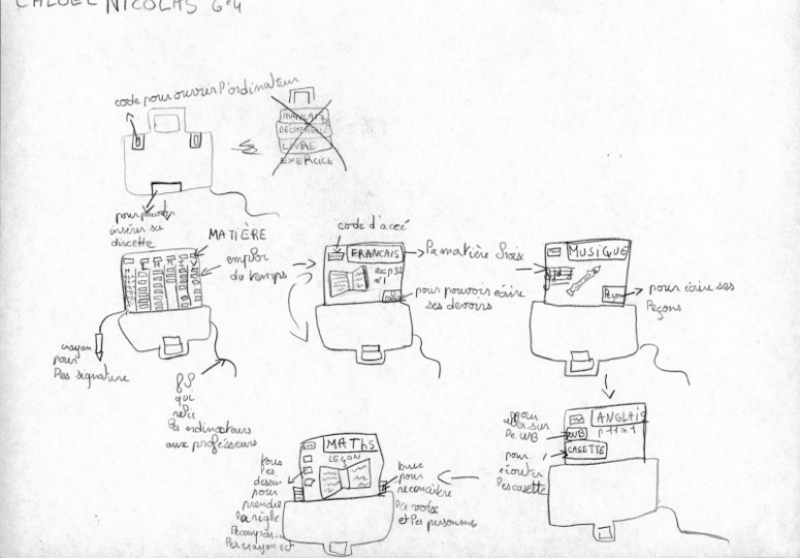
Figure 1 shows the kind of future things with their main transformation states that we obtain from children that were given the task of depicting with drawings their schoolbag if it was not solely done to carry books, notebooks and pens.
Figure 1. By courtesy of the ACEDU FUI project: how a ten years old child portrayed his future schoolbag by drawings as being a wearable computer.
WHERE DOES INNOVATION COME FROM? A CASE STUDY: CLOTHES FOR THE FUTURE From our experience in open innovation in Living Labs, there are no users needs for future things. People do have needs about existing devices and these needs can be used to correct or improve them, but they do not ask for future devices.
As a matter of fact, main innovations in the last decades, from personal computer to smart tablets, do not come from people needs, although what were future things became everyday things. However, people can imagine alternative worlds populated with future things and science fiction is a good provider of future things. Prospective cognitive ergonomics can get future objects by making people envisage alternative worlds by using, for instance, the “WHAT IF NOT” (WIN) method of creativity for innovation.
It is also possible to analyze how people perform a given task. Due to habits, nobody calls into question task performance. Thus, the WIN method is to trigger the possibility of different task procedures, mainly by digital computation, which means rationality: analyzing how a given task is presently done in order to provide an efficient computation. Note that the way users are performing their tasks can be seen as satisfying, with no special needs, and that this know-how can be implicit in the sense that they cannot explain how they proceed.
In the following sections we present a research of future things as alternatives worlds of clothes.
Homo Textilus is an ANR project that aims to envisage what may be in the future the interaction between people and their clothes.The garment is an everyday thing and you cannot do without. It has private properties as each individual selects, assembles, or even transforms her clothes. It is an eminently social purpose since it determines the appearance of each as well as the type of social groups that make a specific appearance being a sign of recognition and of belonging. It is finally an object of aesthetic innovation with fashion designers and fashion shows.
Garment is also an object of technical innovation, but one of the last places that have not yet invested the digital technologies that can help to interact with the garment, to transform it through some "intelligence" of interaction. In the field of digital textile and clothes, garment is expected as the next conquest of digital innovations that will transform our behaviour (see McCann & Bryson, 2009 for a review). According to Philips Electronics (Baurley, 2004), “our environment of the future will consist of invisible interactive systems that will be embedded in our living spaces and clothing, creating an ambient intelligence that could form a natural part of our life”. Smart Clothes are clothes that could be transformed, that can change its intrinsic properties (structure, shape, texture, colour), but also its functions (dressing, warm, protect, serve to social identity and ceremonial), and be implemented with new functions (administering medication, communication, alert). When one begins to imagine what becomes possible in the field of Smart Clothes, he expect emerging innovations that may change our uses of clothing. A part of the project was open innovation about future garments.
Method
In the framework of the Homo Textilus project, our objectives were to define future intelligent garments and their accessories, in order to determine: the possible, the acceptable, the potential and the uses. To do so, we have adopted a step-by-step approach, where we have use a variety of methodologies for different purposes (ex: questionnaires, short interviews, brainstorming, scenario based techniques).
In this paper we mainly present methodology and results about the counterfactual technique used to elicit new ideas.
The procedure consists in two-hour and a half sessions of brainstorming divided in two parts.
In the first part we present 29 PowerPoint slides that contain scenes of illustrative professional situations or of everyday life (ex: sport, leisure, businessmen negotiating, doctors counselling, etc.). Participants were to answer questions like: “in which way an intelligent garment could help you to… in which way an intelligent garment could be of practical use in the situation in which…” Participants were to write first their ideas on a post-it, and when all the participants have finished explain them to the group of participants and the research team.
In the second part of the session, we have used counterfactual reasoning to elicit ideas about different kinds of garments (shoes, hats, skirts, etc.) in an array of situations, with questions like: “if your hat was another thing, what it could be?”; “could you imagine another function for this garment?”, etc. After completing this task, we ask participants to try to draw a picture of the objects they have thought about.
To validate procedures we have proceeded first to a pre-test with 50 students. Results presented in this paper come from a 10-people sample, which participated, in a more systematic subsequent session.
Results and discussion
The results show the complementary roles of scenario-based techniques combined with counterfactual reasoning. Scenarios elicit mainly general functions and counterfactual reasoning provides more precise information on changes in objects structure and procedures.
With counterfactual based questioning we collected 61 propositions or new idea about digital clothes involving many kinds of functions (ranging from textile properties to garments made of electronic parts such as sensors and actuators). These ideas were grouped in five functional categories: utility or practical (34%, e.g. gloves that help to detect objects in women handbag and become lit when the hand reaches into the handbag”; or “gloves that have sensors to find objects), communication (31%, e.g., dress of a salesperson who could replace social codes and detect customers by sensors and address the usual formulas of courtesy), protection (15%, e.g., sweaters for sailors that change shape to serve as a life jacket and have a system to regulate temperature and avoid hypothermia), health (12%, e.g., garments that change colour when they detect germs) and leisure (8%, e.g.,. collars with integrated hood to wear in discos, which could reduce volume when you talk with someone).
After using the WIN method (“what if your clothes were not only for dressing… What else they could be used for?”) we proceeded to brainstorming activity where subjects have to explain and discus their ideas. The example that follows illustrates the process.
When initially brainstorming, the group was discussing how to clean garments with electronic parts. Then, a participant said that “the clothes could serve for transportation as in industrial laundries in which, for dry cleaning, there are storage conveyors to transport clothes from one location to another”.
This participant explained: “the hangers for clothes are hung on a rail with a conveyor belt. A machinery is transporting the clothes by moving the belt on the rail. In the streets, if there were conveyor belts for hangers (that would be incorporated in coats), when you want to be transported, your smart clothe has an hanger that comes out from the back of your neck, which engages automatically to the conveyor. This could be as simple to use than a ski tow”.
The process of imagining this future object was to use “street” as a substitute of “laundry” and to use “clothes + body” as a substitute of “clothes”. (See Tijus & Brezillon, 2006, for substitutes in creativity]. This thinking process can be summarized as follows: [clothes: to be clean], [clothes: to be clean [laundry]], [clothes: to be clean [laundry with conveyor belts: transport of clothes]]:: [street with conveyor belts: transport of clothes + body].
Next step was the group criticizing this idea and adding some completion with exoskeletons that are already used to run faster or to carry heavy charges. Exoskeletons included in the clothes could take the shape of a seat to be comfortable during the journey.
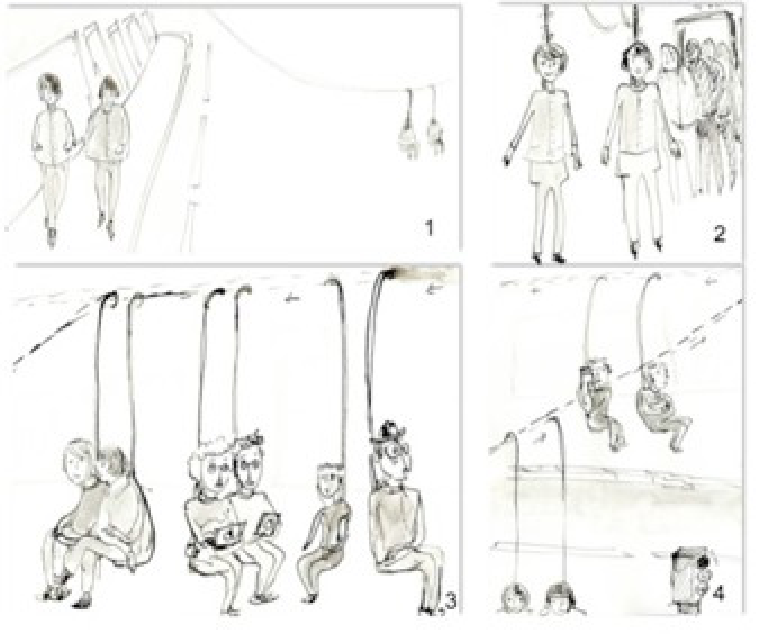
Fig 2. By courtesy of the Homo Textilus project: future possible Smart clothing for transport.
Figure 2 shows the smart clothes for public transport. Contrary to some of the other ideas we collected, - such as smart clothes for flying, this possible future thing was among those we kept for future investigation, since it can be
portrayed by a drawing that was the picture N° 3 in figure 2.
Participants were then asked to draw the other main states of the process of using the smart clothes for transport, that were picture 2 (departures), picture 4 (arrivals) and picture 1 (context).
It is because we get parts and structure, but also precise goals and how object changes through using it, that we can start thinking about ergonomics of possible future clothes for transport. Thus, the group was reasoned about:
Users actions: Users indicate their destination to the transport system through Smart-phone GPS: car navigation systems were taken as possible systems to be adapted for simplicity and familiarity.
Feedbacks: Feedbacks were imagined as being provided both through the Smartphone and with your front part of rails (changing color, from green to red) to indicate the arrival,
Transparency: Simple graphic designs at departure will indicate how it works.
Presence: The needs of being careful about your personal affairs (what happens it something falls down? You could really enjoy if well prepared for transport).
Safety: What happens if someone is ill? Security button? Could the system bring you directly to hospital?
Affordances: Having the rails indicating where to catch the tow with displays of arrows and distance.
Although there still were unsolved problems (what’s about children, what’s about disabilities, what’s about when two or more persons want to travel together) and although the group does not like it (e.g., things like this may exist in the future but I don’t like them: you are not free to move, it would be ok only for short travels), the system was judged as satisfactory for utility (we need efficient and cheap transportation system) and usability (it could be simply used except for some of us).
Principles for prospective cognitive ergonomics As a consequence of the preceding theoretical assumptions about benefits of using counterfactual reasoning to elicit precise information about changes that could be done in actual events to imaging future things, we report some principles for the methodology that could be applied for efficient prospective ergonomics:
Future things do come from imagination and tasks analysis Future things do not come from users needs but from imagination about alternative worlds that can be populated with future things and from task analysis rationality. This is the reason why the “what if not” (WIN) creativity appears to be an efficient method: it allows considering alternative possible worlds (imagination) as well as other rational alternative ways to perform existing tasks.
Notwithstanding industrial and economic plausibility Industry and economy doesn’t matter. The evaluative criteria don’t take into account if the object can be done according to actual technologies, nor if it is economical viable.
Naïve users participation Because these future things are made for the people, the method is naïve users oriented for having future things that fit their needs and desires. Thus, future things are conceived by people naïve to them.
Rationality Because naïve users are also inexperienced with these objects that do not exist, the conception method is to be rationality oriented. Prospective ergonomics cannot use unrational solutions, contrary to corrective ergonomics if these are “what people need / want now”.
Object oriented more than users oriented conception The methodology is then also object oriented because we do not know what would be users if the imagined object become a real one.
Object at the basic level of categorization The things that are imagined have to be at least at the basic level of categorization, which means objects that can be portrayed by drawings, in order to get parts and a structure.
Well-defined goals for usages of objects The goals to pursuit in using imagined things have to be sufficiently detailed, as well as the main changes of states that have to be done to obtain these goals.
Best rational ergonomic solution for a given future objet The find the best procedure for using the future object: the one that satisfies a number of ergonomic criteria: simplicity, familiarity, feedbacks, transparency, presence, safety and affordances.
A conception of future object that is based on ergonomics An ergonomic solution might trigger redesigning the imagined object, if necessary to improve the correspondence between the object (parts, structure, function, surface) and the procedure (the sequence of basic actions, through the succession sub-goals that are the main changes of states).
A conception of future object that implements a viable model of possible users A model of users is implemented in any object made for humans: A tool such a hammer has a handle adapted to people hands. With the cognitive digital devices, the ones that capture and compute data from humans, this principle is of importance because of the dynamicity of the users model. For instance if people imagine a system that computes their emotion in order to provide them a proper entertainment, ergonomics is therefore concerned by the kind of model of user’s emotion that is to be implemented, by the dynamic of interaction between this model of emotion and real emotion, and how well they fit together, according to varying contexts.
CONCLUSIONS
The challenge of designing for people and with people future things is to imagine product that may solve needs people were not even aware they had (Norman, 2009).
In this research, we use several complementary techniques to gather information (questionnaires, scenarios, brain storming sessions, WIN techniques) that elicit all together more of 300 ideas. In this paper we specially have emphasized the role of counterfactual reasoning to get more precise information about changes in actual world to become new things (states, parts of the structure, functions, procedures).
We also seek to further specify ideas by asking subjects to draw pictures of them. Having innovation that can be portrayed by drawings is useful for the design of the user-device interaction through procedures. These drawings are also useful because “a picture is worth 10, 000 words” (Larkin & Simon, 1987). First, when participants are portraying their solutions with drawings, they provide information they will maybe not verbally express. For instance, figure 2 provides information about how high from the ground clothes would be transporting people, and is portraying how a whole set of clothes interact in the transportation system. From talks, such information may remain implicit. Second, drawings are displaying the whole structure, something that is difficult to embrace with words. Third, as cartoons, drawings can exhibit the process of changes in the main steps of usability. Fourth, because inferences are better made on graphics, participants evocate problems they did not foreseen before the solution was on paper. Note that drawings on paperboard could be improved using interactive whiteboards.
While searching for future smart clothes, participants provided ideas such as "clothes to fly; clothes for transport, clothes than can self-repaired, etc.". Among those, we could fortunately have some that participants can fully specify. The provisionality of having precise things is one of the main criteria for the further development of ergonomic thinking about future things. This does not mean that imprecise ideas are not promising, but that we cannot "ergonomize" them, which means not being able to develop their usability and learnability. Although we do not take into account economic or industrial criteria, the innovation market will be more receptive if the imagined future things are already users friendly.
ACKNOWLEDGMENTS
The researches reported in this paper were funded by ANR (Homo Textilus), Fonds Unique Interministériel (ACEDU) and Investissement d’Avenir (eGonomy).
REFERENCES
Bacon, A.M., Walsh, C.R. & Martin, l. (2013). Fantasy proneness and counterfactual thinking. Personality and Individual Differences 54. 469–473. Ballon, P., Pierson, J., & Delaere, S (2007). Fostering Innovation in Networked Communications: Test and Experimentation
Platforms for Broadband Systems. In S.B. Heilesen, & S. Jensen (eds.) Designing for Networked Communications – Strategies and development. (pp.137-166). Hershey (PA) / London, IDEA. Barcenilla, J. & Tijus, C. (2012). Ethical issues raised by the new orientations in ergonomics and living labs. Work, 41, 5259-
5265. Baurley, S. (2004). Interactive and experiential design in smart textile products and applications. Personal and Ubiquitous Computing, 8, 274–281. Byrne, R. M. J. (2002). Mental models and counterfactual thoughts about what might have been. Trends in Cognitive Sciences, 6(10), 426–431. Bornet, C., Brangier, E., Barcenilla, J. & Deck, P. (2013). Enrichir la créativité des ingénieurs avec l’analyse de l’activité et les
personas : le cas d’un projet d’ergonomie prospective. In F. Hubault (eds.) Ergonomie et Société : quelles attentes, quelles réponses? SELF’2013, Congrès International d’Ergonomie. Paris, France. Carroll, J.M. (2000). Making Use: Scenario-based Design of Humanecomputer Interaction. MIT Press, Cambridge, MA. Declerck, G. (2013). Le possible peut-il être perçu ? Tracés. Revue de Sciences Humaines. Réalité(s) du possible en sciences humaines et sociales. n°24, 2013/1, E.N.S. Editions, 85-103. Gabora, L. (2002). Cognitive mechanisms underlying the creative process. In T. Hewett and T. Kavanagh (eds.) Proceedings of
the Fourth International Conference on Creativity and Cognition. October 13 -16, Loughborough University, UK. 126 -133. Gibson, J. J. (1986). The Ecological Approach to Visual Perception, Hillsadle, Lawrence Erlbaum Associates. Green, T. R. G. (1989). Cognitive dimensions of notations. In V. A. Sutcliffe and L. Macaulay (Eds.) People and Computers. (pp.
443-460). Cambridge University Press: Cambridge,. Kirsh, D. (2013). Embodied Cognition and the Magical Future of Interaction Design. ACM Transactions on Computer-Human Interaction, Vol. 20, No. 1, Article 3 (March 2013). Larkin, J.H., & Simon, H.A. (1987). Why a diagram is (sometimes) worth ten thousand words. Cognitive Science, 11, 65-99. Markman, K. D., McMullen, M. N., & Elizaga, R. A. (2008). Counterfactual thinking, persistence, and performance: A test of the reflection and evaluation model. Journal of Experimental Social Psychology, 44(2), 421–428. McCann, J. & Bryson, D. (2009). Smart clothes and wearable technology. Woodhead Textiles Series, N° 83. Norman, D. A. (2009). The design of future things. New York: Basic Books / Perseus Book Group. Roberts A. (2004). What Might Have Been. Weidenfeld & Nicholson Robert, J-M., & Brangier, E. (2012). Prospective ergonomics: origin, goal, and Prospects. Work, 41, 5235-5242 Roese, N. J. (1997). Counterfactual thinking. Psychological Bulletin, 121, 133–148. Taylor, S.E., Pham, L.B., Rivkin, I.D. & Armor, D.A (1998). Harnessing the imagination. Mental simulation, self-regulation, and
coping. American Psychologist. Vol. 53, 4, 429-439. Tijus, C. & Brezillon, P. (2006). Problem solving and Creativity for Decision Support Systems. In Creativity and Innovation in Decision Making and Decision Support, Vol 1, F. Adam, P. Brezillon, S. Carlsson, and P. Humphreys (eds.). Ludic Publishing Ltd. 277-293. Tijus, C., Brézillon, P., Poitrenaud, S., & Léger, L. (2009). Counterfactual based innovation, a Galois lattice approach.
Proceedings of the IEEE Research, Innovation and Vision for the Future, RIVF, 176-179. Wise, E., & Høgenhaven, C. (2008). User-Driven Innovation. Oslo: Research Policy Institute - Nordic Innovation Centre, 136.
LISTED IN THE AHFE DIGITAL BOOKSTORE CATALOGUE
Explore the complete digital volume
Advances in Ergonomics In Design, Usability & Special Populations: Part III
Read this individual research paper free through the original publisher, or explore the full digital proceedings book.
ISBN 978-1-4951-2108-1
Explore this ISBN in the AHFE Bookstore ↗Listed in the July 2026 bookstore catalogue; search by ISBN to confirm current availability · Digital book purchase optional