Krystyna Gielo-Perczak (2022). Multi-Method Systems Modeling and Analysis: Is It Possible to Apply Holistic Design, Linking the Physical and Cognitive Aspects?. In: Advances in Ergonomics In Design, Usability & Special Populations: Part II. AHFE Open Access, vol. 19. https://doi.org/10.54941/ahfe1001260
The objective of this study is to present relevant data which would support proposed taxonomy and methodology in physical-cognitive based control models of human performance. This approach can be applied directly to the development of emerging worker/user body systems with equal emphasis on biomechanical and cognitive performance. The worker’s biomechanical and physiological responses and functions are not imposed by the environment but are established by the system itself. Thus, there is an emerging need for the concept of a human system with perceptive insight into the complexity of the mutual relationships of the human biomechanical measures and cognitive factors. The description of human operators/users should reflect the biomechanical measures of fatigue and the complexity of brain activity, which includes cognition and the dynamic process of knowing. Many system control problems arise from a lack of attention to the interactions among different human system components in relation to the work/activity environment. In order to predict the ecological connectivity there is an arising necessitation to model the mutual relationships of environment, perception, body sensors and task. The proposed method can be represented in terms of control-theoretical features for quantitative predictions in the various work environment behaviors.
In human performance we need to consider cognitive as well as biomechanical factors in task analysis. We make many attempts to adapt the theoretical concepts of mechanics to biomechanical knowledge. However, we should look for the existing mechanism in the human body which leaves room for variation and flexibility. It is this flexibility that enables living organisms to adapt to new circumstances. Physical work capacity in ergonomics refers to physiological and biomechanical limitations. It is still widely discussed and the most recent studies bring into consideration triadic system with strong connection between physical capacities and the environment and cognitive capacities and the environment, and the mutual weak link between cognitive influences on physical capacities (Marras & Hancock, 2014). However, the studies confirmed that perception of stress and mental demands significantly influence the biomechanical response (Marras et al., 2000, Davis et al., 2002). The physical capacities measured by biomechanical responses or cognitive effects, are related to one another and determined the design process .
The worker’s biomechanical and physiological responses and functions are not imposed by the environment but are established by the system itself. Thus, there is an appearing demand for the concept of a human system with perceptive insight into the complexity of the mutual relationships of the human biomechanical measures and cognitive factors (Gielo-Perczak and Karwowski, 2003). The dramatically changing technology, growing environment of the Smart Buildings challenge the designers to complex users’ demands. The description of human operators should reflect the biomechanical measures of fatigue and the complexity of brain activity, which includes cognition and the dynamic process of knowing. We need to determine to what degree the biomechanical measures of fatigue may be used to predict performance failure of critical worker tasks.
The current design of Smart Buildings, integrating control of Heating, Ventilating and Air Conditioning (HVACT) systems of an enclosed environment, reveals a need incorporating an operator decision on control process. How designers of the systems can affect user comfort by controlling HVAC systems performance?
HVAC system provides adequate indoor air quality by conditioning the air in the occupied space of a building in order to provide for the comfort of its occupants, diluting and removing contaminants from indoor air through ventilation, and providing proper building pressurization. However, the control design of HVAC system of three main environmental characteristics (temperature, humidity, suspended particulates dust and gas) doesn’t include human-operator interaction which will significantly improve control/dynamics/diagnostics requirements (Gielo- Perczak, 2013). Thus, there is a need for a system design approach with application of control theory.
MODEL OF HUMAN PERFORMANCE LINKING THE PHYSICAL AND COGNITIVE Factors Affecting Physical Work or Activity Capacity
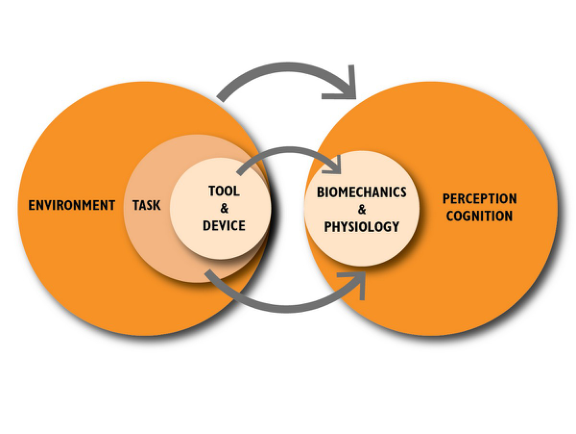
Many system control problems arise from a lack of attention to the interactions among different human system components in relation to the work environment. In order to predict the ecological concept of connectivity there is a revealing demand to model the mutual relationships of environment, perception, body sensors and task.
A conceptual model linking these elements with the work environment, task and tool is presented in Figure 1.
Figure 1. Factors affecting physical work or activity capacity.
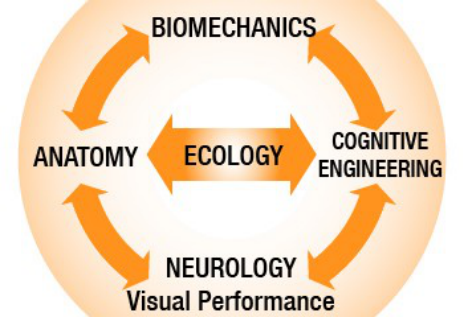
Biomechanical body capacities are significantly affected by visual factors (color, working space) and confirmed by studies presented as a linked system in Figure 2. Cognitive element implements interaction between nervous system, perception, emotion, environment and should be addressed as separate structure.
Figure 2. Model of human performance linking the physical and cognitive factor.
Design of a Physical-Cognitive Based Control Model The work environment is perceivable directly. Through perception and cognition, controlling of a task takes place when psychophysical assessments confirm the existence of the harmonizing design of an individual’s body dimensions with work demands. Human performance modeling relates not only to the work environment but to the concept of affordation. Affordances are opportunities for action. According to Gibson (1986) what we perceive when we look at objects are their affordances, not their qualities, i.e. what the objects afford us is what we normally pay attention to. Thus, an affordance is objective in the sense that it is fully specified by externally observable physical reality, but subjective in the sense of being dependent on the behavior of a particular kind of organism. Gibson suggested that perception of the world is based upon perception of affordances, of recognizing the features of the environment which specify behaviorally relevant interaction. Affordance is what an environment offers a human. He tailors it to his need making necessary changes. Hence, coherent networks are formed based on the changes needed environment.
The design of a physical-cognitive-based control model involves the attributes of work environment, cognition, and body sensors, which collectively determine the control of environment (i.e. work process). The information pick-up is considered as a single-channel mechanism (Figure 3). In this model, three phases are considered: 1) conversion of the input environment of a work process to sensory output by the body sensors, 2) perception process, 3) cognition decision and response selection. The coefficients represented by perception and body sensors are proportional to the age and vision conditions of a worker.
The proposed physical-cognitive control model utilizes body sensors’ feedback loop, together with the loop which continually adds the perception and cognition parameters, in an attempt to make the decision output as safe as possible. Feedback control is based on using the outcome of the task and tool in order to control it. It uses the difference between the actual output y and the input x in order to reduce it. The task corresponds to the control dynamics of the interactions between the human body and its environment. The feedback corresponds to the output of body sensors. Perception corresponds to the nervous system which, with cognition, plays a controller’s role. The control problem is how to act in such a way that it accomplishes the desired task. One major advantage of the feedback control is sensitivity to changes in the parameters of the task.
Fig. 3 Learning based human performance.
An appropriate level of comprehension is needed to act appropriately, but the priority for short-term control of the situation does not always enable the human operator to comprehend the situation fully before acting (Gielo-Perczak, 2001). Although some aspects of emotion can be developed very early through education and extensive, deliberate practice. Characterized as direct perception, emotion is an observable, lawful phenomenon that is measurable and potentially teachable (Figure.4).
Understanding the relation between humans and environment is necessary to predict the present day work performance. The current need is that, machines should have emotional attributes in order to take appropriate actions with changing environment. Rasmussen modeled human behavior into skill, rule and knowledge based classes. Skill is not conscious but is a highly integrated task. Rule refers to following a given set of procedures when a situation arises . Knowledge based behavior has a subjective side i.e. personal aim associated with it. These models have formed the basis of complex models being deployed in decision-making and control. The field of physical ergonomics allows the use of these cues to develop emotion-based models to efficiently respond dynamically to changes in environment. Adaptation is considered to be a process of modifying the parameters of the system and the control actions.
Fig. 4 Adaptive based human performance.
The proposed models represented in terms of control-theoretical features for quantitative predictions in the various work and environment behaviors include the feedback principle which is the response of voluntary activity defined by Wiener (1948/2000).
Decisions we make are based on emotions and feeling following them. Functional MRI demonstrated the anatomical correlation of emotion with the anterior cingulate cortex. Also to support this finding, EEG activity at this area was found to change based on the task at hand. Emotion is a predictor of the situations to come. Its integration into modeling is the most important aspect of performance prediction. Intentionality and self-control: a strong desire to do something helps us achieve it. Cingulate cortex was proved to be associated with a person’s emotional self- control and adaptation to changing conditions.
The objective is to build upon the stimulus response model proposed by Rasmussen adding an ecological perspective to it. Ecological approach to human performance modeling: affordance based perception of Environment makes it a dynamic action unlike previous assumptions. The proposed models for human performance constitutes affordance and emotion, based learning and adaptive respectively. Neuro-ecological approach based on affordance and emotion: short-term ability to perform activities like evaluation, observation, execution etc. at a work place is limited by mental elements of the worker. The need for prioritizing this ability is debated, as it doesn’t equip a person to understand the bigger picture. To better comprehend a work situation and act accordingly, there need to develop models based on emotion. Familiarity of environment is established by detecting the invariants within.
GOLDEN SECTION IN WORKPLACE DESIGN AS A GAIN IN CONTROL THEORY FOR HUMANS Ergonomists still search for a harmonizing feature of human dimensions and preferable workplace. There is an opinion that working positions are different from static positions, so there is a need for redefining anthropometric dimensions. Thus, the anthropometric body dimensions for engineering designs were divided into two groups: structural and functional dimensions. Structural dimensions are taken with the body of the subject in fixed and standardized positions. Functional dimensions are taken with the body in various working positions which are usually more complex (Van Cott and Kinkade, 1972). However, the concept of the harmony of human dimensions related to the top of the sacrum and expressed in the golden section to workplace design (Doczi, 1994) coalesces these structural and functional demands. For each task, there is a different body segment that should be considered as a transitional element harmonizing a human body with the workplace. A different parameter of the body should be chosen for characteristic variables of tool or work design. The golden section ratio conjoins these two components.
This basic pattern, referred to as the golden section, that can exist in human dimensions was explored in a recent study (Gielo-Perczak, 2001) and its application to ecological workplace design proposed. The golden section ratio is 0.618. The golden section exists in our life and confirms its power arising from a unique capacity to unite the different parts of the structures, while preserving their own identity. The golden section can lead to the creation of harmony of human dimensions with preferable workplace design and provides a gain in control theory for humans. Examples of this type of analysis are revealed in stairway, industrial knife and surgical scalpel design.
Harmonizing Feature in Stairway Design and Human Dimensions Many aspects of stairway design have been identified as important to safe stairway use: step height, depth and width, lighting, surface materials and handrails. Many researchers have investigated various aspects of stairway safety; however, the most interesting study performed by Irvine et al. (1990) in which stairway preference and acceptability were investigated with psychophysical techniques. The results of this study revealed that subjects were more sensitive to changes in riser height than they were to changes in tread depth. All stairways effectuate a certain gait on the user and, by investigating the user’s perception of an acceptable or preferable stairway, the authors proposed design recommendations. Results from this approach, when ratios of riser to tread were calculated, confirmed the applicability of the golden section to stairway design (Gielo-Perczak, 2001). A series of six experiments was conducted where subjects ascended and descended 19 sets of stairways with different riser and tread dimensions. Seven or eight stairways were used in each experiment to investigate either ascending or descending tasks. Sixty-six people, ranging in age from 19 to 69, participated as subjects: 40 women and 26 men. Subjects were instructed to identify stairways that they considered acceptable, and the one stairway they most preferred. Additional calculations (Gielo-Perczak, 2001) concluded that the three most preferred and acceptable stairway designs expressed by the ratio of riser to tread were (165/279 mm), (183/279 mm) and (183/305 mm) as Irvine et al. (1990) recorded. The concept of the golden section confirms these results, where the ratios were 0.591, 0.656 and 0.600, respectively, which are the closest to 0.618. The golden section may reveal a harmonizing feature between human dimensions (i.e., foot length) and the acceptable and preferable stairway design (i.e., riser). The studies of the stairway confirm that subjects preferred designs related to their body segment lengths. The stairway design can be characterized by a relationship of the length of a foot to height of a riser, and the most preferred designs by the respondents confirm a golden section ratio. The subjects also exercised the perception of affordances, of recognizing the features of the environment which specify behaviorally relevant interaction.
Harmonizing Feature in Industrial Knife and Surgical Scalpel Design, and Human Dimensions As another example, industrial knife design study (Hsiang et al., 1997) was considered in the study of the golden section as a harmonizing feature of workplace design and human dimensions. Due to the traditionally high rate of injuries, knife design is an important factor in workplace safety. Nine different knife designs were evaluated by ten subjects in a study conducted by Hsiang et al. (1997). Ten subjects cut outlined clay patterns in 15 minutes, with each one of the different knives. The nine different knife designs were generated from the following combinations: three grip sizes, three coupling angles between the grip and the blade, three blade heights measured from the middle of the blade, and three blade lengths. During cutting tasks, one knife was chosen by most of the subjects because it provided ‘reasonably good’ cuts in most situations (Gielo-Perczak, 2011) proposed. Using the grip circumference as a dimension relating to hand, and blade length as the main component of knife design, then the golden section ratio reveals this specific knife design as the best one.
Scalpels are among the most commonly used tools in modern surgery, which are inadequate for fine and curved incisions. The current flat-sided scalpel design limits the surgeons’ ability to create precise, small incisions because the handle tends to rotate in their hands, especially for nonlinear incisions. To overcome this problem, an ergonomic scalpel handle design has been proposed which features a cylindrical cross-section and smooth tapering that naturally fits hand positions which are used for creating an incision. The designed and manufactured a scalpel handle increased the comfort, control, and precision a surgeon has when creating an incision. The comfort of the scalpel handle was based on how it feels in the surgeon’s hand, involving the handle and blade length, diameter of a grip, cross-sectional design, and balance. Control was gained by a design that does not slip or rotate unexpectedly in the hand. Precision was generated from the surgeon’s ability to stabilize their arms, shoulder, and torso, limiting unbalanced movements. Improving precision required the scalpel handle to be designed such that it will not force the surgeon to move their body in an undesirable manner.
It has been postulated that an ergonomic handle design would incorporate the golden section ratio within and hand dimensions. Based on nine surgeons’ feedbacks fourteen prototypes were produced. An analysis of the grip perimeter formed three fingers of the right hand and blade length of the designs was conducted to determine if the golden section ratio was observed. Through the force and moments measurements using an AMTI AccuSway force platform it was found that the handles with the lowest applied forces were those where the ratio of the blade length to the handle circumference was closest to the golden section ratio. The psycho-psychical assessments of nine surgeons affirmed an existence of the golden section in surgical device design as a preferred design harmonizing hand dimensions with surgeons’ work demands (Gielo-Perczak et al. 2011).
CONCLUSIONS
Calculating and applying a golden section ratio would be an attempt to redefine stairway building codes or tool standards. For each task, there is a different body segment which should be considered as a transitional element harmonizing a human body with the workplace. It is proposed that the elements to be considered for a knife design are grip size circumference and blade length; for stairway design, the length of foot and height of a riser. The psychophysical assessments presented in Gielo-Perczak (2001) of the results found in the studies by Hsiang et al. (1997) and Irvine et al.(1990) affirm an existence of the golden section in workplace/tool design as a preferred design harmonizing an individual’s body dimensions with work demands.
A golden section was confirmed by psychophysical studies of stairway and tool design as it relates to the workplace requirements and human preferences. This concept is intended to serve as an introductory guide for ergonomists who are required to define population groups and apply their knowledge to the geometric design of the places where people work and live. There is a need to establish principles for deriving dimensions from anthropometric measurements and applying them to the design. The design based on a golden section can be a useful approach at an introductory design stage for biomechanical analysis which would confirm its effectiveness and efficiency.
Control theory for humans to modeling performance was mainly described by Jagacinski and Flach (2003); however, functional operator’s models revealing learning capacity or possessing emotions during making control decisions were never taken into account. The complexity of human decisions needs advanced investigation particularly, when interactions of control system on users and operators are at different level of perception.
REFERENCES
LISTED IN THE AHFE DIGITAL BOOKSTORE CATALOGUE
Explore the complete digital volume
Advances in Ergonomics In Design, Usability & Special Populations: Part II
Read this individual research paper free through the original publisher, or explore the full digital proceedings book.
ISBN 978-1-4951-2107-4
Explore this ISBN in the AHFE Bookstore ↗Listed in the July 2026 bookstore catalogue; search by ISBN to confirm current availability · Digital book purchase optional