Soraia Ala, Alexandre Cruz (2023). Smart product: product requirements for the development of a responsive mirror for elderly support. In: Human Dynamics and Design for the Development of Contemporary Societies. AHFE Open Access, vol. 81, pp. 176–186. https://doi.org/10.54941/ahfe1003546
A responsive smart product can connect with a network, to sense and gain awareness as well as to react to input signals and align with them. This paper describes the product requirements gathering process to assist the development of a responsive bathroom mirror connected with emergency centres for elderly support. The rapidly increasing ageing population has led to increased number of elderly people living alone. In this sense it is essential to pursue strategies that can guarantee ageing in place safely, independently, and with confidence, and improve the quality of life of those who wish to continue living in their own living environment. Driven by recent advances in technology, the development of smart products that can respond to human needs and wants, and to improve everyday tasks, became a tangible reality. When smart products are developed for senior citizens daily support, responding to what their expectations are and whether they are satisfied with them, and what opportunities and worries they associate with their age, overcoming technological barriers from the user's point of view, it will have a huge impact on the communities: older people, their families, and the healthcare system. To address these issues, this paper provides a systematic identification of product requirements, technological and from user’s point of view, for the future development of a responsive mirror. Towards a holist development approach, first, existing studies on smart products, research on related technological trends and development were reviewed, supplemented with case studies of existing smart products for healthcare. The first list of requirements was developed from this research. Additionally, studies and public statistics were analysed to confirm the relation between domestic environment and high levels of injuries, as well as places and situations of the accidents that have high impact on health and well-being. Smart products typically have a strong sense of technology. Being a mirror a product that is used in a daily basis, it is mandatory to gather simultaneously the user’s preferences and technological requirements. Based on a systematic approach, a Kano Model was developed; requirements were synthesized and organized within a comprehensive user requirement framework delineating three levels of needs: basic, performance and delight. Research from the field of smart products demonstrated that there are several technological trends that can be applied to mirrors, that there are smart mirrors for applications in automobile and fashion industries. Nevertheless, examples of these products in healthcare remains limited. Additionally, recent technological developments enable the development of a responsive smart mirror that not only serve as an interface for displaying information but can predict the presence of the user.
Product Requirements for the Development of a Responsive Mirror for Elderly support 177
INTRODUCTION
Information technology is revolutionizing products. Products once compo- sed solely of mechanical and electrical parts have become complex systems combining hardware, sensors, data storage, microprocessors, software, and connectivity in myriad ways. These smart products offer exponentially expanding opportunities for new functionality, far greater reliability, and capabilities that cut across and transcend traditional product boundaries (Porter and Heppelmann, 2014). One of its potential applications is to sup- port ageing in place, allowing older adults to maintain their independence and enjoy a higher quality of life, while their loved ones have peace of mind knowing that their safety is being monitored.
Smart mirrors are a cutting-edge technology and are gaining traction as a smart device that can integrate a range of functions designed to help the elderly in their daily lives. With this research we aimed at contributing for smart living environments for the elderly, through the identification of the requirements for the future development of a smart mirror for elderly sup- port. To that end, we will start the research by the surrounding concepts definition. Next, towards a holist development approach, existing studies on smart products, research on related technological trends will be perform supplemented with case studies of existing smart products for healthcare. Based on a systematic identification of product requirements for the design and development of a smart responsive mirror, either from technological and from user’s point of view, a list of product requirements will be elaborated as well as a Kano model.
SMART PRODUCTS AND AGEING IN PLACE ‘Ageing in place’ refers to the ability of older adults to live in their own homes, in their familiar communities safely, independently, and comfortably, regard- less of age, income, or ability level, rather than moving to institutions such as nursing homes (Moreland et al., 2020; National Center for Equitable Care for Elders, 2019; Wiles et al., 2012). Ageing in place was seen by Wiles et al. (Wiles et al., 2012) as an advantage in terms of a sense of attachment or connection, practical benefits of security and familiarity, and as being rela- ted to people’s sense of identity through independence and autonomy. It has benefits for older adults, including improved health and well-being, reduced social isolation, and lower healthcare costs (United Nations, 2013). It also has benefits for families and caregivers, who can have greater peace of mind knowing that their loved ones are being well-cared for in their own homes (Mahoney, 2003). Overall, ageing in place is a preferred option for many older adults, and with the right support and resources, it can provide a high quality of life and a sense of independence and dignity.
Smart Products, Smart Mirror, Responsive Mirror Rijsdijk and Hultink (Rijsdijk and Hultink, 2009) defined smartness as a combination of the dimensions autonomy, adaptability, reactivity, multifu- nctionality, ability to cooperate, humanlike interaction and personality, and the scope to which a product possesses one or more of these dimensions.
178 Ala and Cruz
Authors also defined smart products as products that have smartness and intelligence, once they contain information technology (IT) in the form of, for example, microchips, software, and sensors that are able to collect, pro- cess, and produce information. Furthermore, a main requirement for smart products is the capability to adapt to situations, to users, and other products.
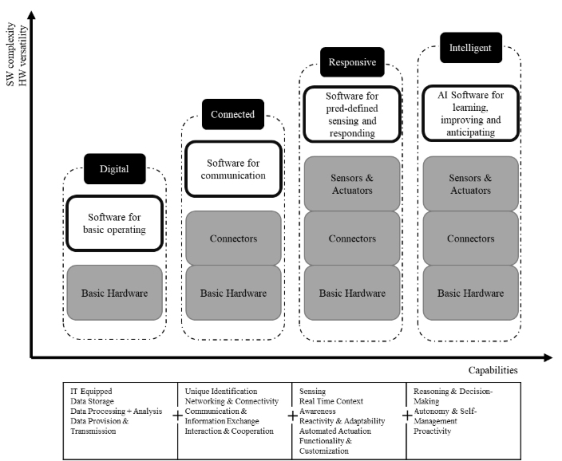
In this sense, smart products are cyber-physical products/systems (CPS) which additionally use and integrate internet-based services to perform a required functionality. CPS is a system featuring a tight combination and coordination between the system’s computational and physical elements. Usually, the sensor and actuator networks are seen as the precursor of CPS. Basically, CPS focuses on intelligent interaction, interactive applications, and even distributed real-time control. Internet of Things (IoT), a concept where an object having the ability to transfer data over a network without the need for human interaction to human or human to computer, is known for its advantage that can help simplify people’s everyday routine (Yusri et al., 2017). IoT has four major components including sensing, heterogeneous access, information processing, applications and services, and some additi- onal components such as security and privacy. Machine-to-machine (M2M) refers to the interaction and communications between computers, embed- ded processors, smart sensors, actuators, and mobile devices without or with limited human intervention. Through interfacing with wireless sensor netw- orks (WSNs), a wide range of information can be collected by sensors for M2M systems. Thus, in addition to M2M communications, machines also can make action through the collected information with the integration with WSNs. With the capabilities of decision-making and autonomous control, M2M systems can be upgraded to cyber-physical systems (CPS) (Chen et al., 2012). Raff et al. (Raff et al., 2020) suggested that smart products may be conceptualized as a range of archetypes that build on each other, and are characterized by a particular configuration of defining criteria in four diffe- rent archetypes, each one being defined by a particular criteria orchestration as follow (see Figure 1):
1. Digital: Smart products that have a digital component but are not neces- sarily connected to the internet (e.g., digital cameras, digital music players, and digital thermometers). 2. Connected: Smart products that are connected to the internet or to other devices (e.g., smart home devices, fitness trackers, and smart speakers). 3. Responsive: Smart products that can respond to user inputs and pro- vide feedback (e.g., touch-screen devices, wearable devices, and virtual assistants). 4. Intelligent: Smart products that have the ability to learn, make decisi- ons, and act autonomously (e.g., self-driving cars, predictive maintenance systems, and artificial intelligence systems).
Based on the reviewed concepts and on Raff et al. archetypes, we define a smart responsive mirror as a device that, by the integration of technology with a traditional mirror, can sense, gain awareness, and respond quickly and
Product Requirements for the Development of a Responsive Mirror for Elderly support 179
Figure 1: Framework of smart product archetypes (Adapted from (Raff et al., 2020)).
positively to customer requests, issues, and changes in the environment. By the integration of basic hardware with sensors, actuators, and connectors, it will be able to sense and identify a fall, and autonomously (IoT) send an alert to a predefined emergency centre.
Domestic Environment and High Levels of Injuries: Studies and Public Statistics In recent years, the relationship between the domestic environment and high levels of injuries has received increasing attention from researchers and health organizations. This paper section aims to analyse studies and public statistics to confirm the correlation between the two and to identify the places and situ- ations in the domestic environment that have the greatest impact on health and well-being.
The pace of population ageing is much faster than in the past. Coun- tries face major challenges to ensure that their health and social systems are ready to make the most of this demographic shift. According to the World Health Organization (World Health Organization, 2020) the proportion of the world’s population over 60 years of age is projected to increase nearly double from 12% to 22% between 2015 and 2050; in 2020 the number of people aged 60 years and older outnumbered children younger than 5 years. With the dramatic increase of this population, the need for programs and ini- tiatives that address their healthy ageing also increases. Ensuring that older adults have access to health care and the ability to “age in place” is a pri- ority both from a quality of life perspective and a cost savings perspective (Litomericky, 1990; National Center for Equitable Care for Elders, 2019).
180 Ala and Cruz
In order to analyse the relationship between the domestic environment and high levels of injuries a comprehensive search was conducted in World Health Organization (WHO) platform, namely the Global Health Estimates (GHE) that provides the latest available data on death and disability globally, by region and country, and by age, sex and cause. The WHO Mortality Data- base is the leading data source for comparative epidemiological studies of mortality by cause.
According to it, leading unintentional injury causes of death include road traffic collisions, drownings, and falls. Cause of falls are age-related loss of muscle mass (known as sarcopenia), problems with balance and gait, and blood pressure that drops too much when one gets up from lying down or sitting (called postural hypotension), being all risk factors for fal- ling (National Center for Equitable Care for Elders, 2019). Stevens at al. (Stevens et al., 2014) study, on older adults at high risk for falls, found that most falls occurred at home and that women and people aged 85 and older were most likely to be injured. More, the study noticed that there was a greater likelihood of injury from falling forward, sideways, and backward and landing flat, compared to falling backward to sitting. And finally, for falls inside the home, there was a significantly greater likelihood of sustaining an injury in the bathroom compared to the living room.
Bathrooms tend to have naturally slippery surfaces and are often wet. Fur- thermore, there are sharp edges that pose additional hazards. Recent studies have shown that for people aged 65 and older, falls account for approxima- tely 60% of all injury-related emergency department visits and over 50% of injury-related deaths annually. And up to 80% of falls in the home occur in the bathroom (Stevens et al., 2014; Tang et al., 2022).
The results of the studies and public statistics proves the correlation between the domestic environment and high levels of injuries and indicates: i. that falls are the most common cause of injury in the domestic environ- ment, accounting for nearly half of all injuries; ii. that risk areas in the domestic environment include the bathroom, kitchen, and stairs; iii. the elderly and young children are the most vulnerable populations in the domestic environment, with falls being the leading cause of injury in both groups.
SMART MIRROR REQUIREMENTS In this paper section we comment on technological trends that support smart products development; recent works related to smart products for health- care; and we briefly review the state-of-the-art in smart mirrors both in the research/prototype stage and commercial ones.
Technological Trends and Smart Products Analysis Smart products are products which incorporate advanced technology, pro- viding us with a range of efficient and creative solutions that make
Product Requirements for the Development of a Responsive Mirror for Elderly support 181
our lives easier. Major technological trends, that can act as enablers to the development of a smart connected mirror, can be summarized as (Brynjolfsson and McAfee, 2014; Business Insider, 2021; Santarelli et al., 2022):
1. Artificial Intelligence (AI) and Machine Learning (ML): AI and ML algo- rithms can be used to make the mirror more intelligent, allowing it to predict user behaviour and preferences. 2. Internet of Things (IoT): IoT technology can be used to connect the mir- ror to other smart devices, allowing for seamless integration and a more personalized experience. 3. Human-Computer Interaction (HCI): HCI research can inform the deve- lopment of more intuitive and user-friendly interfaces for the mirror. 4. Predictive Analytics (PA): PA can be used to anticipate the user’s needs, providing relevant information and recommendations proactively.
Smart mirrors have the potential to revolutionize the automotive and fashion industries by providing new and innovative ways to interact with technology (Badwaik et al., 2022; Bianco et al., 2021; Raff et al., 2020). In the automotive industry, smart mirrors can display important driving infor- mation, improving the driving experience and enhancing safety. In the fashion industry, smart mirrors can change the way customers shop by allowing them to virtually try on clothing and accessories, improving the shopping experie- nce and reducing waste. These are just a few examples of the many potential applications of smart mirrors and the impact they can have on different industries.
First known smart mirror was built by Michael Teeuw back in 2014 using a Raspberry Pi2 (Teeuw, 2014). In the same year that Teeuw mirror was released, Toshiba presented their own concept at CES (Bianco et al., 2021), claiming that it could respond to needs in each living space, like kitchen and living room, once it come with a built-in camera, letting users interact with the mirror via gestures. Badwaik et al. (Badwaik et al., 2022) proposed the development of a smart mirror to monitor and display heart rate, oxy- gen level, and body temperature. For health monitoring, the physiological data is collected by the biomedical sensors in the mirror and communi- cated to medical personnel so they can learn more about the patient’s health.
Healthcare Smart Products Traditional fall detection systems offer several advantages over other forms of emergency response systems, they are typically compact and portable, making them ideal for use by the elderly and young children. Additionally, they provide an immediate response in the event of a fall, which can be cru- cial in the event of an injury. However, traditional fall detection systems also can be intrusive and uncomfortable to wear, and some users may find them unappealing or inconvenient to use. Additionally, being not real-time context aware, they may not be effective in detecting all types of falls, par- ticularly those that occur in the shower or bath. In this section we will
182 Ala and Cruz
list examples of responsive smart products in healthcare (Business Insider, 2021):
1. Fitbit: a wearable device that tracks physical activity, sleep pat- terns, and heart rate. It can be used to monitor health and well- ness, and can also connect with other healthcare devices, such as glu- cose monitors, to provide a more comprehensive view of the user’s health. 2. Apple Watch: a smartwatch that has a range of features to support health and wellness, including heart rate monitoring, fall detection, and an ECG app. It can also be used to track physical activity, sleep patterns, and provide reminders to take medication. 3. Echo Dot with Alexa: a smart speaker that can be used to access health information and manage healthcare tasks, such as setting reminders to take medication or ordering groceries. Alexa can also provide informa- tion on symptoms and conditions, and can connect with other healthcare devices, such as smart scales, to provide a more comprehensive view of the user’s health. 4. Beddi Smart Alarm Clock: a bedside device that tracks sleep patterns and provides personalized recommendations for sleep improvement. It can also be used to control other devices in the room, such as lights and smart plugs, and can provide weather and traffic updates in the morning. 5. Withings Body Cardio Scale: a smart scale that tracks body weight and body composition, including body fat percentage, muscle mass, and bone mass. It can also track heart rate and sync with other health- care devices and apps to provide a comprehensive view of the user’s health. 6. Smart Pill Dispenser: a device that dispenses medication at the appro- priate times and can alert the user when it is time to take their medication. It can also alert caregivers or family members if the user misses a dose and can provide information on medication usage and adherence. 7. Walabot HOME: a smart home device that uses advanced imaging tech- nology to detect and monitor movements, changes, and potential hazards within the home environment. Its ability to detect falls and other hazards, as well as its integration with other smart home devices, make it a valu- able tool for families and caregivers. However, it has some limitations. Its advanced imaging technology may not work well in homes with thick walls or other obstructions, limiting its ability to detect movements and changes within the home environment. Additionally, the device requires a power source and may not be suitable for use in areas without reliable electricity.
Based on bibliographical analysis, and smart products benchmarking, a list of key product requirements, technological requirements, and user needs, was elaborated to serve as input for next stage, the Kano model development (see Table 1).
Product Requirements for the Development of a Responsive Mirror for Elderly support 183
Table 1. Smart mirror product requirements.
Table available in the original PDF paper.
Key product requirements: User Requirements: Technological Requirements User-friendly interface: The interface should be easy to navigate and understand, with clear instructions and visual aids Usability: The mirror should be easy to use and intuitive, especially for elderly users who may have difficulty with technology
Display: The mirror should have a clear and large display that is easily readable from a distance
High-resolution: The display should be of high quality, with a clear and sharp image
Multifunctional: The mirror should have multiple features, including, but not limited to, showing time, weather, news, and personal reminders Automatically monitors for falls
Emergency contact automatically called in case of fall
Sensors: The mirror should be equipped with various sensors (e.g., motion, touch, voice) to allow for easy interaction with the device
Smart connectivity: The mirror should have Wi-Fi connectivity and integration with other smart devices
Voice-controlled: The mirror should be equipped with a voice-controlled system that allows users to control and access features with voice commands
Voice Recognition: The mirror should have advanced voice recognition capabilities to allow elderly users to easily make requests and interact with the device Safety: The mirror should be designed with safety in mind and should have features such as automatic shut-off in case of an emergency
Privacy: The mirror should be designed with privacy in mind and should have secure storage and protection of personal data
Secure and private: The mirror should ensure the privacy and security of the user’s personal information, such as biometrics and other sensitive data Connectivity: The mirror should have connectivity capabilities (e.g., Wi-Fi, Bluetooth) to allow for seamless integration with other devices and easy access to information and services
Power supply: The mirror should have a reliable power source, such as a rechargeable battery or a wired power source
Customizable appearance: The mirror should be able to adapt to the user’s preferred style and design
Customization: The mirror should be customizable to meet the individual needs of each user, including the ability to adjust font size, volume, and lighting
Operating system: The mirror should have a reliable operating system that is optimized for the specific hardware and user requirements
Durability: The mirror should be durable, and able to withstand regular use and potential impacts or falls
Durable construction: The mirror should be made of high-quality materials that are durable and long-lasting
KANO MODEL The Kano Model is a customer satisfaction framework that can be used to evaluate the expectations and preferences of users for a product (Sauerwein et al., 1996). In the context of a responsive mirror for elderly support, the
184 Ala and Cruz
Kano Model can help understand the factors that drive customer satisfaction and identify areas for improvement. The Kano Model categorizes customer requirements into three categories of needs: must-haves, performance attri- butes, and delight. Must-haves are basic requirements that customers expect to be fulfilled, performance attributes are requirements that customers are satisfied with as they are fulfilled to a higher degree, these attributes directly impact the user’s experience and satisfaction; and delight features are unexpe- cted but desirable requirements that can greatly enhance the user’s experience and drive customer satisfaction.
1. Must-haves Attributes: basic attributes would include factors such as accessibility, reliability, and safety. The responsive mirror must be easy for the elderly user to access, operate, and use, and must be reliable in performing its intended functions. Additionally, the mirror must be safe for the user to use, and automatically connected with an emergency centre. 2. Performance Attributes: performance attributes might include factors such as the size and resolution of the display, the responsiveness of the touch controls, and the accuracy of the feedback provided. 3. Delight Features: delight features for the responsive mirror could include advanced features such as voice recognition and control, integration with other devices and systems, and personalized recommendations and feedback.
Kano Model was a valuable tool for understanding the customer requi- rements and expectations for a responsive mirror for elderly support. By identifying the must-haves, performance attributes, and delight features, pro- duct designers can ensure that the responsive mirror meets the needs and preferences of the elderly population and drives customer satisfaction.
DISCUSSION
During the research we concluded that, although the use of smart mirrors in healthcare is limited, there is potential for their use. The ageing population is rapidly growing, and with it, the demand for technology that can help sup- port and improve their quality of life. Equipped with cameras and sensors to track the user’s movements and provide feedback, the responsive mirror can help reduce the falls injuries, as it provides an automatic connection with emergency centres. One of the biggest challenges with the responsive mirror is the cost, as it requires expensive components and specialized software. Addi- tionally, there is a need for reliable and secure data storage and processing to ensure user privacy and security. There is also a need for user-centred design and user testing to ensure that the responsive mirror is accessible, usable, and appealing to the elderly population.
CONCLUSION
The findings of this analysis confirm the relationship between the domestic environment and high levels of injuries. A responsive mirror has the potential to be a valuable tool for reduce the falls injuries in elderly individuals, once it
Product Requirements for the Development of a Responsive Mirror for Elderly support 185
integrates a fall detector into a traditional mirror, using motion sensors that automatically alerts a designated emergency contact.
Based on a systematic approach, a list of product requirements was develo- ped, and a Kano Model was elaborated. Both will serve as a responsive smart mirror process development input. With further development and investment, the responsive mirror has the potential to be an important tool for supporting the elderly population ageing in place.
ACKNOWLEDGMENT
This work is financed by national funds through the FCT – Funda- ção para a Ciência e a Tecnologia, I.P., under the scope of the pro- jects UIDB/04057/2020, UIDB/00481/2020 and UIDP/00481/2020; and CENTRO-01-0145-FEDER-022083 - Centro Portugal Regional Operatio- nal Programme (Centro2020), under the PORTUGAL 2020 Partnership Agreement, through the European Regional Development Fund.
REFERENCES
Badwaik, D., Game, E., Zade, P., Kathote, P., Bhoyar, G., 2022. A review paper on health monitoring smart mirror. Int. J. Res. Appl. Sci. Eng. Technol. 10(IV), 451–454. https://doi.org/10.22214/ijraset.2022.41267 Bianco, S., Celona, L., Ciocca, G., Marelli, D., Napoletano, P., Yu, S., Schettini,
R., 2021. A smart mirror for emotion monitoring in home environments. Sensors 2021, 21(22), 7453. https://doi.org/10.3390/S21227453 Brynjolfsson, E., McAfee, A., 2014. The second machine age: Work, progress, and prosperity in a time of brilliant technologies. W W Norton & Co. Business Insider, 2021. Big Tech in Healthcare: Here’s who wins and loses as Alph-
abet, Amazon, Apple, and Microsoft target niche sectors of healthcare [WWW Document]. Bus. Insid. URL https://www.businessinsider.com/2-14-2021-big-te ch-in-healthcare-report (accessed 1.23.23). Chen, M., Wan, J., Li, F., 2012. Machine-to-machine communications: Architectures, standards and applications. KSII Trans. Internet Inf. Syst., 6(2), 480–497. https: //doi.org/10.3837/tiis.2012.02.002 Litomericky, S., 1990. Ageing and health. Stud. Pneumol. Phtiseol. Cechoslov., 50,
584–588. Mahoney, A. R., 2003. The paradox of aging in place in assisted living, by Jacquelyn Beth Frank. Contemp. Sociol. 32(5), 565–566. https://doi.org/10.2307/1556465 Moreland, B., Kakara, R., Henry, A., 2020. Trends in nonfatal falls and fall-related
injuries among adults aged ≥65 years — United States, 2012-2018. MMWR. Morb. Mortal. Wkly. Rep. 69(27), 875–881. https://doi.org/10.15585/MMWR .~MM6927A5 National Center for Equitable Care for Elders, 2019. Aging in place: A resource for health centers. HRSA Disclaimer. Porter, M. E., Heppelmann, J. E., 2014. How smart, connected products are
transforming competition. Harv. Bus. Rev. Raff, S., Wentzel, D., Obwegeser, N., 2020. Smart products: Conceptual review, synthesis, and research directions. J. Prod. Innov. Manag. 37(5), 379–404. https: //doi.org/10.1111/jpim.12544
186 Ala and Cruz
Rijsdijk, S. A., Hultink, E. J., 2009. How today’s consumers perceive tomorrow’s smart products. J. Prod. Innov. Manag. 26(1), 24–42. https://doi.org/10.1111/j. 1540-5885.2009.00332.x Santarelli, E., Staccioli, J., Vivarelli, M., 2022. Automation and related technolo-
gies: A mapping of the new knowledge base. J. Technol. Transf. https://doi.org/ 10.1007/s10961-021-09914-w Sauerwein, E., Bailom, F., Matzler, K., Hinterhuber, H. H., 1996. The Kano Model: How to delight your customers, in: Preprints Volume I of the IX. International Working Seminar on Production Economics, Innsbruck/Igls/Austria, pp. 313–327. Stevens, J. A., Mahoney, J. E., Ehrenreich, H., 2014. Circumstances and outcomes of
falls among high risk community — dwelling older adults. Inj. Epidemiol. 1(5). https://doi.org/10.1186/2197-1714-1-5 Tang, S., Liu, M., Yang, T., Ye, C., Gong, Y., Yao, L., Xu, Y., Bai, Y., 2022. Association between falls in elderly and the number of chronic diseases and health-related behaviors based on CHARLS 2018: health status as a mediating variable. BMC Geriatr. 22:374. https://doi.org/10.1186/s12877-022-03055-x Teeuw, M., 2014. MichaelTeeuw.nl - The Idea & The Mirror [WWW Docu-
ment]. URL https://michaelteeuw.nl/post/magic-mirror-part-i-the-idea-the-mirr or/ (accessed 2.2.23). United Nations, 2013. Sixty-eighth session Item 27 (c) of the provisional agenda* Social development: follow-up to the International Year of Older Persons: Second World Assembly on Ageing Follow-up to the International Year of Older Persons: Second World Assembly on Ageing Rep. United Nations, 2022. UN Decade of Healthy Ageing [WWW Document]. URL ht
tps://www.decadeofhealthyageing.org/ (accessed 2.1.23). Wiles, J. L., Leibing, A., Guberman, N., Reeve, J., Allen, R. E. S., 2012. The meaning of ‘aging in place’ to older people. Gerontologist 52(3), 357–366. https://doi.org/ 10.1093/geront/gnr098 World Health Organization, 2020. Ageing — Mortality/causes of death [WWW Document]. Matern. NEWBORN, CHILD Adolesc. Heal. AGEING. URL https://platform.who.int/data/maternal-newborn-child-adolescent-ageing/a geing-data/ageing-\/-\/-mortality-causes-of-death (accessed 1.19.23). Yusri, M. M., Kasim, S., Hassan, R., Abdullah, Z., Ruslai, H., Jahidin, K., Arshad,
M. S., 2017. Smart mirror for smart life, in 6th ICT International Student Project Conference: Elevating Community Through ICT, ICT-ISPC 2017. Institute of Ele- ctrical and Electronics Engineers Inc., pp. 1–5. https://doi.org/10.1109/ICT-ISPC .2017.8075339
LISTED IN THE AHFE DIGITAL BOOKSTORE CATALOGUE
Explore the complete digital volume
Human Dynamics and Design for the Development of Contemporary Societies
Read this individual research paper free through the original publisher, or explore the full digital proceedings book.
ISBN 978-1-958651-57-5
Explore this ISBN in the AHFE Bookstore ↗Listed in the July 2026 bookstore catalogue; search by ISBN to confirm current availability · Digital book purchase optional