G. Bedny, W. Karwowski, I. Bedny (2022). Time Structure Analysis in Task with Manual Components of Work. In: Advances in Ergonomics In Design, Usability & Special Populations: Part II. AHFE Open Access, vol. 19. https://doi.org/10.54941/ahfe1001222
A comparison of traditional work time study and the study of temporal parameters of operator’s performance demonstrate that they have both common and distinctive features. However, in both cases concept of time structure of performer’s activity should be considered. The term time structure is a new and important concept in the area of time study and work design. Very often we cannot design equipment or efficient methods of task performance if we do not know time stricture of activity during task performance. A fairly complex time structure of activity is encountered during a manual control of human-machine systems, where cognitive and behavioral actions have complex organization. Therefore, in this paper we consider time structure analysis in tasks with manual components of work.
Manual control is important for automatic system and an efficient transition from automatic to manual control is a critical factor. Total elimination of manual control in automatic systems has negative effect on operator’s performance. Elimination of manual components of work leads to monotony. This is particularly important for vigilant tasks. In many production operations manual components are a main part of work. So, motor components of activity will always be important in human work. In modern production conditions the nature of motor actions has changed and heavy physical work is now significantly reduced. Analysis of the time structure of activity which includes cognitive and motor components is an important step in ergonomic design. It is reasonable to ask what the relationship is between ergonomic design and time study. At first glance, these are two independent areas. However, in reality they are closely interrelated. Evaluation of ergonomic design always involves analysis of human activity or behavior which is a process. More precisely activity is a complex structure that consists of various elements that are unfolding over time. According to SSAT description of activity structure and comparison of this structure with configuration of equipment or human computer interface is a main step in ergonomic design. Design is first of all an analytical process which involves developing an analytical model of an object being designed. The term ‘design’ emerged from engineering. The purpose of design is creation of analytical models of a designed object that does not exists presently. In the absence of basic analytical principles of design it is reduced experimental procedures. In ergonomics analytical models usually are used in analysis of anthropometrical data. Such method is useful but is not sufficient. The structure of activity and specifics of interaction of cognitive and behavioral components of activity are ignored in such design. Typically, an ergonomist uses observation, experiments and does not utilize design models of human activity in finding solutions. However, experiments should be supplementary tools in design.
There is no language of description that would allow creating models of activity in cognitive psychology. Mentalistic models in cognitive psychology cannot are not design models. They describe structure of human cognitive processes but not a human activity structure during interaction with equipment. Design models should be always described in a standardized manner. Examples of such standardized models in engineering are drawings. Human activity structure during task performance also should be described in a standardized manner. In order to develop the new system it is important to find out a list of tasks performed by workers or users, discover their logical organization and describe the structure of activity during performance of various tasks. At the next step structure of activity during task performance is compared with equipment configuration or computer interface and design solution can be made. Description of activity structure or creation of activity models is important for discovering the most efficient method of task performance when the same equipment is used (Bedny, Meister, 1997; Bedny, Karwowski, 2007). Development of such models is important for reliability and safety analysis (I. Bedny, Karwowski, G. Bedny, 2010; G. Bedny, Harris, 2013). Such models are also useful in analyzing dynamics of activity structure modification in training process. The analytical models are important for description of historical evolution of equipment design. In order to meet the new requirements it is often necessary to track all modifications of not only material components of a system but also modifications in a structure of activity. By using Vygotsky’s (1978) terminology we attempt to describe genesis of human activity during interaction with new equipment. Activity is a multidimensional system that should be described by various models. Description of time structure of activity is a critically stage of task analysis and design because it depicts the way activity as a process unfolds in time.
ALGORITHMIC TASK ANALYSIS VERSUS CONSTRAINT- BASED APPROACH In cognitive psychology, there are no methods for describing flexible activity. From this follow basic assumption according to which there are unpredictable external disturbances acting on the system and therefore there is no one the right way of getting the task done. The human behavior is dynamic, requiring workers to adapt to moment-by- moment changes in context. Basic conclusion from this discussion was that existing principle of discovering “one best way of task performance is incorrect. Hence there is the necessity to use constraint-based approach to task analysis. The basis of this principle is an assertion that performers can do the task utilizing any chosen method within the specified constraints. Vicente (1999, p. 72) wrote that workers can independently decide how exactly the task should be performed. In fact, the author refrains from solving various issues in such important area of study as task analysis and design. Any design solution has to take into consideration constraint-based principles. For this purpose it is necessary to identify the most effective strategies to accomplish a particular task in specified constraints conditions. Flexible human activity can be described by using algorithmic description of task performance.
Algorithmic analysis of activity is a particularly powerful method of the morphological approach. It consists of sub- dividing activity into qualitatively distinct psychological units and determining the logic of their sequential organization. Each member of human activity algorithm consists of tightly interdependent homogeneous actions (only motor, only perceptual, or only decision-making actions, etc.) that are integrated by a higher order goal into a holistic system. Subjectively, a member of such algorithm is perceived by a subject as a component of his/her activity, which has a logical completeness. Usually amount of actions in one member of an algorithm is restricted by capacity of short-term memory. While motor actions can be performed simultaneously, mental or cognitive actions are usually performed sequentially. Cognitive actions can be combined with motor actions according to the described in SSAT rules. Members of an algorithm called ‘operators’ and ‘logical conditions’ are units of activity analysis. Operators represent actions that transform objects, energy and information. For example, we can describe operators that are implicated in receiving information, analysis of a situation and its comprehension, shifting gears, levers, etc. Logical conditions are members of an algorithm that include decision-making process and determine the logic of selecting the next operator. Each member of an algorithm is designated by a special symbol. For example, operators can be designated by the symbol O and logical conditions by the symbol l. If decision making is performed based on information extracted from memory the symbol l μ is used. Symbol μ designates memory function that complicates decision making.
The symbols “l” for a logical condition has to include an associated arrow with a number on top that corresponds to the number of an associated with it logical condition. For example, the logical condition l1 is associated with number on top of arrow [Equation or mathematical symbol available in the original paper PDF] 1. An arrow with the same number but a reversed arrow has to be presented in front of a corresponding member of the algorithm to which the arrow refers, [Equation or mathematical symbol available in the original paper PDF] 1. Thus the syntax of the system is based on a semantic denotation of a system of arrows and superscripted numbers. An upward pointing arrow of the logical state of the simple logical condition “l” when, “l” = 1, requires skipping all following members of the algorithm until the next appearance of the superscripted number with a downward arrow (e.g. [Equation or mathematical symbol available in the original paper PDF] 1). So, the operation with the downward arrow with the same superscripted number in front of it is the next to be executed.
Complex logical condition has multiple outputs. For example, L1↑1(1-6) indicates that this is the first complicated logical condition that has six possible outputs: ↑1(1) , ↑1(2) , ↑1(3) … ↑1(6). Arrows after logical conditions ↑(1) demonstrate transition from one member of an algorithm to another (↑1 ↓1). This means that the logical condition according to the output addressed from the upward to the downward arrow is associated with the particular member of an algorithm. Therefore, a human algorithm can be deterministic as well as probabilistic (Bedny, 1987). A deterministic algorithm has logical conditions with only two probabilities 0 or 1. A probabilistic algorithm has more than two outputs with various probabilities or two outputs which can have any value between 0 and 1.
All operators that are involved in receiving information are categorized as afferent operators, and are designated with the superscripts [Equation or mathematical symbol available in the original paper PDF],, as O[Equation or mathematical symbol available in the original paper PDF] If an operator is involved in extracting information from long-term memory, the symbol [Equation or mathematical symbol available in the original paper PDF] is used as O [Equation or mathematical symbol available in the original paper PDF]. The symbol O[Equation or mathematical symbol available in the original paper PDF] w is associated with keeping information in working memory, and the symbol O [Equation or mathematical symbol available in the original paper PDF][Equation or mathematical symbol available in the original paper PDF]is associated with executive components of activity, such as the movement of a gear. Operators with the symbol O [Equation or mathematical symbol available in the original paper PDF][Equation or mathematical symbol available in the original paper PDF] are depicting efferent operators. From the above description, one can see that O [Equation or mathematical symbol available in the original paper PDF] can not include any cognitive actions. Similarly O[Equation or mathematical symbol available in the original paper PDF] can include only perceptual actions. If an operator is involved in extracting information from long-term memory (only mnemonic actions), the symbol [Equation or mathematical symbol available in the original paper PDF] is used as O [Equation or mathematical symbol available in the original paper PDF]. Sometimes after receiving information (performance of O α) it is impossible immediately to use this information. A performer keeps this information in memory and therefore symbol O [Equation or mathematical symbol available in the original paper PDF][Equation or mathematical symbol available in the original paper PDF]w is used. This symbol describes an element of activity that is involved in keeping information in working memory.
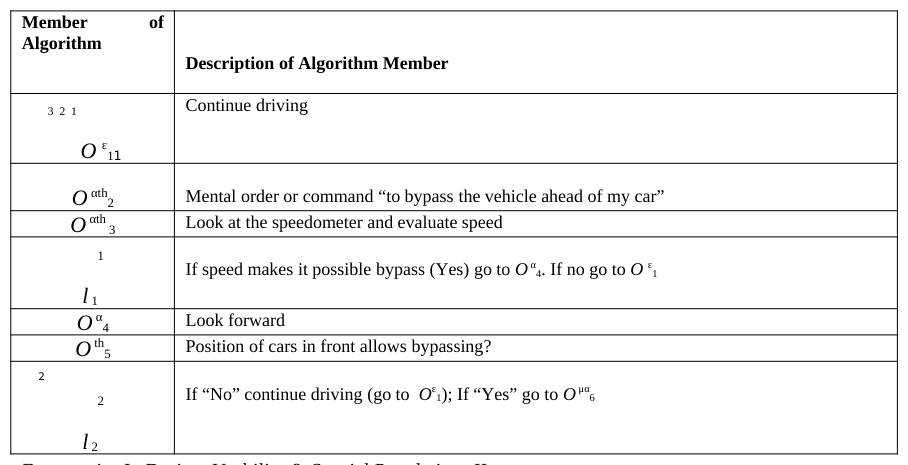
Thinking actions often can be performed based on externally provided information (for example, mental manipulation of externally presented data), or with reliance on the information held by or retrieved from memory (manipulation of data in memory), or thinking actions requiring keeping intermittent data in memory. In this case, we describe thinking operators as O αth or O μth. (α means that thinking operator is performed based on external, for example, visual information, and μ means that such operator requires complicated manipulation in memory). Such symbolic description is used when visual information or information from memory is a critical factor for performance of considered members of an algorithm. Due to the limited scope of this paper we cannot examine in details the method of algorithmic description of activity. Consequently, we consider one a hypothetical example. The task is “A driver bypasses a car in front of his/her car”. This is a real scenario that every driver is familiar with.
Table 1. Algorithmic description of task “bypassing the car in front” Member of Algorithm
The algorithm should be read from top to bottom. In the left column there is a symbolic description of a member of an algorithm in a standardized form which is an example of psychological units of analysis because they have clearly defined psychological characteristics.
ACTIONS AS MAIN UNITS OF ANALYSIS IN ALGORITHMIC TASK DESCRIPTION The concepts of cognitive and behavioral actions are the basis for creation algorithmic model of activity during task performance. So, we will consider them in abbreviate manner. In the West the concepts of activity and action are used interchangeably. The term “action” in activity theory is understood as an element of activity and its main building block. An action can be defined as a discrete element of activity that is directed to achieve a conscious goal of an action. Actions can be further divided into unconscious operations, actual nature of which is determined by concrete conditions under which activity takes place. Achievement of an action goal and assessment of its result is the end point of an action that separates one action from a following action. Actions can be cognitive and behavioral. Therefore, cognition is not just a system of cognitive processes. It also is a system of cognitive actions and operations. Standardized description of cognitive and behavioral actions are necessary for description of activity structure and particularly for design purposes. Actions consist of operations (psychological operations). Motor and cognitive actions should be considered as complex self-regulative systems.
A number of features of cognitive actions have certain analogy with motor actions’ ones. They are goal directed, have a beginning and an end, function according to self-regulation principle, and so on. Motor actions presuppose existence of material objects with which a subject interacts. A subject transforms a material object according to a goal of action. Cognitive actions transform not material objects but information. More precisely, cognitive actions manipulate not material objects but operative units of information (OUI) or operative units of activity. These units of information perform functions that are similar to ones material objects have for motor actions. Such internalized operational units of cognitive actions should be regarded as internal mental tools of activity. Operational units of activity are semantically holistic entities that are formed during acquisition of a specific activity. A person can mentally manipulate images, extracting from memory units of information, mentally manipulate them while thinking, even without an external representation of data.
One way of describing cognitive actions involves utilizing technological terms or terms that describe some task elements associated with a considered action. Taking a reading from a pointer or a digital display are examples of perceptual actions that are described based on technological principles (technological units of analysis). Depending on the distance of observation, illumination and constructive features of a display, a content of a mental operation and time of a performed action can vary. Based on such description as “taking a reading from a pointer on a display” we do not know exactly what action is performed by a subject because conditions of reading can vary. If in edition we use such description as “simultaneous perceptual action” with duration 0.30 second we can really understand what action is performed by a subject. This is an example of perceptual actions that is described based on psychological principles (psychological units of analysis). Extraction of cognitive actions during task performance might be a complex task. In such situation we recommend to use the new eye movement analysis method developed in SSAT (G. Bedny, Karwowski, I. Bedny, 2012). We do not consider this method in our discussion. Cognitive actions sometimes have very short duration and it is often not easy to extract mental operations out of the content of cognitive actions. Therefore in our farther discussion we are offering standardized description of holistic cognitive actions.
Below we present an example of such description of cognitive actions.
1. Direct connection actions unfold without distinctly differentiated steps and require low level of attention. They can be further distinguished as: sensory actions (detection of noise); decision about a signal at a threshold level; obtaining information about distinct features of objects such as color, shape, sound, etc. 2. Simultaneous perceptual actions such as identification of clearly distinguished stimuli that are well known to an operators and only require immediate recognition, perception of qualities of objects or events (recognition of a familiar picture). 3. Mnemonic (memory) actions: memorization of units of information, recollection of names and events, etc. Direct connection mnemonic actions include involuntary memorization without significant mental efforts. 4. Imaginative actions: manipulation of images based on perceptual processes and simple memory operations (mentally rotating a visual image of an object from one position to another according to a specific goal). 5. Decision-making actions at a sensory-perceptual level: operating with sensory-perceptual data like decision-making that requires selecting from at least two alternatives (detecting a signal and deciding to which category it belongs out of several possible categories).
There are also two other groups of mental actions. For example, the second group is mental transformational actions. Such actions as successive perceptual actions; explorative-thinking actions; thinking actions of categorization; logical thinking actions; decision-making actions at verbal thinking level; recoding actions, etc. can be related to this group of actions.
When using eye movement data it is important to find out the difference between successive perceptual and explorative-thinking actions. The main difference between them is that the purpose of successive perceptual actions is developing a perceptual image of an object or percept (for example, categorization of objects based on their shape, color, size, etc.) while the purpose of explorative-thinking actions is to discover a functional relationship between elements of a situation based on presented sensory-perceptual data.
Let us consider method of motor actions description in SSAT. Outside of activity theory there is no clear understanding of the concept of motor actions. A motor action consists of motor operations (motions) that are integrated by a goal of actions. A motor action is a self-regulated element of a motor component of activity. In contrast in engineering psychology and ergonomics the term motor response is used as a synonymous of motor action. Such methods of motor actions’ description can be utilized only when an operator reacts to isolate signals, using discrete actions in highly predictable situations. Due to the fact that motions are elements of motor actions we utilize the MTM-1 system for standardized description of motor actions which is a totally new method of using MTM-1 system in ergonomic studies. The MTM-1 system ignores the concept of motor action and the factor of flexibility of activity during tasks performance. Therefore in our approach MTM-1 system is combined with algorithmic analysis of activity and standardized motions are considered as elements of motor actions. This gives us an opportunity to describe a flexible time structure of human activity which includes cognitive and motor components.
According to SSAT the MTM-1 system utilizes psychological unit of analysis of motions. Thanks to such method behavioral actions that are described by utilizing technological units of analysis (typical elements of task) can be described by using psychological units of analysis (typical elements of activity). Therefore at the first stage we apply a traditional method of motor actions’ description by using technological units of analysis and then transfer them into psychological unit of analysis. Psychological units of analysis describe elements of activity in a standardized manner which allows for unified and unambiguous interpretation of what a performer does. We want to stress that the MTM-1 system does not use such terms as motor actions, and psychological or technological unit of analysis.
We define standardized motor actions as a complex of standardized motions (usually no less than two or three motions) performed by a human body that are unified by a single goal and a constant set of objects and work tools (G. Bedny, 1987; G. Bedny, Karwowski, 2007). Under a standardized motion, or a motor operation, we understand a single motion of a body, leg, hand, wrist or fingers that has a definite purpose in a work process and also corresponds to rules of standardized description. One can clearly describe a motor action only if she/he defines standardized motions imbedded in motor actions. Motor actions that are performed by multiple parts of a body cannot be integrated into one action. For example, two motions simultaneously performed by left and right hand cannot be considered as one motor action. Let us consider an example. ‘Move an arm and grasp a lever’ is a description of a motor action in technological terms. A goal of motor action is to grasp a given lever’s handle for farther use. This is a technological unit of analysis. Such unit of analysis does not give us a clear understanding of this action because we do not know distance or direction of movement and specifics of grasping, a level of cognitive control when a motor action is performed.
Thus we have to transfer technological unit of analysis into psychological one. In order to do that we should describe this motor action as a combination of two standardized motions, ‘move arm’ and ‘grasp lever’. By using MTM-1 system we can describe this motor action as “R40D + G1C1” (in MTM-1 R40D means “reach an object under high level of attentional control or where an accurate grasp is required”; distance of an arm movement is 40 cm; G1C1 means ‘grasp’ (usually requires grasping an object with diameter larger than 0.5’’ and there is some interference while grasping). This description shows that an action should be performed carefully and concentration of attention during this action performance is required. According to MTM-1 performance time of motion R40D = 0.66 sec and G1C1 = 0.26 sec. Therefore, performance time of this motor action is 0.92 sec. Performance time of real execution of this motor action might vary around this time.
This motor action requires the third level of attention concentration and therefore according to SSAT should be related to the third category of complexity. However under stressful conditions or in presence of contradictory information such action can be moved to the fourth category of complexity. Here we only mention that for cognitive actions the lowest category of complexity is the third category. For example, simultaneous perceptual action with 0.3 sec duration according to rules developed in SSAT can be related to the third category of complexity. Hence the first and the second category of complexity can be assigned only for motor actions. Therefore time structure analysis is important for the task complexity evaluation. MTM-1 system does not have such concepts as cognitive and motor actions. A specialist in MTM-1 system begins task analysis by dividing activity during task performance into discrete motions. In contrast, in SSAT the first stage is qualitative and then motor components of a task are divided into actions and then each action is, in turn, divided into operations (motions). Combination it with algorithmic analysis, we can describe a very flexible activity during task performance.
DESCRIPTION OF ACTIVITY TIME STRUCTURE In ergonomics and industrial engineering time structure of activity is a practically unknown concept and it’s misinterpreted in psychology. For example, some psychologists attempt to explain the time structure of activity during skill acquisition process by assuming that, at the initial stage of skill acquisition a trainee cannot perform actions simultaneously or one action right after another which causes pauses between motor and cognitive components (Hacker, 1980). Such pauses are considered as empty time intervals. However, such “empty” time intervals are not really empty. An operator continues processing information during such pauses.
Without developing a time structure of activity we cannot perform quantitative assessment of task complexity. This is due to the fact that activity is a process and we have to evaluate complexity of this process. At this stage of analysis all activity elements are translated into temporal data that demonstrates duration of standardized elements of activity. Technological units of analysis should be transformed into psychological units of analysis. Description of activity time structure is important in designing tools, equipment and for HCI. The main idea is that changes in equipment configuration and computer interface probabilistically change the time structure of activity. A specialist can evaluate and change equipment characteristics based on time structure analysis. The time structure of activity helps a specialist evaluating efficiency of performance of production operations, thus it can be used in the evaluation of safety and training. Time structure of activity cannot be developed until we determine strategies of task performance and a possibility of performing activity elements simultaneously or sequentially. Before developing time structure of activity it is necessary to describe each task algorithmically. Following are the stages of time structure development: 1. Determine a content of activity with a required level of decomposition for defining its elements (psychological units of analysis). 2. Determine duration of elements while considering their influence on each other. 3. Define distribution of activity elements over time, taking into account their sequential and simultaneous performance. 4. Specify the preferable strategy of activity performance and its influence on duration of separate elements and of the whole activity. 5. Determine the logic and probability of transition from one temporal sub-structure to another. 6. Calculate duration and variability of activity during a task performance. 7. Define how strategies of activity change during skill acquisition, and estimate what elements are intermediate and which ones are final in the time structure.
The critically important step in development time-structure of activity is determining strategies of task performance. For example, in a dangerous situation, when actions have a high level of significance, an operator performs them sequentially, even if they are simple. However, in a normal situation, when the consequences of errors are not severe, the same simple actions will be performed simultaneously. Strategies of activity also depend on the logical components of a work process and the complexity of separate elements of activity. SSAT offers rules that determine a possibility of combining various components of activity and specifically: 1) a possibility to combine motor components of activity; 2) a possibility of combining cognitive components; 3) a possibility to combine motor and cognitive components of activity.
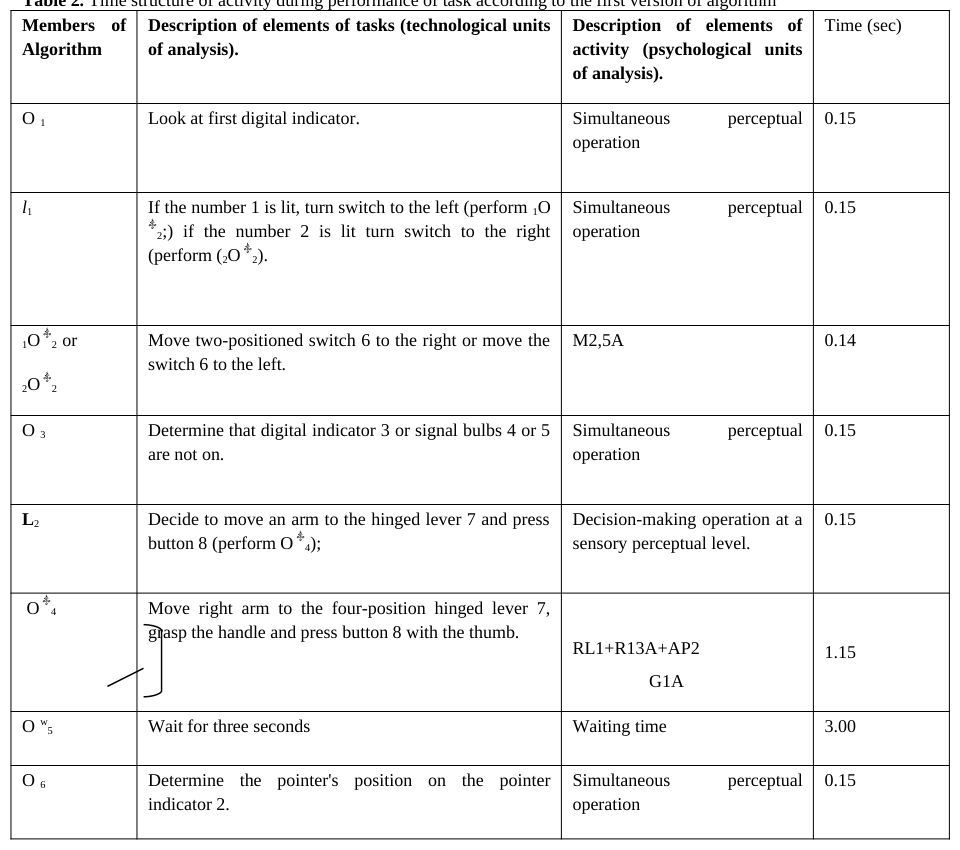
In SSAT such possibility depends on a level of concentration of attention during performance of such elements (Bedny, Karwowski, 2007). At the final stage of a design process analytical models are tested experimentally and some corrections are possible. These are common steps not only for ergonomic but also for engineering design. There is a probabilistic relationship between these models and real performance. The more times a subjects perform the same tasks the more closely this subjects’ activity approaches developed models. We consider as an example the task that includes a combination of cognitive and motor actions Bellow we present time structure of activity during task performance in a tabular form.
Table 2. Time structure of activity during performance of task according to the first version of algorithm Members of Algorithm
We presented the time structure of activity in a tabular form but when there are complex combinations of activity elements (activity elements are performed simultaneously) the most informative is a graphical form of a time structure description. This method of presentation is usually done after a tabular form is developed. Below we present the graphical model of the activity time structure for the above described task (first version, see Figure 1).
Figure 1. Graphical presentation of time structure of a task performance utilizing experimental control board (the first version of the algorithm).
Figure available in the original PDF paper.
In the graphical model of time structure of activity on Figure 1 individual elements of activity are presented by horizontal lines. The elements are specified by symbols above the segments. Microelement EF describes perceiving signals and simple decision making at sensory perceptual level that includes as “yes” or “no” or “if-then” decisions. Segment under EF designates duration of such mental action. Similarly, other segments designate duration of various elements of activity. According to introduced rules, EF can be further divided into perceptual and decision making mental operations in order to distinguish simple perceptual actions from decision making actions at sensory perceptual level. In more complicated situations duration of decision making actions can be evaluated experimentally or required data can be taken from other sources. For example, O [Equation or mathematical symbol available in the original paper PDF]
6 and L3 are also involved in decision making process at the sensory perceptual level. We determined duration of these elements using data from a handbook of engineering psychology (Myasnikov, Petrov, eds., 1976) and divide them into two mental operations. The elements of activity that are overlapped by other longer elements are designated by a dashed line. For example, O [Equation or mathematical symbol available in the original paper PDF]
10 and l5 are overlapped by O [Equation or mathematical symbol available in the original paper PDF] 11. So, for O [Equation or mathematical symbol available in the original paper PDF] 10 and l5 we did not assign performance time when we calculated duration of the whole task. One can make conclusions about possibilities to perform actions simultaneously or sequentially not only based on analyses of separate actions or operations, but also based on analysis of possible strategies of task performance. For example, if a performer is very skilled and/or consequences of wrong actions are not significant, then actions can be performed simultaneously. If actions are not automated and errors are undesirable, they should be performed sequentially.
Some symbols on Figure 1 require additional explanation. M2.5A means “move object against stop” when distance is 2.5 cm. Letters P and D over a segment mean “perception” and “decision making”. RL1 means “normal release performed by opening fingers”. R13A means “reach an object in a fixed location, when distance is 13 cm”. AP2 designates “apply pressure with effort less than 15 kg”. G1A means “easily grasped”. This element is overlapped by AP2. The letters W and Per. mean “waiting period”. M5B designates “move an object 5 cm to an approximate location (requires an average level of concentration of attention). T180S designates “turn 180 degrees with small effort (from 0-1 kg.)”. Other elements of activity are designated similarly.
Let us consider units of analysis that are used during algorithmic description of task and temporal analysis of activity. The first two members of the algorithm (O[Equation or mathematical symbol available in the original paper PDF]
1 and l1) are the result of artificial dividing of element EF into two separate mental operations that are related to different members of the algorithm. This was performed for purposes of distinguishing in the future analysis which members of the algorithm are associated with decision making at a sensory perceptual level and the members of the algorithm that are comprised of simultaneous perceptual actions (operation).
In all other situations we divide tasks into separate members of algorithms according to recommendations described in SSAT. Usually a member of an algorithm includes 1-4 actions that are integrated by a high order goal which is a goal of a member of an algorithm (goal which should be achieved during performance of a particular member of an algorithm). For example, a member O[Equation or mathematical symbol available in the original paper PDF]
2 contains one motor action “move an arm to a lever, grasp it and simultaneously press a button with a thumb.” This action, in turn, is comprised of the following motor operations: (motions) “move arm,” “grasp a handle” and “press a button with a thumb”. All these operations are integrated by a goal of a motor action. Similarly, other members of the algorithm are described. In this example we covered only one strategy of task performance. Therefore, logical conditions did not include associated arrows and corresponding transitions to required members of the algorithm.
CONCLUSIONS
The time structure of activity during task performance is unknown concept outside of SSAT. Rather than consider separate parametric characteristics of activity, such as time of task performance, reaction time, reserve time, or conduct time line analysis which is a crude method of time measurement of task performance we suggest to use the concept of activity time structure. For development of time structure of activity it is necessary to bridge from technological units of analysis to psychological units of analysis. Technological units of analysis describe time structure of activity in technological terms or in a common language. These units simply describe some stage of task performance. Psychological units of analysis describe typical elements of activity in a standardized manner. If we know duration of separate elements of activity, rules of their performance in sequence or simultaneously, logic of transition from one element to another, and probability of performance we can develop time structure of activity during task performance.
One the critical stages of time structure development are algorithmic description of task performance. Human algorithm should be distinguished from a mathematical or computer algorithm. Main units of analysis in a human algorithm are cognitive and behavioral actions. In algorithmic analysis of task performance human activity is divided not only into actions, but also into algorithmic elements or members of an algorithm such as operators, and logical conditions. Members of an algorithm can be considered as a subsystem of activity which has a higher order goal that can integrate the same type of actions into such subsystem. A logical condition is a decision-making process that determines which member of an algorithm and therefore which actions are selected. An algorithm can be probabilistic as well as deterministic. Deterministic algorithms have logical conditions with only two outputs, 0 or 1. If an operator’s activity is multivariate and it can be described by a probabilistic algorithm. In such cases logical conditions can have more than two outputs and vary from 0 to 1. Hence logical conditions can transfer activity flow from one member of algorithm to another with various probabilities. Each member of an algorithm has a special symbolic designation and demonstrates psychological meaning of these members of algorithm. We have describe principles of algorithmic analysis in abbreviate manner.
Algorithmic analysis of human activity eliminates contradiction between the so called “one best way of performance” and “the constraint-based approach”. Actions comprise of smaller units-operations. For motor actions such units are motions. This makes it useful to utilize MTM-1 system for description of motor components of activity. In SSAT MTM-1 system is used in totally new fashion. Motions are considered to be components of motor actions which are in turn are components of member of an algorithm. Combining MTM-1 system with algorithmic analysis allows us to described very flexible activity. Usually the most complex time structure of activity is encountered when activity is a combination of relatively simple cognitive actions and motor actions of various complexity because of the fact that cognitive actions cannot be performed simultaneously and should be performed in sequence. This is why we paid special attention to such types of activity time structure where motor components are combined with cognitive components.
Building activity time structure is an efficient tool for assessment of efficiency of human performance. Combination of activity elements and therefore time structure of activity is determined by equipment configuration. Changes in equipment or software design lead to changes in time structure of activity. If during interaction with equipment time structure of activity is very complex this means that a performance method should be changed or equipment is not designed efficiently. Hence, efficiency of ergonomic design and efficiency of task performance can be evaluated based on analyzing activity time structure. The developed method can be used as a purely analytical one or in combination with simplified experimental procedures. Design should not be reduced to purely experimental methods as it is done in cognitive psychology. In contemporary human-machine and human-computer systems activity during task performance is flexible and therefore only after time structure of activity is developed total time of task performance can be estimated.
REFERENCES
Bedny, G. Z. (1987). The psychological foundations of analyzing and designing work processes. Kiev: Higher Education Publishers Bedny, G., Meister, D. (1997). The Russian Theory of Activity: Current application to design and learning. Lawrence Erlbaum
Associates, Publishers. Mahwah, New Jersey. Bedny, G.Z., Karwowski, W. (2007). A systemic-structural theory of activity. Application to human performance and work design. CRC, Taylor and Francis Bedny, I. S., Karwowski, W., Bedny, G.Z. (2010). A method of human reliability assessment based on systemic-structural
activity theory. International journal of human-computer interaction. 26, 377-402
Bedny, G. Z., Karwowski, I. Bedny, I. S. (2012). Complexity evaluation of computer-based tasks. International journal of human-computer interaction. 28, 236-257 Bedny, G. Z., Harris, S. H. (2013). Safety and reliability analysis methods based on systemic-structural activity theory. Journal of
risk and reliability. V. 227, 549-557 Vicent, K. J. (1999). Cognitive work analysis. Toward safe, productive, and healthy computer-based work. Lawrence Erlbaum Associates, Publishers. Mahwah, New Jersey. Vygotsky, L. S. (1978). Mind in society. The development of higher psychological processes, Cambridge, MA: Harvard
University Press.
LISTED IN THE AHFE DIGITAL BOOKSTORE CATALOGUE
Explore the complete digital volume
Advances in Ergonomics In Design, Usability & Special Populations: Part II
Read this individual research paper free through the original publisher, or explore the full digital proceedings book.
ISBN 978-1-4951-2107-4
Explore this ISBN in the AHFE Bookstore ↗Listed in the July 2026 bookstore catalogue; search by ISBN to confirm current availability · Digital book purchase optional