Annika Riegera, Regina Stollb, Kerstin Thurowa, Matthias Weippertab (2022). Workload Responses to Sensory-Motor Tasks Under Time Pressure in Life Sciences Labs: Effects of Task Complexity. In: Advances in Ergonomics In Design, Usability & Special Populations: Part III. AHFE Open Access, vol. 20. https://doi.org/10.54941/ahfe1001292
The aim of this study was to assess workload response during a simulated pipetting task of different complexity under time pressure conditions. Thirty healthy volunteers (12 female / 18 male) gave their written informed consent to take part. After training they underwent a standardized test protocol including a baseline measurement (REST), a control pipetting condition under time pressure (CON), a complex pipetting task under time pressure (COMP), and recovery (RECOV). To avoid order effects pipetting tasks have been carried out in a counterbalanced order. Measurements included heart rate (HR), heart rate variability (HRV), breathing rate (BR), as well as diastolic and systolic blood pressure (DBP, SBP). NASA TLX was applied in order to assess perceived workload. There were minor, but significant elevations of HR, BR, SBP during CON and COMP when compared to REST and RECOV. However, with the exception of HRV measures, physiological data were not sensitive to variations in cognitive demands between the two pipetting conditions. Further, perceived mental effort differed significantly between CON and COMP and thus mirrored the different complexity of tasks. It can be concluded that the addition of cognitive demands under sensory-motor demands can be reflected by some HRV indices and subjective workload ratings but not by HR, BR and BP.
Pipetting, defined as a method of transferring an exactly defined quantity of liquid from one vessel to another by means of a pipette (Fredriksson, 1995), is a typical task in the biological domain. It requires high sensory-motor skills such as eye-hand coordination or motor speed. Often pipetting is carried out under time pressure, due to time- critical biological processes. Further, due to the complexity of the processes and concurrent processing demands, multitasking is common in life science laboratories. Attentional resources and working memory play significant roles also during “simple” pipetting tasks. Depending on the task and process, mental demands can contribute to larger extent to overall workloads, especially during novel processes in research labs. Efficient operation of multiple tasks requires that information-processing demands imposed on operators do not exceed their personal capabilities (Eggemeier, Wilson, Kramer, & Damos, 1991). Demands that exceed the individual limit can lead p. e. to errors, degradations in performance and crew problems.
To meet system demands, high information processing capacity and resources are required. Research shows that an increasing amount of working people suffer from occupational overload. Therefore, assessment of occupational workload associated with complex environments has become an important issue in system evaluation and occupational health, respectively. Workload assessment techniques include performance-based assessment techniques, subjective workload assessment techniques, and physiological workload assessment techniques (Eggemeier, et al., 1991; Helander, 2006).
The aim of this experimental study was to evaluate typical sensory-motor tasks in life science laboratories that differed in terms of cognitive load.
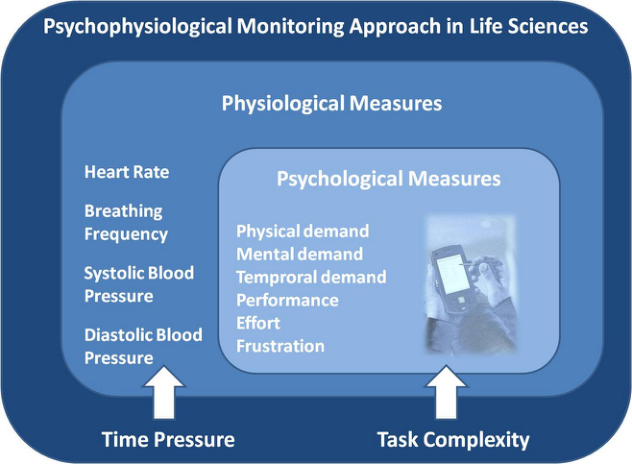
METHOD FRAMING This study was conducted in order to get feedback on the effects of pipetting task on individual workload response. The theoretical foundation of this workload monitoring is given by a psychophysiological concept linking physiological assessments and psychological assessments under real-time monitoring conditions. This approach is explained below and illustrated in figure 1.
Physiological workload assessments The ability to define accurately an operator’s state in real time has gained much interest in recent years and is much desired. One approach is to classify individual’s occupational workload according to physiological response. Physiological recordings provide an objective source of information on operator’s state. Improvements in technical solutions, non-invasiveness, and mobile equipment made it even more compelling. Different physiological indices related to cardiac, eye, and brain functions have been considered for the assessment of operators’ effort at the workplace (Wilson & Eggemeier, 1991). Cardiac measurements allow researchers to understand the functioning of the autonomic nervous system. High workload as a result of stressful stimuli mobilizes the body and results p. e. in increased heart rate (HR), increased breathing and sweating. In our study, the physiological workload response was measured continuously by the BioHarness™ 3 which is a compact physiological monitoring module that enables the capture and transmission of HR, heart rate variability (HRV) measures and breathing rate (BR) via mobile data networks. Data were transferred in real time via Bluetooth technology to a smartphone and to the server architecture. Systolic (SBP) and diastolic blood pressure (DBP) were monitored using the Withings Blood Pressure Monitor. Data could be displayed and saved within the Withings application using the smartphone.
HRV analysis was carried out to get a detailed insight into cardiac autonomic modulation under the different tasks conditions. Representative three minute RR time series were analyzed in the frequency domain. Variance of the RR segments in the low frequency (LF-Power) and the high frequency band (HF-Power) were calculated. While the HF band is predominantly influenced by the parasympathetic outflow to the heart, the LF band is influenced by both autonomic branches (sympathetic and parasympathetic). The ratio of LF and HF (LF/HF) is thought to reflect the sympatho-vagal balance (Task Force of the European Society of Cardiology and the North American Society of Pacing and Electrophysiology, 1996). Higher values of the LF/HF ratio are thought to reflect sympathetic dominance. Further, DFA α1, sample entropy (SampEn) and correlation dimension D2, nonlinear measures of HRV, were calculated to test whether these indicators would be superior to the conventional HRV frequency indices in distinguishing the different task conditions.
Psychological workload assessment Subjective measures of workload are, even if they are not without problems, the most commonly used measures in multi-task environments due to their ease of use and practicability. Particularly in combination with physiological indices, subjective experience is an important indicator of workload level and provides greater insight into the dynamics of workload. The psychological workload experience was captured via smartphone application using the validated questionnaire NASA Task Load Index (NASA TLX (Hart & Staveland, 1988)). The NASA TLX consists of the six subscales mental, physical, and temporal demands, performance, effort, and frustration. The combination of these dimensions represents the workload of a person. According to the findings of Hart et al. (Hart, 2006), who described that in research a common and valid modification to the original questionnaire is to eliminate the weighting process and analyze the subscales individually, in our study only raw TLX values were used for individual workload analysis.
Real-time monitoring system Retrospective questions often ask respondents for information they cannot provide with validity. The advantage of real-time data capturing is that these methods provide more realistic information because people are monitored in a realistic setting and asked for information they probably know, such as current behavior, experiences and circumstances. Real-time monitoring and transmission of physiological recordings were enabled by a remote telemonitoring system which included the multiparametric sensor module, a monitoring center, and a communication center connecting both components (Zhang, Stoll, Stoll, & Thurow, 2013; Zhang, Thurow, & Stoll, 2013). The system allows interpretation and analysis of data immediately after data capturing and can be seen as a modern and flexible workload assessment tool which can be used in multi-task environments such as the Life Sciences.
Figure 1. Monitoring approach for real-time assessment of operator's workload Participants and Study protocol
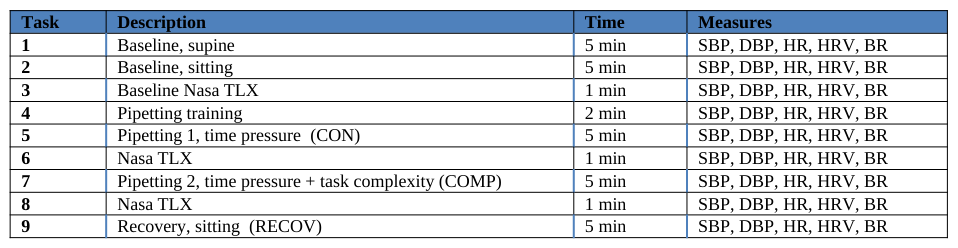
30 young volunteers (12 female, 18 male; age: 24.1 ± 2.9 years) took part in this study. Approval of the local ethics commission was obtained. The protocol for this study required the subject to perform two pipetting conditions, a simple pipetting task (CON) and a more complex pipetting task (COMP) with an increased perception and working memory load, both executed under time pressure (see Table 1). Before task completion, baseline measures of HR, BR, DBP, and SBP were recorded in supine and sitting position (REST). The pipetting tasks were followed by a recovery phase (RECOV). Subjective experience was assessed before investigation to get baseline workload scores, and following each task condition. To avoid order effects tasks were carried out in a counterbalanced order.
Table 1: Design of study protocol for psychophysiological assessments Task Description Time Measures 1 Baseline, supine 5 min SBP, DBP, HR, HRV, BR 2 Baseline, sitting 5 min SBP, DBP, HR, HRV, BR 3 Baseline Nasa TLX 1 min SBP, DBP, HR, HRV, BR 4 Pipetting training 2 min SBP, DBP, HR, HRV, BR 5 Pipetting 1, time pressure (CON) 5 min SBP, DBP, HR, HRV, BR 6 Nasa TLX 1 min SBP, DBP, HR, HRV, BR 7 Pipetting 2, time pressure + task complexity (COMP) 5 min SBP, DBP, HR, HRV, BR 8 Nasa TLX 1 min SBP, DBP, HR, HRV, BR 9 Recovery, sitting (RECOV) 5 min SBP, DBP, HR, HRV, BR
Statistical Analysis Data were analyzed using the statistical software SPSS version 21.0 for Windows (SPSS, Inc., Chicago, IL, USA). Results are expressed as mean and standard deviations. ANOVA for repeated measures was used to test for significant differences of HR, HRV, BR, blood pressure and subjective measures across the four experimental conditions. Post-hoc pairwise comparisons were carried out to test for significant effects of complexity on perceived effort and physiological workload indicators. All statistical tests were two-tailed with the alpha level set at 0.05.
RESULTS
Physiological workload response There were significant increases in BR during CON compared to REST (20,4 ± 3,9 vs. 15,5 ± 3,8 breaths/minute, p < 0.001) and RECOV (20,4 ± 3,9 vs. 15,5 ± 3,3 breaths/minute, p < 0.001). Likewise, BR differed significantly between COMP and REST (20,6 ± 4,3 vs. 15,5 ± 3,3 breaths/minute, p < 0.001) as well as during COMP and RECOV (20,6 ± 4,3 vs. 15,5 ± 3,3 breaths/minute, p < 0.001). No differences in BR were found in pairwise comparisons between REST and RECOV (p = 1.000) or between CON and COMP (p = 1.000).
Figure 2. Behavior of BF during task completion (N = 30)
Figure available in the original PDF paper.
HR of subjects differed significantly between both pipetting conditions and REST (CON-REST: 78,6 ± 14,4 vs. 70,6 ± 9,1 beats/minute, p < 0.001; COMP-REST: 78,9 ± 11,0 vs. 70,6 ± 9,1 beats/minute, p < 0.001). Furthermore, Ergonomics In Design, Usability & Special Populations III
HR decreased significantly after task completion (CON-RECOV: 78,6 ± 14,4 vs. 70,9 ± 10,0 beats/minute, p < 0.001; COMP-RECOV: 78,9 ± 11,0 vs. 70,9 ± 10,0 beats/minute, p < 0.001). Neither between REST and RECOV (p = 1.000) nor between CON and COMP (p = 1.000) significant differences of mean HR were found (see Figure 3).
Figure 3. Behavior of HR during task completion (N = 30)
Figure available in the original PDF paper.
SBP showed the same trend as BR and HR. It differed significantly between REST and CON (118,9 ± 10,8 vs. 125,5 ± 11,6 mmHg, p < 0.01), REST and COMP (118,9 ± 10,8 vs. 125,9 ± 11,8 mmHg, p < 0.001), between CON and RECOV (125,5 ± 11,6 vs. 118,4 ± 9,8 mmHg, p < 0.001) as well as COMP and RECOV (125,9 ± 11,8 vs. 118,4 ± 9,8, p < 0.001) but not between the pipetting conditions (p = 1.000). No significant differences were evident for DBP (see Figure 4).
Figure 4. Mean values of SBP (filled circles) and DBP (open circles) across the different experimental conditions (N = 30)
Figure available in the original PDF paper.
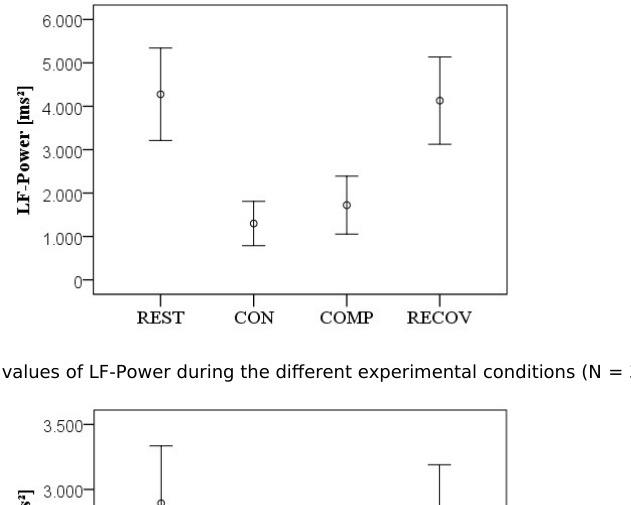
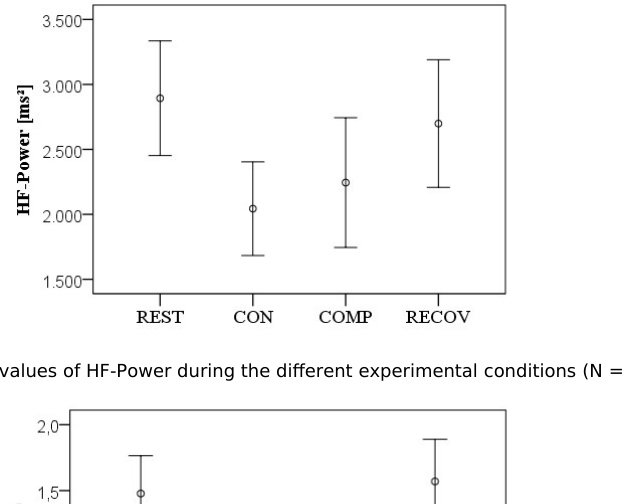
There was a significant reduction of all analyzed HRV measures under the pipetting tasks compared to rest and recovery (figures 5-8). However, as average heart rate has a strong impact on all HRV measures, the main interest was to estimate the potential of HRV to distinguish between the two task conditions where similar heart rates were evident. We found that despite a similar net effect of the pipetting tasks on HR, LF-Power and LF/HF-Ratio tended to be higher during COMP (1299 ± 1370 ms² vs. 1721 ± 1786 ms²; p = 0.058 and 0,63 ± 0,47 vs. 0,81 ± 0,67; p = 0.065; see Figures 5 and 7). No significant differences were found for HF-Power (see Figure 6). The nonlinear indicator DFA α1 differed significantly between the two task conditions (0,58 ± 0,15 vs. 0,63 ± 0,16; p < 0.05; see Figure 8), while no significant differences were evident for SampEn and D2 (not shown).
Figure 5. Mean values of LF-Power during the different experimental conditions (N = 30)
Figure available in the original PDF paper.
Figure 6. Mean values of HF-Power during the different experimental conditions (N = 30)Figure 7. Mean values of the LF/HF-Ratio during the different experimental conditions (N = 30)Figure 8. Mean values of DFA α1 during the different experimental conditions (N = 30)
Figure available in the original PDF paper.
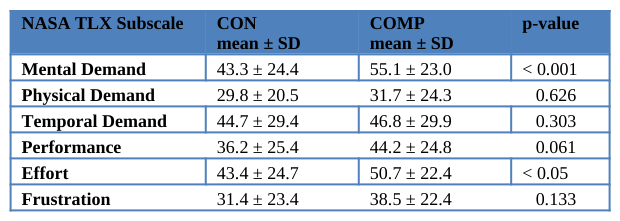
Subjective workload experience Subjective workload was rated on a scale from 0 to 100 immediately after task completion. Pairwise comparisons between task conditions revealed that perceived mental demand and effort differed significantly between CON and COMP. There was a statistical trend, implying satisfaction with the performance to be greater for the simple pipetting task. No differences were found for physical, temporal demands as well as frustration (see Table 2).
Table 2: Results of ANOVA for repeated measures including the six subscales of NASA TLX p-value NASA TLX Subscale CON mean ± SD
CONCLUSIONS
Pipetting tasks induced only minor but significant elevations of HR, BR, and SBP when compared to rest or recovery. Comparison between the CON and COMP task revealed no effect of complexity on HR, BR and blood pressure. However, results of the HRV analysis implied an increase of sympathetic cardiac activity in relation to vagal cardiac activity (Rojo-Alvarez et al., 2007; Task Force of the European Society of Cardiology and the North American Society of Pacing and Electrophysiology, 1996). Also, subjective workload measures indicated an increased mental demand and effort during COMP. It can be concluded that the addition of cognitive demands under sensory-motor demands can be reflected by nonlinear HRV indices and partially by subjective workload but not by HR, BR and measures of blood pressure.
ACKNOWLEDGEMENT
The authors wish to thank the Federal Ministry of Education and Research (BMBF Germany) for the financial support (FKZ: 03Z1KN11). We also thank Weiping Zhang for the technological support of this study and Florian Husmann for his support in data collection and data preparation.
REFERENCES
Eggemeier, F. T., Wilson, G. F., Kramer, A. F., & Damos, D. L. (1991). Workload assessment in multi-task environments. In D. L. Damos, , (Ed.), Multiple task performance (pp. 207-216). London, Washington D.C.: Taylor and Francis. Fredriksson, K. (1995). Laboratory work with automatic pipettes: a study on how pipetting affects the thumb.
Ergonomics, 38(5), 1067-1073. Hart, S. G. (2006). NASA-task load index (NASA-TLX); 20 years later. Paper presented at the Proceedings of the Human Factors and Ergonomics Society, San Francisco, CA. Hart, S. G., & Staveland, L. E. (1988). Development of NASA-TLX (Task Load Index): Results of Empirical and
Theoretical Research. Advances in Psychology, 52, 139-183. Helander, M. (2006). A guide to human factors and ergonomics. London, Bristol PA: Taylor and Francis. Rojo-Alvarez, J. L., Sanchez-Sanchez, A., Barquero-Perez, O., Goya-Esteban, R., Everss, E., Mora-Jimenez, I., et al. (2007). Analysis of physiological meaning of detrended fluctuation analysis in heart rate variability using a lumped parameter model. Paper presented at the Computers in Cardiology (CAR 2007), Durham, NC. Task Force of the European Society of Cardiology and the North American Society of Pacing and
Electrophysiology. (1996). Heart rate variability: standards of measurement, physiological interpretation and clinical use. Circulation, 93(5), 1043-1065. Wilson, G. F., & Eggemeier, F. T. (1991). Psychophysiological assessment of workload in multi-task environements. In D. L. Damos (Ed.), Multiple Task Performance (pp. 329-360). London, Washington D.C.: Taylor and Francis. Zhang, W., Stoll, R., Stoll, N., & Thurow, K. (2013). An mhealth monitoring system for telemedicine based on
WebSocket wireless communication. Journal of Networks, 8(4), 955-962. Zhang, W., Thurow, K., & Stoll, R. (2013). A SOA and knowledge-based telemonitoring framework: Design, modeling, and deployment. International Journal of Online Engineering, 9(6), 48-57.
LISTED IN THE AHFE DIGITAL BOOKSTORE CATALOGUE
Explore the complete digital volume
Advances in Ergonomics In Design, Usability & Special Populations: Part III
Read this individual research paper free through the original publisher, or explore the full digital proceedings book.
ISBN 978-1-4951-2108-1
Explore this ISBN in the AHFE Bookstore ↗Listed in the July 2026 bookstore catalogue; search by ISBN to confirm current availability · Digital book purchase optional