B. Barkokébas Juniora, A. B. B. H. Pintob, L. B. Martinsb (2022). Working Conditions in the Sector of Urban Passenger Transport the Metropolitan Region of Recife. In: Advances in Ergonomics In Design, Usability & Special Populations: Part III. AHFE Open Access, vol. 20. https://doi.org/10.54941/ahfe1001341
The article aims to analyze the conditions of employment of the driver and the bus conductor, the urban passenger transport in the Metropolitan Region of Recife sector, aiming at the performance and quality of life of workers. The survey of the working conditions of these two professionals was conducted in 19 transport companies Recife by staff researcher at the Laboratory of Ergonomics and Universal Design ( LABERGODesign ) of the Federal University of Pernambuco and the Center for Health and Safety at Work ( NSHT ) University Pernambuco with support from Regional Labor Attorney of the 6th Region of the Ministry of Labour ( MPT ). For this survey was carried out in 19 bus companies, methodological procedures for measurement of risk - noise, vibration, heat, total dust O2 and CO; Applied checklists for workplace of the driver and the bus conductor; applied questionnaires to both driver and collector, also made an assessment of postural discomfort using the tool Corlett diagram, in addition to photographing and filming in a real work situation of the driver and conductor. The results obtained from the research we identified the actual working conditions - physical, cognitive and organizational - of those two professionals and analyzed the jobs of the driver and conductor. The results show the consequences that the driver and conductor suffer to spend too much time sitting and with little break time, what are the areas of the body most affected by pain and discomfort in those two professions, including organizational issues they face, well as the physical and environmental risks that are exposed during a working day of 8 hours, 10 and 16 hours. The analysis of the research has relevance to the areas of occupational safety and ergonomics since the results may contribute to intervene in the security and quality of life of such professionals.
The first records of public transportation that has news dating from the fourth century BC in Greece, where the Greeks were the pioneers in the construction of roads and the first bodies. When the Romans took over the empire developed the "Carrozzieri" a kind of public transportation more modern than that of the Greeks and widened roads to facilitate their expansion, but with the fall of that empire, their advent disappeared (FRANQUES, 2002).
In 1661, in France, Blasé Pascoal, considered the father of buses around the world to create a public transport carriages made by eight places with animal traction, with seating for the driver and his helper, and that followed a route, time and price pre-established (Franques, 2002; COSTA, 2006). In 1826, a merchant of Nantes in France makes a pun on the transport "omnibus" meaning "for all", thus, users started referring to as omnibus transportation. In this same city, later the first public transport service in adopting this final nomenclature to refer to such transport (; COSTA 2006 FRANQUES, 2002) was created. However, the first bus of the World was created in 1895 by Karl Benz (FRANQUES, 2002).
In Brazil, the first bib arrived in 1919, were mounted on trucks buses where only the front of that vehicle was conserved and part of the body was a huge wooden box with glasses and banks. Soon after came the bodies in plaque and in 1926 were imported bib called the "yellow coach" (VICASA). In 1941 he was made the first Brazilian brothers Grassi by bus, with seating for 45 (forty five) people in the 50s and the first national chassis (CENTERONIBUS).
In Recife, the first bus service began circulating in the 30s, replacing the trams. In the 40s, the bus was already considered the primary means of public transportation, and in 1956, 106 companies operating 48 lines of Recife (MILBUS, 2004). From the 70's chassis and suspension were begun thinking about the passenger who then would give some comfort to the users as it no longer had the traditional bumps. Thus, with industrialization and new market requirements, the bus had to modify gaining tremendous importance in day-to-day lives and becoming the primary means of public transportation.
Despite the evolution and modernization in manufacturing of buses, the space for drivers and collectors are still composed of minimum space to carry out their bodily movements, manipulation and visualization necessary equipment to perform their activities. But you already see a concern with respect to the scaling of space by manufacturers of parts and equipment and assemblers in the pursuit of quality and segurançaa of vehicles and the comfort and well-being of drivers and conductors.
Characterization of urban bus According to the Brazilian Standard NBR 15570 (ABNT, 2009), vehicles for passenger transport should be classified according to their type, class composition and, considering the technical and operational characteristics of the lines where they will be used.
The Brazilian Traffic Code - CTB (ano1996) and the National Traffic Council - CONTRAN (1996) classified as coach, public transportation motor vehicle having a capacity of 20 seated passengers, although this number may be lower in case of need to provide greater comfort for passengers (ABNT, 2009). May be single, double hinged floor or floor. As for the class of vehicle, the NBR 15570 (ABNT, 2009), takes into account the capacity, the minimum gross weight and maximum total length for classifying the different types of vehicles.
CHARACTERIZATION OF ACTIVITY Bus driver
According Gorni (1997), the activity of the bus driver is driving passengers to a specific place. The driver performs the task of transporting passengers with the means available to it (the vehicle being the conducting medium) and within the conditions laid down not only the conformation of the physical space of the command post, but also by the rules imposed by the company. The activity is quite complex activating physiological and mental functions, as the driver shifts to trigger commands, hear noises and signals decoding them as possible mechanical malfunction, communicate with the passenger, plan their actions according to momentary situations, among other.
Bus Conductor The main activity of the bus conductor is to charge the tickets to passengers within the standards set by the company and the Greater Recife Metropolitan Transport Consortium. Also part of the routine of a trader to provide information to assist the driver and passengers in some of its functions to observe the entry and exit of passengers in the vehicle.
OCCUPATIONAL RISKS According to ABHO (Brazilian Association of Occupational Hygienists) we can classify the risks of working as environmental hazards (physical, chemical and biological) due to these propagate the environment and security risks (mechanical and ergonomic) because they are static or due to unsuitability of the environment to man.
We define environmental risk under paragraph 9.1.5 of the NR-9 as: "... the physical, chemical and biological, existing in the workplace agents, due to their nature, concentration or intensity and exposure time are capable of causing damage to workers' health. "As for this research, the objective is to analyze the environmental and safety risks they face drivers and collectors urban buses in the Metropolitan Region of Recife is a brief explanation of the physical hazards: noise, heat, vibration, the chemicals: Total dust, CO and O2, and ergonomic hazards.
Noise The sound is caused by the variation in pressure or velocity of molecules in a fluid medium and is a form of energy which is transmitted by the collision of such molecules (Gerges, 1992). Every sound that becomes unpleasant or undesirable to the recipient is called noise. Therefore, the difference between sound and noise depends on each individual, their socio-cultural and emotional state.
Noise induced occupational origin, known in English literature as noise-induced permanent threshold shift hearing loss - NIPTS, can be defined as a sensorineural, bilateral, cumulative loss that manifests as the years pass. It is the result of chronic exposure to noise sound pressure levels ranging from 80 to 120 dB (A) in the workplace. Lodges in the inner ear, the cochlea, through the destruction of sensory cells (outer hair cells) that are replaced by supporting cells forming scars. (MAIA, 2001) Heat
According Primed and Soares (1991), the energy that moves the body of higher temperature to the body at a lower temperature named after heat. In this way heat is a form of energy in transit determined by the temperature difference between the two systems.
Vibration The vibration is moving bodies equipped with the inherent mass and elasticity. The human body has a natural vibration. If an external frequency coincides with the natural frequency of the system, the resonance amplification which involves movement occurs. The vibration energy is absorbed by the body as a consequence of promoted attenuation by tissues and organs. Unlike other agents, where the employee is taxable, exposing themselves to risks in the case of vibration, there must be characteristically contact between the worker and the machine or equipment to transmit vibration.
Dust According to NHO - 06 chemical agent dust is all solid particle size or nature of any origin formed by the rupture of an original solid, suspended or able to remain suspended in the air material. These particles typically have irregular shapes and are larger than 0.5 micrometers.
Gases Carbon monoxide (CO) is a colorless, odorless toxic gas that interferes with the blood's ability to carry oxygen. CO is non-irritating and can lead the worker to a sudden collapse of the effects of exposure to CO poisoning is severe it can cause neurological damage, illness, coma and death. The most common symptoms of CO exposure are headache, drowsiness, nausea and pressure in the thoracic region.
Ergonomic risks
Ergonomic risks can be defined as "any factor that interferes with the psychophysiological conditions of the worker, causing discomfort or affecting their health" (FIOCRUZ, 1998). To assess the working conditions ergonomic job analysis should be performed, as established in this NR-17 as minimum working conditions.
Controls should be done through annual ergonomic analysis, to see if all standards for a good man's interaction with the task conforms to the standards of NR-17.
The consequences of activities with high ergonomic risks to workers are the development of musculoskeletal pain affecting all structural, physiological and psychological part. Some work-related diseases may be the pains of the spine (neck pain, back pain, back pain), spine radiating to the upper limbs (cervicobrachialgias) or lower limbs (sciatic pain) in addition to those resulting from repetitive strain such as RSI (Repetitive Strain Injury) / MSDs (Musculoskeletal Diseases Related to Work), tendinitis, bursitis, shoulder impingement syndrome, pronator teres syndrome, among others, which can lead to temporary or permanent removal of the employee ((Lira et al, 2007 , Lima, and Cruz, 2010).
According to Moraes and Montalban (2007), fall into this category problems: postural, dimensional, informational and perceptual, actional, cognitive, organizational. In addition to the physical and environmental, labor accident, natural and sensory-physiological problems.
METHODOLOGICAL PROCEDURES The survey of the conditions of the job these two professionals was conducted from March 8 to April 10, 2013. The evaluations took place from 11:30 am on the eighteenth urban bus terminals corresponding to the nineteen urban bus companies serving the entire metropolitan area of Recife, contained in the Grand Reef Consortium of Transportation website.
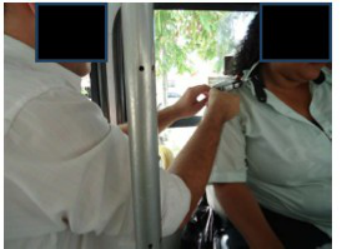
Recognizing risk was accomplished through data collection and inspection of enterprises in the workplace. Measurements were made of the risks of noise, vibration, heat, full dust, CO and O2. For noise analysis type Edge dosimeters were installed on the lapel of drivers and conductors of the lines being monitored along the journey part of 4 hours of work, because they refer to cyclical activities. The result will be normalized to 8, 10, and 16 hours. (Figure 1)
Figure 1. Noise Dosimeter (compiled by author)
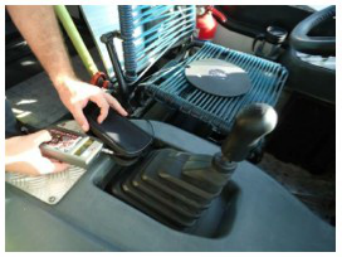
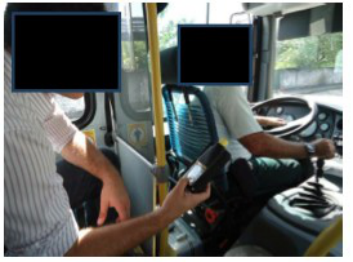
Accelerometer for vibration analysis model HAVPro 05035 was installed in the driver's seat being configured to vibrate the whole in order to check the amount of energy transferred from the machine to the worker (Figure 2) body. The analysis consisted of measuring heat using the heat stress meter Questemp 34 °, with the equipment located in the mediation of employment of the driver and conductor. (Figure 3)
Figure 2. Accelerometer. (compiled by the author) Figure 3. Meter heat stress (compiled by author)
Gravimetric pumps installed in the waist of professionals coupled with PVC tape and positioned near the breathing zone with flow rates of 1.7 L / min, the sampling time of 4 hours (Figure 4) were used to collect particulate (dust). The carbon monoxide and oxygen evaluations were conducted on the M40 Multi-gas Monitor, where it was positioned in the mediation of the jobs of the collector and driver. (Figure 5)
Figure 4. Gravimetric pump. (compiled by the author) Figure 5. Multi-gas Monitor (compiled by author)
Was applied during the visits to nineteen bus companies, the Checklist with the aim of finding a systematic way, information and quantify data on the job of the driver and conductor to give support to the analysis of the questionnaires professionals. The questionnaire was structured in four parts: personal data; desktop: bus and bus terminal; conditions of physical and cognitive health, and work organization. Was applied to 185 workers, with ninety-five ninety drivers and collectors, nineteen urban bus companies.
For evaluating postural discomfort, we used the diagram and Manenica Corlett (1980), where motorists through the regions mentioned, would classify the presence or absence of pain. The pain scale is intended to make the visual record of officials assessed in more symptomatic regions. To complement the survey of working conditions, photographs and footage of drivers and conductors in a real work situation were made.
RESULTS AND DISCUSSION
As for the profile, the 95 drivers interviewed 76% were aged 31-50 years, 60% with a high school degree, 69% 1-10 years time in the company to 76% from 1 to 20 years holding the position driver. In the case of 90 collectors interviewed 52% were aged 25-35 years, 75% had completed high school, 58% 1-10 years time in the company to 71% from 1 to 20 years serving as the collector .
It is noteworthy that, when asked about working hours, 43% of drivers be answered from 9 to 10h 13 to 14h 11% and 16% for more than 14 hours. Similar percentages were alleged by collectors, ie, 42% from 9 to 10 am, 14% of
11 to 14 hours and 16% more than 14 hours. These percentages show a workday well above 8 hours, especially if associated with time to meet the route and lunch breaks and between trips.
Ergonomic risks Regarding the analysis of the ergonomic risks of jobs driver and collector, can be identified:
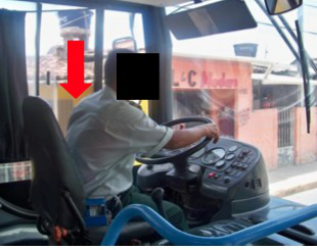
The driver for the implementation of its activities, spends a lot of time sitting with little time for breaks and may cause circulatory impairment. The act of driving requires many twists trunk (side slopes associated with trunk rotations), with repetitive upper limb movements, which may cause postural problems. The engine side of the job hinders the passage causing the driver needs to elevate his legs to get as much out of his job, showing one dimensional problem of job The application of the Corlett, and Manenica (1980), the diagram showed, according to the 95 drivers interviewed, the most affected areas were: neck 25%, whose pain may be related vibration and awkward postures; lumbosacral area - Mid-back 29 % back-basin and lower 32% 24% - may be related to vibration, with prolonged stay in the sitting posture and poor posture, legs - 34% right and 40% left - may be related to the permanence of posture seated throughout the workday and the flexion-extension of the lower limbs when using pedals bus, right shoulder 24%, may be related to the constant need to shift - observed postures when changing gears , such as flexion and abduction of the right shoulder.
Figure 6. Lumbosacral region (compiled by author) Figure 7. Lower region (compiled by author)
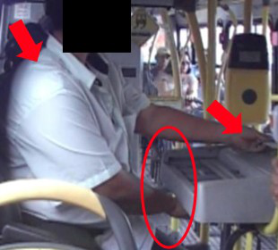
The collector adopts postures at rest with anterior tilt or arm above his shoulder to sustain and maintain balance. Often adopts a relaxed position with the support on the sacral region which can lead to back pain and overload the musculoskeletal system and may cause postural problems. During execution of work activities, uses very repetitive and pincer grip with wrist movements, and movements associated stem which can lead to the appearance of nervous disorders such as the carpal tunnel syndrome. How much time passes with outstanding legs, if you have not or do not use the footrest, there may also be circulatory disorders.
His job requires permit easy access due to the position of the arms of the chair, on some buses analyzed, are not retractable, beyond the position of the ratchet and cassette, some collectors have shorter stature need not dwell on the drawer so he can record the journey in electronic turnstile, showing dimensional problems. Moreover, it is an activity that has great mental burden since it deals with money, because the collector is constantly required to receive and spend the change correctly, besides often having to give users information on the driver. It is also a job that requires the employee to remain in a constant state of alert due to probable burglary / theft.
The application diagram of painful areas and Manenica Corlett (1980), showed, according to the 90 collectors interviewed, who were the most affected areas: neck 28%, whose pain may be related to vibration and awkward postures found during work , lumbosacral region - 27% average back-back-36% and bottom 23% basin - may be related to the vibration, longer stay in the sitting posture and poor posture, legs - 30% right and 30% left - may be related to the permanence of the seated posture, no footrest, or no use of supporting and adopting postures of knee flexion.
Figure 8. Lumbosacral region. (compiled by the author) Figure 9. Lower region. (compiled by author)
Organizational problems, both for the driver and for the collector, take into account breaks between trips, working patterns, monotony, time to meet the route, which often comes all intertwined, because at the time a jam occurs travel delays hence the stress increases, the breaks tend to slow the pace of work becomes more pronounced and recovered by the controllers of the terminal becomes larger.
Regarding the positions taken by both drivers such as collectors, one can see that these work sitting for long hours in jobs that offer uncomfortable equipment, the state of maintenance of the equipment itself, partly by the absence of evidence [eg . headrest, arms on the banks of the drivers etc] and partly because these professionals know not adjust [eg adjusting the footrest of collectors, height of banks etc.] associated with the physical and environmental conditions - noise, temperature, vibration,. dust, CO - at the limit of their tolerance indexes.
Physical and environmental risks Regarding the analysis of physical-environmental risks of jobs driver and collector, can be identified that have a correlation with the problems related to safety, are noise, vibration, temperature and pollution that need to be measured and compared with tolerance indexes in order to have a measure of normalcy.
Whereas the workday is 8 hours per day, which relates to occupational exposure to noise is the driver can check table 1 that 21.05% of drivers are over the limit allowed by the NR-15 85 dB (a) characterizing risk to health and that 63.16% of the bus drivers are exposed to noise above 80 dB (a), this value being considered action level, ie, depending on individual susceptibility, as this track there is the possibility of installing noise-induced hearing loss.
When we extrapolate the workload for the journey of 10 hours per day, ie considering 2 extra hours more work, we can see that the percentage of workers exposed passing to 36.84%, Table 17, above the level tolerance limit of NR- 15 85 dB (a) and 57.9% of drivers are above the action level, the same happens when extrapolated to 12 hours (47.37%) and 14 hours (68, 42%) and there is the potential for hearing loss.
Starting from the premise that the industry practice days of 16 hours of work, we can see that 84.21% of drivers of urban transport are above the tolerance limits (Table 17) and it was found that for this journey all drivers are above the action level, ie all urban drivers depending on their individual susceptibility, may develop by Noise Induced Hearing SALE - PAIR.
Table 1 - Percentage of drivers exposed to noise.
Thus the combined action of noise, which also has effects on extra-auditory system linked to the effects of heat, can cause the activity to be potentially more exhausting than if we take the results in isolation.
With regard to occupational exposure of collector on a journey of 8 hours of work, Table 2, the noise is possible to see that 22.22% of collectors are above the limit allowed by NR-15 85 dB (A) characterizing risk health and that 33.34% of the bus conductor are exposed to noise above 80 dB (a), this value being considered action level, ie, depending on individual susceptibility, from that song there is a possibility installation of noise-induced hearing loss.
When we extrapolate the workload for a journey of 10 hours, ie, considering the extra 2 hours more work you can see that the percentage of workers exposed passing for 33.33% above the tolerance level of NR-15 to 85 dB (a) and 44.44% of collectors are above the action level, the same happens when extrapolated to 12 hours (38.89%) and 14 hours (44.44%), the potential exists of hearing loss (Table 2).
Starting from the principle that the practice of journeys of 16 hours of daily work happens in this sector, we can see that 55.56%, Table 2, the collectors are above the tolerance limit of 85 dB (A), as well as the entire population exposed only 5.56% are below the action level of 80 dB (a), i.e., only this percentage is within the range that is not threatened to develop Noise Induced Hearing Loss - NIHL.
Table 2 - Percentage of Collectors Exposed to Noise (%) Of Collectors Exposed to Noise
For drivers and collectors, reviews of dust, oxygen and carbon monoxide are shown below the limits prescribed by the laws. Thus, the chemical does not influence significantly on the desktop.
With respect to temperature, only one company provided in the post above the driver's heat tolerance limits, according to NR-15, 30.5 °. As for the post of collector, all the other companies had temperatures below but very near the limit of tolerance. The heat influences the muscular system and associated with high humidity, can cause fatigue, causing stress.
CONCLUSIONS
According to the data collected, drivers and collectors are professionals who although they have different tasks, share the same space and live with the same working conditions. Leaving it is possible to see that not all professionals, including drivers and conductors, are exposed above the tolerance limits prescribed by the laws, but the majority are above the action level, which, depending on individual susceptibility and the trailer combined effects to exposure to multiple agents, it is possible to verify the existence of an enabling environment to the emergence of diseases, so it is evident the need to develop control measures for these positions in order to minimize the risk of developing occupational diseases.
Another issue to be studied is the effect of the sun, or during the rainy season, often where the driver needs to adopt or inadequate compensatory so that they can perform the task postures. Thus, the activity of the driver needs to maintain maximum attention, because any carelessness can cause an accident, besides being bombarded with various information such as traffic lights, the cars around you, pedestrian walkway, drive the bus, request entry / descent passengers, ie lots of information that must be processed instantly and coded so that it can respond quickly and safely.
Finally, technological research has relevance to the areas of occupational safety and ergonomics as the proposed survey and analyze the working conditions so that they can intervene in safety and quality of life of such professionals. Thus future research will be used to study regarding the solutions to eliminate or alleviate the problems arising during the study.
REFERENCES
Associação Brasileira de Higienistas Ocupacionais – ABHO. Disponível em: http://abho.org.br/ Associação Brasileira de Normas Técnicas - ABNT. Normas Brasileiras NBR 14022/2009 – “Acessibilidade em veículos de características urbanas para o transporte coletivo de passageiros.” ABNT, 2009. Associação Brasileira de Normas Técnicas - ABNT. Normas Brasileiras NBR 15570 – “Transporte – Especificações técnicas
para fabricação de veículos de características urbanas para transporte coletivo de passageiros”. ABNT, 2009. Conselho Nacional de Trânsito. Resolução n. 811/96. Disponível em: http://www.rontan.com.br/legislacao/adaptacao/Resolucao %20CONTRAN%20811-96%20Onibus-Micros.pdf. Costa, E. A. V. G. da. “Estudo dos Constrangimentos Físicos e Mentais Sofridos pelos motoristas de ônibus urbano na cidade do
Rio de Janeiro.” Dissertação. Universidade Pontifícia Católica- PUC – RIO, 2006. Franques, M. “Uma Breve História do Transporte Coletivo Mundial”, 2002; retirado do site: http://www.milbus.com.br/portal/dicas, em mai. 2012. Gorni, L. F. “Diagnóstico ergonômico: análise da tarefa do motorista para o desenvolvimento de novs arranjos em painéis.”
COPPE/UFRJ. Florianópolis: 4o Congresso Latino Americano de Ergonomia, 1997. Lima, A. A. et al. “Estudo ergonômico do posto de trabalho do motorista de ônibus circular da linha Grajaú-Centro.”
Monografia de curso de Especialização. Pontifícia Universidade Católica do Rio de Janeiro, PUC/JR, 2010. Lira, B. et al. “Efeitos Biomecânicos e Neurofisiológicos da Terapia Manual Aplicada a Coluna Vertebral” – Segmento Lombar, Monografia, Universidade Federal de Pernambuco, 2007. Milbus. “História do ônibus: Trolebus no Brasil I, II, III”, 2004; retirada do site: http://www.milbus.com.br/hist_portal/-101k,
2012. moraes, A. de; Mont’alvão, C. “Ergonomia: conceitos e aplicações.” Ri de Janeiro: Ed. 2AB, 2007. Vicasa. “A História do Transporte” – VIC, retirado do site: http:// www.vicasa.com.br/folder ed03_03.asp, 2012.
LISTED IN THE AHFE DIGITAL BOOKSTORE CATALOGUE
Explore the complete digital volume
Advances in Ergonomics In Design, Usability & Special Populations: Part III
Read this individual research paper free through the original publisher, or explore the full digital proceedings book.
ISBN 978-1-4951-2108-1
Explore this ISBN in the AHFE Bookstore ↗Listed in the July 2026 bookstore catalogue; search by ISBN to confirm current availability · Digital book purchase optional