Marizilda dos Santos Menezes, Charles Ricardo Leite da Silva, João E. Guarnetti dos Santos (2022). Design of Protective Clothing: Discussing the Brazilian Projects with Significant Ergonomic Attributes. In: Advances in Ergonomics In Design, Usability & Special Populations: Part III. AHFE Open Access, vol. 20. https://doi.org/10.54941/ahfe1001347
Faculty of Architecture, Arts and Communication, UNESP - Univ Estadual Paulista, Av. Eng. Luiz E. C. Coube, 14-01, 17033-360 - Bauru - São Paulo, BRAZIL
This study aims to present research on protective clothing. Initially, we explain what are the garments of protection, importance of your research, and then we try to describe the relationship between fashion design and ergonomics in order to contribute to research on occupational safety. Contextualizing research on the topic, in order to reflect on the design of wearable devices, as investigated, garments of protection. To do so, carry on about the state of art of clothing. Finally, we address the particularities of a user-centered research, with a view to effective usability.
Usual social, cultural and regional climate needs can play an important role in the development of people's clothes and style, are directly on the clothes or their complements / accessories (AL-Ajmi, 2008). Research by McCullough and Wyon (1983) indicate that sets of clothes and accessories worn by people are influenced by the seasonality of the outdoor climate. We should mention that in Brazil, in general, climatic conditions have great thermal amplitude between different periods of the year.
It is known that clothes may provide, for example, lower or higher insulation to the body of the user. Since clothing can positively affect individual sense of thermal comfort. At the same time, it is known that the nature of the work activity and other conditions of work vary and may establish a synesthetic experience positive or negative for the worker.
With technological advancement, it is important that the textile industry is always innovating and making new discoveries to please their customers and users, who are increasingly demanding (Souza and Araujo, 2009). The study of comfort in clothing aims to improve the quality of life of the user population.
This article presents some partial results related to doctoral research of the first author, which discusses the importance of technological innovations incorporated into textile fibers, which provide a significant improvement in comfort for workers. Leite (2013) states that in Brazil, currently, the number of accidents has decreased year after year, due to an implemented culture, where it stimulates the enhancement of safety in industrial environments. Ergonomics In Design, Usability & Special Populations III
Nevertheless, even before this reality, many incidents and accidents still occur. Thus, in order to collaborate with a greater reduction in these numbers, we have identified the occurrence of some problems related to creation, management and distribution of personal protective garments, available in Brazil. The purpose of this paper is to identify some of these problems in order to point out some directions for solutions and actions to be implemented.
PERSONAL PROTECTION Personal protective garments are intended for protection against risks likely to threaten the safety and health at work (MTE 2011).
Nationally, these garments are regulated by the Ministry of Labour and Employment - MLE, government body that controls and enables manufacturers of these products to market. Nevertheless, in countries like Brazil, with continental characteristics such as claims Sayad (2000), adds itself, many "Brazils", where their regional differences may correspond to the differences between nations, efforts must be made to construct a reality where artifacts that surround occupational safety are there to the worker in accordance with their individual characteristics to their effective use.
The legislation by regulatory norm 17 (NR17), points out that employers should take the initiative to provide more comfort to the workers. In order to protect themselves from the risks to the task, arising from work activity. In addition, specifically through the regulatory norm 6 (NR6), allocates the specific obligation of the employer to provide its employees garments suitable working conditions. The variety of garments of this kind is large and occurs due to the diversity of purposes, Figure 1 presents a few examples.
Figure 1: Example of protective clothing trunk circulating in Brazil. (collection of researchers).
Figure available in the original PDF paper.
Guimarães (1977) estimates that, nowadays, people spend more than a third of their lives in the workplace. Therefore, that is leading the garments used on this site and contribute to the act without welfare. According to Maciel and Nunes (2011), the influence of exogenous aspects such as sunlight, heat, rain, and cold winds that make the use of industrial uniforms with specific features even more indispensable to the achievement of the tasks efficiently and accurately.
The challenge of this moment, right now, is not only to create new technological solutions. As pointed out by Shneiderman (2006), the challenge for designers is to understand in more depth what the user wants. Therefore, so they can respond to the challenge by creating artifacts more useful and satisfactory for a larger number of people. All this corroborates and complements with touches of Norman (2006), where he states that the mission design is to help create increasingly useful, good, cute, cheap and effective products. At the same time, practice demonstrates, however, in certain cases, aesthetically prevails, causing product as beautiful as impractical. In other cases, the concern about providing certain facilities and equipment of an excess of extra functions just producing products that become inefficient, precisely the ambition of total efficiency.
IMBRICATED FASHION DESIGN WITH ERGONOMICS It is the recent establishment of the first institutions of design education in Brazil. Therefore, just a few decades, we can follow the evolution of the institution and teaching fashion design in Brazil. For its part, according to Pires (2012), is unprecedented and remarkable similarities between the design and fashion both in social relations, such as academic and industrial production.
World, depending on the location in question and their clusters, we know that the figure of fashion (or correlated) designer is very present agent or "operative" for the production of articles of clothing.
In this sense, it becomes clear where the skills and professional skills of designers are approved by a regulatory system where just such a professional can do certain activities. These local, professional responsibilities are placed in a unique way, where only designer produces designs. It is clear that in this way, professional activity is partially limited, but so easily controlled or managed.
Respecting the premise that products and services cannot cause harm to the health or safety of consumers, the creation of tools to identify the so-called accidents consumption is required. Simplistically, we say that an accident occurs when a consumer product and / or service causes any physical harm to the user (or third party) even when used or handled correctly according to the instructions and warnings present.
We know of cases where the production of garments and caused accidents occur consumption for its users. The BBC news agency reported in 2009 that a survey of the Chinese government found that children's clothing produced in China's Guangdong province had high levels of metals in their composition that could bring harm to health (cause infections in the skin and airways).
The Brazilian press reported, for example, in 2011, the Brazilian government intervention in the production and marketing of garments and other textile artifacts produced with U.S. hospital waste arising from the production center for export of rural Pernambuco, in northeastern Brazil. It is up to us to demonstrate that there is a significant risk to the health of users of these products. Even more difficult was the government that need to intervene, could not easily identify or blame involved in this practice. For such behaviors, which evoke and advocate the responsible professional practice, training and enabling these professionals competently.
METHODOLOGICAL PROCEDURES The evolution of ergonomics shows that his focus shifted from the workplace to the organizational system. In order to comply the established objectives, we use the arguments of us Hendrick (2005), in finding that experienced a phase where the practices of ergonomics take refuge in technology focused in a broader context, the call macroergonomics.
According Guimarães (2010), the macro view of current ergonomics focuses on the man, the work process and organization, the environment and the machine as a whole of a larger system. Conceptually, macroergonomics is a socio-technical approach because it deals with three subsystems: the technological, the personal, and the work that constitutes organizational structure and processes.
The macroergonomics in its approach, according to Hendrick & Kleiner (2000), is both top-down, because it adopts a strategic, bottom-up approach, because the approach is participatory and middle-out, because it focuses on the process.
The methodological procedures employed in this work involved literature, which has very limited literature even in Brazil, where we evaluate the published research on such equipment. In addition to academic studies, published in theses and dissertations; documentary survey, which was analyzed legislation Brazilian and specific standards of safety garments, so we could understand the details of reality investigated, and an approach of anthropological/ethnographic along the Brazilian petrochemical industry die, where they toured the manufacturing facilities of the two companies, located in southeastern Brazil. The choice of this segment is justified based on being a strategic segment and continued government investment.
The reasons for using participatory ergonomics is to generate better ideas and solutions design, ease of implementation and return of value to both the organization and for individuals (Haines et al., 2002). Yet to the authors, contrary forces include the cost and time involved, helping to make interventions on a rolling program, need to motivate direct participants and those related to the company but not directly participating in the process (the shareholders).
RESULTS
In order to raise the demand Ergonomic Items (IDEs) perceived by workers, based in Guimarães (2009), inductive not from a single question "Tell me about your protective clothing open interviews were conducted cite positives and negatives ".
Were administered in a group ranging from 2 to 4 people, lasting 10-35 minutes. Responded to interview 100% of the population of the study area.
The responses were recorded using an audio recorder and transcribed. Data were grouped by similarity of meaning through content analysis (Bardin, 2010), put them on a spreadsheet in Excel ® to be analyzed. The irrelevant information was purged and the responses were grouped by affinity, i.e., similar responses were considered as a single IDE.
For purposes of prioritizing the IDEs, the order of mention of each item is used as a weight of importance by the reciprocal of their position, ie, the item mentioned in the wretched position assigned the weight 1 / p. Thus, the first factor mentioned receive the weight 1/1 = 1 ½ = 0.5 second, third 1/3 = 0.33, and so on. The trend of using the reciprocal function is to value the first items mentioned, and the fourth item from the difference becomes less significant. The sum of the weights for each item gives rise to the rank of importance of items that will guide the development of a questionnaire to be completed by all employees.
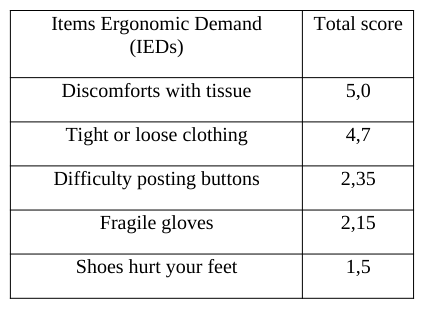
Table 1 depicts the five most significant IDEs, from which one can see that the main ergonomic constraints are directly related to the garments provided by the organizations that ignore the characteristics of the users.
Table 1: Results obtained from open interviews (Data compiled by the authors).
The data analyzed, allowed very rich and complex in accordance with the findings of Das and Alagirusamy (2010) results. We found that the outsourcing process, very present in the studied organizations, which indirectly stimulates the selection and control of the minutiae involving protective garments were neglected. Since there is no legal support for improvement of this process, the companies are not aware of some problems/constraints to which they submit their workers.
In order to improve the current state of protection of the professionals who participated in the survey, some proposals for garment ergonomic intervention in the activities carried out there were elaborate. The goal is to make more comfortable, safe and therefore efficient.
However, it is worth stressing that such projective proposals are preliminary in nature, since to have confirmation that the proposal is indeed effective and efficient, you need to submit it for validation step of the proposed ergonomic solution by means of tests. These techniques aim at testing query users (employees) of the solutions that may be implemented, detailed or implanted (Moraes and Mont'Alvão, 2003).
CONCLUSION
In this sense, the imminent adoption of measures, from the point of view of safety management, which found that many of these problems in the design of garments is given by the low participation of designers involved in the design of these garments as pointed Nielsen (1991) is required and Coates (2005).
For its part, little diversity of models encourages the use of products with no required interaction / adaptation with biotype of some groups of workers. In addition, this shows the lack of research, aimed at minimizing the impact of the observed problems.
REFERENCES
Al-ajmi, F. F; Loveday, D. L.; Bedwell, K. H.; Havenit, G. (2008). “Thermal insulation and clothing area factors of Ergonomics In Design, Usability & Special Populations III typical Arabian Gulf clothing ensembles for males and females: Measurements using thermal manikins”. In: Applied Ergonomics, 39. pp. 407–414. Bardin, Laurence. (2010). “Análise do Conteúdo”. Lisboa: edições 70. 288pp. Coates, J. F. (2005). “From my perspective: the future of clothing”. In: Techn. Forecasting & Social Change, 72. pp.
101-110. Das, A.; Alagirusamy, R. (2010). “Science in clothing comfort”. New delhi, Cambridge, Oxford: WPI. Guimarães, Lia Buarque de Macedo. (2010). Eds. “Macroergonomia: colocando conceitos em prática”. Porto Alegre: FEENG. 152pp. Guimarães, Ruth. (1977). “Conquistas humanas: vestuário”. Vol. III. São Paulo: Círculo do Livro. 297pp. Hendrick, Hal W. “Macroergonomic methods”. (2005). In: Handbook of human factors and ergonomics methods.
Stanton, Neville; Hedge, Alan; Brookhuis, Karel; Salas, Eduardo; Hendrick, Hal (Eds.) Boca Raton: CRC Press. pp. 751-754. Hendrick, Hal W.; Kleiner, B. M. (2000). “Macroergonomics: an introduction to work system design”. Santa Monica, CA: Human Factors and Ergonomics Society. Leite, Charles. (2013). “Design of personal protective equipment: to promote of Brazilian artifacts with ergonomic
attributes”. In: Arezes, P. (Eds.). Occupational safety and Hygiene. London: CRC Press. Maciel, Dulce Maria Holanda; Nunes, Ana Camila Nobre X. (2011). “Uniformes: bem estar e segurança para trabalhadores de limpeza pública”. In: Revista Moda e Palavra, ano 4, n.7. pp. 59-74. Mccullough, E. A.; Wyon, D. P. (1983).“Insulation characteristics of winter and summer indoor clothing”. In:
ASHRAE Trans., 89, Part 2B, pp. 614–629. Moraes, Anamaria de; Mont’alvão, Claudia Renata. (2003). “Ergonomia: Conceitos e Aplicações”. Rio de Janeiro: iUsEr. MTE – Ministério do Trabalho e Emprego. (2011). “NR6 - Equipamento de Proteção Individual”. Brasília: MTE. Nielsen, Ruth. (1991). “Work Clothing”. In: International Journal of Industrial Ergonomics, 7. p. 77-85. Norman, Donald. A. (2006). “O design do dia-a-dia”. Trad. Ana Deiró. Rio de Janeiro: Rocco, 271p. Pires, Dorotéia Baduy. (2010). “Revisão bibliográfica sobre moda em língua portuguesa”. In: Revista Ciência e
Cultura, v. 2. pp. 38-44. Sayad, A. (2000). “O retorno: elemento constitutivo da condição do imigrante”. In: Travessia: Revista do Migrante.
São Paulo, XIII. Shneiderman, Ben. (2006). “O laptop de Leonardo: como o novo Renascimento já está mudando a sua vida”. Trad.
Vera Whately. Rio de Janeiro: Nova Fronteira. 286pp. Souza, Katarine Ma Chiste Brandão Antunes de; Araújo, Maurício de Campos. (2009). “A importância do estudo do conforto para uniformes profissionais”. In: Colóquio de Moda, 5., Recife. Anais do 5o. Colóquio de Moda. Recife: Faculdade Boa Viagem/Universidade Federal de Pernambuco.
LISTED IN THE AHFE DIGITAL BOOKSTORE CATALOGUE
Explore the complete digital volume
Advances in Ergonomics In Design, Usability & Special Populations: Part III
Read this individual research paper free through the original publisher, or explore the full digital proceedings book.
ISBN 978-1-4951-2108-1
Explore this ISBN in the AHFE Bookstore ↗Listed in the July 2026 bookstore catalogue; search by ISBN to confirm current availability · Digital book purchase optional