Charles Ricardo Leite da Silva, Gabriela Sousa Ribeiro (2022). Ergonomic Evaluation as a Holistic Evaluation in Company Assembly Hydrometers. In: Advances in Ergonomics In Design, Usability & Special Populations: Part I. AHFE Open Access, vol. 18. https://doi.org/10.54941/ahfe100798
1 Program of Doctor in Design, Faculty of Architecture, Arts and Communication, UNESP - Univ Estadual Paulista, Av. Eng. Luiz E. C. Coube, 14-01, 17033-360, Bauru - São Paulo, Brazil ↗
2 Program of Doctor in Urbanism, Faculty of Architecture and Urbanism, Federal University of Rio de Janeiro – UFRJ, Av. Reitor Pedro Calmon, 550, Cidade Universitária, 21.941-901, Rio de Janeiro - RJ, Brazil ↗
The manual assembly equipment has been cited as one exposed to several ergonomic constraints, such fractionation is associated with the task of occupation, facilitating the monotony and high number of repetitive movements that may cause occupational diseases of physical and psychological harm. Seeking to adapt the work to the characteristics and skills of professionals in the assembly of the sector totals, ergonomic intervention System Human-Machine Task was performed in an industry located in Recife-PE assembly of water meters, comprising the steps of Ergonomic Assessment, Ergonomic Diagnose and Ergonomic Projects. To meet the objectives of the first stage, unsystematic observations, documentary analysis of records and PPRA PCMSO Company, open interviews and structured questionnaires with workers in the sector were applied. In the second stage, the deepening of the problems found in the first study were from task analysis, systematic observations for analysis of postures assumed, according Worksheet RULA (Rapid Upper Limb Assessment) analysis of the physical costs from the implementation of the diagram discomfort/pain, and anthropometric studies by two-dimensional anthropometric dummies. In the third step, were proposed suggestions for improvements to the problems encountered and prioritized. The results indicated order problems and physical environmental, organizational, job, biomechanical and psychosocial. The high levels of discomfort/pain are justified by inadequate occupational postures combined with repeatability of movements in accomplishing the task. Therefore, are necessary changes and adjustments in working conditions of workers in the sector under study, to provide them better quality of life.
The very Ergonomics helps to improve the day-to-day working conditions of people in organizations. However, as Ergonomics In Design, Usability & Special Populations I (2022) technology evolves, so with the research, how to conduct work activities is reconsidered.
According Montmollin (1996), prescribed work involves machines and procedures assume that officially define and regulate the work. This is a set of requirements defined within an organization, for specialized sectors in order to achieve particular goals.
While the real work is understood as something that goes effectively in the workplace, through the days and nights, local, environmental, operational and organizational conditions (Moraes and Mont'Alvão, 2003).
In organizations, the prescribed task can appear in different forms: formal or informal description, instruments and means of information, procedures, detailed procedures, work instruction sheets, among others. In addition, towards meeting goals, ways of using organizational support, meeting deadlines, compliance procedures and rules, as well as the subject requires dual activity of mental preparation and manual execution.
Accordance Moraes and Mont'Alvão (2003), in practice the analysis, one cannot ever consider one side without the other - the task (prescribed work) or activity (actual work) - without constantly referring to the other.
However, we emphasize the affirmation Daniellou (2004), that the work is never a simple instruction execution. Significant deviations between prescription and reality can be causes of difficulties for operators and it should reduce them to a better prescription, although it is known to be impossible to annul them.
To this end, it is interesting that, in preparing the prescription of tasks, physical and cognitive characteristics of the operator, including anthropometric characteristics and operative modes are taken into account.
In this sense, the work of manual assembly equipment usually profusely quoted as exposed to ergonomic constraints activity, because the segmentation of tasks, monotony and repetitive movements that may cause occupational diseases of physical and psychological harm.
This paper presents the results of research conducted during the course of conducting training in postgraduate level in Ergonomics. We assumed that ergonomics can help solve a number of related health, safety, comfort and efficiency social problems and can contribute to preventing errors, improving performance argues Dul and Weedmeester (2001).
The objective of this research was to adapt working conditions, an assembly of water meters French company, located in Brazil, to the skills, abilities and limitations of workers.
MONTAGE HYDROMETERS The company in question is an assembly plant velocimetric and volumetric hidrometers. It is a subsidiary of Franco- German multinational organization, headquartered in France. Began its activities in Brazil in 2002, as representations of office, but only in late 2003 began to act as editor of hydrometers. Since then, its production is per order, taking account of both the Brazilian market, with its main customers are companies of water supply, as having production for export, mainly to France, which passes its products to other countries in Europe.
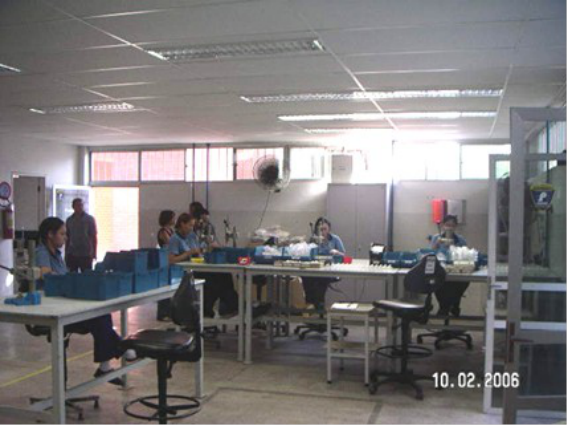
There are two types of layout in the factory, which vary according to the demand of produced water meters. Models A, B and C are mounted on line, as shown in Figure 1.
Ergonomics In Design, Usability & Special Populations I (2022)
Figure 1: Production system layout via "online" (collection of the author).
Figure 2 illustrates the mounting system cell, used when mounting the model is D.
Figure 2: Mounting via layout "in cell" (collection of the author).
Figure available in the original PDF paper.
At the time of research, the company had 35 employees, spread across all sectors of the factory assembly. In researched at the beginning of the research sector, were allocated 8 people were later hired 3 more employees being surveyed in this sector, sleeps 6 females and 5 males.
Ergonomics In Design, Usability & Special Populations I (2022)
METHODOLOGICAL PROCEDURES For this, we use the methodology of us systemic approach, advocated by Moraes and Mont'Alvão (2003), which considers the human-task-machine-environment interface for an ergonomic intervention. Therefore, we hope to propose requirements for solution of the problems encountered in order to subsidize comfort, safety and quality of life for workers. The methodology is based on a descriptive and exploratory research, consisting of the steps: (i) assessment, (ii) diagnosis and (iii) ergonomic designs.
Ergonomic Assessment Step lifting ergonomic constraints. Unsystematic observations were made in a real work situation, documentary analysis of environmental risk prevention program and the medical control Occupational Health Program, open interviews and structured questionnaires with all workers involved in the activity, which served as input for the structure identification of the plant, questioning, categorizing the ergonomic problems of the human-task-machine system. Besides formulating the opinion ergonomic. It was also applied to the matrix tool Severity, Urgency and Trend (GUT), developed by Kepner and Tregoe (1976), in order to guide more complex decisions and prioritize the issues to be prioritized in the second stage of the research.
Ergonomic Diagnosis To further investigate the problems encountered and prioritized, occupational postures assumed by all workers were analyzed, relating them to the repetitiveness of tasks and manifestations of discomfort / pain in body regions. To this end, systematic observations of positions taken for analysis were performed according to the worksheet RULA (Rapid Upper Limb Assessment), proposed by McAtamney and Corlett (1993), Analysis of the physical costs of assemblers’ hydrometers, with application diagram discomfort/pain of Corlett and Bishop (1976), and anthropometric studies, two-dimensional anthropometric dummies.
For analysis of the postures assumed, systematic observations were conducted during visits to industrial plants, from the filming of the jobs in real use situation and work with a digital camcorder from Sony ® brand, for a period of 50 minutes each post. Passed to the computer, the movies were "paused" every 30 seconds and analyzed from the RULA worksheet Online (www.rula.co.uk) when the postures assumed for all body regions were identified. Such analyzes encompassed both physical structures present in the sector under study, which vary depending on the demand for the model produced totals.
To obtain the data through the discomfort / pain diagram, discomfort scale with five intervals , numbered 1-5 was used: 1 corresponds to a comfortable situation (no pain), 2 corresponds discomfort or mild pain, 3 relates the discomfort or mild pain, 4 attributed to severe pain or discomfort, and 5 used in unbearable pain or discomfort (Corlett and Bishop, 1976).
To confirm the data obtained from the application of RULA worksheet and discomfort / pain diagram are the result of work stations with inadequate dimensions to the characteristics of users, we proceeded to anthropometric studies of situation found in company. Measurements of workstations, which were transferred to the AutoCAD ® program were studied from two-dimensional anthropometric dummies, dealing with representations in the human scale of the larger man (H95%) and the smaller woman (M5%) were performed from Panero and Zelnik (2002). Such tools are essential for defining the requirements for visibility and biomechanical angles of comfort as well as match these parameters with the slot position of the eyes, arms and legs of the extreme users.
Ergonomic Project After the phases of observations, records and diagnostic ergonomic constraints to which workers are subjected, highlighting the recognition of its causes have been proposed suggestions for improvements to the problems encountered. It is worth mentioning that these proposals were in line with the strategic decisions of the organization, Ergonomics In Design, Usability & Special Populations I (2022) seeking greater quality of life for workers.
RESULTS
The results indicated physical problems-environmental, organizational, job, biomechanical and psychosocial. We observed high levels of discomfort / pain, justified by inadequate occupational postures combined with repeatability of movements in accomplishing the task.
Currently, new horizons opened under the ergonomic standpoint, which became part of his studies focus on work organization, aimed at improving the management of the organizational process. Moreover, realize the systemic nature of the job, with emphasis on holistic trend systemic approach to problems, emphasizing the organizational and psychosocial aspects, which are often suppressed by physiological aspects inherent in professional activity.
Our analyses found that accidents, injuries and number of human losses that cause harm to the health of workers, which could be interpreted are not reported as if the organization did not offer the health risks of their workers. This situation differs from the data of the program for prevention of environmental risks.
Ergonomic problems identified were categorized in the formulation of an opinion on the ergonomic workstation, highlighting the issues of security features, or instruction on processes and procedures, or posture, range of areas, among others. The opinion ergonomic rated the typology of the problem, identifying the constraints of the task, the human cost, ergonomic disorders, preliminary suggestions and restrictions. The repetitiveness of activities, depending on the fractionation of these, was accused of causing intense as ergonomic sector workers studied the constraints factor.
The tool matrix Severity, Urgency and Trend (SUT), proposed by Kepner and Tregoe (1976), pointed out that problems related to: flexion of the cervical and upper limb prolonged, frequent use of forceps movement and noise during cleaning reached base for the two layouts factory assembly studied, maximum levels: 5 for Severity x 5 for emergency x 5 for trend, totaling 125 in GUT score for each of the items indicated ergonomic demand. Culminating thus prioritization and deepening during these ergonomic diagnosis, phase of research The results obtained with the application of RULA showed that the joints of the most overloaded due to the posture required by transaction type workers are: shoulder, neck, wrist and hand. The jobs entail reviews: frequent shoulder elevation above 90°; static contraction of the neck, causing muscle fatigue and tension and frameworks in character burning pain in the region of cervical paraspinal muscles and upper trapezius; postures of flexion and extension, ulnar deviation and radial caliper and movements in the joints of the wrist and hand, which, combined with the repetitiveness, are risks for the development of occupational diseases factors such as tendonitis and carpal tunnel syndrome; movement amplitudes off levels comfort, especially in relation to the shoulders (above 60 °), in ranges of objects and trigger buttons, repetitive movements, especially the wrist and hand, and the maintenance of prolonged static postures and cervical flexion.
CONCLUSION
The present study had limitations that suggest caution in considering the results presented. One concerns the amount of systematic observations for application of the technique RULA. The analysis would be enriched if they were carried out observations at various periods of the working day, to analyse the differences in performing the activity. The other deals with the influence of other sectors in the way the task is performed on the workstation.
Finally, we realize the prerogative of changes and adaptations in the working conditions of the investigated segment, in order to make it safer, comfortable, and hence increase the quality of life of these people and their work efficiency work.
Ergonomics In Design, Usability & Special Populations I (2022)
REFERENCES
Corlett, E. N.; Bishop, R. P. (1976). “A tecnique for assessing postural discomfort”. In: Ergonomics, v. 19, n. 2, pp.
175-182. Daniellou, F. (2004). “Introdução: Questões epistemológicos a cerca da ergonomia”. In: A ergonomia em Busca de seus princípios: debates epistemológicos. DANIELLOU, F. (Eds.). São Paulo: Edgard Blücher. Dul, J.; Weedmeester, B. (2001). “Ergonomia Prática”. São Paulo: Editora Afiliada. McAtamney, L.; Corlett, E. N. (1993). “RULA: a survey method for the investigation of work-related upper limb
disorders”. In: Applied Ergonomics, v. 4, n. 2, p. 91-99. Montmollin, M. (1996). “L’ergonomie”. Paris: La Découverte. Moraes, A.; Mont’Alvão, C. (2003). “Ergonomia: Conceitos e Aplicações”. Rio de Janeiro: iUsEr. Panero, J.; Zelnik, M. (2002). “Dimensionamento humano para espaços interiores - Um livro de consulta e referência para projetos”. Editora Gustavo Gili, S.A. Barcelona.
Ergonomics In Design, Usability & Special Populations I (2022)
LISTED IN THE AHFE DIGITAL BOOKSTORE CATALOGUE
Explore the complete digital volume
Advances in Ergonomics In Design, Usability & Special Populations: Part I
Read this individual research paper free through the original publisher, or explore the full digital proceedings book.
ISBN 978-1-4951-2106-7
Explore this ISBN in the AHFE Bookstore ↗Listed in the July 2026 bookstore catalogue; search by ISBN to confirm current availability · Digital book purchase optional